
Our readers keep the lights on and my morning glass full of iced black tea. As an Amazon Associate, I earn from qualifying purchases.
Specs are compiled from manufacturer listings and verified buyer reviews and can change over time — please confirm the key details on the product page before buying.
If you are stepping up from a kit lens, the fastest way to change your photos is a fast prime lens — one with a wide aperture like f/1.8. These lenses let in more light, blur the background behind your subject, and push you to move your feet instead of just zooming, which makes you a better photographer. This guide covers nine budget-conscious lenses for Canon and Sony cameras, from the legendary nifty-fifty to long manual telephoto zooms.
I’m Min — the founder and writer behind Gadgets Feed. This guide is built by comparing the manufacturers’ published specifications and the patterns across verified customer reviews, so you get each pick’s real strengths and trade-offs instead of marketing spin.
A great affordable lens should make your camera feel new again without emptying your wallet. We have gathered the best affordable camera lenses that deliver sharp images, creamy bokeh, and real value for everyday shooters.
Our Picks at a Glance


How To Choose The Best Affordable Camera Lenses
Before you click buy, ask what you shoot most. A 50mm prime is a fantastic all-rounder for portraits and street scenes. A 85mm lens gives you a more compressed, flattering look for headshots. A telephoto zoom — like a 55-250mm — pulls distant wildlife or sports action close, while an ultra-wide 9mm captures entire rooms and sweeping landscapes.
Your camera’s sensor size is the second big filter. Full-frame cameras use lenses meant for that larger sensor, while APS-C cameras (like most Rebel and Sony a6000-series bodies) can use lenses built for their smaller sensor. A 50mm lens on an APS-C body acts more like an 80mm lens on a full-frame camera, which is great for portraits but makes it harder to shoot in tight rooms.
Autofocus vs. manual focus
Autofocus (AF) lenses are convenient — you half-press the shutter and the camera locks onto your subject. Manual focus (MF) lenses have no electronic contacts, so you rotate the focus ring yourself to get the image sharp. Manual focus is cheaper and can be a great teacher, but it is far slower for action shots, and your camera won’t detect the lens at all until you switch to Manual (M) mode.
Prime vs. zoom
A prime lens has one fixed focal length, meaning you zoom by moving your body. It is usually lighter, sharper, and lets in more light for the money than a zoom. A zoom lens offers flexible framing from one spot, which is essential for events and wildlife. The trade-off is often a smaller aperture and softer corners for the same price.
Quick Comparison
| Model | Best For | Focal Length | Max Aperture | Focus Type | Amazon |
|---|---|---|---|---|---|
| Canon EF 50mm f/1.8 STM★ Best Overall | Best Overall portrait + low light | 50mm | f/1.8 | Auto (STM) | Amazon |
| BENOISON 85mm f/1.8 MFBudget Portrait | Budget portrait prime | 85mm | f/1.8 | Manual | Amazon |
| YONGNUO YN50mm F1.8Budget Autofocus | Budget autofocus 50mm | 50mm | f/1.8 | Auto/Manual | Amazon |
| JINTU 85mm f/1.8 MF | Manual learners on a budget | 85mm | f/1.8 | Manual | Amazon |
| Big Mike’s 500mm/1000mm f/8 | Super-telephoto wildlife trials | 500mm-1000mm | f/8 | Manual | Amazon |
| Big Mike’s 420-1600mm f/8.3 | Long-range zoom flexibility | 420mm-1600mm | f/8.3 | Manual | Amazon |
| Canon EF-S 55-250mm f/4-5.6 IS II | Best value telephoto zoom | 55-250mm | f/4.0-5.6 | Auto | Amazon |
| Sony FE 50mm F1.8 | Full-frame Sony portrait prime | 50mm | f/1.8 | Auto | Amazon |
| VILTROX 9mm F2.8 | Ultra-wide APS-C vlogging | 9mm | f/2.8 | Auto | Amazon |
In‑Depth Reviews
1. Canon EF 50mm f/1.8 STM Lens
Our pick — over 4.5★ from 18,500+ verified ratings; the strongest balance of quality and price.
The legendary nifty-fifty that makes kit-lens photos look professional overnight.
This is the lens photographers argue is the single best value in the whole hobby. It pairs a 50mm focal length with a maximum aperture of f/1.8, which means it gulps light for evening shots and melts backgrounds into creamy bokeh. The crowd favorite — 4.8 stars across 18,000+ owners — centers on image quality, with over 800 owners praising how sharp and clean the photos come out.
On APS-C cameras like a Rebel T7, the 50mm acts like an 80mm lens, which makes it a natural portrait tool. The stepping motor (STM) autofocus is near-silent, so video shooters get smooth focus without clicking sounds on the soundtrack. It focuses as close as 1.15 feet and magnifies up to 0.21x, letting you fill the frame with a face or a small object for detail shots.
Buyers report that this lens improved their photos more than their zoom did, and a long-term owner says it stays sharp even after two years of use. The autofocus speed gets mixed feedback — it is accurate but not the fastest — and there is no image stabilization, so you will want steady hands or a tripod in dim light. The glass construction uses 6 elements in 5 groups, keeping it light enough to carry daily.
What wins people over
- Beautiful background blur and amazing bokeh effects
- Quiet STM autofocus that works well for movies
- Sharp results that hold up even after years of use
Where it asks patience
- Autofocus speed is decent but not lightning quick
- No image stabilization built in
- Corners soften a touch when shot wide open
The one to beat: Buy this if you want the fastest path to sharp, creamy-background portraits on a Canon DSLR at a price that feels like a steal.
Who should look elsewhere: If you need a zoom for framing flexibility or must shoot fast action, this prime will feel limiting.
2. BENOISON 85mm f/1.8 Manual Focus Lens
An 85mm manual prime that teaches you focus while flattering every face.
This is a full manual lens — no autofocus, no electronic contacts — so your camera will show “lens not attached” until you set the mode dial to Manual (M). That sounds scary, but it is exactly why beginners love it: you learn to turn the focus ring and see sharpness happen. Owners mention it is a great starter lens for learning the craft and a useful little tool for pros who want full control.
You get creamy, blurred backgrounds (bokeh) for half-body, full-body, and face close-up portraits, thanks to the 85mm focal length and f/1.8 aperture. A Subwavelength Coating (a special anti-reflective layer) cuts glare, so your shots stay clear in bright light. It fits Canon EOS Rebel T8i, T7i, T7, T6, SL3, SL2, and full-frame bodies like the 5D Mark IV and 6D Mark II — but not EF-M or RF mount cameras, and some customers note it did not fit their Canon M50 Mark ii.
Owners praise the build and optics for the price, with 37 calling out the quality. The recurring caution is the focus — being manual, it demands patience, and a few buyers were disappointed expecting autofocus. Lighter than some rivals, the build feels less substantial than a metal-barreled lens, but the sharp first-use results on a Canon EOS X7 win people over fast.
Sharp teacher: It is a great portrait lens that forces you to master focus, delivering incredibly sharp photos once you nail the ring.
Reach for this if… you want an 85mm portrait look on a tight budget and are happy to learn manual focus properly.
Look elsewhere if… you shoot moving subjects or want point-and-shoot autofocus — this lens will not do that.
3. YONGNUO YN50mm F1.8 Auto Focus Lens
A featherweight 50mm with autofocus that gets you artistic shots for pocket change.
Weighing just 120g, this is the lightest prime in the lineup — you will forget it is on the camera. It is the first prime lens Yongnuo ever made, a 50mm f/1.8 designed as an excellent addition to the EOS 18-55mm kit lens. Unlike the manual 85mm options above, this one supports both AF autofocus and MF manual focus, so you can let the camera do the work or take control.
The larger f/1.8 aperture gives you much faster shooting in low light and better edge-to-edge sharpness than a kit zoom. It is smaller than the mk2, focuses quickly, and the wide aperture is perfect for artistic, blurred-background shots. It accepts 52mm filters and uses 6 elements in 5 groups, with a maximum angle of view of 46 degrees.
Owners single out lens quality, with 63 praising it and 52 more the value. The honest gripes are the build and the focus ring: it feels cheaply made, the ring is loose, and the autofocus can be noisy, which some owners described as slow and clunky. A used unit seized up after six weeks in one case, so the lightweight build is less durable than a Canon original — treat it gently and it rewards you with clarity.
Bang for buck: An ideal first 50mm that produces amazing clarity for newbies, with bokeh that rivals pricier glass when paired with a speedbooster.
Best for: Beginners who want autofocus convenience and a 50mm staple without spending Canon money.
skip it if: Build quality and silent operation matter more to you than the price tag.
4. JINTU 85mm f/1.8 Manual Focus Lens

A sturdy metal 85mm that makes engagement photos look dreamy on a Rebel.
Most budget primes are plastic, but this JINTU 85mm uses a strong metal body construction with a hybrid aspherical element, giving it a reassuring heft and a premium feel in the hand. It is a full manual lens — set the mode dial to Manual (M), pick your ISO and shutter speed, then fine-tune the front focusing ring until your target is sharp. Owners say it fits a Rebel T3i perfectly and is very easy to pick up even for non-pros.
The f/1.8 large aperture makes the depth of field shallower, weakening the background and highlighting your subject while letting in plenty of light. It pairs high-index, low-dispersion glass with an HD Coating to deliver clear, sharp images with minimal distortion. The compatibility list is immense, covering T8i through T1i, SL3 through SL1, plus full-frame bodies like the 5D Mark IV and 6D Mark II.
Owners call the photos “dreamy” and “very clear and beautiful,” with one using it for engagement pictures. It is good value for the money, and buyers appreciate that it arrives with a cleaning cloth, lens cleaner, and a protective bag. The catch is it is manual focus with no stabilization, so moving subjects will test your skills, and your camera will show “lens not attached” until you set it to M mode.
Dreamy results: Packs a metal build and sharp optics that produce beautiful, clear portraits for a very reasonable price.
Perfect if: You want a tougher, metal-bodied 85mm to learn manual focus on and shoot portraits that look far more expensive than the lens.
Not for: Anyone who needs autofocus — this is pure manual, and you chase focus on every single shot.
5. Big Mike’s 500mm/1000mm f/8 Manual Telephoto Lens

A 500mm super-telephoto that brings distant wildlife close without the price.
You cannot hand-hold this and expect sharp shots — owners are unanimous that a solid tripod is mandatory. This is a 500mm f/8 manual telephoto with a 2X teleconverter that doubles the power to a groundbreaking 1000mm. The high-index, low-dispersion multi-coated optical glass keeps photos clear and sharp, and the lens weighs about 1.5 pounds, light enough to carry on a hike even with the tripod.
It is fully manual — focus ring and aperture ring both — so you set the mode dial to Manual and fine-tune everything yourself. Reviewers point out surprising sharpness for the price, with one resolving 32 lines per inch at 32 feet when stopped down to f/16. The 2X converter costs you 2 stops of light, making the effective aperture f/16, so you will shoot at high ISO in anything but bright daylight.
Owners praise the value, with 309 calling out quality and 178 more the value for money. The honest limitations: manual focus is stiff, the stop-down ring is very stiff, and it is dim at f/8. One critical owner hit a recurring flaw where the T-mount adapter screws loosened during use out in the field, so check the mount before trusting it on a shoot.
What earns its keep
- Sharp results at a fraction of Canon’s super-telephoto prices
- Doubles to 1000mm with the included 2X converter
- Lightweight at 1.5 pounds for its reach
What demands patience
- Requires a solid tripod for every shot
- Manual focus and aperture rings are stiff
- 2X converter drops the effective aperture to f/16
The budget birding bridge: Buy this if you want to test whether you love super-telephoto shooting before investing thousands in premium glass.
Think twice if: You want sharp handheld shots or fast autofocus — neither exists on this lens.
6. Big Mike’s 420-1600mm f/8.3 HD Manual Zoom Lens

A manual zoom that stretches from 420mm to 1600mm for moon and wildlife shots.
Where the 500mm lens is a fixed prime, this one zooms — from 420mm all the way to 800mm natively, then a 2X teleconverter doubles that to a whooping 1600mm. It is a Canon long-range lens built for sports and wildlife, with a 62mm filter thread and an f/8.3 aperture for crisp results. Owners captured a water tower 9.6 miles away, proving the reach is real.
It is fully manual with no autofocus and no image stabilization, so it demands a tripod and patience. The quality gets mixed feedback — one owner calls it “fantastic quality for a manual zoom,” capturing sharp moon shots that outperform a phone’s zoom, while another calls it junk. Compatibility is also inconsistent: it fits some Canon Rebel models perfectly, like the T5 and T7, but one owner reported it did not fit their 80D as advertised.
The zoom capacity and value win over many — 57 owners mention quality and 40 mention value, though both are genuinely mixed verdicts rather than clear praise. The recurring frustration is the manual focus, which is hard to nail on a small subject, plus occasional missing parts in the box. It weighs 1.7 pounds and carries an HD Coating to reduce flare, but the chromatic aberration (color fringing on high-contrast edges) shows up in some shots.
Huge reach, huge caveats: It delivers impressive long-distance shots for the money, but only in the hands of a patient manual shooter on a tripod.
Choose this if: You shoot the moon, distant birds, or landscapes and want zoom flexibility instead of a fixed 500mm.
Pass if: You want guaranteed compatibility and sharpness — this one is a lottery on fit and quality.
7. Canon EF-S 55-250mm f/4.0-5.6 IS II Telephoto Zoom Lens

A Canon telephoto zoom with real image stabilization that makes distant subjects look sharp.
If you want telephoto reach without going fully manual, this is the pick. It is a 55-250mm zoom with a maximum aperture of f/4.0 to f/5.6, and it has optical image stabilization — meaning it physically steadies the glass to counter your hand shake, which is a huge help at 250mm. Owners praise the image stabilizer and autofocus performance, calling it a solid entry-level telephoto that works well for wildlife and distant subjects.
The optics use 12 elements in 10 groups with a UD glass element, which reduces color fringing and keeps images sharp. It weighs 1.3 pounds and uses a micromotor focus system — not the fastest, but accurate and reliable. One event photographer called it an absolute steal, saying 120mm shots show amazing detail compared to the 18-55mm kit lens.
It is a Canon EF-S mount, meaning it works with APS-C bodies like the EOS 7D Mark II and 90D but is not compatible with full-frame DSLRs. Since this is the renewed version, condition is the main variable — several owners found swirl marks or scratches on the front glass that needed cleaning, though most said it looks and works like new afterward. The quality earns 27 positive mentions and performance 19, with sharpness praised across the zoom range.
Why it stands out
- Optical image stabilization for steady handheld tele shots
- Sharp, clear images across the full 55-250mm range
- Reliable Canon autofocus that just works
What to check on arrival
- Renewed units sometimes arrive with glass marks needing a clean
- Not compatible with full-frame Canon DSLRs
- Micromotor focus is reliable but not the quickest
The safe telephoto buy: Choose this when you want autofocus, stabilization, and reach on an APS-C Canon — a proven formula with few surprises.
Look elsewhere if: You shoot a full-frame body, which this EF-S mount will not fit.
8. Sony FE 50mm F1.8 Standard Lens

The compact nifty-fifty that turns a Sony full-frame camera into a portrait machine.
This is Sony’s answer to the Canon classic — a 50mm f/1.8 prime designed for full-frame E-mount cameras, weighing just 6.6 ounces. The large f/1.8 aperture creates beautiful defocusing effects, and the 7-blade circular aperture shapes that blur into smooth, round bokeh. It is compact and light enough to be the lens you leave on the camera every day.
The optics use an aspherical element to control spherical aberration and coma, plus a double-gauss configuration that suppresses field curvature and distortion. Owners call it an excellent nifty-50 all-rounder, particularly good for portraits, with detail that stays sharp without distortion. It performs especially well in the f/4 to f/8 range, which is exactly where you will shoot most portraits and street scenes.
Owners praise the lens quality, with 119 calling it out, 79 more the value, and 77 the sharpness. It is a great budget portrait option for the A7 III and A7 IV, delivering natural 50mm framing and beautiful bokeh. The honest limits: autofocus speed gets mixed feedback and the motor is noticeably noisy, and the plastic body is not weather-sealed. But as owners say, the quality-to-price ratio is hard to argue with for the price.
The Sony workhorse: A lightweight, sharp 50mm that delivers beautiful bokeh and natural perspective for portraits, street, and video on any E-mount body.
Best for: Sony full-frame shooters who want the classic 50mm look — sharp, blurry backgrounds, and pocketable size.
Not for: Anyone who needs silent or lightning-fast autofocus, or weather sealing for harsh conditions.
9. VILTROX 9mm F2.8 E-Mount APS-C Lens
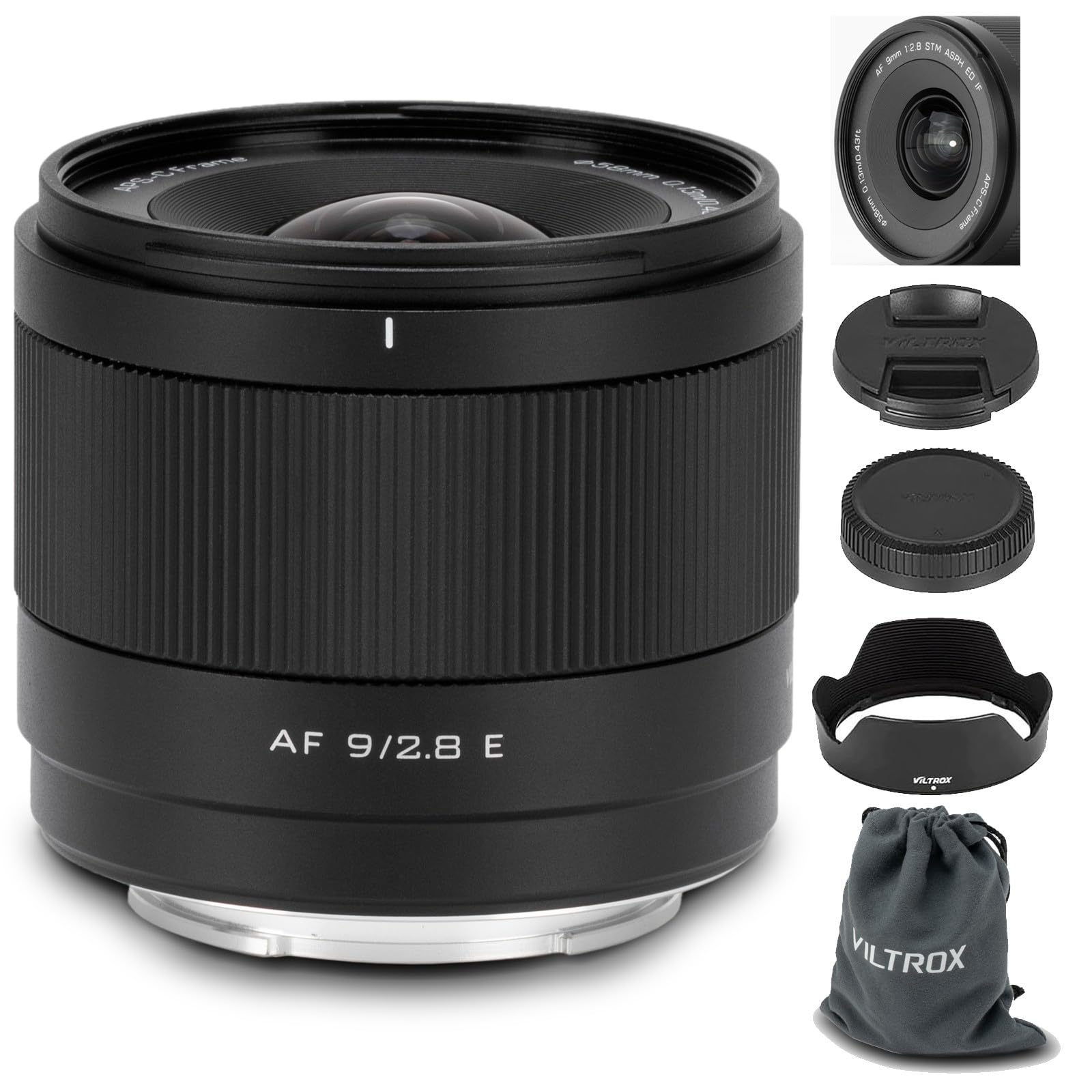
A 113.8-degree ultra-wide prime that fits a whole room in one frame.
This is the widest lens in the lineup, and it changes how you shoot entirely. The 9mm focal length delivers a 113.8-degree field of view, equivalent to 13.5mm on a full-frame camera — perfect for expansive landscapes, tight interiors, group selfies, and vlogs. Weighing about 175g, it is compact enough to ride on a gimbal for creators on the Sony ZV-E10 or FX30.
The F2.8 aperture captures more light in dim environments, letting you use slower shutter speeds with less blur in handheld shots. It focuses as close as 0.13m, so you can emphasize dramatic foreground-background relationships. The advanced Eye and Face Detection autofocus keeps moving subjects — pets, street moments, vlogs — sharp with an internal focus mechanism and STM motor for smooth, quiet operation.
Owners praise the sharpness and reliable performance, with 70 calling out quality and 56 more the value. It is a popular choice among amateurs and pros, with one owner noting it eliminates the need for stitching wide panoramas. The optics use 13 elements in 11 groups, including 2 aspherical, 3 extra-low dispersion, and 3 high-refractive-index elements for edge-to-edge sharpness. The mixed note is bokeh, which is scene-specific on an ultra-wide, plus some owners noted autofocus hunts in low light and a slight edge aberration.
What earns its place
- Sharp results with fast, accurate autofocus
- Extremely lightweight at roughly 175g
- 113.8-degree field of view captures entire scenes
The honest trade-offs
- Bokeh quality is mixed and scene-dependent
- Autofocus hunts in low light sometimes
- Slight edge aberration and corner darkening with filters
Perfect if: You are a content creator or landscape shooter on a Sony APS-C body who wants an ultra-wide with autofocus and a featherweight build.
pass on it if: You mainly shoot portraits — the ultra-wide perspective distorts faces at close range.
Understanding the Specs
Focal Length (mm)
This number tells you the lens’s angle of view and magnification. A 50mm lens shows a “normal” perspective close to your eye. An 85mm lens compresses the scene and flatters faces, making it a portrait favorite. A 9mm lens is ultra-wide, fitting an entire room in the frame — but it distorts faces at close range. On an APS-C camera, multiply the number by about 1.6 to get the full-frame equivalent view.
Aperture (f-stop)
The f-number (like f/1.8 or f/8) measures how wide the aperture blades open. A lower number lets in more light and creates a shallower depth of field — that creamy blurred background called bokeh. A higher number like f/8 lets in less light, so you need a tripod or bright sun. Fast lenses (f/1.8 or f/2.8) are the ones to buy for portraits and evening shots.
FAQ
Will an EF lens work on my Canon Rebel camera?
What is the difference between a 50mm and an 85mm lens for portraits?
Why does my camera say lens not attached on a manual lens?
Is manual focus hard to learn for a beginner?
Do these affordable lenses have image stabilization?
Will a full-frame 50mm lens work on my APS-C Sony camera?
Is a prime lens better than a kit zoom lens?
What does the 2X teleconverter on the super-telephoto lenses do?
Which lens should I buy first for portraits?
Are renewed or refurbished lenses worth buying?
Final Thoughts: The Verdict
For most buyers, the affordable camera lenses winner is the Canon EF 50mm f/1.8 STM because it delivers sharp portraits, beautiful bokeh, and quiet autofocus at a price that feels like a steal, backed by the strongest owner consensus in this roundup. If you want a telephoto zoom with image stabilization for wildlife, grab the Canon EF-S 55-250mm IS II. And for a wide-angle vlogging and interior lens on Sony APS-C, the VILTROX 9mm F2.8 is the one to reach for.
How We Picked
We do not accept paid placement. Every pick is matched to a real buyer and a real use-case; we do not hands-on test units.
Sources & Methodology
Specifications: manufacturer listings and product documentation. Review insights: verified customer reviews, as of August 2026. Pricing: not shown on this page (it changes often); check the current price via the retailer link.
As an Amazon Associate, Gadgets Feed earns from qualifying purchases. This does not affect which products we feature.