
Our readers keep the lights on and my morning glass full of iced black tea. As an Amazon Associate, I earn from qualifying purchases.
Specs are compiled from manufacturer listings and verified buyer reviews and can change over time — please confirm the key details on the product page before buying.
Sealing a finished painting with the wrong varnish can ruin it. You pick a “matte” bottle, brush it on, and it dries with a sheen you never wanted — or worse, it clouds, yellows, or refuses to cure. This guide matches the finish you want to a varnish that delivers it.
I’m Min — the founder and writer behind Gadgets Feed. This guide is built by comparing the manufacturers’ published specifications and the patterns across verified customer reviews, so you get each pick’s real strengths and trade-offs instead of marketing spin.
Acrylic varnish shields finished work from dust, UV rays, and scratches. Your choice depends on desired sheen, durability, and application method.
Our Picks at a Glance


How To Choose The Best Acrylic Varnish
Choosing a varnish means picking sheen, application method, and protection level. Decide those three, and the right bottle narrows down quickly.
Match the finish to the surface
Matte kills glare and reads as modern and flat — perfect for photographing art and for miniatures you handle. Satin sits between gloss and flat, giving a subtle, natural sheen that flatters most acrylic paintings. Gloss deepens color and adds a wet, rich look, but it reflects light, which can make art hard to photograph cleanly.
Brush vs. spray: it’s a workflow choice
Brush-on varnishes give you control on large flat canvases and are easy to clean up with water. Aerosols shine on textured pieces like models, 3D prints, and pastel work where a brush would drag the surface — but they demand ventilation and a steady hand to avoid pooling or drips.
Check drying and cure time
Drying to the touch and fully curing are two different moments. A varnish can feel dry in an hour yet stay soft for days, so a piece stored too soon can pick up fingerprints or stick to things. Know the full cure time before you stack or frame your work.
Quick Comparison
| Model | Best For | Finish | Volume | Application | Amazon |
|---|---|---|---|---|---|
| DecoArt DuraClear Matte★ Best Overall | Easy brush-on sealing | Matte | 236 ml | Brush | Amazon |
| Vallejo Polyurethane MattMiniature Master | Miniatures & 3D prints | Matte | 200 ml | Brush / Airbrush | Amazon |
| Winsor & Newton Galeria SatinSatin balance | Fine art canvases | Satin | 250 ml | Brush | Amazon |
| Krylon Gallery UV Archival Gloss | Large canvas protection | Gloss | 11 oz | Aerosol | Amazon |
| Vallejo Permanent Matte | High-volume batch work | Matte | 500 ml | Brush / Airbrush | Amazon |
| Liquitex Pro Spray Matte | True flat spray finish | Matte | 12 oz | Aerosol | Amazon |
| Winsor & Newton Galeria Matte | Model topcoats | Matte | 75 ml | Brush / Airbrush | Amazon |
| U.S. Art Supply Matte | Budget-friendly bulk | Matte | 32 oz | Brush | Amazon |
| Gamblin Gamvar Gloss | Color-rich oil-style gloss | High-Gloss | 8.5 oz | Brush | Amazon |
In‑Depth Reviews
1. DecoArt DuraClear Matte Varnish
Our pick — over 4.5★ from 850+ verified ratings; the strongest balance of quality and price.
The crowd-pleasing brush-on that seals almost anything without drama.
Buyers keep reordering this varnish, and the reviews pages sum it up: “This varnish is so easy to work with, dries very quicky and leaves a beautiful matte finish.” It brushes on smooth and streak-free over dry acrylic paintings, polymer clay, wood, metal, or plastic, so it is the default pick for mixed-media crafters who switch surfaces all day.
What wins people over is the speed. It dries quickly, so you can stack two coats and reorder a backup bottle the same week — exactly what several happy owners describe doing after just one first try. At 236 ml it holds about 6% more liquid than the 250 ml Winsor & Newton satin jar, giving you a touch more working time per purchase for the same kind of brush work.
Here is the honest catch: “matte” here means low-sheen, not dead flat. Owners are split on this — some love the soft look on decoupage, while others note a slight sheenand warn not to expect a completely flat matte if that is your specific need. For most acrylic painting and craft sealing, that soft finish looks beautiful; for modelers who need absolute flat, it is a fit-note, not a flaw.
What owners rave about
- Dries fast enough to recoat the same day
- Brushes on evenly with no streaks
- A little goes a long way across many surfaces
Keep in mind
- Has a slight sheen — not a fully flat matte
- Matte purists may want a dedicated flat formula
Reach for this if: you want one easy, quick-drying varnish for paintings, decoupage, and craft projects without fussing over technique.
Look elsewhere if: you need a true dead-flat matte finish with zero reflection at all.
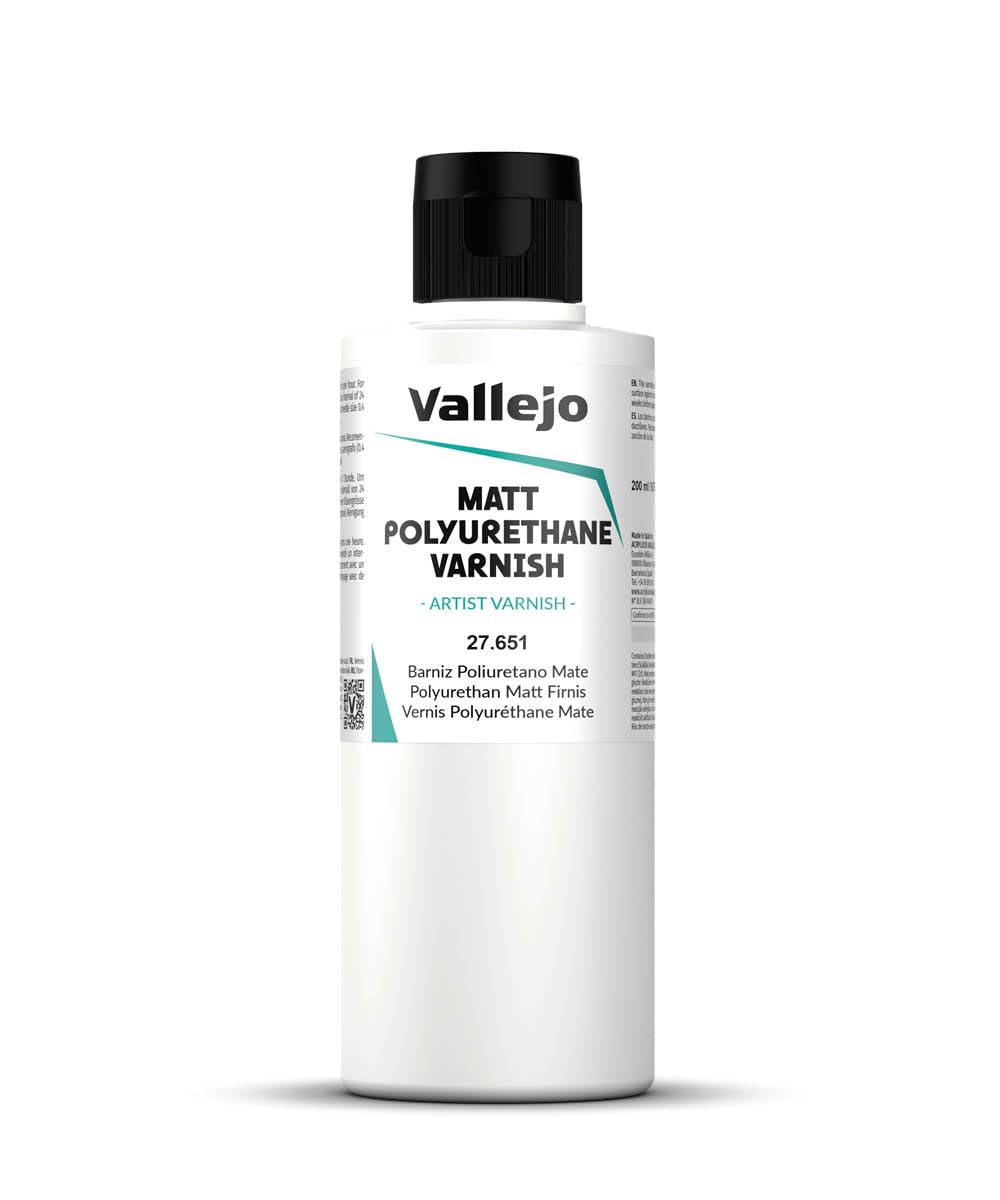
2. Vallejo Polyurethane Matt Varnish
A tough matte shell built for high-contact models that get handled.
This is a polyurethane clear coat, which means it is engineered for one job: surviving constant handling without scratching or chipping. It is the go-to for wargaming figures, scale models, and dioramas because it dries to the touch in one hour and forms a tough, flexible, non-yellowing layer that blocks dust and moisture.
Owners describe using it on 3D-printed miniatures and statues with no glossy look at all — the matte stays matte, which is rare among brands that slap “matte” on the label. It also brushes onto wooden ships and seals the wood beautifully. One clever owner even reports running it over watercolor on slate outdoors, where 5-6 coats survived weeks and thunderstorms without fading or running — proof of how durable the film really is.
Hobbyists report two practical quirks: in an airbrush it works when thinned with water, but it can clog high-end airbrushes if you don’t move quickly, and a few note the price has crept up versus local hobby shops. Brushed on, a small amount covers a decent area, so you won’t need much per project.
True flat protection: the standout trait is a genuinely non-glossy matte that shrugs off scratches on heavily handled miniatures.
One caveat: airbrush users should thin it and work fast to avoid clogging a fine needle.
Best for: miniature painters, 3D print hobbyists, and model builders who handle their finished pieces.
skip it if: you only paint large flat canvases and never touch your work after it dries.
3. Winsor & Newton Galeria Satin Varnish
The middle-ground finish that keeps paintings looking like paintings, not plastic.
If you want protection without deciding between flat and shiny, this is the bottle. It is a uniquely removable satin varnish made to guard finished acrylic paintings from dirt and grease build-up, and it hits that in-between sheen beautifully — as owners put it: “This gives the perfect satin finish! Not shiny and not matt.”
For fine art canvases, this is the workhorse. It applies evenly, dries with no brush marks, and gives “just the right sheen” — a phrase that shows up repeatedly from painters who want their colors to breathe rather than disappear under glare. Available in 75 or 250 ml bottles, this larger jar gives you room to cover a whole body of work.
Two timing notes matter here: it needs 24 hours to dry, and a full 7 days to cure completely. That means you shouldn’t stack or frame paintings the same week you varnish. Also, a small number of buyers received bottles that were already opened or had no inner seal, so give yours a quick inspection on arrival before brushing over your best piece.
Perfect middle sheen: this is the finish for painters who find gloss too shiny and matte too flat.
Plan ahead: the 24-hour dry time and 7-day full cure are real — patience is part of the process.
Pick this if: you paint fine-art acrylics and want a removable, protective satin coat that flatters color.
Think twice if: you need a quick turnaround — this one demands a week before it is fully set.
4. Krylon Gallery Series UV Archival Gloss Spray

Maximum UV defense in an aerosol for large canvases and mixed media.
This is the spray to grab when you want maximum UV protection on fine art projects without touching a brush to the surface. It delivers a glossy finish that professional painters have trusted for years — one working artist notes it makes paintings harder to photograph due to reflected light, which tells you exactly how gloss this finish really is.
What keeps people loyal is the way it works across media. Buyers report it on charcoal, pastels, inks, colored pencil, acrylic, graphite, and watercolor, over paper, canvas, wood, and board — all accepting it without issue, with low odor, fast drying, and no yellowing or cracking on canvas. At 12-15 sq ft per 11 oz can, it stretches across several canvases.
The honest trade-offs: the smell is strong (the label warns it is extremely flammable with harmful vapors, so spray outdoors or in a separate ventilated room), and it takes around a day or two to dry. A few owners also report nozzles gumming up mid-can, so keeping a spare nozzle on hand is a smart habit with this one.
Why it earns its spot
- UV protection that matters for archival work
- Works on a huge range of media and surfaces
- Fast-drying with no yellowing or cracking
The fine print
- Strong odor — needs outdoor or ventilated spraying
- Gloss sheen reflects light, complicating photos
- Nozzles can gum up before the can empties
Reach for it when: you need broad UV protection across many media types in a fast aerosol format.
Pass it by if: you work indoors without ventilation or prefer a brush-on, odor-free workflow.
5. Vallejo Permanent Acrylic Varnish Matte

A huge 500 ml bottle of true matte that covers armies, not just one model.
This is the volume play for anyone who varnishes constantly. At a full 500 ml with 40 sq ft of coverage, it is the biggest bottle in this lineup — built for batch-protecting figures, dioramas, and wargame armies rather than rationing drops. The formula is water-based, UV-resistant, and highly scratch-resistant once the film has polymerized, and it stays a true matte rather than drifting satin.
Airbrush users report perfect, even application with a true matte result and no color shift or detail loss — critical when you’ve spent hours on tiny highlights. Brush-on also works well: owners say to shake it thoroughly since the liquid settles faster than paints do, and to avoid over-applying or it can feel sticky even after two weeks.
One recurring note: the 500 ml bottle is a commitment. Owners find it great value per ounce, but warn it can’t be pre-mixed and stored in an airbrush cup — you have to thin only what you’ll use immediately. For indoor and outdoor surfaces alike, the weather resistance makes it genuinely versatile.
Economy without compromise: the best cost-per-milliliter in the list, and it still delivers a dead-flat matte.
The discipline it needs: shake constantly, mix small airbrush batches fresh, and never over-apply.
Best for: modelers and miniature painters who burn through varnish by the bottle and want true matte at scale.
Not for: casual painters who varnish a few canvases a year and would waste most of this giant jar.
6. Liquitex Professional Spray Varnish Matte

The archival spray that gives you a genuinely flat finish without the gloss creep.
If Krylon’s gloss is too shiny for you, this is the matte counterpart from the professional shelf. It is archival, permanent, non-removable, and dries to a non-tacky, hard, flexible surface that is non-yellowing and water-resistant when dry. Owners chasing a true flat finish report this one actually delivers it — described in the reviews as the “best, truest matte” over acrylic.
The 12 oz / 400 ml can carries real protection: it guards against dirt, oil, scratches, and UV damage. Gouache artists find it seals without changing color, and mixed-media painters use it as a finishing layer on multi-media pieces. It also conforms to ASTM D4236, meaning it’s rated safe for educational use.
The trade-off for that true matte is in the technique. A frosted look appears right after spraying but fades as it dries, and the full dry time stretches to 48 hours with a 72-hour full cure — so patience is mandatory. The nozzle is also the weak link: several owners mention it clogging around half a can unless you invert it and clear it after each use.
What makes it premium
- True matte finish, not a satin imposter
- Water-resistant, UV-protective, non-yellowing film
- Archival and safe for educational use
What to manage
- 48-hour dry time plus 72-hour full cure
- Nozzle clogs unless you invert the can after spraying
- Thin coats only — heavy spray pools and drips
Choose this if: you want a professional, archival matte spray and are willing to master thin coats and nozzle care.
pass on it if: you need a varnish that’s dry by morning — this one asks for several days.
7. Winsor & Newton Galeria Matte Varnish

The flat coat that modelers switch to and never leave.
This is a uniquely removable matte varnish in a compact 75 ml jar, and it has become the topcoat of choice for serious model builders. Long-time tabletop miniature painters describe it as “the only sealer I use” — and that loyalty comes from a clear matte finish that doesn’t reflect light the way other varnishes do.
Modelers pick this for control. It applies easily with a brush by hand and dries in about 6 hours, and its finish lets you manipulate ink washes — pulling excess away to avoid a muddy look. Airbrush users find it goes on flawlessly, with one owner setting pressure at 20 psi and getting a perfect coat right out of the bottle. One airbrush user cautions: thin it with IPA and spray carefully for an excellent flat finish, but it takes some tuning.
The 75 ml size is the main thing to weigh. It is a premium, removable finished coat for acrylic paintings and models, but the jar is small compared to the 236-500 ml options elsewhere in this list — you’ll buy more often if you varnish large surfaces regularly.
Flat control, not flat drama: the finish reads as subdued and clean, perfect for models and ink-heavy work.
Small jar, real cost: the premium removable formula comes in a 75 ml bottle that goes fast on big projects.
Best for: model plane, tank, and miniature painters who want a reliable, controllable flat topcoat.
Reconsider if: you varnish large canvases — the small jar forces frequent repurchasing.
8. U.S. Art Supply 32 oz Matte Varnish

A full quart of sealer that protects your art without emptying your wallet.
This is the budget pick that thinks big. At a full 32 oz (1 quart), it is the largest bottle in the entire lineup — a permanent, non-yellowing matte acrylic varnish that dries clear to a water-resistant finish. For canvas prints, the matte finish minimizes reflections and glare, which makes photographing your artwork dramatically easier.
The formula is designed for straightforward protection, not fussy technique. Owners use it to seal collage work, cover items securely, and even do wood transfers — applying the medium, pressing the print, and letting it dry overnight to boost contrast. It mixes well with paint to thicken it when needed, giving it a second life beyond pure varnishing. It is also ASTM D4236 compliant, so quality and safety standards are met.
The honest caveats come from specific use cases. On glass, a thin coat wasn’t waterproof after 8 hours and needed the full 24-hour cure to truly set — so test on a scrap first if you’re working on non-porous surfaces. Some owners also feel it dries a touch too quickly, which matters less on large canvases where you can move fast.
The big wins
- 32 oz of coverage — far more than any other pick
- Matte finish reduces glare for photography
- Mixes into paint to adjust thickness
The trade-offs
- Needs a full 24-hour cure before it’s water-resistant
- Dries quickly, so work in sections on big pieces
Grab this if: you want maximum coverage per dollar for sealing canvases, prints, and collage work.
Look elsewhere if: you need a varnish that’s safe on glass or non-porous surfaces without careful testing first.
9. Gamblin Gamvar Picture Varnish

A synthetic resin gloss that deepens color until your art looks lit from within.
Painters who want their colors to pop choose Gamvar. This synthetic resin varnish, similar to natural Damar, is famous for transforming finished work — owners describe colors becoming dramatically more vibrant with just one or two coats, and “deepens pigments dramatically with one or two coats” is a claim that keeps coming back. The gloss surface evens out the painting, hiding the matte-and-gloss patches where oil or acrylic dried unevenly.
What makes it special is how soon you can use it. Unlike traditional varnishes that demand waiting months for a painting to fully cure, Gamvar can be used sooner than other varnishes — a huge advantage for working artists who finish a piece and want it protected fast. Owners note it dries crisp and applies like a dream, stretching economically across four paintings from a single bottle.
The gloss is the entire identity here, which means it isn’t for everyone. If you want a flat, glare-free finish for photography, this will frustrate you — it adds a moderate sheen that deepens and enriches but reflects light. This is a premium, targeted tool for painters who prize color depth and a classic oil-painting look.
Color revelation: the gloss finish intensifies pigments and evens out the surface like nothing else in this list.
Know the look: high-gloss means glare — a trade-off for photographers but a gift for color lovers.
Pick this if: you’re an oil or acrylic painter who wants rich, deepened color and can varnish sooner than with other formulas.
Avoid it if: you need a flat, non-reflective finish or plan to photograph your art without glare.
Understanding the Specs
Finish Type: Matte vs Satin vs Gloss
Matte kills reflection and reads as flat and modern; satin offers a subtle, natural sheen that flatters most paintings; gloss deepens color but adds glare. The biggest beginner mistake is trusting the label — several “matte” products here still carry a slight sheen, so read reviews for the real behavior before you commit.
Drying vs. Cure Time
Dry time is when the surface stops feeling wet, while full cure is when the film reaches maximum hardness and water resistance. A varnish can feel dry in an hour yet stay soft for days — the Winsor & Newton satin needs 24 hours to dry but 7 days to fully cure. Always leave that full window before stacking, framing, or handling your work.
Application: Brush vs. Aerosol
Brush-on varnishes give you control on large flat surfaces and clean up with water. Aerosols are better for textured pieces like models and pastels where a brush would drag the surface, but they demand ventilation and careful thin coats to avoid drips. Your choice here should match your most common project type.
Removability and UV Protection
Some varnishes like the Winsor & Newton Galeria line are uniquely removable, letting conservators strip the varnish later without harming the paint beneath — ideal for fine art. UV-resistant formulas like the Krylon and Liquitex sprays protect against fading from sunlight, essential for pieces displayed in bright rooms or outdoors.
FAQ
Why does my matte varnish dry with a sheen?
How long should I wait before varnishing a fresh acrylic painting?
Can I use a brush-on varnish on miniatures and 3D prints?
What is the difference between dry time and full cure time?
Is it safe to spray varnish indoors?
Why does my varnish look cloudy or frosted right after spraying?
Can varnish be removed if I make a mistake?
Does varnish protect my painting from water damage?
Is gloss or matte better for photographing my artwork?
How many coats of varnish should I apply?
Final Thoughts: The Verdict
For most people, the acrylic varnish winner is the DecoArt DuraClear Matte because it is the easiest, quickest-drying all-rounder for paintings, decoupage, and mixed media — a crowd favorite with a 4.7-star rating across hundreds of reviews. If you want a professional true matte spray for archival work, grab the Liquitex Professional Spray. And for color-hungry painters who want gloss that deepens pigments, the Gamblin Gamvar is the one to reach for. Whichever you choose, respect the dry and cure times — patience at the end is what makes the varnish earn its keep.
How We Picked
We do not accept paid placement. Every pick is matched to a real buyer and a real use-case; we do not hands-on test units.
Sources & Methodology
Specifications: manufacturer listings and product documentation. Review insights: verified customer reviews, as of August 2026. Pricing: not shown on this page (it changes often); check the current price via the retailer link.
As an Amazon Associate, Gadgets Feed earns from qualifying purchases. This does not affect which products we feature.