
Our readers keep the lights on and my morning glass full of iced black tea. As an Amazon Associate, I earn from qualifying purchases.
Specs are compiled from manufacturer listings and verified buyer reviews and can change over time — please confirm the key details on the product page before buying.
Choosing a camping hatchet means balancing swing weight, blade bite, and how it rides on your pack. The ideal camping hatchet splits kindling cleanly, holds an edge through a weekend, and stays comfortable for extended use. This guide breaks down nine of the most popular options by the specs that actually matter in the field.
I’m Min — the founder and writer behind Gadgets Feed. This guide is built by comparing the manufacturers’ published specifications and the patterns across verified customer reviews, so you get each pick’s real strengths and trade-offs instead of marketing spin.
You’ll see exactly which head weights and blade lengths turn a camping hatchet into a trusted trail companion versus a frustrating one.
Our Picks at a Glance


How To Choose The Best Camping Hatchet
You need a hatchet that splits kindling, clears small branches, and drives tent stakes with one hand, but you also need it light enough to carry on a hike. A head weight between 1.3 and 1.5 pounds delivers the momentum to split kindling without exhausting your arm. Here is what to look for.
Match Head Weight to Your Task
Head weight dictates swing momentum and chopping power more than any other spec. A heavier head, like the Husqvarna’s 1.32-pound hand-forged design, powers through denser wood but can tire your arm faster. Lighter models, such as the Schrade at 1.4 pounds total, feel easy for splitting small kindling but may need more swings on thicker logs. Match head weight to your primary task: heavier for dense logs, lighter for kindling and carving.
Check the Blade Steel and Edge Geometry
Carbon steel takes a razor edge but rusts easily; stainless resists corrosion but may dull faster. Carbon steel, like the 1065 used in the WICING, tends to take a razor edge and hold it, but can rust if neglected. Stainless steel is more corrosion-resistant. A full tang design, where the steel runs the entire length of the handle, eliminates weak points at the neck.
Consider the Handle and Safety Features
Wood handles absorb vibration but need oiling; composite handles resist weather but transmit more shock. Wood handles, like the beech or hickory options on the WICING and Husqvarna, offer a classic feel and absorb vibration well but may need oiling. Composite handles, like the Gerber’s shock-absorbent build, resist weather but transmit more vibration. A secure sheath protects the blade and prevents accidental cuts during transport.
Quick Comparison
| Model | Best For | Head Weight | Blade Length | Handle Material | Amazon |
|---|---|---|---|---|---|
| Fiskars 375501-1001★ Best Overall | All-around camp chopping | 0.68 kg | — | Alloy Steel, Wood | Amazon |
| WEYLAND Bushcraft HatchetBest Value | Bushcraft tasks on a budget | 13.5 oz | 7 in | Plastic | Amazon |
| Wakeman Hand Axe ComboMost Versatile | Survival gear in one kit | — | 5 in | Composite, Nylon | Amazon |
| NedFoss Warthog | Balanced carving and chopping | 15.5 oz | 4.2 in | Wood | Amazon |
| WICING 13.5 Inch | Traditional wood-handle feel | 2.1 lb | 4.13 in | Beech Wood | Amazon |
| Schrade Delta Class Bedrock | Backpacking survival kit | 1.4 lb | 3.8 in | Glass Fiber Filled PA | Amazon |
| ESTWING Sportsman’s Axe | Rugged one-piece steel | — | 3.25 in | Alloy Steel, Leather | Amazon |
| Husqvarna Hatchet | Classic Swedish craftsmanship | 1.32 lb | — | Hickory | Amazon |
| Gerber Freescape | Extended reach for bigger jobs | — | — | Nylon Composite | Amazon |
In-Depth Reviews
1. Fiskars 375501-1001 Hatchet
Our pick — over 4.5★ from 700+ verified ratings; the strongest balance of quality and price.
A 1.5-pound splitter that’s become the crowd’s default for camp chores.
The Fiskars earns its top spot by nailing the fundamentals: a molded head that won’t loosen, a low-friction coating that stops the blade from sticking in wood, and a Dura frame handle that’s lighter than steel but stronger. At a 1.5-pound total weight, it’s the lightest pick here alongside the heavier choppers, making it a joy to pack on a long hike.
Buyers report this replaced a 20-year-old X7 hatchet and call it a “cheap practical tool very light weight easy to pack.” The proprietary blade-grinding technique (a special sharpening method) delivers a sharper edge that owners say holds well, and the shock-absorbing handle design prevents overstrike damage when you miss your mark. Its 15.5-inch length gives you leverage without the bulk.
The stickiness is the low-friction coating that powers through wood, so most sessions end with clean splits rather than a wedged blade. While a few owners find cutting performance mixed, the overwhelming consensus — from nearly a thousand ratings with a 4.8 average — is that this is the best all-around hatchet for the money.
What Owners Rave About
- Sharp from the start with a precise edge grind
- Feels lighter than its 1.5-pound spec while swinging
- Molded head stays tight, no loosening over time
What to Expect
- Not a heavy-duty splitter for thick, knotty logs
- Some owners find cutting performance mixed on larger wood
Grab this if: you want a lightweight, reliable hatchet that handles camping, kindling, and small logs without a second thought.
Think twice if: your primary task is splitting large logs — the lighter head will make you work harder.
2. WEYLAND Bushcraft Hatchet
A 7-inch blade that carves a niche for serious bushcraft work.
The WEYLAND swings above its price tier with a full tang construction — a single piece of 3Cr13 stainless steel that runs through the handle, eliminating the weak points where cheaper hatchets snap. Its 7-inch blade is the longest in this lineup, beating the Wakeman’s 5-inch edge by a full 40%, which translates to more surface area for processing firewood and clearing branches.
At just 1.7 pounds with a head weight of 13.5 ounces, it’s nimble enough for detail work like carving camp projects or preparing stakes. The included MOLLE sheath attaches to backpacks and belts, keeping the hatchet within arm’s reach on the trail. Owners call the balance “comfortable” and the value “excellent for a bugout bag.”
The honest trade-off is the handle screws. Owners mention that “the screws for the handle come loose” during use, and one owner lost two screws while chopping kindling. It’s a fixable issue with thread-locker, but worth knowing before you rely on it for a heavy weekend. The durability concerns appear in the review patterns, though the sharpness stays a highlight.
Sharp and Versatile: The 3Cr13 steel takes a good edge and the slim contour makes it a pleasure for both chopping and controlled cuts.
Watch the Hardware: The handle screws demand occasional tightening; treat them gently and they’ll hold.
Reach for this if: you want a long, sharp blade for bushcraft tasks without paying premium prices.
Look elsewhere if: you need a maintenance-free tool — the screws need periodic attention.
3. Wakeman Camping Hand Axe with Survival Gear
A 4-piece survival kit built around a 5-inch chopping blade.
The Wakeman is less a bare hatchet and more a complete camp toolkit. Inside the composite handle nests a serrated wood saw, and attached to the blade sheath rides a magnesium fire starter — everything you need to process wood and start a fire in one 2.3-pound package. That weight makes it the heaviest of the mid-range picks, a trade-off for the integrated gear.
Owners are genuinely surprised by the performance. “Durable and sharp, surprised how well the edge has held up and the head hasn’t loosened at all,” one buyer reports after cutting trails through pine and dry old oak. The ergonomic textured handle keeps fatigue at bay during long sessions, and the 14-inch length gives solid leverage for chopping small tree limbs.
The saw is handy for smaller work and stays secured with a buckle, though a few owners note the saw teeth arrived with minor defects and the carry handle felt flimsy. The belt clip on the nylon sheath makes it easy to keep close. Quality is what wins people over here — the most-cited positive aspect — and it’s the strongest value proposition among the survival-style hatchets.
The All-in-One Appeal
- Integrated saw and fire starter save pack space
- Edge holds up through tough cutting sessions
- Contoured handle offers a stable, comfortable grip
The Catch
- Heavier than dedicated hatchets at 2.3 pounds
- Carry handle on the sheath can arrive damaged
Pick this if: you want a do-it-all emergency tool for the truck or campsite rather than a pure chopper.
Skip if: you’re counting every ounce in a backpack — the added gear has a weight cost.
4. NedFoss Warthog Camping Hatchet

A 15.5-ounce head on a 4.2-inch blade tuned for precision.
The Warthog is crafted from a single piece of steel with a 5.0mm blade thickness, so it survives tough tasks without easily dulling. Its 15.5-ounce head and 4.2-inch curved blade make it nimbler than longer hatchets — owners describe it as “small, practical, and really well made,” ideal for garden work and detail-oriented camp tasks.
The natural wood handle is etched with a warthog pattern, giving it a distinctive look that earns praise for its appearance — the second most-cited aspect. It’s balanced and comfortable for backpacking, though it’s lighter than the WEYLAND at 15.2 ounces total, which means less raw chopping power but easier control. The custom leather sheath wears comfortably on a belt.
Owners note it works for field dressing big game and chips away at wood easily, though the blade tends to stick in the sheath and the wood handle can feel slippery. It’s not designed for full-on wood-splitting, so keep expectations set for carving, pruning, and light chopping. The quality earns consistent praise, with sharpness holding well after use.
Precision-Focused: The curved head design allows fine carving work that heavier hatchets can’t match.
Size Reality: Smaller than many expect; think of it as a trail companion, not a log splitter.
Best suited for: campers who value a beautiful, controllable tool for carving and small jobs over raw splitting power.
Not ideal if: you plan to process substantial firewood — the light head demands more effort.
5. WICING 13.5 Inch Hatchet

A 2.1-pound head and 4.13-inch blade with a timeless hardwood grip.
The WICING leans into tradition with its 1065 high carbon steel blade and beech wood handle, a combination that delivers “impressive weight, quality, balance for price” according to owners. At 2.1 pounds, it’s one of the heavier picks, which gives it authority when splitting small logs but can tire a wrist during prolonged use.
The 13.5-inch length and balanced weight facilitate controlled swings while reducing fatigue, making it perfect for chopping firewood or clearing branches. Customers note it arrives “sharp ready to use” with a durable leather sheath and a quality sharpening stone included in the package. The appearance is a consistent highlight, with the natural wood grain and steel contrasting nicely.
The honest mixed feedback centers on quality and sharpness from the start — some find it excellent while others report a loose handle. The most common positive is value for money, so it’s a strong budget-conscious choice. As one owner put it: “not so light that it bounces,” giving it a satisfying, solid feel in hand.
Traditional Strengths
- Carbon steel takes and holds a sharp edge
- Comfortable beech handle absorbs shock well
- Leather sheath and sharpening stone included
Quality Variance
- Some units arrive with a loose handle
- Sharpness from the start is inconsistent
Reach for this if: you want a classic wood-handled hatchet with real splitting weight at a fair price.
Consider carefully if: you need guaranteed quality — inspect the handle fit on arrival.
6. Schrade Delta Class Bedrock Axe

A 1.4-pound survival axe with a fire starter hidden in the shaft.
The Schrade’s defining feature is its dependability in a survival scenario: an extra-large ferro rod stored inside the shaft for fire starting, plus a hammer pommel on the butt for driving stakes or light pounding. At 11.8 inches overall with a 3.8-inch blade and a 1.4-pound weight (1 lb 6.4 ounces), it’s compact enough for backpacking yet substantial enough for camp chores.
The 3Cr13 titanium-coated stainless steel blade takes a “razor edge with minimal effort,” and the ergonomic black rubber grip prevents slipping during use. Owners praise its well-balanced weight and compact size, calling it “perfect for backpacking” and noting the built-in ferro rod is a secure bonus. The black thermoplastic belt sheath offers quick access.
The trade-off is blade steel softness — one owner reports hitting metal caused three large knicks on first use. Durability gets mixed feedback, with some saying it takes a beating while others report breaking during use. The sharpness and weight are the standout positives, making it a smart kit addition for light-to-medium cutting.
Built for Backcountry: The integrated fire starter and hammer pommel make it a true survival multi-tool.
Soft Steel Reality: Avoid hard impacts like metal or rocks; the edge nicks easily.
Pick this if: survival preparedness matters more than raw chopping power — the fire-starting capability is a genuine edge.
Look elsewhere if: you need a tough blade for heavy, repeated splitting.
7. ESTWING Sportsman’s Axe

A forged one-piece steel head and handle with zero weak points.
The Estwing is crafted from a single piece of solid American steel, eliminating weak points from castings or welds. This forged-in-one-piece design delivers class-leading durability — owners call it “very sharp and well balanced,” praising its feel in hand for everything from splitting firewood to pulling tent stakes. The 14-inch length with a 3.25-inch blade keeps it nimble.
The genuine leather grip is hand-sanded and lacquered for comfort, a touch that earns consistent praise for appearance — the top-cited positive aspect. The rugged ballistic nylon sheath protects the hand-sharpened 4-inch cutting edge and offers a belt loop for easy carry. It’s made in the USA in Rockford, IL, using American steel, a point of pride for many buyers.
The honest caveat is durability and sharpness get mixed reviews at scale — some reviewers point out it “becoming severely chipped and needing sharpening after several uses.” The forged steel is hard but can be brittle on hard impacts. It’s a beautiful, functional tool, though treating the edge with care is wise. The versatility for home fireplace and campsite duty is a recurring strength.
Forged Excellence
- One-piece steel construction is virtually unbreakable
- Comfortable leather grip with timeless style
- Effective tent stake puller built into design
Edge Care Needed
- Hard steel can chip on heavy impacts
- Factory edge may need sharpening after several uses
Choose this if: you value a sturdy, American-made tool that looks as good as it performs.
Think twice if: you’ll be hitting buried wood or rocks — the edge is hard but not indestructible.
8. Husqvarna Hatchet
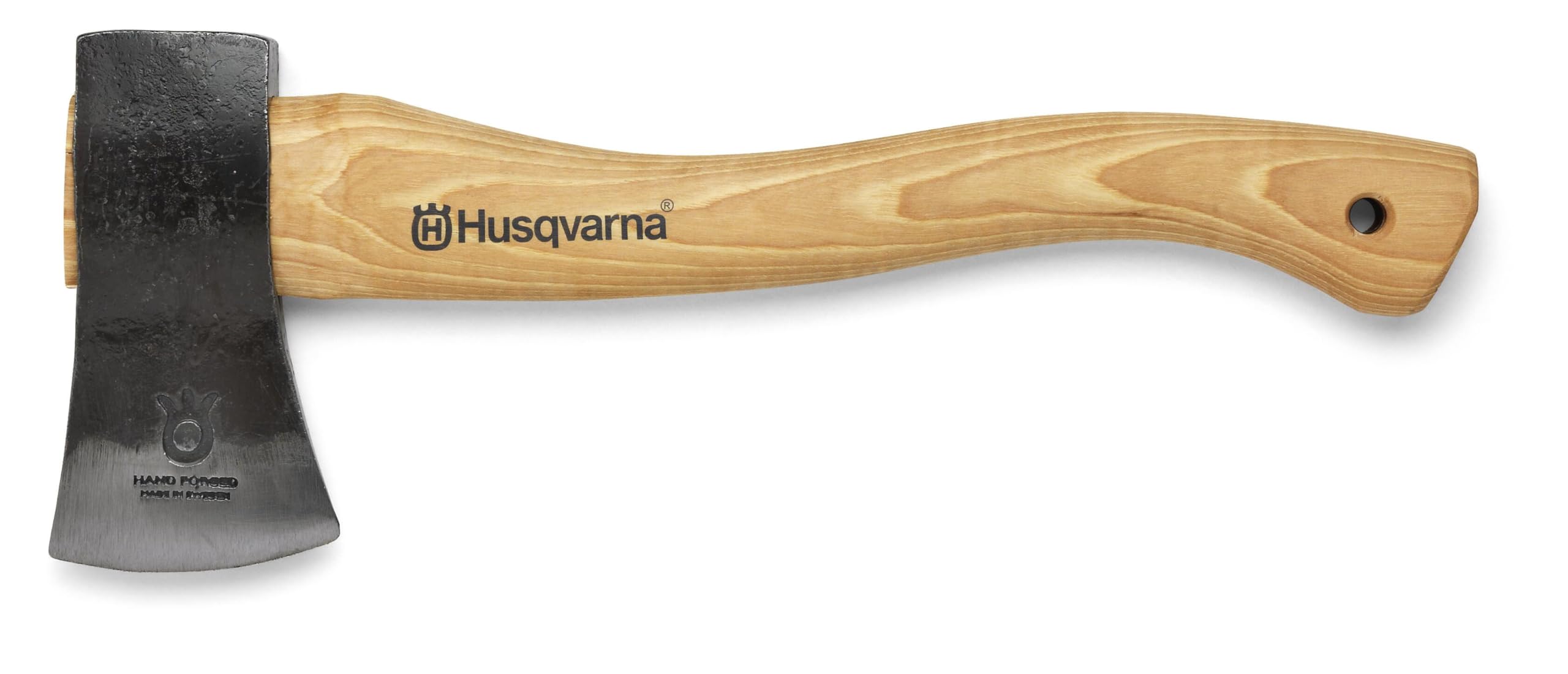
A 1.32-pound hand-forged head on a hickory handle from Sweden.
The Husqvarna is a hand-forged hatchet designed for one-handed use on light wood cutting, built with premium hickory and Swedish steel. Its 1.32-pound axe head is the heaviest in this lineup, delivering real chopping authority that owners say “performs flawlessly for limbing, felling, splitting.” The 14.97-inch length offers a comfortable reach for camp chores.
Owners are deeply loyal, with one noting they own four different Husqvarna axes. The handle is tight-grained hickory that many sand and oil to perfection, and the blade arrives with a coarse edge that “took well” to sharpening. It arrives unfinished, so plan to sharpen and oil the handle before field use.
The honest note is that it arrives unfinished and unsharpened, so expect some setup time with a sharpening stone and linseed oil before it’s field-ready. Some owners see the hand-forged details as a durability question, but most agree the steel holds a good edge after initial work. It’s made in Sweden, a pedigree that justifies the premium positioning.
Classic Swedish Steel: The hand-forged head and hickory handle deliver a balanced, powerful swing.
Requires Setup: Plan to sharpen and oil the handle before heavy use — it’s a project, not plug-and-play.
Reach for this if: you appreciate traditional craftsmanship and don’t mind spending time tuning a tool to perfection.
Look elsewhere if: you want a ready-to-use hatchet straight from the start.
9. Gerber Freescape Hatchet

A 17.3-inch reach with a PTFE-coated blade that glides through wood.
The Gerber Freescape stretches the hatchet definition with its 17.3-inch overall length, making it an ideal compromise between a full camp axe and a compact hatchet. Owners describe it as “too long for one hand, too small for two,” which is exactly the balance for processing larger kindling and splitting firewood up to 4 inches in diameter. Its forged steel head pairs with a PTFE coating (a non-stick layer) that reduces friction for cleaner chops.
The composite handle is shock absorbent, reducing hand strain during extended sessions, and the soft-touch over-mold adds comfort. At 2 pounds, it’s substantial without being unwieldy, and the slim sheath ensures safe storage. Shoppers say it cuts “4-inch branches in half the time” and splits firewood under 3.5 inches diameter with ease.
The one trade-off is the blade’s splitting efficiency — one owner notes it requires 4-5 blows even on dry wood, suggesting the sharp edge is better for chopping than splitting. The head protector is bulky, and the handle can feel slick, though both are fixable. The quality and sharpness earn top praise, with owners calling it “sharp and durable” and noting the edge stays true.
The Long Reach
- Extra length adds leverage for bigger branches
- PTFE coating reduces friction and sticking
- Shock-absorbent handle eases hand strain
Field Notes
- Not ideal for one-hand carry or fine carving
- Splitting thick logs demands several blows
Pick this if: you want a versatile tool that bridges hatchet and axe territory for heavier camp tasks.
Skip if: you need a compact, one-hand tool for backpacking — the length adds weight and bulk.
Understanding the Specs
Head Weight & Total Weight
Head weight (measured in pounds or ounces) is the mass of the steel blade — it drives how deep the hatchet bites into wood. A heavier head like the Husqvarna’s 1.32 pounds powers through dense logs, while lighter heads like the Schrade’s 1.4-pound total reduce fatigue. Total weight matters for carrying: the Fiskars at 1.5 pounds packs easier than the Wakeman’s 2.3 pounds.
Blade Length & Steel
Blade length (in inches) sets the cutting surface area. The WEYLAND’s 7-inch blade processes larger wood, while the Schrade’s 3.8-inch blade suits precision work. Steel type affects edge retention: 1065 carbon steel (WICING) sharpens easily but can rust; 3Cr13 stainless (WEYLAND, Schrade) resists corrosion; alloy steel (Fiskars, Gerber) balances toughness and edge life.
FAQ
What head weight is best for a camping hatchet?
Is a full tang hatchet better than a composite handle?
How do I keep the handle from coming loose?
Does a longer blade mean better chopping?
Will a 3.8-inch blade handle firewood?
What’s the difference between carbon steel and stainless steel blades?
Is a heavier hatchet always better for splitting?
How should a hatchet be carried for safety?
Can I use a hatchet for carving and camp craft?
What should I do if my hatchet arrives with a dull edge?
Final Thoughts: The Verdict
For most people, the camping hatchet worth owning is the Fiskars 375501-1001 because its 1.5-pound weight, sharp blade grind, and low-friction coating make it the best balance of portability and performance. If you want the longest blade and don’t mind tightening screws, the WEYLAND Bushcraft Hatchet offers a 7-inch edge at a budget-friendly price. And for survival-focused campers who need fire-starting built in, the Schrade Delta Class with its integrated ferro rod is the one to reach for.
How We Picked
We do not accept paid placement. Every pick is matched to a real buyer and a real use-case; we do not hands-on test units.
Sources & Methodology
Specifications: manufacturer listings and product documentation. Review insights: verified customer reviews, as of August 2026. Pricing: not shown on this page (it changes often); check the current price via the retailer link.
As an Amazon Associate, Gadgets Feed earns from qualifying purchases. This does not affect which products we feature.