
Our readers keep the lights on and my morning glass full of iced black tea. As an Amazon Associate, I earn from qualifying purchases.
Specs are compiled from manufacturer listings and verified buyer reviews and can change over time — please confirm the key details on the product page before buying.
Your young catcher’s hand takes a beating from pitches that keep getting faster, so the right catchers glove for youth must protect it while staying light and loose enough for a kid to squeeze closed on their own. You want a mitt that fits well, breaks in quickly, and absorbs sting so your child stays in the game and enjoys the position. Here is how the best youth mitts compare on those three points.
I’m Min — the founder and writer behind Gadgets Feed. This guide is built by comparing the manufacturers’ published specifications and the patterns across verified customer reviews, so you get each pick’s real strengths and trade-offs instead of marketing spin.
We have compared the top-rated mitts to find the best options for keeping young players comfortable and confident behind the plate.
Our Picks at a Glance


How To Choose The Best Catchers Glove For Youth
Buying a youth catcher’s mitt is different from buying a fielder’s glove because catching takes the hardest hits on the field. Your main goals are protecting the hand, making the mitt easy to close, and choosing a size that fits muscles that are still growing. Here is what actually matters when you are comparing models.
Padding That Matches the Pitch Speed
The most important job of a catcher’s mitt is to stop the ball from stinging. For younger kids facing pitches in the 45 to 60 mph range, look for a cushioned palm and a padded index finger. As pitchers get faster and harder, the padding needs to be thicker — several youth mitts are built with high-density foam specifically to handle those impacts.
Game-Ready vs. Long Break-In
A stiff glove is frustrating for a child who just wants to play catch. Some mitts are marketed as “game-ready” right from the start, while others need weeks of conditioning to soften up. If you do not have time to break in a glove before the season starts, prioritize one that is described as soft and pliable from day one.
Sizing and Hand Orientation
To make sure your child can close the mitt easily, look for a circumference between 31.5 inches and 33 inches — the smaller end is easier for a young hand to control. You also need to pick the correct orientation: a right-hand throw means the glove goes on the left hand, and a left-hand throw means it goes on the right. Every mitt is built for only one of these.
Quick Comparison
| Model | Best For | Size | Material | Break-In Level | Amazon |
|---|---|---|---|---|---|
| Rawlings Renegade★ Best Overall | All-around youth starter | 32.5 inches | Leather | 90% Factory | Amazon |
| Mizuno Prospect PowerCloseEasy Squeeze Pick | Easy squeeze for smaller hands | 31.5 inches | Bio Soft Leather | Soft | Amazon |
| Akadema AGC98 Prodigy | Deep pocket and pro feel | 32 inches | Leather | Stiff initially | Amazon |
| Rawlings NXT Contour Fit | Competitive travel ball | 32.5 inches | Pro-Soft Leather | Ready-to-Play | Amazon |
| Wilson A360 | Budget-friendly durability | 31.5 inches | Faux Leather | Stiff | Amazon |
| Gracfulcub | Light backyard play | 33 inches | Faux Leather | Game-Ready | Amazon |
| HolyElks | Budget starter for ages 8–12 | 33 inches | PU Synthetic Leather | Fast Break-In | Amazon |
In‑Depth Reviews
1. Rawlings Renegade Youth Catcher’s Mitt
Our pick — over 4.5★ from 900+ verified ratings; the strongest balance of quality and price.
The real-leather mitt that is already 90% broken in before it reaches your door.
Its leather shell palm delivers a pro feel, holds its shape, and adds durability. It weighs just 16 ounces, so a young player can hold it up for a full inning without their arm tiring out. This is the pick that balances everything — quality construction, ready-to-play feel, and a price that stays reasonable for a starter mitt.
What wins people over is the build quality, and the value holds up too. Buyers report the padding is solid for pitches up to 50-60 mph, but above 60 mph the protection gets thinner — note as your pitcher gains velocity. The one honest trade-off is durability: while many owners say the glove is holding up great after 90+ games, a few report the laces breaking within six months. For a 9-year-old just starting out, this mitt is ready for the field almost immediately.
The fit works for both smaller hands and adults with smaller hands, making it a versatile choice that can grow with your player. It takes a bit of work to fully form the pocket, but once you do, catching becomes noticeably easier. Instructors recommend it as the best value for a starter mitt.
top pick overall
- Real leather shell for durability and shape retention
- 90% factory break-in means less work for you
- Comfortable cushioned palm and index finger pads
needs break-in
- Padding thins out above 60 mph pitches
- Some owners mention laces wearing out in six months
who it suits: The young catcher getting their first real leather mitt who wants game-ready performance without the work.
think twice if: Your child faces pitchers throwing over 60 mph regularly — the padding starts to feel thin at that speed.
2. Mizuno Prospect PowerClose Youth Catcher’s Mitt
The 31.5-inch mitt built with PowerClose technology to make catching easy for younger hands.
Mizuno’s PowerClose Technology is the defining feature here — it’s designed specifically so younger players can snap the mitt shut without fighting the leather. The Bio Soft Leather has a balanced oil and softness that gives excellent feel while staying firm enough for control. This is the mitt for the kid whose hands are still too small to wrestle a stiff glove closed.
Owners praise its durable build that holds up well over time. One family noted that after their son previously complained of pain while catching, he now has no complaints with 10-year-old pitchers throwing about 45-50 mph — the padding is doing its job. The mitt is described as ready to go with a little fine tuning, and one child could even catch with it right from the start.
It runs small, so size up for older or larger-handed players. The review pages sum it up: “Really nice broken in leather.” If you have a smaller-framed catcher, this is ideal — just size up if your child is on the bigger side.
easy to close: The PowerClose design means a younger player can actually squeeze it shut, which is half the battle in learning to catch.
runs small: This mitt is built for smaller hands — check your child’s hand size against this one before ordering.
3. Akadema AGC98 Prodigy Series Glove

The 32-inch mitt whose deep pocket and mantis pattern make the ball disappear into the leather.
The defining spec here is the 32-inch circumference with a Praying Mantis pattern and deep pocket — a combination that helps young catchers secure balls and transfer them quickly. Owners note the “mantis” pocket is excellent for squeezing balls. Near-pro-grade leather and reinforced stitching protect the thumb-index area from 75+ mph pitches.
This mitt boosts a kid’s desire to catch, according to owners — the ball finds the pocket, and catching starts to feel rewarding instead of painful. It fits an average adult hand too, so it can be shared or used for years as your child grows. The open back and spiral lock web design add to the pro feel.
The honest caveat is the break-in: this glove is stiff initially. Customers note it takes lanolin and a ball to soften it up over about a week, though some say it breaks in faster than expected and becomes game-ready in roughly 45 days. One owner found it ran smaller than the size indicated, so consider sizing carefully if your child is at the upper end of the range.
reach for this if: You want a pro-feeling mitt with a pocket that swallows the ball and padding that handles 75+ mph pitches.
be patient with: The stiff leather takes real work to break in — plan to condition it well before the season starts.
4. Rawlings NXT Youth Baseball Glove Series
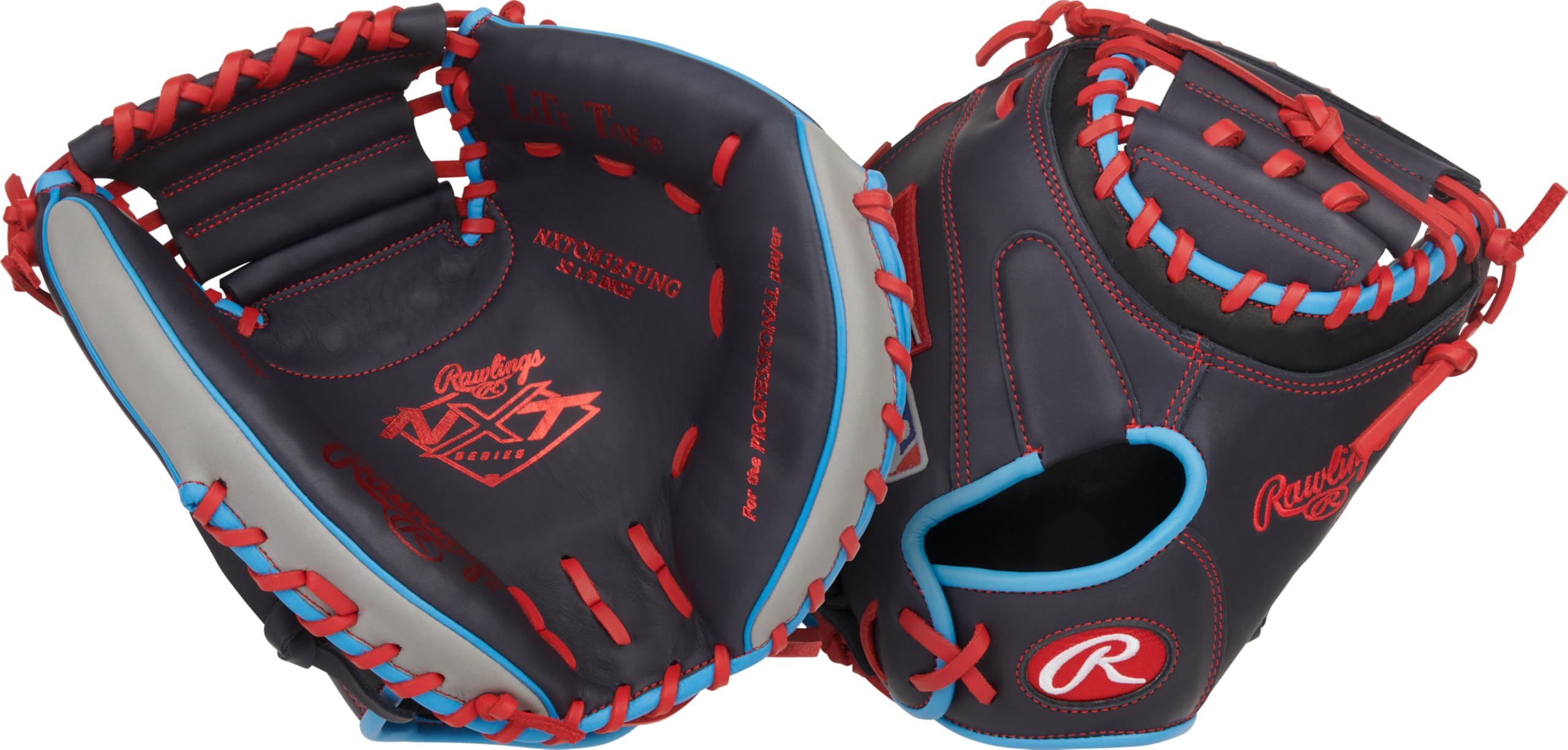
The 32.5-inch mitt built for travel ball with a Contour Fit made for smaller hands.
The Youth Contour Fit Technology is what separates this mitt from the rest — it features a narrower wrist opening, lowered finger stalls, and a contoured hand shape. That means better control and quicker transfers for kids with smaller hands. The smooth Pro-Soft leather delivers a soft feel while maintaining the structure needed for competitive innings. This is the premium pick for the player who is serious about the position.
Designed for travel ball and competitive youth players, the NXT Series uses a 32.5-inch 1-Piece Solid Web catcher’s mitt with a deep pocket for confident receiving. The padded thumb sleeve and adjustable pull lace wrist strap create a secure, comfortable fit. Owners praise the vibrant colors and note it breaks in quickly — one child was using it just days after receiving it. Another young catcher had it nearly game-ready after about 6 good sessions of playing catch and a few practices, with the parent working the leather at every opportunity.
The trade-off to weigh is durability — while build quality earns strong praise, a few owners note the palm can deteriorate after about a month of heavy use. This is the most expensive mitt on this list, so consider whether your player’s commitment level justifies the higher tier.
competition ready: The Contour Fit and pro-style web design give serious young catchers the control they need for faster games.
premium price: This is the top-tier priced mitt here — best for a dedicated young player, not a first-time beginner.
5. Wilson 2021 A360 Youth Baseball Glove

The 31.5-inch mitt with a CarbonLite Shell that cuts weight without cutting durability.
The CarbonLite Shell is the headline feature here — it reduces the weight of the glove without sacrificing durability, which matters for a young catcher who has to hold it up for entire innings. The Velcro design allows for easy in-game adjustments, so you can fine-tune the fit quickly between pitches. At 1.1 pounds, this is an easy mitt for a small player to manage.
Owners praise its suitability for young catchers, lasting a full season. One family used it as a primary 8U catcher’s mitt and reported it lasted the entire season and is still good for several more. It fits a 7-8 year old very well. Reviewers point out the mitt gets better with each use, and conditioner helps speed up that process.
The honest catch is the break-in: this glove is pretty stiff when new. Owners found it took a while to break in, with one child complaining it was stiff even after conditioning for a few weeks — though it worked out great eventually. One buyer paid for a professional break-in to get it game-ready. If you buy this one, get it early and work the leather before the season starts.
best for: The young catcher needing a durable, lightweight mitt on a budget — it lasts a full season and then some.
measure first: This glove is stiff from the start, so budget time to break it in or pay for a pro service.
6. Gracfulcub Baseball Catcher Glove

The 33-inch faux leather mitt with high-density foam padding that works right from the start.
High-density foam padding in the palm and index finger, plus a plush wrist guard, absorb impact. The trap-style shallow pocket allows for quick ball transfer with smooth, controlled motion. This is a lightweight synthetic leather mitt that breaks in quickly for a game-ready fit, perfect for young players just learning the position.
Owners find it functional for backyard play, and one family noted it works real good for a little league player to start out with. The same buyer’s grandson used it for 2 years as a starter catcher and it is still holding up good. That kind of longevity for a starter mitt is impressive. The breathable lining keeps hands dry, and the double-layer reinforced construction resists impact without losing shape.
The honest take on durability is mixed here — while some owners say it is really good for the price, others find it doesn’t last long. One owner mentioned the glove is “kinda sticky inside and out” when new, but hoped it would go away with use. This is a solid entry-level choice for a child who is just starting out and might not be ready for a premium investment.
reach for this if: Your kid is starting out in T-ball or backyard catch and you want a functional mitt without a big price tag.
set expectations: Durability is hit-or-miss here — some last years, some wear out sooner.
7. HolyElks Baseball Catcher’s Mitt

The 33-inch PU leather mitt that arrives loose enough to catch with almost no break-in.
Its flexible build requires minimal break-in, delivering instant game-ready performance. The double palm construction ensures maximum pocket stability, and the easy-to-squeeze design enhances ball grip and control. The sponge-backed wrist support with ergonomic padding prevents abrasion and adds comfort for long practices.
Buyers praise this mitt for its fit, which suits ages 8-12. One buyer reports their 9-year-old son loves it, and the glove “came pretty loose so he didn’t have to break it in much” — so your child can use it the day it arrives. The durable build uses premium leather lacing and professional-grade stitching to resist tearing.
The trade-off is sizing — one owner found it runs a little on the small side. It is designed for youth and adults aged 16+, with a right-handed thrower orientation. This is the most budget-friendly option on the list, making it a great first mitt for a child who is still deciding if catching is their position.
game-ready feel: This mitt comes loose enough that a 9-year-old can use it immediately, with no conditioning marathon.
fit check needed: It runs slightly small, so it suits younger, smaller-handed players best.
Understanding the Specs
Mitt Size and Why It Matters
Youth catcher’s mitts typically range from 31.5 inches to 33 inches in circumference. A smaller mitt is easier for a child to close quickly and control, while a larger one offers more catching surface but requires a stronger hand to squeeze shut. Match the size to your child’s hand strength, not just their age — a smaller-framed 10-year-old may handle a 31.5-inch mitt better than a 33-inch one.
Break-In Level
Break-in is how soft and flexible the leather becomes so the mitt can close easily around the ball. A “game-ready” or 90% factory-broken-in mitt works almost immediately, while a stiff mitt needs weeks of conditioning with glove oil, a ball in the pocket, and repeated squeezing. If the season starts soon, prioritize a softer mitt or plan to work the leather daily.
Padding and Protection
The padding in a catcher’s mitt absorbs the impact of each pitch so the ball doesn’t sting the hand. Look for cushioned palms and padded index fingers, especially as pitchers get faster. High-density foam offers better shock absorption than basic padding. If your child faces 50+ mph pitches, make sure the padding is substantial enough to handle that velocity.
Hand Orientation
Every catcher’s mitt is built for a specific hand. A right-hand throw means the glove is worn on the left hand, so the right hand is free to throw. A left-hand throw is the opposite. Always check this spec before buying, because a mitt built for the wrong hand will be uncomfortable and nearly impossible to use properly.
FAQ
What size catcher’s mitt does my child need?
How long does it take to break in a youth catcher’s mitt?
What is the difference between a right-hand throw and left-hand throw mitt?
How much padding does a youth catcher need?
Is a leather or synthetic mitt better for a young catcher?
Why does my child’s mitt keep stinging their hand?
Can an adult use a youth catcher’s mitt?
What does a closed web versus open web mitt mean for a catcher?
Final Thoughts: The Verdict
The top pick for most young catchers is the Rawlings Renegade because it delivers real leather quality with a 90% factory break-in, so your child can use it almost immediately. If your player has smaller hands and struggles to close a mitt, the Mizuno Prospect PowerClose is the one to reach for. And for a budget-conscious starter, the HolyElks gets kids catching the day it arrives.
How We Picked
We do not accept paid placement. Every pick is matched to a real buyer and a real use-case; we do not hands-on test units.
Sources & Methodology
Specifications: manufacturer listings and product documentation. Review insights: verified customer reviews, as of August 2026. Pricing: not shown on this page (it changes often); check the current price via the retailer link.
As an Amazon Associate, Gadgets Feed earns from qualifying purchases. This does not affect which products we feature.