
Our readers keep the lights on and my morning glass full of iced black tea. As an Amazon Associate, I earn from qualifying purchases.
Specs are compiled from manufacturer listings and verified buyer reviews and can change over time — please confirm the key details on the product page before buying.
A weeping water pump, a pinhole in a heater core, or a head gasket that lets white vapor drift from your tailpipe — a cooling system leak is the kind of problem that turns a daily driver into a paperweight. This guide sorts through the best antifreeze leak sealant options by how they actually behave in real engines, not by what the bottle promises.
I’m Min — the founder and writer behind Gadgets Feed. This guide is built by comparing the manufacturers’ published specifications and the patterns across verified customer reviews, so you get each pick’s real strengths and trade-offs instead of marketing spin.
Finding a dependable antifreeze leak sealant means matching the formula type to your specific leak, so we break down nine top contenders by their real-world sealing behavior.
Our Picks at a Glance


How To Choose The Right Antifreeze Leak Sealant
The first thing to know is that no sealer rescues a gaping hole in your engine block. These products are engineered for pinhole leaks, cracked gaskets, and weeping seals — the slow drips that stain your driveway. The right pick depends on where the leak lives and how permanent you need the fix to be.
Match the formula to the leak size
Liquid formulas with fine particles work best on small, slow leaks because the particles circulate and gradually bridge the crack. Fiber-based products add a web-like weave over the breach, which lets them handle slightly larger holes. If you have a serious split in the block, no pour-in sealer is a real repair — it buys time, not a cure.
Read the material compatibility list
Cooling systems mix metals — aluminum radiators, plastic end tanks, rubber hoses, and steel blocks. A sealer that is safe for one might damage another, so check the compatible materials before you pour. The smartest approach is to pick a formula that explicitly covers the metals in your system.
Follow the instructions exactly
These products are not “pour and forget.” Most require a warm engine, a specific idle period, and the correct coolant level to circulate the sealer through the system. Skipping the idle step means the particles never reach the leak. The difference between a seal that holds for years and one that fails in a day is usually the preparation.
Quick Comparison
| Model | Best For | Format | Volume | Compatible Materials | Amazon |
|---|---|---|---|---|---|
| BG Universal Cooling System Sealer★ Best Overall | Small leaks & head gaskets | Liquid | 12 Fl Oz | Metal, Plastic, Rubber | Amazon |
| Bar’s Leaks Radiator Stop Leak 2X ConcentrateSmart Value | Minor gasket & radiator leaks | Liquid | 6 oz | Aluminum | Amazon |
| K-SEAL Coolant Leak Repair ST9501Easy Pour | Fast, easy pour-in fixes | Liquid | 472ml | — | Amazon |
| Irontite Ceramic Motor Seal | Permanent ceramic coating | Liquid | 16 oz | — | Amazon |
| BlueDevil Radiator & Block Sealer | Permanent radiator & block repair | Liquid | 16 oz | Aluminum, Metal, Plastic | Amazon |
| K&W FiberLock Head Gasket & Block Repair | Larger holes & head gaskets | Fiber liquid | 32 Fl Oz | — | Amazon |
| Bar’s Leaks High Mileage Cooling System Repair | Weeping water pump leaks | Liquid | 16.9 oz | — | Amazon |
| Bar’s Leaks Radiator Stop Leak Tablet | Quick tablet drop-in fix | Tablets | 2.1 oz | Aluminum, Metal | Amazon |
| XADO ATOMEX Stop Leak Radiator Coolant Additive | Rust & corrosion prevention | Liquid | 250 ml | — | Amazon |
In-Depth Reviews
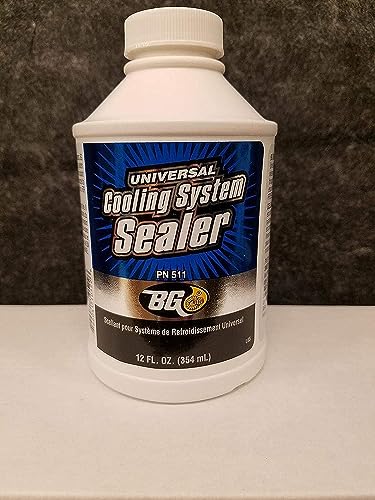
1. BG Universal Cooling System Sealer
Our pick — over 4.5★ from 100+ verified ratings; the strongest balance of quality and price.
The quick-acting sealer that claims a head gasket fix within a single hour of driving
When a tiny leak is hiding somewhere you cannot reach, this is the pour-in that gets to work fast. The formula is built from silicone (a flexible, heat-resistant compound) and is safe for the metal, plastic, and rubber parts that make up a typical cooling system. Buyers report it stopping a steamy exhaust leak in roughly an hour of driving — the kind of result that separates a real sealer from a gamble.
What wins people over is its effectiveness — it is the most-praised trait by a clear margin, with leakage control right behind it. One owner with a slow leak that needed antifreeze every two weeks went eight full weeks without a top-up after adding this, as the particles sealed the hole gradually. Another watched a pinched o-ring leak stop immediately after following the instructions, which shows how much prep matters.
This is a mid-range option that also happens to be the crowd favorite here — a 4.6-star standing with over 100 owners backing it. Weighing 12.8 ounces, it is noticeably heavier than the 8-ounce Bar’s Leaks 2X Concentrate, so you get a bigger pour for your dollar. The one caveat is that it is built for small, slow leaks — a serious crack in the block is still beyond what any bottle can do.
What seals the deal
- Stops small leaks within about an hour of driving
- Safe for metal, plastic, and rubber systems
- Effectiveness is the most-praised trait in owner feedback
Know the limit
- Built for small leaks, not major block cracks
- Best results require following the exact instructions
Reach for this if: you have a slow coolant weep or a small head gasket leak and want a fast, well-reviewed sealer.
Look elsewhere if: your leak is a major split — no pour-in sealer replaces a real repair there.
2. Bar’s Leaks Radiator Stop Leak 2X Concentrate, 6 oz.
The concentrated stop-leak that promises double the power in a compact 6-ounce bottle
This is the value pick that targets minor leaks in radiators, gaskets, heater cores, and freeze plugs while staying affordable. As a 2X concentrate, the maker claims it packs double the sealing power of most other stop-leak products, and it works with all types and colors of antifreeze. At just 8 ounces, it is compact enough to stash in a trunk emergency kit, unlike the bulkier 12.8-ounce BG sealer above.
The story here is effectiveness — it is the most-praised trait by far in the feedback. One owner with a tiny head gasket leak on a 1999 Ford Ranger with 200,000 miles put in half a can with 50/50 antifreeze and only needed half a cup of top-up over the following 12 months. That is the kind of long-tail result that makes a budget bottle feel like a bargain.
The honest trade-off: this is a temporary patch, not a permanent repair. It sealed one busted radiator long enough to get home, and it fails on larger leaks. Some owners found it held for only a day before the leak returned worse. The formula is made for aluminum systems, so check your radiator material before you pour.
Great stopgap: a cheap, effective first line of defense against minor leaks that buys you real time.
The honest catch: on bigger breaches it is a ride-home fix, not a lasting repair — and it can re-leak.
3. K-SEAL Coolant Leak Repair, ST9501 472ml
The pour-and-go formula that covers nearly every leak point in your cooling system
If you want a single bottle that claims coverage across the whole system, this is it. The K-SEAL ST9501 is an all-purpose formula designed to stop leaks in the radiator, head gasket, block, water pump housing, heater core, and freeze plug — with no special steps beyond pouring it in. The “pour and go” approach is the whole pitch, making it a favorite for owners who want a fix without a mechanic’s manual.
The clear strength is how fast and easy it works. Owners mention pouring it in and seeing a radiator leak gone within a couple of days, and one called it a money-saver that works quickly to stop leaks. That simplicity is the reason it shows up in so many “the best coolant stop leak” comments from satisfied buyers.
The catch is that results are not universal. A water pump leak defeated it entirely, with one owner reporting it “has done nothing to stop a small leak” and moving on to replace the part. This bottle is best treated as a first attempt on common leaks — not a guarantee against every seal in the engine.
Why it earns its spot
- Covers radiator, head gasket, block, pump, heater core, and freeze plug
- Fast results reported on radiator leaks within days
- Simple pour-and-go process needs no tools
Where it falls short
- Water pump leaks may resist the formula
- Not a guaranteed fix for every seal type
Best if: you want one easy bottle that covers the common leak points without any prep work.
Think twice if: you already know the leak is in the water pump — that is where this one struggles.
4. Irontite Ceramic Motor Seal – 16 oz.

The ceramic-based sealer that claims a durable coating and a 10% cooling boost
Instead of just plugging a hole, this one forms a ceramic coating across the inside of your cooling system — a layer the maker says is resistant to high temperatures and seals cracks, porous areas, and leaks in head gaskets, radiators, and intake gaskets. It is a different strategy from particle sealers, aimed at longer-lasting protection rather than a quick plug.
The maker also claims it improves engine cooling performance by as much as 10%, helping reduce overheating. Owners back up the sealing claim with strong words — the feedback shows it sealing “almost anything” short of a serious crack in the block or head., per the manufacturer, giving it a long track record.
There is a real prep requirement here: the coolant system needs to be surgically clean before you pour. The feedback is blunt that all rust must be gone for it to work well. And on a severely damaged head gasket, even this ceramic approach failed, so it is not a cure for catastrophic damage.
Long-term play: a durable ceramic seal for systems that are clean and have moderate leaks, not catastrophic ones.
The price of entry: you must flush the system scrupulously clean first, or the coating may not set.
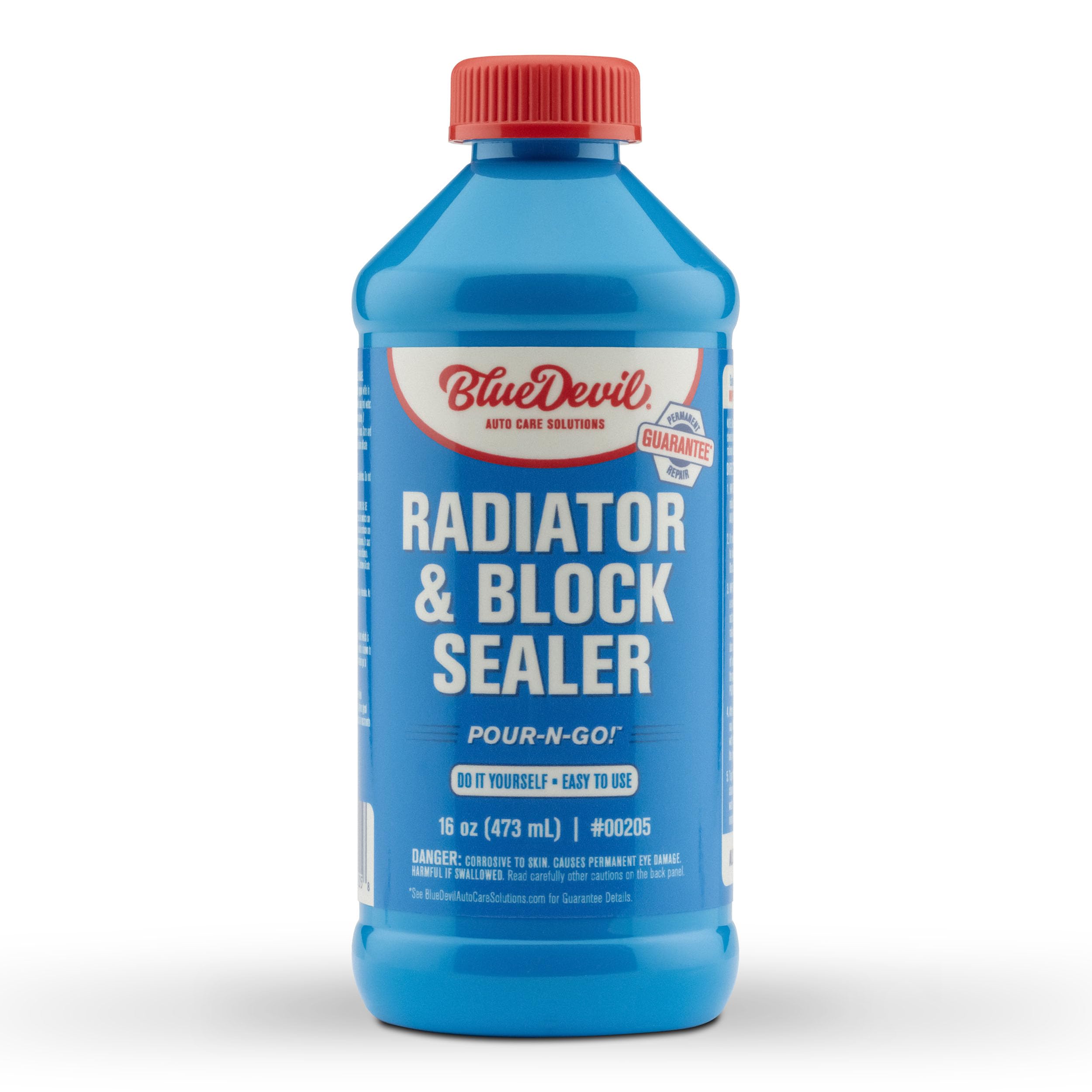
5. BlueDevil Radiator & Block Sealer – 16 oz
The permanent-fix specialist that claims safe sealing for plastic, aluminum, and metal radiators
For owners wanting a repair that outlasts the season, BlueDevil pitches itself as a permanent fix for radiator and engine block leaks. The formula contains no solids or fibrous materials, which is its key safety claim — nothing to gunk up your heater core. It works on plastic, aluminum, and metal radiators, and the manufacturer backs it with a guarantee.
The real-world stories are dramatic. One owner watched a cracked engine block go from spraying water to a trickle and then stop, right after replacing the water pump. Another drove for months with no leak after treating a leaking radiator, avoiding a shop visit entirely. The value angle is strong — the feedback highlights money saved as the most-praised trait, since it replaces a costly repair.
The honest caveat is that effectiveness is genuinely mixed in the feedback. While many report total success, others found it gunked up their systems or failed to stop the leak. It is a high-variance product: excellent when it works, and it does not work for everyone. Treat it as a strong first attempt, not a sure thing.
The winning angle
- Contains no solids or fibers that clog heater cores
- Safe for plastic, aluminum, and metal radiators
- Backed by a manufacturer guarantee
The honest reality
- Effectiveness is genuinely mixed — it fails for some owners
- Occasional reports of gunking up the system
Choose this when: you want a permanent-style fix and accept the possibility it may not work on your specific leak.
Pass on it if: you cannot risk any chance of system gunking — a fiber sealer may be more predictable.
6. K&W 401224 FiberLock Head Gasket & Block Repair – 32 Fl Oz

The fiber-weave heavyweight built for larger holes and blown head gaskets
When the leak is bigger than a pinhole, this is the bottle to reach for. K&W FiberLock uses military-strength fibers that create a multi-layer, web-like weave over cracks — a structure engineered to seal larger holes with less fluid loss than competitive products., and the 32 fl oz bottle is the biggest pour in this lineup.
The success stories are impressive when instructions are followed to the letter. A blown head gasket on a 1995 Honda Civic held after using one-third of a bottle with a slow addition to 50/50 coolant and a 15-minute idle. Another owner with an overheating Hyundai Elantra and milky oil added a third of a bottle with distilled water and held for months. Leak prevention is the most-praised trait here.
But this is the highest-variance product on the list. The feedback on functionality is genuinely mixed, and clogging is the most-cited negative — one owner’s radiator clogged after the seal, requiring a replacement. Several warn it is “like super glue” and can ruin an engine if misused. This is powerful but demanding: follow the steps exactly or risk real damage.
The strength
- Military-strength fibers handle larger holes
- Biggest bottle at 32 fl oz for multiple uses
- Leak prevention is the most-praised trait
The serious risk
- Clogging is a real, reported risk in radiators
- Functionality is genuinely mixed — misuse can damage engines
Best for: confident DIYers with a blown head gasket who will follow the precise idle and coolant instructions.
Not for: anyone who cannot commit to exact prep — this one punishes shortcuts.
7. Bar’s Leaks 1150-4PK High Mileage Cooling System Repair, 4-Pack

The four-bottle fleet that targets weeping water pumps on high-mileage engines
If you own an older vehicle with a slow weep, this multi-pack gives you four chances to get it right. Each 16.9 oz bottle is a High Mileage formula aimed at stopping cooling system leaks, and the pack weighs a hefty 5.19 pounds — enough product to treat multiple vehicles or re-treat the same one as needed. Owners used a single bottle on a 2012 F-150 water pump leak and avoided a repair.
Effectiveness is the standout trait here, with leakage prevention close behind. The feedback is full of avoidance stories: a weeping water pump sealed for 2,500+ miles in 100°F heat with the AC running, and a 2003 Ford Explorer’s coolant leak stopped after a second bottle. Some owners note cold weather can cause intermittent re-leaks, but the seal generally holds.
The realistic downside is that it is a time-buyer, not a cure. One pump lasted three 2,000-mile trips before failing — which is exactly the point: it bought time for parts to arrive. There are also rare clogging reports, so flush if you notice poor flow. The 4-pack price is premium, but the per-bottle cost makes it a solid value for multiple vehicles.
Multi-vehicle hero: four bottles to spread across a fleet or re-treat a stubborn weep.
Time-buyer honest note: it extends a pump’s life but does not make it immortal — plan the real repair.
8. Bar’s Leaks HDC-12PK Radiator Stop Leak Tablet – 2.1 oz

The 12-tablet pack that drops into the reservoir with zero measuring or mixing
For the simplest possible fix, drop a tablet into the coolant reservoir and let it dissolve. This pack of 12 tablets (each 2.1 oz) is the no-mess approach — no pouring, no measuring, no pre-dilution. The tablets also condition the cooling system, inhibit rust and corrosion, lubricate water pump seals, and help control electrolysis, so they do more than just plug a hole.
The numbers speak: effectiveness is the most-praised trait at a huge margin, with leak prevention right behind. Owners fixed a water pump gasket leak on a Ford Taurus by simply dropping tablets into the reservoir, and stopped a significant radiator leak on a Nissan Pathfinder with six tablets dissolved in hot water. The feedback shows minor leaks can be fixed with as few as three tablets.
The one clear limit is that these are for small leaks, not gaping holes. The feedback notes it works “as long as the leak isn’t a gaping hole,” and it can clog a coolant tube in rare cases. This pack is best for preventative maintenance or a known minor weep — keep a few tablets in the glovebox for emergencies.
The easy win
- Drop-in tablets need no measuring or mixing
- Effectiveness is the most-praised trait
- Also conditions and lubricates the system
The limit
- Only for small leaks — not gaping holes
- Rare reports of coolant tube clogging
Grab this if: you want the simplest possible maintenance fix you can keep in the trunk.
skip it if: you have a known large leak — this one is for weeps, not ruptures.
9. XADO ATOMEX Stop Leak Radiator Coolant Additive – 250 ml

The budget bottle that adds rust prevention while it claims to seal small cracks
This entry-level option mixes leak sealing with long-term protection. The XADO ATOMEX additive is designed for gasoline and diesel engines, and the maker says it prevents rust and corrosion while stopping leaks. It is compatible with gaskets, rubber hoses, aluminum, plastic, and steel radiators — a broad safety net for older systems that need more than just a plug.
The positive side is clean: leak prevention is the most-praised trait. One owner sealed a visible crack completely with no coolant loss since application, and a 2017 F-150 3.5 EcoBoost had all its tiny leaks stopped. The “Great German product” comments point to a solid reputation for those it works on.
The downside is stark — functionality is genuinely mixed, and the failures are absolute. One owner reported it “had absolutely no effect” on a radiator leak, only for another product to plug it in ten minutes. This is the budget gamble: cheap enough to try, but with a real chance it simply does nothing on your specific leak. For rust prevention it is a fine choice; for a definite seal, its odds are the weakest here.
The budget appeal
- Adds rust and corrosion prevention while sealing
- Safe for gaskets, hoses, aluminum, plastic, steel
- Entry-level price point
The gamble
- Functionality is genuinely mixed — some see zero effect
- Best treated as a prevention, not a guaranteed fix
Fine for: preventative maintenance on an aging system where rust protection matters as much as sealing.
Not the pick if: you have an active leak that must stop now — the odds are better elsewhere.
Understanding the Specs
Liquid vs. Fiber vs. Tablet Formulas
The format decides what kind of leak the product can handle. Liquid particle formulas (like BG and Bar’s Leaks 2X) circulate fine particles that bridge small cracks gradually. Fiber formulas (like K&W FiberLock) use a web-like weave to handle larger holes. Tablets (like Bar’s Leaks HDC) dissolve in the reservoir — the simplest but least powerful option for big breaches.
Compatible Materials
Your cooling system mixes aluminum radiators, plastic end tanks, rubber hoses, and steel blocks. A sealer that is safe for one metal may damage another, so always check the compatible material list before pouring. Products like BG list metal, plastic, and rubber — a broad safety net — while Bar’s Leaks 2X specifies aluminum, which suits modern radiators.
FAQ
How long does an antifreeze leak sealant actually last?
Will a leak sealant fix a blown head gasket permanently?
Can a stop-leak product clog my heater core or radiator?
Do I need to drain my coolant before adding a sealer?
Is a liquid sealer better than a tablet for a radiator leak?
How much sealer should I use for my vehicle?
Will these products work with modern aluminum radiators?
Can I drive normally right after adding a leak sealant?
What is the difference between the Bar’s Leaks 2X Concentrate and the High Mileage formula?
Is a leak sealant a real repair or just a temporary patch?
Final Thoughts: The Verdict
For most people, the best antifreeze leak sealant is the BG Universal Cooling System Sealer because it stops small leaks within an hour of driving and is safe for metal, plastic, and rubber systems. If you want a compact, budget-friendly single-use fix, grab the Bar’s Leaks 2X Concentrate. And for a blown head gasket where you can commit to exact instructions, the K&W FiberLock is the one to reach for.
How We Picked
We do not accept paid placement. Every pick is matched to a real buyer and a real use-case; we do not hands-on test units.
Sources & Methodology
Specifications: manufacturer listings and product documentation. Review insights: verified customer reviews, as of August 2026. Pricing: not shown on this page (it changes often); check the current price via the retailer link.
As an Amazon Associate, Gadgets Feed earns from qualifying purchases. This does not affect which products we feature.