
Our readers keep the lights on and my morning glass full of iced black tea. As an Amazon Associate, I earn from qualifying purchases.
Specs are compiled from manufacturer listings and verified buyer reviews and can change over time — please confirm the key details on the product page before buying.
You want a car panel to look like it rolled out of a showroom, and the tool that decides that is the spray gun. Runs and orange peel (a bumpy, textured finish) usually come from the gun, not your skill. Here are the best picks for spot repairs and full repaints, with the specs that make the real difference.
I’m Min — the founder and writer behind Gadgets Feed. This guide is built by comparing the manufacturers’ published specifications and the patterns across verified customer reviews, so you get each pick’s real strengths and trade-offs instead of marketing spin.
Whether you’re a weekend warrior or a retired pro picking up the gun again, choosing the right automotive paint spray gun is the single smartest step toward a flawless finish you’ll be proud to show off.
Our Picks at a Glance


How To Choose The Best Automotive Paint Spray Gun
Picking a spray gun is about matching the tool to your air supply and the materials you spray. Start with your compressor, then match the nozzle, then look at the cup and cleanup.
Match the Gun to Your Air Compressor
The single biggest mistake is buying a gun your compressor can’t feed. HVLP (high volume, low pressure) guns are efficient but demand a serious air supply. Check the gun’s CFM (cubic feet per minute) requirement against what your compressor actually delivers. A small 4-gallon compressor running at 4.0 SCFM will constantly run to keep up with a gun that wants 10 CFM or more.
Choose the Right Nozzle Size
Nozzle size controls how thick a material you can spray. A 1.3mm nozzle is ideal for thin basecoats and clearcoats. A 1.4mm is a versatile middle ground for single-stage paints. For thick primers and 2K urethanes, you want a 1.8mm or larger nozzle. Some kits include multiple nozzle sets so one gun handles everything.
Weigh the Cup and Feed Type
Gravity feed guns have a cup on top, using gravity to pull paint down into the gun. They work well with lower air pressure and leave less paint wasted in the cup. Siphon feed guns draw paint up from a cup below and tend to need more air. Disposable cup systems are popular because the liner and filter are thrown away after use, making cleanup dramatically faster.
Quick Comparison
| Model | Best For | Nozzle Size | Air Pressure | Air Consumption | Amazon |
|---|---|---|---|---|---|
| Fuji Spray T75G★ Best Overall | Pro Finishing | 1.3mm | Turbine | — | Amazon |
| Ingersoll Rand 210GSmart Value | Budget Pro Results | .05in | 60 PSIG | 11 cfm | Amazon |
| Astro EUROHE103Clearcoat King | Budget Clearcoat | 1.3mm | 29 psi | 10.5 – 12.5cfm | Amazon |
| InoKraft D1 LVLP | Low Air Volume | Multiple | 25 PSI | — | Amazon |
| Master Elite PRO-33 | Full Kit Versatility | 1.3, 1.4, 1.8mm | Regulated | — | Amazon |
| Graco-Sharpe FX3000 | Professional Value | 1.3 mm | 29psi | — | Amazon |
| DeVilbiss StartingLine 802342 | Entry-Level Kit | Multiple | 20psi | — | Amazon |
| DeVilbiss StartingLine 802343 | Complete DIY Painting | Multiple | 26psi | — | Amazon |
| 3M Accuspray ONE | Fast Cleanup System | 1.2, 1.3, 1.4, 1.8mm | Varies | — | Amazon |
In-Depth Reviews
1. Fuji Spray 5175G – T75G Gravity Spray Gun
Our pick — over 4.5★ from 350+ verified ratings; the strongest balance of quality and price.
A featherlight 885g gravity-feed gun that delivers waterborne finishes with pro-grade smoothness.
This is the crowd favorite for a reason — it is the pick that earns the top spot. The defining trait is its weight: at 885g it is 100g lighter than the previous GXPC model, and the balanced center cup makes it feel agile in your hand. That balance is the first thing people notice when they switch to a gravity feed gun for the first time.
The 100% stainless steel fluid components mean you can soak the disassembled parts in acetone for deep cleaning without worrying about corrosion. The high-efficiency air cap is tuned to cut overspray and improve atomization, which is exactly why the finish quality gets such consistent praise — buyers report glass-smooth results with negligible overspray. The convenient side pattern control knob lets you adjust the fan width from small to large without stopping.
If you already own a turbine system, this gun fits right in. It works with 2-stage non-Fuji turbine setups, and the box includes a 600cc nylon cup, air cap set, wrench, and cleaning brush, so you can start spraying immediately. The 24-month parts and labor warranty covers you longer than most budget guns do.
The Finish Is The Story
- 885g weight with balanced center cup reduces fatigue
- Wider, more uniform fan pattern cuts passes in half on wide panels
- Stainless steel fluid path survives acetone soaking
Set Your Expectations
- Requires a turbine system, not a standard compressor
- Cap can leak if the seal gets dirty — clean it with a stick or cloth
- Premium price tag for serious users only
Reach for this if: you already own a turbine system and want a noticeable upgrade that sprays waterborne lacquers and finishes with professional consistency.
Look elsewhere if: you are shopping for your first gun and only have a basic air compressor — this one needs a turbine to shine.
2. Ingersoll Rand 210G Gravity Feed Spray Gun
A screw-lid gravity-feed gun with a translucent 20oz cup that prevents drips and shows paint level at a glance.
The reason this gun earns its reputation is the screw-on lid on the translucent 20oz cup. Owners mention that the secure lid means no more spills when you set the gun down, and the translucent plastic lets you see exactly how much finish remains without opening it. The clever venting prevents the mess that plagues cheaper siphon guns.
It runs on a standard compressor, and while the max pressure is rated at 60 PSIG, customers note it behaves well even at 60-80 PSI. The integrated air regulator with a gauge gives you user-friendly control over airflow, and the suspension hook makes storage simple. The filter ensures your paint stays clean for the best end result.
This is the gun people buy and keep for years — “invest in one of these and you don’t need another spray gun” is the recurring sentiment. It works fine on a small 4-gallon compressor for doors and small projects, though it will run constantly, so it is not the choice for whole-house or full-car marathon sessions. Cleanup takes about 10 minutes with latex paint.
The Mess-Free Advantage
- Screw lid that buyers love for preventing drips
- Translucent cup shows finish level at a glance
- Works with a small compressor for small jobs
Keep In Mind
- Needs a water separator and pressure regulator at the gun for best results
- Requires about 11 cfm, so a small compressor runs constantly
The verdict: a value-focused gravity feed gun that outperforms its price point for part-time car spraying and small projects.
One limitation: it is not built for continuous full-car production work — give it doors, panels, and small jobs and it shines.
3. Astro EUROHE103 EuroPro High Efficiency/High Transfer Spray Gun
A 1.3mm clearcoat specialist that atomizes at 22-25 PSI for a glass-smooth, orange-peel-free finish.
This is the budget clearcoat specialist. With its 1.3mm tip, it produces a glass-smooth finish with no orange peel, and reviewers point out it atomizes like mist at just 22-25 PSI. That low operating pressure means it is forgiving to learn on, and the integrated regulator keeps the setup simple.
At 29 PSI operation pressure and 10.5-12.5 cfm air consumption, it does need a real compressor — a 60-gallon unit is what owners typically run. But the payoff is a finish quality that people compare to guns costing far more. It handles unthinned high-build urethane primer without complaint, and the 11″-13″ max pattern at 6″-8″ distance covers panels efficiently.
Treat this as a dedicated clearcoat gun, not an all-rounder. Metallic finishes can turn blotchy, and it seals poorly, but for laying clear over your base coat, it excels. The compact body and long trigger pull need a little practice, but the results justify the effort.
Where It Wins
- Glass-smooth clearcoat finish with no orange peel
- Operates efficiently at just 22-25 PSI
- Handles unthinned high-build urethane primer
The Trade-Offs
- Metallic finishes can spray blotchy
- Small size and long trigger throw feel different at first
Who it beats: dedicated clearcoat guns costing many times more — this is the budget way to get a show-quality clear.
skip it if: you need one gun to do metallics, sealer, and clear; this one is happiest when focused on clear.
4. InoKraft D1 LVLP Spray Gun Kit
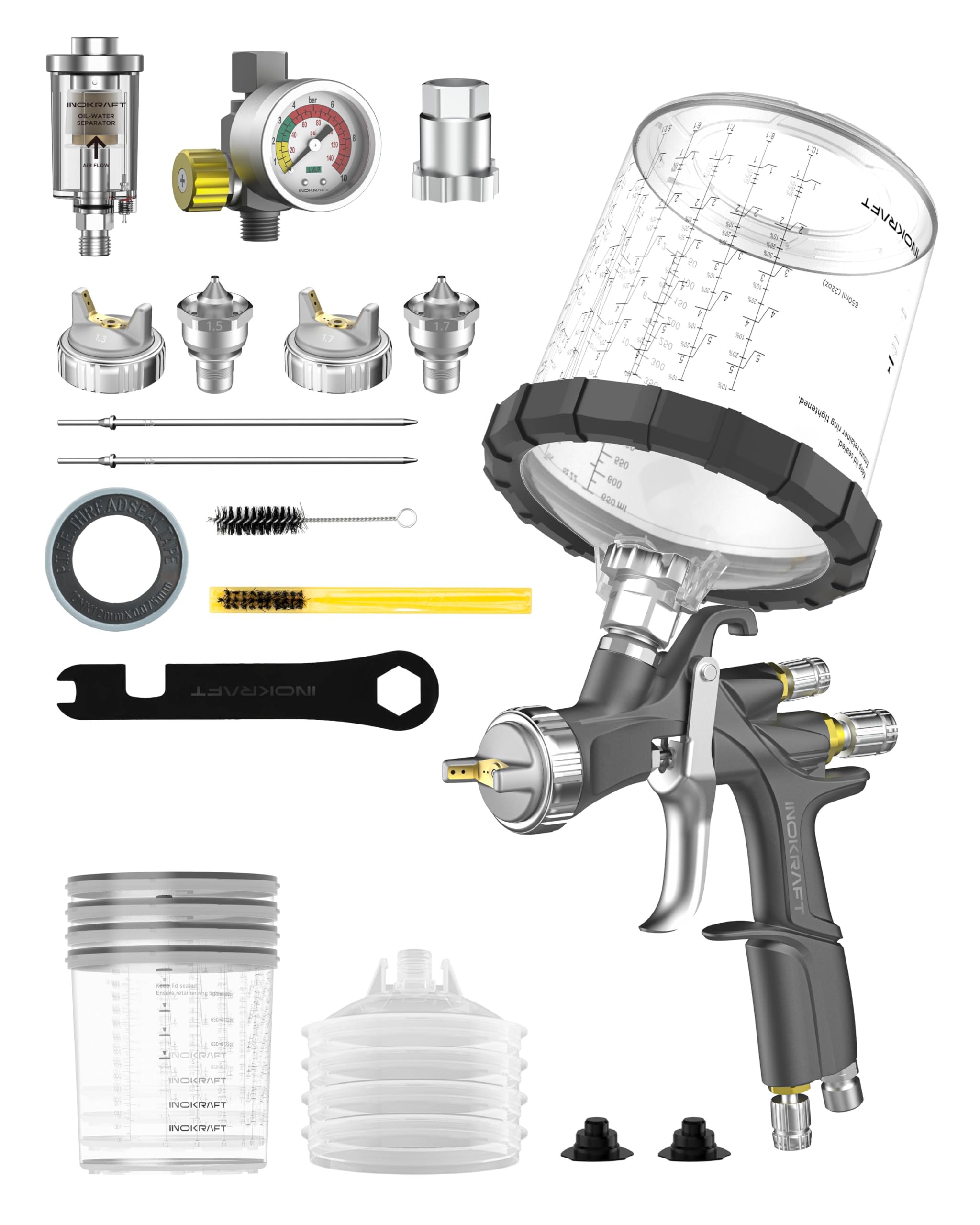
An LVLP gun that runs at just 25 PSI, making it ideal for small compressors on spot repairs.
LVLP stands for low volume, low pressure, and that is exactly the trick here. This gun is built for people whose compressor cannot feed a hungry HVLP gun. Owners run it at just 25 PSI at the gun from a 40 PSI compressor, getting minimal overspray and even, flat coverage.
The kit arrives with multiple tip sizes so you can match the nozzle to the material, and the 22-ounce disposable cups make cleanup almost trivial — especially with latex. You spray, you throw the liner away, and the gun itself barely needs rinsing. The 650 ml tank volume gives you solid working time between fills.
It is brilliant for small jobs like a bumper corner or a spot repair, which is exactly how many buyers use it. The catch is setup-dependent behavior: the spray quality changes noticeably with your air pressure and fluid settings, so there is a learning curve. Check that the needle and seat are matched before first use, since an occasional kit has shipped with mismatched parts.
The Low-Air Advantage
- Runs beautifully at just 25 PSI at the gun
- Multiple tip sizes included for different materials
- Disposable cups make latex cleanup easy
The Catch
- Spray quality is setup-dependent — pressure and fluid need tuning
- Check needle and seat match before first use
Reach for this if: your compressor is on the smaller side and you want a gun that gives professional results on spot repairs without demanding huge CFM.
Think twice if: you need a production gun for full car repaints — this one is happiest on focused, smaller jobs.
5. Master Elite PRO-33 Series HVLP Spray Gun Ultimate Kit

A versatile kit with 1.3mm, 1.4mm, and 1.8mm tips plus a 1-liter cup for primer-to-clear coverage.
This is the versatility champion. The PRO-33 ships with the 1.4mm tip installed, plus complete 1.3mm and 1.8mm atomizing sets including matching needles, fluid nozzles, and air caps. That means you can spray thin basecoats with the 1.3mm, switch to the 1.4mm for single-stage and clear, and swap to the 1.8mm for thick 2K primers — all with the same gun body.
The 1-liter aluminum cup is generous enough for serious work, and the high-flow air pressure regulator with a gauge puts precise control at your hand. The stainless steel components are waterborne compatible, so the latest automotive waterborne paints won’t corrode the internals. An MPS adapter lets you use disposable cups when you want fast cleanup.
It carries the name of a trusted industry leader, and the build quality gets consistent praise — buyers with decades of professional experience say it has the look and feel of a quality gun. The recurring honest note is that the air cap holes can clog and mess with the pattern, but clearing them restores the spray. The adapter glass has also been known to break on some units.
Everything Included
- Three complete tip sets (1.3mm, 1.4mm, 1.8mm) in the box
- 1-liter aluminum cup for longer working sessions
- Waterborne-compatible stainless steel internals
Little Quirks
- Air cap holes can clog and distort the pattern until cleared
- Adapter glass has occasionally arrived broken
Best for: the DIY painter who wants one gun that handles every stage of a repaint — primer, base, and clear — without buying separate tools.
The honest note: it is not a SATA, but for the money it performs genuinely well, and clearing a clogged air cap is a quick fix.
6. Graco-Sharpe 288879 HVLP FX3000 Paint Spray Gun
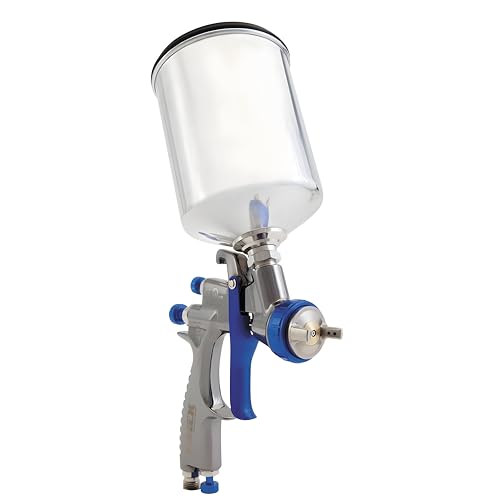
A lightweight 1.3mm HVLP gun that pros say delivers Iwata-like performance at a budget price.
Professional painters choose this gun for a reason. Its 1.3mm HVLP (high-volume, low-pressure) gravity feed design draws comparisons to pricier models — experienced shoppers say it delivers “Iwata-like performance at a lower price.” The light, compact body lets you work for hours without fatigue, and it lays down metallics and pearls evenly, a task that stumps many budget guns.
Set it up at 29 PSI and the clear lays down like glass. It atomizes well across a wide range of materials, from light low-solids clear down to feather fill primer, and it works with PPG urethane. The included 600cc aluminum cup, wrench, and cleaning brush get you started immediately.
The finish quality is what wins people over — buyers who painted entire cars with it describe smooth, professional results with no spitting. The honest trade-offs are small: the fluid nozzle can stick and need a 19mm socket to break loose, and durability gets mixed feedback. But as a base or clear coat gun, this is the value king.
The Pro Endorsement
- Atomizes metallics and pearls evenly like a higher-end gun
- Lightweight and compact for comfortable all-day use
- Handles everything from feather fill primer to clear
Small Gripes
- Fluid nozzle can stick and need a socket to remove
- Durability receives mixed feedback from long-term users
The verdict: a pro-grade performer at a working-person’s price, and the go-to recommendation for anyone painting cars, motorcycles, or panels who wants showroom results.
One thing to know: give it a proper 29 PSI setup and it rewards you with a glass-like clear coat.
7. StartingLine HVLP Automotive Spray Painting and Detail Spraying Kit 802342
A DeVilbiss entry kit that handles metallics, pearls, and satin clears better than its price suggests.
DeVilbiss is a name with real history in spray equipment, and this StartingLine kit is that heritage at an entry-level price. It is built for the DIY painter taking on a few bikes or cars a year, not daily production work. The kit includes a gravity feed HVLP gun plus a detail gun for smaller touch-ups.
Where this kit genuinely surprises is with tricky paints. Buyers report it handles metallic and pearl paints, color flake, satin clear, and base coats beautifully — even outperforming a more expensive DeVilbiss model on pearlescent finishes. It is a huge improvement over old siphon guns for these materials.
The honest trade-offs are the plastic feel and fragile tips, plus a detail gun needle that can leak until lubed. Set it at 20 PSI with the fan wide and fluid 1-2 turns open, and it performs admirably. It is ideal as a primer gun for anyone just getting into paint work, and the included case keeps everything organized.
The Surprise Performer
- Handles metallics, pearls, and color flake with impressive ease
- Includes both a main gun and a detail gun in a case
- Outperforms costlier models on pearlescent paints
The Honest Side
- Plastic feel with fragile tips that need care
- Detail gun needle can leak until you lube it
Best for: the beginner who wants a trusted brand name and a kit that handles a few projects a year — especially if you spray pearl or metallic finishes.
Not for: daily professional use, where the plastic construction and fragile tips will wear out quickly.
8. StartingLine HVLP Complete Auto Painting and Priming Kit 802343

A complete HVLP kit that sprays 2K primer, base, and clear for garage repaints with professional-looking results.
This is the bigger brother of the 802342 kit, built for the DIY automotive guy who wants to do a complete repaint from bare metal to clear. The kit’s real strength is handling thick materials — it sprays high-build 2K primer beautifully, then switches over to basecoat and clearcoat for a finish owners call “professional results.”
The gravity feed, high volume, low pressure design is forgiving for a first-time painter, and the kit gives you the tools to move through a full paint job. Owners mention their garage paint jobs come out “A plus” with this setup. It also works well for painting classic cars where matching that original satin or flat clear matters.
The honest notes: the spray pattern can be inconsistent on some materials, and the metal cup can break at the fitting if you are not careful. It is genuinely better than some pricier competing guns for primer work, and it needs around 26 PSI to run clean. It may not be show-quality for a meticulous professional, but for a DIYer it delivers.
The Complete Package
- Handles high-build 2K primer plus basecoat and clearcoat
- Gravity feed HVLP design that is beginner-friendly
- Delivers garage paint jobs owners call professional
The Caveats
- Spray pattern can be inconsistent on some materials
- Metal cup can break at the fitting if mishandled
Reach for this if: you are repainting an older car or doing serious bodywork in your garage and want a kit that moves through primer, base, and clear.
Think twice if: you are chasing show-quality perfection — this is a great DIY tool, not a competition-grade sprayer.
9. 3M Accuspray ONE Spray Gun System
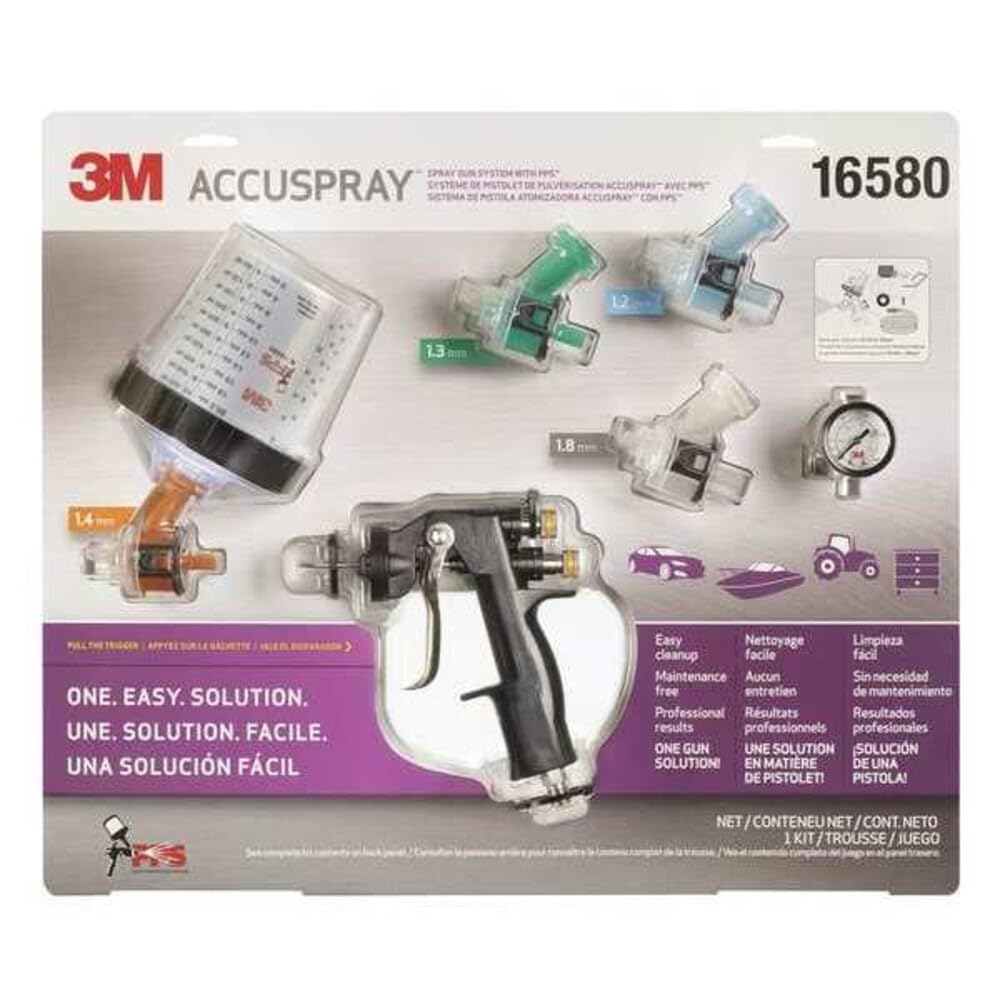
The system that turns cleanup from a 20-minute chore into a 2-minute swap with disposable liners and nozzles.
This is the modern answer to paint cleanup. The Accuspray ONE works with 3M’s PPS disposable lid and liner system, which means you measure, mix, filter, and spray all from a single disposable cup. When you are done, you throw the liner away instead of scrubbing a metal cup. Customers note using less than 4 ounces of thinner for a full cleanup.
The kit is remarkably complete: one gun, four nozzles (1.2mm, 1.3mm, 1.4mm, 1.8mm), a plastic cup, collar, five disposable lids with built-in filters, and five liners. The replaceable atomizing heads mean every time you swap a nozzle, you get the performance of a brand-new gun. The 360-degree paint range lets you spray at any angle, even upside down, which is a standout for tricky panels.
It is a fantastic choice for the DIY auto enthusiast spraying PPG Omni or Deltron metallics, and it handles primer, base, and clear with even coats. The recurring complaint is the poor instructions and the cost of replacement consumables — liners and nozzles add up. It also needs a high-CFM compressor for best results.
The Cleanup Revolution
- Disposable cup and liner system cuts cleanup to minutes
- Four nozzles included for every material from primer to clear
- 360-degree spray range works even upside down
The Cost of Convenience
- Replacement nozzles and liners are an ongoing expense
- Instructions are notoriously poor — plan to learn by doing
Best for: the painter who values speed of cleanup over everything and wants a complete system that handles every stage of a car repaint from one gun.
Look elsewhere if: you want zero ongoing consumable costs — the disposable system is brilliant but it is not free.
Understanding the Specs
Nozzle Size (mm)
This is the hole the paint passes through, and it controls what you can spray. A 1.3mm nozzle handles thin basecoats and clearcoats with fine atomization. A 1.8mm nozzle lets thicker primers and 2K urethanes flow through without clogging. Kits with multiple sizes give you flexibility, but a dedicated gun with one perfect size often sprays better than a compromise.
Air Pressure (PSI)
This is the air pressure at the gun that atomizes the paint, breaking it into a fine mist. HVLP guns usually run at 20-29 PSI at the cap. Too much pressure creates overspray and waste; too little leaves a pebbly texture. A built-in regulator with a gauge helps you dial in the right setting quickly.
Air Consumption (CFM)
This is how much air the gun uses, measured in cubic feet per minute. It is the spec most often ignored and most often regretted. A gun needing 10-12 CFM will starve a small compressor, causing pressure drops mid-spray. Match the gun’s CFM to your compressor’s actual output, not its peak rating.
HVLP vs LVLP
HVLP (high volume, low pressure) uses lots of air at low pressure for efficient transfer with less overspray, but demands a big compressor. LVLP (low volume, low pressure) uses less air, making it friendlier to smaller compressors while still giving good transfer. The right choice depends entirely on your air supply.
FAQ
What size air compressor do I need for an automotive paint spray gun?
What is the difference between a 1.3mm and a 1.8mm nozzle?
Is HVLP or LVLP better for painting a car?
Why does my paint finish look like orange peel?
Can I use a spray gun with a small 4-gallon compressor?
What is the best nozzle size for clearcoat?
How do I clean a spray gun after using automotive paint?
Are disposable paint cup systems worth the extra cost?
Can I spray metallic paint with a budget spray gun?
What does gravity feed mean on a spray gun?
Final Thoughts: The Verdict
Across the board, the automotive paint spray gun winner is the Fuji Spray T75G because it pairs featherlight balance with a flawless, glass-smooth finish for serious finishers. If you want pro-grade results on a working budget, grab the Graco-Sharpe FX3000. And for the easiest cleanup you will ever experience, the 3M Accuspray ONE is the one to reach for.
How We Picked
We do not accept paid placement. Every pick is matched to a real buyer and a real use-case; we do not hands-on test units.
Sources & Methodology
Specifications: manufacturer listings and product documentation. Review insights: verified customer reviews, as of August 2026. Pricing: not shown on this page (it changes often); check the current price via the retailer link.
As an Amazon Associate, Gadgets Feed earns from qualifying purchases. This does not affect which products we feature.