
Our readers keep the lights on and my morning glass full of iced black tea. As an Amazon Associate, I earn from qualifying purchases.
Specs are compiled from manufacturer listings and verified buyer reviews and can change over time — please confirm the key details on the product page before buying.
Your amplifier only sounds as good as the power it receives, and that thin black cable from the wall can hold it back. Replacing it with a dedicated Audiophile Power Cord (a high-quality AC cable designed to deliver cleaner electricity) is a popular hi-fi upgrade. Cleaner current reduces background noise, tightens bass, and reveals more detail in your music.
I’m Min — the founder and writer behind Gadgets Feed. This guide is built by comparing the manufacturers’ published specifications and the patterns across verified customer reviews, so you get each pick’s real strengths and trade-offs instead of marketing spin.
We’ve narrowed the field to the six cords that owners actually praise, from heavy-duty braided cables to premium silver-plated designs, so you can hear the difference a quality audiophile power cord makes in your system.
Our Picks at a Glance

How To Choose The Best Audiophile Power Cord
Before you spend money, know this: a power cord is not a magic wand. It feeds your components with cleaner, more consistent current, which matters most in a revealing system. Start with the specs that actually change what you hear, then match the cord to your gear.
Match the gauge to the job
The gauge is the thickness of the wire inside, and a lower number means a thicker conductor that carries more current. A 10AWG or 7AWG cord is built for power-hungry amplifiers that need big, instant current swings. A 14AWG cord is lighter and works well for line-level source components like CD players and DACs, where the draw is smaller and the focus is on detail.
Look at the conductor metal and shielding
The conductor metal and its purity shape the sound. Oxygen-Free Copper (OFC) and Ohno Continuous Cast (OCC) copper are prized for their low resistance, which preserves subtle detail. Shielding — like a braided copper layer — blocks electromagnetic and radio interference from entering the cable and muddying the signal. If your system sits near Wi-Fi routers or other electronics, shielding matters more.
Check the connectors
The plugs are the physical contact points, and quality here prevents signal loss. Gold-plated contacts resist corrosion and make a reliable connection. Look for a firm-fitting IEC end that grips the component securely, so the connection never loosens or arcs. A solid copper ground pin is another sign of a thoughtfully built cord.
Quick Comparison
| Model | Best For | Gauge | Length | Key Feature | Amazon |
|---|---|---|---|---|---|
| WAudio Hi-End 10FT★ Best Overall | Power-hungry amplifiers | 10AWG | 120 inches | Oxygen-Free Copper cores | Amazon |
| TODN 6.5ft OCCBest Value | Value-conscious upgraders | 7AWG | 78.74 inches | 3-Core OCC Copper | Amazon |
| Pangea AC-14SE MKII | Source components | 14 | 39.37 inches | Cardas Grade One Copper | Amazon |
| AudioQuest NRG-X3 | DACs and desktop gear | — | 39.37 inches | Long-Grain Copper | Amazon |
| Pangea AC 9SE MKII | High-current amplifiers | — | 59.06 inches | Cardas Grade One Copper | Amazon |
| AudioQuest NRG-Y3 | Full systems | — | 78.72 inches | Silver-Plated Drain Wires | Amazon |
In‑Depth Reviews
1. WAudio Hi-End HiFi Audio AC Power Cable Power Cord US Plug – 10FT (3M)
Our pick — over 4.5★ from 250+ verified ratings; the strongest balance of quality and price.
The heavyweight that feeds hungry amplifiers with clean, stable current.
This is the cord for serious amplifiers that demand instant power. Its 10AWG Oxygen-Free Copper cores deliver strong, stable signal transmission, which is exactly what a high-current amp needs to maintain its grip on the music. Its braided construction resists wear and tear, a build quality owners consistently praise.
Buyers report dramatic results on serious gear. On McIntosh components, the sound opened up with deeper bass and crisper highs, and one former skeptic became a convert. A DarkVoice tube amp gained a deeper, more open, and richer presentation that made the upgrade feel unexpectedly dramatic. You will need patience, though — the cord requires roughly 100 hours of break-in before it hits its smoothest, most detailed form.
This cord is seriously heavy. Owners mention the 6’6” version weighs about 10 pounds, so plan for that when routing it behind your rack. The bulky ends add roughly 5 inches of depth behind your equipment, which means tight cabinets may need modification. Compared to the TODN at 7AWG and 78.74 inches, this one stretches longer at 120 inches — a full 3.0x longer — while staying at a comparable premium tier.
What wins people over
- 10AWG oxygen-free copper delivers clean, strong current to power-hungry amps
- Customers note real gains: deeper bass and crisper highs on high-end gear
- Braided, heavy-duty construction feels built to last
The trade-offs to know
- Very heavy and stiff — routing takes effort
- Bulky ends add several inches of depth behind your rack
- Needs roughly 100 hours of break-in before its best sound arrives
Grab it for: amplifiers and receivers that draw big current and reward a thick, heavy conductor.
Think twice if: your cabinet is cramped — the stiff, bulky ends and heavy weight demand generous clearance.
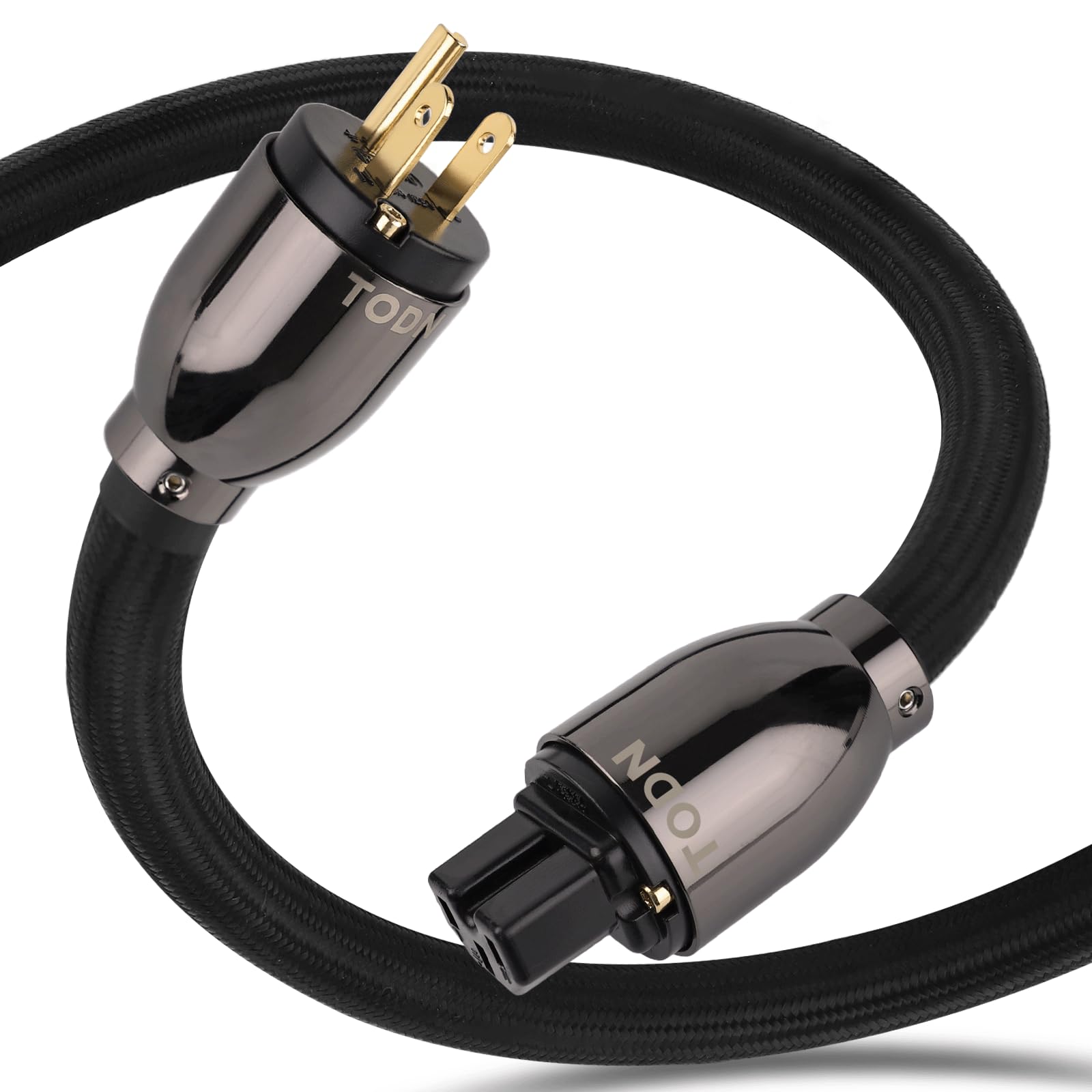
2. TODN 6.5ft Audiophile Audio AC Power Cable 3-Core OCC for Speaker/Amp
A 7AWG OCC cord that delivers premium performance without the premium price.
This cord punches far above its price point. It uses three OCC (Ohno Continuous Cast) copper conductors with a low resistance that reveals subtle details like breath sounds in vocals and instrument overtones. The 7AWG gauge is the thickest in this lineup — a 2.0x step up from the Pangea AC-14SE MKII’s 14-gauge — which means it delivers strong, uncompressed transient current to your amp.
The sound is balanced across the frequency range. After 48 hours of burn-in, the cord reaches its full potential, delivering powerful and deep bass, rich and full mids, and crisp and clear highs. Plugging it in is straightforward: connect the male ground side first, then insert it vertically into the socket. Reviewers point out immediate soundstage and imaging improvements on CD players and integrated amps, with one calling it a huge improvement on a 10-year-old Marantz system with tighter, heavier bass.
Its high-density OFC copper braided shielding minimizes noise and reduces EMI and RFI, making quality and value the standout themes. The catch is cosmetic — the thick build scratches easily during installation, so handle it with care. At 6.5 feet (2 meters), the short length can be hard to shape, so give it some breathing room behind your rack.
Value champion: the 7AWG OCC conductors and 24K gold-plated plugs deliver a genuinely premium build, and shoppers say the sound rivals cords that cost three times as much. The recurring gripe is the finish — it scratches easily during installation, so handle it with care.
Who it’s for: anyone upgrading a DAC, phono stage, or amplifier who wants noticeable gains without emptying their wallet.
Reach for this if: you want the thickest conductor here at a budget-friendly price.
Look elsewhere if: you need a long run or a finish that stays pristine through handling.
3. Pangea Audio AC-14SE MKII Audiophile Signature Power Cable Cord Upgrade for Audio, Video and Electronic Gear 1 Meter

A no-compromise source-component cord with a silver-plated shield and gold-plated contacts.
Built specifically for line-level components like preamps, CD players, and DACs, this cord uses a no-compromise Cardas Grade One Copper center conductor. Its 14-gauge design delivers wide-band power to gear that draws less current but needs clean, detailed flow. The silver-plated copper braided shield blocks interference, and the screw-in screw-out solid copper ground pin makes a rock-solid earth connection.
Owners praise sound quality most, with far more noting improvements than any other aspect. Reduced hum from speakers and enhanced midrange performance are the recurring wins. One owner who compared many high-end cables found the Pangea gave a major upgrade with deeper, tighter bass and crisper highs — an upgrade dramatic enough to order two more. The thing is, this cord is system-dependent: some owners hear a dramatic shift, while one skeptical buyer heard no difference at all.
At 39.37 inches, this is a short cord — a full 3.0x shorter than the 120-inch WAudio — so it is best for gear sitting close to your outlet or power conditioner. The 24K gold-plated solid blade contacts ensure superior electrical contact. Flexibility gets mixed feedback, so if your setup needs tight bends, allow extra slack.
the balance: you get Cardas Grade One Copper (a high-purity copper conductor) and silver-plated shielding (a protective layer that blocks interference) at a price owners call a bargain. Nearly three hundred buyers have rated it highly, making it the crowd favorite.
Baseline honesty: the benefit is system-dependent, so on a modest setup you might notice little change. Buy it for a resolving system and the difference is real.
Best for: preamps, DACs, and CD players that reward clean, shielded power delivery.
Not the fit if: your components sit far from the outlet — the 1-meter reach forces a tight setup.
4. AudioQuest NRG-X3 Power Cable (1m, 1 x C13 > 1 x 3-Prong Wall Plug)
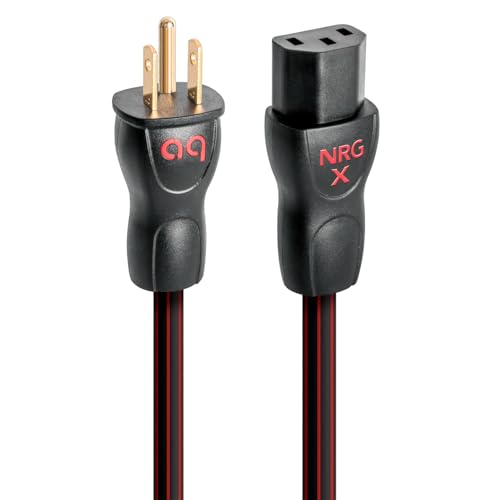
A flexible, noise-dissipating upgrade that slips easily behind your rack.
This is the cord that solves a real-world problem: the stock cable that came with your gear is too stiff to fit behind your entertainment center. The NRG-X3’s Long-Grain Copper conductors minimize distortion caused by grain boundaries within the metal, and its Direction-Controlled Conductor design ensures induced noise is dissipated and drained properly. This results in a quiet background with minimal distortion.
Versatility is the selling point. AudioQuest positions it as an outstanding upgrade for DACs, powered desktop speakers, game consoles, streamers, and more. It is rated for use with AV receivers, integrated amplifiers, monoblocks, powered speakers, and subwoofers, so one cord can serve a range of gear. The semi-solid concentric conductors pack strands tightly so they never change position, significantly reducing strand-interaction distortion.
Real-world feedback is measured, not gushing. One headphone amp owner heard a slight, hardly noticeable improvement and honestly flagged that it could be placebo, while another on a Parasound amp called it a noticeable improvement. The flexibility is the quiet win here — it was suggested specifically to replace an OEM cable too stiff to route, and it worked just fine in that tight spot.
The flexible pick: this is the cord to grab when routing space is tight. It is lighter and more manageable than the thick OCC cords, and the noise-dissipation technology keeps the signal clean.
Honest note: the audible gain is subtle for some, dramatic for others. If you expect a night-and-day shift, this may underwhelm; if you want a clean, flexible upgrade, it delivers.
Choose it for: desktop setups, DACs, and tight spaces where a stiff cord simply will not fit.
skip it if: you are chasing maximum conductor thickness for a high-current amp.
5. Pangea Audio AC 9SE MKII Signature Power Cable 1.5 Meter
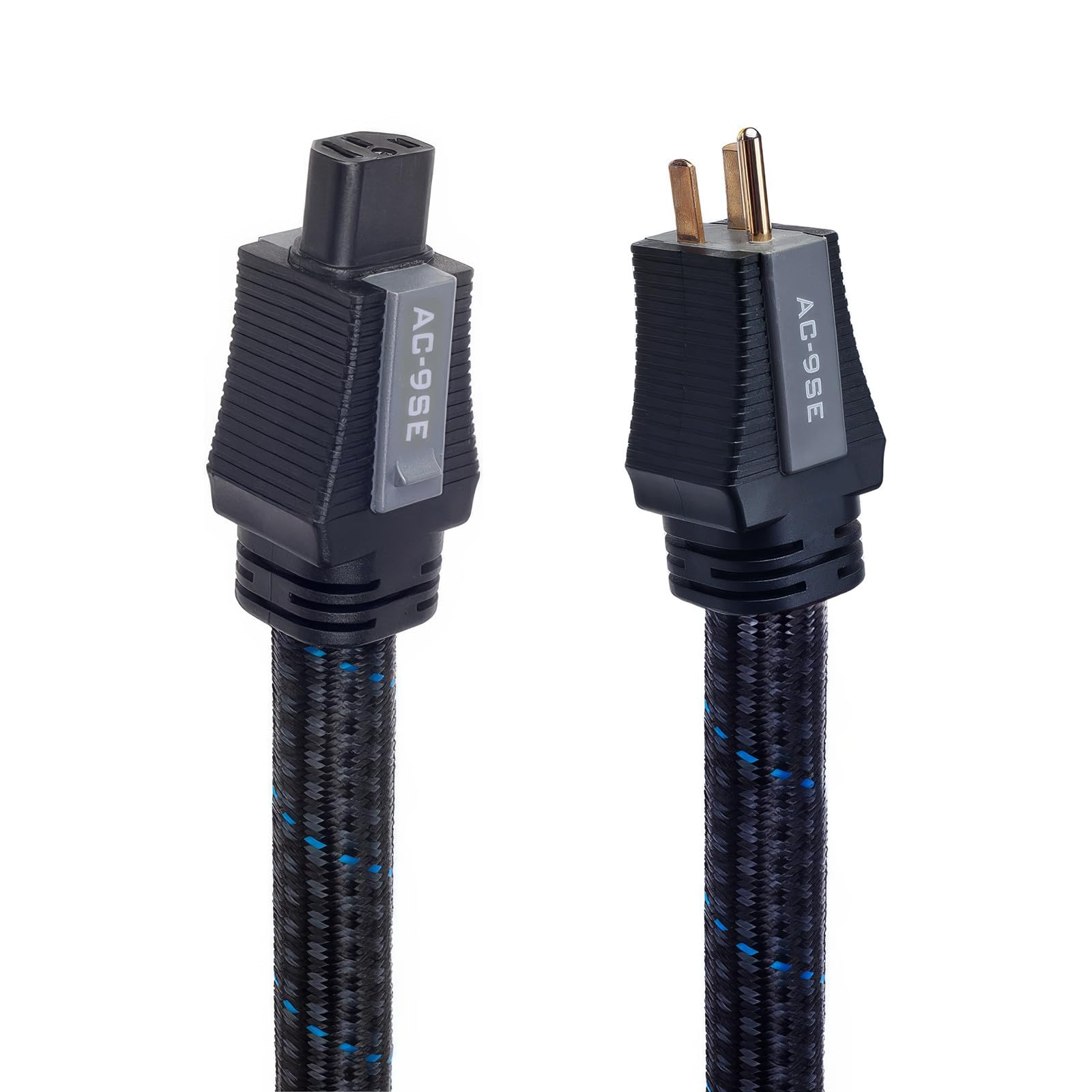
A garden-hose-thick cord that feeds class A amplifiers with authority.
This is the premium cord for gear that is genuinely power-hungry. It combines no-compromise Cardas Grade One Copper with 99.99% purity OFC conductors, and it is designed specifically to deliver the high-current power that audio amplifiers need. The DeathGrip IEC connector uses massive gold-plated contacts to lock onto your component’s IEC input with a solid, secure grip.
Owners are blunt about its size: it is as thick as a garden hose and about as flexible as a steel rod. You need real space behind your gear to accommodate it, and there is very little flex at the ends. One owner uses it from the wall plug to a power stage that easily drives a pure class A amplifier asking up to 1kW of instant power — exactly the scenario this cord was built for.
The sound improvement is substantial. A noticeable improvement appears after 100 hours of use, with owners reporting improved bass texture and a lower noise floor. Some say it outperforms cords costing thousands, revealing new detail in familiar songs. Build quality is the most-praised aspect, with strong feedback on clarity and value for money.
Why it earns the premium spot
- Cardas Grade One Copper and 99.99% purity OFC for clean high-current flow
- DeathGrip IEC with massive gold-plated contacts locks on securely
- Buyers report improved bass texture and lower noise after 100 hours
The honest caveat
- Extremely thick and inflexible — needs generous clearance behind gear
- Little to no flex at the ends makes tight routing difficult
- Flexibility is the one aspect owners consistently flag as negative
Built for: high-current amplifiers and power stages that draw serious instantaneous power.
Not for: tight racks — the steel-rod stiffness demands space and careful planning.
6. AudioQuest NRG-Y3 Power Cable (2m, 1 x C13 > 1 x 3-Prong Wall Plug)
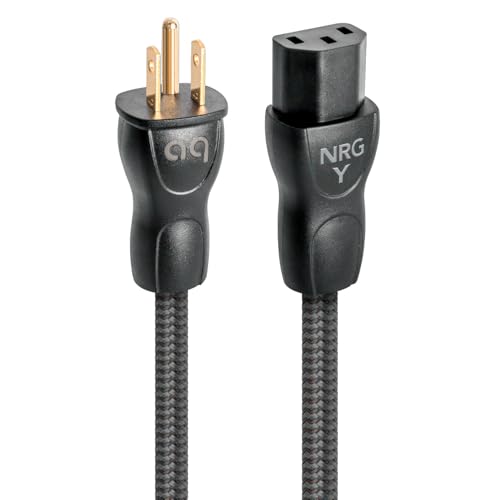
The step-up cord that drains noise away with silver-plated conductors.
This is the more advanced sibling in the AudioQuest family, and the upgrade is in the details. It uses Long-Grain Copper conductors to minimize grain-boundary distortion, plus Direction-Controlled silver-plated shield conductors that efficiently drain RF noise to ground through the third pin. Semi-Solid Concentric Conductors keep strands packed tightly, reducing strand-interaction distortion for a cleaner signal.
At 78.72 inches (2 meters), this cord reaches across a full rack, and it works with AV receivers, integrated amplifiers, monoblocks, powered speakers, and subwoofers. Owners mention consistent gains: one JBL subwoofer got tighter, faster bass with less muddiness and reduced standby hum, while an Arcam SA30 amp paired with Sonus Faber speakers showed less background noise and better instrument separation right away.
Owners praise quality and sound quality most, and benefits accumulate when using multiple AudioQuest cables together. One owner notes it delivers power unimpeded without active cleaning, best paired with a line conditioner or hospital-grade socket to reduce antenna interference. The honest framing from another owner: the sound is a little better, and it looks far better than the flimsy cord that came with the TV. It is a fat, substantial cable that feels like a serious component.
The system cord: this is the one to standardize on if you are upgrading multiple components. The silver-plated drain wires and noise-dissipation technology reward a full-system approach where gains stack.
Expectation set: the improvements are real but measured — less muddiness, reduced hum, cleaner separation. This is refinement, not a dramatic transformation.
Pick this for: building out a full system where every component benefits from clean, shielded power.
Consider the alternative if: you only need one short cord for a single source — the shorter NRG-X3 covers that job at a lighter weight.
Understanding the Specs
Gauge (AWG)
This is the thickness of the wire inside the cable. A lower number means a thicker conductor that carries more current with less resistance. Thick 7AWG or 10AWG cords suit power-hungry amplifiers that need big, instant current swings. Thinner 14AWG cords are lighter and work best for source components that draw less current but need clean, detailed flow.
OFC vs OCC Copper
Oxygen-Free Copper (OFC) removes oxygen from the metal to reduce resistance and preserve detail. Ohno Continuous Cast (OCC) copper goes further, using a single-crystal casting process that eliminates grain boundaries within the metal. Less resistance and fewer boundaries mean the signal passes with less distortion, which is why OCC is considered the premium choice.
FAQ
Do audiophile power cords actually make a difference in sound?
What does burn-in time mean for a power cord?
What gauge do I need for my amplifier?
Will an audiophile power cord fit my equipment?
How long do these cords need to be?
Are thicker cables always better?
What is the difference between the AudioQuest NRG-X3 and NRG-Y3?
Can I use these cords with a power conditioner?
Final Thoughts: The Verdict
For most people, the audiophile power cord winner is the WAudio Hi-End 10FT because its 10AWG oxygen-free copper cores deliver clean current to high-demand amplifiers, and owners consistently report real sonic gains. If you want the thickest conductor for the least money, grab the TODN 6.5ft OCC with its 7AWG OCC copper and 24K gold plugs. And for a full-system, noise-dissipating approach, the AudioQuest NRG-Y3 is the one to reach for, especially when paired across multiple components.
How We Picked
We do not accept paid placement. Every pick is matched to a real buyer and a real use-case; we do not hands-on test units.
Sources & Methodology
Specifications: manufacturer listings and product documentation. Review insights: verified customer reviews, as of August 2026. Pricing: not shown on this page (it changes often); check the current price via the retailer link.
As an Amazon Associate, Gadgets Feed earns from qualifying purchases. This does not affect which products we feature.