
Our readers keep the lights on and my morning glass full of iced black tea. As an Amazon Associate, I earn from qualifying purchases.
Specs are compiled from manufacturer listings and verified buyer reviews and can change over time — please confirm the key details on the product page before buying.
Your safety on the track starts with the certification sticker on the helmet. That sticker, whether Snell SA2020 or SA2025 (the latest safety standards for sanctioned racing), proves the shell meets the required impact protection. After that, you are really choosing for fit, weight, and how the visor handles glare and fog — because a helmet you dread wearing is a helmet you will not wear properly.
I’m Min — the founder and writer behind Gadgets Feed. This guide is built by comparing the manufacturers’ published specifications and the patterns across verified customer reviews, so you get each pick’s real strengths and trade-offs instead of marketing spin.
Every full-face model here is certified for track use, so you can focus on fit and features. Here is how the auto racing helmet field splits by weight, shell material, and real-world comfort.
Our Picks at a Glance

How To Choose The Best Auto Racing Helmet
Racing helmets are not motorcycle helmets. An auto racing helmet is built to Snell SA standards, which test for the specific kinds of impacts and fire exposure you meet in a car, not on the road. The very first thing to check is the certification, because many track and autocross organizations will not let you run without the right one.
Read the certification, then the size chart
Snell SA2025 is the newest standard, and SA2020 is the previous one. Both are current for many events, but the SA2025 update is what the newest shells carry. After certification, the single biggest mistake is guessing your size. Measure the circumference of your head just above the eyebrows, then match it to the brand’s chart — a round 58cm head can be a Large in one shell and an XL in another.
Match the shell to your event
Fiberglass and fiber-reinforced plastic shells give you the best weight-to-protection balance for autocross, club racing, and karting. A lighter shell (around 2.25 kg) means less neck strain over a long day, while a slightly heavier shell often carries extra sound damping and a plusher liner. If you plan to add a Head and Neck Support device, make sure the helmet has the threaded inserts built in.
Quick Comparison
| Model | Best For | Certification | Weight | Shell Material | Amazon |
|---|---|---|---|---|---|
| Conquer 350-FF-SA20★ Best Overall | Autocross & karting on a budget | Snell SA2025 | 3.4 pounds | Fiberglass composite | Amazon |
| Typhoon BF1-760 | Extra room for fire protection | Snell SA2020 + DOT | 4 pounds | Fiberglass | Amazon |
| ILM Model 760 | Road course beginners | Snell SA2025 | 2.25 kg | Fiber Reinforced Plastic | Amazon |
| ILM Model 890 | Budget-conscious racers wanting quality | Snell SA2025 | 2.27 kg | GFRP composite | Amazon |
In-Depth Reviews
1. Conquer 350-FF-SA20
Our pick — over 4.5★ from 200+ verified ratings; the strongest balance of quality and price.
The lightweight fiberglass shell that nails the essentials without the premium price tag.
Fit is where this helmet wins its fans. Owners consistently report the Conquer matches their head shape well, and the reviews sum it up: “Excellent protection. Perfect fit.” That fit confidence matters because a helmet that shifts mid-run is a distraction you do not want during a timed autocross pass.
On the scale, it lands at 3.4 pounds, which makes it noticeably lighter than the Typhoon’s 4 pounds — a real difference when you are holding your head steady through long corners. The one-hand flip-up shield stays put when you raise it, and the 3mm anti-scratch, flame-resistant shield has tear-off posts so you can peel away dirty film layers mid-event. A fire-retardant padded interior and airflow venting keep things cooler, and it ships with a soft carry bag.
The catch is sizing nuance. The fit feedback is positive, but one buyer with a 58.5cm head found the Large tight on top with loose cheeks, while the XL fit the crown but lost cheek contact. If your head is long and narrow rather than round, another brand’s shell may suit you better — but for the classic round head shape, this is the crowd favorite at a very hard-to-beat value.
What owners rave about
- Fit is the standout — it feels secure and doesn’t hamper driving
- Lightweight at 3.4 pounds, lighter than the Typhoon’s 4
- Shield flips up one-handed and holds position
Who should measure twice
- Round-face shapes fit best; long/narrow heads may need another brand
- Fog can appear if temps hit the wrong points
Reach for this if: you want a Snell SA2025 shell that a casual autocross or go-kart driver will love from the first wear.
Look elsewhere if: your head is long and narrow — the round shell geometry simply will not hug those cheeks.
2. Typhoon Helmets BF1-760

The double-certified shell that leaves room for fire protection underneath.
What stands out about the Typhoon is its dual certification. It meets Snell SA2020 for racing and also the DOT Federal Motor Vehicle Standard 218 (FMVSS 218), so this is the rare helmet that crosses into street-legal territory — though it is built for automobile racing first. For club racers who want one helmet that ticks both boxes, that is a meaningful advantage.
Buyers report it “runs a little big,” which is exactly what you want if you layer fire protection or a balaclava underneath. The Kevlar chin strap with a D-ring closure slides easily, and the HANS threaded inserts in the shell make adding a head and neck restraint straightforward. The 3mm optically correct hard-coated face shield uses eyeport gaskets to keep out dust, and the plush liner plus rear exhaust vents handle comfort on warm days.
The honest trade-off is weight. At 4 pounds, it is about 18% heavier than the Conquer’s 3.4 pounds, so your neck does more work over a long weekend. One owner also called out the “funny chin lip” as a minor aesthetic quibble, but the build quality and comfort get consistent praise. If the extra pounds bother you, the fiberglass ILM models shed some weight.
Built for layering: the slightly generous fit is a feature, not a flaw, when you add fire protection underneath.
Dual certification: Snell SA2020 plus DOT FMVSS 218 means one helmet serves both track and legal road duty.
Pick it for: the driver who wants belt-and-suspenders certification and plans to wear fire protection underneath.
Think twice if: ounces matter to you — this is the heaviest shell in the lineup at 4 pounds.
3. ILM Model 760
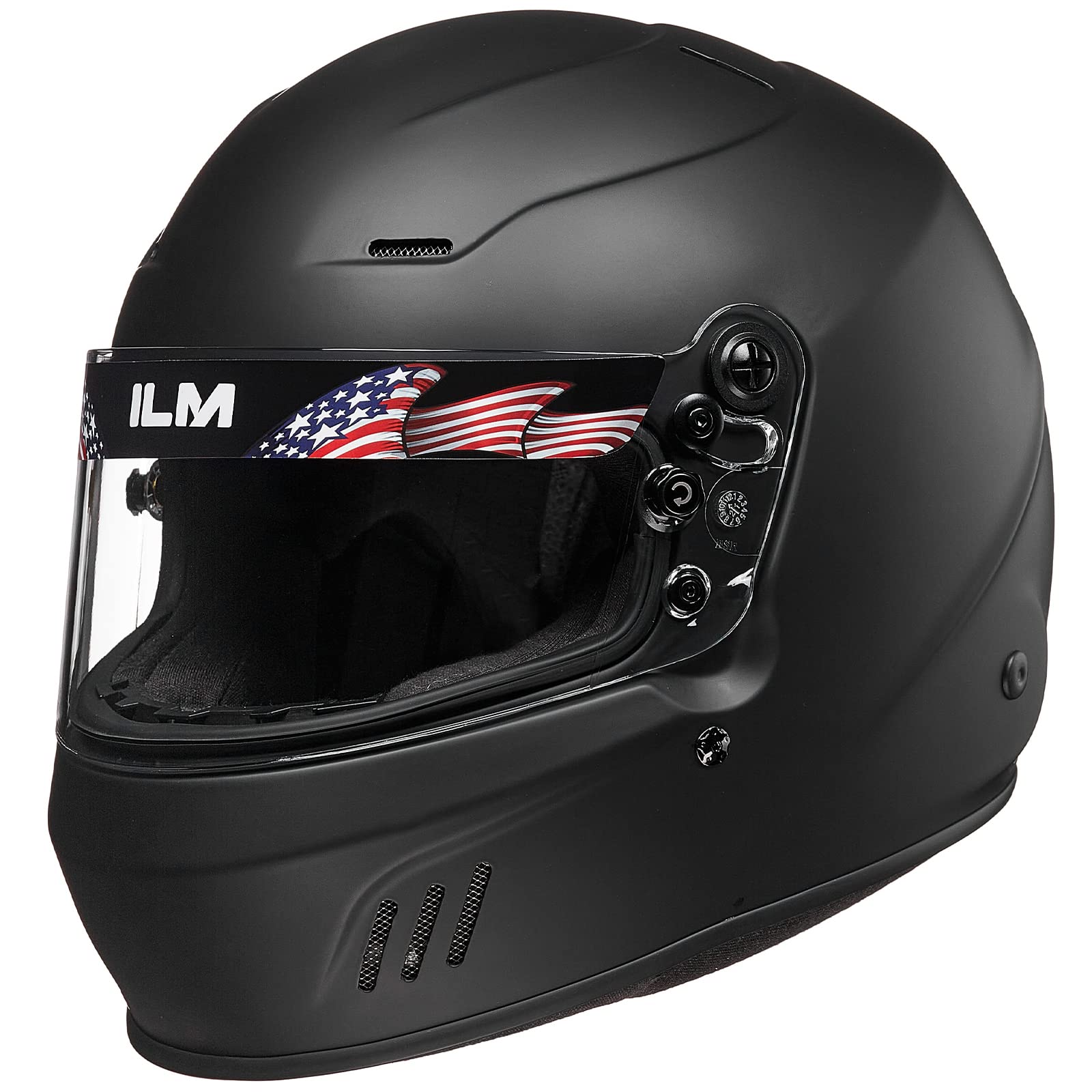
A featherweight 2.25 kg shell that road-course beginners call ideal.
This ILM is the lightest shell in our comparison, tipping the scale at 2.25 kg — just a hair under the 890’s 2.27 kg. That low weight is the headline because it translates directly to less neck fatigue across a full day of track sessions. The fiber-reinforced plastic (FRP) shell carries the Snell SA2025 certification, so it is ready for current sanctioning rules.
Ventilation is a big part of the story. With 16 vents, this helmet moves air far more aggressively than most rivals, which makes it a strong pick for warm-climate road courses. The 40mm sunshade film along the top of the visor cuts sun glare without tinting your whole view, and the high-density Expanded Polystyrene (EPS) fire-retardant inner pads add a comfortable, safety-minded liner. HANS/HNR M6 threaded inserts are built into the shell, so a head and neck restraint bolts straight on.
The catch is reliability of the purchase experience, not the helmet itself. While the fit and value draw praise from most owners, a small number hit a frustrating return process when sizing went wrong — one buyer’s refund took far longer than promised. The advice: measure carefully against the chart before ordering. As an adage one owner leaned on, “you get what you pay for” — most owners say this gives you plenty.
Light on your neck: at 2.25 kg, it is the lightest shell here, built for long days without fatigue.
Airflow king: 16 vents plus a 40mm sun visor film make hot-weather track days far more bearable.
Reach for it when: you are a road-course beginner who wants the newest Snell SA2025 cert in the lightest shell possible.
Be careful with: sizing — order a size up if you are between measurements, because returns can drag.
4. ILM Model 890

The old-hand favorite that proves a certified shell can still come cheap.
Here is a helmet that earns its reputation from decades of experience. As one owner with over 55 years of riding and racing put it, “Awesome helmet incredible price… unbelievable product for under.” The 890 leans on a fiber-reinforced plastic (GFRP) composite shell with the Snell SA2025 stamp, and the matte black finish gives it a serious track presence for the money.
Quality is the most-discussed strength here — more owners single it out than any other feature. Fit and value-for-money follow closely, which tells you this is a helmet that exceeds expectations at its price point. The 40mm sunshade film on the visor works to reduce glare, the high-density EPS fire-retardant liner keeps things comfortable, and HANS/HNR M6 threaded inserts are ready for a neck restraint.
Two honest caveats. First, some owners mention the Snell certification and visor functionality are not universally consistent, and a few note reduced visibility in the peripheral field. Second, if you wear prescription glasses, this shell is a tough fit — one owner switched to an open-face helmet just to keep wearing glasses. It remains a superb value, but size and eyewear compatibility deserve a careful look first.
The rave list
- Quality is the top praised feature across owners
- Lightweight at 2.27 kg, just under the 760’s 2.25
- Built-in HANS inserts and 40mm sun visor film
Look out for
- Prescription glasses are a tight squeeze inside the shell
- Some owners question the Snell certification consistency and peripheral view
Grab it for: the budget-conscious racer who wants a Snell SA2025 fiberglass shell that over-delivers for the price.
skip it if: you wear glasses on track — this shell may force you to an open-face design.
Understanding the Specs
Snell SA2020 vs SA2025
These are the safety certifications that govern auto racing helmets. SA2025 is the newest standard, while SA2020 is the previous generation; both are accepted at many events today. The certification tells you the shell passed impact and fire tests. Always check what your specific track or club requires, because some organizations mandate the newest standard.
Shell Weight and Material
Helmets range from about 2.25 kg to 4 pounds depending on the shell material. Fiberglass and fiber-reinforced plastic (FRP or GFRP) composite shells offer the best balance of light weight and protection. A lighter helmet means less strain on your neck over a long race day, which is why weight is one of the first numbers serious buyers compare.
FAQ
What does Snell SA2025 certification actually mean?
Can I use a motorcycle helmet for auto racing?
How do I measure my head for the right helmet size?
What are HANS threaded inserts and do I need them?
Why does helmet weight matter so much for racing?
Can I wear prescription glasses under a full-face racing helmet?
What is the sunshade film on the visor for?
How do I keep the visor from fogging up?
Final Thoughts: The Verdict
For most drivers, the auto racing helmet winner is the Conquer 350-FF-SA20 because it pairs a lightweight 3.4-pound fiberglass shell with a fit that owners consistently praise. If you want the double safety stamp of Snell SA2020 plus DOT certification with room for fire protection, grab the Typhoon BF1-760. And for the lightest shell with the best airflow for hot track days, the ILM Model 760 is the one to reach for.
How We Picked
We do not accept paid placement. Every pick is matched to a real buyer and a real use-case; we do not hands-on test units.
Sources & Methodology
Specifications: manufacturer listings and product documentation. Review insights: verified customer reviews, as of August 2026. Pricing: not shown on this page (it changes often); check the current price via the retailer link.
As an Amazon Associate, Gadgets Feed earns from qualifying purchases. This does not affect which products we feature.