
Our readers keep the lights on and my morning glass full of iced black tea. As an Amazon Associate, I earn from qualifying purchases.
Specs are compiled from manufacturer listings and verified buyer reviews and can change over time — please confirm the key details on the product page before buying.
You plug your guitar, bass, or keyboard into a mixer, and the sound comes out weak or noisy — an active DI box fixes that by boosting the weak, unbalanced signal into a clean, balanced line your mixer or interface can hear properly. The real question is which power option, pad, and build will survive your specific gig. Here are the honest strengths and trade-offs of the top active direct boxes, so you can match one to your instrument and your stage.
I’m Min — the founder and writer behind Gadgets Feed. This guide is built by comparing the manufacturers’ published specifications and the patterns across verified customer reviews, so you get each pick’s real strengths and trade-offs instead of marketing spin.
Your instrument type — a passive bass, a stereo keyboard, or a piezo-equipped acoustic (a pickup that senses string vibration) — determines which active di box you need, because each requires different power sources and tone-shaping controls to match your exact rig and signal chain.
Our Picks at a Glance


How To Choose The Best Active DI Box
An active DI box exists for one job — to take your instrument’s high-impedance signal and turn it into a low-impedance balanced output your mixer can receive without noise or tone loss. Unlike a passive box that just uses a transformer, an active one runs a powered circuit that preserves your pickups’ full frequency range, which is why quiet passive pickups suddenly sound clear and loud through a console.
Power: Phantom, Battery, or Both?
Every active DI needs juice, and how you power it changes your life on stage. Most run on 48V phantom power sent down the XLR cable from your mixer or interface — this means no batteries to swap mid-set, but it also means your board must actually supply phantom power. Some boxes add a 9V battery as a fallback, and a few even accept USB power from a power bank, so you’re never stuck silent on a bare stage.
Tone-Shaping Controls: Pads, Filters, and Polarity
A pad switch (usually -15dB or -20dB) is what stops a hot active pickup or line-level keyboard from overloading your mixer input with distortion. A ground lift switch breaks the ground loop that causes that annoying 60Hz hum when you’re sharing power with lighting rigs. Low-cut filters tame muddy rumble, polarity reverse fixes phase cancellation, and a merge switch sums stereo sources to mono — figure out which of these your rig actually needs before you spend.
Build and Channels
If you’re hauling this to gigs weekly, a steel or alloy enclosure matters far more than a plastic shell that cracks in a road case. Stereo players — keyboardists especially — should look for dual-channel boxes that preserve their left/right mix, while mono guitar and bass players just need a rugged single-channel unit. Consider whether you also want a Thru output to keep feeding your stage amp while the mixer gets the clean balanced signal.
Quick Comparison
| Model | Best For | Power Options | Pad Switch | Weight | Amazon |
|---|---|---|---|---|---|
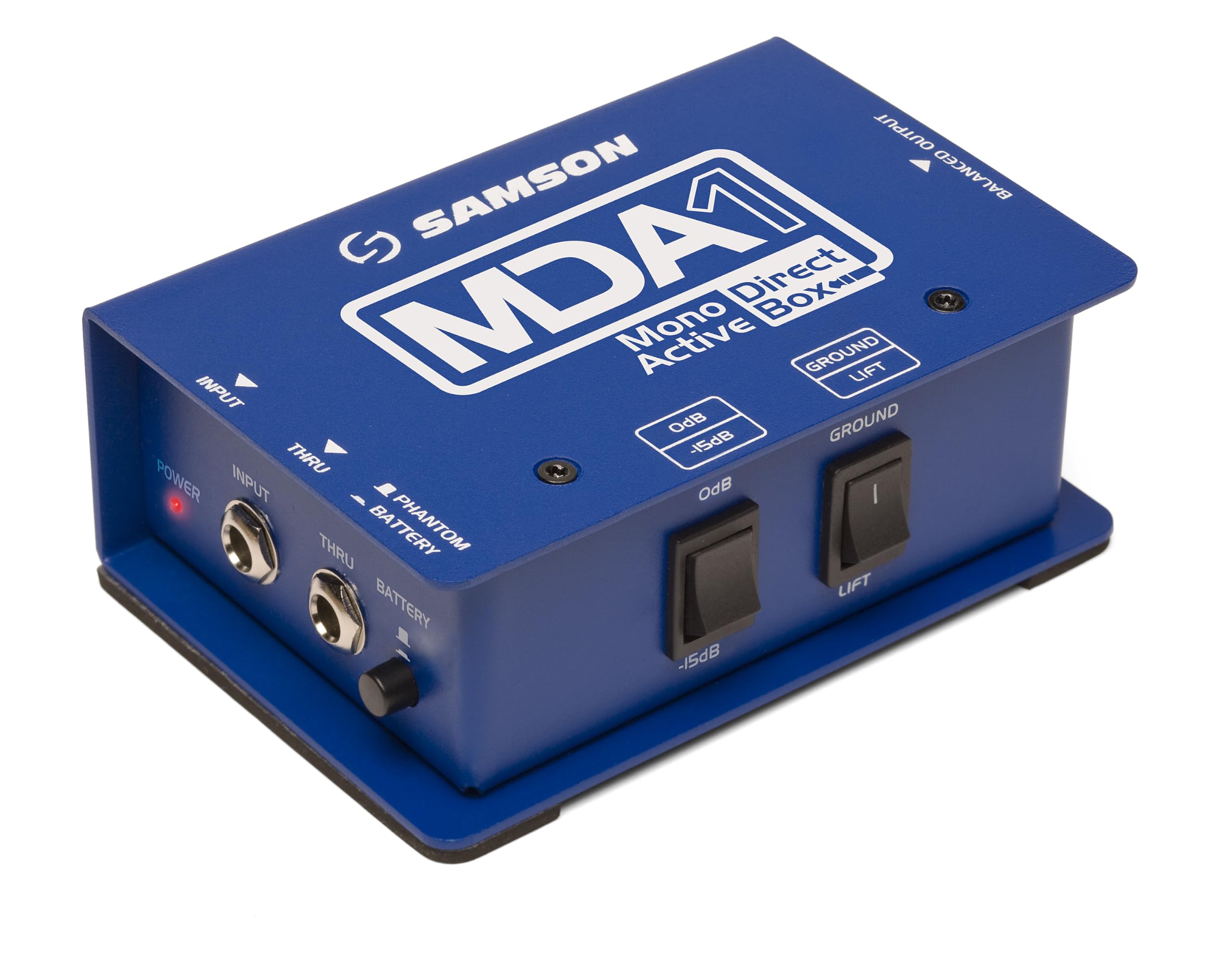
| Samson MDA1★ Best Overall | Budget mono stage workhorse | 48V Phantom or 9V Battery | 0dB / -15dB | 1.3 pounds | Amazon |
| Bolanle J22Most Versatile | Stereo sources with flexible power | 48V / 9V / USB | Yes | 2.03 pounds | Amazon |
| ART DualXDirectBest Dual Value | Dual channels at a fair price | Phantom or 9V | 0 / -20 / -40 dB | 1 pounds | Amazon |
| Mackie MDB-1A | Phantom-powered mono reliability | 48V Phantom only | -15dB | 12.8 ounces | Amazon |
| JOYO JDI-48 | Studio reamping + DI combo | 48V Phantom only | -15dB | 1.02 pounds | Amazon |
| Radial Pro48 | Pro-grade mono transparency | 48V Phantom only | -15dB | 0.56 kg | Amazon |
| BSS AR-133 | Installed theater rack systems | Phantom or 9V | 0 / -20 / -40 dB | 650 g | Amazon |
| Radial J48 MK2 | Top-tier phantom-powered studio | 48V Phantom only | Yes | 1.5 pounds | Amazon |
| Rupert Neve RNDI | Reference-grade tone purists | 48V Phantom only | — | 1.02 kg | Amazon |
In‑Depth Reviews
1. Samson MDA1 Mono Active Direct Box
Our pick — over 4.5★ from 450+ verified ratings; the strongest balance of quality and price.
The budget-priced steel box that punches far above its weight class, making Radial owners do a double take.
The Samson MDA1 earns its spot because it sounds identical to direct boxes that cost three times as much. Buyers report clean, uncolored sound with a true bypass (a switch that routes your signal straight through when the unit is off), and one owner who ran it head-to-head against a Radial J48 in both the studio and live couldn’t hear any difference after three years of use.
It runs on either 48V phantom power or a 9V battery, so you’re covered whether your mixer supplies phantom or you’re on a bare stage. The all-metal, impact-resistant steel case shrugs off road abuse, and the Ground Lift switch kills that hum from shared AC circuits. Everything sits in a 1.3-pound package that’s easy to toss in a gig bag alongside your cables.
The only real caution is in the details — the 2-position 0dB/-15dB attenuation switch (which lowers the signal level by 15dB for hot inputs) needs to be set correctly for loud signals, and hot PA connections can cause loud pops if you unplug things while the system is live. It’s a habit thing, not a flaw. A 4.7-star rating across 450+ ratings tells you almost everyone walks away happy.
Why It Wins Stages
- Clean, transparent signal that rivals DI boxes costing far more
- Phantom or 9V power flexibility for any rig
- Steel case built for gig-bag life
- Ground lift switch banishes 60Hz hum
Watch The Details
- No XLR Thru output — just 1/4″ input and thru
- Hot PA connections can pop if you unplug while live
- Single channel only, so no stereo summing
Reach for it if: you’re a gigging guitarist or bassist who wants pro-grade sound without spending pro-grade money.
Keep this in mind: the pad switch is your friend — set it to -15dB for hot active pickups to avoid clipping your mixer.
2. Bolanle J22 Direct Active Stereo DI Box
The only box in this lineup with three power sources, so a dead battery or missing phantom never silences you.
Bolanle’s J22 solves the one nightmare every keyboardist fears — being on stage with no way to power your DI. It’s the only active DI in its class that runs on 48V phantom power, a 9V battery, or 5V USB from any power bank, which means there’s always a path to signal. If you’ve ever been the player muttering “sorry, I can’t play” while someone hunts for a battery, this is your fix.
The Bolanle J22 is built for stereo rigs — run a keyboard, dual-output synth, or two instruments at once through the dual unbalanced 1/4″ TRS inputs (jacks that carry both left and right channels), and the dual balanced XLR outputs keep your left/right separation intact with no mono-summing. A 180° polarity reversal switch and a ground lift give you total control over interference, and the metal housing handles the road, sweat, and drops. Owners mention excellent quality and no added noise, with one noting it works great in church systems.
The 2.03-pound weight makes it noticeably heavier than single-channel boxes — roughly double the ART DualXDirect’s 1-pound frame — but that’s the price of dual outputs and a sturdier enclosure. The switchable pad and HPF (high-pass filter, which rolls off low-end rumble) round out a package that reviewers consistently call well-built and worth the modest asking price.
What Makes It Special
- Three power options — phantom, 9V battery, or USB power bank
- True dual-channel stereo separation for keyboards
- Ground lift kills 60Hz hum from lighting rigs
- Switchable pad and HPF for tone control
Consider This
- Heftier than single-channel rivals at 2.03 pounds
- Batteries not included
- Fewer total reviews means less long-term field data
The stereo stage solution: keyboard and synth players who refuse to lose their left/right mix — this is the one.
Worth noting: if you only play mono guitar, a single-channel box gives you the same clean signal in a lighter package.
3. ART DualXDirect Dual Professional Active Direct Box
A featherweight dual-channel pro box that turns two instruments into one clean, 600-ohm balanced feed.
ART’s DualXDirect is a workhorse that weighs just 1 pound but carries two full channels, making it a fantastic asset for small venues and quick setups. It converts high-impedance balanced or unbalanced inputs into 600-ohm balanced outputs, which is exactly what your mixer wants to see for a clean, noise-free signal. The fully active design runs on either phantom power or a 9V battery, so you’re not locked into one source.
The real standout here is the switchable input attenuation — you get a 0, -20, or -40 dB pad, giving you far more headroom control than most boxes in this class. That’s the kind of range that lets one unit handle a quiet piezo acoustic guitar or a screaming hot keyboard without touching another piece of gear. Customers note it solved an inaudible passive pickup issue for a church soloist, and a guitarist runs a looper pedal through a PA channel with zero problems.
One honest quirk: the battery holder’s thumbscrew is stiff enough that you’ll want a screwdriver, and the unit stays powered by phantom even when switched off, so you should turn down the XLR input before plugging or unplugging. These are minor workflow habits, not dealbreakers. Priced well below boutique dual boxes, this is the smart buy for players who need two channels without the premium tax.
Dual-Channel Muscle
- Two independent channels in a 1-pound chassis
- Fully active with phantom or 9V power
- Three-step pad (0 / -20 / -40 dB) for any source
- Switchable low-pass filter and phase invert
Small Quirks
- Battery compartment thumbscrew is stiff
- Stays phantom-powered even when switched off
- Stainless steel but no carrying case included
Ideal for the minimalist: grab this if you need two channels and hate hauling heavy gear — 1 pound is barely noticeable in any bag.
A polite warning: the phantom-stays-on behavior means always mute your channel before unplugging.
4. Mackie MDB Series Active Direct Box (MDB-1A)

A phantom-only mono box with a clever merge switch that turns your two-input pedalboard into one clean send.
Mackie’s MDB-1A is the silent professional’s choice — a 12.8-ounce phantom-powered box that owners describe as solid, quiet, and reliable even after a year of steady use. It takes a high-impedance 1/4″ input, sends a Thru output to your stage amp, and delivers a balanced XLR to the desk with a ground lift to kill hum. There’s no battery option here; it runs purely on 48V phantom, so make sure your mixer or interface supplies it.
The feature that sets this apart is the Merge switch. Engage it and the Thru jack becomes a second instrument input, so you can sum a stereo source down to mono right at the box — perfect for a pedalboard with two outputs. Add a low cut switch, a polarity switch, and a -15dB pad, and you have a surprisingly flexible mono unit. One reviewer runs it on a pedalboard specifically for practice and dual-chain merging, which tells you how versatile the routing is.
The 10,000-ohm impedance and 20kHz frequency response keep your tone intact, and the build is classic Mackie — well-made with a flawless reputation behind it. Just remember: no phantom power, no signal, so test your console before you rely on it.
What owners love: the merge switch opens routing options no other mono box in this range offers, and the build quality earns consistent praise for quiet, reliable operation.
The honest catch: it’s phantom-only, so a mixer without 48V leaves you silent until you find one.
Best for the pedalboard purist: this is the box to reach for when you want a clean mono send with flexible input routing.
Look elsewhere if: your gigging reality includes mixers with no phantom power — battery options serve you better.
5. JOYO Reamping & Active DI Box for Guitar/Bass JDI-48
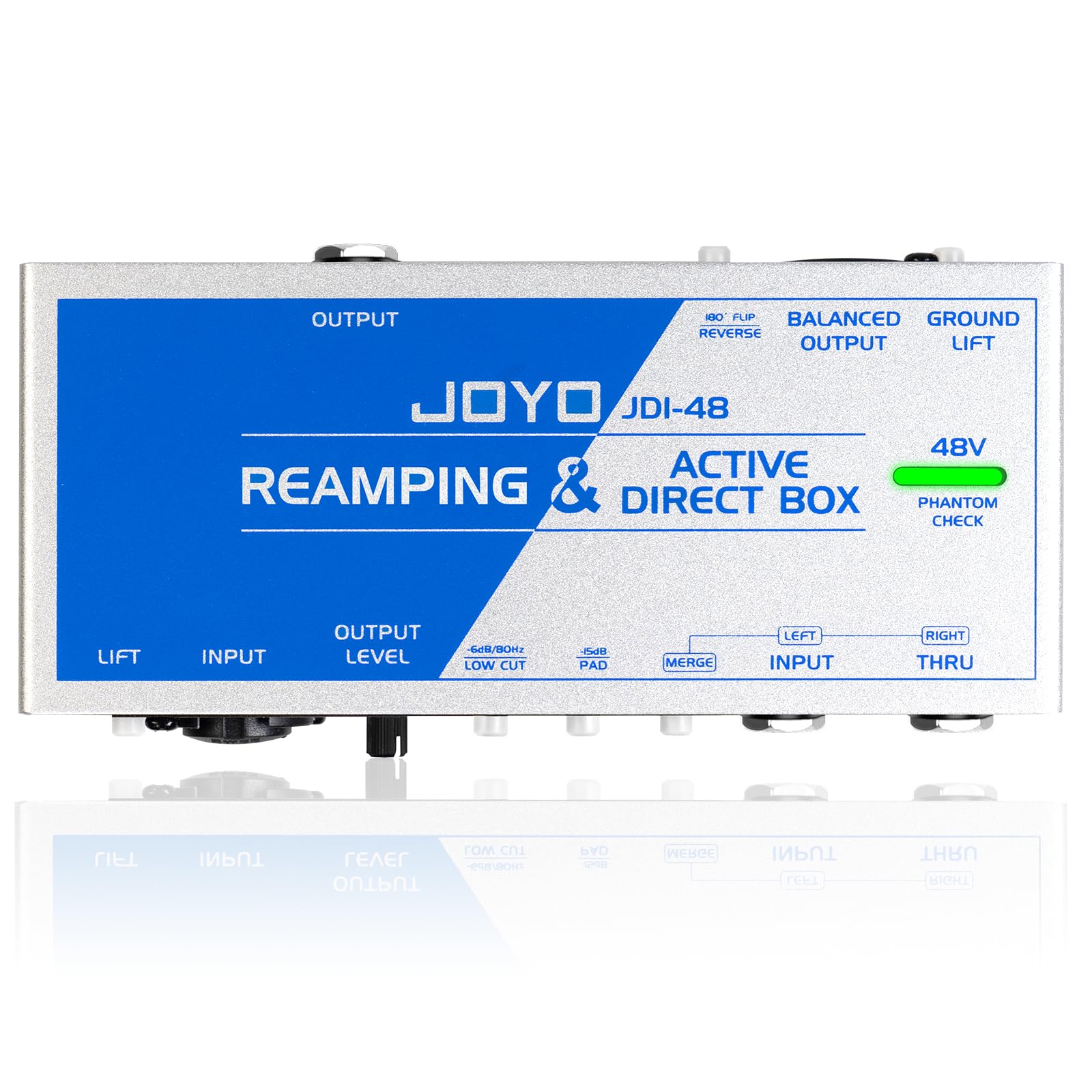
Half DI, half reamp box — a two-in-one that turns a bedroom into a working studio without re-recording takes.
The JOYO JDI-48 is the only unit here that genuinely earns the “studio” label because it does two jobs. The active DI section sends your clean balanced signal to a mixer or interface, while the reamping circuit routes pre-recorded tracks back through your amplifier for tone-shaping — and you can run both simultaneously to capture a direct and a mic’d amp at the same time. That’s a workflow boost that would normally cost you two separate pieces of gear.
The combo reamping port accepts both 6.35mm TRS instrument cables and XLR lines without adapters, and engaging the MERGE switch turns the Thru jack into a second instrument input for flexible routing. It’s powered purely by 48V phantom, which keeps things battery-free and quiet, and the aluminum alloy chassis sits neatly on any standard pedalboard. Reviewers use it for NAM captures and describe it as a really clean sounding piece.
The trade-off is that it’s phantom-only — there’s no 9V option for stages where phantom isn’t available, and one owner notes the -15dB pad isn’t quite enough for very hot signals. But for the home studio crowd specifically, the 1.02-pound box delivers clear direct recording and amp reamping in one compact black unit. The 80Hz low-cut filter, polarity reverse, and ground lift cover the usual studio problem-solving bases.
Studio Muscle
- DI and reamping in one unit, usable simultaneously
- Combo port handles TRS and XLR without adapters
- 80Hz low-cut, polarity, and ground lift controls
- Pedalboard-friendly compact aluminum build
Studio Limitations
- No 9V battery option — phantom power only
- Attenuation may not fully tame the hottest signals
- Reamp learning curve if you’re new to the workflow
Grab this for the bedroom studio: if you record at home and want direct + reamped tones, this is the most cost-effective two-in-one.
Skip it on the road: live-only players who face mixers without phantom power will want a battery-capable box instead.
6. Radial Pro48 Active 48-Volt Compact Direct Box

The guts of Radial’s famous J48 in a simpler shell — a no-frills pro box that engineers swear by.
Radial built the Pro48 for one purpose: to give you the exact same active circuit as their flagship J48 without the extra bells and whistles. That means the proprietary analog circuit with a low-noise op-amp (a chip that amplifies your signal with minimal added hiss) delivers that clean, forward sound that makes your instrument stand out and sit louder in the mix — “the guts of a J48 without all the bells and whistles,” as one buyer put it. It’s a standard piece of audio gear every engineer should own.
Powered entirely by 48V phantom, it accepts a 1/4″ input and outputs balanced mono XLR, with a -15dB pad specifically designed to make it workable with active preamps and line-level instruments. The steel enclosure is built for the road, and the three-year transferable warranty shows the company stands behind it. Buyers have used it for nine years straight and describe the build quality and performance as fantastic.
At 0.56 kg it’s noticeably compact and easy to wedge into any setup. The honest mixed note in the feedback is durability — most reviewers point out great longevity, but an occasional unit has a transformer that can work loose, so it’s worth a periodic check if you’re touring hard. This sits at a moderate price point that’s a genuine step up in brand trust from the budget boxes, without reaching the flagship’s price.
The pro consensus: a no-compromise active circuit in a rugged steel shell — the thing people rave about is how much louder and clearer your instrument sounds through it.
One thing to watch: mostly great durability, but the transformer can loosen on a hard-touring unit, so give it a shake-test now and then.
Choose this for the trust factor: you want Radial’s pro reputation and their J48 sound without paying flagship money.
Think twice if: you need a battery fallback — the Pro48 is phantom-only, so carry a battery box as backup.
7. BSS Audio AR-133 Active DI Box

The installed-theater legend with a 40dB pad range that handles everything from guitar pickups to line level.
BSS has been the quiet backbone of theater sound for years, and the AR-133 is exactly why. It offers switchable input attenuation across 0dB for guitar-type pickups, -20dB for line level, and a -40dB setting that comes in handy during live shows when you’re dealing with wildly different source levels. One buyer has run them for about six years in a theater and couldn’t be happier with their performance — that’s the kind of long-haul trust this box earns.
The 650-gram unit runs on phantom power or a 9V battery, giving you flexibility for both installed racks and portable gigs. It’s a mono channel with switchable low-pass filtering, and the low-noise design makes it a favorite for acoustic instruments — buyers describe it as clear, clean sound for acoustic guitar with very low noise and great flexibility. The all-steel construction is built to sit in a rack for years.
This is the most expensive non-Radial option here, and you’re paying for the BSS brand’s reliability in installed sound. The feature set is straightforward — no merge switch, no reamping — but what’s there is rock solid. At 650 g it’s heavier than the ART DualXDirect’s 1 pound, reflecting a denser, more industrial build meant for permanent installation rather than constant swapping.
Why theaters love it: the three-step pad range and low-noise circuit handle any source a production throws at you — the thing buyers mention most is its flawless years-long performance.
Know before buying: this is a no-frills pro tool, so don’t expect stereo merging or reamping extras.
Best for the installed sound pro: house techs and theater engineers who need a box that never fails mid-show.
Not the pick for: solo gigging players who want compact multifunction features — this is a specialist tool.
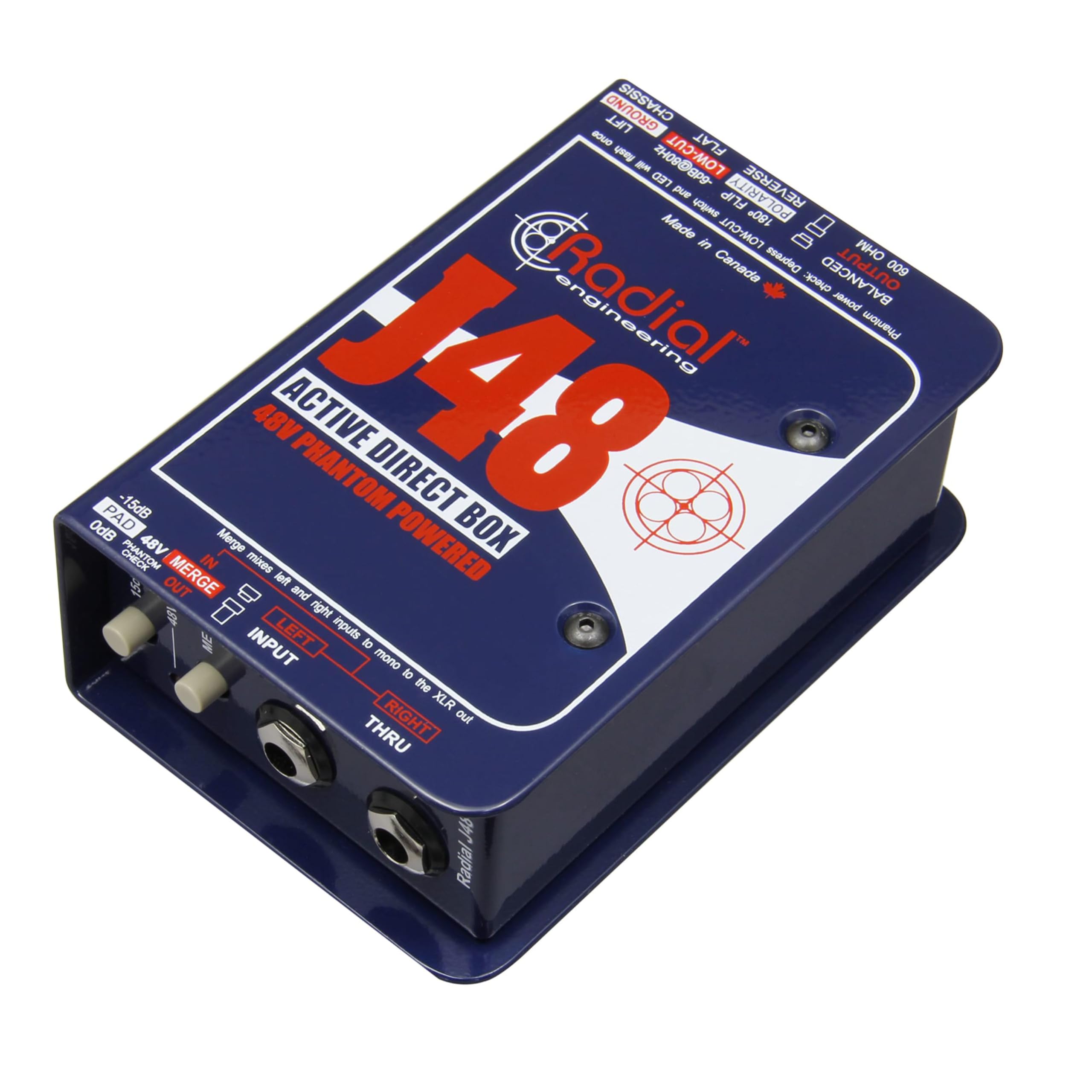
8. Radial J48 MK2 48V Phantom Power Active Direct Box
The flagship phantom-powered DI that FOH engineers praise and studio players treat as their permanent go-to.
The Radial J48 MK2 is the box that other active DIs get compared to, and it earns that spot with a full feature set wrapped in a 1.5-pound alloy steel tank. It runs a 9V rail voltage powered by 48V phantom, and the 1/4″ input and thru, merge, pad, polarity, ground lift, and low-cut filter give you every tool to solve any signal problem on the fly. It’s the complete package, which is why it’s the best all-around DI box in owner feedback.
What wins people over is how it transforms quiet, passive instruments. A Fender American Jazz Bass with stock pickups suddenly gets a level boost with no distortion and full frequency response — shoppers say FOH engineers praising the tone. The steel case is described as rock-solid tank build, and the sound is crisp and neutral across active bass, passive electric, and low-output piezo mandolin alike. One keyboardist in a band says phantom power makes a big difference in their recorded tracks.
The build is compact at roughly 6.5 x 4.1 x 3.1 inches, and it’s the standard against which the Samson MDA1 was measured — the Samson held its own, which speaks volumes. With a 4.8-star rating across 120+ ratings, it’s among the highest-rated boxes here and a genuine lifetime purchase for serious players. It’s phantom-only, so no battery backup, but if you’re always near a real mixer, that’s rarely a concern.
Why It’s The Standard
- Boost quiet passive pickups to full, undistorted level
- Full control set — merge, pad, polarity, ground lift, low-cut
- Alloy steel tank build good for years of touring
- Neutral, transparent tone across many instrument types
The Fine Print
- No battery option — strict 48V phantom requirement
- Premium build demands a premium budget
- Merge feature is handy but rarely the reason to buy
Invest if you’re serious: studio and stage players who want one DI that never needs replacing — this is the one to buy and forget.
Look at the Samson instead if: you want 90% of this performance at a fraction of the price and don’t need the full feature set.
9. Rupert Neve Designs RNDI 1-Channel Active Instrument Direct Box

The reference-grade DI that makes every instrument sound musical — with custom transformers and a discrete FET circuit.
If there’s a single box that guitar players describe as the best DI they’ve ever heard, it’s the Rupert Neve Designs RNDI. The custom transformers and discrete FET amplifier circuit deliver a pure, musical tone that buyers report is a night-and-day improvement over other premium boxes like the Radial JDI or J48. One owner calls it the best piece of pro audio gear they’ve ever purchased, with keyboard sounds that come alive and acoustic tones stripped of all harshness.
The standout feature is the Speaker/Instrument switch, which lets you connect it between an amp and speaker as well as between an instrument and amp — that’s rare flexibility. A LED current consumption meter tells you at a glance how much headroom you have, and it all lives in a rugged steel chassis. For acoustic players, the pristine tone with a Gibson Hummingbird gets praised by fans and engineers at every gig. It works like a charm and owners consider it worth every penny.
There are two honest caveats. First, it needs 48V phantom power, and one buyer specifically notes you need a clean mic preamp — running it from a line-in causes coloration. Second, it’s single-channel, and one owner regrets not buying the two-channel version for stereo sources. At 1.02 kg it’s the heaviest of the mono boxes, but that weight is the steel chassis and custom iron doing real work. This is the top-shelf choice for those who hear the difference.
The sound people describe: pure, musical tone that removes harshness and makes instruments sound alive — the thing everyone raves about is the complete tone purity.
Heed the requirements: it demands phantom power from a quality preamp, so budget for that before you buy.
For the tone purist: if you can hear the difference and want the best sound money can buy, this is the final stop.
Think twice if: you play stereo sources or often face mixers without phantom — the Bolanle J22 serves that need better.
Understanding the Specs
48V Phantom Power vs 9V Battery
Phantom power travels down the XLR cable from your mixer, audio interface, or console, so you never worry about battery drain mid-set. A 9V battery option is your safety net on stages where the desk doesn’t supply phantom. Some boxes go further — the Bolanle J22 even accepts 5V USB from a power bank, which is the ultimate fallback. The more power options a box has, the fewer “sorry, I can’t play” moments you’ll face.
Ground Lift and the 60Hz Hum
A ground lift switch breaks the ground loop that causes that low 60Hz hum (a steady electrical buzz) when your gear shares AC power with lighting rigs or other noisy electronics. It’s among the most important controls on an active DI for live players. Engage it when you hear hum you can’t otherwise trace, and the interference typically disappears at the source.
Pad Switch and Headroom
A pad switch (often -15dB, -20dB, or -40dB) reduces the input signal level so hot active pickups or line-level keyboards don’t overload your mixer input with distortion. The more steps available — like the ART’s 0 / -20 / -40 dB — the more source types you can handle with one box. Setting it wrong is the most common beginner mistake.
Balanced XLR and Impedance
An active DI converts your instrument’s high-impedance, unbalanced signal into a low-impedance, balanced output. Balanced XLR is what professional mixers expect, and it rejects noise over long cable runs. The active circuit is what preserves your pickups’ full frequency range, which is why quiet passive pickups sound clear and loud through a console.
FAQ
What is the difference between an active and passive DI box?
Will an active DI box make my passive bass pickups louder and cleaner?
Do I need 48V phantom power on my mixer to use an active DI?
What does the ground lift switch actually do on a live stage?
Can I use an active DI box for stereo keyboards or synths?
What is a pad switch and when should I use it?
Can I use an active DI to send a clean signal to my amp as well as the mixer?
What is reamping and why would I want a DI box that does it?
How much weight difference does a premium DI box make for gigging?
Is an expensive active DI box actually worth it over a cheaper one?
Final Thoughts: The Verdict
For most players, the active di box winner is the Samson MDA1 because it delivers clean, transparent sound that rivals boxes costing three times as much, with phantom or battery power and a steel case built for the road. If you play stereo keyboards, the Bolanle J22 is the one to reach for, thanks to dual channels and three power options. And if you’re a studio player who wants to capture direct and reamped tones at once, the JOYO JDI-48 is the smartest buy of the group.
How We Picked
We do not accept paid placement. Every pick is matched to a real buyer and a real use-case; we do not hands-on test units.
Sources & Methodology
Specifications: manufacturer listings and product documentation. Review insights: verified customer reviews, as of August 2026. Pricing: not shown on this page (it changes often); check the current price via the retailer link.
As an Amazon Associate, Gadgets Feed earns from qualifying purchases. This does not affect which products we feature.