
Our readers keep the lights on and my morning glass full of iced black tea. As an Amazon Associate, I earn from qualifying purchases.
Specs are compiled from manufacturer listings and verified buyer reviews and can change over time — please confirm the key details on the product page before buying.
You need a tracker that fits how you ride. A general fitness watch, like the Amazfit or COROS, logs your rides and also tracks daily steps and sleep. A dedicated bike computer, such as the iGPSPORT or Garmin, mounts to your handlebars and shows maps plus cycling-specific metrics. Pick a watch if you want one device for everything; pick a computer if you want navigation and deeper ride data.
I’m Min — the founder and writer behind Gadgets Feed. This guide is built by comparing the manufacturers’ published specifications and the patterns across verified customer reviews, so you get each pick’s real strengths and trade-offs instead of marketing spin.
Here’s the short version: for turn-by-turn maps on a large touchscreen, activity tracker for cycling buyers should weigh a dedicated computer against a multisport watch for all-day wear.
Our Picks at a Glance

How To Choose The Best Activity Tracker For Cycling
Your first decision is the form factor. A watch stays on your wrist around the clock, so it tracks sleep and heart rate even when you are not riding. A bike computer mounts to your handlebar and gives you larger maps and data built for cycling. Ask yourself: do you want one device for daily life and rides, or a dedicated tool for the bike?
GPS Accuracy and Satellite Systems
A tracker that drops your signal under tree cover ruins a ride log. Look for dual-band GPS, which receives L1 and L5 frequencies to stay locked in high-rise cities. Products like the iGPSPORT BSC500 and SUUNTO Race S use this tech, while simpler units rely on single-band chips that can drift.
Battery Life vs. Display Size
A bright color screen drains power fast. The Amazfit Active 3 lasts up to 12 days on a charge, while the Wahoo Bolt V3 gives you about 20 hours of GPS — you recharge it more often but get a bigger handlebar display. Match battery life to your longest planned ride, not your daily commute.
Sensor Compatibility for Serious Riders
Cyclists who train with power meters or cadence sensors need ANT+ support, which broadcasts data to many devices at once. The Garmin Edge 540 and COROS PACE 3 both pair with external sensors, but a basic watch like the Amazfit Active 3 skips ANT+ entirely. Check whether your heart-rate strap or power meter will talk to your tracker before buying.
Quick Comparison
| Model | Best For | Display | Battery Life | Water Rating | Amazon |
|---|---|---|---|---|---|
| Amazfit Active 3★ Best Overall | All-day watch with GPS | 1.32″ AMOLED | 12 days | Not rated | Amazon |
| iGPSPORT BSC200SBest Value | Budget navigation rides | 2.4″ Color | 25 hours | IPX7 | Amazon |
| iGPSPORT BSC500Top Performer | Touchscreen map navigation | 3.3″ Touch | 25 hours | IPX7 | Amazon |
| COROS PACE 3 | Featherweight training watch | 1.2″ Transflective | 38 hours GPS | Not rated | Amazon |
| Garmin Edge Explore 2 | Easy touchscreen navigation | 3″ Touch | 16 hours | Not rated | Amazon |
| SUUNTO Race S | Premium GPS watch for rides | 1.32″ AMOLED | 30 hours GPS | Not rated | Amazon |
| Garmin Edge 540 | Serious performance training | 2.3″ LCD | 26 hours | Not rated | Amazon |
| Wahoo ELEMNT Bolt V3 | Button control in any weather | 2.3″ LCD | 20 hours | IPX7 | Amazon |
| Hammerhead Karoo | Smartphone-like touchscreen | 3.2″ LCD | 15 hours | Not rated | Amazon |
In-Depth Reviews
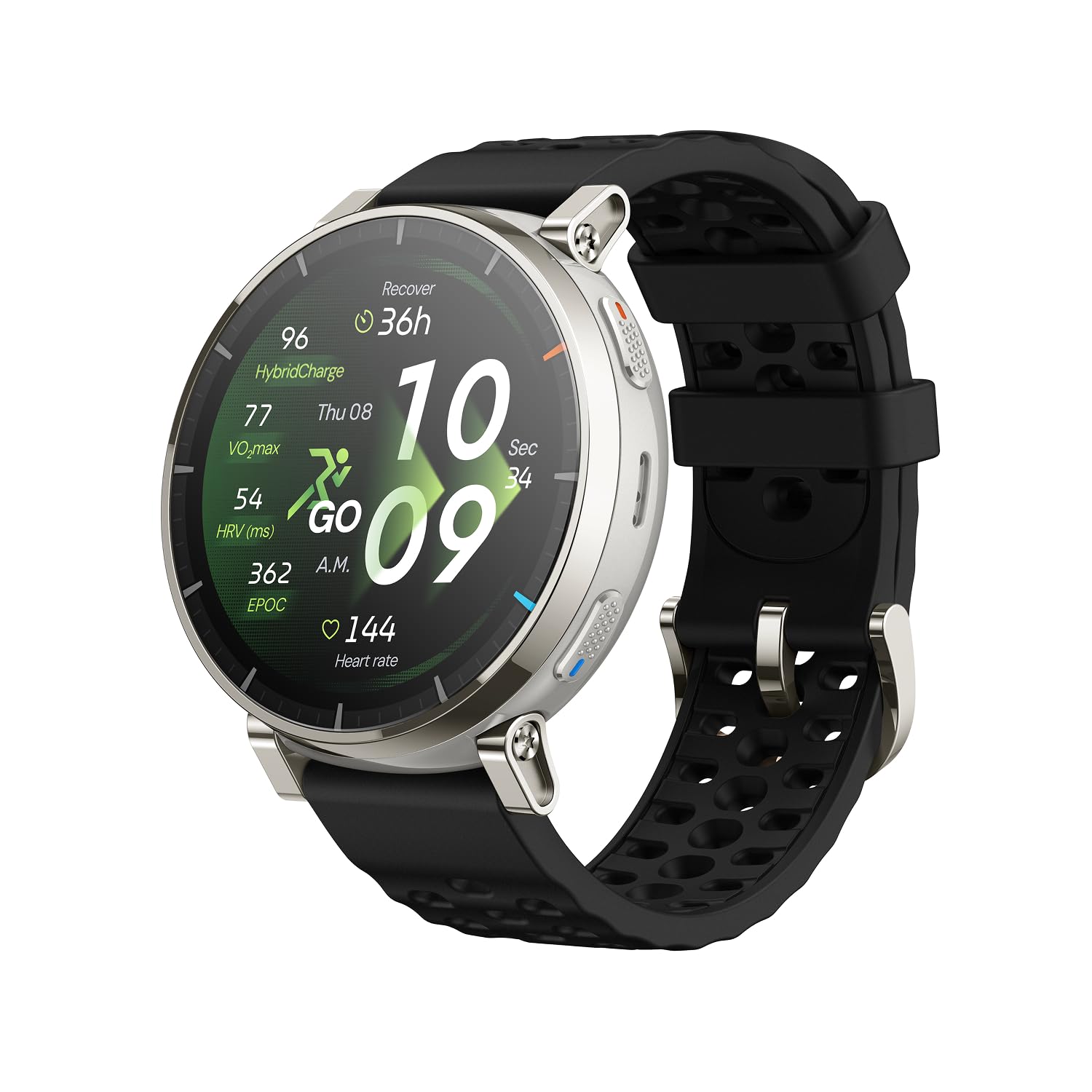
1. Amazfit Active 3 Smart Watch
Our pick — 4.5★ from 300+ verified ratings; the strongest balance of quality and price.
This watch doubles as a cycling computer with offline maps and turn-by-turn directions.
That 1.32″ AMOLED display is vibrant enough to read maps under bright sunlight, a claim backed by owners who say the screen stays sharp outdoors. The sapphire glass and stainless steel frame shrug off the kind of abuse wrist devices see — buyers report 30+ miles, car work, and even hot tub exposure without issues.
You get precise GPS with six satellite systems, plus free offline maps with turn-by-turn directions and automatic rerouting when you stray off course. Critical for cyclists: the Zepp Coach delivers structured running plans, but the bike mode tracks your rides while the BioTracker sensor monitors heart rate, blood oxygen, and stress around the clock. Riders report the battery easily spans multi-day outings, with one owner noting it lasts over 3 days between charges while others see close to the full 12 days.
A factory silicone band feels weak to some, and the app has a learning curve compared to competitors. Owners who switched from a Galaxy 4 found the tracking more accurate, and the double-click plus hold gesture prevents accidental stop during rides.
What wins riders over
- Crisp 1.32″ AMOLED screen holds up in direct sun
- Up to 12 days of battery between charges
- Offline maps with turn-by-turn rerouting
- Sapphire glass and steel frame handle rough daily use
Honest trade-offs
- Factory band feels flimsy to some owners
- Zepp app is less polished than the hardware
- Slightly large for small wrists
Reach for this if: you want one device that tracks rides, sleep, and recovery without constant charging.
Look elsewhere if: you need ANT+ power meter pairing — this watch skips it entirely.
2. iGPSPORT BSC200S GPS Bike Computer
This bike computer packs Garmin-style navigation for a fraction of the typical cost.
Owners consistently describe it as a bargain that does everything they need for a third of the cost of rival computers. The 2.4″ semi-transparent, semi-reflective screen stays readable in direct sunlight, and the 600mAh battery delivers up to 25 hours per charge — one owner rode 194 miles over 19 days and still had 16% left.
For navigation, you can create routes in the iGPSPORT app or import from Strava, Komoot, or Ride with GPS. One-touch navigation sends your chosen destination to the device instantly, and the continue-last-ride function picks up where you left off if you stop for a break. It pairs with iGPSPORT front lights and radar to show power levels and nearby vehicles, plus over 100 riding data points like speed, cadence, grade, and FTP.
The screen is small with tiny fonts, and the side buttons need a firm press with gloves. Some owners found maps low-resolution and unlabeled, and the device is delicate — one survived a year before a handlebar drop ended it.
Why it’s a steal
- 25-hour battery from a 600mAh cell
- IPX7 waterproof rating shrugs off rain
- Imports routes from Strava, Komoot, and Ride with GPS
- Type-C charging tops up in just 1.5 hours
Where it compromises
- Small screen with low-resolution maps
- No lanyard or USB-C cable included
- Polarized sunglasses can black out the display
Grab this for: your first cycling computer or a budget-friendly navigation upgrade.
Think twice if: you need a big readable map with touchscreen pan and zoom.
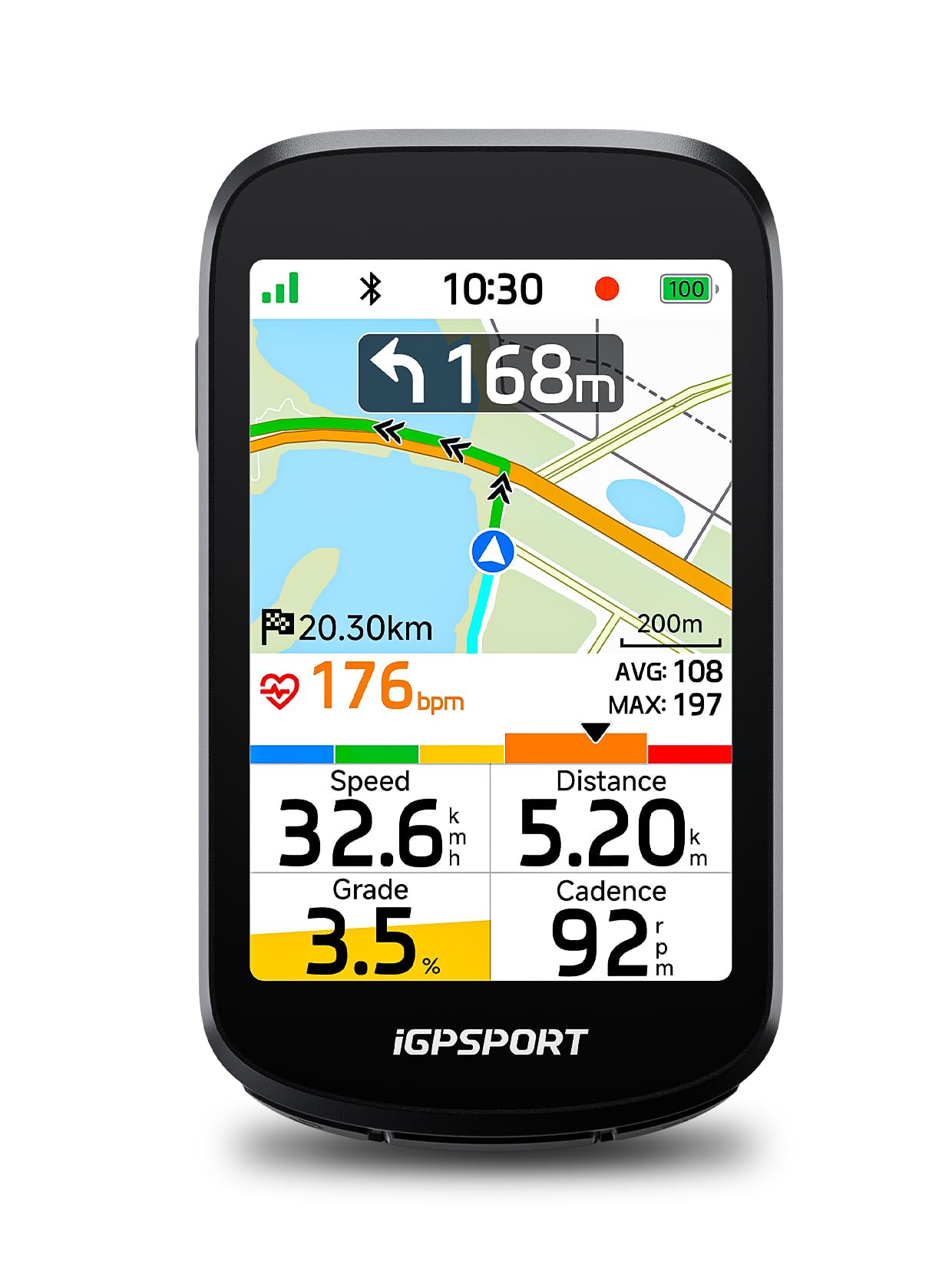
3. iGPSPORT BSC500 GPS Bike Computer
A big touchscreen with voice navigation makes this the closest thing to a car GPS for your bike.
The 3.3″ touchscreen shows up to 12 data fields per page and supports both touch and button control, so gloved hands still work. Dual-band GPS receives L1 and L5 frequencies across five satellite systems — GPS, Beidou, GLONASS, Galileo, and QZSS — and owners mention satellite lock in seconds, even before the first ride.
Turn reminders adjust their warning distance based on your speed; the faster you ride, the earlier the prompt. If you stray off course, yaw planning auto-generates a new route. The loudspeaker delivers voice navigation cues, plus radar alerts when paired with a rear light, so you glance at the screen less and focus on the road. Riders call it superior to Garmin and Bryton for a fraction of the price, with one noting it costs about 25% of a Garmin and 50% of a Bryton.
While the display is sharp in sunlight, the map can feel unlabeled at low zoom, and the companion app has quirks. The battery matches Garmin units at up to 25 hours, and it pairs instantly with cadence sensors and Garmin Varia radar.
Editor’s read: This suits riders who want a big, readable screen with voice prompts but do not want to pay Garmin prices. Its 3.3″ display is 2.5 times larger than the Amazfit Active 3’s 1.32″ screen, so you can preview a route at speed without squinting.
The catch: app navigation quirks and a learning curve for setup. Owners recommend importing routes via Komoot for smoother results.
Best suited for: non-pro athletes who want a big screen, voice cues, and reliable radar pairing.
Pass if: you prefer a tiny, lightweight unit over a larger handlebar display.
4. COROS PACE 3 GPS Sport Watch

At 30g, this watch is nearly unnoticeable yet delivers 38 hours of GPS tracking.
At just 30g with the nylon band and an 11.7mm ultra-slim profile, this watch disappears on your wrist for 24/7 wear — owners love it as a lighter alternative to an Apple Watch for long workouts. The always-on 1.2″ transflective touchscreen stays readable in full sun while sipping power.
Battery life is the headline: 38 hours of continuous GPS tracking or 24 days of daily use. Customers note 8+ days with 23% left, and even 2+ weeks on a single charge with regular use. Dual-frequency GPS keeps tracks accurate even in high-rise cities, and the redesigned satellite chipset locks signal quickly under tree cover.
Run, trail run, bike, swim, strength, snowboard, ski, and XC ski modes cover your whole week. The COROS App builds custom routes and syncs breadcrumb navigation directly to the watch. For cyclists adding a Garmin bike computer, this watch works as a heart-rate monitor via ANT+.
What stands out
- 30g weight with nylon band — barely noticeable
- 38 hours of continuous GPS tracking
- Dual-frequency GPS stays accurate in cities
- Rich workout data in the COROS App
Keep in mind
- Charging cable can be finicky and needs precise positioning
- Watch can shut off below 10% charge
- Workouts don’t close Apple Health Rings without a Strava workaround
Choose this when: you want a dedicated sports watch with marathon-class battery and a featherlight build.
skip it if: you need smartwatch features like music streaming or Apple Health integration from the start.
5. Garmin Edge Explore 2

This 3-inch touchscreen computer offers preloaded maps and quick sensor pairing.
The 3″ high-resolution display is glove- and rain-friendly, staying visible even in direct sunlight. Preloaded road, off-road, and indoor activity profiles work right from the start — one owner set it up and connected radar, cadence, and speed sensors within seconds. Ride type-specific maps highlight popular roads and trails, with high-traffic roads shown directly on the map so you can plan around congestion.
Battery life hits 16 hours, enough for a 30-mile hilly ride at 8,500 feet that barely dented the charge. USB-C charging is a welcome modern touch. When paired with your smartphone, LiveTrack and GroupTrack keep friends updated, while smart notifications and built-in incident detection add safety on outdoor rides. eBike riders get alerts based on battery status, assist level, and range.
The software feels dated to some owners, with clunky menus and no Wi-Fi — cable updates required. Map data can be years old, and the Garmin Connect app is inferior to RideWithGPS for route planning.
Why riders like it: the combination of a large color touchscreen and 16-hour battery in a package that owners call “everything I need, very little I don’t.”
The honest downside: the interface feels like 20-year-old software, and there’s no Wi-Fi for wireless updates.
Perfect for: non-techies who want a big readable map and easy sensor pairing on day one.
Not for: riders who demand the latest maps and a modern app interface.
6. SUUNTO Race S GPS Sports Watch

This 60g watch offers 30 hours of GPS and offline maps for long rides.
At 60g and just 11.4mm thin, the Race S fits nearly everyone with all-day comfort. The 1.32″ 466dpi AMOLED touchscreen is sharp, with a digital crown for easy browsing in any condition. Owners call it an awesome daily tracker for nearly any activity, from cycling to backcountry adventures.
Battery life is the endurance star: 30 hours in performance mode with best GPS accuracy, or 13 days in daily use. Fast charging refills it fully in about an hour — reviewers point out a 2-week battery with regular use and a charge that outlasts races without dying. Dual-band GNSS receives L1 and L5 across five satellite systems for precise tracking in high-rise cities and complex terrain.
With over 95 preset sports modes, from cycling to paragliding, this watch covers your whole athletic life. Global offline maps with 2km zoom-out, route navigation, and find-back navigation keep you oriented. Professional metrics like TSS, CTL, HRV, and VO2 MAX feed into the Suunto App’s AI Coach, and SuuntoPlus connects with 300+ partner services.
Why it earns the premium
- 30 hours in performance GPS mode
- 466dpi AMOLED touchscreen is razor sharp
- 95+ sports modes cover cycling to paragliding
- Fast charging refills in about an hour
Things to weigh
- Heart-rate monitoring is less accurate than Garmin’s
- Maps take a while to download to the watch
- Some shoppers say the device stopping during exercise
Reach for this if: you tackle ultra-distance rides and need navigation tools that rival a bike computer on your wrist.
Look elsewhere if: wrist-based heart-rate accuracy is your top priority for interval training.
7. Garmin Edge 540

This button-driven computer delivers multi-band GNSS and 26-hour battery for training.
The Edge 540 is built for performance, with multi-band GNSS technology for enhanced positioning accuracy in the most challenging environments. Button controls work reliably with gloves and in wet conditions — owners prefer them over touchscreens that misbehave when wet. GPS accuracy stands out, with fast satellite lock even under tree cover.
Battery life reaches up to 26 hours in demanding use, or up to 42 hours in battery saver mode. One owner rode 100+ miles and still had over 75% charge. Daily suggested workouts and training prompts appear on screen, with personalized coaching that adapts to your current training load and recovery when paired with a power meter and heart-rate monitor.
ClimbPro shows remaining ascent and grade on every ride so you can gauge effort, while the power guide recommends targets throughout a course. Stamina insights tell you how much longer you can push it. The button interface has a learning curve, and the 2.3″ LCD display won’t win beauty contests, but the depth of training data is unbeatable at this level.
Editor’s read: ClimbPro shows remaining ascent and grade so riders can pace climbs precisely.. This is the pick for athletes who live in the numbers.
The catch: more complex than a Wahoo, with a steeper learning curve and menu navigation that takes time to master.
Best for: committed cyclists who train with power meters and want structured coaching on the bars.
pass on it if: you just want simple navigation without the training-data rabbit hole.
8. Wahoo ELEMNT Bolt V3
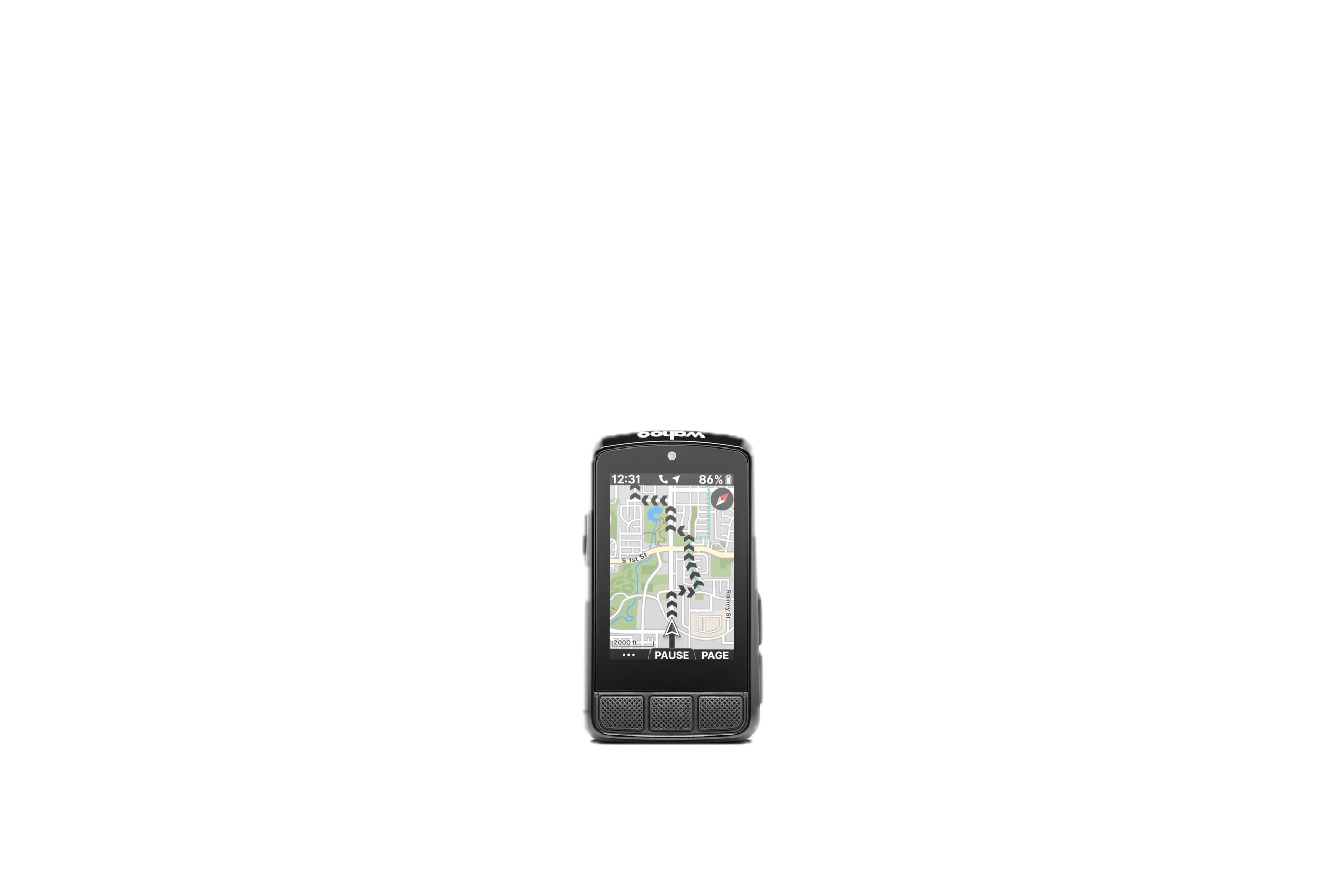
This 84g, button-operated computer is IPX7-rated for reliable use in rain.
The Bolt V3 auto-generates turn-by-turn prompts for routes imported from Strava, Ride With GPS, and Komoot, with top LEDs and audible cues telling you at a glance what’s next. Automatic route downloads and workout uploads happen wirelessly when synced with compatible accounts, so completed rides upload to all authorized platforms without any effort.
At just 84g with a 2.3″ LCD screen, owners call it compact as a Tic Tac. All buttons, no touchscreen — a deliberate choice that owners praise for gloves, sweat, and rain. One rider prefers these buttons over any touchscreen for wet-weather riding. The IPX7 rating handles downpours, and pairing with ANT+ rearview radar shows approaching vehicles directly on the screen with LED alerts.
Battery life hits 20 hours, and the device pairs flawlessly with heart-rate straps, power meters, and lights. The core issue is reliability — some buyers report connection problems with the GPS live tracker, though a restart usually fixes it. The screen brightness ships set for battery optimization, which can be too dim in sunlight until you change it.
Why it shines
- 20-hour battery with IPX7 waterproofing
- Physical buttons work great with gloves and in rain
- Automatic sync with Strava, Ride With GPS, and Komoot
- Compact 84g design mounts easily on any bar
What owners flag
- Occasional GPS live tracker connection issues
- Screen brightness needs adjusting for sunlight
- Pan and zoom feature removed in newer models
Choose this when: you ride in all weather and want a compact, dependable button computer.
Reconsider if: you want a touchscreen experience or need offline music storage.
9. Hammerhead Karoo Bike Computer

This 3.2-inch touchscreen offers phone-like responsiveness and customizable screens.
The Karoo’s 3.2″ LCD touchscreen responds like a phone, and owners say you can easily adjust the display for as much or as little information as you want. The maps are good, with multi-band GNSS technology ensuring accurate tracking from city streets to rugged trails. One rider, after 15 years in the Garmin ecosystem, permanently exited thanks to the Karoo’s intuitive design and clear, fully customizable screens.
Battery life reaches 15 hours, and ample storage memory speeds up map rendering so you spend less time waiting and more time exploring. Connectivity spans SRAM AXS components, E-Bikes, and ANT+ lights, with instant pairing reported for sensors. The touchscreen stays responsive even with gloves, and the device reads clearly in all light conditions.
While the Karoo earns praise as a navigation king, reliability is the recurring caution — some owners mention it stopped working after a few months, and one had a 15-year Garmin veteran switching permanently. The price sits at the premium end, and value for money gets mixed reviews. Those who love it call it the best computer they’ve owned.
What wins people over: the intuitive touchscreen UI, fully customizable screens, and maps that rival a car GPS. Owners say it’s “outstanding” and a “versatile” choice.
The honest trade-off: reliability reports are split — some riders hit a dead unit after a few months while others swear by it daily.
Best suited for: tech-savvy riders who want a phone-like navigation experience and deep SRAM AXS integration.
Pass if: you’re budget-conscious or need proven long-term reliability over cutting-edge features.
Understanding the Specs
GPS and Dual-Band GNSS
Dual-band GNSS receivers listen to L1 and L5 frequencies simultaneously, which locks your position faster and holds it under tree cover or between tall buildings. Single-band trackers drift more in these conditions, so riders in cities or forests should prioritize dual-band models like the BSC500 or SUUNTO Race S.
Battery Life in Hours vs. Days
Watches quote daily-use battery (Amazfit at 12 days, COROS at 24 days), while bike computers quote GPS-active hours (BSC500 at 25 hours, Edge 540 at 26 hours). For a full day of riding, you need 15+ GPS hours; for multi-day bikepacking, look at 25+ hours or a watch with 30+ GPS hours like the COROS PACE 3.
FAQ
What is the difference between a cycling watch and a bike computer?
Will my power meter or cadence sensor pair with an activity tracker?
How many hours of GPS battery do I need for a long ride?
What does IPX7 waterproof rating mean for cycling?
Can I use a fitness tracker for both cycling and running?
How does turn-by-turn navigation work on a bike computer?
Will my tracker sync rides to Strava automatically?
What is the best budget activity tracker for cycling?
Final Thoughts: The Verdict
For most riders, the activity tracker for cycling winner is the Amazfit Active 3 because its 12-day battery, 1.32″ AMOLED screen, and six-satellite GPS make it the most versatile all-day companion. If you want a big touchscreen with voice navigation on your handlebars, grab the iGPSPORT BSC500. And for serious training data with stamina insights and ClimbPro, the Garmin Edge 540 is the one to reach for.
How We Picked
We do not accept paid placement. Every pick is matched to a real buyer and a real use-case; we do not hands-on test units.
Sources & Methodology
Specifications: manufacturer listings and product documentation. Review insights: verified customer reviews, as of August 2026. Pricing: not shown on this page (it changes often); check the current price via the retailer link.
As an Amazon Associate, Gadgets Feed earns from qualifying purchases. This does not affect which products we feature.