
Our readers keep the lights on and my morning glass full of iced black tea. As an Amazon Associate, I earn from qualifying purchases.
Specs are compiled from manufacturer listings and verified buyer reviews and can change over time — please confirm the key details on the product page before buying.
Blasting eats air faster than almost any other tool in a workshop. A sandblaster or media blaster can drain a small tank in seconds, leaving you waiting for the pump to catch up instead of working. The single number that decides whether a compressor can handle blasting is CFM at 90 PSI, not the motor’s horsepower or the tank’s PSI rating. This guide focuses on that metric, tank size, and pump durability, so you pick a unit that keeps the nozzle moving.
I’m Min — the founder and writer behind Gadgets Feed. This guide is built by comparing the manufacturers’ published specifications and the patterns across verified customer reviews, so you get each pick’s real strengths and trade-offs instead of marketing spin.
The list below uses flexible matching for high CFM output and larger tanks, so not every pick is the exact size you searched, but the nearest same-type unit serves the same purpose. Here is our breakdown of the air compressor for blasting to help you decide where your money goes.
Our Picks at a Glance


How To Choose The Best Air Compressor For Blasting
Blasting is the toughest job you can give an air compressor, so the buying rules are different than for nail guns or tire inflation. You need sustained air volume, a tank that buffers the demand, and a pump that can run for long stretches without overheating. Understanding these three pillars will keep you from buying a unit that stalls mid-job.
Prioritize CFM at 90 PSI Over Everything
The CFM (cubic feet per minute) rating at 90 PSI tells you how much air the pump actually delivers under load. A sandblaster typically needs 10+ CFM to work properly, and if your compressor can’t keep up, the nozzle pressure drops and the blasting slows to a crawl. Look at the 90 PSI number first; a unit that delivers 13.7 CFM will outwork a smaller pump even if the horsepower numbers look similar.
Match Tank Size to Your Blasting Duration
Tank capacity acts as a buffer between the pump and the nozzle. A 20-gallon tank gives you a short burst before the pump refills, which is fine for spot jobs. An 80-gallon tank holds a much larger reserve, so you can blast continuously for minutes without the pressure dropping below your working range. If you are painting or blasting a full vehicle, bigger is genuinely better here.
Choose Pump Style for Continuous Use
Oil-free pumps are lower maintenance and quieter, but oil-lubricated cast iron pumps are built for the heat and wear of continuous duty. Two-stage pumps compress air twice for higher pressure and efficiency, which is why serious shops prefer them. The material of the pump head, such as FC35 Grade cast iron, tells you how long the unit will survive regular blasting sessions.
Quick Comparison
| Model | Best For | Air Flow (CFM) | Tank Size | Max Pressure | Amazon |
|---|---|---|---|---|---|
| NorthStar Gas (5.5 HP)★ Best Overall | Portable remote jobs | 13.7 cfm | 20 gallons | 90 PSI | Amazon |
| NorthStar Pump (13 HP)Top Performer | Custom high-volume builds | 24.4 cfm | 30 gallons | 175 PSI | Amazon |
| VEVOR 80 Gal (6.5 HP)Quiet Giant | Quiet shop production | 15.5 cfm | 80 gallons | 145 PSI | Amazon |
| VEVOR 15HP Gas | High output portability | 33 cfm | 30 gallons | 115 PSI | Amazon |
| California Air Tools 60 Gal | Noise-sensitive workshops | 10.6 cfm | 60 gallons | 125 PSI | Amazon |
| DEWALT 60 Gal | High-pressure two-stage work | 15.3 cfm | 60 gallons | 175 PSI | Amazon |
| Ingersoll Rand 2340L5-V | Reliable continuous sandblasting | 14 cfm | 60 gallons | 175 PSI | Amazon |
| Ingersoll Rand 2475N7.5 | Professional shop demand | 24 cfm | 80 gallons | 175 PSI | Amazon |
In‑Depth Reviews
1. NorthStar Gas-Powered Air Compressor, 90 PSI, 13.7 CFM
Our pick — 4.5★ from 70+ verified ratings; the strongest balance of quality and price.
A gas-powered workhorse that follows you anywhere there’s no power outlet.
The Honda GX160 OHV engine with low oil shutdown is the heart here, and it starts reliably every time according to the majority of owners. That engine drives a full cast iron pump with a V-style cylinder design, which keeps it cooler during long runs. With 13.7 cfm of air flow and a 20-gallon tank, it delivers enough volume for steady blasting and spraying without constantly cycling.
The floating-type Swedish steel valves are a durability highlight, giving you much longer valve life than cheaper pumps. At 217 pounds, it is not light, but buyers report it is not much heavier than the electric motor version of the same compressor. Its 41″L x 19″W x 40″H footprint and wheels make it maneuverable for remote sealcoat spraying, where it held 90 PSI without complaint.
Owners mention a few delivery issues, including an improperly installed fitting and a throttle valve rubbing the gas tank, but the fixes were simple flips and additions of rubber. After those small repairs, it ran 20 hours flawlessly blowing sprinklers, with the plastic throttle tube holding up. This is the balanced pick for someone who needs gas portability and cast iron reliability in one package.
Why It Wins The Shop
- Honda GX160 engine starts on first crank, a huge plus for remote sites
- Full cast iron pump with Swedish steel valves for a long service life
- Holds 90 PSI steadily for spraying and light blasting tasks
What To Watch
- Occasional delivery quality issues like loose fittings to check on arrival
- 20-gallon tank limits long continuous blasting sessions
- 217-pound weight is hard to maneuver solo on uneven ground
Reach for this if: you work at job sites without electricity and need a dependable gas unit that starts every time.
Look elsewhere if: you plan to blast for hours at a stretch, as the 20-gallon tank will have the pump cycling often.
2. NorthStar Air Compressor Pump, 175 Max. PSI, 24.4 CFM at 90 PSI, 2-Stage
A monster pump for custom builds that never lets a sandblaster run low.
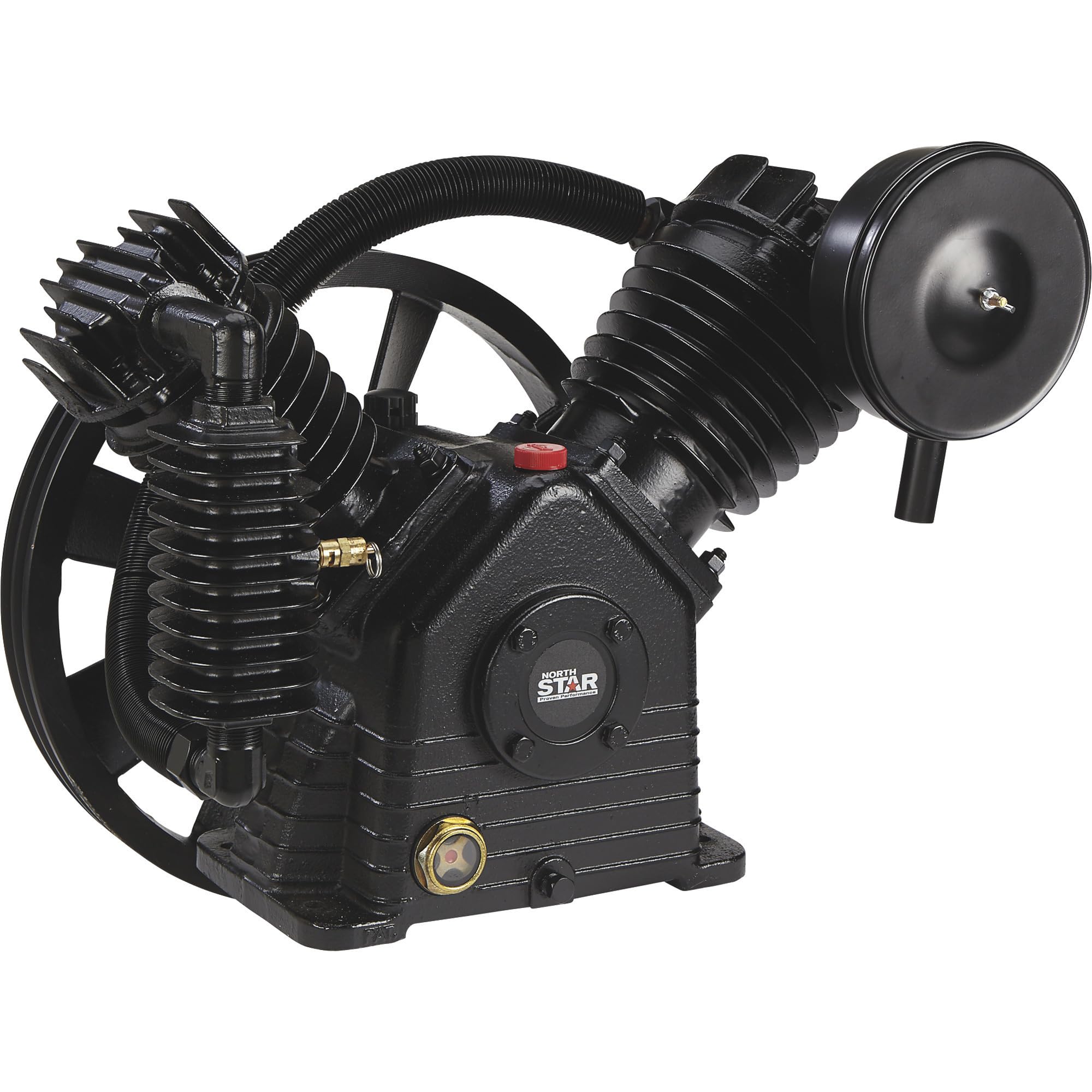
This is not a plug-and-play compressor; it is the bare pump you pair with your own motor and tank for a serious blasting setup. The headline is 24.4 cfm at 90 PSI, which is a 2.4x jump over the 13.7 cfm of the gas NorthStar above. That volume gap is exactly why owners upgrading from smaller units say their sandblaster never runs low on air.
The full cast iron construction with FC35 Grade pump head and floating-type Swedish steel valves gives it the durability for continuous duty. It operates at a slower RPM to run cooler and last longer, a design choice that pays off when you are blasting for extended periods. At 135 pounds, it is heavy and needs two people to move, but the 21″L x 21″W x 21″H dimensions make it compact once mounted.
You get the advertised 24.4 CFM (cubic feet per minute, the airflow that drives your blaster) as long as you pair it with the right motor and pulley, and customers note it fills a 100-gallon tank to 175 psi (pounds per square inch, the pressure that pushes abrasive) from empty in just over six minutes with a 5 hp electric motor. The catch is installation: you must use flare fittings, not compression fittings, because compression fittings blow off under that pressure. One reviewer noted metal particles in the oil after an hour, but that appears to be an isolated defect rather than the norm.
Insider’s note: This pump rewards buyers who already have a tank and motor, delivering heavy volume at a fraction of the cost of a complete premium unit.
The trade-off: You must handle the plumbing and mounting yourself, and the flare fitting requirement is non-negotiable for safe operation.
3. VEVOR 80 Gallon Air Compressor, 145PSI Oil Free Stationary
An 80-gallon oil-free unit that paints a whole car without dropping below 120 psi.
The selling point here is the massive 80-gallon tank, which dwarfs the 20-gallon capacity of the gas NorthStar by a 4.0x margin. That huge reserve means you get sustained air supply for painting and blasting without the pump cycling constantly. The 6.5 HP oil-free motor delivers 15.5 SCFM at 90 PSI, enough to keep a spray gun or small blaster moving steadily.
It is an 86dB low-noise stationary compressor, so it is noticeably quieter than typical shop units. Reviewers point out it is oil-less, quiet, and has fast recovery, with one painting a full car without the pressure dropping below 120 psi and finding no water in the tank. The high-strength cold-rolled steel plate tank is built to handle harsh workshop environments without gas leakage.
You need 220V/60Hz single-phase power and a hardwire connection, as the included 4-foot 12-gauge wire is too short for most setups. The 264.6-pound weight means it is a permanent installation, not a portable tool, and it runs hot so anchoring and padding are recommended. It arrives without a regulator, so budget for that accessory plus a water separator for painting work.
Why it stands out: The oil-free design cuts maintenance and noise, while the 80-gallon reserve handles long production work in a fixed shop spot.
Before you commit: Confirm your 240V wiring is ready, and plan to add a regulator and separator for clean, controlled airflow.
4. VEVOR 15HP Gas Powered Air Compressor, 30 Gallon Horizontal

Piston-pump power up to 33 cfm that fills truck tires and runs spray guns with ease.
The 33 cfm at 115 PSI is the highest raw volume here, a 2.4x step up from the NorthStar gas unit’s 13.7 cfm. That output comes from a 15 hp gas-driven piston pump, and the difference in maximum horsepower is equally stark — 15 hp versus the 5.5 hp of that same NorthStar, a 2.7x gap. It allows for fast inflation, with the manufacturer claiming a 2-minute fill time on many tasks.
The 30-gallon horizontal tank with dual air outlets lets you run two tools simultaneously, which is handy for blasting while a second tool stays pressurized. Four smooth-rolling wheels make it genuinely portable for outdoor projects, and the automatic shut-off protects the pump by shutting down during low oil levels. Cast iron cylinders and frames resist wear and deformation under heavy use.
Owners are impressed with how it runs spray guns and builds pressure fast, even from a “little guy” perspective. However, a few flagged quality issues: a non-functional pressure relief valve on one unit, an outlet gauge that read inaccurately, and a quick connect that was incompatible with US hoses. One buyer mentioned a breakdown within five months, so inspect the fittings carefully upon arrival.
What You Gain
- 33 cfm output handles heavy blasting and simultaneous dual-tool use
- Gas engine means it works anywhere, no power cord needed
- Wheels make this high-output unit genuinely mobile
Quality Checkpoints
- Fittings like the quick connect may need swapping for US-standard hoses
- Some units arrived with minor damage or gauge inaccuracies
- Support can be hard to reach, per owner reports
Choose this for: high-volume gas portability where you need 33 cfm on wheels without a power source.
Think twice if: you want a set-and-forget stationary unit, since the gas engine and fittings need more attention.
5. California Air Tools CAT-60040CAD 4.0 HP Ultra Quiet

The 75-decibel unit that lets you hold a conversation while it runs.
Noise is the defining trait here — it operates at only 75 dBA, making it one of the quietest compressors in its class. That is achieved with twin 2.0 HP motors running at just 1680 RPM, a design that creates less noise and wear. Owners who replaced 29-year-old loud compressors measured it at 79dB at one foot and 72dB at twelve feet, which makes shop conversation possible while it works.
The 60-gallon ASME tank provides solid reserve for blasting, and the oil-free dual piston pump lasts over 3,000 hours. Airflow is 12.80 CFM at 40 PSI and 10.60 CFM at 90 PSI, which is lighter than the other heavy hitters here but still workable for smaller blasting jobs. A factory-installed EZ-1 Automatic Drain Valve removes the chore of manual draining with a pre-set timer.
The 98% Air Dryer System keeps moisture out of your lines, a real bonus for painting. One owner ran it for six years on a 20A breaker without issues, only dealing with small slow leaks causing a restart every 24-36 hours. The trade-off is that CFM is the lowest of the 60-gallon units here, so it suits lighter blasting and general shop use better than full-time sandblasting.
The appeal is obvious: near-silent operation with a large 60-gallon tank and auto-drain maintenance for a home workshop.
Know your limits: At 10.6 cfm, it won’t feed a hungry production blaster the way the 24 cfm units will.
6. DEWALT 60-Gallon Stationary Vertical Air Compressor
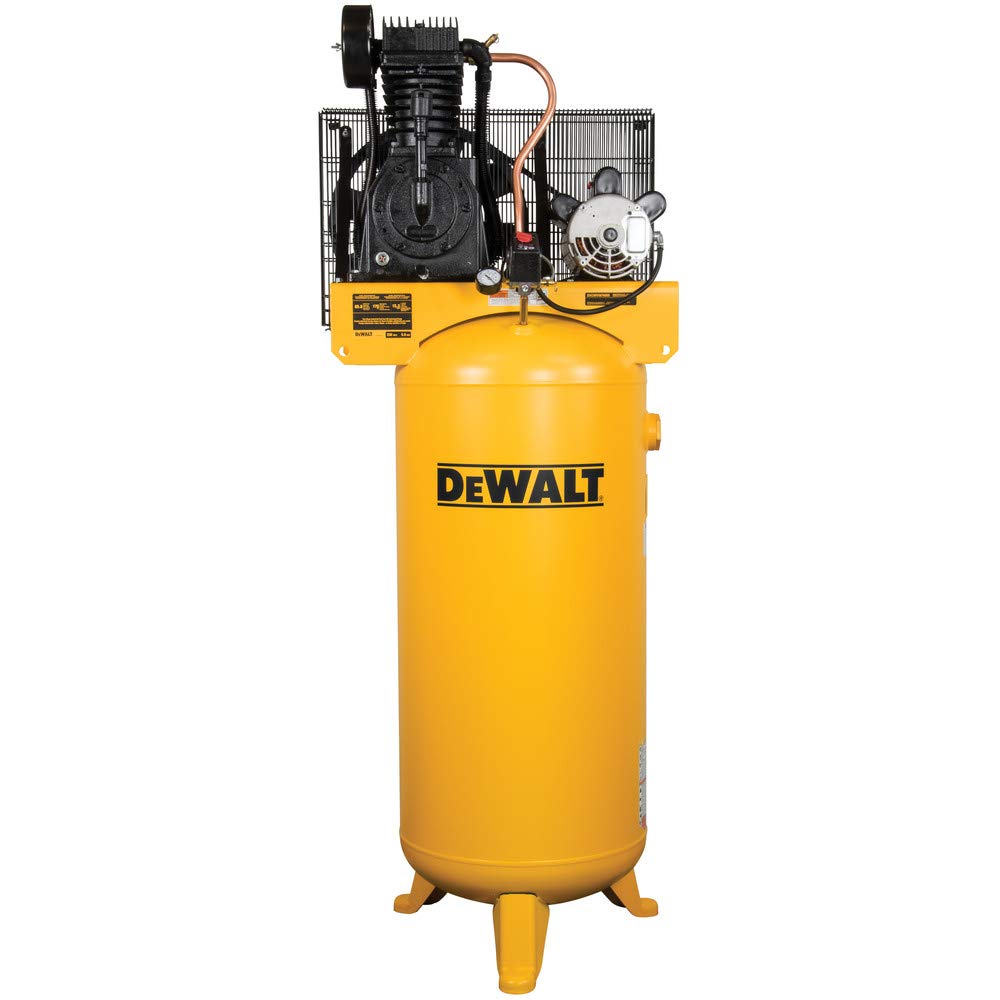
A two-stage vertical that hits 175 PSI and holds pressure for days.
The two-stage pump is the story here, delivering 15.3 SCFM at 100 PSI and 13.5 SCFM at 175 PSI. That high-pressure capability is what separates it from single-stage units, giving you more stored energy for impact tools and blasting. A 5 HP, 230-volt electric motor with thermal overload protection keeps it running consistently without overheating.
At 65 dB, it’s one of the quietest stationary compressors here, ideal for noise-sensitive workshops. The 60-gallon tank pressure gauge lets you easily monitor the two-stage pump, and the vertical design boost floor space. Shoppers say it holds pressure remarkably well, with one noting it still had pressure after seven days off.
Build quality earns consistent praise, with multiple buyers calling it flawless in operation and appreciating how quickly it reaches 170 psig. Quality control is a recurring concern — one unit shipped with a hole in the welded seam, a serious issue that took time to resolve. Also, the wiring instructions are sparse, so plan for a professional hookup of the 230V circuit.
The Strong Suit
- Two-stage pump delivers 175 PSI for high-demand work
- 65 dB operation is among the quietest here
- 60-gallon vertical tank saves valuable shop floor space
The Risk
- Quality control slips on some units, including weld issues
- Missing wiring instructions complicate the 230V install
- Heavier and taller than horizontal designs, at 80″H
Best for: buyers who want high PSI and quiet operation in a compact vertical footprint.
Proceed with care if: you need a flawless out-of-the-box unit, since a few shipments had QC problems that required warranty support.
7. Ingersoll Rand 2340L5-V 5 HP Type 30 Two-Stage

A cast iron 5 HP two-stage that blasts AR15 parts in a third of the time.
The Type 30 design with individually cast cylinders and a one-piece connecting rod is built for 100% continuous duty, which is exactly what blasting demands. It delivers 14 cfm of air flow and runs at 230 volts single phase, making it a straightforward shop installation. The 60-gallon vertical tank gives you the reserve to keep a nozzle moving without constant pump cycling.
Owners who sandblast share a consistent story: it took a third of the time and made half the noise compared to their old 30-gallon units. The cast iron construction handles high volume and high pressure without interruption, and it reaches 150 PSI quickly. At 430 pounds, this is a permanent anchor in your shop, not a tool you move around.
The main caveat is setup scrutiny — one buyer found pump bolts not even started and a stripped drain plug, so a full bolt check on delivery is wise. It also requires the manufacturer’s oil for the two-year warranty to hold. Some owners add aftermarket drain valves and wire it for 220V themselves for a cleaner setup. This is the reliable choice for someone who values continuous-duty build over portability.
The enduring appeal: A genuine continuous-duty two-stage that cuts blasting time significantly while running quieter than single-stage rivals.
The homework: Budget for a thorough arrival inspection and the correct Ingersoll Rand oil to keep the warranty valid.
8. Ingersoll Rand 2475N7.5 7.5 HP Two-Stage

A heavy-duty 7.5 HP two-stage with an 80-gallon tank for shops that never want to run dry.
This is the flagship of the lineup, pairing a 7.5 hp two-stage pump with an 80-gallon ASME receiver tank and 175 psig maximum operating pressure. It moves 24 cfm of air, putting it level with the NorthStar pump above but as a complete, factory-assembled unit. The cast iron pump is rated for 15,000+ hours of continuous duty, the durability benchmark for professional blasting.
The All Season Select synthetic lubricant runs 2,000 hours between changeouts, four times longer than petroleum-based oils. At 611 pounds, this is a serious piece of machinery built for a medium-sized shop that will never run out of air, as owners put it. The 38″L x 24″W x 70″H footprint demands floor space, but the output justifies the footprint.
Owners call it phenomenal and more substantial than they need, a common sentiment for overachieving hardware. The synthetic oil is expensive, and that is the one recurring complaint about running costs. A two-year warranty is available if you purchase the All-Season Select lubricant start-up kit, which also includes first-year maintenance parts.
The Heavyweight Case
- 24 cfm and 175 PSI from an 80-gallon tank handles the biggest blasting jobs
- 15,000-hour pump life means decades of shop service
- 2000-hour oil intervals cut maintenance time dramatically
The Cost Of Power
- 611-pound weight requires a permanent, reinforced floor spot
- Premium synthetic oil adds a recurring expense
- 7.5 HP at 230V needs a serious electrical circuit
For the professional: If your shop runs blasting daily and downtime is not an option, this 24 cfm, 80-gallon unit is the endgame.
For the hobbyist: The power and price are overkill for occasional use, so a smaller two-stage saves money without sacrificing much.
Understanding the Specs
CFM at 90 PSI
CFM (cubic feet per minute) is the volume of air the pump delivers at a given pressure. For blasting, the 90 PSI number is the one that matters, because that is the pressure range most blasters operate in. A unit delivering 13.7 cfm will struggle to feed a large nozzle, while 24 cfm or more keeps production moving. Always compare this number first, before horsepower or tank size, because it directly determines whether your tool gets enough air.
Two-Stage vs. Single-Stage Pumps
A single-stage pump compresses air once, while a two-stage pump compresses it twice for higher pressure and better efficiency. Two-stage units like the Ingersoll Rand models deliver 175 PSI, which means more stored energy in the tank and faster recovery under load. They also run cooler and last longer, making them the right choice for continuous blasting duty where the pump runs for extended periods without rest.
FAQ
How much CFM do I need for sandblasting?
Will a 20-gallon tank work for blasting?
What is the difference between oil-free and oil-lubricated pumps for blasting?
Can I use a gas-powered compressor for blasting indoors?
Is a two-stage compressor worth the extra cost for blasting?
What size of tank is best for a home workshop blasting setup?
How loud are blasting compressors in decibels?
Do I need special fittings for a high-CFM blasting compressor?
How long should a blasting compressor last with regular use?
What electrical requirements do I need for a stationary blasting compressor?
Final Thoughts: The Verdict
For most people, the air compressor for blasting winner is the NorthStar Gas-Powered Air Compressor because it pairs a dependable Honda engine with cast iron build quality, offering reliable portability for remote jobs. If you want high-volume output for a custom tank setup, grab the NorthStar 24.4 CFM Pump. And for a professional shop that needs continuous-duty power, the Ingersoll Rand 2475N7.5 is the one to reach for.
How We Picked
We do not accept paid placement. Every pick is matched to a real buyer and a real use-case; we do not hands-on test units.
Sources & Methodology
Specifications: manufacturer listings and product documentation. Review insights: verified customer reviews, as of August 2026. Pricing: not shown on this page (it changes often); check the current price via the retailer link.
As an Amazon Associate, Gadgets Feed earns from qualifying purchases. This does not affect which products we feature.