
Our readers keep the lights on and my morning glass full of iced black tea. As an Amazon Associate, I earn from qualifying purchases.
Specs are compiled from manufacturer listings and verified buyer reviews and can change over time — please confirm the key details on the product page before buying.
You want speakers that sound great while staying affordable, and under $150 you have two real choices: a powered set that plugs into anything, or a passive pair that needs an amplifier but lets you shape the sound. Either way, you can skip the thin, tinny audio of cheap speakers — the picks here deliver real bass, clear vocals, and build quality that feels like it costs more.
I’m Min — the founder and writer behind Gadgets Feed. This guide is built by comparing the manufacturers’ published specifications and the patterns across verified customer reviews, so you get each pick’s real strengths and trade-offs instead of marketing spin.
Whether you’re upgrading a desk setup or building a small living room system, the best bookshelf speakers under $150 balance real bass, clear highs, and honest build quality for the money.
Our Picks at a Glance


How To Choose The Best Bookshelf Speakers Under $150
The first fork in the road is powered versus passive. Powered speakers have a built-in amplifier, so you plug them in, connect a source, and listen. Passive speakers need a separate amplifier or receiver, which adds cost and a little setup effort, but often rewards you with better detail and the freedom to upgrade gear later.
Match the speaker to your room and gear
Think about your space first. A compact pair with a 4-inch woofer can still fill a small to medium room, but if you want serious low-end thump for a larger living area, a 5-inch driver gives you more physical bass presence. Also check what you’re connecting — a turntable or TV usually pairs well with passive speakers and a receiver, while a phone or laptop works easily with powered Bluetooth models.
Don’t ignore the tweeter and crossover
The tweeter handles the high frequencies, and a silk dome tweeter (a soft fabric dome that reproduces highs smoothly) is the most common choice here because it avoids harshness. The crossover is the circuit that splits the audio signal between the woofer and tweeter; a steeper slope, like 18dB/octave, means the drivers blend more cleanly at higher volumes with less distortion.
Quick Comparison
| Model | Best For | Driver Size | Type | Connectivity | Amazon |
|---|---|---|---|---|---|
| Micca RB42★ Best Overall | Deep bass in a compact pair | 4-inch woofer | Passive | Wired | Amazon |
| Jamo S 803Home Theater Star | Home theater and TV setups | 5-inch woofer | Passive | Wired | Amazon |
| Micca MB42X G2 | Near-field listening and small rooms | 4-inch carbon fiber woofer | Passive | Speaker Wire | Amazon |
| HiVi-Swans Oasis 140 | Budget audiophile value | 4-inch metal woofer | Passive | Wired | Amazon |
| Edifier R1280T | Easy plug-and-play with remote | 4-inch full range unit | Powered | AUX (2 inputs) | Amazon |
| Pyle 5.25″ | Loud, room-filling output | 5.25-inch woven woofer | Passive | Wired (RCA binding posts) | Amazon |
| Edifier MR3 | Studio-style monitoring with Bluetooth | 3.5-inch mid-low driver | Powered | Bluetooth 5.4, RCA, AUX, TRS | Amazon |
In‑Depth Reviews
1. Micca RB42 Reference 2-Way Passive Bookshelf Speakers
Our pick — over 4.5★ from 800+ verified ratings; the strongest balance of quality and price.
The compact pair that lets you unhook your subwoofer and still feel the bass.
The Micca RB42 earns its spot for one reason: the low end. Its 4-inch woofer (the driver that handles bass) uses a long throw design with a coated pressed paper cone, and reviewers call the bass “surprising” for the size — One owner measured clear output down to 45Hz in their room.. If you play EDM or hip-hop in a 20×20 room, this pair makes a subwoofer feel optional, which is rare at this price.
The engineering underneath is what separates it from cheaper passive pairs. A 10-element crossover splits the signal with an 18dB/octave slope — dramatically steeper than the 12dB/octave on the Micca MB42X G2 below — which the maker says boosts power handling and reduces distortion at high volumes. Its 0.75-inch silk dome tweeter uses a neodymium magnet for efficiency., and the sound signature is smooth and silky rather than bright or piercing.
The honest trade-off is power. These are inefficient speakers, so they want an amplifier with real wattage to shine — pair them with a decent class D amp and you’re in business, but a weak receiver will leave them sounding anemic. They’re also 7.9 inches deep and rear ported, meaning they need clearance from the wall behind them to breathe. Buyers report they’re ideal as surrounds or for a PC setup, and are recommended with Kanto SP32PL stands if you want them off the desk.
What Wins People Over
- Deep, punchy bass that rivals much bigger speakers
- Silky smooth highs with zero harshness
- Solid MDF cabinets with magnetic grills
Know Before Buying
- Power hungry — needs a high-wattage amp to perform
- Rear ported, so they need wall clearance behind them
- Port noise can appear at very high volumes
The crowd favorite: If you want maximum bass and don’t mind adding a real amplifier, this is the pair to build a system around.
Consider elsewhere: If you need plug-and-play simplicity without an amp, a powered model like the R1280T below is easier.
2. Jamo S 803 Black – Pair
The stylish 5-inch pair that makes your TV and receiver sound dramatically better.
If your speakers sit next to a television, the Jamo S 803 fits right in. Owners mention: “These speakers sound very well with your TV and AVR” (an audio-video receiver, the box that powers and routes sound). Its 5-inch woofer is 25% bigger than the 4-inch driver in the Micca RB42, so it delivers more physical punch for movie explosions. It’s also Dolby Atmos ready (a surround sound format), so it can join a setup with upward-firing speakers.
The styling is a genuine departure from the typical black box. A 25mm (1-inch) soft dome tweeter sits above the woofer, and the WaveGuide acoustic technology helps spread sound across the room. Owners describe the sound as having crisp highs and rich mids, with a huge soundstage that makes singers feel like they’re in the room — one reviewer noted the “singers were in the living room entertaining her.”
There’s a real catch for music lovers, though. While these excel with movies and TV, some owners find the mids get lost when playing familiar songs — vocals can sound recessed compared to dedicated music speakers. They also change character with your gear: with a cheap amp the treble can sound harsh, but with a better integrated amplifier the sound becomes refined, spacious, and airy. Think of them as speakers that scale with the quality of your receiver.
Best for TV duty: A great-looking pair that shines with movies and surround sound, and rewards you if you upgrade your amplifier later.
Reach for these if… your primary use is home theater or TV with an AVR, and you value looks and a big soundstage.
Look elsewhere if… your priority is critical music listening, where the mids can feel less present than rivals.
3. Micca MB42X G2 Premium 2-Way Passive Bookshelf Speakers

The upgraded classic that sounds bigger than its size, especially up close.
The Micca MB42X G2 is the second-generation version of a budget favorite, and it fixes the original’s biggest flaw. The old model had bright, fatiguing mids (the mid-range frequencies where voices live); the G2 tames the tweeter (the driver for high notes) for a more neutral sound. Inside, you get an upgraded 4-inch carbon fiber woofer with a rubber surround and a 0.75-inch silk dome tweeter, and customers note the soundstage feels balanced and dynamic.
Where this pair truly excels is near-field listening — that’s sitting close, like at a desk. Owners describe the sound as detailed with crisp highs and solid bass, and many note it “sounds larger than its size.” Its frequency response spans 55Hz to 20kHz with 80W per channel handling.. The crossover uses a 12dB/octave slope, which is less steep than the RB42’s 18dB/octave, so it’s a touch simpler in design but still very capable at normal volumes.
Two honest notes before you buy. First, the deep bass is decent but not subwoofer-level — owners recommend adding a sub if you want real low-end thump for movies. Second, The drivers require 100+ hours of break-in before sounding their best., so don’t judge them in the first week. And while most praise the premium appearance and solid build, a small number flag the mounting as fiddly if you plan to wall-mount them.
Near-field star: A refined, balanced listen that beats soundbars for desktop use and rewards patient break-in.
Pick this for: a desk setup or small study where you sit close and want detail over raw bass.
Think twice if: you need deep home-theater bass without adding a subwoofer.
4. HiVi-Swans Oasis 140 Passive Speakers
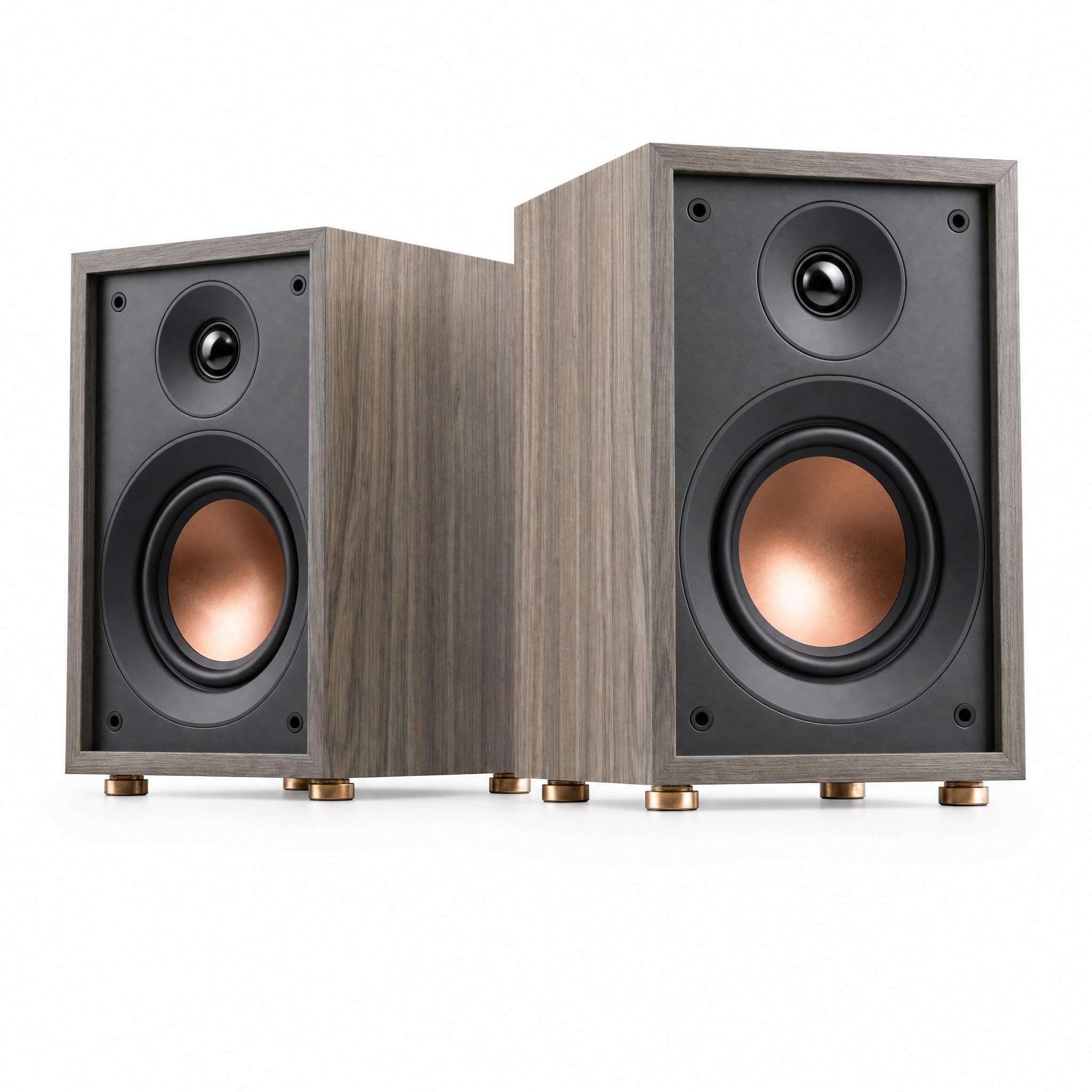
The gray fabric-wrapped pair that scales its sound with your amplifier budget.
HiVi-Swans has a cult following among budget audiophiles, and the Oasis 140 shows why. This 2-way speaker uses a 20mm soft dome tweeter that reaches highs up to 20kHz, paired with a 4-inch metal dynamic woofer for natural, punchy bass. The look is the standout here — a pure design with grey flexible fabric mesh that owners describe as delicate and soothing, a clear upgrade from the typical black vinyl box.
The real story is how these speakers react to better gear. Reviewers point out they “scale intensely” with amplifiers — the same pair that sounds good with a basic Fosi amp transforms into something remarkable with a higher-end integrated amp. The build quality gets consistent praise: heavy, sturdy cabinets, substantial gold binding posts, and a matte finish that looks premium. They’re rated for rooms up to 20×20 feet and deliver more output than their size suggests.
There are two genuine quirks to know. The port can be noisy at certain frequencies — some owners simply plug it and use a 100Hz high-pass filter instead. And the off-axis response is poor, meaning the sound changes noticeably if you move your head; these demand proper toe-in toward your listening position. The sound is also famously “warm,” so pairing them with an already-warm amplifier (some mention Yamaha) can be too mellow.
Gear scaler: An impressive, build-quality-first pair that rewards a good amp and proper positioning.
For the patient listener: Best if you already own a decent amplifier and value looks plus upgrade potential.
Not for casual setups: The fussy off-axis response and port behavior demand careful placement.
5. Edifier R1280T Powered Bookshelf Speakers

The powered pair that sounds amazing straight from the start with zero extra gear.
If you don’t own an amplifier and don’t want to buy one, this is the simplest path to great sound. The Edifier R1280T is a powered speaker — the amplifier is built in — so you connect your phone or laptop and you’re listening in under a minute. Total output is 42W RMS., which is plenty for a bedroom, office, or small living room. Owners describe the experience as transformative, with one saying it felt like “listening to music for the first time.”
The connectivity is genuinely flexible for a budget pair. Two AUX inputs mean you can connect two devices at once — say, a computer and a record player — without unplugging and switching cables. A 13mm silk dome tweeter handles the highs while a 4-inch full range unit delivers the mids, all wrapped in a classic wood-finish MDF cabinet. The included remote control handles volume and mute, and bass and treble knobs sit on the side of the main speaker.
The main limitation is the low end. These are not bass monsters — owners consistently note the bass is decent but not deep, and recommend adding a subwoofer if you want real punch for action movies or EDM. They’re also not studio monitors; the sound is tuned for enjoyment, not flat accuracy. But for casual music, movies, and video at a desk or bookshelf, the combination of easy setup, rich sound, and remote control is hard to argue with.
Plug-and-play champ: Rich, full sound with a remote and dual AUX inputs for anyone who wants music without the amplifier learning curve.
Choose this for: a no-fuss desktop or bedroom setup where you just want great sound immediately.
skip it if: you demand deep bass or flat studio-style accuracy — consider a sub or the MR3 below.
6. Pyle 5.25″ Wired Bookshelf Speakers Pair
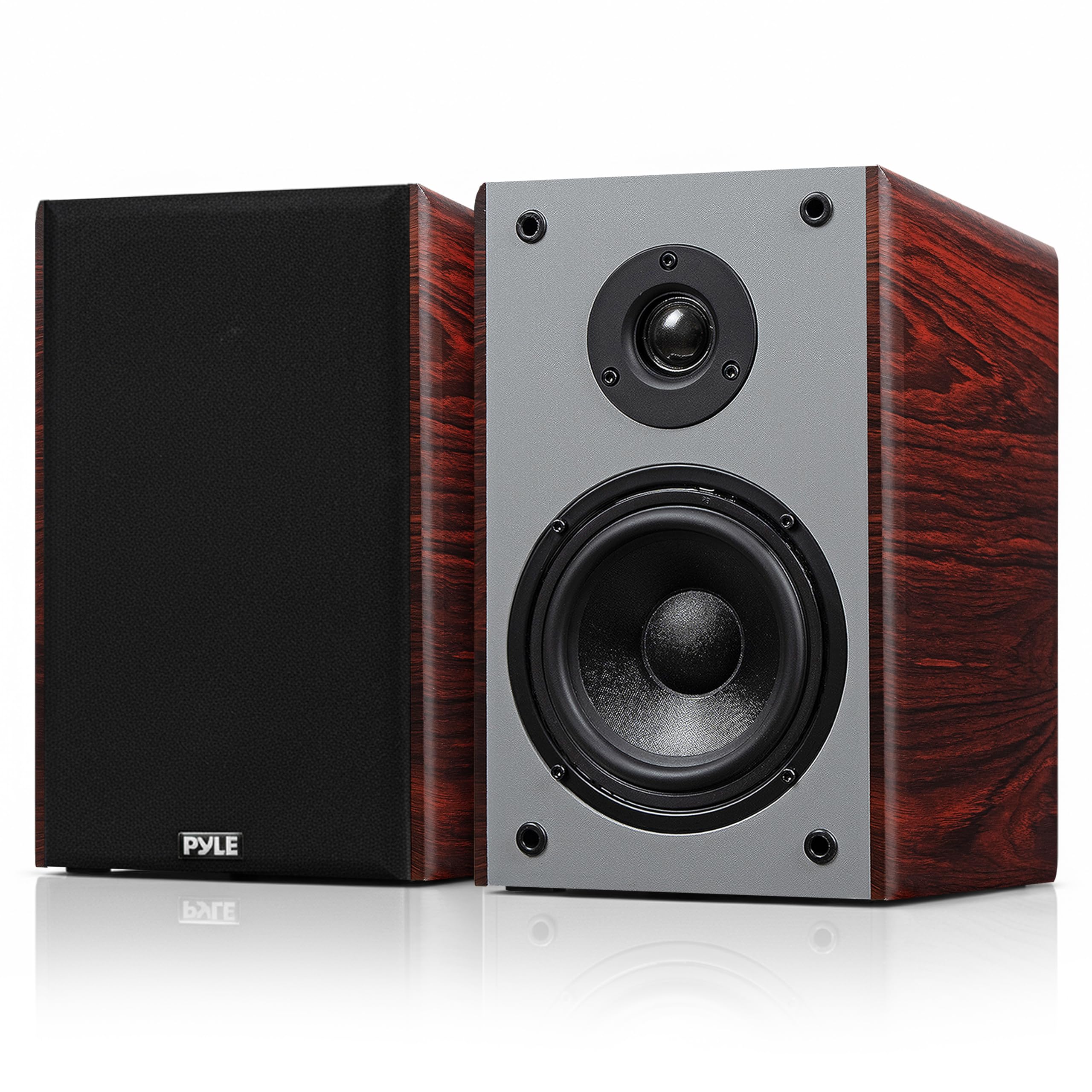
The loud, big-sounding pair that brings a home-theater punch to small rooms.
This is the biggest driver in the lineup, and you can hear it. The Pyle pair uses a 5.25-inch woven glass fiber woofer — larger than the 4-inch drivers on the Miccas — It delivers 50W RMS per speaker (100W per pair) with 200W peak power.. Owners describe the sound as “solid, big, punchy,” with bass that one reviewer compared to vintage 80s EPIs. If volume and presence are your priority, this pair delivers.
The 0.75-inch silk dome tweeter handles the highs, and a 12dB crossover splits the signal across a 65Hz–20kHz frequency range. Build quality leans on 12mm MDF with a cherry wood grain finish, and the front magnetic grills detach for a cleaner look. Flexible gold-plated 5-way binding posts accept banana plugs, spades, or bare wire, and built-in wall mount brackets come included — plus speaker wire in the box. At 11.75 x 7 x 6.5 inches each, they’re compact enough for a desktop or media center.
The honest caveat is in the mid-range. While owners praise the loudness and value, some note the high-mids can sound a bit forward, and the bass, while punchy, isn’t as deep or full as pricier options. One owner found they nearly matched a much more expensive Klipsch pair in loudness and clarity but had less bass fullness. For small rooms, an office, or a den, they’re a fantastic value; just don’t expect subwoofer-level depth without help.
Loud-and-proud: Big, clean output for the size with wall-mount brackets included — a strong pick for home theater.
Best for: small living rooms and dens where you want to feel the sound without spending a fortune.
Keep looking if: audiophile mid-range purity matters more to you than raw volume.
7. Edifier MR3 Powered Studio Monitor Speakers

The compact studio-style pair that wires into everything and streams wirelessly too.
This is the most connection-friendly speaker in the lineup. The Edifier MR3 is Hi-Res Audio certified with Its flat frequency response extends from 52Hz to 40kHz., and it’s powered, so no amplifier is needed. The standout feature is Bluetooth 5.4 with multi-point connection, letting you stream from a phone while a computer stays wired in. For inputs, you get balanced TRS, RCA, and AUX, plus a headphone output on the front for private listening.
Sound quality gets the most praise here, and it’s earned. The 3.5-inch mid-low drivers and 1-inch tweeters They deliver 18W x 2 RMS with a 92.5dB peak SPL. — strong enough for a 10×12 office, which owners confirm. Three sound modes (Music, Monitor, Custom) let you shift the tuning, and the EDIFIER ConneX app adds in-depth EQ control. Pair them with a subwoofer and owners say the combo outperforms pricier all-in-one systems.
The trade-offs are small but real. Some shoppers say the Bluetooth pairing button on the back can be finicky, and a few mention connectivity hiccups where the volume knob stops responding until you unplug and replug. The rear bass and treble dials are subtle in their effect, and the front power button’s modes are hard to tell apart. For music, gaming, and basic editing at a desk, though, the versatility and clean sound make it a top contender.
Swiss Army speaker: Wireless streaming, studio-style inputs, and app EQ make this the most flexible powered pair here.
Go with this if: you want one pair that handles desktop, TV, vinyl, and phone streaming without extra gear.
Be prepared for: occasional Bluetooth pairing quirks that need a quick unplug-and-replug to fix.
Understanding the Specs
Woofer Size and Bass
The woofer is the larger driver that produces low and mid frequencies. A 4-inch woofer (as in the Micca RB42 and MB42X G2) is compact and suits desks and small rooms, but a 5-inch or 5.25-inch woofer (as in the Jamo S 803 and Pyle) moves more air, giving you physically stronger bass. Bigger isn’t always better — it depends on your room size and whether you’ll add a subwoofer.
Crossover Slope
The crossover is the circuit that splits the audio signal between the woofer and the tweeter. The slope — measured in dB per octave — tells you how quickly the signal rolls off. A steeper slope, like 18dB/octave on the Micca RB42, means the drivers blend more cleanly at higher volumes with less distortion and better off-axis response. A gentler 12dB/octave slope (on the MB42X G2 and Pyle) is simpler and still sounds great at moderate volumes.
FAQ
Do I need an amplifier for these bookshelf speakers?
What is the difference between powered and passive speakers?
Will a 4-inch woofer give me enough bass?
Can I use these speakers with my TV?
What does a silk dome tweeter do?
What does the crossover slope number mean?
How much wattage do I need to drive passive speakers?
Are these speakers good for a desk setup?
What is the difference between the Micca RB42 and MB42X G2?
Can I wall-mount any of these speakers?
Final Thoughts: The Verdict
If you want one dependable pick, the best overall pick is the Micca RB42 because it delivers the most impressive bass and smooth highs for the money — the crowd favorite with a strong owner following. If you want a powered pair that needs no amplifier and comes with a remote, grab the Edifier R1280T. And for a home theater with a receiver, the Jamo S 803 with its bigger 5-inch woofer and Dolby Atmos readiness is the one to reach for.
How We Picked
We do not accept paid placement. Every pick is matched to a real buyer and a real use-case; we do not hands-on test units.
Sources & Methodology
Specifications: manufacturer listings and product documentation. Review insights: verified customer reviews, as of August 2026. Pricing: not shown on this page (it changes often); check the current price via the retailer link.
As an Amazon Associate, Gadgets Feed earns from qualifying purchases. This does not affect which products we feature.