
Our readers keep the lights on and my morning glass full of iced black tea. As an Amazon Associate, I earn from qualifying purchases.
Specs are compiled from manufacturer listings and verified buyer reviews and can change over time — please confirm the key details on the product page before buying.
Stargazing through a camera lens has a way of upending every assumption you have about tripods. The flimsy photography stand in your closet will wobble for a 30-second deep-sky exposure, and the massive video rig your friend uses is too heavy to haul up a dark-sky hill. For tracking the moon, stacking galaxies, or keeping a smart telescope locked on target, the real job is simple: hold your gear absolutely still for minutes at a time. The best astrophotography tripods share rigid legs, a sag-free head, and a load rating that clears your heaviest lens with margin.
I’m Min — the founder and writer behind Gadgets Feed. This guide is built by comparing the manufacturers’ published specifications and the patterns across verified customer reviews, so you get each pick’s real strengths and trade-offs instead of marketing spin.
A stable base that resists wind and vibration is non-negotiable for sharp night-sky shots. The astrophotography tripod choices below prioritize rock-solid stability, generous load capacity, and smart height options for your specific camera setup.
Our Picks at a Glance


How To Choose The Best Astrophotography Tripod
When you shoot the night sky, your tripod must hold your camera rock-steady during long exposures, yet still be light enough to carry to a dark site. Match the tripod’s weight and leg width to your gear: heavy rigs need wide legs for wind resistance, while light kits can use featherweight models that pack easily.
Match the Load Rating to Your Gear
Your camera, lens, and a tracking mount or telescope all stack onto the tripod head. A rule of thumb that works here: you want a tripod rated for roughly double your current kit’s weight. A tripod rated for 17.6lb gives you a comfortable safety margin under a full-frame body with a 200-600mm lens, while a 20lb-rated unit feels secure even with a smart telescope parked on top. Under-rating invites slow, frustrating droop.
Legs, Locking, and Head Types
Carbon fiber legs cut weight without sacrificing rigidity, making them the top choice for travel-focused astro shooters. Twist locks are low-profile and snag-free, while flip locks deploy faster but add bulk. Ball heads reposition the camera in one motion for stills, while fluid heads deliver smooth, damped pans for video or planetary tracking. Choose based on whether you shoot mostly stills or mostly video.
Quick Comparison
| Model | Best For | Max Load | Weight | Max Height | Amazon |
|---|---|---|---|---|---|
| NEEWER TP74★ Best Overall | Heavy gear & video | 17.6 lb / 8 kg | 10.9 lb | 74 in | Amazon |
| NEEWER TP37Great Value | Budget full-size | 17.6 lb / 8 kg | 9.4 lb | 74 in | Amazon |
| K&F 90″ OverheadTall & Nimble | Tall reach & gimbal | 22 lb / 10 kg | 4.5 lb | 90 in | Amazon |
| Vortex Mountain Pass | Scopes & hunting | 22 lb | 0.45 kg | — | Amazon |
| SIRUI AM-284 | Travel carbon fiber | 33.1 lb / 15 kg | 2.69 lb | 47.2 in | Amazon |
| K&F X-Series 68″ | Value carbon fiber | 16 kg | 1.55 kg | 172.5 cm | Amazon |
| SIRUI AM-324 | Heavy load hiking | 44 lb / 20 kg | 3.1 lb | 57.1 in | Amazon |
| SmallRig AD-100 | Video & events | 22 lb / 10 kg | 11 lb | 197 cm | Amazon |
| Peak Design Travel | Ultimate portability | 20 lb | 1.29 kg | 60 in | Amazon |
In‑Depth Reviews
1. NEEWER 74″ Video Tripod with Fluid Head (TP74)
Our pick — over 4.5★ from 550+ verified ratings; the strongest balance of quality and price.
The heavyweight that wins over deep-sky shooters with a rock-steady 17.6 lb load ceiling.
For astrophotography, this is the pick that removes “is my tripod moving?” from your list of worries. The double tandem aluminum alloy legs hold a max load of 17.6 lb/8kg, which means it supports heavy rigs like a full-frame Sony mirrorless with a 200-600mm lens attached. Build quality and sturdiness are what win people over here, and it shows in the confidence you feel the moment the legs are locked.
The fluid drag pan head is the other star. It rotates a full 360° and tilts from -75°/+90°, so you can smoothly track a bright planet or pan across the Milky Way without jerky micro-movements. A bubble level sits right on the head to help you keep level, which saves real time when you are polar aligning. The 3″ (75mm) bowl base includes a 360° scale for precise panoramic composites.
Buyers report it supports heavy telephoto lenses with no sag, and the head works with both DJI RS2/RS3 gimbals and Manfrotto standard quick-release plates, so switching between tripod and gimbal shooting is fast. The 1/4″ and 3/8″ screws on top make it compatible with Sony, Canon, Nikon DSLRs, mirrorless cameras, and telescopes. At 10.9 pounds it is not a lightweight, but for an observatory-style setup the trade-off is worth it.
What owners love
- Rock-steady under heavy telephoto loads
- Smooth fluid head with 360° pan
- Works with gimbal and Manfrotto plates
Fair warnings
- Heavy at 10.9 lb to haul uphill
- Legs are slow to extend
Best for: shooters with heavy telephoto lenses or telescopes who value absolute stillness over portability, and want gimbal-to-tripod flexibility.
Think twice if: you hike long distances to dark sites — 10.9 lb of tripod gets old fast on a trail.
2. NEEWER Basics 74″ Video Tripod (TP37)
A full-size metal workhorse that undercuts the premium crowd while holding 17.6 lb steady.
For budget-minded astro shooters who refuse to give up height, this NEEWER Basic delivers surprising polish. Its all-metal frame with a 73mm enlarged chassis supports up to 17.6 lb/8kg, and the triangle mid-spreader plus nonslip rubber feet anchor it on uneven grass or gravel. Owners say it performs like a fluid head setup costing several times more, with smooth, controlled pans.
The damped fluid head gives you 360° pan and a -70°/+90° tilt range, and a bubble level speeds up horizontal alignment, which helps when you are leveling a star tracker. Height adjusts from 33″ to 74″ thanks to three-section legs with plastic buckles, so it reaches a comfortable eyepiece height for most tall setups. The quick-release plate is Manfrotto-style, which makes it easy to swap gear.
The recurring caveat is the leg clips — owners mention they may fail, though the tripod remains sturdy overall. The head also lacks counterbalance, so a heavy front-loaded camera can nose-dive if you are not careful, which means this suits light to moderate rigs best. It folds down to 35″x6.3″x6.3″ and ships with a carrying bag, keeping its footprint travel-friendly.
Who it fits: beginners and value hunters running a compact mirrorless or a smart telescope who want full height and smooth pans without the premium price.
The one caveat: the plastic leg clips need gentle handling, and heavy front-heavy gear will overwhelm the head.
3. K&F CONCEPT 90″ Ultra High Overhead Tripod
The 90-inch giant that stands taller than the crowd and still folds to 21 inches.
If your back is tired of crouching to find the eyepiece, this is the tallest pick here. The K&F CONCEPT reaches a maximum height of 90 inches — a 22% higher reach than the NEEWER TP74’s 74 inches — so you shoot standing up straight even with a long telephoto. It does this with a 4-section leg design that collapses to just 21.3 inches and weighs 4.5 pounds, which is remarkably light given that the NEEWER TP74 weighs 10.9 pounds.
The gimbal head is a different tool from the fluid heads above. Its patent design allows flexible legs with 0-180° tilt and full 360° panoramic rotation, and the enlarged 28mm diameter center column reduces vibrations for sharper images. The 28mm ball head carries a load capacity of 22 lb/10kg, which clears a medium telescope or a spotting scope with ease. An oil-free damping design keeps movements smooth.
Buyers praise its stability for astro use even at 6 feet tall, with steady performance on a spotting scope at 20X. The detachable monopod adds flexibility in tight spaces. The only recurring note is that the horizontal mechanism has a touch of play that complicates fine adjustments, and some recommend hanging a sandbag on the hook for extra wind resistance. It packs with a tripod bag included.
Standout strengths
- 90-inch max height for comfortable standing use
- Lightweight 4.5 lb with a compact 21-inch fold
- Gimbal head with 22 lb load capacity
Keep in mind
- Horizontal arm has slight play during fine adjustments
- Folded shape is bulky despite the short length
Reach for it if: you shoot standing up, use a spotting scope or smaller telescope, and want a versatile gimbal head plus a detachable monopod for low shots.
Look elsewhere if: you prefer a classic fluid head for smooth video pans, or need a rock-solid column for a heavy equatorial mount.
4. Vortex Mountain Pass Tripod Kit

A rugged, packable companion built for spotting scopes and heavy binoculars in the field.
This one is for the glassers — the shooters who spend hours looking through a spotting scope at the moon or a distant landscape rather than framing a sensor. The Vortex Mountain Pass uses a two-way pan and tilt head with an Arca-Swiss compatible quick-release system, so your scope or binoculars mount and release fast. With a 22-pound max load, it handles larger binoculars and spotting scopes without struggling.
The machined aluminum design packs down to just 19″ x 4″ and is light enough to slip into a backpack, making it a favorite for hikers and hunters who want steady views from ridgelines. Telescoping legs adjust independently and lock with a quick flip of a lever, so setting up on uneven ground is a two-second job. Owners find it solid and stable for glassing with large binoculars, noting it holds optics steady in the field.
The honest limit is that the basic head is not built for long camera lenses — it is best paired with a scope or binoculars rather than a 600mm telephoto. Some also find it pricey for what it includes, though the build quality and Vortex durability justify the cost for dedicated outdoor use. A hook on the column lets you hang weight for extra wind stability when you are glassing in a breeze.
Best fit: hunters, hikers, and birdwatchers who want a lightweight, stable, packable base for a spotting scope or binoculars.
Not for: heavy telephoto camera lenses or video work — keep it as a dedicated optics tripod.
5. SIRUI AM-284 Carbon Fiber Tripod

A 2.69-pound carbon fiber traveler that still carries a staggering 33.1 lb of gear.
Here is the case for carbon fiber done right: SIRUI’s AM-284 weighs just 2.69 lb/1.22kg, yet its load capacity is a towering 33.1 lb/15kg — among the highest per-pound ratings on this list. That ratio makes it a dark-sky hiker’s dream, because you can carry it for hours and still trust it under a decent tracking mount or a long telephoto lens. Owners confirm it fits in airline carry-on bags and is perfect for smart telescopes like the Seestar S30.
The 4-section column legs extend from 8cm/3.2 inches up to 120cm/47.2 inches, and twist locks make setup quick. A semi-automatic pull button offers three fixed leg angles — 22, 55, and 85 degrees — so finding a stable low stance on rough terrain is easy. The removable rubber feet swap for included steel spiked feet, which grip soft grass or dirt far better for a stable platform.
The verdict from buyers who use it under a Nikon Z8 with heavy glass is that it handles multi-minute wide-angle exposures and even 1/15-1/30s shutter speeds on long lenses without shake. The one thing to know: at a maximum of 47.2 inches, you will crouch or kneel to compose. A 5’10” owner notes they must kneel to use the viewfinder, so plan for seated observing or a shorter shooting style.
Why it stands out
- Incredible strength-to-weight ratio
- Fits airline carry-on bags
- Steel spikes included for soft ground
Plan for
- Max height under 4 feet means kneeling
- No center column for ultra-low macro shots
Choose it for: backcountry astro trips where every ounce matters, and smart telescopes or mid-size mirrorless kits are your main payload.
skip it if: you need a standing eyepiece height or regularly carry a heavy equatorial mount.
6. K&F Concept X-Series 68″ Carbon Fiber Tripod
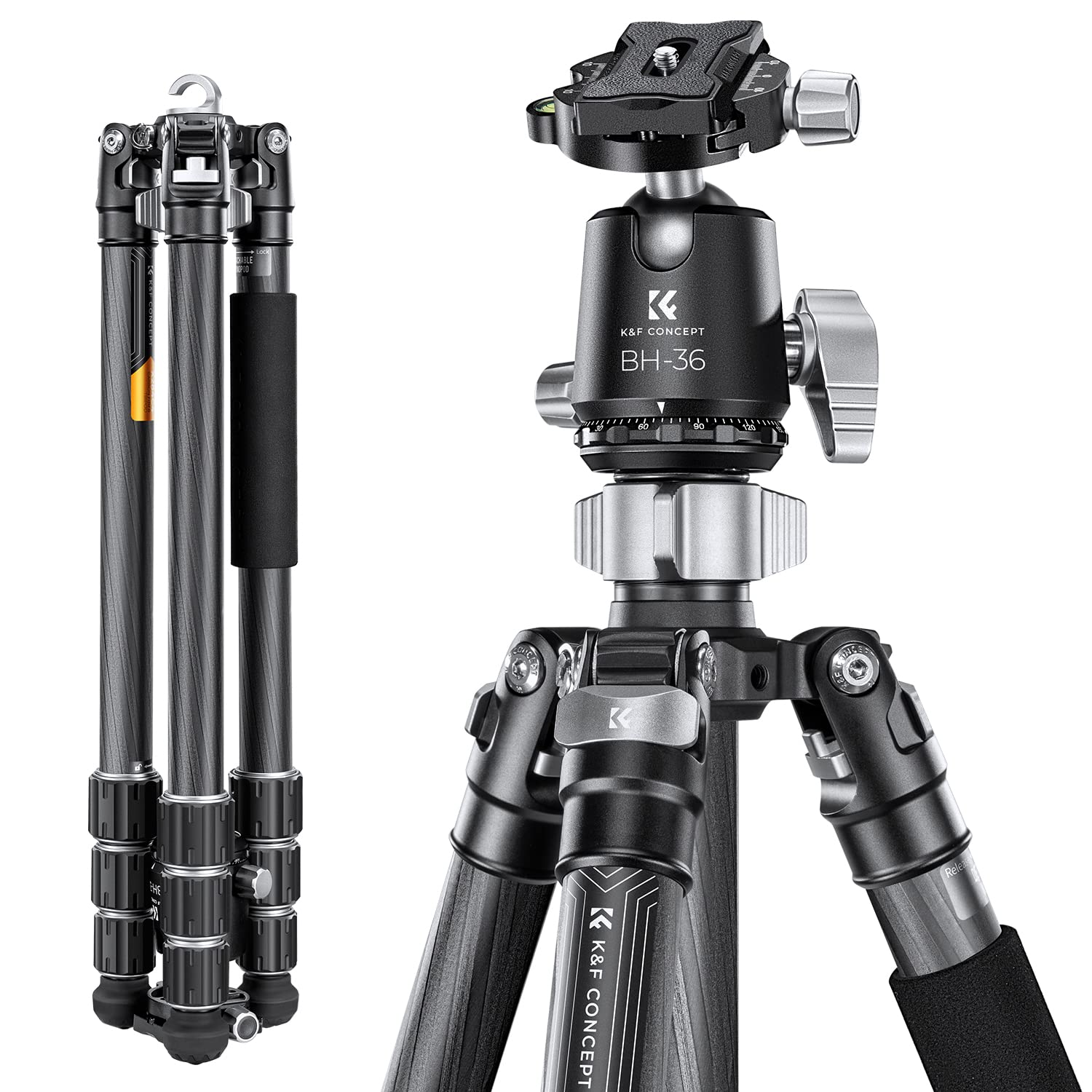
A 28mm carbon tube workhorse that holds a DSLR with a 600mm lens without flinching.
K&F’s X-Series is the pick that bridges do-it-all versatility with premium materials at a reasonable price. The 28mm full tube is made of carbon fiber, keeping the net weight with the camera ball head at just 1.55 kg, so it travels easily to a dark-sky site. A 36mm CNC metal ball head — machined via computer-controlled precision — resists friction and rust for a longer service life.
Load capacity is an impressive 16 kg, and the head rotates a full 360 degrees, which helps you frame any patch of sky without repositioning the whole tripod. The standard 1/4-inch thread works with most Arca-Swiss quick-release plates, and the 1/4-inch screw fits most cameras, DSLRs, projectors, and telescopes. It extends to a maximum height of 172.5 cm and drops to a minimum of 58.5 cm for low-angle compositions.
Owners consistently call it well-built and solid, with one confirming it handles a DSLR with a 600mm lens with ease. The recurring minor gripe is the screw-down leg locks and a friction-screw plate holder that you need to tighten carefully. The ball head also lacks a spring-loaded plate release, so there is a small risk of the camera toppling if you loosen the knob too far. Weighting is recommended in high winds.
Reach for it if: you want a full-height carbon fiber tripod that can hold a big telephoto lens without breaking your budget.
Be careful: the friction-screw plate holder demands a deliberate touch, and you will want a sandbag hook weight in windy conditions.
7. SIRUI AM-324 Carbon Fiber Tripod

The 44 lb-rated monster that carries a mini observatory and still weighs only 3.1 pounds.
For the most demanding loads — a full camera, a star tracker, and a hefty telephoto piled on top — this SIRUI is the strongest here. The 4-section legs use 10x carbon fiber tubes at a 32mm max diameter, giving a rated load capacity of 44 lb/20kg while the whole tripod weighs just 3.1 lb/1.4kg. That means it quietly out-handles everything else on this list for sheer weight tolerance.
The no-center-column design is a deliberate astro choice: it removes a classic source of vibration and lets you drop the camera extremely low for macro or ultra-low Milky Way shots. The flip locks offer three leg angles (22, 55, and 85 degrees), and the Allen key lets you fine-tune leg tightness so the joints stay firm as they wear. It extends from 3.1 inches to 57.1 inches, and retracts to a compact 20.5 inches.
Buyers swapping from a midrange tripod call it a solid upgrade, noting the extra weight is justified by stability and height, and that heavy spike feet plus a hook make it rock-steady for long lenses. The trade-off is height: at 57.1 inches max, a 5’9″ owner will find it slightly short for standing use. The leg stability and locking mechanism earn mixed feedback — some find them secure, others report legs loosening over time.
What earns its place
- Enormous 44 lb load capacity
- Only 3.1 lb to carry
- No center column for ultra-low shots
Watch out
- Max 57-inch height favors seated use
- Twist locks may need re-tightening over time
Take it for: heavy rigs, small telescopes, and macro-adjacent low-angle shots where stability beats standing height.
Leave it if: you are tall and insist on composing while standing upright.
8. SmallRig AD-100 FreeBlazer Carbon Fiber Tripod

A 78-inch video tripod with a one-lever leg lock that sets up as fast as a Sachtler.
Video-centric astro shooters — think time-lapses, planetary tracking clips, or event coverage — will love how this one handles. The SmallRig AD-100 uses a one-step locking system where a single toggle locks two legs at once, so you stop fiddling with four joints per leg. The carbon fiber build weighs 5kg (11 lbs) and supports a maximum safe load of 10kg (22 lbs), which is plenty for a cinema-style body plus a long lens.
The damping-adjustable fluid head allows 360° pan and +90°/-60° tilt, and the step-less damping lets you pan smoothly at whatever speed you need to track a target. A ⌀75mm detachable bowl head plus interchangeable wide feet and spike feet help quick leveling on uneven ground. The removable telescopic handle adjusts from 9.1″-14.2″ to suit either dominant hand, and the snap-on dual-mode quick-release plate works with DJI RS 2/RS 3/RS 4 gimbals or MFT plates.
Owners who shoot 30+ events a year say it performs like a tripod at a fraction of the cost, with a head as smooth as a Manfrotto and leg setup that is noticeably quicker. The recurring caveat is that the plastic locking mechanism feels a little cheap and weak next to the rest of the build, and the screw-on handle extension is easy to lose. It reaches 197 cm maximum height, so tall shooters get standing height comfortably.
Built for: semi-pro videographers and hybrid shooters who need fast deployment, smooth damped pans, and gimbal compatibility in one rig.
Accept that: the plastic locking bits feel below the quality of the legs, and the handle needs a tightener so it does not walk away.
9. Peak Design Travel Tripod (Carbon Fiber)

The water-bottle-diameter tripod that proves portability and pro stability can coexist.
This is the tripod that reimagines what “travel” means for astro shooters. The Peak Design folds down to the diameter of a water bottle — 0.83″D x 3.11″W x 15.35″H — so it disappears into a backpack’s side pocket or a motorcycle saddlebag. Despite the tiny footprint, it supports up to 20 lbs, which handles a full-frame DSLR with a telephoto lens and even holds a 40X spotting scope steady enough to view Saturn.
Setup speed is the headline feature. The unique leg design deploys and locks in seconds with no flipping or fumbling, and the quick-release lever system mounts your camera smoothly. The omnidirectional ball head uses a single adjustment ring for fast, intuitive control, and a built-in mobile mount pops out of the center column for quick phone shooting. The integrated hook lets you hang extra weight for stability anywhere.
Buyers praise its top-notch quality and the fact that it fits perfectly in backpack pockets, with one noting it is stable even with large lenses thanks to the center hook. The honest trade-offs: the leg clips can pinch skin, the ball head’s vertical mobility is limited without a third-party L-bracket, and the hex wrench holder ejects easily, losing tools. This is a premium pick for travelers who shoot anywhere.
Why it is iconic
- Packs down to water-bottle size
- Supports up to 20 lb of gear
- Deploys in seconds with one lever
Consider before buying
- Leg clips can pinch skin
- Ball head needs an L-bracket for vertical shots
Invest here if: you travel constantly, pack light, and want a premium carbon fiber tripod that rides in a bottle pocket and stabilizes a long lens.
Reconsider if: you shoot with a heavy equatorial mount or want a full fluid head for video — this is a stills-focused travel tool.
Understanding the Specs
Load Capacity
This number tells you the heaviest rig the tripod can safely hold. It matters more for astrophotography than for everyday snapping because a star tracker, telescope, or long telephoto stacks a lot of weight on the head. Look for a rating that clears your heaviest camera-and-lens combo with a comfortable margin, so the legs and head do not sag mid-exposure.
Leg Material and Locking
Carbon fiber legs save serious weight without sacrificing rigidity, making them the go-to for travel astro shooters. Twist locks are low-profile and snag-free, while flip locks are faster to deploy. For the night sky, you also want legs that flare wide — three fixed angles help you find a stable low stance on uneven ground. Metal spikes that swap in for rubber feet are a bonus on grass and dirt.
FAQ
Will any regular camera tripod work for astrophotography?
How much load capacity do I need for a full-frame camera and tracking mount?
Is a fluid head or a ball head better for night sky shooting?
How tall should my astrophotography tripod be?
Does carbon fiber really matter for astro tripods?
Why does a center column cause vibration problems?
Can I use a video tripod for still astrophotography?
How do I stop my tripod from shaking in the wind?
Is a travel tripod sturdy enough for a smart telescope?
What does the bubble level do for astrophotography?
Final Thoughts: The Verdict
For most people, the astrophotography tripod winner is the NEEWER TP74 because it pairs a rock-steady 17.6 lb load capacity with the smooth fluid head that heavy telephoto setups demand at a price that undercuts the premium tier. If you want a tall reach that spares your back, grab the K&F CONCEPT 90″. And for the traveler who values portability above all, the Peak Design Travel Tripod is the one to reach for.
How We Picked
We do not accept paid placement. Every pick is matched to a real buyer and a real use-case; we do not hands-on test units.
Sources & Methodology
Specifications: manufacturer listings and product documentation. Review insights: verified customer reviews, as of August 2026. Pricing: not shown on this page (it changes often); check the current price via the retailer link.
As an Amazon Associate, Gadgets Feed earns from qualifying purchases. This does not affect which products we feature.