
Our readers keep the lights on and my morning glass full of iced black tea. As an Amazon Associate, I earn from qualifying purchases.
Specs are compiled from manufacturer listings and verified buyer reviews and can change over time — please confirm the key details on the product page before buying.
Backing out of a tight spot or into a dark driveway is where most of us fear the dreaded crunch. A backup camera with sensors does the looking for you — the camera shows what is behind, and the sensors beep faster as you get closer to an obstacle. This guide breaks down the top picks so you can choose the system that matches how you park, what you drive, and how much effort you want to put into installation.
I’m Min — the founder and writer behind Gadgets Feed. This guide is built by comparing the manufacturers’ published specifications and the patterns across verified customer reviews, so you get each pick’s real strengths and trade-offs instead of marketing spin.
After comparing these systems, the best backup camera with sensors balances a clear live view with accurate, reliable proximity warnings that you can actually trust on the road.
Our Picks at a Glance

How To Choose The Best Backup Camera With Sensors
To pick the right backup camera with sensors, you need to weigh three things: how wide and clear the view is, how the sensors alert you to distance, and how simple the install is. A camera that shows a broad, sharp image in daylight and darkness, plus sensors that beep before you bump something, turns parking into a stress-free task.
Field of view: the wider, the better
This is the number that decides whether you see a car sneaking into your blind spot. The viewing angle is measured in degrees, and systems here range from a tight corridor to a sweeping panorama. A larger angle gives you a fuller picture of the space directly behind and beside the bumper, which is a lifesaver in crowded lots.
Sensor type and detection range
Sensors work by sending out a signal and listening for the echo off an object, then turning that into a beep or a visual warning. They have a set distance where they start detecting, and they usually beep faster as you close in. Look for a sensor range that matches where you park — a longer detection distance gives you more time to react.
Installation and power source
Some systems plug straight into your 12V car charger port and are genuinely “plug and play.” Others need you to wire the camera to your reverse lights so it only turns on when you shift into reverse. If wiring feels intimidating, a plug-in system is less messy and easier to remove, but it may stay on when the engine is off, which can drain the battery over days of idling.
Quick Comparison
| Model | Best For | Field of View | Sensor Detection | Monitor | Amazon |
|---|---|---|---|---|---|
| Seventour TC-1 1080P PDC System★ Best Overall | Feature-rich value | 170 degrees | Radar within 3 meters | 7-inch | Amazon |
| Xtremevision Car Rover 170 | License-plate frame style | 170 degrees | 1-6 feet | External (not included) | Amazon |
| nVision Hopkins 60195VA | Reliable compact system | 60 degrees | Up to 5.5 feet | 2.5-inch | Amazon |
In‑Depth Reviews
1. Seventour TC-1 1080P Backup Camera with PDC Sensors
Our pick — over 4★ from 90+ verified ratings; the strongest balance of quality and price.
The all-in-one kit with a big screen, a radar buzzer, and a price that feels like a steal.
If you want a complete parking setup without assembling parts yourself, this kit delivers. You get a 1080P full HD camera (a high-resolution video feed that shows crisp details) paired with a 7-inch monitor — a much larger screen than the small displays on rival kits — plus a 170-degree wide-angle lens, so you can see pedestrians and cyclists entering your blind spot. The camera and monitor ship as one unit, giving you a near-factory-installed experience from an aftermarket package.
The icing on the cake is the integrated radar sensor. While you are parking, any obstacle or pedestrian within 3 meters triggers a “drip drip” alarm, and the urgency builds until it holds a constant tone when something is within 0.5 meters. Night driving is covered too — the camera’s LED light automatically switches on in low light to keep the image clear. The maker backs the TC-1 with a 6-month replacement promise and a free 1-year repair, which is rare reassurance at this level.
There is one honest catch about power. Because it draws from the car charger port, it does not fully shut off when the engine is off — buyers report a battery drained after about 30-hours of idle in cars where that port stays live. If your car’s port stays on, you will want to unplug it or wire the red lead to your reverse lights instead so it only wakes when you back up.
What you gain
- Big 7-inch monitor for a clear, comfortable view
- 1080P resolution with a 170-degree angle to see more behind you
- Radar buzzer with a steady alarm when an object is within 0.5 meters
What to watch
- Screen stays on when the 12V port is live and the engine is off
- One reviewer noted the buzzer arriving without power — test it early
Reach for this if: you want a complete, feature-packed kit — camera, screen, and proximity buzzer — in one box.
Look elsewhere if: your car’s charger port stays powered when parked, since the screen can quietly drain the battery over long idle stretches.
2. Xtremevision License Plate Frame Backup Camera Kit

A heavy metal plate frame that hides the camera and packs in three parking sensors.
If you like the idea of a camera that sits flush with your license plate rather than bolting on separately, this frame-style kit is worth a look. The heavy-duty plated frame is built to avoid scratching your paint, and it comes with three parking sensors that detect obstacles from 1 to 6 feet. The detection range makes it a practical choice for new drivers still learning the limits of their bumper.
On the imaging side, a CMOS image sensor delivers sharp pictures both day and night, with 2 automatic LED lights and a black photoresistor that turns them on in low light and off in bright areas. The field of view matches the top pick at 170 degrees, giving you a similarly wide sweep behind the car. The sensors also pair audible beeps with visual feedback, so you get both a sound and a glance check.
Where this one splits opinion is the audio warnings. The sensor speaker is loud with no volume control — one owner moved the whole unit to the trunk to soften it. A recurring theme in feedback is false “STOP” alerts after rain or when the constant-power wiring confuses the sensors, pointing to a possible water-resistance weakness. The camera quality itself is fine, but the sensor quirks mean it rewards patience and careful wiring.
The honest read: this is a solid-looking frame with accurate distance sensing when wired right, but the loud alerts and occasional false stops after rain make it a fit for tinkerers rather than set-and-forget buyers.
Pick this for: a stylish, paint-safe plate-frame look with a 170-degree view and three sensors for close-in detection.
Think twice if: you dislike loud, non-adjustable beeping — or if your climate brings frequent rain, which seems to trigger false stops.
3. nVision Hopkins 60195VA Rearview Camera System
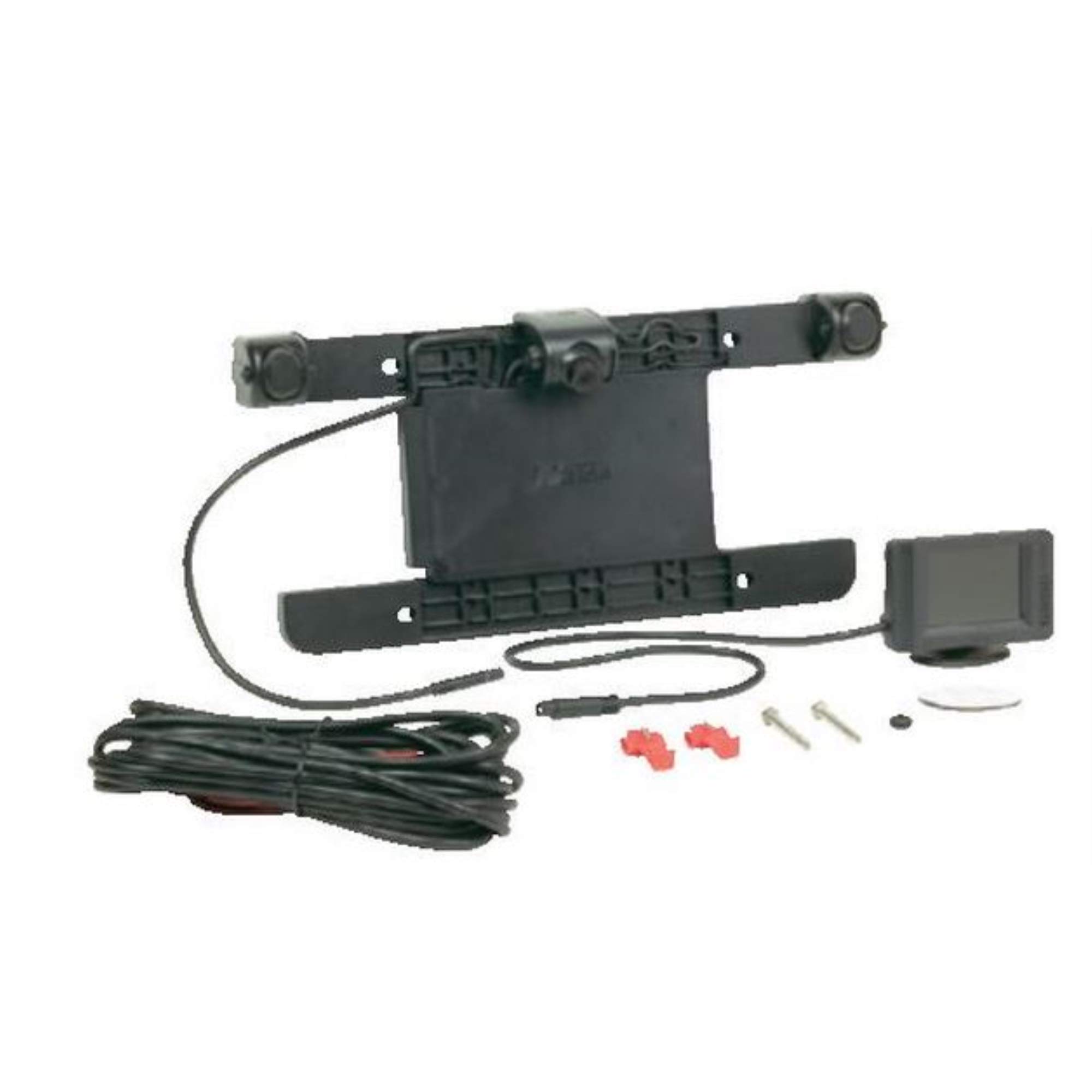
A dependable 2-sensor system whose SmartZone tech names the exact distance to what is behind you.
Where the other picks lean on a wide sweep, this nVision system plays a different game: precision over panorama. The included bracket carries two sensors, and the SmartZone sensing technology tells you the exact location and distance of an object, detecting things up to 5.5 feet away. The sensors are adjustable, so you can tune the detection zone to your specific vehicle’s shape rather than settling for a one-size fit.
The trade-off is the view — a 60-degree field of view is a 2.8x gap narrower than the 170 degrees on the picks above, so it shows the space directly behind you rather than the full lot. The 2.5-inch LCD color monitor is compact enough for clean dash placement, and owners consistently praise the clear picture; several rate it an 8 out of 10 against a Cadillac’s factory unit. The ultrasonic sensors pair beeping with colored boxes that shift from yellow to red as you close in.
Installation is the real commitment here. Owners mention it can take hours, with some finding the supplied grommet unusable and the plate needing flatting and notching. But the consensus is that the effort pays off: the same owners note the wired setup survived severe storms, and trailer users say the camera aligns beautifully with their ball hitch for hookups. One note of caution — a trailer hookup can keep the distance sensor glowing red, though muting the buzzer and watching the color indicators works around it.
Why owners stay loyal
- SmartZone tech pinpoints exact object location and distance
- Clear, bright picture that rivals a factory Cadillac unit
- Adjustable sensors tune detection to your vehicle
Where it asks for patience
- 60-degree view is far narrower than the 170-degree rivals
- Installation can take hours and need plate modification
- Small 2.5-inch monitor, and proximity sensors can be finicky in cold and rain
Choose this when: you want a rugged, dependable wired system with precise distance readouts and you are comfortable with a challenging install.
skip it if: you need a wide, sweeping view of the area behind you — the 60-degree angle and tiny screen will feel limiting.
Understanding the Specs
Field of View
This is the width of the scene the camera captures, measured in degrees. A 170-degree angle shows a wide sweep across both sides of your bumper, which is ideal for spotting cars and pedestrians approaching from the side. A 60-degree angle shows a narrow corridor directly behind you — enough for trailer alignment but not for checking blind spots. Wider is almost always better for parking.
Sensor Detection Range
Parking sensors have a maximum distance at which they start detecting an object, and they beep faster as that object gets closer. A system that detects at 3 meters gives you more warning time than one that only starts at 1-6 feet. The alert style matters too — some use a simple buzzer, while premium systems like SmartZone name the exact distance and show colored indicator boxes on screen.
FAQ
Do backup cameras with sensors work at night?
What does the parking sensor actually measure?
Will this fit my license plate without damaging my car?
Is a 170-degree camera better than a 60-degree one?
Why do my sensors give false “STOP” alerts?
Will a plug-in camera drain my car battery?
How hard is it to install one of these systems?
Can I use one of these with a trailer or truck?
Final Thoughts: The Verdict
For most buyers, the backup camera with sensors winner is the Seventour TC-1 because it combines a 1080P 170-degree view, a 7-inch monitor, and a radar buzzer in one affordable kit that is genuinely plug-and-play. If you prefer a license-plate frame look with three sensors and don’t mind a loud speaker, grab the Xtremevision frame. And for a rugged, precise wired system that pinpoints object distance, the nVision Hopkins is the one to reach for — just budget the time for its demanding install.
How We Picked
We do not accept paid placement. Every pick is matched to a real buyer and a real use-case; we do not hands-on test units.
Sources & Methodology
Specifications: manufacturer listings and product documentation. Review insights: verified customer reviews, as of August 2026. Pricing: not shown on this page (it changes often); check the current price via the retailer link.
As an Amazon Associate, Gadgets Feed earns from qualifying purchases. This does not affect which products we feature.