
Our readers keep the lights on and my morning glass full of iced black tea. As an Amazon Associate, I earn from qualifying purchases.
Specs are compiled from manufacturer listings and verified buyer reviews and can change over time — please confirm the key details on the product page before buying.
To keep a fridge running through a blackout or power tools at a job site, you need a deep-cycle battery (one that can be drained and recharged repeatedly without damage), not a standard starting battery built for a burst of engine-cranking power. The right 12V battery for your generator matches your actual usage pattern—cranking, deep cycling, or both—not just the biggest box on the shelf. Below are the best options for home backup, off-grid power, and portable use, each vetted for real-world performance.
I’m Min — the founder and writer behind Gadgets Feed. This guide is built by comparing the manufacturers’ published specifications and the patterns across verified customer reviews, so you get each pick’s real strengths and trade-offs instead of marketing spin.
You’ll see how lithium batteries slash weight and deliver more usable power, how AGM and SLA lead-acid models offer budget-friendly reliability, and what to check so your 12v battery for generator truly meets your needs. By the end, you’ll know exactly which chemistry, capacity, and safety features matter most for your generator setup.
Our Picks at a Glance
How To Choose The Best 12V Battery For Generator
Before you compare models, understand that a generator battery serves two very different jobs. The first is cranking the generator’s engine, which needs a quick, high-current burst. The second is acting as a house battery, storing power from solar or the generator itself to run appliances later. Some batteries are built for one job; dual-purpose ones handle both.
Match the chemistry to your routine
Lithium iron phosphate (LiFePO4) batteries are the modern favorite—they are much lighter than lead-acid, can be discharged deeply without damage, and typically handle thousands of cycles. Sealed AGM and SLA (sealed lead-acid) batteries are the budget-friendly workhorses; they cost less upfront but weigh significantly more and generally offer fewer deep-discharge cycles before performance fades.
Check the amp-hour capacity you actually need
The “Ah” or amp-hour rating tells you how much current a battery can supply over time. A 100Ah battery can, in theory, deliver 1 amp for 100 hours, or 10 amps for 10 hours. To run a refrigerator drawing 5 amps overnight, you’ll want at least a 100Ah capacity—more if you plan several days off-grid or for a whole-home backup configuration.
Verify the battery’s safety and protection systems
Lithium batteries rely on a Battery Management System (BMS) to prevent overcharging, over-discharging, and short circuits. This is also what stops charging in freezing weather, which protects the cells. For lead-acid models, check that the battery is sealed and spill-proof so it’s safe to mount in different positions and won’t leak acid.
Quick Comparison
| Model | Best For | Chemistry | Capacity | Weight | Amazon |
|---|---|---|---|---|---|
| LiTime 12V 100Ah★ Best Overall | RV & home backup | LiFePO4 | 100Ah | 21.9 lbs | Amazon |
| BtrPower 12V 30AhBest Value | Portable & small loads | LiFePO4 | 30Ah | — | Amazon |
| Newport 12V50AhCompact Pick | Trolling motors | AGM Lead-Acid | 50Ah | 32 lbs | Amazon |
| Mighty Max 12V 100AH | Solar & budget backup | SLA / AGM | 100Ah | 28 lbs | Amazon |
| WEIZE 12V 100Ah | Heavy backup loads | SLA / AGM | 100Ah | 63 lbs | Amazon |
| SUPER EMPOWER 12V 100Ah | Cold-climate use | LiFePO4 | 100Ah | 21.6 lbs | Amazon |
| HumsiENK 12V 100Ah | Bluetooth monitoring | LiFePO4 | 100Ah | 19.73 lbs | Amazon |
| WEIZE Dual Purpose 12V 90AH | Starting & cycling | AGM | 90Ah | 50.7 lbs | Amazon |
| WattCycle 12V 100Ah | Off-grid systems | LiFePO4 | 100Ah | 23.2 lbs | Amazon |
In-Depth Reviews
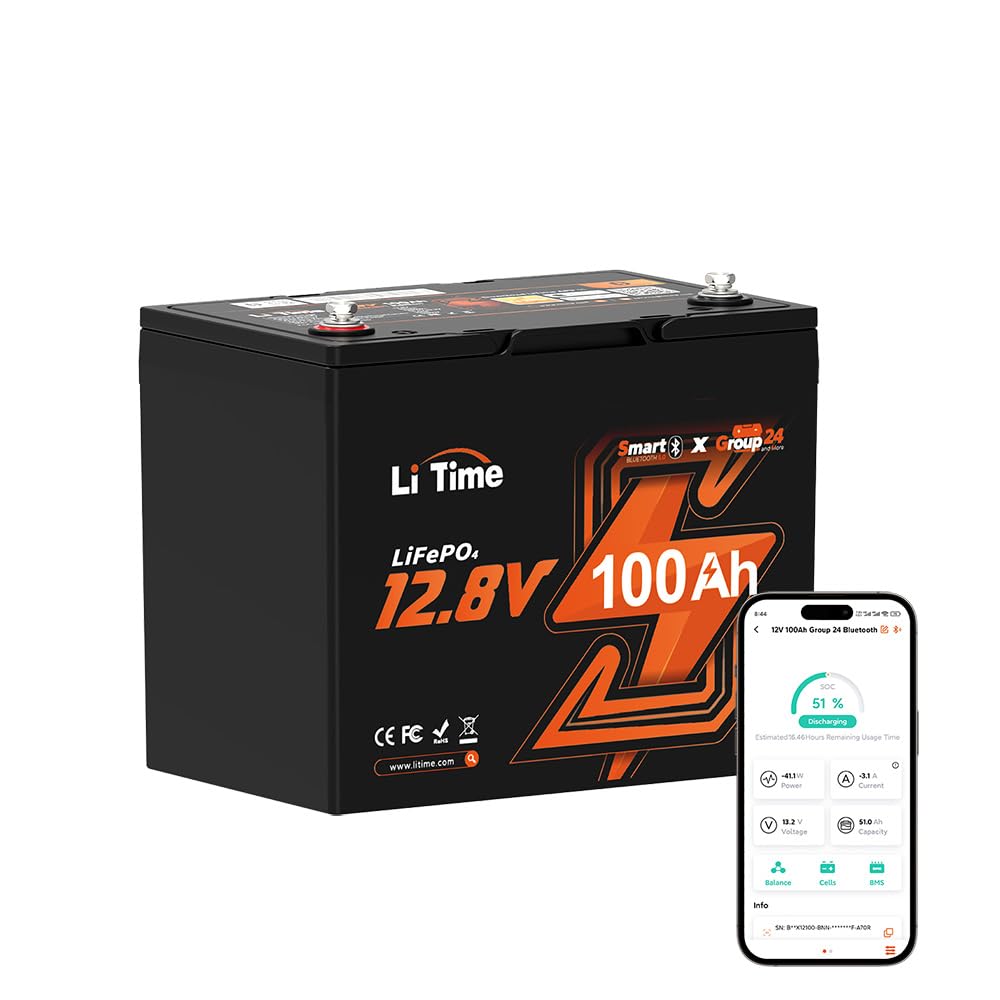
1. LiTime 12V 100Ah LiFePO4 Battery
Our pick — over 4.5★ from 700+ verified ratings; the strongest balance of quality and price.
The smart lithium powerhouse that fits standard battery boxes and tells you its state of charge.
The LiTime 12V 100Ah is a lithium iron phosphate drop-in replacement for lead-acid batteries, and it’s the easiest recommendation for most generator and off-grid backup users. It weighs just 21.9 lbs, which is roughly 63% lighter than a comparable ordinary lead-acid battery, so hauling it into an RV compartment or a truck bed is genuinely easy. The built-in 100A BMS provides 20+ safeguards, including a low-temperature cutoff that stops charging in freezing temps to protect the cells.
Its defining feature is the smart Bluetooth 5.0 connectivity, which pairs with the LiTime App via QR code. You can check voltage, charge rate, and discharge rate from your phone—owners love seeing real-time state of charge instead of guessing. In a tent trailer, buyers report getting the full 100Ah usable capacity versus roughly half of what a lead-acid battery provides, and it held 99% charge after two trips. The battery’s 4,000+ deep cycles and 10-year lifespan mean this is likely the last battery you’ll buy for a decade.
The main trade-off with any lithium battery is the charger: it needs a LiFePO4-compatible unit to reach full capacity. Some owners note the app can be glitchy during charging, requiring a reconnect, and it needs a compatible LiFePO4 (lithium iron phosphate) charger to charge fully. Durability is proven, though—owners mention 2 years of service in a truck bed powering a fridge and compressor with a 30A draw and 34 cycles, running strong. The 5-year warranty and AIG Product Liability Insurance provide solid confidence.
Why it wins
- Only 21.9 lbs—about 63% lighter than lead-acid, so installation is a one-person job
- Real-time Bluetooth monitoring via app shows exact state of charge
- 4,000+ deep cycles and a 10-year lifespan
- Supports expansion up to 20.48kWh for growing off-grid systems
Keep in mind
- App can be glitchy during charging and may need reconnecting to refresh
- Requires a LiFePO4-compatible charger for full capacity
Reach for this if: you want maximum usable capacity with minimal weight and don’t mind using a phone app to keep tabs on your power.
Look elsewhere if: you’re on a strict budget and prefer the simpler, cheaper lead-acid route.
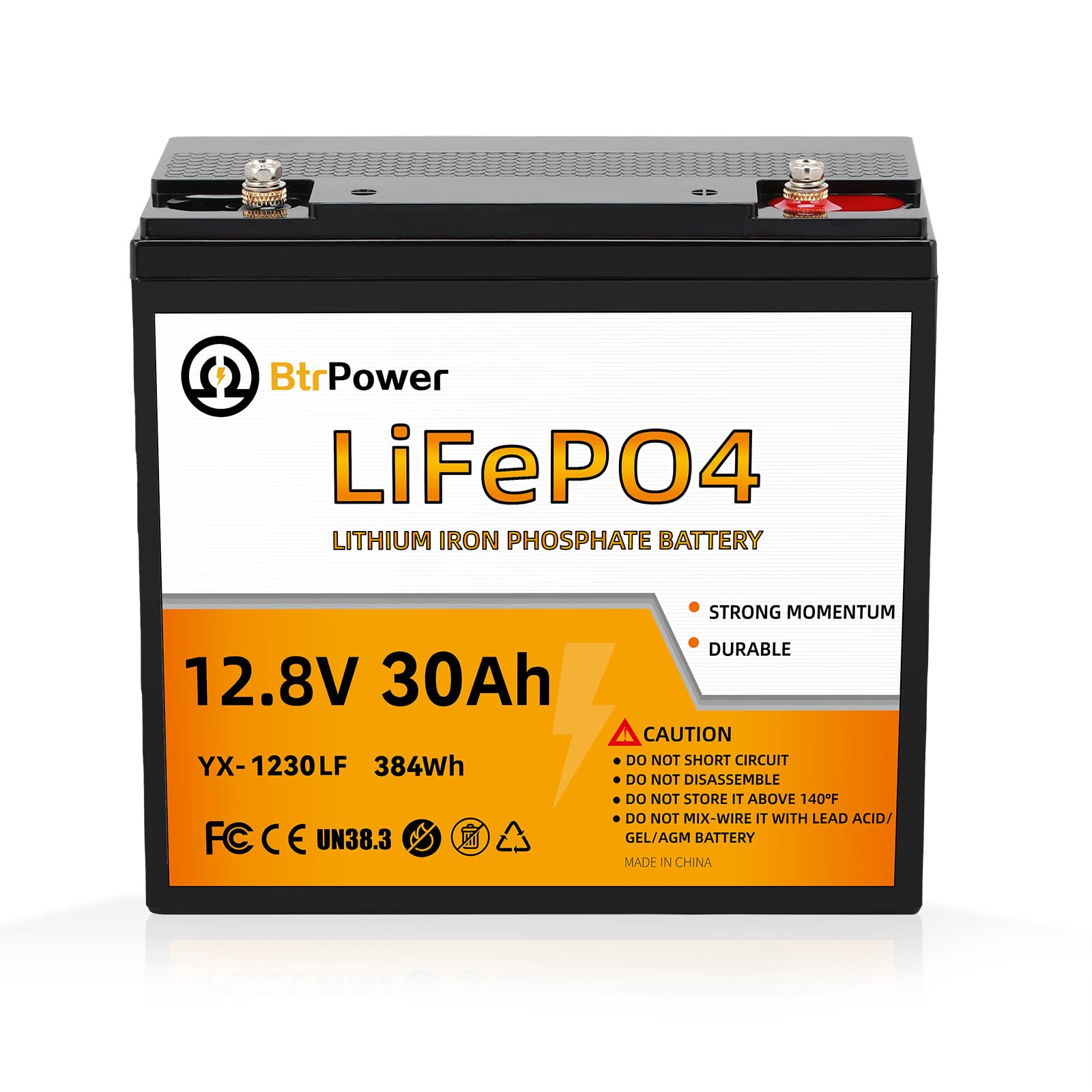
2. BtrPower 12V 30Ah LiFePO4 Battery
A pint-sized lithium battery that runs serious loads—from trolling motors to wheelchairs.
The BtrPower 12V 30Ah is the compact value pick that punches well above its size. It’s a true deep-cycle lithium iron phosphate battery with a 30Ah usable capacity, designed to be 30% lighter than an equivalent SLA battery, making it a favorite for portable and mobile setups. A built-in 30A BMS guards against overcharge, over-discharge, over-current, and short circuits, with cell voltage self-balancing for longevity.
Customers note running heavy loads without issue, including a 3000-watt inverter, solar charging, and a continuous server load, with the note that “batteries are solid, no issues 6 months in.” In a fishing setting, owners found it fits a Vexilar flasher perfectly and holds a charge a long time, and one wheelchair user described it as a massive upgrade over the old 2x12V lead-acid 55 amp batteries, saying the performance was “amazing.”
The real selling point is the 5,000+ deep discharges at 100% depth of discharge—that’s dramatically more cycles than the 300-500 typical of lead-acid batteries. It operates from -4°F to 140°F, with low-temperature protection that cuts off charging below 32°F and auto-recovers at 41°F. At 12.8 volts, it’s a straightforward drop-in for solar systems, trolling motors, and RVs.
What impresses
- 5,000+ deep cycles vs 300-500 for lead-acid
- 30% lighter than SLA batteries for easy carrying
- Handles heavy loads, including a 3000-watt inverter
- Maintenance-free and works in a wide temperature range
The catch
- 30Ah capacity is limited for whole-home backup
- M5 terminals may need adapters for some setups
Best for: anyone who needs a light, portable lithium battery for a trolling motor, fish finder, small solar setup, or mobility device.
Not for: running a large RV or whole-house backup load—that needs a 100Ah class battery.
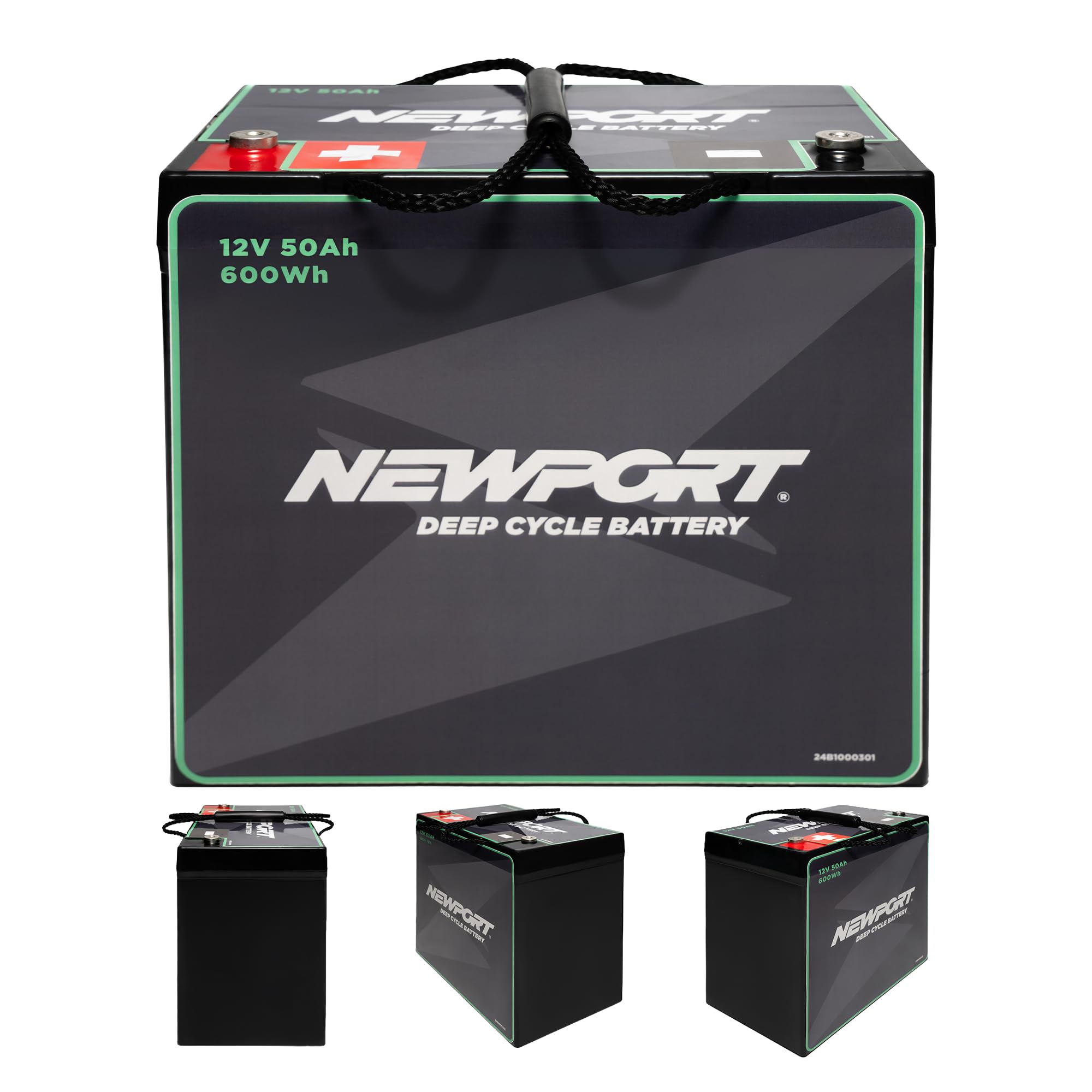
3. Newport 12V50Ah Deep Cycle Marine Battery
A surprisingly light sealed AGM marine battery that delivers steady power all day on the water.
The Newport 12V50Ah is a sealed AGM (Absorbent Glass Mat) lead-acid battery built for marine duty, and at 32 lbs it’s notably easy to move around for a lead-acid option. It’s a true deep-cycle battery charging 12V output with 50Ah capacity, targeted at trolling motors and boat electrical systems. The sealed, leak-proof construction means no acid spills and no maintenance—just install and run.
Owners consistently praise its runtime and stability: on a 55lb trolling motor, reviewers point out 4+ hours of use with stable voltage, and others describe it as powerful enough for a 40lb trolling motor and great with a depth finder. The build is solid and maintenance-free, which makes it a practical choice for boaters who don’t want to fuss with flooded cells. Its compact size also makes it a candidate for small solar setups.
The honest downside is the hardware: the battery lacks terminal bolts, so you’ll need to supply your own. A few also note there’s no charge indicator, and one bought a Noco Genius 1 charger only to find it tops out at 30Ah, not 50Ah. It carries a 1-year limited warranty, which is standard for the category.
What stands out
- 32 lbs—light for a sealed lead-acid marine battery
- 4+ hours on a 55lb trolling motor with stable voltage
- Sealed, leak-proof, maintenance-free design
Watch out for
- Terminal bolts not included
- No charge indicator built in
Choose this if: you want a dependable, affordable sealed battery for a trolling motor, fish finder, or boat accessories and don’t mind buying terminals separately.
skip it if: you need a high-capacity 100Ah-plus battery for extended off-grid running.
4. Mighty Max Battery 12V 100AH

A UL-certified sealed lead-acid workhorse that keeps fridges and lights running for days off-grid.
The Mighty Max ML100-12 is a 12V 100AH Group 27 Sealed Lead Acid (SLA) battery that’s UL certified and a smart budget pick for home backup and solar systems. At 28 lbs, it’s surprisingly manageable to lift compared to other 100Ah lead-acid batteries, and its spill-proof SLA design lets you mount it in any position. With a high discharge rate, wide operating temperatures, and deep discharge recovery, it’s built for steady, repeated use.
Owners running solar power systems report it performs well and provides plenty of power, with one detailing how it runs a fridge, fan, and lights without issues, and another powering all the LED lighting in a shed. In a van conversion, it consistently showed 4 red lights versus the old battery’s 2-3 after overnight use, and one buyer ran a 32″ TV and Roku on a 500W inverter for 4 hours with only 1% drain. It also scored well as a trolling motor battery, delivering 8+ hours of use with 35% charge left.
The recurring caveat is that, like any lead-acid battery, some units don’t hold a charge as long as owners hope, and at 28 lbs it’s not light. The listing includes the battery and screws only—no wire harness or mounting accessories—and it has a full one-year warranty. For a no-maintenance 100Ah with a serious track record in solar and backup duty, this is a very accessible place to start.
Why it works
- 28 lbs—light for a 100Ah slab
- Runs fridge, fan, and lights off-grid for days
- UL certified with spill-proof SLA design
Consider this
- Lead-acid chemistry means fewer deep cycles than lithium
- No wiring or mounting hardware included
Reach for this if: you want budget-friendly 100Ah capacity for solar, van life, or emergency backup with a simple sealed construction.
Think twice if: you plan to drain the battery near 100% regularly—lithium handles that far better.
5. WEIZE 12V 100Ah Deep Cycle Battery

A heavy-duty sealed AGM built for generator backup, running lights and vents for 20 hours straight.
The WEIZE 12V 100Ah is a Group Size 31 sealed lead-acid battery engineered for serious backup loads, and it’s the go-to when you need maximum lead-acid capacity. It’s rated with a 1150A max discharge current, meaning it can handle a high surge from an inverter, and it has a low 3% self-discharge rate, so it holds its charge while sitting between uses. This battery explicitly lists generator as a fitting application alongside RV, solar, and marine use.
Owners prove its stamina: one ran 18 interior LED lights and 3 vent fans for over 20 hours without recharging, and another setup with 4 parallel batteries feeding a 2000W inverter created a ~4.8kWh backup system that can power 120V outlets, fans, and a garage door. For off-grid RVers, a pair of these lasted 2 years with 2x150W solar, powering a 700W inverter for appliances without issues. The AGM (absorbent glass mat) construction means no fluid checks—a major convenience.
The catch is weight: at 63 lbs, this is a heavy unit that owners consistently flag as very hard to move and install. One buyer’s honest take is that it’s “better than nothing, not a Tesla Powerwall,” meaning it’s a solid emergency backup but won’t run heavy appliances like stoves or HVAC. It’s sealed, maintenance-free, and spill-proof, making it a dependable pick for stationary home backup where weight matters less.
What delivers
- 1150A max discharge for inverter surges
- Ran 18 LED lights and 3 vent fans for 20+ hours
- Sealed AGM—no maintenance, no spills
- 3% self-discharge rate holds charge in storage
The trade-off
- 63 lbs—genuinely heavy to install
- Won’t run stove, dryer, or HVAC loads
Best for: stationary home or generator backup where weight is no object and you want proven, no-fuss 100Ah lead-acid power.
Not for: anyone who needs to move the battery frequently—lithium is far lighter.
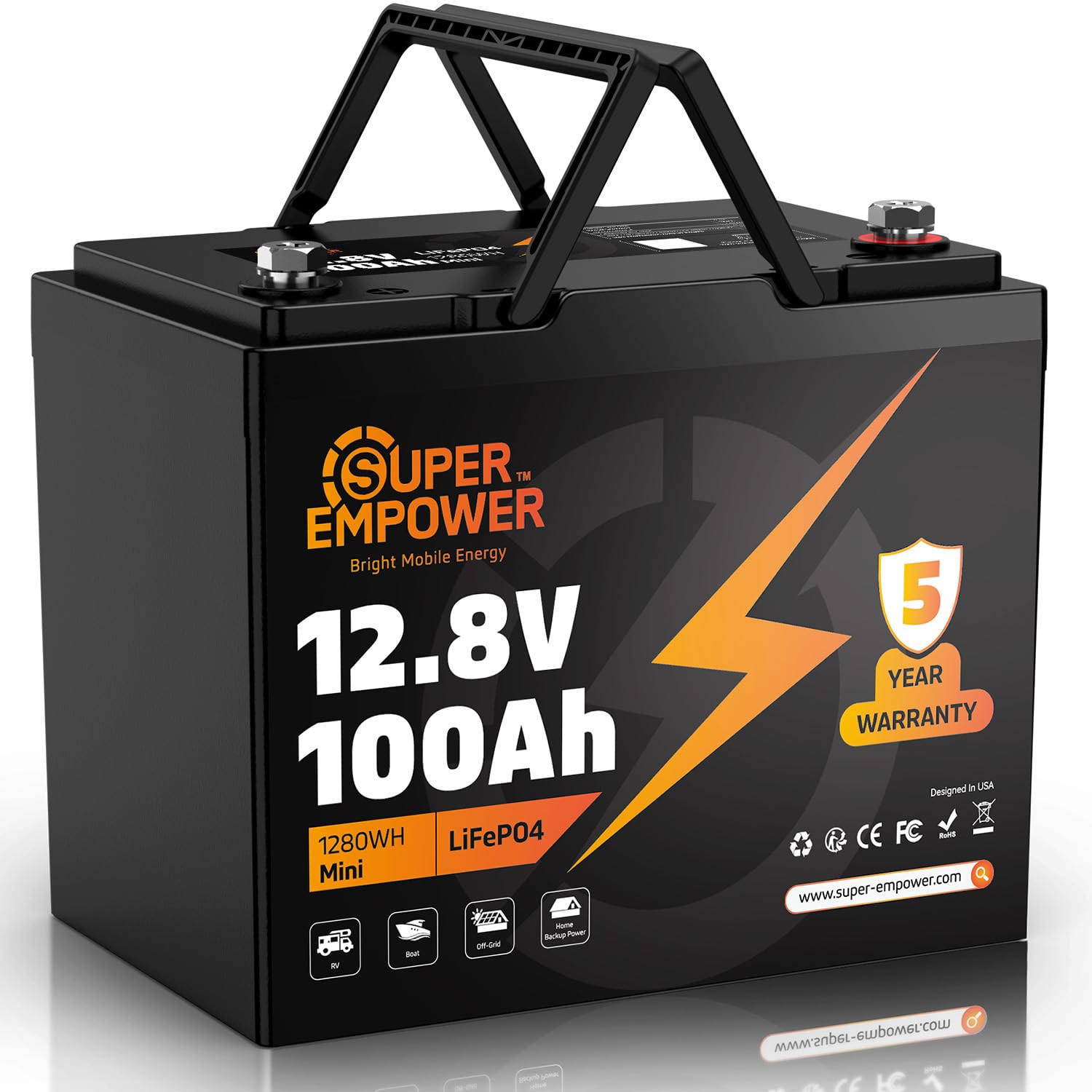
6. SUPER EMPOWER 12V 100Ah LiFePO4 Battery
A featherweight lithium battery with true cold-weather charging protection for year-round RV power.
The SUPER EMPOWER 12V 100Ah LiFePO4 battery is a premium lithium option that stands out for its sturdy low-temperature charging function. At just 21.6 lbs, it’s a true drop-in replacement for lead-acid, AGM, or SLA (sealed lead-acid) batteries in a BCI Group 24 size with M8 terminals, fitting most standard battery boxes without modifications. The built-in 100A BMS (battery management system) manages charging, discharging, current, and temperature, actively protecting against overcharge, over-discharge, overcurrent, and short circuits.
Its defining cold-weather feature is automatic charging shutdown below 32°F (0°C), with discharge stopping at -4°F (-20°C), resuming above 41°F (5°C). This is crucial for RV and off-grid setups that see freezing nights. Owners consistently note it lasts incredibly longer than lead-acid alternatives, with one reporting it kept a sump pump running during severe storms, and another calling it more powerful than many small power stations. The weight savings are a recurring theme—buyers love how easy it is to move compared to lead-acid.
Like other lithium batteries, it requires a compatible LiFePO4 charger or a solar controller set to lithium mode, and it’s not suitable for engine starting or cranking. Shoppers say the initial charge takes a while but recharges quickly afterward, and there’s no battery percentage readout built in. It supports expansion up to 4S4P for a 51.2V 400Ah configuration with 20.48kWh capacity, and it comes with a 5-year warranty.
Why it shines
- Charging auto-pauses below 32°F to protect cells
- Only 21.6 lbs with folding handles for easy carrying
- Kept a sump pump running through severe storms
- Supports 4S4P expansion to 20.48kWh
Keep in mind
- Needs a dedicated LiFePO4 charger
- Not for engine starting or cranking
Choose this if: you camp or run backup power in genuinely cold climates and want lithium’s weight savings plus freeze protection.
Look elsewhere if: you need a battery that can also start a generator engine—this one is storage only.
7. HumsiENK 12V 100Ah LiFePO4 Battery with Bluetooth
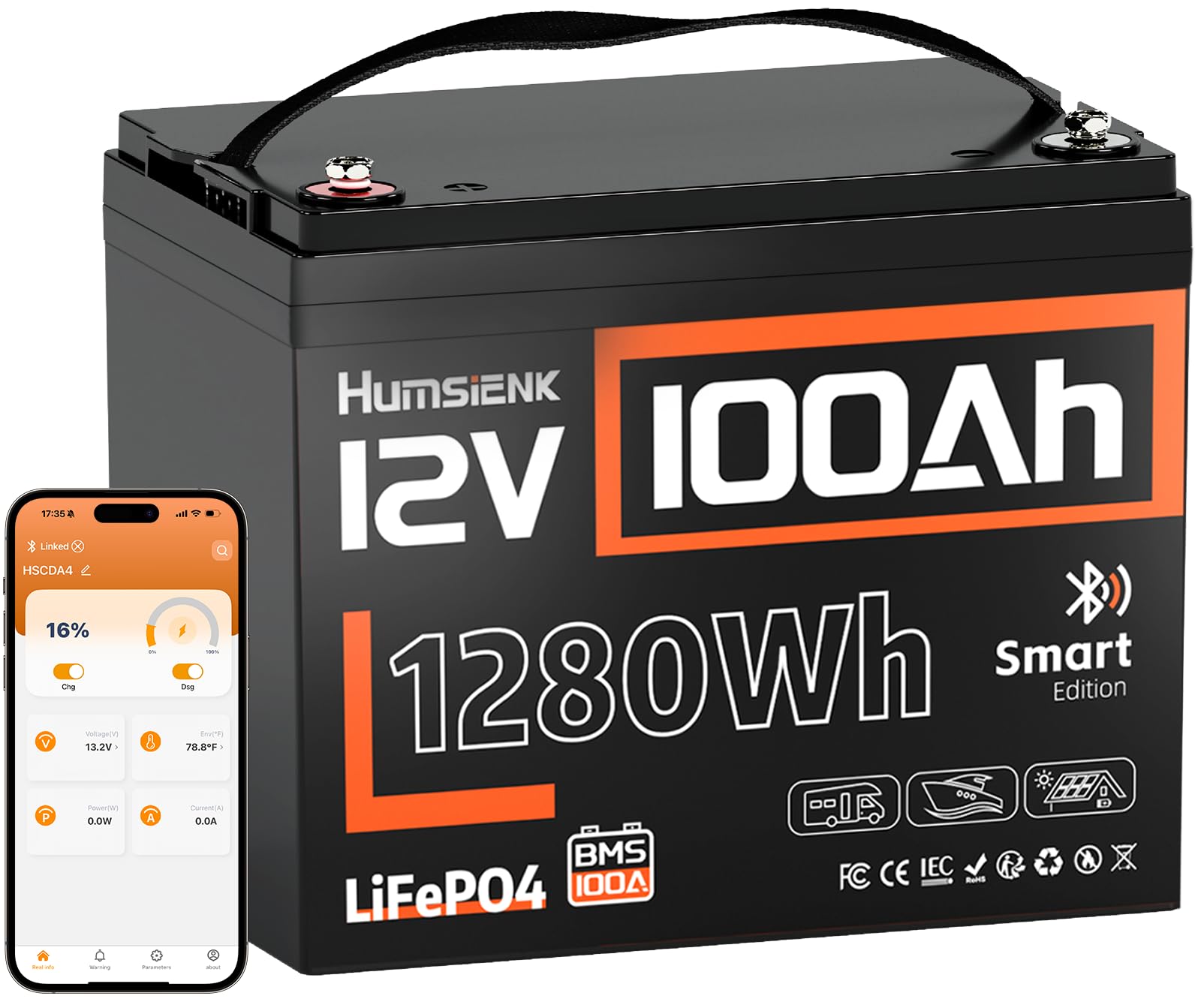
An ultralight smart lithium battery that tracks voltage and temperature from your phone.
The HumsiENK 12V 100Ah LiFePO4 battery delivers 1280Wh of power in a package that weighs just 19.73 lbs—making it one of the lightest ways to get a full 100Ah capacity. It’s engineered to be 35% smaller and over 60% lighter than lead-acid, with a BCI Group 24 size that fits battery boxes from Group 24 to 31 globally. The upgraded 100A smart BMS pairs with a dedicated app for real-time monitoring of voltage, temperature, and other key parameters.
What wins people over is the app experience: owners describe the Bluetooth connectivity as “excellent” and note the app updates several times per second with detailed alarms and per-cell data. One buyer ran major kitchen appliances off it, and others use it as a perfect drop-in replacement for RV, solar, or marine use. The battery’s A+ grade LiFePO4 cells are UL tested, FCC and CE certified, with an IP65 waterproof rating and support for up to 15,000 cycles.
The honest caveat is that a small number of units arrive unable to hold a charge, and app connection issues can complicate charging diagnostics. The operating range of -4°F to 158°F with automatic low-temperature shutdown is solid, and it allows 4S4P configurations up to 48V and 20.48 kWh. It’s backed by a 5-year warranty with 24-hour customer service—a strong safety net.
What impresses
- Only 19.73 lbs—an ultralight 100Ah
- Bluetooth app with per-cell data and fast updates
- IP65 waterproof rating
- Supports up to 15,000 cycles
The risk
- Occasional units fail to hold a charge
- App connection issues can complicate diagnostics
Reach for this if: you love monitoring your power system in detail from your phone and want the lightest possible 100Ah battery.
Be cautious if: you’d rather have a dead-simple battery with no app dependency—the Bluetooth is a core feature here.
8. Weize Dual Purpose AGM Battery BCI Group 24M
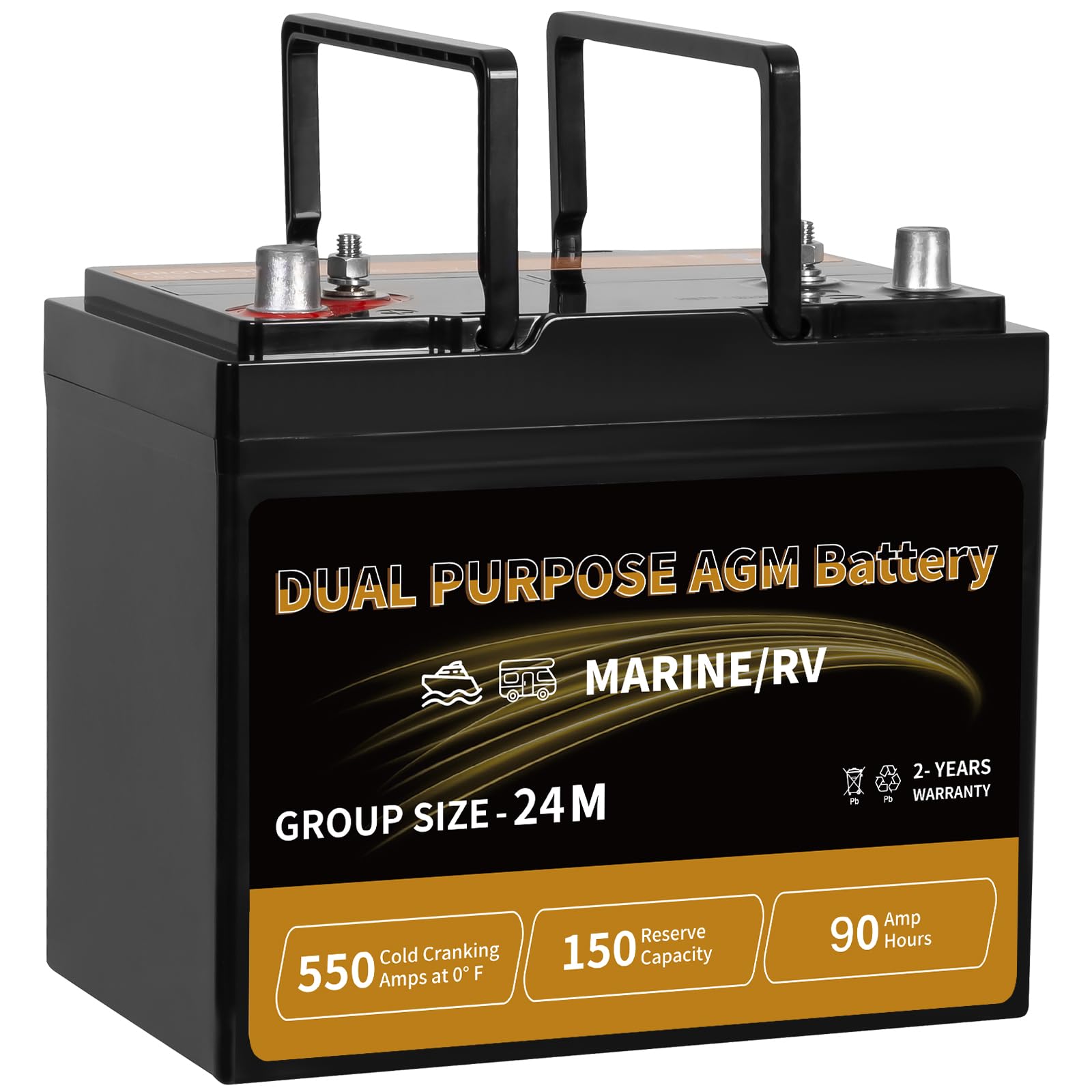
The one battery that both cranks a big engine and powers a deep-cycle load—a true two-in-one.
The WEIZE BCI Group 24M is a dual-purpose sealed AGM battery, meaning it does double duty: it can start an engine and also handle deep-cycle discharging, making it a savvy choice for a generator that needs both cranking power and house power. It’s rated with an impressive 550CCA (Cold Cranking Amps) for starting confidence and 150RC (Reserve Capacity) for sustained power delivery, with a 90Ah capacity. At 50.7 lbs, it’s solidly built for the task.
Owners are genuinely impressed with its muscle—one reported it “powerful enough to start a 5.3 v8 engine,” while another said it starts an 8.1L big block easily and charges quickly. The quick-charge feature is a standout, with the manufacturer claiming it charges up to five times faster than standard. It also offers 2x more cycle life than traditional flooded marine batteries and 20x more vibration resistance, which matters in a moving vehicle or marine environment.
There’s mixed feedback on longevity: a few buyers report it won’t hold a charge, but most find it stays fully charged with minimal usage and call it heavy-duty and well-built. One buyer even said it outperforms the Interstate battery it was bought as a backup for. It carries a 2-year warranty, which is twice the industry standard, and the multi-terminal design (DT, SAE/M8) gives flexibility for different connections.
Why it’s versatile
- 550CCA starting power—starts a 5.3 v8 engine
- Dual-purpose: crank and deep-cycle in one unit
- Charges up to five times faster
- 2-year warranty, double the standard
Note
- 50.7 lbs—needs a hand installing
- Some owners mention charge-holding issues over time
Best for: anyone who wants one AGM battery that can both start a generator or boat engine and power accessories—no separate house battery needed.
Consider alternatives if: you only need deep storage and never start an engine; a pure deep-cycle model gives more capacity per dollar.
9. WattCycle 12V 100Ah LiFePO4 Battery
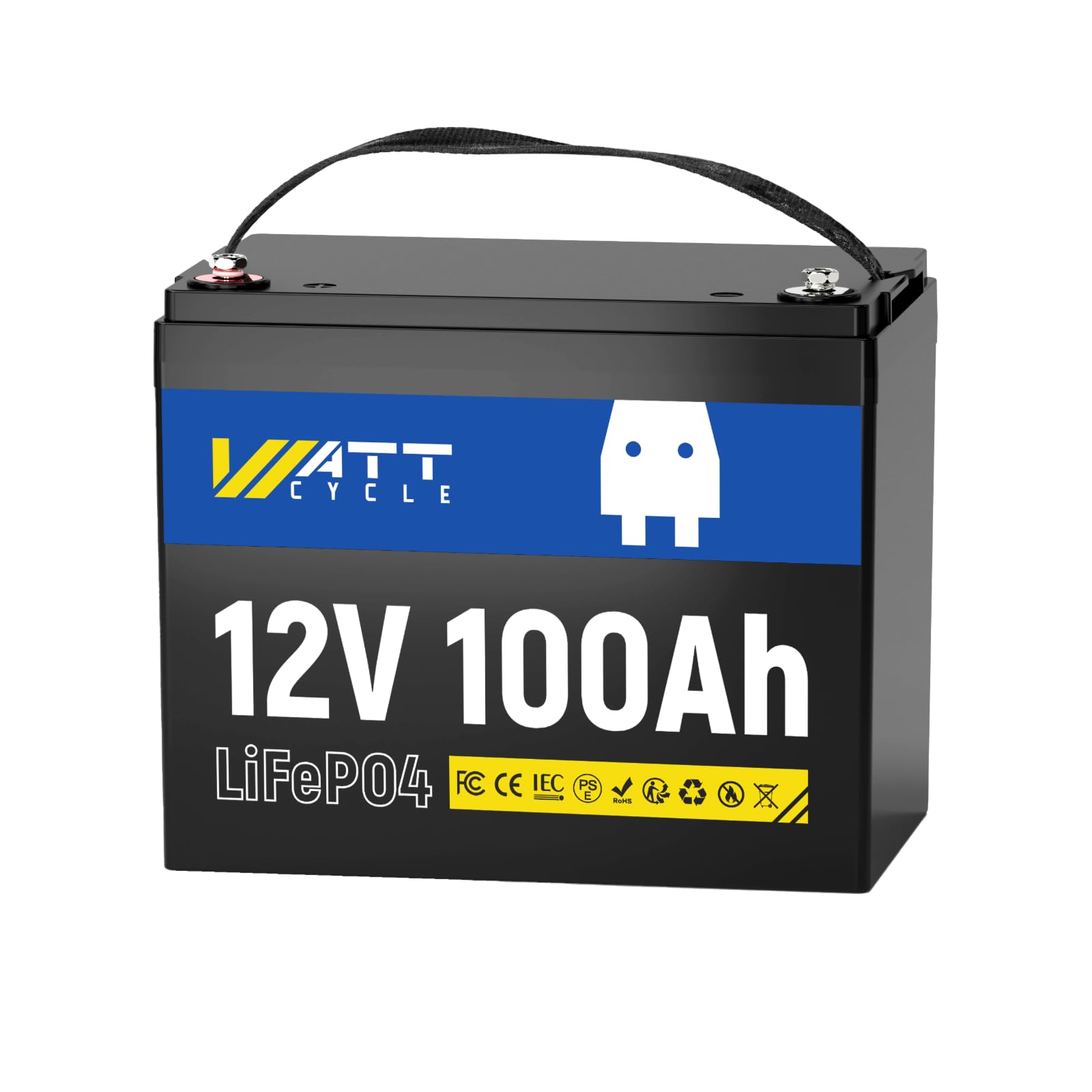
A certified, no-frills lithium 100Ah that runs telescopes for a week and recharges on schedule.
The WattCycle 12V 100Ah LiFePO4 battery is a clean, dependable lithium option for off-grid systems, with a compact footprint of just 10.2 x 6.6 x 8.2 inches and a weight of 23.2 lbs. Its A+ grade cells and built-in 100A BMS disconnect the battery if discharge current exceeds 300±50A, adding a strong layer of safety. It has earned SDS/UN38.3/FCC/CE/ROHS certifications, so the quality and safety boxes are well checked.
Buyers find it performs excellently, particularly with trolling motors, and appreciate its light weight compared to lead-acid. One owner powers two telescopes for a week without recharging, and another uses it as the house battery for a 19′ boat running VHF, lights, a bilge pump, and a 300W inverter. The capacity is verified—owners measured ~47Ah charged in under 4 hours, confirming the full 100Ah, and it stays above 12.5V per battery after months of use. It also allows up to 4 in series or 4 in parallel for a remarkable 20.48kWh capacity.
The main honest caveat is that there’s no built-in Bluetooth, so one owner added a third-party monitor to track state of charge. Also, a few owners note one battery in a multi-battery bank can discharge slightly faster than the others, requiring monitoring. The 15,000-cycle rating and deep-cycle design make it a long-term buy, and the included M8 screws, insulated caps, and instruction manual mean it’s ready to install from the start.
What delivers
- 15,000-cycle rated lifespan
- Runs two telescopes for a week without charging
- Verified full 100Ah capacity with fast recharge
- SDS, UN38.3, FCC, CE, ROHS certified
Good to know
- No Bluetooth—needs a third-party monitor for SOC
- In multi-battery banks, individual units can drain unevenly
Reach for this if: you want a certified, no-nonsense lithium 100Ah for solar, trolling, or off-grid house power without paying for smart features you won’t use.
Skip if: you need phone-app monitoring built in—this one is intentionally simple.
Understanding the Specs
Amp-Hours and Runtime
amp-hours (Ah) tells you the energy capacity of a battery. Think of it as the fuel tank size. A 100Ah battery can deliver 1 amp for 100 hours, or 5 amps for 20 hours. For a generator battery, larger capacity means you can run a fridge, lights, or an inverter for more hours between charges. Lithium batteries let you use near 100% of that rated capacity, while lead-acid batteries should ideally only be drained to about 50% to preserve their life.
BMS Protection in Lithium Batteries
The Battery Management System (BMS) is the safety brain of a lithium battery. It constantly monitors the cells to prevent overcharging, over-discharging, excessive current, and short circuits. Many also have low-temperature cutoff, which stops charging in freezing weather to protect the chemistry. For a generator or backup use, a good BMS is non-negotiable—it’s what makes a lithium battery safe to live with.
FAQ
Can lithium batteries be used to start a generator engine?
What capacity battery do I need for a generator?
What is the difference between a starting battery and a deep cycle battery?
Are AGM batteries better than flooded lead-acid for this purpose?
How long can a 100Ah battery run a refrigerator?
What does cold cranking amps (CCA) mean for a generator battery?
Is it safe to charge a lithium battery in freezing temperatures?
How long does a lithium battery last compared to lead-acid?
Final Thoughts: The Verdict
The winner for most people is the litime 12v 100ah because it combines the lightest practical weight, a full 100Ah of usable power, and phone-app monitoring in one smart package. If you want the same lithium benefits but need freeze protection for cold climates, the SUPER EMPOWER is the one to reach for. And for a budget-friendly lead-acid backup that just works, the Mighty Max continues to prove itself in real solar and van setups.
How We Picked
We do not accept paid placement. Every pick is matched to a real buyer and a real use-case; we do not hands-on test units.
Sources & Methodology
Specifications: manufacturer listings and product documentation. Review insights: verified customer reviews, as of August 2026. Pricing: not shown on this page (it changes often); check the current price via the retailer link.
As an Amazon Associate, Gadgets Feed earns from qualifying purchases. This does not affect which products we feature.