
Our readers keep the lights on and my morning glass full of iced black tea. As an Amazon Associate, I earn from qualifying purchases.
Specs are compiled from manufacturer listings and verified buyer reviews and can change over time — please confirm the key details on the product page before buying.
When the lights go out, a 300Wh power station is the difference between a dark, dead phone and a working router, a lit room, and a warm meal. This guide breaks down the nine best models in this size class, focusing on the specs that actually matter for emergency backup and weekend camping—real capacity, real output, and real-world reliability.
I’m Min — the founder and writer behind Gadgets Feed. This guide is built by comparing the manufacturers’ published specifications and the patterns across verified customer reviews, so you get each pick’s real strengths and trade-offs instead of marketing spin.
Here is the honest shortlist of the best 300wh power station picks, ranked by real-world performance, portability, and owner satisfaction.
Our Picks at a Glance

How To Choose The Best 300Wh Power Station
Match the station’s watt-hour capacity and continuous output to the devices you’ll actually plug in. A 300Wh unit balances enough capacity for a blackout’s essentials with a weight that’s easy to toss in a trunk for camping.
Match capacity to your devices
Check the wattage of the things you want to run. A laptop might draw 60W, a mini-fridge around 70W, and a CPAP machine about 30W. A 300Wh station gives you roughly one to four hours of run time on those kinds of loads; a 600W surge handles the brief spike a fridge compressor needs when it kicks on.
Choose the right battery chemistry
Look for LiFePO4 (LFP) batteries—they last for thousands of charge cycles, meaning they’ll still hold most of their capacity after years of weekly use. Older lithium-ion chemistries wear out faster. This matters most for a device you might keep in a closet for emergencies and forget about until you need it.
Count your output ports and check solar input
Make sure the station has the right mix of AC outlets, USB-C PD (for fast laptop charging), and a car port for 12V gear. If you plan to recharge off-grid, check the max solar input wattage—a higher number means you can use a bigger panel and refill the battery in a few hours of sun rather than a full day.
Quick Comparison
| Model | Best For | Capacity | Continuous Output | Weight | Amazon |
|---|---|---|---|---|---|
| EF ECOFLOW RIVER 3★ Best Overall | Best Overall / UPS | 245Wh | 600W | 7.8 lbs | Amazon |
| OUPES Exodus 350Premium Pick | Fast Solar Recharge | 288Wh | 350W | 9.2 lbs | Amazon |
| BLUETTI Elite 30 V2Top Performer | High Output / UPS | 288Wh | 600W | 9.5 lbs | Amazon |
| Anker SOLIX C300 | Ultra-Light Portability | 288Wh | 300W | 1.41 lbs | Amazon |
| Bailibatt 300W | Budget Value | 257Wh | 300W | 5.4 lbs | Amazon |
| DYNESS 300W | Compact Camping | 256Wh | 300W | — | Amazon |
| GRECELL 330W (288.6Wh) | Multi-Device Charging | 288.6Wh | 330W | 7.3 lbs | Amazon |
| GRECELL 330W (230.88Wh) | Feature Packed | 230.88Wh | 330W | — | Amazon |
| EF ECOFLOW RIVER 2 240 | Reliable Backup | 243Wh | 300W | 7.7 lbs | Amazon |
In‑Depth Reviews
1. EF ECOFLOW Portable Power Station RIVER 3, 245Wh 550W
Our pick — 4.5★ from 850+ verified ratings; the strongest balance of quality and price.
The smartest 300Wh-class station, blending instant UPS backup and rapid recharge.
When a storm knocks out your power, the RIVER 3 steps in before you even notice—its AC outlet switches to battery supply in under 20 milliseconds, fast enough to keep a sensitive DVR or home server running smoothly. Unlike the others here, this one doubles as a real uninterruptible power supply, which is why it tops the list. At 7.8 lbs, it’s also 30% smaller than the industry average, so it slips into a closet or a duffel without hogging space.
Recharging is the fastest in this class—it goes from empty to 100% in just 1 hour on AC, or 2.6 hours with a 110W solar panel. Inside is an LFP battery rated for 3000+ charge cycles, which translates to roughly 10 years of regular use. Owners have leaned on it through a 72-hour outage to keep lights, phones, and tablets running, and the 600W max output (with X-Boost) handles small appliances that exceed the base 300W rating. The one recurring gripe is the display—some buyers report the screen is hard to read in certain light, so don’t rely on it as your primary battery gauge.
Owners praise the solid build (142 mentions) and the 1-hour charging speed (104 mentions). Owners mention: “After a recent 72hr plus outage this is a perfect solution to keep small lights and phone/tablets etc powered up.” It runs near-silent at under 30 dB measured 1.5 feet away, so it won’t hum you out of a bedroom during an outage.
Why It Wins
- 1-hour AC recharge beats nearly every rival
- <20ms UPS switch protects sensitive electronics
- LFP battery lasts 3000+ cycles for a decade of use
- Quiet operation under 30 dB
Trade-Offs
- Display can be hard to read in some lighting
- 245Wh is on the lower end of this size class
Grab it for: anyone who wants instant, silent backup for a router, modem, or DVR during outages, plus fast top-ups between uses.
Think twice if: you need the larger 288Wh capacity of the BLUETTI for all-night appliance runs—the trade-off is the slower 70-minute wall charge.
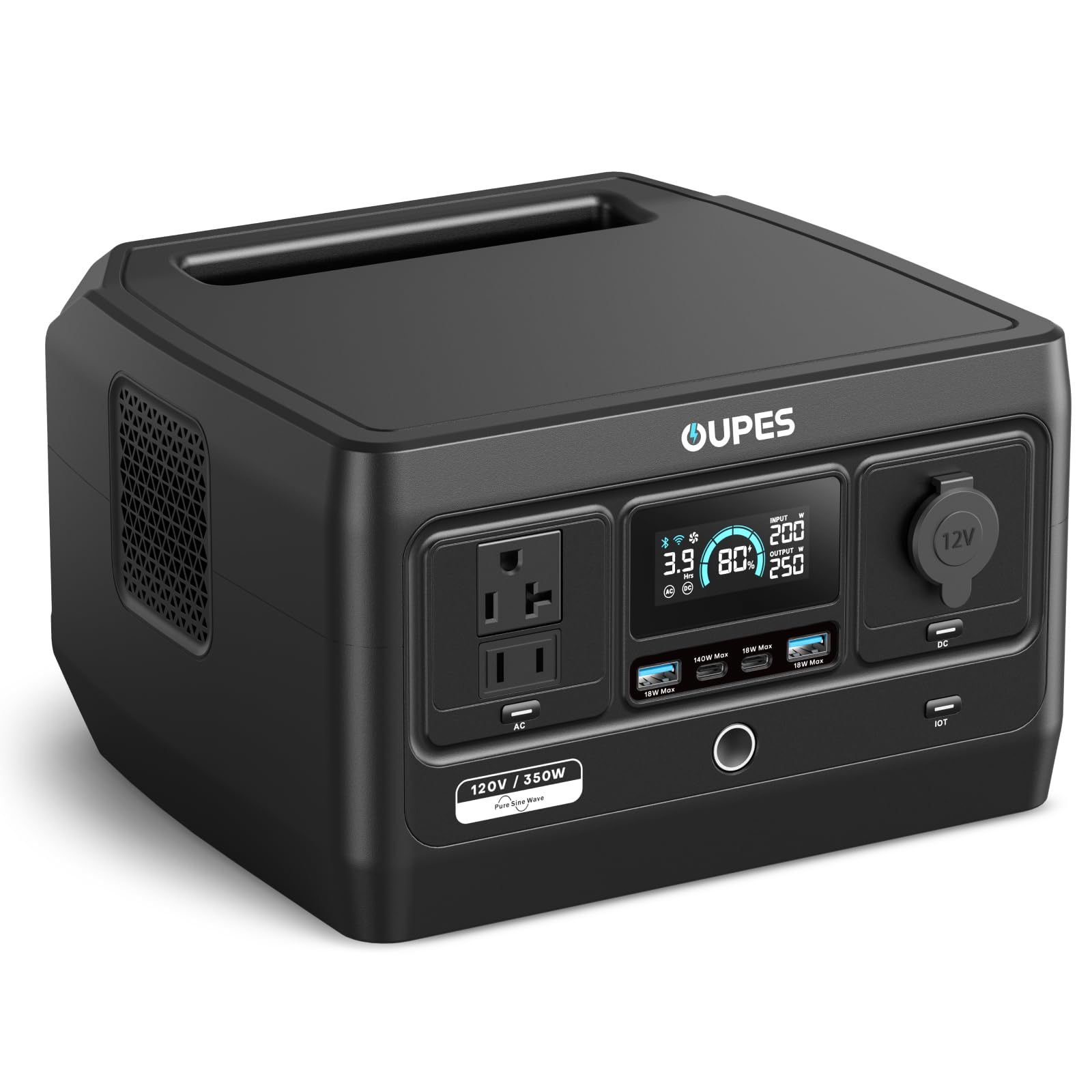
2. OUPES Exodus 350 Portable Power Station, 288Wh 350W
A creator-focused powerhouse that recharges in 69 minutes and feeds a laptop at full speed.
The Exodus 350 is the one for digital nomads and photographers who need full-speed laptop power in the field. Its 140W USB-C PD port bypasses the clunky power brick entirely, and the 288Wh LiFePO4 battery delivers a clean 350W of continuous pure sine wave output (600W surge) for camera rigs, drones, and CPAP machines. At 9.2 lbs with an ergonomic handle, it’s built to move from a roof tray to a camp table without complaint.
The solar story here is where it leaves the pack—it accepts up to 240W of solar input, charging from 0% to 80% in just 69 minutes on a sunny day. That’s roughly triple the solar intake of the ECOFLOW RIVER 3’s 110W limit, making it the best pick for off-grid trips where you need to refill daily. A built-in smart app with Wi-Fi and Bluetooth lets you watch input and output wattage, tweak charging speed, and even get over-the-air firmware updates from your phone.
Performance is the top owner praise (21 mentions), with power output close behind. It also delivers sub-10ms UPS protection, so a sudden grid drop won’t interrupt a Wi-Fi call or a work-from-home setup. The one mixed note is Bluetooth connectivity, which some owners found finicky to pair on the first try. The 3000+ cycle LFP battery means it should still be going strong a decade from now.
Standout Strengths
- 240W solar input recharges in 69 minutes
- 140W USB-C PD charges laptops at full speed
- <10ms UPS shields sensitive gear
- Smart app with OTA updates
Worth Knowing
- Bluetooth pairing can be tricky at first
- 350W continuous output is lower than the 600W rivals
Choose it for: creators and overlanders who want the fastest solar refill in this size class and full-speed laptop charging on the go.
Pass if you: need to run a small kettle or toaster—the 350W continuous limit means those stay in the BLUETTI’s lane.
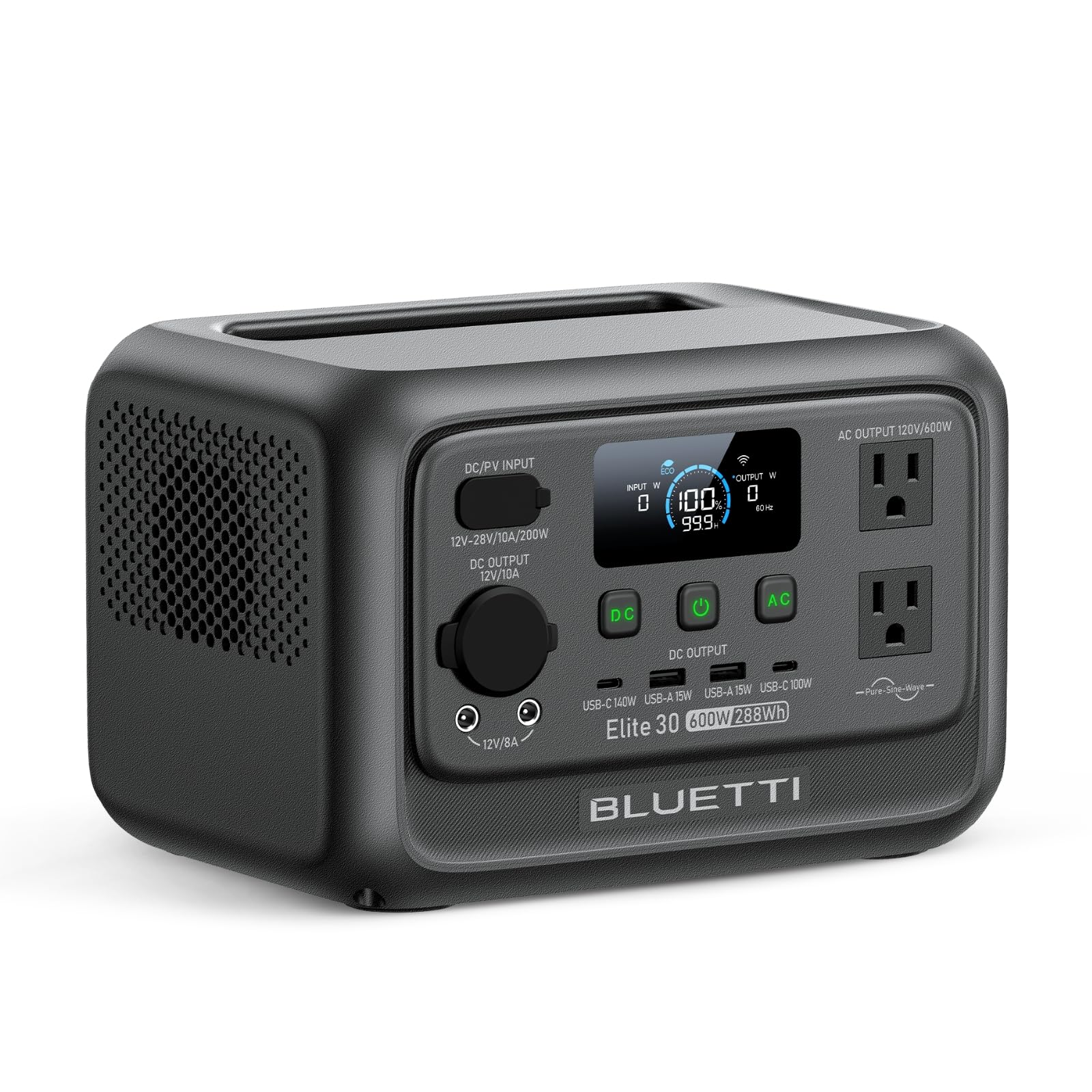
3. BLUETTI Elite 30 V2 Portable Power Station 288Wh 600W
600W of continuous output that runs a small kettle and still fits under a desk.
Most 300Wh-class stations cap out around 300W continuous, but the Elite 30 V2 doubles that to a full 600W—enough to run a small kettle, toaster, or space heater that its rivals simply can’t touch. It even has a Power Lifting Mode that pushes up to 1500W surge for those brief power-hungry moments. All that punch comes in a 9.5 lb package that owners say is small enough to slip under a desk as a permanent UPS for a home office or server rack.
Charging is genuinely fast: 0% to 80% in 45 minutes and full in 70 minutes via the 380W adjustable wall charger. The 10ms UPS switch is fast enough to protect a CPAP, laptop, or network gear through sudden blackouts, which is why several owners use it to replace aging dedicated UPS units.
Owners most praise performance (99 mentions) and reliability (93), with 53 charging-speed mentions backing the 45-minute claim. One honest fit note: the fan can spin up under sustained load, and battery life gets mixed feedback from owners who expected longer runtime at high draw—a reality of any 288Wh pack. Standby power consumption is a low 4.5W, so it won’t drain itself sitting in a closet.
What Stands Out
- 600W continuous output—double most rivals
- 45-minute charge to 80%
- 10ms UPS switch protects sensitive gear
- Versatile 8 charging modes
The Fine Print
- 9.5 lbs is heavier than the super-light Anker
- High-load runs drain the 288Wh pack quickly
Reach for this if: you need to power a small appliance or keep a home office alive through outages—the 600W output is the real differentiator.
Look elsewhere if: weight is your #1 concern; the Anker SOLIX C300 is nearly 8 lbs lighter.
4. Anker SOLIX C300 Portable Power Station with Protective Bag, 288Wh, 300W
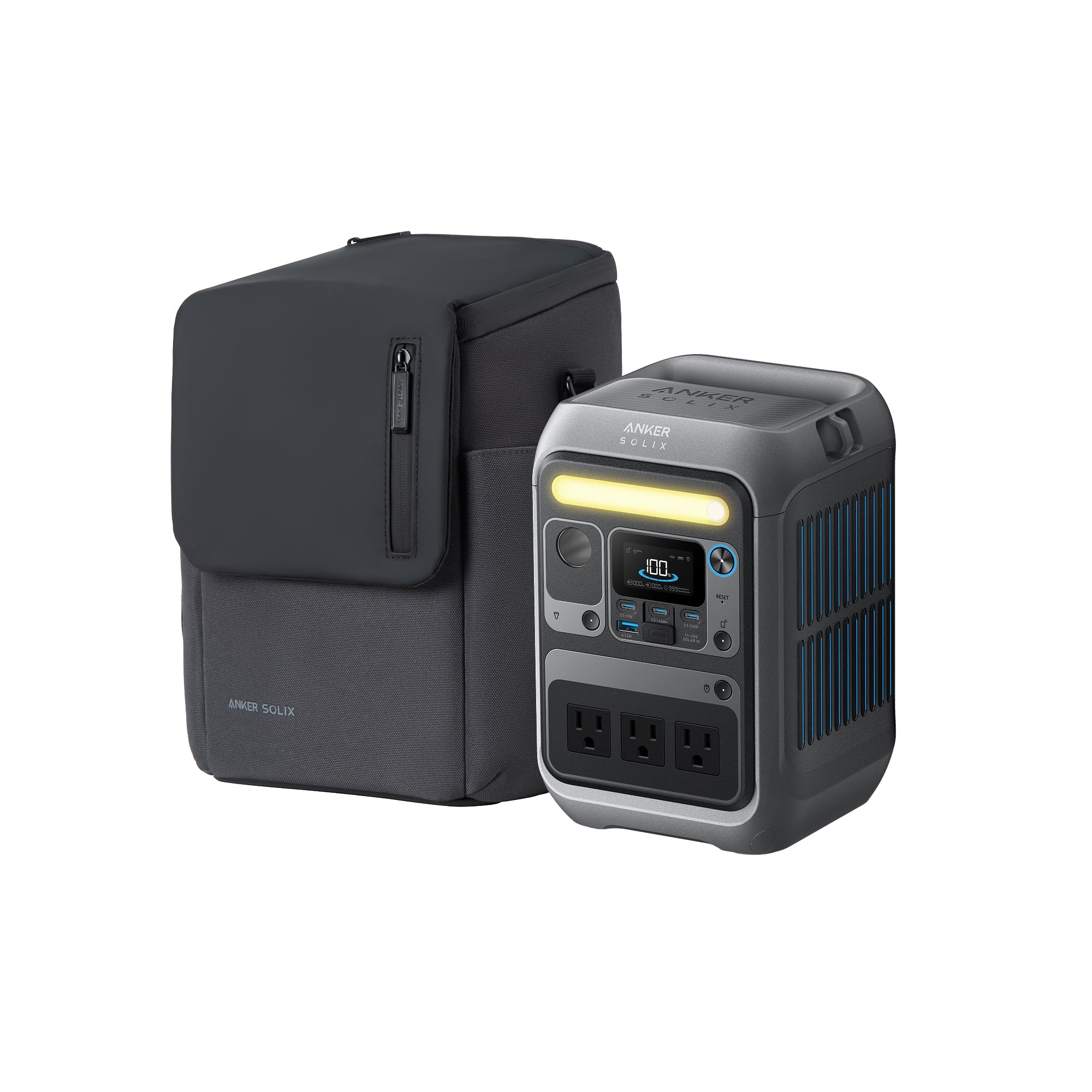
A featherweight 288Wh station that disappears into a bag, yet powers a full campsite.
At just 1.41 lbs including its protective bag, the SOLIX C300 is almost absurdly easy to carry—you’ll forget it’s in your backpack until you need it. That kind of portability is unheard of in the 288Wh class, where most units tip the scales at 7 to 9 lbs. It’s the obvious pick for hikers, festival-goers, and anyone who dreads lugging heavy gear. Owners use it to inflate air mattresses, top off everyone’s phones, and run a speaker all weekend.
The 300W output is enough for laptops, cameras, and small devices, delivered through 7 ports: 1 car socket at 120W, 3 USB-C (140W, 100W, 15W) and 2 USB-A at 12W. Recharging is flexible—hit 80% in about an hour via the dual USB-C PD 3.1 ports, or top up with up to 100W of solar input using Anker’s SOLIX panels. The protective bag adds a layer of ruggedness without adding bulk, and the dark gray shell hides scuffs from a day on the trail.
One setup note from the listing: first-time activation requires recharging with an 18W or higher USB-C wall charger, and only the USB-C2 and USB-C3 ports handle that. It’s not compatible with SOLIX PS30, PS200, or PS400 panels, so check panel compatibility before buying a solar setup. Owners consistently call it dependable—several have bought multiple units after the first one proved itself on trips.
The Big Wins
- 1.41 lbs—the lightest 288Wh station by far
- Comes with a protective bag
- Dual 100W+ USB-C PD for fast laptop charging
- 80% charge in about an hour
Before You Buy
- 300W output won’t run a small kettle
- Requires an 18W+ charger for first activation
Best suited for: ultralight packers and travelers who want real 288Wh capacity without the 9-lb anchor.
Not for: anyone planning to run a mini-fridge or toaster—those need the BLUETTI’s 600W continuous output.
5. Bailibatt Portable Power Station 300W, 257Wh, 4.6lbs Solar Generator
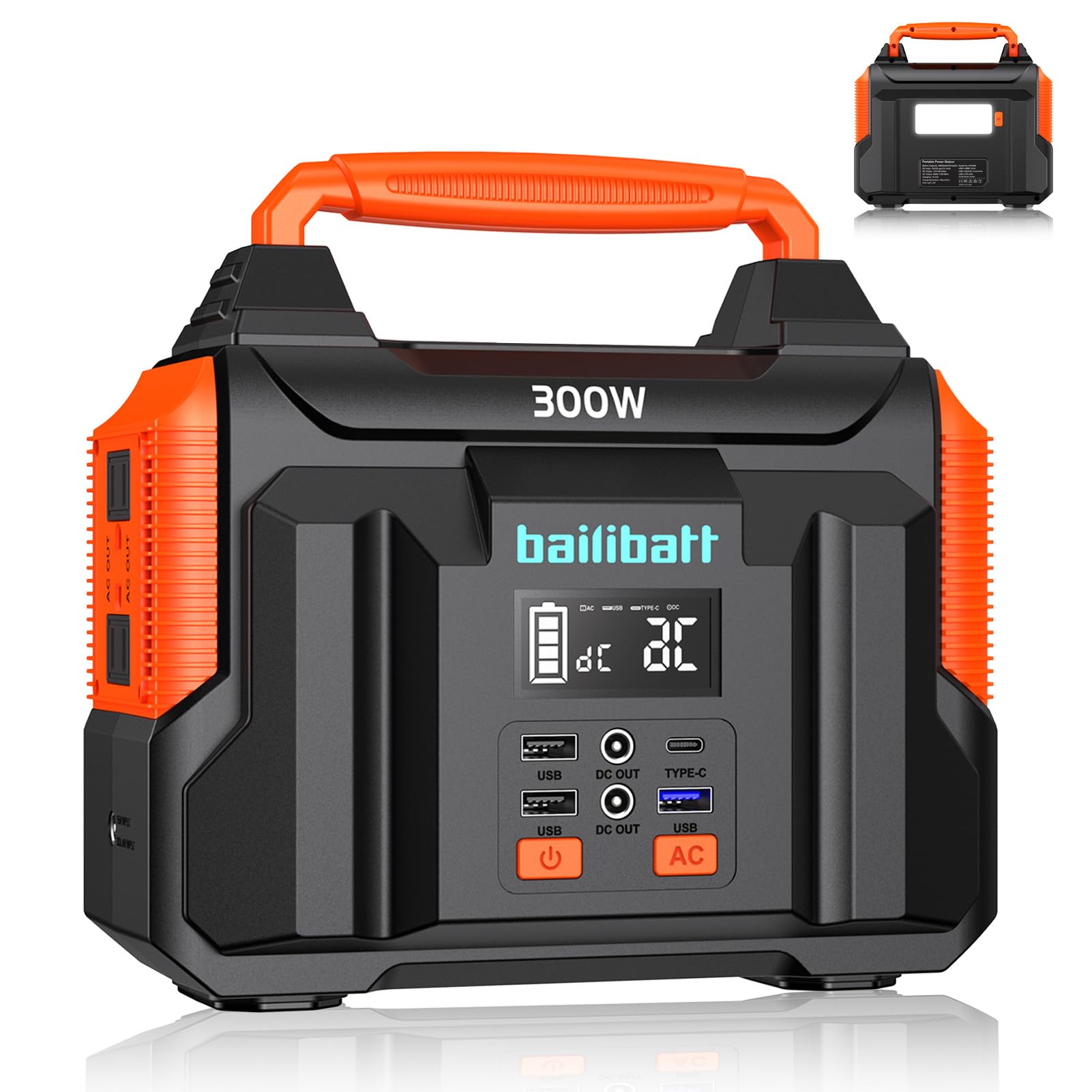
A 4.6-lb grab-and-go station that keeps a CPAP running for two nights.
The Bailibatt is the budget hero of this list—it’s the lightest full-featured station here at just 4.6 lbs (compared to the ECOFLOW RIVER 3’s 7.8 lbs), yet it still packs a 257Wh battery with dual 120V pure sine wave AC outlets. That weight difference makes it the easy choice for hikers and travelers who count every ounce. The 69,600mAh capacity is enough to charge phones, laptops, tablets, and cameras through a weekend. Owners run their CPAP machines off it with a 12V adapter for two full days, and one saved a pork shoulder smoke when the grid dropped mid-cook—the Traeger fired right back up to finish the last 4 hours.
It juggles up to 8 devices at once across its AC and DC outputs (300W total limit), with three ways to recharge: AC wall adapter, 12V car outlet, or solar panels (sold separately). The clear LCD screen shows operating status at a glance, and the built-in BMS monitors voltage, current, and temperature to protect the pack. The Grade-A battery supports 1500+ charge cycles, and the ABS shell keeps weight down. Quality is the top praise from owners, with reliability a close second.
Battery life gets honest mixed feedback—some owners say a full charge passes quickly under continuous load, which is par for the course at this price and capacity. The package is refreshingly simple: station, AC adapter, and manual. There’s no car charger cable or solar panel in the box, so budget for those separately if you want them. Customers note: “It runs for two days using 12v” on a CPAP—real endurance when you match the output to the device.
Why It’s a Steal
- 4.6 lbs—lightest station in this guide
- Dual 120V pure sine wave AC outlets
- 1500+ cycle battery with BMS protection
- Charges up to 8 devices at once
Know the Limits
- 300W total load cap restricts larger appliances
- No car charger cable or solar panel included
Buy it for: budget-conscious campers and CPAP users who want the lightest possible 300W-class station for overnight trips.
skip it if: you need sub-30-minute wall charging—the ECOFLOW RIVER 3 hits 100% in 1 hour versus several for this one.
6. DYNESS Portable Power Station 300W, 256Wh Solar Generator
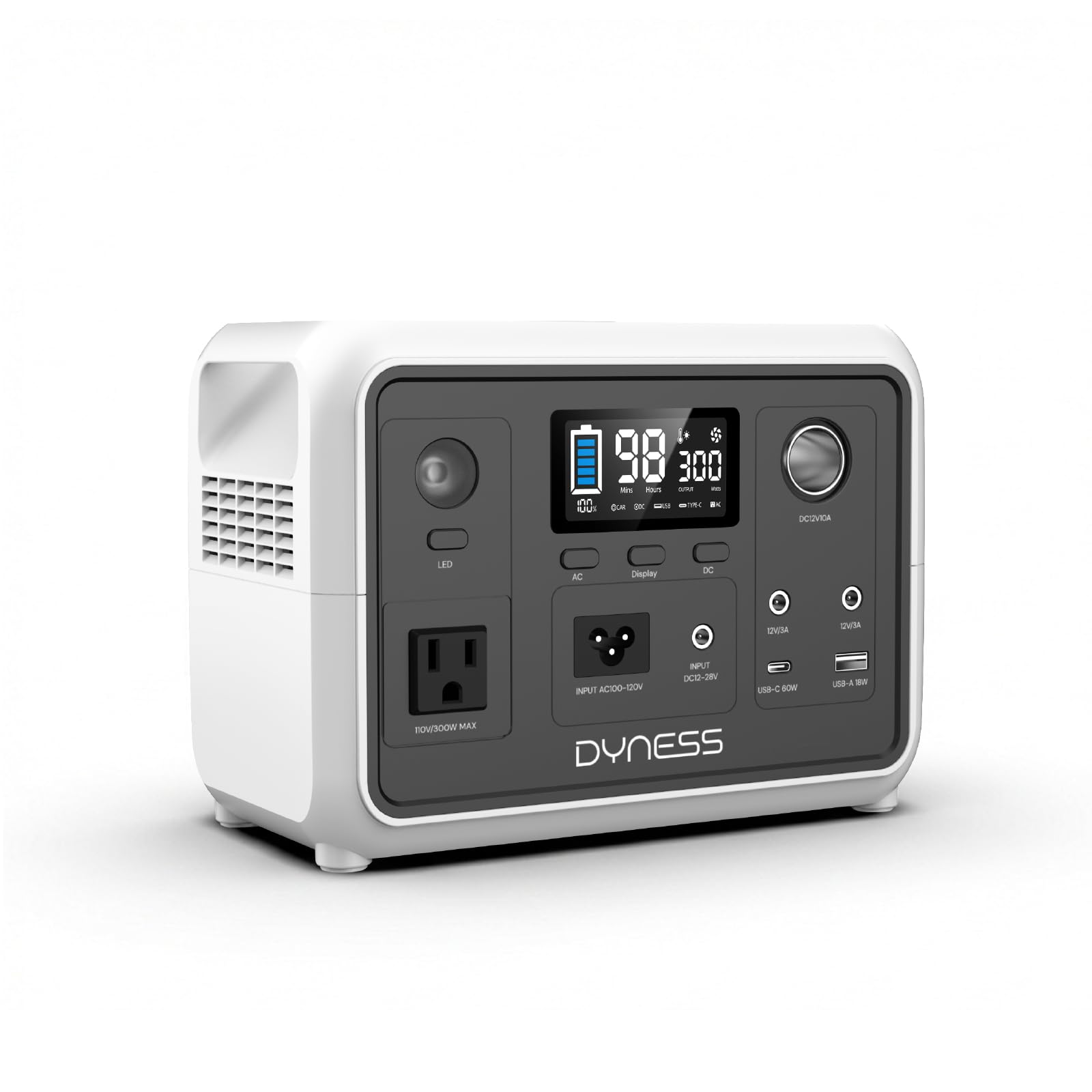
A compact 256Wh station that inflates mattresses and runs a DC fridge with ease.
The DYNESS 300W is a sleeper hit for campers—reviewers point out it successfully inflated both full and queen-size air mattresses, a task that trips up smaller power banks. At 256Wh with a LiFePO4 battery, it’s built for multi-day trips, and the 300W continuous output handles laptops, routers, mini-fridges, and cameras. The compact frame (9.3″ x 5″ x 6.8″) fits in tight corners of a tent or RV cabinet without hogging space.
Its 6 output ports cover the essentials: 1 AC outlet, USB-C, USB-A, 2 DC outputs, and 1 car outlet. That spread means you can run a mini-fridge on DC while charging your phone on USB-C and keeping a lamp on the AC plug, all at once. Recharging is flexible too—AC wall outlet, compatible solar panel, or car charger, with dual-input support for faster top-ups. The included car cigarette cable is a nice bonus that many rivals charge extra for.
Owners praise the clear info view on the display and the durable build, calling it a solid “grab and go” station for weekend trips. One owner ran a 55 cu ft DC fridge/freezer for 3 hours with power left over, and a 75W solar panel recharged it quickly without overheating over a 10-hour connection. Performance and functionality are the two aspects owners mention most, both with strong positive sentiment. There’s not much to knock at this price—just keep expectations realistic for high-draw appliances.
Camping Credentials
- Powers air mattresses, fans, and DC fridges
- 6 ports including car outlet
- Car cigarette cable included
- LiFePO4 for long cycle life
Reality Check
- 300W output won’t run high-draw appliances
- Limited review history means fewer long-term data points
Pick this for: car campers who want a dependable, compact station with a car cable in the box and enough juice for a weekend.
Consider the upgrade if: you want 600W output for small appliances—the BLUETTI Elite 30 V2 is the step up.
7. GRECELL 330W Portable Power Station 288.6Wh Solar Generator
An 8-port hub with a 60W USB-C PD that out-charges most rivals’ standard ports.
If your gear bag is a tangle of cords, the GRECELL 330W (288.6Wh) is the station that keeps everything plugged in at once. Its 8 ports—1 AC outlet, a 60W USB-C PD, an 18W USB-C PD, 2 USB-A with Quick Charge 3.0, and a car port—let you charge a laptop, two phones, a tablet, and a camera simultaneously, up to 330W total. Individual per-port switches mean you can cut power to unused outputs and avoid draining the battery needlessly.
The 288.6Wh capacity and 600W surge handle a CPAP machine, mini-fridge, projector, or fan for typical use. Owners have run a Ninja woodfire grill for about 2 hours on a charge, dropping to 60%—real-world endurance that beats the smaller 230Wh GRECELL sibling. The aluminum and metal alloy build feels sturdier than the plastic shells on budget rivals, and the built-in carry handle makes transport easy. A 24-month warranty backs it up.
Value is the standout trait for 24 owners, with functionality (13) close behind. The 60W USB-C PD charges laptops over twice as fast as standard USB-C ports, per the listing. Recharging is flexible via AC, car, or solar with a built-in MPPT controller that squeezes more from panels. The honest note: charging capacity and durability get mixed feedback, so keep it to light or medium loads rather than pushing it to the limit daily.
Why It Shines
- 8 ports charge a whole family’s devices at once
- 60W USB-C PD for fast laptop charging
- 600W surge handles appliance startup spikes
- 24-month warranty
Keep in Mind
- Charging capacity and durability get mixed owner feedback
- 7.3 lbs is mid-pack for weight
Choose it for: families or tailgaters who need one station to charge a pile of devices simultaneously without juggling cables.
Look past it if: you want the lightest carry—the Bailibatt is nearly 3 lbs lighter, though it has fewer ports.
8. GRECELL Portable Power Station 330W, 230.88Wh Lithium Battery

9 ports, a wireless charging pad, and a 3-mode flashlight in one camp-ready box.
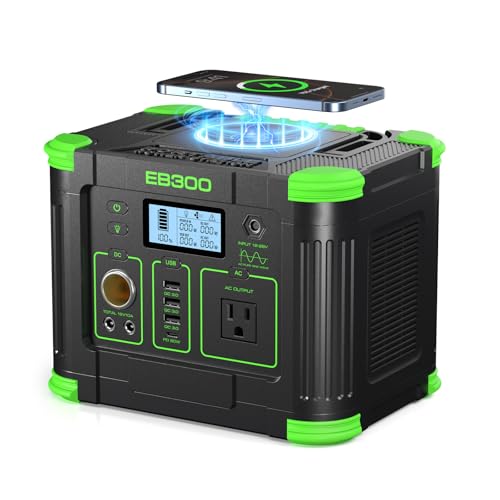
The GRECELL 330W (230.88Wh) is the Swiss Army knife of this list—a 5W wireless charging pad on top, a 3-level brightness LED flashlight with SOS mode, and 9 total ports including 2 DC 5521 outputs. It’s the station you grab for a night at deer camp when you need lights in a shed (a real owner scenario) or a Cub Scout trip where three families’ phones and a Nintendo Switch all need juice. The 330W output with 600W surge runs laptops, TVs, mini-fridges, and CPAP devices rated under 330W.
Wireless charging is the a neat extra—set a compatible phone on top and it tops up without a cable, though owners note protruding camera bumps can make the connection finicky. The built-in flashlight with steady and SOS modes is a genuine lifesaver during outages, and the compact frame (12.8″ x 7.68″ x 8.46″) fits in a bin or cabinet. Three recharging modes cover wall, solar (100W panel, about 5-9 hours depending on sun), and car 12V socket.
Power quality is the top owner praise (110 mentions), followed by value for money (49). One owner ran three lights for nearly two weeks nonstop on a charge. The practical numbers: a 200W rice cooker used about 44-50% of the battery for one cup of rice, and a mini PC gamed for 4-5 hours. The caveat is charging speed and battery life, which get mixed owner feedback—expect the 6-7 hour wall charge to be a patient wait, and the fan to spin up after a few minutes under high load.
The Extras That Sell It
- 5W wireless charging pad on top
- 3-level flashlight with SOS mode
- 9 ports including 2 DC 5521 outputs
- 600W surge for appliance startups
Where It’s Slower
- 6-7 hour wall charge is the slowest here
- Fan noise kicks in under sustained load
Best for: campers who want one box that charges devices wirelessly and doubles as an emergency flashlight.
Think twice if: fast wall recharging matters—the ECOFLOW RIVER 3 hits full in 1 hour versus 6-7 here.
9. EF ECOFLOW RIVER 2 240 Portable Power Station, 243Wh 300W

A proven 243Wh workhorse that runs a pool pump for 4-5 hours on one charge.
The ECOFLOW RIVER 2 240 is the station that proves durability matters more than headline specs. Its 243Wh LFP battery is rated for over 3000 recharge cycles before hitting 80% capacity—nearly a decade of regular use—and the advanced BMS monitors voltage, current, and temperature to keep it safe. A real-world owner runs their above-ground pool pump off it for 4-5 hours per charge and refills it fully in just 30-40 minutes, proof of the X-Stream fast-charging tech. At 7.7 lbs with a built-in handle, it’s a dependable companion for car camping and blackouts alike.
The output suite covers 6 simultaneous devices across 300W AC outlets, USB-C, and USB-A, with a 600W peak for startup surges. Owners have used it to power LED lights and a router, run a PoE security dish, and even keep a Geodnet GNSS station running 24/7 with a 100W solar panel for daytime recharging. The standalone 5-year service package adds confidence that budget rivals don’t match. Build quality leads owner praise at 50 mentions, with compact size and portability close behind.
One honest mixed note: some shoppers say it won’t charge in the car, which is a real limitation if you planned to top up during a road trip. Battery life and value also get mixed owner feedback—it’s excellent in its class but not the cheapest, and a 243Wh pack drains faster under sustained load. The 5W wireless pad on the pricier GRECELL is missing here—you get cleaner core functionality instead of gimmicks. For an above-ground pool pump or a weekend of phone and light charging, it’s rock solid.
Built to Last
- 3000+ cycle LFP battery lasts a decade
- 30-40 min recharge tops up fast
- 5-year service package included
- Powers a pool pump 4-5 hours per charge
Watch Out For
- Some buyers report it won’t charge in the car
- 243Wh capacity is the smallest here
Get it for: buyers who want a proven, long-lived station with a 5-year service plan for basic outage and camping duty.
Skip if: you need max capacity—the 288Wh OUPES or BLUETTI hold nearly 20% more for all-night runs.
Understanding the Specs
Watt-Hours (Wh) vs. Watts (W)
Think of watt-hours as the fuel tank and watts as the engine. A 288Wh station holds more energy than a 245Wh unit, so it runs a 60W laptop for roughly 4.8 hours versus 4 hours. But the watts determine what you can plug in at all—a 350W station can’t start a 600W kettle no matter how full the battery is.
Pure Sine Wave Inverters
This is the “clean” power that comes out of the AC outlet. Sensitive electronics like laptops, CPAP machines, and audio gear prefer it over modified sine wave output, which can cause hum or erratic behavior. All nine stations here use pure sine wave inverters, so you don’t need to worry about fried gear.
FAQ
How long will a 300Wh power station actually run my devices?
What is the difference between 300Wh and 288Wh capacity?
Will a 300Wh station run my CPAP machine overnight?
Can a 300Wh power station power a mini-fridge?
How long does it take to recharge a 300Wh power station?
What does UPS mode mean on a power station?
Is LiFePO4 battery worth paying extra for?
Can I charge my laptop directly with USB-C?
Can I run a 300Wh station while it’s charging?
How many devices can I plug in at onceHow many devices can I plug in at once?It depends on the station’s port count and total wattage limit. The GRECELL 330W (230.88Wh) supports up to 9 devices with its wireless pad, USB-C, USB-A, DC, and car outlets. The Bailibatt charges up to 8 devices across its dual AC and DC outputs. The catch is the total load can’t exceed the station’s rated output—so you can’t run two 200W appliances on a 300W station simultaneously. Check each port’s individual rating too; a USB-A port may only deliver 12W even if the station outputs 300W AC.What is the difference between peak surge and continuous output?Continuous output is the power a station can sustain indefinitely—like running a fridge. Surge (or peak) is a brief burst of extra power for appliances that spike on startup, like the compressor kick of a small fridge or the initial draw of a motor. The BLUETTI Elite 30 V2 delivers 600W continuous and 1500W surge, so it can start a small kettle that a 300W continuous station can’t even attempt, even though both are in the same 288Wh capacity class.Can I power my TV with a 300Wh station?Yes, most modern TVs draw 50-150W depending on size and type. A 300W continuous station easily runs a 55-inch LED TV for a few hours. Add a soundbar or streaming stick and the draw rises, cutting runtime. For a full movie night, consider a 288Wh station like the BLUETTI, which delivers more sustained output headroom.Do I need a solar panel to use a power station?No, every station here recharges from a standard AC wall outlet. Solar is an optional add-on for off-grid use when there’s no wall power. The OUPES Exodus 350 accepts up to 240W solar input for the fastest sun refill, while the Anker SOLIX C300 takes up to 100W. If you plan to pair a panel, check the max input wattage and compatibility list—some brands restrict which panels work, like Anker’s SOLIX series.Can I take a 300Wh power station on a plane?No. Airline regulations typically limit lithium batteries to 100Wh carry-on, and most airlines prohibit batteries over 160Wh outright. At 230-288Wh, these stations exceed the limit and cannot be checked or carried on. They’re designed for car trips, camping, RVs, and home backup—not air travel. If you need in-flight power, look at small 60-90Wh power banks instead.?
Final Thoughts: The Verdict
For most buyers, the best 300wh power station is the EF ECOFLOW RIVER 3 because it combines the fastest 1-hour wall recharge, a <20ms UPS switch that protects sensitive electronics, and a lightweight 7.8-lb frame—proven across hundreds of owner experiences. If your priority is maximum output to run a small kettle or toaster, grab the BLUETTI Elite 30 V2 with its 600W continuous power. And for the lightest carry possible—just 1.41 lbs—the Anker SOLIX C300 is the one to reach for when every ounce counts on the trail. One honest nudge: buy the RIVER 3 if you want a station that recharges fast and lasts a decade; the crowd of 800+ owners backs it up.
How We Picked
We do not accept paid placement. Every pick is matched to a real buyer and a real use-case; we do not hands-on test units.
Sources & Methodology
Specifications: manufacturer listings and product documentation. Review insights: verified customer reviews, as of August 2026. Pricing: not shown on this page (it changes often); check the current price via the retailer link.
As an Amazon Associate, Gadgets Feed earns from qualifying purchases. This does not affect which products we feature.