
Our readers keep the lights on and my morning glass full of iced black tea. As an Amazon Associate, I earn from qualifying purchases.
Specs are compiled from manufacturer listings and verified buyer reviews and can change over time — please confirm the key details on the product page before buying.
If you are tired of asking people to repeat themselves or cranking the TV volume until the walls shake, the real challenge is finding a behind-the-ear hearing aid that delivers clear speech without harsh feedback or constant fiddling. The truth is, the best pick for you depends on one thing: how much control you want over your sound. Some models are ready to wear right from the start, while others put a full app-driven sound studio in your pocket.
I’m Min — the founder and writer behind Gadgets Feed. This guide is built by comparing the manufacturers’ published specifications and the patterns across verified customer reviews, so you get each pick’s real strengths and trade-offs instead of marketing spin.
You want a behind ear hearing aid that fits your daily life, whether that means staying discreet at work or streaming calls via Bluetooth. This guide breaks down the top models so you can match the right technology to your hearing loss and your routine.
Our Picks at a Glance

How To Choose The Best Behind Ear Hearing Aids
Buying a hearing aid is a personal decision, not just a tech purchase. The right choice depends on your level of hearing loss, your comfort with technology, and your daily environment. Here’s what actually matters when comparing behind-the-ear (BTE) models.
Decoding Amplification and Channels
Amplification (measured in dB) tells you how much louder the device can make sounds. More channels (like 4 or 16) mean the aid can fine-tune different frequency bands separately, which helps clarify speech while managing background noise. A basic amplifier boosts everything; a digital aid with multiple channels separates what you want to hear from what you don’t.
Battery Life vs. Charging Convenience
Look at both the runtime on a single charge and the total backup power in the charging case. A case that holds multiple extra charges lets you go days without hunting for an outlet. Fast-charge features—like getting hours of use from a 15-minute top-up—are a lifesaver if you forget to charge overnight.
Control: Buttons, App, or Both
Some prefer simple physical buttons for volume and modes, which are easy to operate by feel. Others want a smartphone app to adjust frequency, directionality, and scene modes. Decide how much fiddling you are willing to do before you commit to a model.
Quick Comparison
| Model | Best For | Amplification | Battery Runtime | Key Control | Amazon |
|---|---|---|---|---|---|
| MDHearing VOLT 4★ Best Overall | Audiologist-tested simplicity | Dual-directional mics | All-day, portable case | Push-button | Amazon |
| Banglijian Rechargeable BTEBudget Champion | Budget-friendly flexibility | Up to 40dB | 20 hours | Button Control | Amazon |
| Banglijian Ziv-2064-Channel Value | 4-channel value seekers | 4 Channels | 20-24 hours | Button Control | Amazon |
| Taosmart BTE Buds | Discreet all-day wear | USA DSP chips | 20 hours (+60 with case) | One-hand buttons | Amazon |
| Vivtone Lucid508 | Extended backup power | Up to 41dB | 25 hours (+125 with case) | Button Control | Amazon |
| Oricle TrueFit | LED battery monitoring | 16-Channel DSP | Rechargeable | Button Control | Amazon |
| ELEHEAR-Beyond | App-driven customization | 50dB | 20 hours (+100 with case) | Bluetooth App | Amazon |
| ELEHEAR-Beyond Pro | Music & high-fidelity sound | 50dB | 20 hours (+4 charges) | App Control | Amazon |
In‑Depth Reviews
1. MDHearing VOLT 4 OTC Hearing Aids
Our pick — 4.5★ from 20+ verified ratings; the strongest balance of quality and price.
Audiologist-designed clarity with a smaller, glasses-friendly profile that fades into daily life.
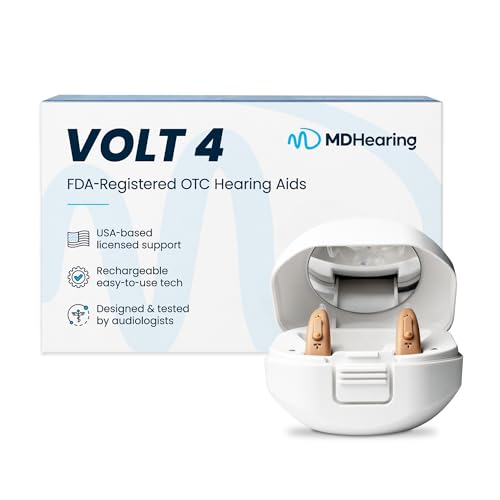
The VOLT 4 is the pick for people who want hearing help without a tech project. It is ready to wear from the start, with a setup process simple enough that many owners say they almost forget they have them on. The upgraded chip and dual-directional microphones suppress feedback and echoes for clearer conversations., which means fewer of those annoying squeals when you hug someone or wear a hat. It is designed specifically for adults with mild-to-moderate hearing loss, and the automatic noise canceling helps you focus on one voice in a crowded room.
Comfort is a major theme here. The behind-the-ear casing is contoured to sit securely alongside your glasses, so you can wear both without irritation. The rechargeable battery delivers a full day of use, and the upgraded portable charging case means you can top up without hunting for a wall outlet. It weighs just 7.6 g, making it a featherlight presence compared to bulkier models.
You get crisp sound that rivals (and sometimes beats) far more expensive prescription aids. Expect a real adjustment period—your brain needs weeks to re-learn how to filter sounds—but the US-based support team guides you through it. The trade-off? There is no Bluetooth, so if you want to stream calls or music directly, you will need to look at app-driven models.
What Owners Love
- crisp sound with no phone squealing
- Charging case holds 3-4 charges for on-the-go power
- Comfortable, discreet fit that works with glasses
Consider This
- No Bluetooth streaming for calls or music
- Steep adjustment curve for new users
- Charging case is small and easy to misplace
Reach for this if: you want a proven, audiologist-tested device that handles noisy environments gracefully without needing a smartphone.
Look elsewhere if: Bluetooth streaming is a must-have for you—this model keeps things intentionally simple.
2. Banglijian Rechargeable BTE Hearing Aids
A featherweight at just 1 g, packing 20 hours of power and a fit kit for almost any ear.
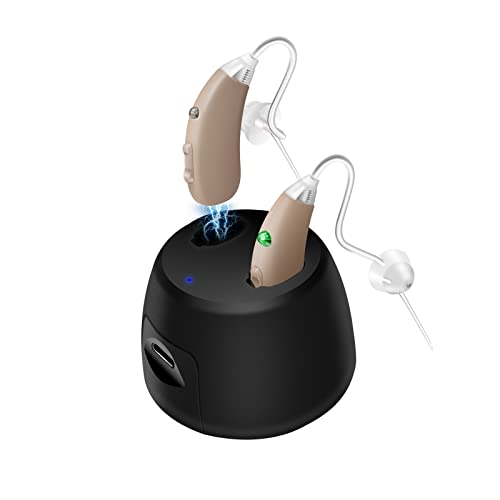
This is the smart budget play for someone who wants serious flexibility without the premium price tag. The slim tubes provide average gain up to 35dB, and if you need more power, a thick tube option pushes amplification up to 40dB for moderate-severe loss. You get 20 different sizes and shapes of earplugs, plus two thin tubes, two thick tubes, and two ear hooks—so finding a comfortable, secure fit is genuinely possible.
Buyers report the charge lasts several hours and the fit is better than other models they have tried. The volume control sits hidden behind the ear, which keeps the device looking clean while staying easy to reach. A DSP intelligent noise reduction chip helps cut background noise, and you can switch between Quiet and Noisy modes depending on whether you are reading at home or eating out.
The 20-hour battery life after a full charge means you can wear them from morning commute to evening TV without anxiety. At 1.3″L x 0.5″W and only 3.2 g, it is remarkably compact for a BTE device—noticeably smaller than some rivals. Just know that at this price point, the sound is plainer and more straightforward than the high-end app-tuned models.
Smart Budget Fit: An entry-level device that nails the basics—comfort, battery, and simple controls—without overwhelming you with features you will never use.
The Honest Limit: It amplifies sound clearly but lacks the sophisticated speech-enhancement of pricier digital aids; think of it as a reliable everyday helper, not a precision instrument.
3. Banglijian Ziv-206 Hearing Aid (2 Units)
The crowd favorite that upgrades your world with four channels of clear, feedback-free sound.
If there is one thing owners agree on, it is that the Ziv-206 is a superb alternative to expensive prescription aids, with clear amplification that helps them hear sounds they haven’t heard in years. The 4-channel signal processing divides incoming sound into separate frequency regions, which means layered noise reduction and acoustic feedback cancellation work smarter, not just louder. That translates into real-world calm—one owner specifically notes there is no feedback even with hats, hair, or objects near the ears.
Battery life here is genuinely impressive: a 2-hour charge delivers 20-24 hours of use, so you can charge it overnight and forget about it for a full day. The USB charging means you can power up anywhere, from a laptop at work to a power bank on a trip. At 1.4″L x 0.3″W, it is a slim, discreet profile that sits comfortably behind the ear.
The thing everyone raves about is the quality—it is the most-mentioned positive by a wide margin, and the value for money trails close behind. The noisy mode effectively filters restaurant chatter, and the five volume levels are simple to navigate. The honest caveat: battery life and noise level draw mixed reactions, and some compare it to their programmed prescription aids and find it less refined. The 18-month warranty and responsive customer service give you a solid safety net.
Value Heavyweight: Thousands of owners have made this their daily driver, praising its clear amplification and easy controls over costly alternatives.
The Fit Note: Speech can feel slightly less refined than custom-programmed aids, so treat it as an excellent upgrade—not a replacement for a professional fitting.
4. Taosmart OTC Behind-The-Ear BTE Ear Aid Buds

A low-profile BTE design so discreet and light it disappears behind your ear.
This model is built for people who want to forget they are wearing hearing aids. The behind-the-ear construction and light-weighted case use medical-grade materials, so it sits comfortably for long stretches without that “I’m wearing a device” feeling. The low-profile design has a natural appearance that is small and almost invisible, which boosts confidence in social settings.
Power is a strong suit: 20 hours of hearing time on one quick charge, extending to 60 hours with the external charging case. Both the aids and the case are rechargeable, so you never buy button batteries again. A single-hand operation lets you adjust volume and mode without needing a mirror or a manual, and the fit works comfortably alongside eyeglasses.
What owners appreciate most is the clear, natural sound that comes from the advanced USA DSP chips prioritize human voice frequencies for clearer speech.. There is no whistling, which is a common frustration with lesser devices. Just remember the acclimatization period is real—experts and owners alike say your brain needs 4 to 8 weeks to adjust to sounds you haven’t heard in a long time.
Discreet Daily Driver: Owners consistently praise the comfortable fit, clear sound, and easy charging case—a genuine value compared to high-end prescription aids.
The Small Catch: Some note it lacks a dedicated storage case, and the sound, while clear, may not match the precision of top-tier app-tuned devices.
5. Vivtone Lucid508 Rechargeable Hearing Aids
A power house that turns two hours of charging into over a week of backup listening.
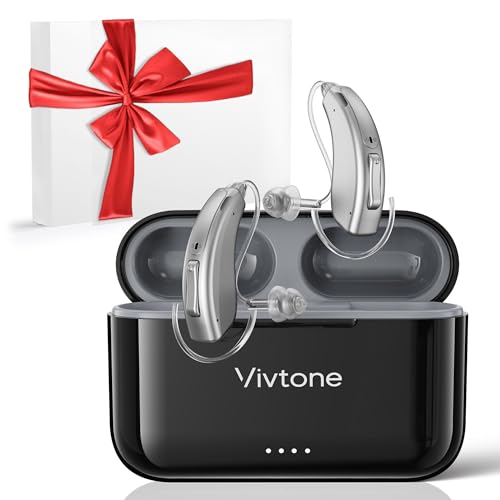
If battery anxiety keeps you from enjoying your hearing aids, this is the model that ends it. The Lucid508 delivers 25 hours of use from a 2-hour charge, and the charging case holds four more full charges for both units—that is 125 hours of backup power. You can literally go on a week-long trip without packing a charger, and the auto-on/off feature means you never waste battery by forgetting to switch them off.
You get sound amplification up to 41dB (a measure of how much louder sounds become), suitable for mild to significant hearing loss. Digital processing keeps background noise and whistling at bay, and you get three distinct modes: Quiet for normal environments, Noisy for busy places with background reduction, and a tinnitus masking mode that plays soothing tones to reduce perceived ringing.. The smaller, lightweight design uses medical-grade materials so it stays nearly invisible behind your ear.
Owners consistently highlight the simple instructions and reliable performance, and the 24×7 customer care team is a reassuring presence if you hit a snag. The honest note: sound quality and reliability get mixed feedback in the wider owner base—some hear beautifully in church, while others find the default settings too amplified. Give yourself time to find the right mode and volume.
Power-First Pick: The standout reason to choose this is the sheer battery math—25 hours per charge and 125 hours of backup in the case.
Finding Your Setting: The default sound can feel very amplified to some ears; be prepared to experiment with the modes to land on your balance.
6. Oricle TrueFit Rechargeable BTE Hearing Aids
A perfect-fit promise with a clear LED battery gauge so you always know your power status.
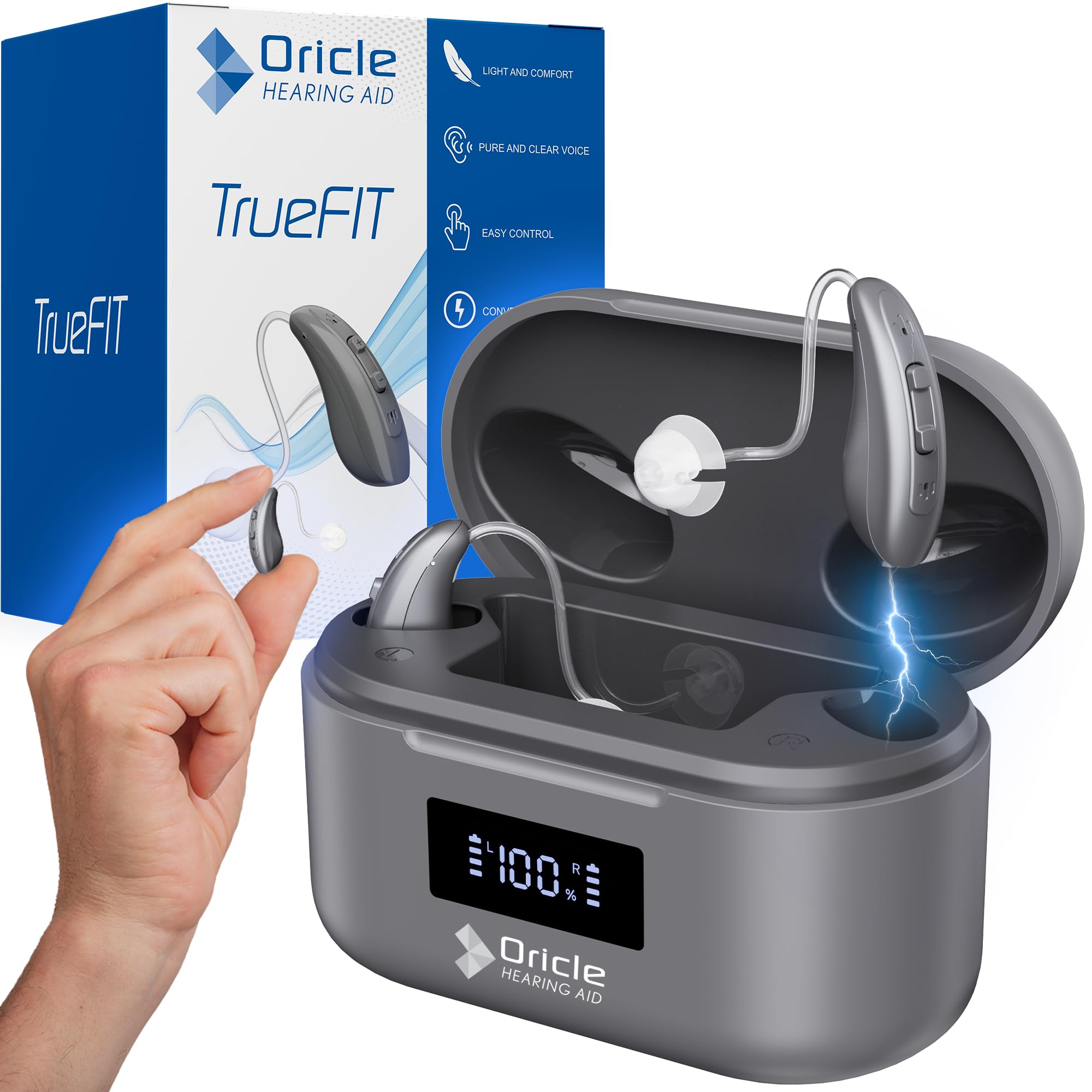
What sets the TrueFit apart is the charging case’s clear LED display showing the exact battery percentage—no more guessing whether you have enough juice for the evening. It is designed for mild-to-moderate hearing loss, intelligently filtering and fine-tuning sound so you hear conversations without overwhelming your ears. The advanced 16-channel DSP digital noise reduction and 16 EQ band adjustments work together for a more natural listening experience.
You get four adaptive modes tailored to different environments—Normal, Restaurant, Outdoor, and Music—plus 11 volume levels controlled by intuitive buttons. The automatic on/off when placing in or removing from the case is a thoughtful touch, and you can manually power on by holding the “–” button for 5 seconds. Three ear dome sizes are included for a secure, comfortable fit.
The sleek, low-profile design blends in naturally for everyday use at home or in public. Owners mention the quality is solid, but the hearing tubes run about half an inch too short for some ears, which pushes the aid to sit on top of the ear rather than behind it. Check your ear anatomy and be ready to experiment with the included dome sizes.
Clarity Control: The 16-channel processing and four scene modes give you real command over how you hear different environments.
The Fit Catch: The factory tubes may be short for some wearers, so confirm the fit early or you might find the aid resting oddly on your ear.
7. ELEHEAR-Beyond OTC Hearing Aids

A 50dB amplifier that hands you a full sound studio through a Bluetooth app.
This is for the tech-comfortable user who wants to sculpt their hearing experience. VocClear AI boosts speech clarity by 17% and reduces background noise by 24dB., delivering crisp sound in everything from crowded cafes to quiet calls. The 50dB amplification is designed for mild to moderate hearing loss, with feedback reduction that keeps the squeals away.
The ELEHEAR app is the star here. You can adjust volume, frequency, sound directionality, and environment profiles with a tap. Four tailored scene modes adapt to your life, and the Bluetooth connectivity is a genuine asset—customers note a Bluetooth range of about 40 feet., making it easy to stream calls and music without touching your phone. Nine dome sizes are included to find that snug, barely-there fit.
Battery life is superb: up to 20 hours on a single charge, plus 4 extra charges in the case for 100 hours total. A 15-minute quick charge provides 6 hours of runtime., perfect for travel emergencies. Performance and value for money are the most-praised aspects, with owners loving the adjustable settings and intuitive app. The mixed notes come down to sound quality in very noisy restaurants and the occasional feedback, so temper expectations for the most chaotic environments.
Customization King: Owners consistently praise the app-driven control and Bluetooth reliability—the ability to tweak directionality and profiles is a genuine step up.
Noisy Room Reality: While AI amplifies speech well, it can still struggle in packed restaurants; the default wire length also runs short for some, though support has sent longer ones free.
8. ELEHEAR-Beyond Pro OTC Hearing Aids
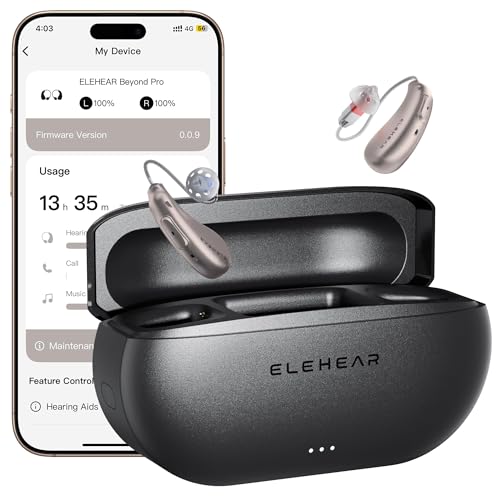
A featherlight RIC design that turns your hearing aids into a high-fidelity music system.
The Beyond Pro is the enthusiast’s choice, VocClear 2.0 technology delivers 30% clearer speech. while eliminating muffled, distorted, and sharp tones. With enhanced high-frequency detail up to 8500Hz and ultra-low latency of just 8ms, conversations sound natural and immediate—no lag between the lip movement and the sound in your ear. The 50dB amplification suits mild to moderate loss.
Music lovers will appreciate the dedicated Music Mode, specially tuned to preserve the richness of vocals and high-frequency instruments. You also get 20 rich soundscapes—rain, breeze, vinyl crackle, ambient tones—to blend in for meditation, deep focus, or just winding down. The ELEHEAR smart app works on iOS and Android, with an upgraded interface for one-tap actions and voice adjustments.
The Receiver-in-Canal (RIC) design is featherlight and contours to your ear, so you might genuinely forget you are wearing them. Battery life delivers up to 20 hours on a single charge, with the case providing 4 additional full charges. A 15-minute fast charge provides 6 hours of use.. Owners praise the sound clarity, voice quality, and the ability to adjust volume and tone for each ear independently. The trade-off is a chunkier design and occasional fit issues with the ear cups for some.
Fidelity First: The combination of 8500Hz high-frequency detail, 8ms latency, and a tuned music mode makes this the best-sounding pick for audiophiles.
The Premium Cost: The design is noticeably chunkier than sleeker rivals, and some reviewers point out fit issues with the included ear cups that require experimentation.
Understanding the Specs
Decibels (dB) and Amplification
Amplification is measured in decibels (dB), which tells you how much louder the device can make incoming sound. A 50dB amplification is a powerful boost suited for moderate loss, while lower figures like 35-40dB suit milder cases. More power is not always better—too much can distort speech if your hearing is only mildly impaired.
Channels and DSP Processing
Channels are independent frequency bands the aid can adjust separately. A 4-channel device splits sound into four regions for basic tuning; a 16-channel model offers much finer control, which helps separate speech from background noise. DSP (Digital Signal Processing) is the chip that does this work—think of it as the brain that decides what to amplify and what to suppress.
FAQ
How long does a full charge last on behind-the-ear hearing aids?
Will these hearing aids work with my eyeglasses?
What is the difference between Quiet and Noisy modes?
How long does it take to get used to new hearing aids?
Can I stream phone calls and music through these hearing aids?
Are these hearing aids suitable for severe hearing loss?
How often do I need to charge the hearing aid case?
What is feedback and how do these aids prevent it?
Final Thoughts: The Verdict
For most people, the behind ear hearing aids winner is the MDHearing VOLT 4 because it delivers audiologist-tested clarity with dual-directional microphones and a comfortable, glasses-friendly design—all without requiring a smartphone. If you want app-driven customization and Bluetooth streaming, grab the ELEHEAR-Beyond. And for budget-conscious buyers seeking a reliable everyday helper with a huge fit kit, the Banglijian Ziv-206 is the one to reach for. The crowd favorite among thousands of owners is the Ziv-206, holding a strong 3.9-star score, but the VOLT 4 takes the top spot for its refined, no-fuss approach to daily clarity.
How We Picked
We do not accept paid placement. Every pick is matched to a real buyer and a real use-case; we do not hands-on test units.
Sources & Methodology
Specifications: manufacturer listings and product documentation. Review insights: verified customer reviews, as of August 2026. Pricing: not shown on this page (it changes often); check the current price via the retailer link.
As an Amazon Associate, Gadgets Feed earns from qualifying purchases. This does not affect which products we feature.