
Our readers keep the lights on and my morning glass full of iced black tea. As an Amazon Associate, I earn from qualifying purchases.
Specs are compiled from manufacturer listings and verified buyer reviews and can change over time — please confirm the key details on the product page before buying.
When you search for a 600 watt solar panel, you aren’t really hunting for one single rigid slab. You’re looking for the smartest way to get that total output onto your RV, van, boat, or cabin roof — and that usually means a kit of smaller panels wired together. The core trade-off: rigid glass panels boost efficiency and durability, while flexible panels minimize weight and conform to curved roofs.
I’m Min — the founder and writer behind Gadgets Feed. This guide is built by comparing the manufacturers’ published specifications and the patterns across verified customer reviews, so you get each pick’s real strengths and trade-offs instead of marketing spin.
Before you buy a 600 watt solar panel, you need to know where you’ll mount it, how much weight your roof can hold, and how you’ll wire it. This guide compares flexible and rigid kits to help you choose the right one for your roof.
Our Picks at a Glance


How To Choose The Best 600 Watt Solar Panel Setup
Match the panel type to your roof’s shape and weight capacity. A rigid glass panel on a flat RV roof behaves very differently from a flexible module on a curved van top, so start by looking at your own mounting surface.
Rigid Glass vs Flexible Modules
Rigid panels use tempered glass, an aluminum frame, and typically deliver higher efficiency per square foot, which means more power from a smaller footprint. Flexible panels, on the other hand, use an ETFE top sheet (a tough, light-transmitting plastic film) and can bend up to 30 degrees to hug a curved roof line where glass would crack or lift off.
Wiring for Real Output
Wiring configuration (series vs. parallel) determines your system’s voltage and current. Series wiring raises voltage while parallel wiring raises current, and most kits give you the choice through MC4 connectors (the standard quick-connect solar plugs). Watch for maximum voltage limits on your charge controller, and remember that shade on one panel can drag down the whole string unless the panel has partial-shading tolerance.
Quick Comparison
| Model | Best For | Max Power | Item Weight | Material Type | Amazon |
|---|---|---|---|---|---|
| Renogy 1280W Kit★ Best Overall | Big roof, biggest output | 320W per panel (4 panels) | 144 pounds | Monocrystalline Silicon, Tempered Glass | Amazon |
| DOKIO 600W SetBest Flexible Pick | Curved van roofs | 600W (six 100W panels) | 13.9 pounds | ETFE | Amazon |
| DOKIO 600W 6-Pack | 12V system expansion | 600W (six 100W panels) | 13.9 pounds | Monocrystalline Silicon | Amazon |
| ECOBOSS 600W 6-Pack | High-efficiency rigid value | 600W (six 100W panels) | 72 pounds | 3.2mm Tempered Glass, N-Type Cells | Amazon |
| ECOBOSS 600W 3-Pack | Partial shade tolerance | 600W (three 200W panels) | 71.9 pounds | 3.2mm Tempered Glass, N-Type Cells | Amazon |
In‑Depth Reviews
1. Renogy 1280 Watt N-Type 18BB Solar Panels
Our pick — over 4★ from 100+ verified ratings; the strongest balance of quality and price.
The rigid heavyweight champion for serious off-grid builds that need maximum roof power.
This is the kit for someone who wants to overshoot 600W entirely. The package ships four 320W panels for a combined 1280W, and the maker notes it performs 20 watts higher than a regular 300W panel per module. That means a daily 3200Wh of electricity potential — enough to run a roof air conditioner on a 2500W inverter for up to 3 hours on a sunny afternoon, based on owner reports.
N-Type 18BB cells and IP68 rating protect against harsh weather. N-Type 18 busbars (the thin metal lines on the cell surface that collect electricity) reduce the hot spot effect in bad conditions, and the panels carry an IP68 rating (dust-tight and protected against continuous immersion). The anti-corrosion coating and multi-layered sheet lamination protect the cells from physical damage, and the whole panel is EL certified — a test that checks for microcracks invisible to the naked eye.
At 144 pounds for the full set, this is a two-person job, but an older owner notes the size is “perfect” — not too heavy to be manageable and not so small that you need dozens. Buyers report running these in multiple series and parallel configs (2S4P, 3S2P, 4S2P) with excellent results, and one van build went 9 days off-grid on cloudy days without ever draining the batteries.
What wins people over
- Quality is the most-praised aspect, with owners noting solid connectors and seals.
- Power output exceeds combined spec by about 10% in one reported installation.
- Pre-drilled holes make mounting on RVs, rooftops, cabins, and yachts straightforward.
The honest trade-offs
- The set is heavy at 144 pounds, so it needs solid roof structure and helpers.
- Some owners mention frames bending on arrival, and one panel shattered in shipping before being replaced free.
- Value for money gets mixed feedback compared to cheaper flexible kits.
Reach for this if: you have a large flat roof, want to run heavy loads like air conditioning, and prefer rigid glass durability.
Look elsewhere if: your roof is curved or you need a lightweight portable setup.
2. DOKIO 600W Flexible Solar Panel Set
The featherweight that bends 30 degrees to hug curved van roofs where glass can’t go.
If you’ve got a curved roof on a van, boat, or trailer, this kit solves that exact problem. Each of the six 100W modules is a flexible ETFE panel (a tough plastic top sheet that lets light through well and resists wear), and together they weigh just 13.9 pounds — a tiny fraction of the 144-pound Renogy kit. These bend safely up to 30 degrees, so they hug your roof’s curve without cracking.
Customers note real-world output around 85W max per panel on casual use, which is honest for flexible technology. One buyer notes it’s “great for overpaneling power stations” — that means adding more panel wattage than the station’s rating so you can still harvest meaningful power on cloudy days. The MC4 connectors (standard solar quick-plugs) make wiring simple, and each module ships with foam protectors to reduce the risk of shipping damage.
The trade-off is fragility: thin panels can crack under rough handling. One owner describes pinching the panel causing a crunch sound, though no actual damage resulted, and advises carrying it by the junction box. These are best treated as semi-permanent, mounted with adhesive or grommets flush to the roof rather than flexed repeatedly.
Low-profile powerhouse: the ETFE laminate mounts flush without drilling and handles heat well, per owner reports — ideal for RVs and boats where every inch of roof clearance matters.
Handle with care: thin and light means fragile under rough handling; semi-permanent mounting is the recommended path.
Best suited for: curved or uneven surfaces where a rigid glass panel physically won’t fit, and weight is a real concern.
Think twice if: you expect heavy-duty, toss-it-in-the-truck durability — treat these gently.
3. DOKIO 600W Flexible Solar Panels 6-Pack
The flexible six-pack purpose-built for larger 12V off-grid setups needing easy expansion.
This sibling kit to the previous DOKIO set is tuned for 12V systems, with six 100W monocrystalline modules summing to 600W. The 30-degree bend arc lets each panel adapt to curved or uneven surfaces on campers, RVs, boats, and trailers. At 13.9 pounds, it’s dramatically lighter than any rigid glass kit, so roof stress is minimal.
What wins people over here is straightforward power output — reviewers point out it kept a 100amp LiPo battery charged through several weeks of rainy and overcast weather. One reviewer noted them to a kids’ power wheel with a charge controller so the toy never needs plugging in. The recurring praise is that it works great for the price.
One owner measured panel temperatures around 180°F in direct sun, hot enough to burn skin. The maker warns against mounting on combustible materials and requires ventilation space for heat to escape. Treat that install guidance as mandatory, not optional.
Easy expansion: series or parallel wiring via MC4 connectors lets you scale up without re-buying, and the included bag adds portability.
Heat management: keep panels clear of surfaces you don’t want damaged, and never glue them flat to a vehicle roof without airflow underneath.
Choose this when: you run a 12V system on a curved surface and want a lightweight, expandable 600W array.
skip it if: your roof can’t tolerate extreme heat, or you need the higher efficiency of rigid glass cells.
4. ECOBOSS 600W TÜV Certified Solar Panel 6-Pack
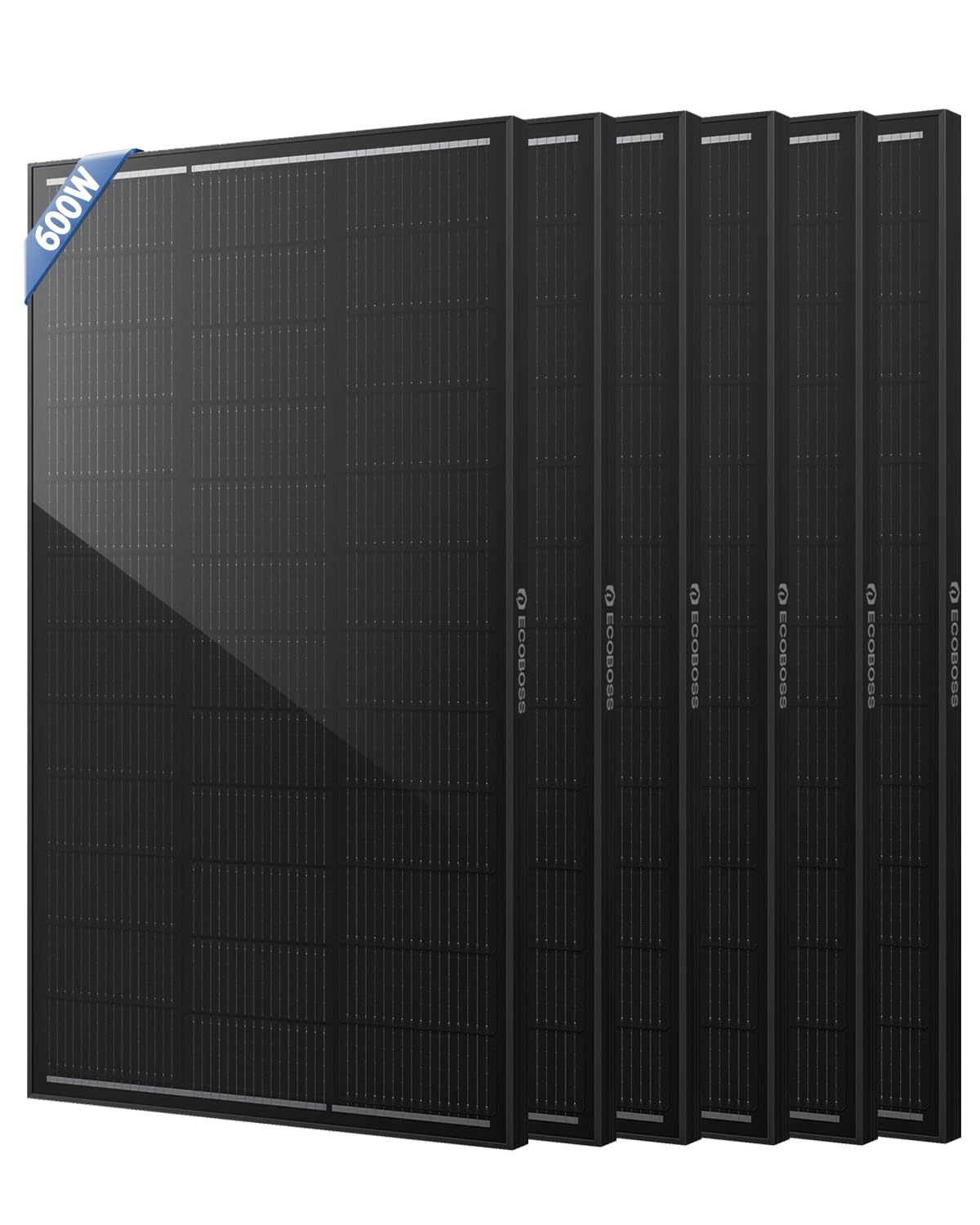
The rigid value pick packing N-Type cells and 25.8% efficiency into a 600W six-panel kit.
This is the best of both worlds for budget-minded buyers who still want rigid glass durability. The six 100W panels use N-Type monocrystalline cells with a 16BB design (16 busbars that reduce resistance loss and minimize microcracks) to hit up to 25.8% conversion efficiency. The whole kit weighs 72 pounds — substantial, but far from the 144-pound Renogy set.
Real shoppers say solid output numbers. Two panels in direct sun measured 160-170W combined, and one North Carolina buyer pulled nearly 210W from the pair at 2pm. The 3.2mm tempered glass and corrosion-resistant aluminum frame earn consistent praise for build quality, and the IP68-rated junction box (dust-tight and immersion-protected) handles rain, snow, and dust.
The one honest limitation is shade tolerance. Owners are clear these panels have none — a shadow across part of the panel drops output hard. One buyer sums it up: “If you live in an area without a lot of shade these will be perfect.” For open-sky installations they’re a strong value, but partial shade kills the performance.
What owners praise most
- Power output is the #1 positive aspect — panels meet or beat claimed wattage in full sun.
- Build quality feels “more expensive than paid” per owner feedback, with sturdy steel frames.
- Light enough to be portable, and value for money gets consistent positive marks.
The catch
- No shade tolerance at all — even partial shadows cut output hard.
- Lower output on cloudy days, and the panels run hot at 119°F in testing.
- Some owners find them heavy to lift and position.
Best for: open, unshaded rooftops and off-grid sites where efficiency per dollar matters most.
Not for: tree-lined campsites or any location where shade hits the panels during the day.
5. ECOBOSS 600W TÜV Certified Solar Panel 3-Pack
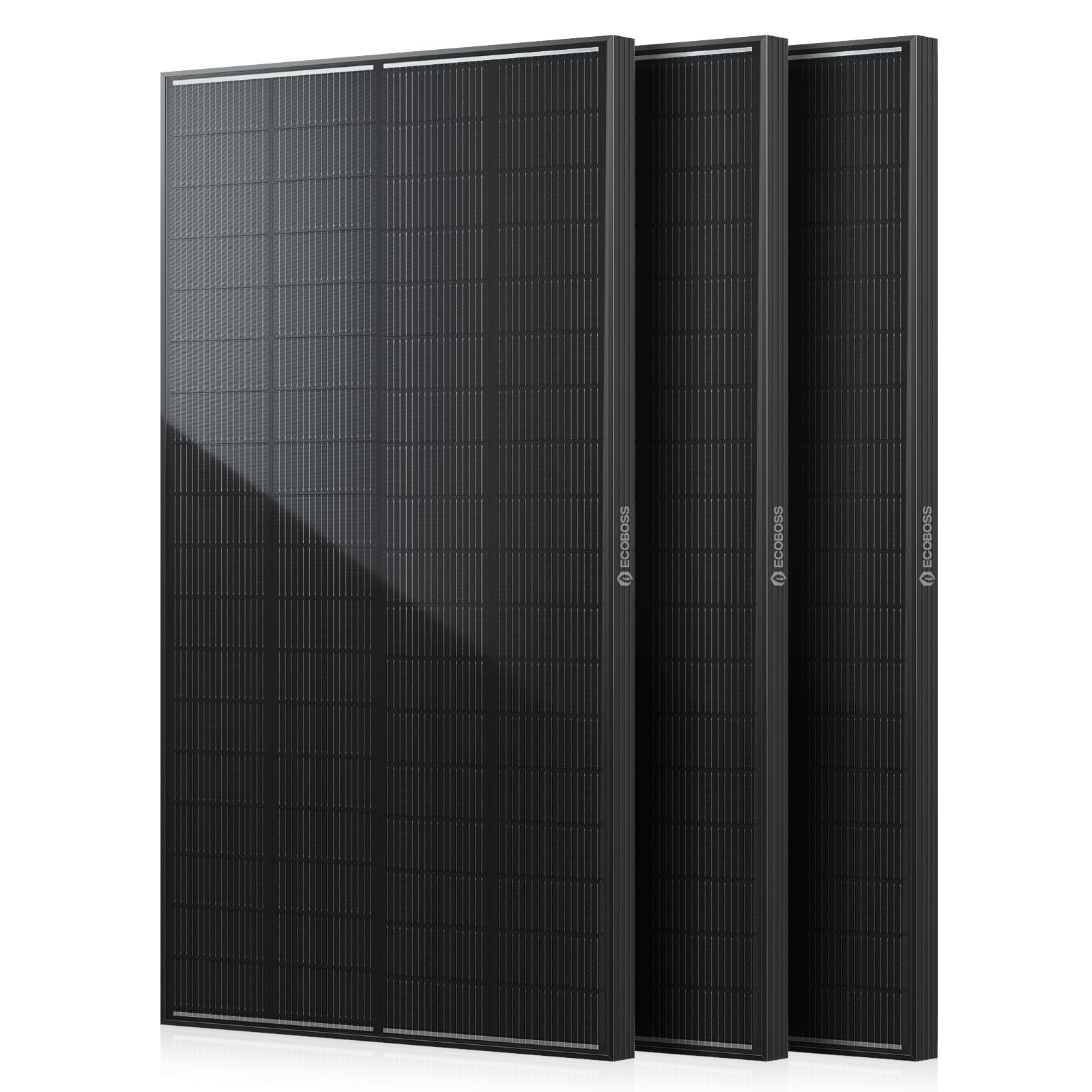
The premium rigid option with genuine partial-shade tolerance and a 25-year performance warranty.
This one stands apart for a specific reason: it’s engineered to keep producing when part of the panel gets shaded. A series-parallel cell-string architecture lets unshaded sections continue generating, and controlled testing showed up to 50% higher output than a comparable three-string series design in shade. That’s the difference you feel at a campsite under a tree canopy.
The three 200W panels sum to 600W and carry the same TÜV certifications (IEC 61215, IEC 61730, and UL 61730 for design durability and electrical safety). Each panel measures 52.8 x 30.3 x 1.18 inches and weighs 23.8 lbs, so you’re lifting three manageable slabs rather than one monster. The 25% efficiency N-Type 16BB cells make the most of limited roof space.
Owners consistently rate performance as the standout feature, with one reporting 225 watts at 4pm and another nearly 700W total from the set mounted flat on a camper van charging a 400Ah battery bank. The low temperature coefficient of -0.3%/K means power loss stays minimal in hot summer weather. The main caveat: individual panels rarely hit their full 200W promise in real-world conditions, which is normal for any solar setup depending on angle and temperature.
The standout strengths
- Performance is the #1 praised aspect, especially in low-light conditions.
- Partial-shade tolerance beats most rigid panels in this class.
- Backed by 10-year technical support and a 25-year performance warranty.
Fair warnings
- Real output lands below the 200W per-panel promise — 190W flat-mounted is typical.
- Frame stiffness gets mixed feedback for handling; two people are recommended.
- One damaged panel in shipping was replaced next day per owner report.
Pick this if: you park in partial shade and need panels that keep working, or you want long-term warranty coverage.
Reconsider if: you need absolute peak wattage per panel and can’t accept real-world output below spec.
Understanding the Specs
N-Type Cells and Busbars
N-Type monocrystalline cells are a newer solar technology that handles heat better and degrades slower than older P-Type cells, so your panel keeps producing power longer in hot climates. Busbars are the thin metal lines on the cell surface that collect electricity; more busbars (like 18BB or 16BB) mean less resistance and fewer hot spots, which helps the panel last longer and perform better in harsh weather.
IP Rating and ETFE Surface
The IP68 rating on rigid panels means they’re dust-tight and protected against continuous immersion in water, so rain and washing won’t hurt them. Flexible panels use an ETFE top sheet instead of glass — a tough plastic film that transmits light well and resists wear, which is what lets them bend while staying durable.
FAQ
Can I mount a flexible 600W panel set directly on a wood or foam roof?
Why does my 600W panel kit only produce 400-500W in real use?
What is the difference between series and parallel wiring in a 600W kit?
How hot do flexible solar panels get and is it a problem?
Is a rigid glass 600W panel better than a flexible one for an RV?
What does a partial-shade tolerant panel actually do differently?
How many 100W panels can I safely connect in parallel?
What does TÜV certification mean for a solar panel?
Final Thoughts: The Verdict
For the majority of shoppers, the 600 watt solar panel winner is the Renogy 1280W kit because it delivers the most proven real-world power output with EL certification (a test that checks for micro-cracks) and IP68 durability (fully sealed against dust and water) — the crowd favorite with nearly 900+ owners backing its reliability. If you need a lightweight panel for a curved van roof, grab the DOKIO 600W flexible set. And for partial-shade tolerance with long-term warranty coverage, the ECOBOSS 200W three-pack is the one to reach for.
How We Picked
We do not accept paid placement. Every pick is matched to a real buyer and a real use-case; we do not hands-on test units.
Sources & Methodology
Specifications: manufacturer listings and product documentation. Review insights: verified customer reviews, as of August 2026. Pricing: not shown on this page (it changes often); check the current price via the retailer link.
As an Amazon Associate, Gadgets Feed earns from qualifying purchases. This does not affect which products we feature.