
Ditching a carburetor for a self-tuning throttle-body EFI system unlocks instant cold starts, consistent air-fuel ratios at any altitude, and a smooth idle that doesn’t require a screwdriver. Yet the aftermarket EFI landscape is littered with systems that promise plug-and-play simplicity but deliver flat spots, failed fuel lines, or a frustrating laptop-only tuning interface. The difference between a crisp throttle tip-in and a stumble that leaves you stranded often comes down to ECU heat tolerance, pump compatibility, and whether the system supports a returnless fuel line configuration on your specific chassis.
I’m Min — the co-founder and writer behind Gadgets Feed. I’ve spent hundreds of hours cross-referencing dyno charts, poring over technical service bulletins, and analyzing thermal management data on these conversion kits to separate the fire-and-forget solutions from the projects that still need a speed-density seminar to run right.
I’ve organized this comparison around real-world fitment, self-tuning accuracy, and thermal endurance so you can confidently choose the correct best aftermarket efi for your build without wasting a season on parts that don’t work together.
How To Choose The Best Aftermarket EFI
Selecting an aftermarket EFI system is about matching fuel delivery architecture, tuning complexity, and thermal design to your engine’s displacement, cam profile, and intended driving conditions. A system that works flawlessly on a mild 350 small-block may overheat its ECU or reject a returnless line on a 500-horsepower stroker with a 236°/242° cam. The same system may offer no provision for disabling MDS or calibrating the speedometer for 37-inch tires. The following considerations will filter out the mismatched options before you spend a weekend wiring.
Fuel System Architecture — Returnless vs. Return-Style
The most common install mistake involves fuel pressure regulation. Returnless systems simplify the wiring and reduce engine bay clutter by placing the regulator inside the tank or along the supply line, but some require strict adherence to a 5-point installation criteria that can fail in ambient temperatures above 80°F. Return-style systems offer more forgiving pressure tuning across hose lengths but demand a dedicated return line from the regulator back to the tank — a non-starter for many modern chassis without pre-bent lines. Verify whether the kit includes a pump, a compatible regulator, and a fuel line that resists ethanol degradation. Several user reports cite fuel lines turning brittle and crumbling after just a few years of use.
Self-Tuning Capability and Laptop Dependency
The best aftermarket EFI systems learn fuel and timing tables through wideband oxygen sensor feedback without requiring a laptop for every adjustment. Handheld controllers offer real-time trim tweaks for idle speed, target AFR, and timing advance — enough for most naturally aspirated street builds. Forced induction applications or engines with aggressive lobe-separation angles typically demand a laptop for base-map creation and datalogging analysis. If you plan to run a turbo or a nitrous plate, prioritize systems that allow full table manipulation through Windows software rather than simple +/-% trims on a gadget.
ECU Thermal Endurance and Mounting Location
Under-hood temperatures on a hot restart after a highway pull can exceed 200°F on the intake side. Several premium EFI ECUs are known to drop into limp mode or fail intermittently when subjected to continuous radiant heat from headers and exhaust manifolds. Some kits require mounting the ECU inside the passenger cabin or behind the glove box — a significant installation consideration that affects wire routing and overall tidiness. Check user experiences for thermal failure reports before committing to a kit that cannot be relocated without voiding a warranty or losing calibration data.
Quick Comparison
On smaller screens, swipe sideways to see the full table.
| Model | Category | Best For | Key Spec | Amazon |
|---|---|---|---|---|
| MSD Atomic 2900 | Self-Tuning EFI Kit | Returnless compatibility & no-laptop tuning | Self-tuning, 8 connections, CARB approved | Amazon |
| DiabloSport inTune i3 8300 | Handheld Programmer | GM & Chrysler MDS disable & speedo calibration | Pre-loaded dyno tunes, WiFi update capability | Amazon |
| DiabloSport inTune i3 8100 | Handheld Programmer | Ford Mustang & Ecoboost performance gains | 20-100 RWHP gains, Ford-specific coverage | Amazon |
| Atomic 2700 AirForce Intake | Intake Manifold | LS/LT high-RPM breathing enhancement | 103mm throttle bore, polymer heat-sink resistance | Amazon |
| GM Genuine Parts 55570283 | OE Intake & Fuel Rail Kit | Direct Chevy Cruze/Sonic 1.8L replacement | Complete manifold, rail, injectors — OE spec | Amazon |
| Edge 30200 EZ Programmer | Diesel ECM Tuner | 5.9L Cummins towing & MPG improvement | 3 adjustable power levels, manual-trans focused | Amazon |
| OTC 6550 Master Fuel Injection Kit | Diagnostic Gauge Set | Fuel pressure & leak-down troubleshooting | Large gauge, 25+ adapters for gasoline systems | Amazon |
In‑Depth Reviews
1. MSD Atomic 2900 EFI Fuel Injection Master Kit
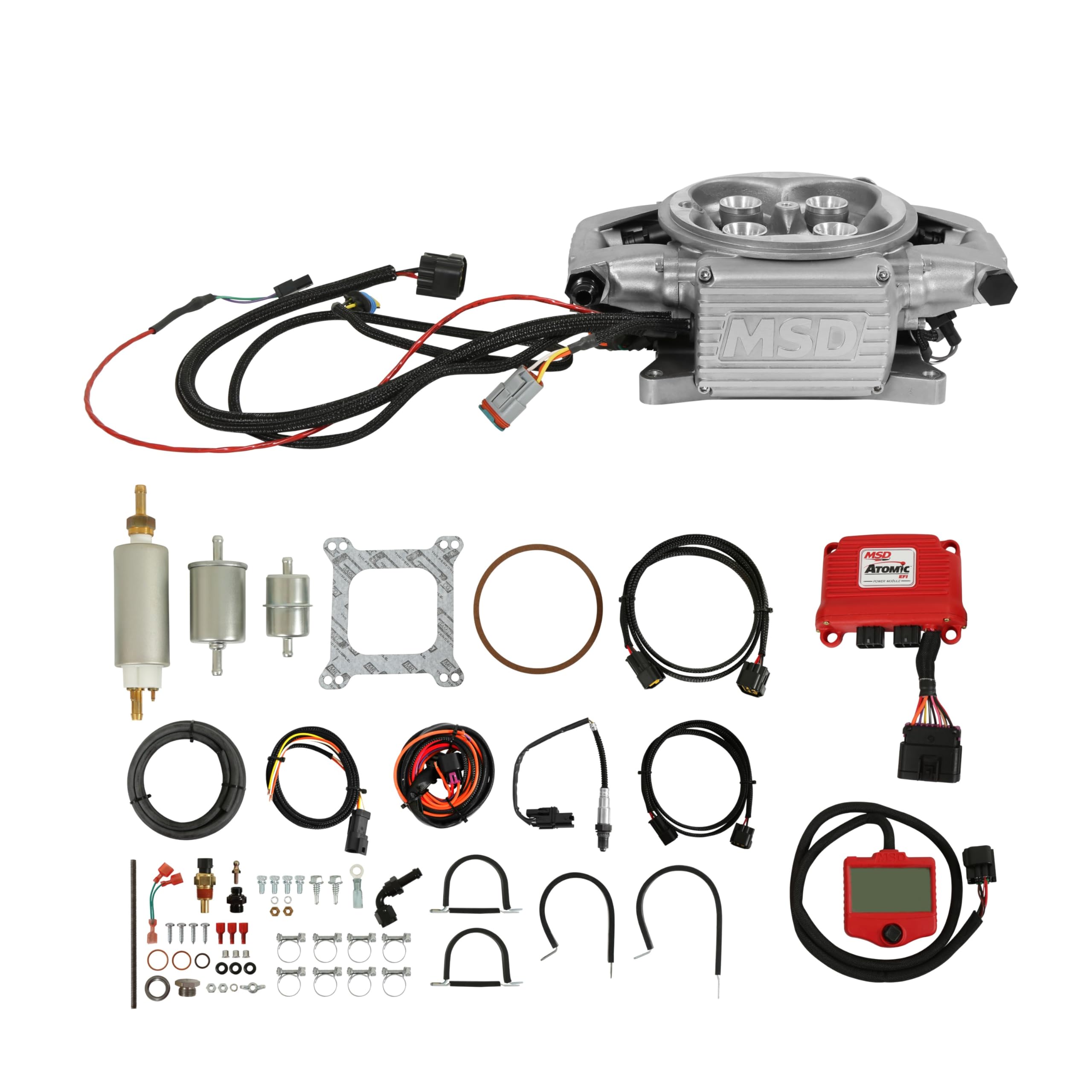
The MSD Atomic 2900 is the gold standard for carburetor-to-EFI conversions precisely because it eliminates the two greatest friction points: the return fuel line and the laptop. The master kit bundles a turbine-style pump with a fuel pump driver module (FPDM) that maintains steady pressure through a single hose, and the handheld controller self-tunes the base ignition and fuel tables by analyzing wideband O2 feedback. CARB approval means it passes visual inspection in regulated states, and the eight-connection wiring harness simplifies the install to roughly an afternoon for anyone comfortable with basic 12-volt circuits.
The self-tuning logic handles cam profiles up to approximately 236°/242° duration at 0.050-inch lift without requiring a custom base map, and the idle quality remains stable even after cold starts below freezing. Several users report that the provided fuel line failed within the first week due to ethanol swelling — a known weak point that should be replaced immediately with PTFE-lined hose. The ECU is also susceptible to heat-induced limp-mode failures when mounted on the intake manifold; relocating the ECU inside the cabin or behind the dashboard resolves this completely and is documented across enthusiast forums as a near-universal recommendation for hot-climate builds.
For someone building a 355-383 small-block with a mild to moderate cam and a single-plane intake, the Atomic 2900 delivers a rock-solid idle, crisp tip-in, and reliable hot-restarts without touching a tuning cable. The lack of built-in datalogging for forced induction setups means turbo and supercharger users will still need a standalone ECU, but for a naturally aspirated street car that you want to drive tomorrow, this kit is the simplest path to reliable injection.
Why it’s great
- Self-tuning with no laptop required — adjust idle, AFR, and timing via handheld
- Returnless fuel line simplifies installation and reduces engine bay clutter
- CARB approved for emissions-legal conversions in regulated states
Good to know
- Included fuel line deteriorates with ethanol fuel; must be upgraded to PTFE-lined hose
- ECU heat-soaks under hood above 95°F; requires relocation to cabin for reliability
- Lacks comprehensive datalogging for forced induction tuning
2. DiabloSport 8300 Intune i3
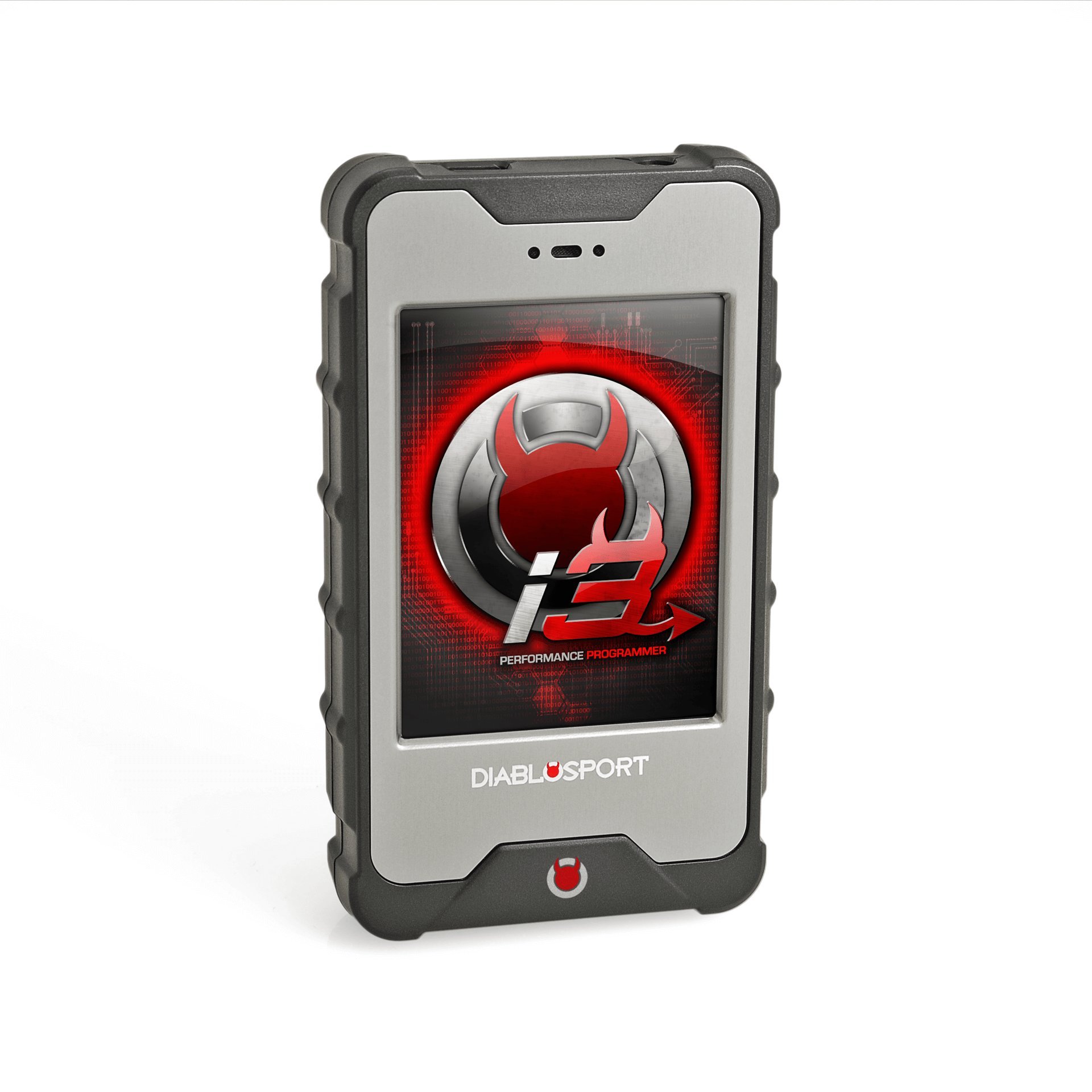
The DiabloSport 8300 is the go-to handheld programmer for late-model GM and Chrysler vehicles that need active fuel management (AFM or MDS) disabled, a speedometer recalibrated for taller tires, or a 20-35 rear-wheel horsepower gain from a premium-octane tune. The device connects via OBD-II and overwrites the factory calibration with dyno-validated fuel and timing tables stored in the unit. The 8300 also supports WiFi updates and simple trim adjustments for throttle response, rev limiters, and torque converter lockup without any laptop involvement beyond the initial registration.
The real-world results on a 5.7L Hemi or a 6.2L LS3 show a noticeable reduction in throttle lag and crisper part-throttle transitions, largely because the tune removes the torque management and fuel-saving lean cruise that manufacturers bake into the stock ECU. However, the 8300 has a documented risk of wiping the vehicle’s original firmware during a failed programming cycle — a known fault acknowledged by Holley support. If the process is interrupted or the 12-volt supply drops during the write, the ECU becomes bricked and must be physically sent out for a re-flash. Updating the device firmware before any vehicle write reduces this risk but does not eliminate it entirely.
For owners of a 2014 Ram 1500 with the 5.7L or a 2005 Chrysler 300C looking for a simple performance unlock without purchasing new injectors or a cold-air intake, the 8300 delivers genuine gains for the money. The one-time license locks the device to a single VIN, so you cannot swap it between vehicles unless you purchase additional licenses, which limits its appeal for a multi-car household.
Why it’s great
- Dyno-tuned gains of 20-35 RWHP on premium fuel without any hardware swap
- Disables MDS/AFM and calibrates speedometer for non-stock tire diameters
- WiFi update capability and OBD-II data logging for diagnostic review
Good to know
- Single VIN lock — cannot share between vehicles without additional license fee
- Known ECU bricking risk during interrupted programming cycles
- Only one tune file per vehicle unless you pay for custom tuning service
3. DiabloSport 8100 inTune i3 (Ford)
This variant of the inTune i3 is tuned specifically for the Ford modular engine family — 1996-2016 Mustang GT, 1998-2016 F-150, the 3.5L EcoBoost, and other popular Ford platforms. The 8100 delivers 20-25 rear-wheel horsepower on naturally aspirated 4.6L and 5.0L motors and a staggering 40-100 RWHP on the 3.5L EcoBoost simply by revising boost targets, spark timing, and fueling tables from the factory conservative calibrations. The device also optimizes automatic transmission shift pressure and timing, which eliminates the lazy 1-2 upshift that many Ford trucks exhibit from the factory.
On a 2016 Explorer Sport 3.5L EcoBoost, one owner reported a 2 MPG improvement along with significantly firmer shifts and the elimination of turbo lag on a standard 87-octane tune — a rare scenario where better fuel economy accompanies more power. The 87-octane tune is genuinely usable for daily driving without detonation, unlike some handheld programmers that require premium for any performance gain. The same versatility also allows gear ratio changes, rev limiter adjustments, and speed limiter removal, making the 8100 a comprehensive ECM reflash tool for a Ford owner building a mild street truck or a weekend track car.
The flip side is the same single-VIN license model and the same bricking risk present across the DiabloSport line. Additionally, GM/Chrysryler owners should specifically avoid this model — the 8100 is Ford-only, and attempting to use it on a non-Ford VIN will result in an incompatibility error. For a Mustang GT owner who wants a quick power bump without opening the engine, the 8100 offers the best return on investment of any modification under a thousand dollars.
Why it’s great
- 40-100 RWHP gains on EcoBoost engines from a simple OBD-II reflash
- Supports 87-octane tune for daily driving fuel economy improvement
- Optimizes automatic transmission shift scheduling for firmer shifts
Good to know
- Ford-specific only — does not work with GM, Chrysler, or other non-Ford VINs
- Single-VIN lock and ECU bricking risk during interrupted writes
- Customer service hold times exceed 45 minutes; no weekend support
4. Atomic 2700 AirForce Intake Manifold

The Atomic 2700 is not a full EFI kit — it is a dedicated intake manifold designed for LS and LT engines that replaces restrictive factory plastic or cast-aluminum runners with a direct-flow path that supports up to a 103mm throttle body. In Lingenfelter’s independent testing on a Z28 Camaro, the AirForce manifold delivered 36 horsepower at the rear wheels over the leading competitor, primarily through improved mid-to-high-rpm volumetric efficiency. The polymer construction absorbs less radiant heat than aluminum, which reduces intake air temperature during extended high-load operation and helps preserve ignition timing advance.
Fitment on a 2018 Camaro 2SS 1LE was straightforward with no check-engine light triggered after installation, though one owner on a Corvette noted flashing defects and excess plastic within the runner bores that required porting work to achieve advertised flow numbers. The 103mm opening demands a matching large-bore throttle body — using a stock 87mm or 90mm unit will create a step mismatch that limits airflow and negates the manifold’s design intent. The manifold accepts stock fuel rails as well as aftermarket rails, including the Atomic LS EFI system, which makes it a natural pairing for someone building a high-output naturally aspirated or mild supercharged combination.
For a street/strip LS build targeting 500+ naturally aspirated horsepower, the 2700 eliminates the bottleneck that stock LS3 manifolds impose above 6,000 RPM. The porting cost mentioned by some owners should be factored into the total budget, as the as-cast runner quality varies. Pair it with a matching throttle body and a competent tune, and the 2700 delivers a measurable power gain that a carbureted intake simply cannot match at the same price point.
Why it’s great
- 36 RWHP gain over competitor manifolds in Lingenfelter dyno testing
- 103mm throttle bore accepts largest available throttle bodies for max airflow
- Polymer construction reduces heat soak vs. aluminum intake manifolds
Good to know
- As-cast quality varies — some units require porting to remove internal flashing
- Requires matching 103mm throttle body; stock 87mm units create a flow step
- Vehicle-specific fitment — not universal across all LS/LT platforms
5. GM Genuine Parts 55570283 Intake Manifold Kit
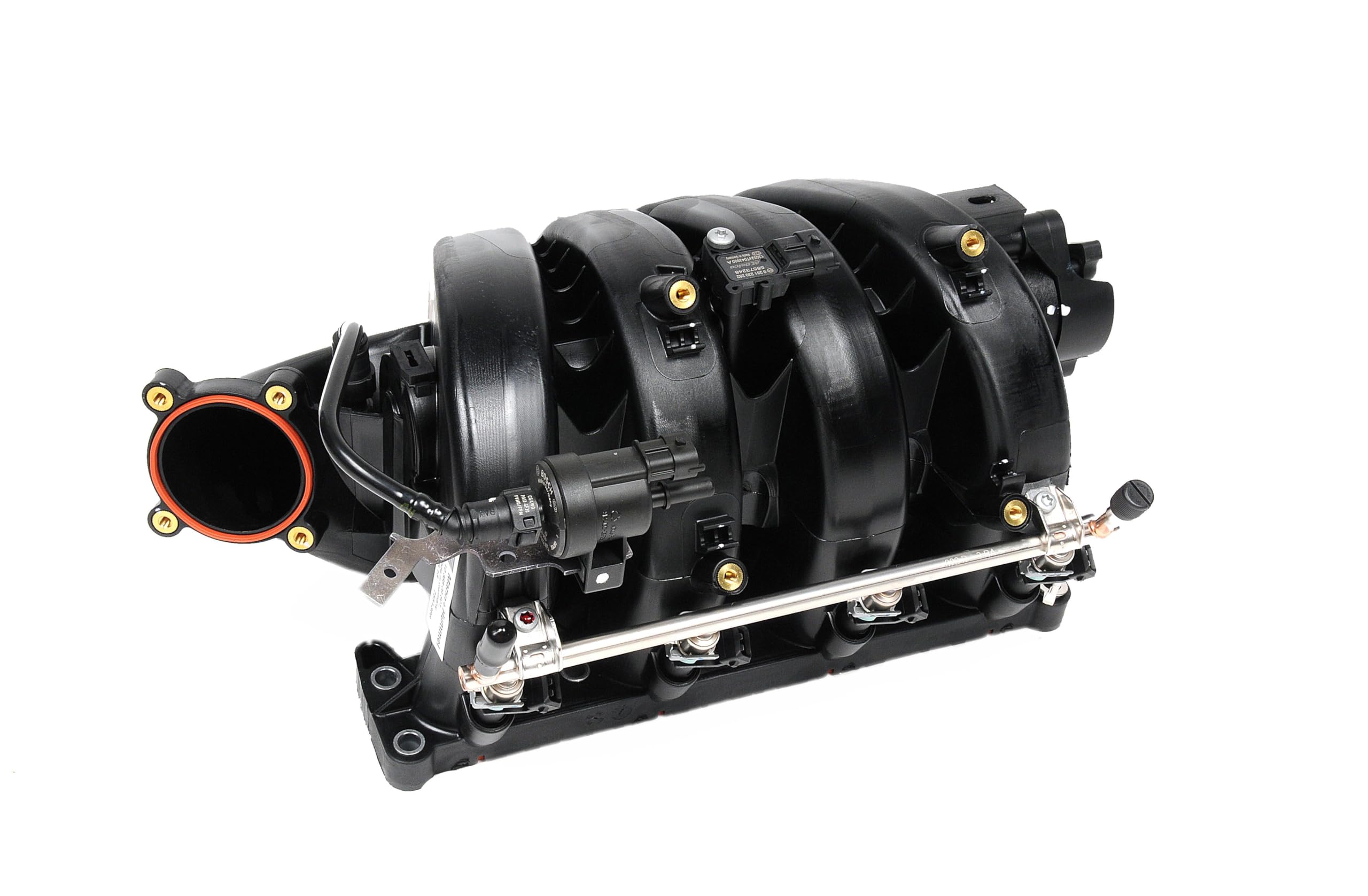
This GM Genuine Parts kit is an all-in-one replacement for the 1.8L naturally aspirated engine found in the 2011-2016 Chevy Cruze, Sonic, and related platforms — not a performance upgrade but a direct OE-spec fix for the infamous intake manifold tuning-arm failure. The kit includes the manifold, the multi-port fuel injectors, and the fuel rail in a single box, which eliminates the guesswork of sourcing separate components from a dealership parts counter. The most common failure mode involves the plastic intake runner control arm snapping, leaving the engine with a persistent check engine light and a noticeable loss of low-end torque.
Installation requires removing the exhaust crossover pipe, the driver-side CV axle, the alternator, and the starter on the Sonic — a 4.3-hour job the first time, though a second attempt cuts to roughly 2.5 hours once the disassembly sequence is memorized. Owners report that the car “runs stronger” after replacement because the manifold is no longer stuck in the high-rpm runner position, restoring the lost low-end torque. At roughly half the price of a dealer-sourced part, the 55570283 is the single most cost-effective fix for this known GM weakness.
This is not a part for power builders — it is a maintenance item that puts the car back to factory specification. If you are diagnosing a P0691 or P0692 code on a 1.8L GM Ecotec with a broken intake runner arm, this kit is the definitive repair. The included injectors are pre-tested and matched to the rail, so no flow-rate balancing is necessary.
Why it’s great
- Complete OE-quality kit: manifold, injectors, and fuel rail in one box
- Direct fix for the notorious intake runner arm failure on GM 1.8L engines
- Costs significantly less than dealer parts counter pricing
Good to know
- Installation is labor-intensive — expect 4+ hours for first-time replacement
- Requires CV axle removal, which introduces risk of ATF leaks
- Not compatible with turbocharged 1.4L Ecotec engines
6. Edge 30200 EZ Programmer

The Edge 30200 EZ Programmer targets the 24-valve 5.9L Cummins engine found in Dodge Ram trucks from the late-1990s through early-2000s, offering three distinct power levels selectable through a simple dashboard-mounted pod. Level 1 is an economy tune that many users report yields a 3-4 MPG improvement over stock on a manual-transmission truck, while Level 2 delivers the best balance of towing torque and fuel economy. Level 3 maximizes fuel delivery and timing, producing a noticeable mid-range pull that pairs well with RV275 injectors but also raises exhaust gas temperatures significantly, demanding pyrometer monitoring.
The programmer restores mid-range torque that is often lost after installing a free-flowing exhaust system — a common first mod on 5.9L trucks that reduces backpressure but also flattens the torque curve. The EZ programmer compensates by adding timing and fuel in the 1,800-2,600 RPM band where these trucks spend most of their towing life. The unit is explicitly not recommended for automatic transmissions — several owners who attempted to use it with the 47RE or Allison automatics experienced clutch pressure spikes that led to transmission failures requiring rebuilds.
For a manual-transmission Dodge Ram owner with a 24-valve Cummins, the Edge 30200 is a proven mild upgrade that makes the truck more pleasant to drive empty and more capable under load. The lack of any forced-induction or transmission tuning parameters means it cannot solve advanced issues like boost fooling or lockup scheduling, but its simplicity is also its strength — plug it in, select a level, and drive.
Why it’s great
- Restores mid-range torque lost after exhaust modifications on 5.9L Cummins
- Three selectable power levels including an economy tune that improves MPG
- Simple dashboard-mounted controller with no laptop required
Good to know
- Not compatible with automatic transmissions — can cause clutch pressure failure
- Does not support boost control or transmission tuning parameters
- Level 3 raises EGT significantly; a pyrometer is essential for safe operation
7. OTC 6550 Master Fuel Injection Kit

This is not a performance EFI system but a professional-grade diagnostic kit for verifying fuel pressure, leak-down rates, and regulator function across most gasoline fuel-injection systems from 1997 and newer. The kit includes a large, easy-to-read pressure gauge with a range suitable for returnless and return-style systems, along with over 25 adapters covering Ford, GM, Chrysler, BMW, and other common automotive quick-connect types. The entire set packs into a hard-shell case that keeps the adapters organized and prevents loss between jobs.
The gauge accuracy is sufficient for diagnosing weak fuel pumps, restricted filters, and failing pressure regulators — conditions that produce drivability symptoms like hesitation under load or hard hot restarts that mimic an ignition problem. Owners of older European vehicles like a 1984 Porsche 911 with Motronic found the adapter selection comprehensive enough to connect to the Schrader valve without any custom fabrication. The one notable limitation is the lack of fittings for modern high-pressure diesel systems — 6.7L Powerstroke owners will need to fabricate their own compression fittings to test rail pressure on common-rail injection systems.
The rubber fuel lines included with the kit are reported to degrade and crumble after approximately 8-10 years of use, even with proper fuel draining after each session. Replacing them with ethanol-resistant PTFE or Viton hose extends the service life indefinitely. For a DIY mechanic who works on multiple family vehicles and enjoys diagnosing hard-starting or misfire issues systematically, the OTC 6550 is the single most useful diagnostic tool after a multimeter and a scan tool.
Why it’s great
- Large, accurate gauge with over 25 adapters for domestic and import gasoline systems
- Hard-shell case keeps adapters organized — no lost fittings between jobs
- Covers returnless and return-style fuel systems found on 1997+ vehicles
Good to know
- Included rubber fuel lines degrade with ethanol fuel; replace with PTFE hose
- No fittings for modern common-rail diesel systems (6.7 Powerstroke, Duramax)
- Not a replacement for a scan tool — only measures fuel pressure and leak-down
FAQ
Can I use a self-tuning EFI on a 600-horsepower stroker with a nitrous plate?
What does the single-VIN lock mean on handheld programmers like the DiabloSport i3?
Why does my manual transmission Cummins need a different programmer than an automatic?
Final Thoughts: The Verdict
For most users building a naturally aspirated street engine, the best aftermarket efi winner is the MSD Atomic 2900 because its self-tuning, returnless compatibility, and CARB approval cover the widest range of carburetor-to-EFI conversions with the least amount of wiring or laptop involvement. If you want a simple power boost on a modern Ford or GM truck without replacing the intake manifold, grab the DiabloSport inTune i3 8300 for its dyno-tuned gains and MDS disable feature. And for a diesel towing truck with a manual transmission, nothing beats the Edge 30200 EZ Programmer for restoring lost mid-range torque and improving fuel economy under load.