
A hollow take, a faint hum beneath the vocal, the thinness of a guitar recorded direct into a laptop — these are the immediate, audible penalties of mismatched gear. Choosing your first or next interface, microphone, and monitoring chain is a dense decision matrix of preamp gain, converter quality, XLR impedance, and software integration. The wrong pick wastes takes and budget equally.
I’m Min — the co-founder and writer behind Gadgets Feed. I’ve spent hundreds of hours cross-referencing preamp specs, dynamic range figures, and bundle component quality to separate genuine studio-grade performance from mere marketing claims in this guide.
Whether you are podcasting, streaming, or tracking demos, this breakdown of the best at home recording equipment will steer you toward a signal chain that captures clean, professional audio from the very first take.
How To Choose The Best At Home Recording Equipment
Selecting a home studio setup is a three-part system: the microphone (source capture), the audio interface (conversion and preamplification), and the monitoring chain (accurate playback). Your choice must balance these components around your primary use case — vocal recording requires different specs than multi-instrument tracking or live podcast production.
Preamp Gain and Dynamic Range
The preamp’s maximum clean gain determines whether a dynamic microphone like the Shure SM7dB reaches its natural volume without an external booster. Interfaces offering +56 dB or more headroom accommodate low-output mics directly. Dynamic range, measured in dB, dictates the distance between the noise floor and the loudest signal — shoot for over 110 dB to capture quiet details without hiss.
Mic Type: Condenser vs. Dynamic vs. Ribbon
Condenser microphones capture more detail and higher frequencies, making them ideal for vocals and acoustic instruments, but they require 48V phantom power from your interface. Dynamic microphones are less sensitive to room noise and handle high SPL sources like guitar cabinets or loud vocals without distortion. Ribbon mics deliver vintage warmth but need very quiet, high-gain preamps.
Bundles vs. Building Piecemeal
Bundles — an interface, mic, headphones, and cables in one box — simplify the buying process and guarantee component compatibility, often saving money compared to buying each item separately. The trade-off is that the included microphone or headphones may be entry-level quality. If you have a higher budget, select each piece individually to match your specific genre and recording environment.
Quick Comparison
On smaller screens, swipe sideways to see the full table.
| Model | Category | Best For | Key Spec | Amazon |
|---|---|---|---|---|
| Focusrite Scarlett 2i2 Studio 4th Gen | Bundle | Complete songwriter studio | 120 dB dynamic range | Amazon |
| Shure SM7dB | Dynamic Mic | Professional vocal isolation | Built-in +28 dB preamp | Amazon |
| Universal Audio Volt 2 | Audio Interface | Vintage-style preamp tone | 24-bit / 192 kHz | Amazon |
| Shure SM4 Studio Kit | Condenser Mic Kit | Mix-ready vocal recording | 1-inch dual-diaphragm capsule | Amazon |
| Arturia MiniFuse Recording Pack | Bundle | Beginner to intermediate production | 192 kHz sampling rate | Amazon |
| Osee GoStream Deck HDMI Pro | Video Switcher | Multi-camera live streaming | 4x HDMI input | Amazon |
| PreSonus AudioBox 96 25th Anniversary | Bundle | All-in-one studio starter | 24-bit / 96 kHz | Amazon |
| Audio-Technica AT2020USB-X | USB Mic | Simple plug-and-play recording | 24-bit / 96 kHz | Amazon |
| MAONO AME2C Pro Bundle | Podcast Mixer | Budget podcast production | 10-channel mixer | Amazon |
In‑Depth Reviews
1. Focusrite Scarlett 2i2 Studio 4th Gen
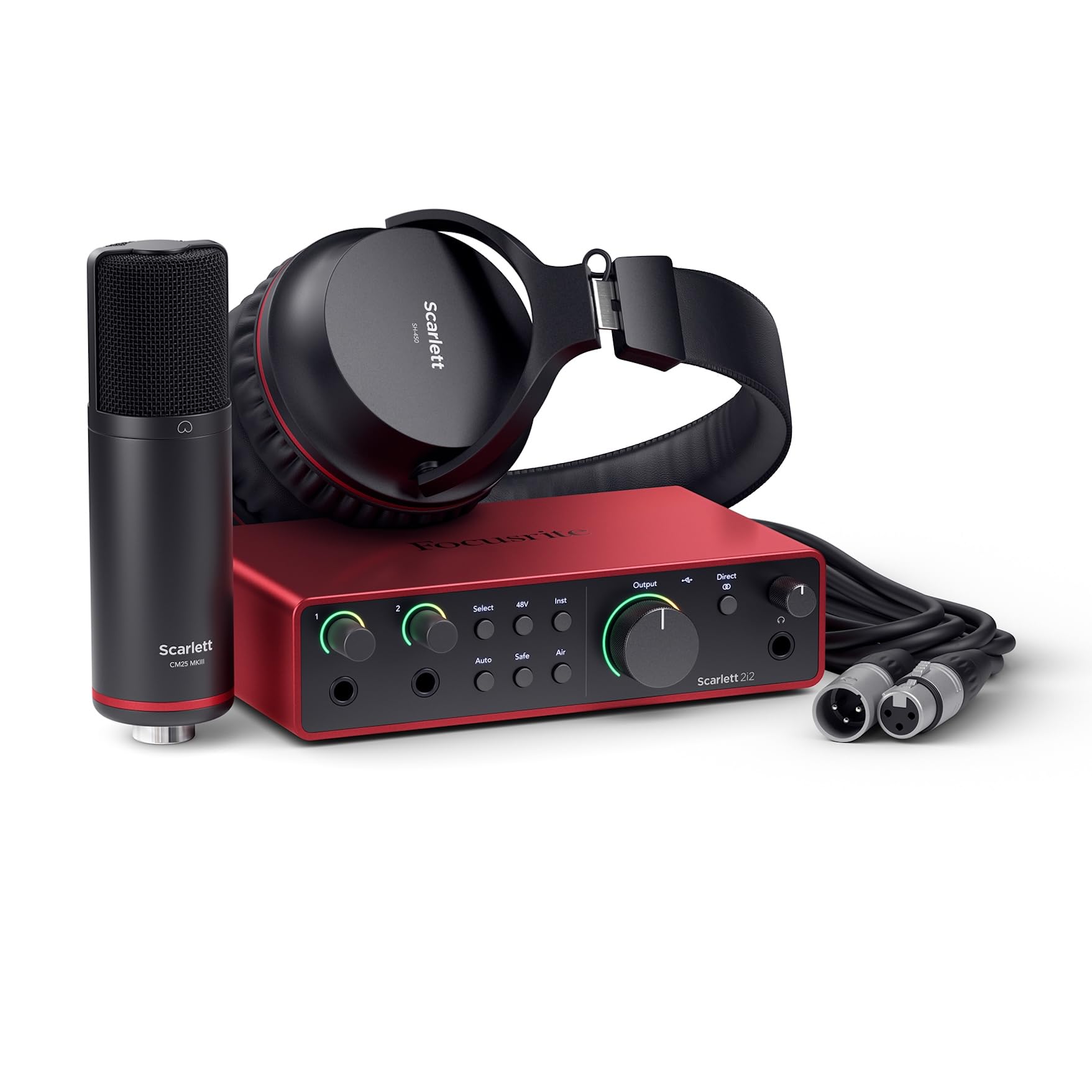
The Scarlett 2i2 Studio 4th Gen bundle sets the benchmark for a complete home recording ecosystem. The interface itself offers 120 dB of dynamic range, matching converters found in Focusrite’s flagship RedNet series, which translates to a remarkably low noise floor for clean vocal and instrument tracking. Auto Gain and Clip Safe are not gimmicks — they actively save takes by setting optimal levels and preventing digital clipping in real time.
The included CM25 MkIII condenser microphone performs well above its bundle-class reputation, delivering a balanced frequency response that requires minimal EQ in post. The SH-450 headphones provide closed-back monitoring with a flat-ish response, letting you hear what the mic actually captures, not a hyped version of it. The bundle also includes Pro Tools Intro+, Ableton Live Lite, and the Hitmaker Expansion plugin suite, giving you professional DAW and processing tools out of the box.
Where this package truly justifies its premium position is the integration — every cable, mic, and headphone is matched to the interface’s specs. You won’t need to troubleshoot impedance mismatches or phantom power issues. If you are serious about recording demos, streaming, or podcasting with minimal friction, this is the setup that removes the weakest link.
Why it’s great
- 120 dB dynamic range rivals flagship interfaces
- Auto Gain and Clip Safe prevent ruined takes
- Complete bundle with DAW and plugin suite
Good to know
- CM25 MkIII mic requires careful placement to avoid plosives
- No dedicated 3.5mm input for external audio sources
2. Shure SM7dB Dynamic Microphone

The SM7dB is the SM7B’s evolution that finally solves the gain starvation problem. By integrating a selectable +18 dB or +28 dB clean preamp directly into the mic body, it eliminates the need for an external Cloudlifter or Fethead. This means you can plug into any standard XLR interface and immediately hit usable levels without adding extra noise or gear to your signal chain.
The precision cardioid pickup pattern, combined with air suspension shock isolation, aggressively rejects room reflections and laptop fan hum. Rear-panel EQ switches for bass roll-off and mid-range presence boost let you shape the tonal character at the source — great for taming proximity effect on deep voices or adding clarity to a muddy track. The all-metal construction and electromagnetic shielding block RF interference from phones and Wi-Fi routers.
For podcasters, streamers, and vocalists who record in untreated rooms, the SM7dB’s dynamic capsule is far more forgiving than a condenser. It won’t capture the echo from across the room. The trade-off is that it requires an audio interface — this is not a USB microphone. But with the built-in preamp, you no longer have to budget for a high-end interface just to drive it.
Why it’s great
- Built-in preamp eliminates need for external boosters
- Superior off-axis rejection for untreated rooms
- EQ switches for source-based tone shaping
Good to know
- Requires XLR interface and cable (not included)
- Heavier build demands a sturdy boom arm
3. Universal Audio Volt 2

The Volt 2 delivers the studio heritage of Universal Audio’s 610 vacuum-tube preamps in a compact, USB-powered interface. Engaging the Vintage mode adds a harmonic richness to vocals and acoustic guitars that typical clean preamps cannot match — it rounds off digital harshness and adds a subtle saturation reminiscent of analog tape. The converters operate at up to 24-bit / 192 kHz, ensuring ultrasonic frequency content is captured without aliasing.
Universal Audio includes the LUNA DAW with the Volt 2, giving you access to their analog-style recording workflow and a selection of UAD plugins. The build quality is notably dense for a bus-powered unit — the metal chassis and metal knobs feel reassuringly solid. Input latency is tight enough for real-time monitoring through your DAW, though the direct monitoring via the built-in headphone jack covers monitoring with zero latency during tracking.
The primary limitation is channel count: two inputs limit you to stereo recording or one mono source plus a DI guitar. For a solo songwriter or podcaster who values tonal character over inputs, the Volt 2’s vintage preamp emulation is a creative tool, not just a utility. It is also iOS-compatible, making it a strong choice for mobile recording with an iPad.
Why it’s great
- Vintage mode adds analog warmth to recordings
- 24-bit / 192 kHz high-resolution conversion
- USB-powered and iOS compatible
Good to know
- Only two inputs, limited for multi-mic setups
- LUNA DAW may have a learning curve for beginners
4. Shure SM4 Studio Recording Microphone Kit

The SM4 is Shure’s modern side-address condenser designed specifically for home studios where proximity effect and room noise are constant battles. The 1-inch dual-diaphragm brass capsule delivers a smooth high-frequency response and controlled low-end that stays clean even when you are close-miking a vocalist. Shure’s patent-pending interference shielding blocks RF noise from nearby electronics — a major advantage in a room full of laptops and routers.
The internal pop filter and integrated woven mesh Faraday cage reduce plosives and electromagnetic interference before the signal hits your interface. This means less time repairing popped consonants in EQ and more time recording usable takes. The capsule handles up to 140 dB SPL without distortion, so you can place it in front of a guitar cabinet or a loud vocalist without worrying about digital artifacts.
What sets this kit apart is the included detachable magnetic pop filter and shock mount — both built with the same all-metal quality as the mic itself. The shock mount effectively isolates handling noise, which is critical because the SM4’s sensitivity picks up subtle room vibrations. This is a condenser microphone that behaves well in imperfect spaces, making it ideal for home studios without heavy acoustic treatment.
Why it’s great
- RF interference shielding for clean audio near electronics
- 140 dB SPL handling without distortion
- Magnetic pop filter and all-metal shock mount included
Good to know
- XLR only, requires an audio interface with phantom power
- High sensitivity may pick up room echo if unaddressed
5. Arturia MiniFuse Recording Pack
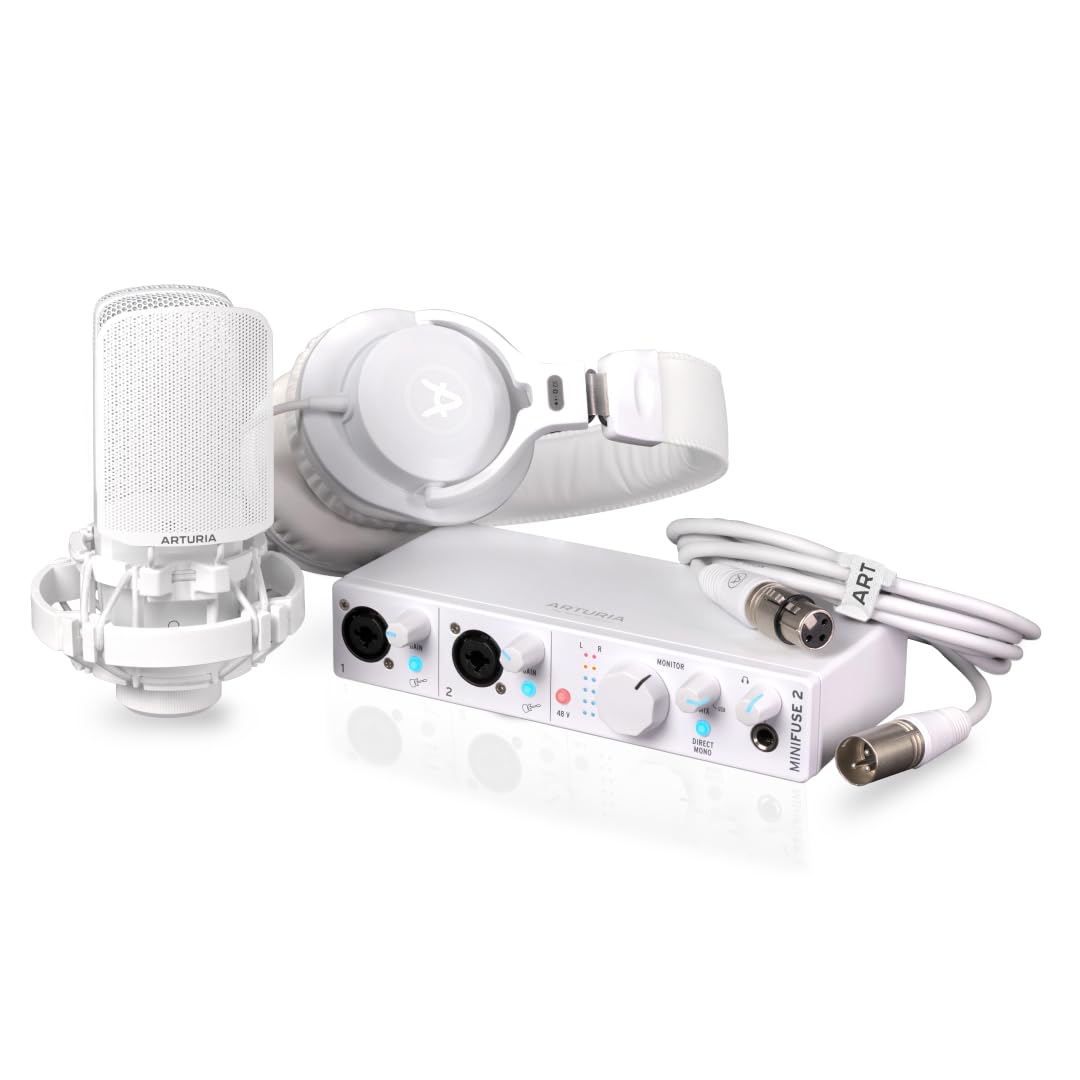
The Arturia MiniFuse Recording Pack is a thoughtfully assembled bundle that prioritizes software value without cheaping out on hardware. The MiniFuse 2 interface delivers 192 kHz sampling rate and a remarkably low noise floor for its class, with MIDI I/O and a built-in USB hub that lets you connect a controller without taking up a port on your computer. The Loopback feature routes computer audio into your recording, perfect for capturing voiceovers alongside game or app audio.
The included condenser microphone captures detailed vocal and acoustic instrument recordings with a clarity that beats typical starter mics. The headphones are comfortable for extended editing sessions and provide a balanced enough response for basic mixing decisions. The software bundle is where Arturia leans in: Ableton Live Lite for DAW production, Analog Lab Intro for virtual synth sounds, Auto-Tune Unlimited for vocal tuning, and NI Guitar Rig 6 LE for amp simulation.
This pack is ideal for the producer or streamer who wants to start creating immediately rather than spending days hunting down drivers and trial software. The interface’s build quality — all-metal chassis, sturdy knobs — suggests it will survive the upgrade cycle, and the included loopback feature keeps it useful even after you move to a pricier interface.
Why it’s great
- Generous software bundle with Ableton Live Lite and Auto-Tune
- Built-in USB hub for MIDI controllers
- Loopback feature for streaming and voiceover recording
Good to know
- Microphone is entry-level, may be upgraded later
- Interface lacks hardware compression or DSP effects
6. Osee GoStream Deck HDMI Pro

While not a traditional recording interface, the GoStream Deck is the missing piece for live streamers and podcasters producing multi-camera shows. It accepts four HDMI sources — cameras, laptops, gaming consoles — and two USB-C inputs, then switches between them via physical buttons and a T-Bar fader. The built-in upstream and downstream keyers support green screen chroma key, picture-in-picture, and lower-third graphics overlay.
The audio control section includes mic and headphone jacks with EQ, limiter, and fader adjustments, letting you mix multiple audio sources independently. It can record the program directly to an SD card or USB SSD while simultaneously streaming to three RTMP destinations. NDI HX input allows high-quality video over your local network, reducing cable clutter for a multi-angle show.
The drawback is the 1080p-only resolution — 4K sources must be downscaled. The membrane control buttons feel less premium than the unit’s capability deserves, and the on-screen menu can be laggy. However, as a dedicated video mixer that replaces a PC-based software switcher, it frees up your computer’s resources for recording or streaming.
Why it’s great
- Hardware switching with T-Bar and physical buttons
- Records to SD/USB while streaming to 3 platforms
- NDI HX input for wireless video sourcing
Good to know
- 1080p only, requires downscaling 4K sources
- Membrane buttons feel less durable than the chassis
7. PreSonus AudioBox USB 96 25th Anniversary Studio

The AudioBox USB 96 has been a beginner-friendly staple for nearly a decade, and the 25th Anniversary edition bundles it with an M7 large-diaphragm condenser microphone, HD7 headphones, cables, and a desktop stand. The interface itself is functionally simple: two combo inputs with class-compliant drivers that work with any major DAW on Windows and macOS. The 24-bit / 96 kHz conversion is enough for clear demos and podcasts without overcomplicating the signal path.
The M7 condenser microphone is the real highlight of this kit — it captures a warm, detailed sound that punches above its bundled price point, making it suitable for vocals and acoustic instruments. The HD7 headphones provide decent isolation and a balanced-enough response for tracking, though you will want something flatter for critical mixing. Studio One Artist is intuitive and includes Studio Magic, a bundle of effects and virtual instruments that gets you producing immediately.
This is a purpose-built bundle for the absolute beginner: it includes every cable and the desktop stand, so you can open the box and record within ten minutes. Experienced users will quickly outgrow the 96 kHz ceiling and the lack of features like loopback or MIDI, but as a low-risk entry point, the AudioBox kit is reliable and well-tested.
Why it’s great
- True all-in-one package with no missing cables
- M7 condenser mic offers warm, detailed audio
- Studio One Artist included with effects bundle
Good to know
- 96 kHz ceiling limits high-resolution recording
- No loopback or MIDI connectivity
8. Audio-Technica AT2020USB-X

The AT2020USB-X brings the studio-standard AT2020 capsule into a USB microphone that bypasses the need for an audio interface entirely. The cardioid electret condenser captures a smooth, extended frequency response (20 Hz–20 kHz) suited for vocals, voiceovers, and acoustic instruments. The built-in high-resolution AD converter operates at 24-bit / 96 kHz, delivering clarity that rivals entry-level interface-and-mic combos.
The microphone features a soft-touch capacitive mute button on the body — a genuinely useful addition for live streaming or podcasting where you need to mute silently without reaching for software controls. The two-state LED ring lights blue when active and red when muted, providing clear visual feedback. The built-in headphone jack with direct monitoring mixes your voice with incoming computer audio with zero latency, though the monitor mix is fixed rather than adjustable.
This is a USB microphone for the user who values simplicity over expandability. You cannot upgrade the mic capsule later or swap it for a different model without buying an interface. The included desktop stand is adequate, but the mic is sensitive enough to pick up room reflections, so a boom arm and pop filter are recommended for serious use.
Why it’s great
- Professional-grade AT2020 capsule in USB form
- 24-bit / 96 kHz conversion for clear audio
- Capacitive mute button with visual feedback
Good to know
- Fixed monitor mix, no adjustable blend
- Sensitive to room reflections, needs treatment
9. MAONO AME2C Pro Bundle

The MAONO AME2C Pro is an all-in-one podcast production console that combines a 10-channel audio interface, XLR dynamic microphone, Bluetooth input, and customizable sound pads into a single bundle. The built-in preamp delivers up to 60 dB of gain with a 48V phantom power option, which means it can drive both the included dynamic mic and higher-end condenser microphones. The 32-bit chipset and denoise function help clean up background noise at the input stage.
The sound pad functionality is the standout feature for interactive podcasters: three pads record up to 60 seconds each with one-key looping, and eight pads hold 20-second clips for intros, stingers, and sound effects. All pad volume can be adjusted independently, and audio can be uploaded via smartphone, PC, or Bluetooth. The interface also includes six reverb modes, 12-step auto-tune, and three-band EQ, giving you on-the-fly vocal processing without needing a computer.
The bundled XLR dynamic microphone includes a built-in double-layer pop filter and delivers clear audio in the 60 Hz–14 kHz range — adequate for speech but lacking the top-end air of a condenser. Long-term reliability is a concern based on user reports of sound pad failures, and some control finickiness requires a sound check before each session. For the price, however, the bundle offers features — sound pads, Bluetooth, guitar input — that competing bundles lack entirely.
Why it’s great
- 10-channel mixer with 11 customizable sound pads
- Bluetooth input for wireless audio from phone or tablet
- Includes guitar/bass instrument input
Good to know
- Reported reliability issues with sound pad longevity
- Mic frequency response lacks high-end detail
FAQ
Is a condenser microphone better than a dynamic microphone for voiceovers?
What sample rate should I record at for podcasting?
Can I use a USB microphone without an audio interface?
Final Thoughts: The Verdict
For most users, the best at home recording equipment winner is the Focusrite Scarlett 2i2 Studio 4th Gen because it delivers a complete, professionally-matched bundle with 120 dB dynamic range, Auto Gain, and a full software suite that removes all barriers to recording. If you need vocal isolation in an untreated room, the Shure SM7dB with its built-in preamp will capture cleaner takes than any condenser. And for a live multi-camera podcast setup, nothing beats the Osee GoStream Deck for hardware-level video switching and streaming.