
A video signal dropout during a live broadcast or a security feed going black right when you need it most is a failure that erodes trust. This guide is built to help you find a 1080P HDMI encoder card hot swappable that delivers uninterrupted, broadcast-grade streams, covering H.265 efficiency, protocol support, and real-world deployment factors.
I’m Min — the co-founder and writer behind Gadgets Feed. My research process for this guide involved cross-referencing technical datasheets, analyzing customer long-term reliability reports, and comparing bitrate efficiency across H.264 and H.265 encoding to pinpoint the most stable streaming solutions.
Whether your workflow involves multi-platform live streaming, IPTV distribution, or remote monitoring, this analysis will help you select the most reliable 1080p hdmi encoder card hot swappable for your specific use case.
How To Choose The Best 1080P HDMI Encoder Card Hot Swappable
Selecting an encoder card means balancing video quality, protocol support, and long-term reliability. Not all encoders handle network interruptions the same way, and some are better suited for specific workflows like live gaming or IPTV.
Encoding Standard: H.265 vs. H.264
H.265 (HEVC) offers roughly half the bitrate of H.264 for equivalent visual quality. For a 1080P60 stream, this means you can maintain crisp detail at lower bandwidths, which is critical when your network isn’t dedicated entirely to the encoder. However, some older decoders and NVRs only accept H.264, so verify downstream compatibility before committing to H.265-only hardware.
Protocol Range and Latency
An encoder that supports RTSP and UDP is essential for low-latency local monitoring, while RTMP and SRT are the go-to protocols for reliable internet streaming over unpredictable connections. The best units support 4+ simultaneous output streams with different protocols, allowing you to push to YouTube, a local recorder, and an NVR all at once without additional hardware.
Hot Swappable Design and Physical Build
A true hot swappable encoder card allows you to replace or reconfigure the hardware without powering down the entire system. Look for units with dedicated HDMI input and pass-through ports, durable metal enclosures for 24/7 operation, and clear status LEDs that indicate power, signal lock, and network connection at a glance.
Quick Comparison
On smaller screens, swipe sideways to see the full table.
| Model | Category | Best For | Key Spec | Amazon |
|---|---|---|---|---|
| ZowieBox | NDI Converter | NDI production workflows | Native NDI HX3 with 4K pass-through | Amazon |
| URayCoder UHE265-1S-4K | Multi-Protocol | Simultaneous multi-platform streaming | 4K@30 input, 4 concurrent protocol streams | Amazon |
| URayCoder UHE265-1L-4K | High Frame Rate | High-FPS streaming at 2K | 4K@30 input, 120fps at 2K | Amazon |
| URayCoder UHE265-1S | Hardware Encoder | Dedicated 1080P hardware encoding | Dual H.265/H.264 chip, 1080P60 output | Amazon |
| J-Tech Digital JTECH-ENCH4 | 4K Input | ONVIF integration with NVRs | 4K@60 input, 1080P60 output | Amazon |
| Magewell USB Capture HDMI Gen 2 | USB Capture | Zero-driver USB capture for PC/Mac | FPGA processing, 1080P60, USB 3.1 | Amazon |
| UNISHEEN BM1000H | Value Encoder | Budget-friendly broadcast stream | H.265/H.264, SRT/RTMP, browser UI | Amazon |
| Elgato Cam Link 4K | Capture Card | DSLR/mirrorless as a webcam | 1080P60 or 4K30, USB 3.0, UVC | Amazon |
| Basicolor KVM Extender | KVM Extender | Long-distance USB and HDMI extension | 1080P@60 over Cat5/6 up to 262ft | Amazon |
In‑Depth Reviews
1. ZowieBox

The ZowieBox is a compact powerhouse that converts HDMI to certified NDI HX3, enabling seamless integration with professional broadcast environments using TriCaster or vMix. Its metal chassis includes a tally light and an LCD status screen, and it supports PoE for flexible placement without a nearby power outlet.
With 4K@30 capture and zero-lag HDMI pass-through, this device is ideal for live gaming or event production where you need to monitor the source on a separate display. The web UI offers full control over PTZ cameras, OSD overlay, and stream settings from any mobile device or browser.
While the hardware is feature-rich, some users report that the internal antenna can be weak when the device is housed in a metal rack, and connecting to certain NDI matrices requires the correct HX mode. For NDI-centric workflows, the ZowieBox delivers professional quality at a mid-range price point.
Why it’s great
- Certified NDI HX3/HX2/HX with low latency
- PoE support and USB-C power backup
- Integrated tally light and LCD status display
Good to know
- Recording splits at 4GB or 45 minutes
- Weak internal transmitter in metal enclosures
2. URayCoder UHE265-1S-4K
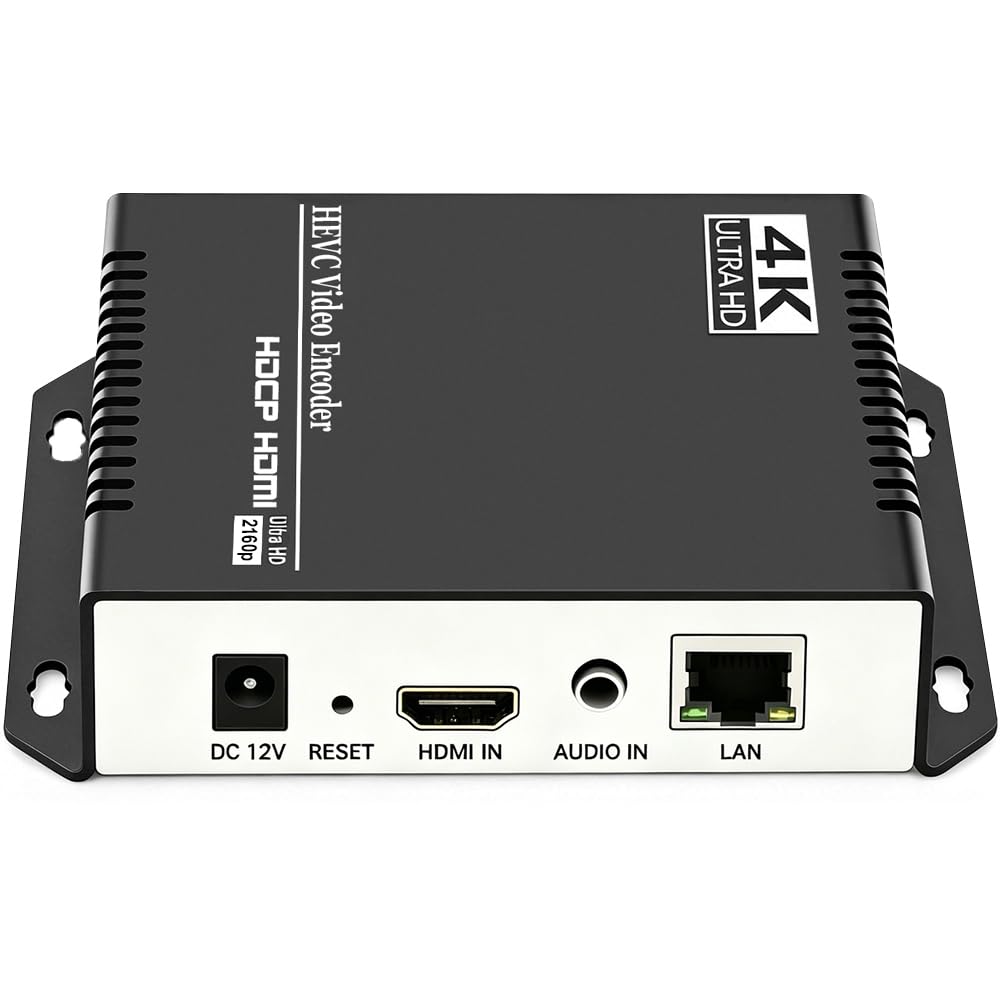
The URayCoder UHE265-1S-4K accepts 4K UHD input at 30fps and outputs 1080P60, while simultaneously pushing four independent streams using different protocols. This makes it perfect for live streaming to YouTube, Facebook, and a local NVR all at once without any extra gear.
It supports a staggering range of protocols including RTMP, RTSP, SRT, HLS, ONVIF, and WebRTC, giving you flexibility for both internet delivery and local surveillance systems. The metal enclosure dissipates heat well, and users note that the picture quality at 2200 kbps H.265 is exceptional for the price.
One notable drawback is that the power supply is not always included in the box, which can be an annoying surprise. The unit also lacks a physical power switch, requiring a manual unplug to fully cycle the hardware. For multi-platform streaming reliability, this encoder is a strong premium choice.
Why it’s great
- Simultaneous 4-stream output with different protocols
- Accepts 4K@30 input for downscaled 1080P output
- Strong tech support with firmware updates
Good to know
- Power supply may need to be purchased separately
- No physical off/on switch
3. URayCoder UHE265-1L-4K
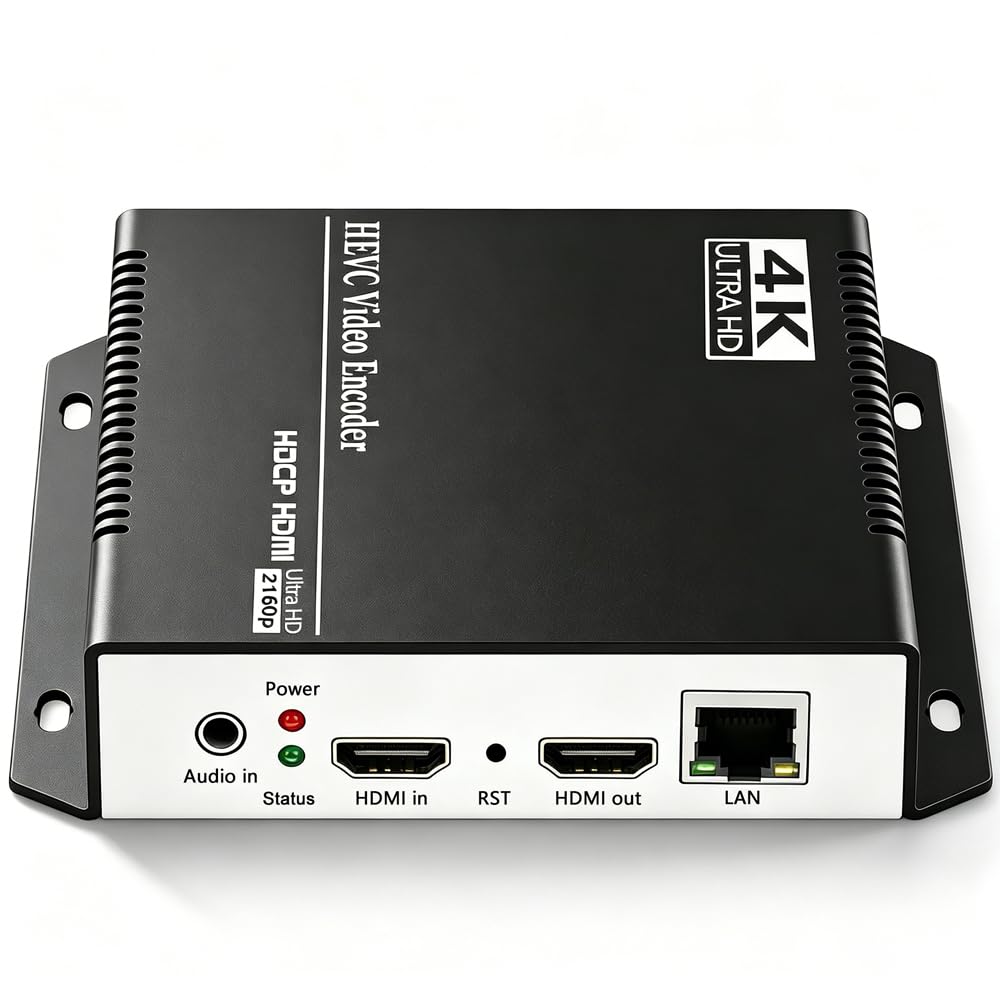
This URayCoder model stands out for its ability to handle 4K@30 input while supporting up to 120fps at 2K resolution, making it ideal for high-frame-rate content like sports or esports streaming. The advanced H.265/H.264 dual encoding chip ensures low-latency output regardless of the resolution.
Protocol support is extensive, covering everything from SRT and WebRTC to Icecast and FLV, which helps future-proof your setup against changing platform requirements. The aluminum shell provides excellent heat dissipation for continuous operation, and the browser-based web UI is intuitive enough for quick adjustments.
Some users have pointed out the lack of a power switch as an annoyance, and while the included manual is helpful, the initial configuration can require a basic understanding of networking to set the static IP. For high-FPS encoding without breaking the bank, this is a premium option with real versatility.
Why it’s great
- 120fps at 2K for smooth motion capture
- Durable metal chassis for 24/7 use
- Broad protocol support including WebRTC
Good to know
- No physical on/off switch
- Requires basic networking knowledge for setup
4. URayCoder UHE265-1S
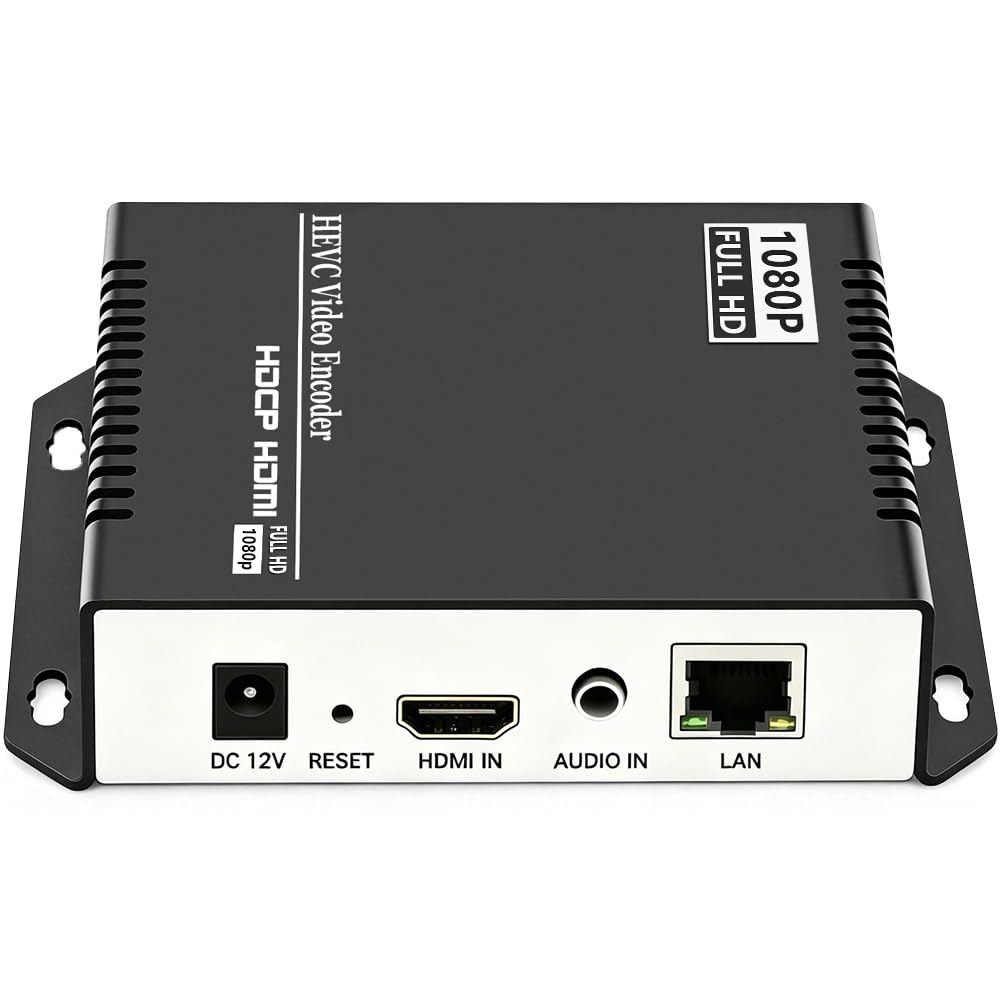
The URayCoder UHE265-1S is a dedicated 1080P60 hardware encoder that delivers broadcast-quality H.265 streams without taxing your computer’s CPU. It supports a wide array of protocols including RTSP, RTMP, SRT, and HLS, allowing direct streaming to platforms like YouTube and Twitch.
Its compact form factor and low power consumption make it suitable for long-duration events, and users have reported flawless operation for over 18 months in live environments. The web GUI allows for easy adjustments to bitrate, frame rate, and OSD overlays without any software installation.
One limitation is that it only supports L-PCM 2ch stereo audio internally; Dolby 5.1 sources need external down-mixing. The factory default static IP (192.168.1.1) can conflict with existing network devices if not changed during initial setup. For pure 1080P encoding value, this is a reliable mid-range workhorse.
Why it’s great
- Dedicated H.265 encoding offloads CPU load
- Stable multi-protocol streaming with low latency
- Easy web GUI for offline and remote adjustments
Good to know
- Only supports L-PCM 2ch audio internally
- Factory static IP may conflict with existing networks
5. J-Tech Digital JTECH-ENCH4
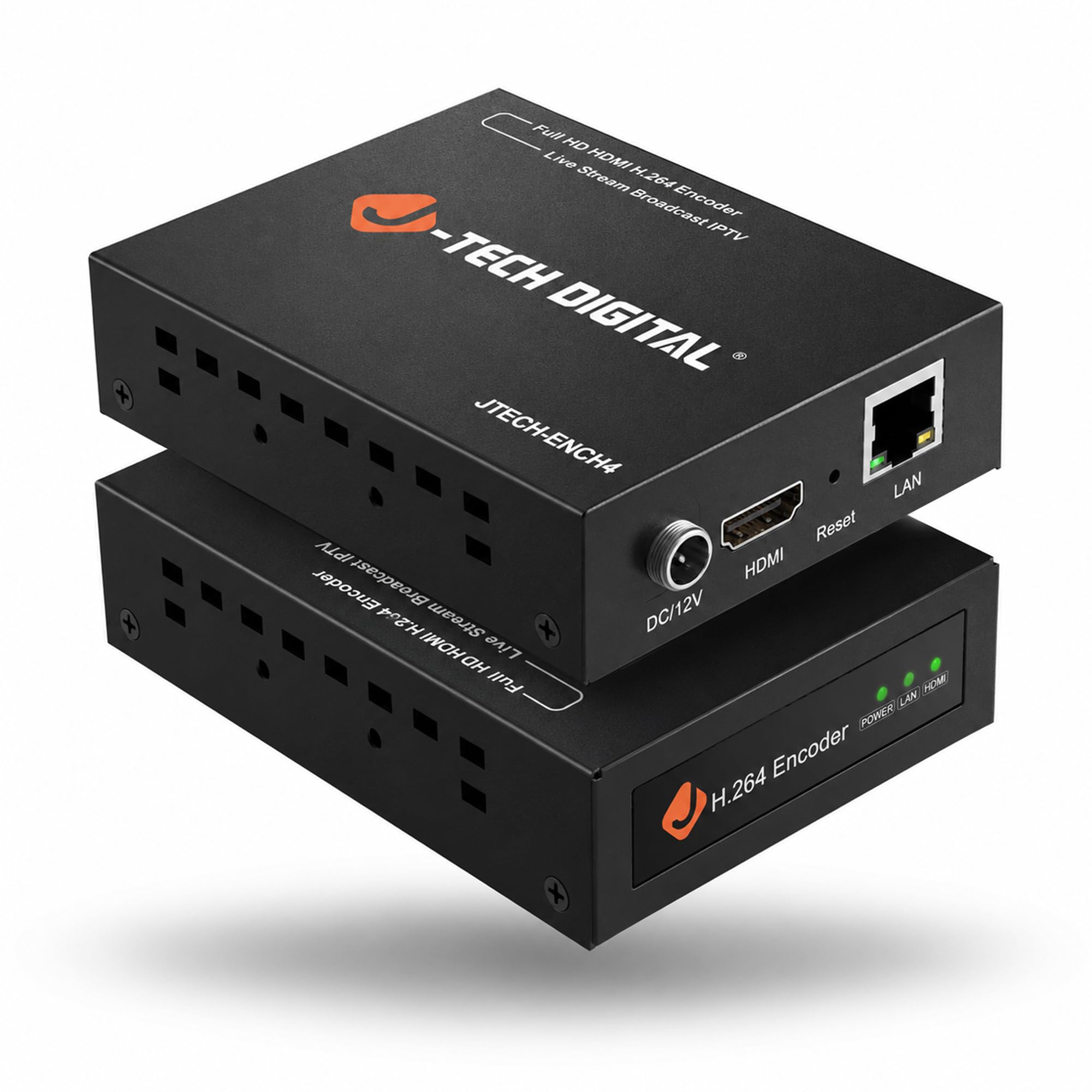
The J-Tech Digital encoder accepts up to 4K@60 HDMI input and outputs a high-quality 1080P60 stream, with the ability to run one main stream and three substreams simultaneously. This makes it particularly useful for security and surveillance setups where you need ONVIF compatibility for your NVR.
Protocol support includes RTSP, RTMP, HLS, UDP, and SRT, and the web interface allows for fine-tuning of video parameters like cropping, rotation, and contrast. The device is widely used to integrate a Raspberry Pi or Fire TV stick into a professional DVR system, and users praise the responsive tech support team based in Texas.
On the downside, a small number of units have experienced power-related failures within the first year, and the static IP address (192.168.1.168) may cause initial connectivity confusion. For ONVIF-centric streaming and security applications, this encoder offers great mid-range performance.
Why it’s great
- ONVIF support for seamless NVR integration
- 4K@60 input with 1080P60 output
- Excellent US-based technical support
Good to know
- Some units report power failure within a year
- Static IP may cause initial network conflicts
6. Magewell USB Capture HDMI Gen 2
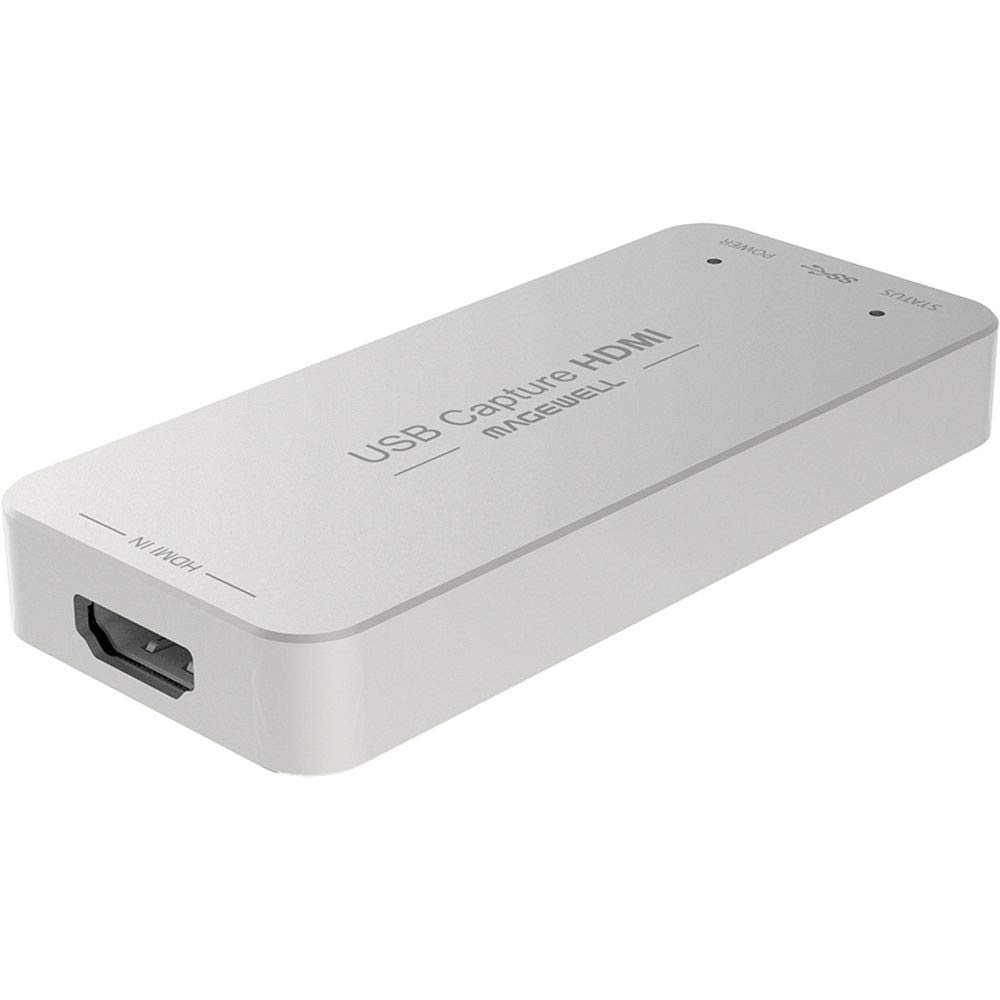
The Magewell USB Capture HDMI Gen 2 is a professional-grade USB capture device that uses FPGA-based video processing for cropping, scaling, de-interlacing, and color conversion without burdening your computer’s CPU. It supports up to 2048×1080@60fps input with true plug-and-play operation on Windows, macOS, and Linux.
The device is built for 24/7 operation with thermal protection and a 3-year limited warranty, making it the go-to choice for mission-critical live production environments. Its UVC compliance means it is recognized instantly by OBS, Zoom, and all major streaming software without any drivers.
At a premium price point, the Magewell justifies its cost with rock-solid reliability and pristine signal handling. The main caveats are the lack of an HDMI pass-through port and the fact that the metal case can get quite warm during extended use. For zero-compromise video capture, this is the benchmark.
Why it’s great
- FPGA handles all video processing off-CPU
- True plug-and-play UVC on all major OSes
- Built for 24/7 operation with 3-year warranty
Good to know
- No HDMI pass-through for local monitoring
- Metal case runs hot during extended use
7. UNISHEEN BM1000H

The UNISHEEN BM1000H is a cost-effective hardware encoder that handles 1080P60 H.265/H.264 encoding, with support for SRT, RTMP, RTSP, and a dozen other protocols. Its browser-based configuration means you can set it up without installing any software, making it accessible even for less technical users.
The palm-sized metal enclosure dissipates heat well and is suitable for 24/7 deployment in digital signage or remote monitoring scenarios. Users have noted that once configured, the device runs stably for weeks with low latency (~0.5s) on RTSP streams, and the video quality is impressively clear for its price point.
The main trade-off is that initial configuration can be challenging for users who are not familiar with networking concepts like subnet masks and DHCP. A few users also wish it had a tripod mount or included a setup tutorial. For an entry-level encoder with professional protocol support, this is a solid value pick.
Why it’s great
- Broad protocol support including SRT and RTMPS
- Browser-based configuration, no software needed
- Compact metal build for 24/7 operation
Good to know
- Initial setup requires networking knowledge
- No 1/4-20 mount included
8. Elgato Cam Link 4K

The Elgato Cam Link 4K is a dedicated HDMI to USB 3.0 capture card designed to turn any DSLR or camcorder into a high-quality webcam for streaming and video calls. It supports up to 4K30 or 1080P60 capture with ultra-low latency, making it a favorite among content creators and remote workers.
Setup is straightforward on Windows, Mac, and iPad with USB-C, and it is instantly recognized by OBS, Zoom, Discord, and Teams. Users pairing it with Sony ZV-E10 and Nikon D750 cameras report flawless 1080P60 video with accurate colors and no sync issues.
The main drawbacks are the fragile USB connector, which some users have reported bending over time, and the lack of included cables beyond the USB 3.0 extension. It also requires a dedicated USB port and cannot be used through a hub. For a simple, reliable camera-to-webcam solution, the Cam Link 4K remains a benchmark.
Why it’s great
- Plug-and-play UVC with instant software recognition
- Supports 1080P60 and 4K30 for flexible streaming
- Ultra-low latency for live video calls
Good to know
- USB connector is fragile and prone to bending
- Does not include an HDMI cable or adapters
9. Basicolor KVM Extender

The Basicolor KVM Extender is an HDMI and USB extender that transmits 1080P60 video over a single Cat5e/6 cable up to 262 feet, while also extending USB 2.0 signals for keyboard, mouse, and storage devices. It uses Power over Cable, so only one end needs to be plugged into an outlet.
This device is best suited for extending a computer to a remote workstation or projector setup where a direct HDMI cable run isn’t feasible. It supports near-lossless video transmission with no noticeable latency, making it suitable for interactive KVM scenarios like controlling a PC from another room.
However, reliability can be inconsistent; some users report failures within a year, and the unit’s USB ports may struggle with power-hungry devices. The image quality is solid for general use, but small text may show slight artifacts. For budget-conscious long-distance HDMI extension, this is a functional entry-level option.
Why it’s great
- Transmits 1080P60 plus USB up to 262 feet
- Power over Cable reduces power supply clutter
- Near-lossless video with no perceivable latency
Good to know
- Some units fail within a year of use
- USB ports may not support power-hungry peripherals
FAQ
Can a 1080P HDMI encoder card be used for live streaming without a computer?
What is the difference between an HDMI encoder and a USB capture card?
Does a 1080P encoder support 4K input?
Final Thoughts: The Verdict
For most users, the 1080p hdmi encoder card hot swappable winner is the ZowieBox because it combines certified NDI HX3, 4K pass-through, and PoE support in a compact form factor perfect for professional broadcast environments. If you want multi-platform streaming with simultaneous protocol output, grab the URayCoder UHE265-1S-4K. And for an entry-level hardware encoder that doesn’t compromise on protocol support, nothing beats the UNISHEEN BM1000H.