
Our readers keep the lights on and my morning glass full of iced black tea. As an Amazon Associate, I earn from qualifying purchases.
Specs are compiled from manufacturer listings and verified buyer reviews and can change over time — please confirm the key details on the product page before buying.
Your boat’s batteries are the reason the motor turns over and the trolling motor keeps pulling. The right charger keeps batteries topped off at the dock, so you never face a dead start battery on a morning run. This guide ranks the 12V marine battery chargers owners trust most, based on real-world performance and key on-water features.
I’m Min — the founder and writer behind Gadgets Feed. This guide is built by comparing the manufacturers’ published specifications and the patterns across verified customer reviews, so you get each pick’s real strengths and trade-offs instead of marketing spin.
We evaluated multi-bank setups, waterproof ratings, and smart charging modes to find the best 12V marine charger for keeping every battery aboard ready.
Our Picks at a Glance
How To Choose The Best 12V Marine Battery Charger
You need to match your charger to how many batteries you have and what type they are. A single-bank charger tops up one battery; a multi-bank charger feeds several at once, with each bank working independently so a trolling motor battery never drains your start battery.
Banks and Amperage: Match Them to Your Setup
Count your batteries first. A bass boat with a start battery plus a trolling motor battery needs a 2-bank charger, and a boat running multiple deep-cycle batteries wants 3 banks. Amperage sets how fast each bank refills — 5 amps per bank handles overnight maintenance, while 10 amps per bank recovers a drained battery noticeably quicker, especially after a long day of fishing.
Waterproofing and Safety Ratings
An onboard charger lives in a damp bilge or under a deck, so the IP rating is your first defense. IP67 means the unit is sealed against dust and can survive brief immersion, while IP68 goes further, handling continuous submersion — a real comfort if water sloshes into your compartment. Beyond that, look for protections like reverse polarity, over-current, and over-temperature cutoffs so a wiring mistake never turns into a fire risk.
Smart Modes for Battery Chemistry
Modern chargers adjust their output based on the battery type you select. Lead-acid, AGM, calcium, and lithium (LiFePO4) batteries all charge to different voltages, so a charger with selectable modes keeps each chemistry safe. A thermal sensor adds another layer, detecting ambient temperature and altering the charge to avoid overcharging in hot climates and undercharging in cold ones.
Quick Comparison
| Model | Best For | Banks | Amperage | Waterproof Rating | Amazon |
|---|---|---|---|---|---|
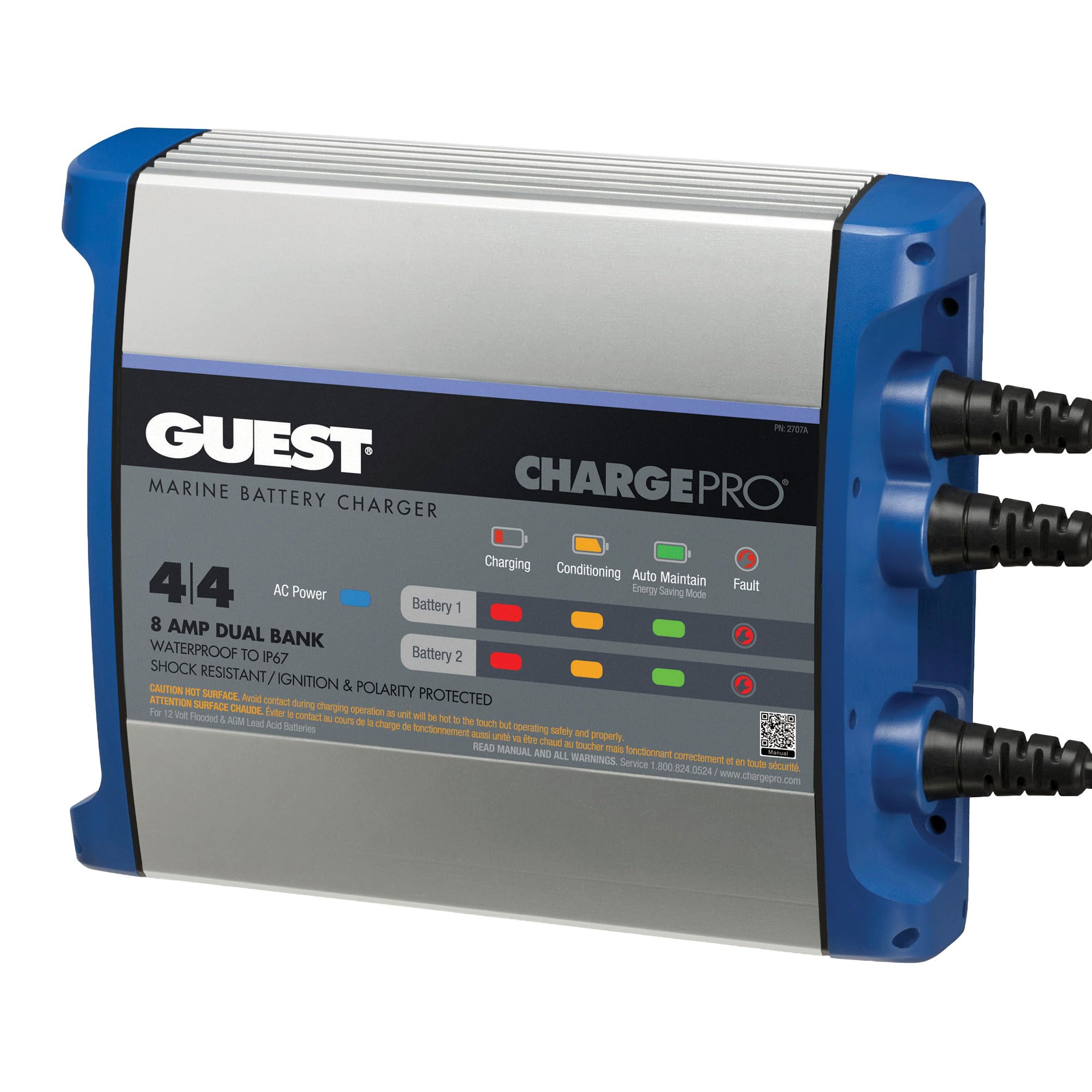
| Guest 2707A 8A 2-Bank★ Best Overall | Independent dual-bank charging | 2 | 8 A | IP67 | Amazon |
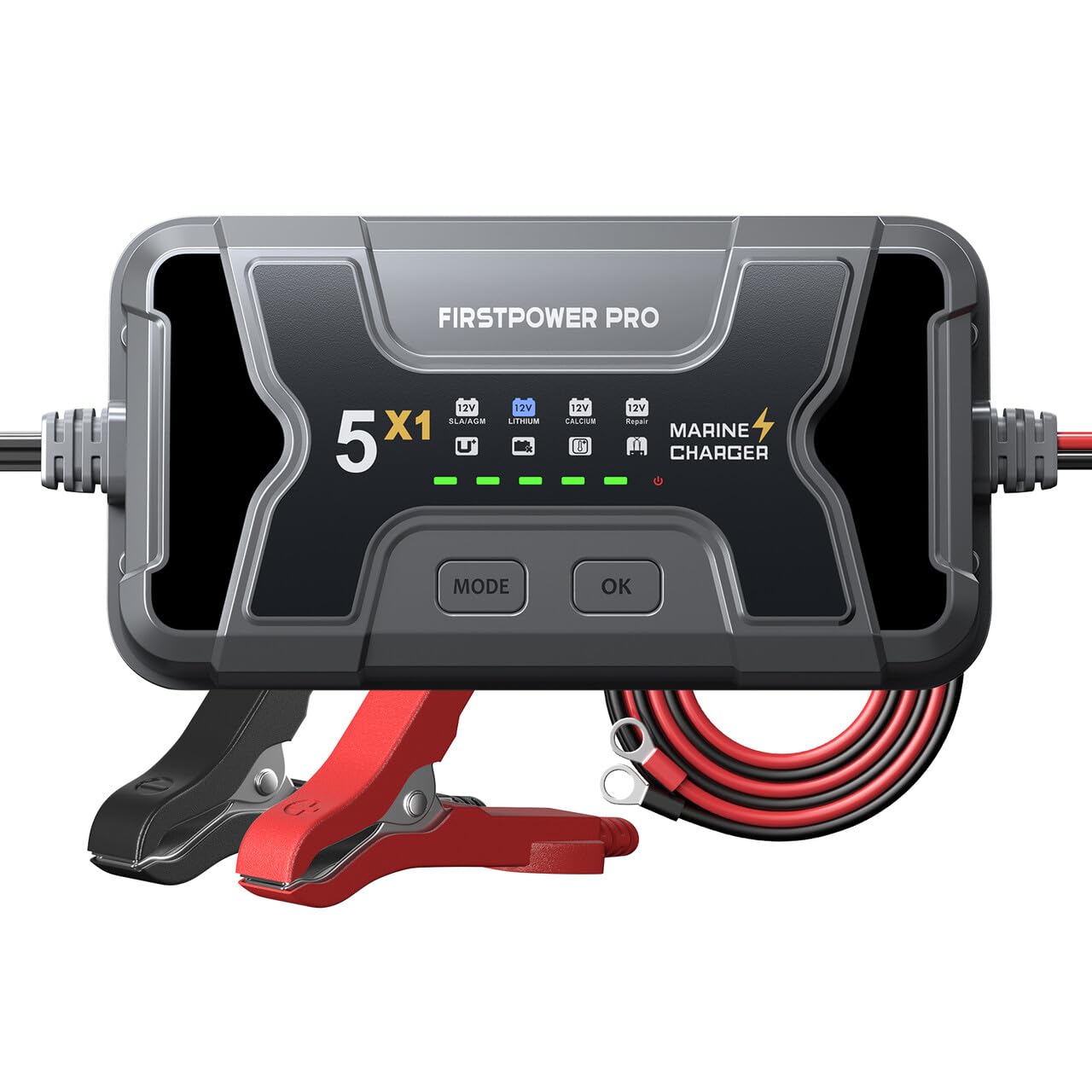
| FirstPower Pro 5X1 5ABest Value | Single-bank budget flexibility | 1 | 5 A | IP68 | Amazon |
| FirstPower Pro 5X3 15A | Three independent charging banks | 3 | 5 A / bank | IP68 | Amazon |
| NOCO GEN5X2 10A 2-Bank | Compact waterproof dual-bank power | 2 | 10 A (5 A / bank) | IP68 | Amazon |
| SOARFLY 30A 3-Bank | High-amp three-battery setups | 3 | 30 A (10 A / bank) | IP68 | Amazon |
| LiTime 2-Bank 10A | Lithium-first dual-bank charging | 2 | 10 A / bank | IP65 | Amazon |
In-Depth Reviews
1. Guest 2707A On-Board Battery Charger 8A / 12V, 2 Bank
Our pick — over 4.5★ from 800+ verified ratings; the strongest balance of quality and price.
A dual-bank charger with independent outputs and an IP67 seal for damp bilge mounting.
This Guest charger runs a dual-bank system that charges two batteries independently, so your start battery and trolling motor battery each get their own attention without one draining the other. At 8 A total, it tops up a pair of 12V flooded or AGM lead-acid batteries and holds them ready. Its IP67 rating means the housing is sealed against dust and protected from brief immersion — you can mount it in a damp compartment and not stress about spray.
What wins owners over is the quality — it’s the most-praised trait by a wide margin, followed closely by how easy it is to install. Buyers report it replaced older brands like a Schumacher and a NOCO and now keeps both boat batteries charged “no problem,” with both showing a higher voltage after charging. The LED indicator lights make reading charge status simple at a glance. Safety is covered with reverse polarity, over-current, over-voltage, and over-temperature protection plus ignition protection and in-line fuse protection, so a wiring slip won’t escalate.
The one trade-off to know: if your boat is bigger than 20 feet, the included cables likely won’t reach — plan on ordering extensions. At 4.5 pounds and with a shock-resistant housing, it feels built for the long haul, but measure your run before you mount it.
Why owners pick it
- Independent 2-bank charging for start and trolling batteries
- IP67 sealed housing shrugs off marine moisture
- Five layers of protection plus in-line fuse
- Plug-and-forget operation praised across reviews
Before you mount it
- On boats over 20 feet, cable extensions are usually required
- Battery life feedback is mixed — a rare unit stops holding a charge after about a month
Reach for this if: you want a dependable 2-bank charger with independent output, rock-solid protection, and easy installation on a boat under 20 feet.
Look elsewhere if: you need more than two banks or your wiring run stretches well past 20 feet.
2. FirstPower Pro 5X1 1-Bank 5A Onboard Battery Charger
A budget single-bank smart charger with three chemistry modes and full IP68 sealing.
This FirstPower Pro is the budget-friendly entry point that still acts smart. It runs a single 5 A bank but supports three charging modes — 12V SLA/AGM (lead-acid), 12V lithium (LiFePO4), and 12V calcium — so you press the MODE button to match your battery chemistry. It’s fully sealed to IP68, meaning dust-tight and protected against continuous immersion, so it’s safe to charge 24/7 onboard without worrying about bilge moisture.
Performance is what owners praise most, with reliability close behind. Owners mention it works great on a boat, is easy to install, and automatically detects lithium batteries — one owner installed it with three LiFePO4 batteries and it recognized them right away. The unit remembers your mode selection, so it defaults to the same chemistry next time you plug in. A built-in thermal sensor detects ambient temperature and alters the charge, preventing over-charging in hot climates and under-charging in cold ones. It also includes an auto repair mode and advanced diagnostics for over-voltage, bad battery, over-temperature, and reverse connection.
The trade-off is durability feedback that’s mixed — an occasional owner reports the quick connectors corroding. The 5 A output is a “respectable” charge rate rather than a fast one, as one buyer put it after realizing they’d ordered the 5 A version, not a 10 A. A 3-year warranty backs the unit, which softens that durability question.
Smart single-bank pick: If you run one main battery and want three chemistries covered with a true IP68 seal, this is the value play — just keep the connections clean and dry.
3. FirstPower Pro 5X3 3-Bank 15A (5A/Bank) 12V Boat Charger
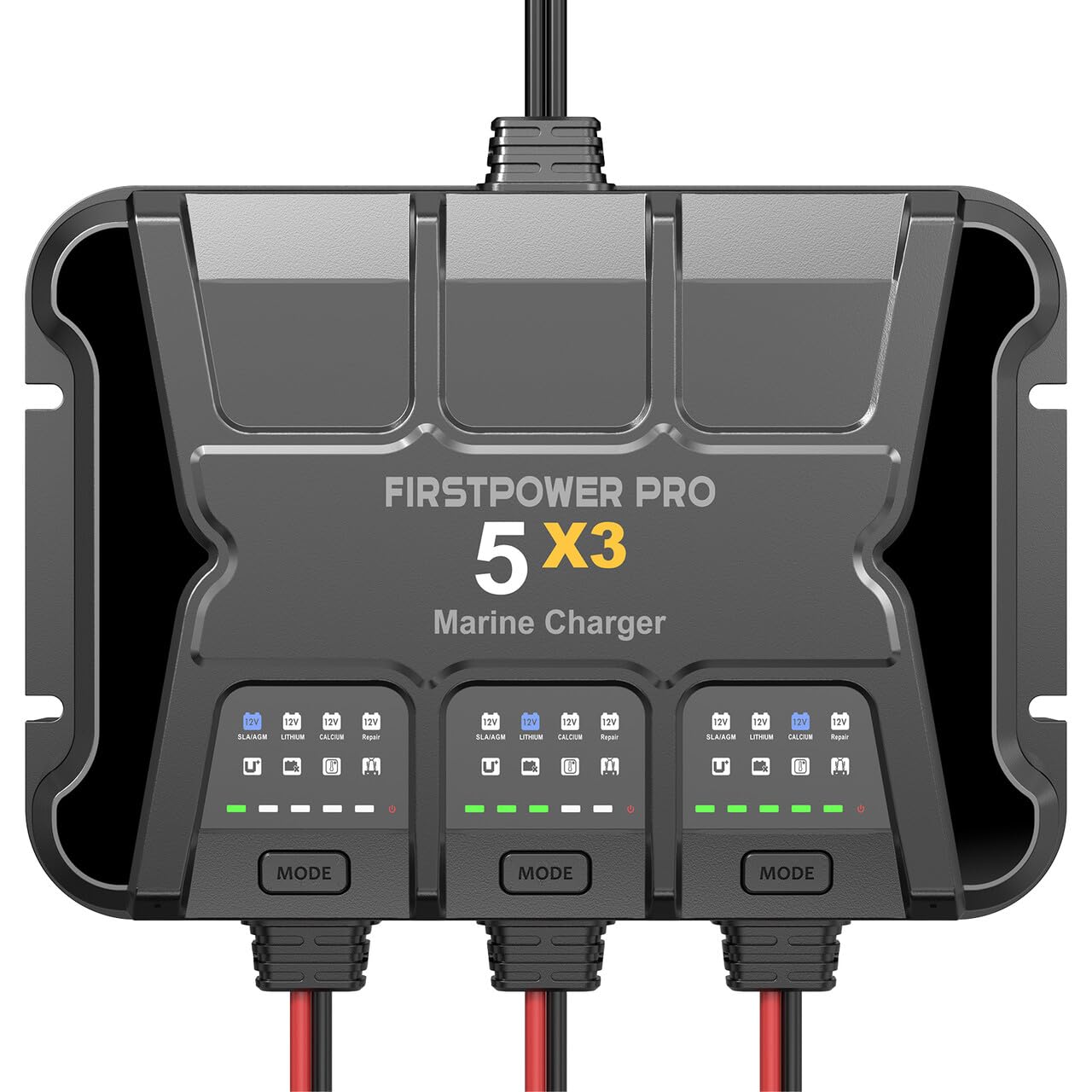
Three independent 5 A banks in one IP68-sealed case, each supporting a different battery chemistry.
This 3-bank FirstPower Pro charger delivers 15 A total (5 A per bank) across three separate channels, so you can charge three batteries at once. Each bank picks its own mode — 12V SLA/AGM (lead-acid), 12V lithium (LiFePO4), or 12V calcium — meaning a boat with a lead-acid start battery and two lithium trolling batteries charges all three correctly at the same time. The IP68 fully-sealed housing (dust-tight and waterproof) is designed to sit onboard and charge 24/7, even in a wet compartment.
Owners who installed it under pressure were pleasantly surprised. One buyer’s old onboard charger died days before a fishing trip to Canada, and this unit mounted vertically into the old spot, felt well made, and got the job done. Another runs it happily with two lithium batteries and a calcium starting battery, calling the performance perfect. It also includes auto repair mode and advanced diagnostics for over-voltage, bad battery, over-temperature, and reverse connection, plus an integrated thermal sensor that adjusts charging for hot and cold climates.
The honest catch is the fresh review count — it’s a newer model with far fewer owners behind it than the Guest or NOCO, so long-term track record is still building. At 1.97 inches deep, it’s a shallower footprint than the Guest’s 2.4-inch depth, which helps when space behind the mounting area is tight. A 3-year warranty and a 5-grid power display showing 20% to 100% help round out the value.
Ideal for: the multi-chemistry boat that needs three independent banks and a shallow, sealed package.
Think twice if: you want a charger with years of owner history behind it — this one’s track record is still young.
4. NOCO GEN5X2 12V 10A 2-Bank OnBoard Marine Battery Charger & Maintainer

A compact dual-bank charger that revives dead batteries and mounts in any orientation.
NOCO’s GEN5X2 is a two-bank onboard charger rated at 10 A total — 5 A per bank — that independently charges 12V batteries in marine, boat, starter, and deep-cycle systems. It’s engineered to be 37% smaller than its predecessor, and that compact size plus an anti-vibration backing lets it mount securely in any orientation, even upside down, on a bracket or bulkhead. The IP68 fully-sealed rating means it survives brutal conditions, including extended underwater testing.
What makes it a true top performer is its ability to charge dead batteries. It can start charging from as low as 1 volt, and a Force Mode manually begins charging batteries down to zero volts to recover deeply discharged or neglected batteries. Selectable modes for each bank — 12V, 12V AGM, 12V Lithium, and 12V Repair Mode — mean it handles lead-acid and lithium-ion chemistries with precision, and the integrated thermal sensor adjusts charging based on ambient temperature. Owners consistently call out its quality and ease of use, noting it doesn’t overcharge, can be left connected while the boat operates, and shows charge status per battery.
The reliability feedback is genuinely mixed, though — some units work flawlessly while occasional reports mention one stopping after second use. That said, the 3-year warranty and NOCO’s customer service have a strong reputation for quick replacements when issues do arise. At 4.2 pounds with 72-inch DC cables and 3/8-inch eyelets, it’s a clean, easy install with the cable reach to handle most layouts.
What earns its keep
- Force Mode revives batteries down to zero volts
- Mounts in any orientation, even upside down
- IP68 sealed for continuous submersion
- Per-bank selectable chemistry modes
The honest caveat
- Reliability is mixed — most units are flawless, some fail early
- Durability gets occasional negative feedback from owners
Go with this if: you want a compact, fully-sealed dual-bank charger that can wake up dead batteries and mounts anywhere.
Weigh it if: you’re wary of reliability reports — the warranty covers you, but a flawless track record matters more to some buyers.
5. SOARFLY 3 Bank Marine Battery Charger, 12V 30A (10A/Bank) Smart Waterproof Onboard
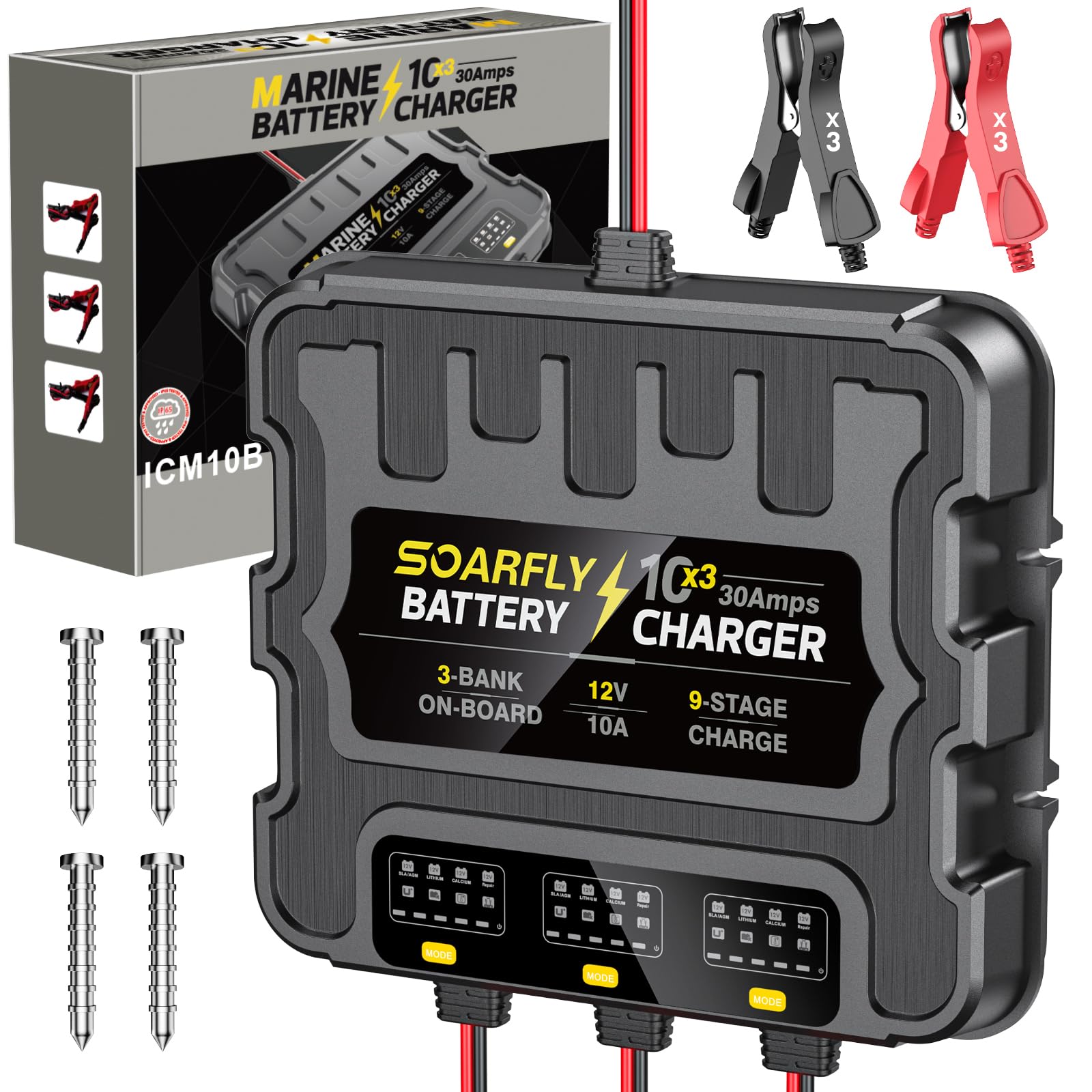
A 30 A three-bank charger that refills drained batteries fast and also works as a car charger.
This SOARFLY charger brings serious amperage to a three-bank setup — 30 A total, with 10 A per bank for 12V lead-acid and lithium-ion batteries. That’s the fastest per-bank output in this lineup, which means a deeply drained trolling motor battery recovers in a fraction of the time a 5 A bank would need. It’s built for boat, starter, and deep-cycle batteries, and the maker notes it can also be used as a car charger, so it pulls double duty in the garage.
Owners describe it as well-built and heavy-duty, with fast charging and a visible per-bank charge level. One buyer used it as a direct replacement for a failed charger, fitting it into the old space, while another praised its staying power after 15 charge cycles. It runs three intelligent modes — 12V SLA/AGM, 12V Li-ion, and 12V Calcium — with each bank controlled independently, and a Force Mode charges dead batteries when voltage drops below 1V. The IP68 rating means it passed extended underwater testing, which gives real confidence for a wet bilge install.
The recurring issue is the clamps — mixed feedback, with one owner noting the banks shipped with alligator clips instead of ring terminals, which complicated a permanent install. Another mentioned a possible backfeed where the lead-acid bank stays lit after power is removed. The 15.15-inch depth is the largest footprint here, so measure your mounting space carefully before committing.
Brute-force charging: If you need three batteries refilled fast and have the space for a larger unit, this delivers big amperage — just plan for the clamp setup and the size.
6. LiTime 2 Bank 12V 10A LiFePO4 Battery Charger, Waterproof, 14.6V Output
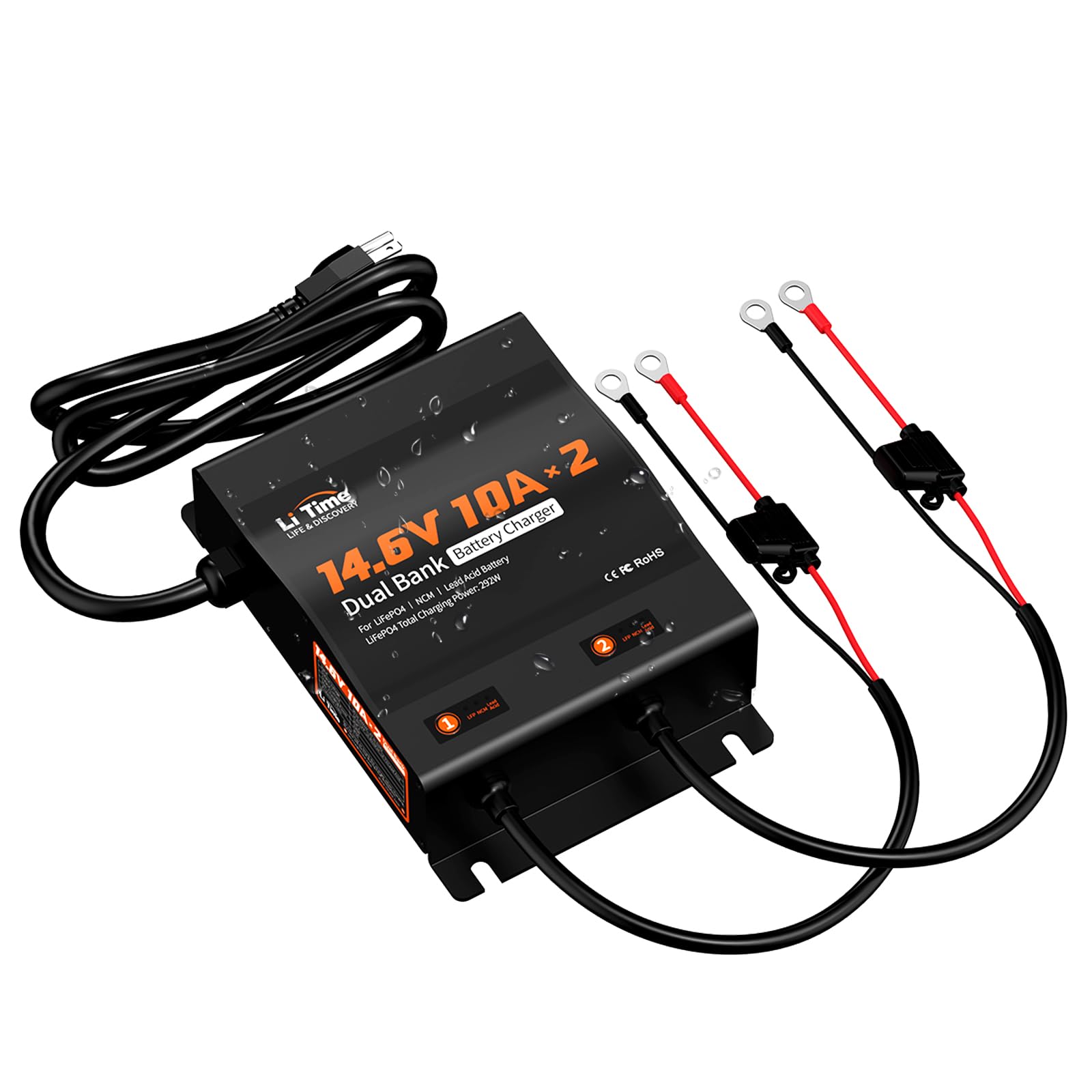
The lithium-tuned dual-bank charger pushing a full 14.6V per bank for modern batteries.
This LiTime charger is built for the lithium-first boat owner. It delivers 10 A per bank across two banks with a 14.6V output — the charging voltage LiFePO4 batteries need to reach a true full state. That makes it a natural fit for RVs, boats, and trolling motors running lithium iron phosphate batteries, though it’s also compatible with standard lithium and lead-acid batteries. The wall cord comes with 15A fuses for higher safety and faster charging efficiency.
Owners find it a great multi-purpose device that’s easy to set up, and the functionality plus charging performance are the traits they mention most. One reviewer noted charging two 12V 300Ah lithium iron phosphate batteries overnight, which is exactly the kind of heavy lifting this 10 A-per-bank output handles. The M8 terminal connection upgrades the link between charger and battery for a more secure hookup, and simultaneous charging of two batteries at once is standard. It carries CE, FCC, and RoHS certifications, plus a 2-year quality warranty.
The real-world warning is heat — a couple of owners noted the charger runs very hot, with one mounting it permanently in an enclosed trailer for ongoing use. The battery chemistry selection requires holding a button and isn’t saved between sessions, a small annoyance if you switch between lithium and lead-acid. At 6.6 pounds and rated IP65, it’s sealed against water jets but not continuous immersion like the IP68 units above, so keep it out of standing water.
Best for: lithium-first setups where a 14.6V charge voltage and 10 A per bank matter more than total immersion protection.
skip it if: you need IP68 submersion tolerance or want a chemistry setting that sticks between uses.
Understanding the Specs
IP Ratings: What They Actually Mean
IP stands for Ingress Protection, and the two digits tell you exactly how sealed a charger is. The first digit covers solids, and the second covers water. IP67 means the unit is fully dust-tight and can survive brief immersion in water. IP68 goes a step further, handling continuous submersion — which is why it’s the rating you want for a charger living in a bilge or low compartment that could flood. IP65, by contrast, handles water jets but not immersion, so it suits drier, protected spots.
Banks vs. Total Amperage
A bank is a single independent charging output, and total amperage is split across the banks you have. A 2-bank charger rated at 10 A delivers 5 A per bank, while a 3-bank charger at 30 A delivers 10 A per bank. More banks let you charge more batteries at once, and higher per-bank amperage means faster refills. For overnight maintenance, 5 A per bank is plenty. For recovering a deeply drained battery quickly, you want closer to 10 A per bank.
FAQ
What is the difference between a 2-bank and 3-bank marine battery charger?
Can a 12V marine charger charge lithium LiFePO4 batteries?
How long does it take to charge a boat battery with a 5A charger?
Is IP68 waterproofing necessary for an onboard charger?
Can I leave a marine battery charger connected 24/7?
What does Force Mode do on a marine battery charger?
How does thermal sensor charging protect my batteries?
Can a 12V marine battery charger also charge a car battery?
What is the difference between a battery charger and a battery maintainer?
How do I choose the right amperage for my boat batteries?
Final Thoughts: The Verdict
For most owners, the 12v marine battery charger worth installing first is the Guest 2707A, because its independent 2-bank charging, IP67 seal, and five layers of protection make it the most trustworthy all-rounder. If you run three batteries with different chemistries, the FirstPower Pro 5X3 gives you three independent IP68-sealed banks at 5 A each. And when you need serious refill speed with force-recovery for dead batteries, the NOCO GEN5X2 is the compact top performer to reach for since it mounts anywhere and shrugs off immersion.
How We Picked
We do not accept paid placement. Every pick is matched to a real buyer and a real use-case; we do not hands-on test units.
Sources & Methodology
Specifications: manufacturer listings and product documentation. Review insights: verified customer reviews, as of August 2026. Pricing: not shown on this page (it changes often); check the current price via the retailer link.
As an Amazon Associate, Gadgets Feed earns from qualifying purchases. This does not affect which products we feature.