
A first telescope often delivers disappointment: a shaky blur where Jupiter should be sharp, or a faint gray dot when you expected a crisp ring. The difference between a toy and a real instrument comes down to three numbers — aperture, focal length, and mount stability — and most budget listings actively obscure what you actually need. This guide cuts through the marketing to find the telescopes that genuinely reward a beginner’s investment.
I’m Min — the co-founder and writer behind Gadgets Feed. For this guide, I’ve analyzed the optical specifications, mount designs, and real-world user reports across nine models to isolate the gear that turns first-time stargazers into lifelong observers.
After hours of comparing glass coatings, tripod rigidity, and magnification math, these picks represent the clearest path to a satisfying first look at the cosmos with a budget telescope for viewing planets and galaxies.
How To Choose The Best Budget Telescope For Viewing Planets And Galaxies
Picking your first telescope is a battle between the exciting numbers printed on the box and the actual experience at the eyepiece. The biggest trap is thinking higher magnification means better views. In reality, aperture — the diameter of the main lens or mirror — is the single most important spec because it dictates how much light your eye gets to work with. More light means brighter, sharper images of Jupiter’s bands, Saturn’s rings, and the fuzzy glow of the Andromeda Galaxy. A 90mm aperture at 100x will show you more than a 50mm aperture at 300x, because the 300x image will be too dim and blurry to resolve anything.
Aperture and Light-Gathering
A common beginner mistake is obsessing over the maximum magnification listed on the product page. A 450x claim sounds impressive, but atmospheric turbulence and the telescope’s optical limits make anything beyond about 200x unusable on most nights. What matters is the aperture: a 90mm objective lens collects about 60% more light than a 70mm lens, meaning you see fainter stars and more detail on planetary surfaces. For planetary observing, 80mm is the bare minimum for a satisfying view of Jupiter’s cloud bands; 90mm or 102mm is noticeably better.
Mount Type and Stability
A telescope is only as good as its mount. A wobbly tripod at high magnification turns every breath and footstep into a jittery mess. Alt-azimuth mounts are intuitive — up, down, left, right — and are the standard for budget telescopes. They are simple for beginners. Equatorial mounts (EQ) are aligned with Earth’s axis and allow you to track celestial objects with a single slow-motion control knob, which is helpful for planets. However, entry-level EQ mounts are often poorly constructed, so a solid alt-az mount is usually the better choice under .
Optical Coatings and Glass Quality
Look for “fully multi-coated” optics. This means every air-to-glass surface has multiple layers of anti-reflective coating, which increases light transmission and reduces internal flare. Uncoated or “fully coated” (one layer per surface) lenses lose a significant percentage of light, making images appear dimmer and washed out. Multi-coating is especially important for seeing subtle details like the Cassini Division in Saturn’s rings or the faint blue-green disk of Uranus.
Quick Comparison
On smaller screens, swipe sideways to see the full table.
| Model | Category | Best For | Key Spec | Amazon |
|---|---|---|---|---|
| SVBONY SV48P | OTA Only | Wide-field & astrophotography | 102mm Aperture / f/6.5 | Amazon |
| Koolpte 130EQ | Reflector | Deep-sky & lunar detail | 130mm Aperture / f/5 | Amazon |
| MEEZAA 90mm | Refractor | Planetary viewing | 90mm Aperture / 800mm FL | Amazon |
| HUGERSTAR 90mm | Refractor | Lunar & planetary views | 90mm Aperture / 800mm FL | Amazon |
| Dianfan 90mm | Refractor | Versatile starter kit | 90mm Aperture / 800mm FL | Amazon |
| HETEKAN 90mm | Refractor | High magnification range | 90mm Aperture / 900mm FL | Amazon |
| Hawkko 90mm | Refractor | Solid all-around beginner | 90mm Aperture / 900mm FL | Amazon |
| Dianfan 80mm | Refractor | Kids & families | 80mm Aperture / 500mm FL | Amazon |
| HUGERSTAR 80mm | Refractor | Portable travel scope | 80mm Aperture / 500mm FL | Amazon |
In‑Depth Reviews
1. MEEZAA 90mm Aperture 800mm Refractor

The MEEZAA 90mm delivers the clearest step up from entry-level 80mm scopes without breaking the budget. Its 90mm fully multi-coated objective gathers significantly more light than smaller alternatives, producing brighter views of Jupiter’s cloud belts and the Cassini Division in Saturn’s rings. The 800mm focal length (f/8.88) naturally reduces chromatic aberration — the purple fringing that plagues cheaper refractors — giving you sharper planetary edges.
The included stainless steel tripod is a standout feature at this price point. It minimizes vibrations, so you can actually use the 240x maximum magnification on stable nights to resolve lunar craters and double stars. The phone adapter works reliably for capturing the moon and bright planets, which is a bonus for sharing your first views. Assembly takes about ten minutes, and the metal OTA (optical tube assembly) feels more durable than the plastic alternatives.
Users consistently report seeing the four Galilean moons of Jupiter and a clear glimpse of Saturn’s rings on the first night of use. At 90mm and 800mm, the MEEZAA strikes the ideal balance between light-gathering power, manageable magnification, and setup simplicity for a beginner who wants real planetary detail without the complexity of an equatorial mount.
Why it’s great
- Stainless steel tripod provides excellent stability at high magnifications
- 90mm aperture reveals Jupiter’s bands and Saturn’s rings
- Fully multi-coated optics reduce glare and boost contrast
Good to know
- Basic finder scope needs careful alignment for accurate aiming
- Maximum usable power is lower than the 240x claim on most nights
2. SVBONY SV48P 102mm f/6.5 Refractor OTA

The SVBONY SV48P is a 102mm achromatic refractor that punches far above its price class. With a fast f/6.5 focal ratio, it collects light quickly enough for wide-field deep-sky sweeps — think the Andromeda Galaxy as a bright, extended smudge — yet retains enough resolution for solid planetary views. The dual-speed 2.5-inch focuser is a luxury normally reserved for scopes costing twice as much, letting you fine-tune focus with precision for high-magnification planetary work.
At just 7 pounds, the OTA is a true grab-and-go instrument. The fully multi-coated AR lenses deliver crisp, high-contrast images with controlled chromatic aberration. Users have reported splitting tight double stars and seeing Mars’ polar cap at 250x, which is remarkable for a 102mm achromat. The tube rings and dovetail plate allow easy mounting on any sturdy tripod or EQ mount you already own.
This is sold as an OTA (optical tube assembly) only — you need to supply your own tripod, mount, diagonal, and eyepieces. That makes it better suited for someone who already has basic gear or wants a foundation they can upgrade around. For the beginner willing to buy a separate mount, the SV48P offers the best optical performance per dollar in this guide and a clear path toward astrophotography later.
Why it’s great
- Dual-speed focuser enables precise fine-tuning for planetary detail
- 102mm aperture outperforms 90mm scopes on faint deep-sky objects
- Wide f/6.5 field is excellent for scanning star fields
Good to know
- Sold without tripod, mount, or eyepieces — budget for extras
- Chromatic aberration visible on very bright objects like Venus
3. Koolpte 130EQ Reflector Telescope

The Koolpte 130EQ brings the largest aperture in this guide — a 130mm parabolic mirror — to the table. That massive light bucket collects enough photons to transform the Andromeda Galaxy from a faint smudge into a clearly defined oval with a brighter core. On the moon, the resolution reveals tiny craterlets inside larger craters. Jupiter’s cloud bands appear with noticeable texture, and the four Galilean moons show as distinct disks rather than points of light.
The German equatorial mount is a double-edged sword. Once accurately polar-aligned, the slow-motion control cables allow smooth manual tracking of planets as they drift across the sky — a big advantage over alt-az mounts for planetary observing. However, the assembly is more complex than a refractor on a simple tripod. Beginners should expect a steeper learning curve, particularly when balancing the tube and aligning the finder scope.
The included wireless remote and phone adapter make it easier to capture what you see, though the best views are through the eyepiece. The 2x Barlow lens doubles the 25mm (26x) and 6.5mm (100x) eyepieces to 52x and 200x respectively. The moon filter reduces glare during full-moon observing. This is the pick if you want the most aperture for your money and are willing to invest time in setup for superior deep-sky views.
Why it’s great
- 130mm aperture outperforms every other model on deep-sky objects
- EQ mount allows smooth manual tracking for extended planetary viewing
- Wireless remote and phone adapter simplify astrophotography attempts
Good to know
- Assembly and polar alignment require patience and study
- Newtonian reflector needs periodic collimation to maintain sharpness
4. HUGERSTAR 90mm Aperture 800mm Refractor

The HUGERSTAR 90mm closely mirrors the MEEZAA’s optical formula — a 90mm f/8.89 fully multi-coated refractor — but adds a dedicated moon filter that reduces glare and reveals finer lunar surface detail. This is a thoughtful inclusion for a telescope primarily aimed at planetary and lunar observation, as the full moon’s brightness can otherwise wash out subtle crater floor textures.
The stainless steel tripod adjusts from 28.7 to 46.4 inches and sports an accessory tray that keeps eyepieces within easy reach, reducing fumbling in the dark. Users note that the phone adapter works well for capturing the moon and bright planets, though some found the adapter’s fit with shorter eyepiece barrels to be finicky. The finder scope is a basic straight-through type, which is adequate but may require neck-craning for overhead objects.
Several user reviews specifically mention seeing Jupiter’s cloud bands and Saturn’s rings on the first night of use, with the moon filter enhancing contrast on craters like Tycho and Copernicus. The included padded carry bag is a practical addition for anyone who plans to travel to darker skies. At this price, the HUGERSTAR 90mm delivers a complete, ready-to-go kit that pairs strong optical performance with genuinely useful extras.
Why it’s great
- Moon filter significantly improves lunar observation comfort and detail
- Stable stainless steel tripod with accessory tray for convenience
- Complete kit with bag, phone adapter, and multiple eyepieces
Good to know
- Phone adapter can be finicky with shorter eyepiece barrels
- Basic finder scope requires careful alignment for accurate aiming
5. Dianfan 90mm Aperture 800mm Refractor

The Dianfan 90mm refractor competes directly with the MEEZAA and HUGERSTAR alternatives, sharing the same 800mm focal length and fully multi-coated optics. Where it differentiates itself is in the completeness of the accessory bundle — it includes a zenith mirror for upright terrestrial viewing, making it a dual-purpose scope that works for birdwatching or landscape observation alongside astronomy. This versatility matters if you want a single instrument that serves daytime and nighttime use.
The stainless steel tripod provides stable support, and the 15-minute assembly time is consistent with other models in this tier. Users have reported clear views of Saturn’s rings and the Andromeda Galaxy. The phone adapter allows for casual lunar photography, and the included carrying bag protects the tube during transport to darker observation sites.
One practical note: the finder scope, like many in this class, is a straight-through design that can be awkward to use when the telescope is pointed near the zenith. Some users found the tripod leg adjustment knobs to be slightly stiff, but once set, the rig holds position without drifting. For a beginner wanting a single package that covers both astronomy and terrestrial observation, the Dianfan 90mm offers a well-rounded solution.
Why it’s great
- 45° diagonal provides upright images for daytime terrestrial use
- Strong 90mm aperture performance for the price point
- Complete kit with bag and phone adapter for travel
Good to know
- Straight-through finder scope is awkward for overhead objects
- Tripod adjustment knobs can be stiff on first use
6. HETEKAN 90mm Aperture 900mm Refractor
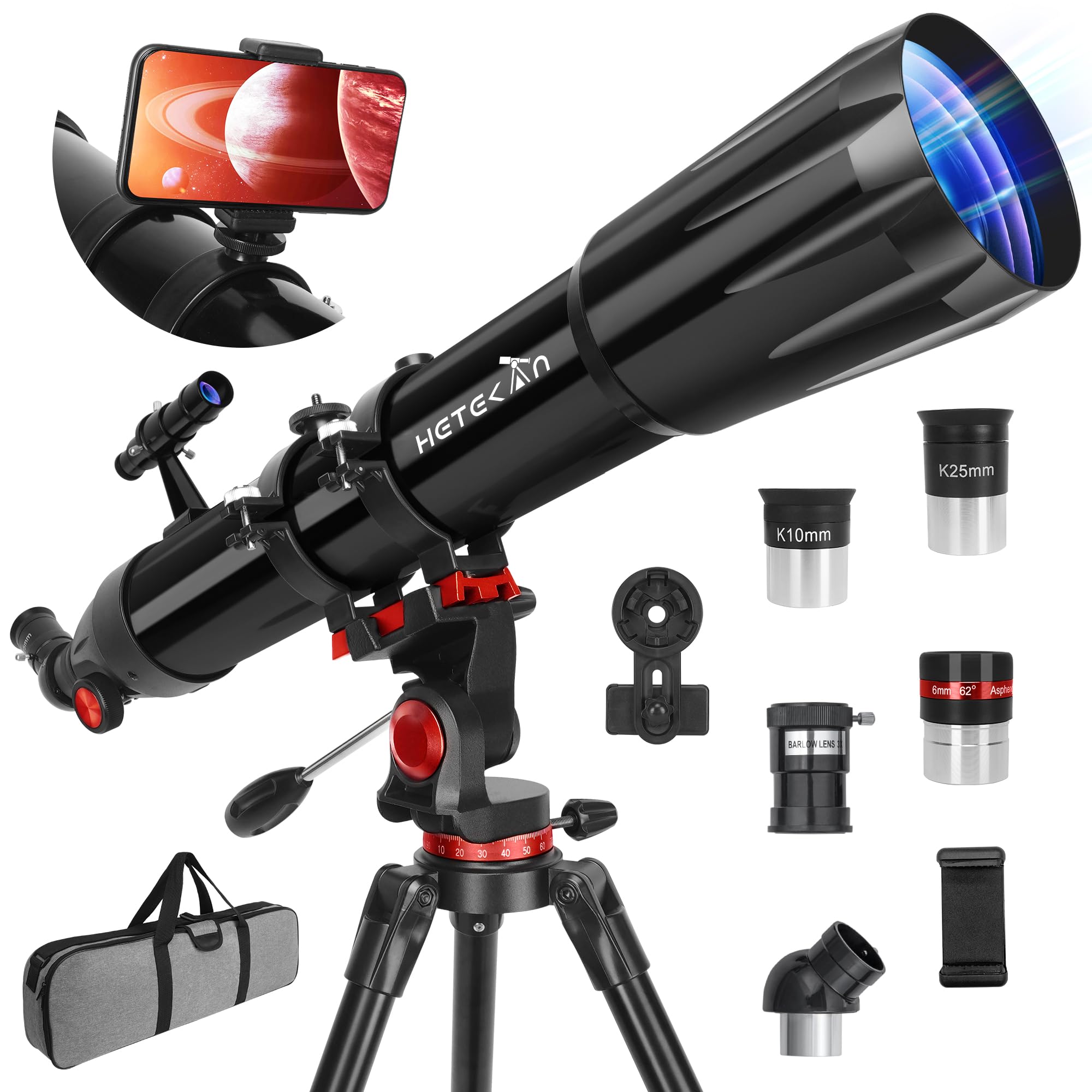
The HETEKAN 90mm steps up to a 900mm focal length (f/10), which gives it a narrower field of view but slightly higher native magnification with the same eyepieces. It includes three eyepieces (25mm, 10mm, and 6mm) plus a 3x Barlow lens, offering a theoretical range from 36x to 450x. The 6mm eyepiece alone provides 150x, which is a practical and useful magnification for lunar and planetary detail on a steady night.
The alt-azimuth mount offers smooth 360-degree horizontal and 180-degree vertical movement, making it simple to track objects across the sky. Users have reported seeing Jupiter’s moons clearly on the first night, and the moon appears sharp with visible crater detail at both 25mm and 10mm settings. The phone adapter works for casual photography, though the 6mm eyepiece can be challenging to use due to its short eye relief — you have to press your eye very close to the glass.
Some users found the instruction manual difficult to interpret and relied on online resources for proper setup. The finder scope is a basic model that benefits from daytime calibration. The Koolpte 130EQ offers more aperture for deep-sky, but for a beginner focused on high-magnification planetary views in a conventional alt-az package, the HETEKAN’s 900mm optical tube is a deliberate choice.
Why it’s great
- Long 900mm focal length delivers higher native magnification per eyepiece
- Included 6mm eyepiece provides a solid 150x planetary view
- Smooth alt-az mount is intuitive for beginners to operate
Good to know
- Short eye relief on the 6mm eyepiece can be uncomfortable
- Instruction manual is light on detail; online research may be needed
7. Hawkko 90mm Aperture 900mm Refractor

The Hawkko 90mm telescope shares the same 900mm focal length as the HETEKAN but benefits from a consistently praised build quality and a simpler alt-az mount that users find immediately intuitive. The fully multi-coated optics are rated to improve light transmittance by approximately 73% over uncoated glass, which makes a tangible difference when trying to resolve faint detail on Jupiter or the subtle shading of a lunar mare.
Users report a 15-minute assembly time and satisfying first views that include sharp lunar craters, Jupiter’s cloud bands, and a glimpse of Saturn’s rings. The stainless steel tripod adjusts from 28 to 46 inches and features an accessory tray for eyepieces. The phone adapter is included and works reliably, with over 80% of users successfully capturing images on their first observation attempt, according to the manufacturer.
The finder scope is a straight-through design, which is standard at this level. The included Barlow lens effectively doubles the available magnification options. The Hawkko’s main advantage is that it comes as a complete, well-integrated package — no need to source extra parts — and the positive user reviews consistently highlight that it exceeded expectations for the price. It is the most balanced beginner kit among the 90mm/900mm models.
Why it’s great
- Fully multi-coated optics provide clear, bright views of planets and moon
- Stable stainless steel tripod with accessory tray and bag
- Excellent user satisfaction with first-night planetary observation
Good to know
- Straight-through finder scope requires some neck flexibility
- Maximum useful magnification is limited by atmospheric conditions
8. Dianfan 80mm Aperture 500mm Refractor
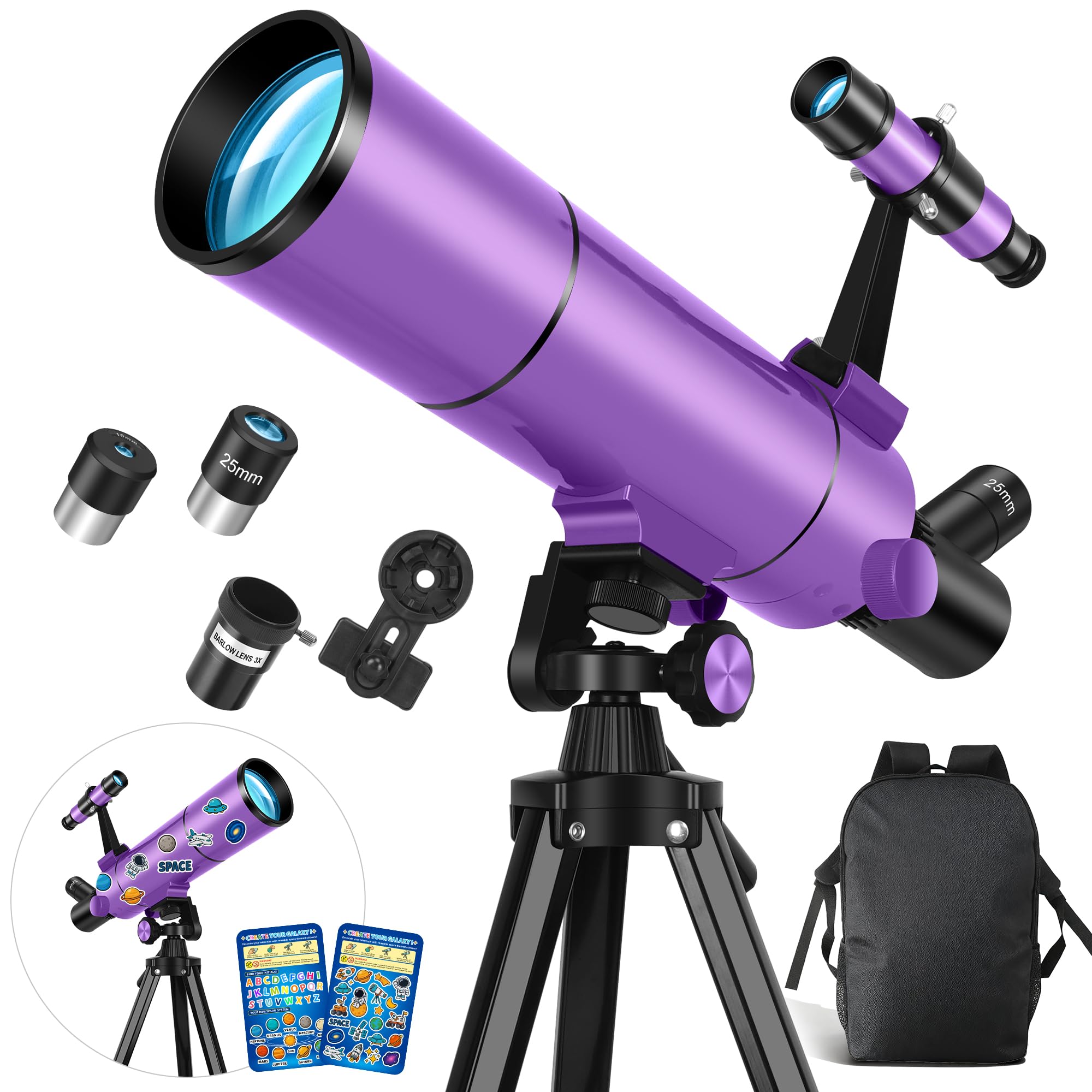
The Dianfan 80mm is clearly designed for families and younger users, but it does not sacrifice optical fundamentals. The 80mm aperture is an honest starting point for lunar observation — it resolves craters like Copernicus and Tycho with satisfying clarity — and the 500mm focal length provides a wider field of view that makes it easier for kids to find and center objects before zooming in. The fully multi-coated optics ensure that the view is not washed out at higher magnifications.
The kit includes reusable astronomy-themed stickers for personalization, a purple color scheme, and a padded backpack for carrying. The phone adapter works for sharing moon photos with friends. The 3x Barlow lens combined with the 10mm and 25mm eyepieces provides a maximum of 150x magnification, which is appropriate for this aperture size — trying to push it beyond would result in dim, unusable images.
The tripod is lightweight, which helps portability but means it is more susceptible to vibrations in windy conditions. Some adult users noted that the tripod could be taller for comfortable seated viewing. The finder scope is basic but functional for a beginner’s first night out. For its price, the Dianfan 80mm offers a genuinely capable instrument wrapped in a package that encourages a child’s interest in astronomy without compromising the quality of the view.
Why it’s great
- Kid-friendly design with stickers and purple color scheme
- 80mm aperture provides legitimate lunar and bright-planet views
- Complete with backpack, phone adapter, and easy assembly
Good to know
- Lightweight tripod can wobble in breezy conditions
- Limited to 150x maximum before image degrades
9. HUGERSTAR 80mm Aperture 500mm Refractor

The HUGERSTAR 80mm is a compact, portable refractor that sacrifices a little aperture for a form factor you can actually carry on a hike. Its 80mm objective and 500mm focal length create a fast f/6.25 system, which means a wider field of view for scanning star fields and larger swaths of the moon. The fully multi-coated optics are identical in quality to the higher-tier models, just in a smaller package.
The tripod adjusts from 16.9 to 44.4 inches, which is notably shorter than most models — suitable for tabletop use or for seated observing at a campsite. The included backpack holds the entire kit neatly, making it genuinely portable. Users report seeing Jupiter’s four moons clearly with the 25mm eyepiece and 3x Barlow combination, and the moon appears crisp with visible crater detail at both low and medium magnifications.
The phone adapter allows for easy image capture, and the 45-degree diagonal provides upright views for daytime use. Some taller users noted the maximum tripod height is insufficient for standing observation. The finder scope is a 5×24 model that works adequately but can be tricky to align precisely. This scope is best suited for someone who values portability and wants a telescope they can take to a dark-sky campsite rather than being limited to backyard observing.
Why it’s great
- Compact and portable with a well-designed backpack for travel
- Wide field of view from the fast f/6.25 optical system
- Complete kit for on-the-go stargazing at dark-sky sites
Good to know
- Tripod height is too short for comfortable standing use
- 80mm aperture is a step down from 90mm models for deep-sky
FAQ
What size aperture do I need to see Saturn’s rings with a budget telescope?
Can I see galaxies with an 80mm or 90mm telescope?
Is a higher magnification number on the box always better?
What is the difference between a refractor and a reflector telescope for planets?
Final Thoughts: The Verdict
For most users, the budget telescope for viewing planets and galaxies winner is the MEEZAA 90mm because it combines the ideal 90mm aperture for planetary detail with a rock-solid stainless steel tripod and fully multi-coated optics in a beginner-friendly package. If you want maximum aperture for deep-sky and are willing to learn an equatorial mount, grab the Koolpte 130EQ. And for the best optical foundation to build on, nothing beats the SVBONY SV48P 102mm — just budget for a mount and eyepieces separately.