
Our readers keep the lights on and my morning glass full of iced black tea. As an Amazon Associate, I earn from qualifying purchases.
Specs are compiled from manufacturer listings and verified buyer reviews and can change over time — please confirm the key details on the product page before buying.
An 8-string bass guitar delivers extreme low-end range for djent, metal, and experimental tones. Standard four and five strings feel limiting, so you’re seeking the sub-bass rumble these extended-range instruments provide. The key is finding a model that offers comfortable playability and reliable hardware. This guide evaluates top 8-string bass guitars based on neck feel, pickup output, and hardware durability.
I’m Min — the founder and writer behind Gadgets Feed. This guide is built by comparing the manufacturers’ published specifications and the patterns across verified customer reviews, so you get each pick’s real strengths and trade-offs instead of marketing spin.
You’ll learn which models offer the best playability for extended-range riffs, and which ones need a little setup work from the start to nail that tight, chugging tone. 8 string bass guitar
Our Picks at a Glance

How To Choose The Best 8 String Bass Guitar
Choosing an 8-string guitar means balancing neck width, scale length, and setup requirements against your skill level. The widest necks demand a stretch, and the lowest strings need the right scale length to stay tight. Match the guitar’s specs to your playing style and experience level for the best fit.
The Multi-Scale Advantage
On a standard straight-fret guitar, the low strings can feel floppy at low tunings. Multi-scale (fanned fret) designs use a longer scale on the low strings — for example, 27 inches on the low end and 25.4 inches on the high strings — to keep tension even. This means you get a tight low B or F# without sacrificing the comfortable feel of the higher frets.
Neck Profile and Playability
An 8-string neck is wider, but thinner profiles like flat D or C shapes reduce fatigue during long sessions. A flat “D” or “C” shape with a smooth finish makes the stretch less tiring. Players transitioning from 7-strings adapt faster to the wider neck than those coming from 6-strings.
Pickups Built for the Low End
Standard pickups can sound muddy with eight strings. Look for humbuckers voiced specifically for extended-range guitars — they keep the low end punchy and defined. High-output pickups with a bass-oriented wind help each palm mute and chug cut through a dense mix without excessive muddiness.
Quick Comparison
| Model | Best For | Body Wood | Pickups | Any Fret | Amazon |
|---|---|---|---|---|---|
| Ibanez RG8★ Best Overall | Upgrading from 7-string | Basswood | 2 Humbuckers | No | Amazon |
| AKLOT XRN-8Modern Metal Pick | Modern metal & djent | Okoume | H-H (14kΩ) | Yes (27″-25.4″) | Amazon |
| Jackson JS32-8 | Value & playability | Poplar | 2 Humbuckers | No | Amazon |
| IYV-IEHLFF8-300 | Budget headless entry | Basswood | Passive Soapbar | Yes (26.5″-28.5″) | Amazon |
| Schecter C-8 Deluxe | Classic rock to metal | Basswood | Diamond Plus-8 | No | Amazon |
In-Depth Reviews
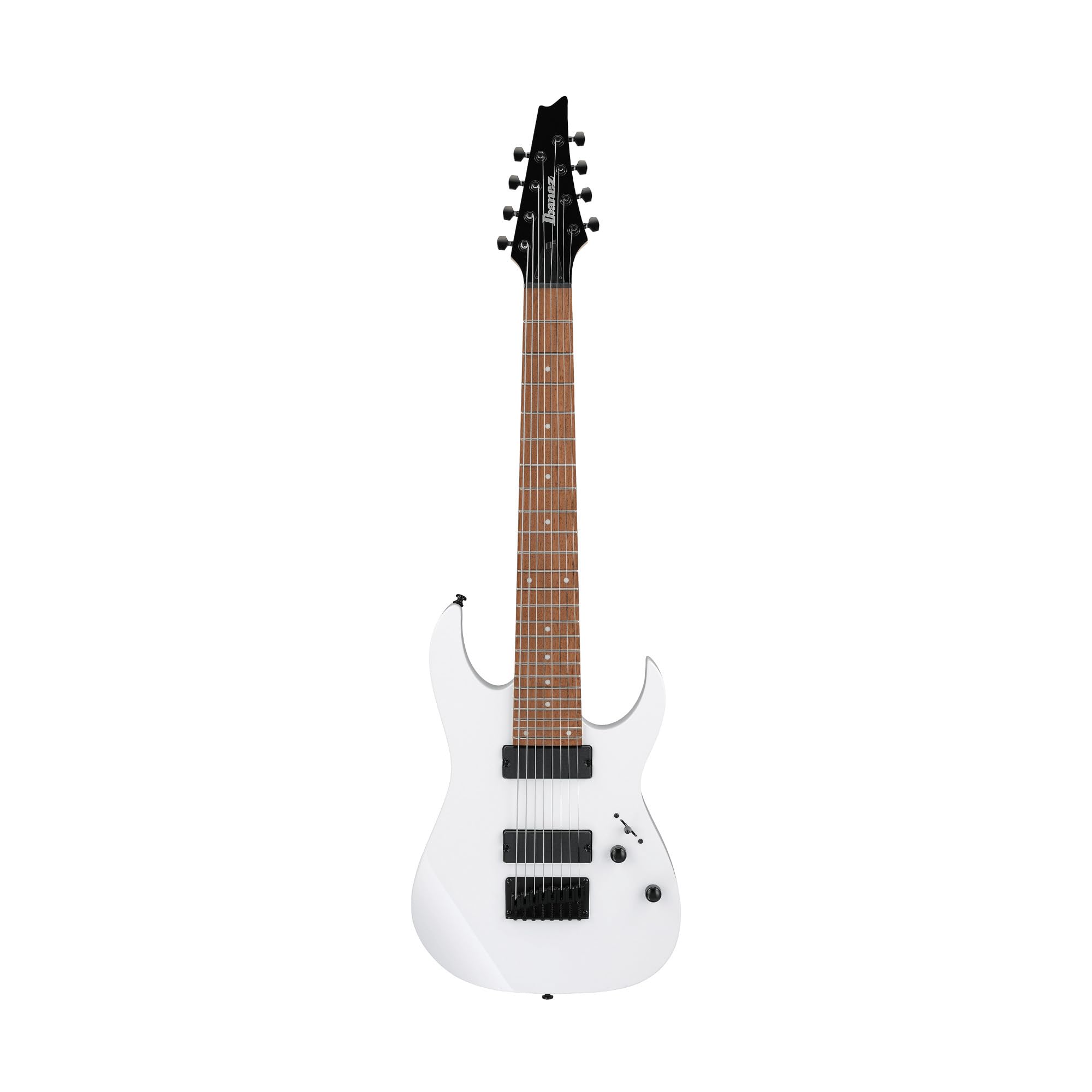
1. Ibanez RG Series RG8 – White
Our pick — over 4.5★ from 90+ verified ratings; the strongest balance of quality and price.
The 7-string player’s natural bridge into eight-string territory without the usual struggle.
If you already handle a 7-string, the Ibanez RG8 is the smoothest step up. Its thin neck profile feels unlike other brands’ wider offerings, and the smooth flat D-shape design keeps the stretch manageable. Owners note it “feels like playing a lute” — light and responsive rather than heavy and sluggish. The meranti body and maple/walnut neck keep the whole instrument comfortable for long sessions.
The RG8 is heavier than some rivals, and the stock strings can produce fret buzz straight from the start. One recurring setup note: the 8th string buzzes on frets 12-15 until you raise the saddle — a simple fix, not a dealbreaker. With a straight neck and spot-on intonation, a quick truss rod and saddle adjustment transforms it into a serious player. The high-quality construction here is what wins people over — buyers consistently compare it to guitars costing twice as much.
Tonally, it’s versatile across jazz, rock, and metal. The stock pickups deliver a “punchy middle, bassy neck” character with enough low-end bite for heavy riffs. The F108 bridge with individual saddles responds well to precise setup, and the finish arrives clean. Just budget some time for humidity awareness — like many solidbody guitars, it’s susceptible to temperature and humidity changes, so a setup tweak per season isn’t unusual.
Why It Wins Players Over
- Flat D-shape wizard neck is fast and comfortable for extended-range playing
- Great value for money — feels like a far pricier instrument
- Versatile pickups handle jazz, rock, and metal with low-end bite
Where You’ll Need Patience
- Heavier than some competitors
- Stock strings cause fret buzz on frets 12-15 until saddle raised
- Susceptible to temperature and humidity changes; locking nut recommended later
Your best move if: you’re a 7-string player who wants a familiar, fast neck without a learning curve.
Think twice if: you’re a pure 6-string player — the wider neck will demand real adjustment time.
2. AKLOT Multi-Scale 8-String Electric Guitar XRN-8
A multi-scale metal machine that sounds like a mid-priced guitar for far less.
The AKLOT XRN-8 is built for modern metal DNA. Its multi-scale design extends to 27 inches on the low end while keeping a familiar 25.4 inches on the high strings — this keeps the lowest tunings tight without sacrificing upper-register speed. The Flat-C roasted maple neck profile is slim and slick, letting you shred through complex leads while the 24 stainless steel frets allow easy bends with no string choke out.
Owners consistently describe the quality as exceptional — one buyer compared the sound directly to expensive guitars in blind tests and found the pickups clean and match-worthy. The okoume body paired with roasted maple delivers a punchy, smooth tone with tight, focused midrange. The staggered individual saddles improve sustain by transferring string energy directly into the body, giving you precise intonation and superb string separation.
What’s in the box improve the value: a distortion pedal engineered for down-tuned guitars, a gig bag, strap, and picks. The high-output, bass-oriented pickups (14kΩ) dominate low and low-mid frequencies while keeping note clarity in dense harmonic layers. Some owners note the hardware feels cheaper than the rest of the package, and a few mention fret edges needing a quick polish, but the playability and tone win out overwhelmingly.
Sound that sells itself: Owners rave that it plays well from the start with “amazing sound” — the kind of tone that makes you forget the price tag.
The honest catch: The included hardware is the weak link; the fretboard and pickups outclass the tuners and bridge, so keep expectations in check there.
Reach for this if: you want a modern metal workhorse with fanned frets and a complete starter kit.
Look elsewhere if: you demand premium hardware from the start — you’ll want to upgrade tuners eventually.
3. Jackson JS Series Dinky JS32-8 – Satin Black

A featherweight Dinky that plays faster than its price suggests.
The Jackson JS32-8 nails the “bang for your buck” brief. It’s light, smooth, and quick to play — the kind of instrument that feels natural in your hands whether you’re riffing or playing blues. The poplar arched top body with a maple neck keeps the weight down while the amaranth fingerboard adds a smooth, fast feel across all eight strings. Owners describe the stock pickup sound as genuinely good, which is rare at this level.
There’s a catch about the fretwork: the edges arrive sharp and need filing. It’s a 20-minute job with fine sandpaper, and after that, the guitar plays flawlessly. The Jackson HT8 string-through body hardtail bridge keeps tuning stable and sustain strong. One owner noted it compares favorably to a mahogany Randy Rhoads V, which says a lot about the tone-to-weight ratio here.
The satin black finish looks aggressive and professional, fitting the metal aesthetic without shouting. The 24-fret design gives you full access to the upper register, and the neck profile is comfortable enough for extended jamming sessions. For players who want a no-nonsense 8-string that just works — after a quick fret polish — this is a strong contender.
The High Points
- Light and comfortable neck — easy for long practice sessions
- Great stock pickup sound for metal and blues
- String-through body hardtail for solid tuning stability
One Thing to Fix
- Sharp fret edges need filing from the start
Who it suits: The jam player who wants a light, fast 8-string while staying affordable.
Who it doesn’t: Anyone unwilling to do a quick fret polish before the first serious play session.
4. IYV- IEHLFF8-300 Multi-Scale Headless 8 String

A headless multiscale djent machine that offers surprising quality for the price.
The IYV headless 8-string is the budget entry point into fanned-fret territory. With a 26.5-28.5 inch scale and passive soapbar pickups, it’s built for low tunings with a comfortable, ergonomic neck. The headless design keeps the instrument compact and balanced, and buyers report the tuning and intonation are easy to get right. It stays in tune well, which is a pleasant surprise at this price point.
Where it falls short is fit and finish. One 2-star review captured the frustration: “Useless unless you’re a luthier and a machinist” — referencing stripped tuner threads, weak nut anchors, and unlevel frets. The build quality varies unit to unit, but the consensus is mixed on the finish, with several owners describing it as rough with paint bleed. The tuning mechanism also takes some work to get right.
If you’re handy with tools or willing to invest in a pro setup, the IYV can become a serious player. The noiseless pickups and solid hardware (for the price) make it a “best budget djent dispenser.” But the recurring gripe is the soft screws and fragile nut area — treat the hardware gently. This is a guitar for the tinkerer, not the plug-and-play crowd.
Value that impresses: Despite the rough edges, owners call it a surprisingly solid build with great pickups — one even said it beats a bridge.
Who this isn’t for: Players without repair skills will struggle; this one demands setup patience or a pro’s touch.
Best if: you’re a budget-conscious tinkerer who wants to explore headless multiscale design.
skip it if: you expect a flawless out-of-box experience — the finish and hardware need attention.
5. Schecter C-8 DELUXE Satin White 8-String

A well-balanced, natural-feeling 8-string wrapped in a striking satin white finish.
The Schecter C-8 Deluxe pairs a basswood body with a maple neck and rosewood fingerboard for a balanced, resonant tone. The TonePros T3BT TOM bridge with string-through-body design delivers solid sustain and tuning stability. Owners appreciate the natural action straight from the start — one described it as “well-balanced,” noting the guitar feels comfortable from the first chord. It’s a versatile instrument that covers metal and classic rock with ease.
The Diamond Plus-8 pickups provide a clear, punchy voice that handles heavy distortion without getting muddy. But there’s a maintenance consideration: the satin white finish shows grime and dust easily, requiring regular wiping with a microfiber towel. An occasional unit arrives with cosmetic issues like a dent or a pickup failure within the first 90 days — quality control isn’t perfect across the board.
If you want a guitar that leans toward classic styling while delivering modern 8-string range, the Schecter delivers. The chrome hardware and dot inlay give it a refined look. Just keep a microfiber cloth nearby and check the electronics early — the warranty process is a hassle if something fails, so test everything thoroughly on arrival.
What Stands Out
- Well-balanced feel with natural action right from the start
- TonePros bridge with string-through body for solid sustain
- Satin white finish looks striking and unique
What Needs Care
- Satin white shows grime and dust easily — needs regular wiping
- Occasional cosmetic or electronics issues on arrival; test thoroughly
Best for: The player who wants a good-looking, versatile 8-string that covers both metal and classic rock.
Look out for: The white finish demands upkeep — choose this only if you don’t mind regular cleaning.
Understanding the Specs
Multi-Scale (Fanned Fret) Design
Multi-scale guitars use different scale lengths for different strings — longer on the low strings, shorter on the high ones. This keeps the low strings tight and defined at low tunings while preserving a comfortable feel in the upper register. Standard straight-fret 8-strings use one scale length for all strings, which can make the low F# feel floppy.
Pickup Output and Voicing
Extended-range guitars need pickups voiced for the low end. High-output humbuckers with a bass-oriented wind (like the 14kΩ in the AKLOT) keep palm mutes and chugs punchy. Standard pickups can sound muddy when pushed into 8-string territory, so check the pickup configuration — H-H (two humbuckers) is the standard for metal.
FAQ
Is an 8-string bass guitar harder to play than a 7-string?
What is the advantage of a multi-scale or fanned fret design?
Do I need a special amp for an 8-string guitar?
How often will I need to adjust the setup on an 8-string?
What gauge strings should I use on a new 8-string?
Can I play blues or jazz on an 8-string?
Are headless guitars better for 8-strings?
Will an 8-string stay in tune?
What is the ideal scale length for heavy low tunings?
What should I check when my 8-string arrives?
Final Thoughts: The Verdict
For most players, the 8 string bass guitar winner is the Ibanez RG8 because it offers the smoothest transition from 7-string playing with a fast, comfortable neck and great value. If you want modern metal versatility with fanned frets, grab the AKLOT XRN-8 — it sounds like a far pricier instrument. And for a light, value-focused option that just needs a quick fret polish, the Jackson JS32-8 is the one to reach for.
How We Picked
We do not accept paid placement. Every pick is matched to a real buyer and a real use-case; we do not hands-on test units.
Sources & Methodology
Specifications: manufacturer listings and product documentation. Review insights: verified customer reviews, as of August 2026. Pricing: not shown on this page (it changes often); check the current price via the retailer link.
As an Amazon Associate, Gadgets Feed earns from qualifying purchases. This does not affect which products we feature.