
Our readers keep the lights on and my morning glass full of iced black tea. As an Amazon Associate, I earn from qualifying purchases.
Specs are compiled from manufacturer listings and verified buyer reviews and can change over time — please confirm the key details on the product page before buying.
When the lights go out, you want to know what still works and for how long. A backup battery stores electricity you can use anywhere—keeping your fridge cold during a storm or running a CPAP machine at a campsite. The real question is which size and power level fit your life, not if you need one.
I’m Min — the founder and writer behind Gadgets Feed. This guide is built by comparing the manufacturers’ published specifications and the patterns across verified customer reviews, so you get each pick’s real strengths and trade-offs instead of marketing spin.
You might need a light 192Wh unit for phones or a 3600Wh beast for whole-home essentials. This breakdown of the best backup battery options sorts the truly useful from the overkill.
Our Picks at a Glance

How To Choose The Best Backup Battery
The biggest mistake buyers make is grabbing the biggest number they can afford without checking what it actually powers. A 192Wh unit and a 3600Wh unit are both backup batteries, but they serve completely different jobs. Start by listing what you need to keep running, then match the capacity to that list.
Match Capacity to Your Real Load
Capacity is measured in watt-hours (Wh) — the total energy stored. A small 192Wh station will charge phones and run a fan for an evening, while a 3600Wh station can power a refrigerator for over a day. Look at the wattage of your appliances; a fridge typically draws 100-200W, so a 2048Wh battery could run it for roughly 10-20 hours. The higher the Wh, the longer your devices stay on, but the heavier and pricier the unit gets.
Check the Continuous and Surge Output
Output, measured in watts (W), tells you what you can plug in at once. Every station has a continuous rating (what it handles steadily) and a surge or peak rating (a brief boost for starting motors, like a fridge compressor). A 1500W station runs most home essentials, but a power tool or a microwave might need 2000W or more to start. Always compare the continuous number, not just the peak.
Prioritize LiFePO4 for Longevity
Lithium Iron Phosphate (LiFePO4) batteries last many more charge cycles than standard lithium-ion. Many models rated for 4000 cycles or more mean you can charge daily for over a decade before capacity drops. If you plan to use it weekly — or keep it topped up for emergencies — this chemistry pays off in the long run.
Quick Comparison
| Model | Best For | Capacity | AC Output | Weight | Amazon |
|---|---|---|---|---|---|
| Jackery Explorer 1000 v2★ Best Overall | Mid-size home backup & camping | 1070Wh | 1500W | 23.8 lbs | Amazon |
| DaranEner NEOZ 192WhBest Value | Portable device charging | 192Wh | 300W | 5.7 lbs | Amazon |
| GRECELL 2400WTop Performer | Heavy appliance backup | 1843.2Wh | 2400W | 55.6 lbs | Amazon |
| Dabbsson 2000L | Whole-home essentials | 2048Wh | 2200W | 41 lbs | Amazon |
| Anker SOLIX S2000 | Fridge backup & UPS | 2010Wh | 1500W | 35.7 lbs | Amazon |
| BLUETTI Elite 200 V2 | High-wattage appliances | 2073.6Wh | 2600W | 53.4 lbs | Amazon |
| BLUETTI AC200L | Expandable home & RV | 2048Wh | 2400W | 61.4 lbs | Amazon |
| Anker SOLIX C2000 Gen 2 | Fast-recharge camping & home | 2048Wh | 2400W | 41.7 lbs | Amazon |
| EF ECOFLOW DELTA Pro | Max capacity home backup | 3600Wh | 3600W | 99 lbs | Amazon |
In-Depth Reviews
1. Jackery Explorer 1000 v2 Portable Power Station
Our pick — over 4.5★ from 3,500+ verified ratings; the strongest balance of quality and price.
The balanced mid-size pick that powers your fridge and your campsite without breaking your back.
You can move this one—it weighs 23.8 lbs with a foldable handle—yet it still delivers real power. The 1070Wh capacity and 1500W AC output (with a 3000W surge peak) run everything from a fridge to an electric pot. Buyers report it keeping a full-size refrigerator going for 6-1/2 hours, making it a genuine home-outage partner, not just a camping toy.
The charging speed is the crowd favorite — you can go from 0% to 100% in one hour, but only if you switch on the emergency charging mode in the Jackery App first. Leave it in the default 1.7-hour mode and you protect the battery’s long-term health. The LFP battery retains over 70% capacity after 4,000 charge cycles, making it a decade-plus investment.
Versatility is where it shines: two USB-C ports (one with 100W PD fast charging), a USB-A, a DC car port, and three pure sine wave AC ports. The pure sine wave means clean power that’s safe for sensitive gear like CPAP machines — owners say a 4-night camp used just 15-20% per night. The app works over Bluetooth from 30 feet away, even without cell service. Buyers also report it powers a boat at anchor all night via a 110V-to-50A pigtail, running three small fridges, an ice maker, and a fan for 7-8 hours.
What Owners Love
- Quality is the most-praised trait by far — build feels solid and reliable
- Charging speed comes second: under 2 hours to full in fast mode
- Quiet overnight charging mode drops noise to 30 dB
Before You Buy
- No 12V barrel ports, and the solar port only works with Jackery panels
- Too heavy for hiking — owners say it’s ideal for car camping, not backpacking
Reach for this if: you want one station that covers home outages, road trips, and campsite power without feeling like you’re hauling furniture.
Look elsewhere if: you need to run heavy tools like a 12″ miter saw — owners mention it fails on those high-startup loads.
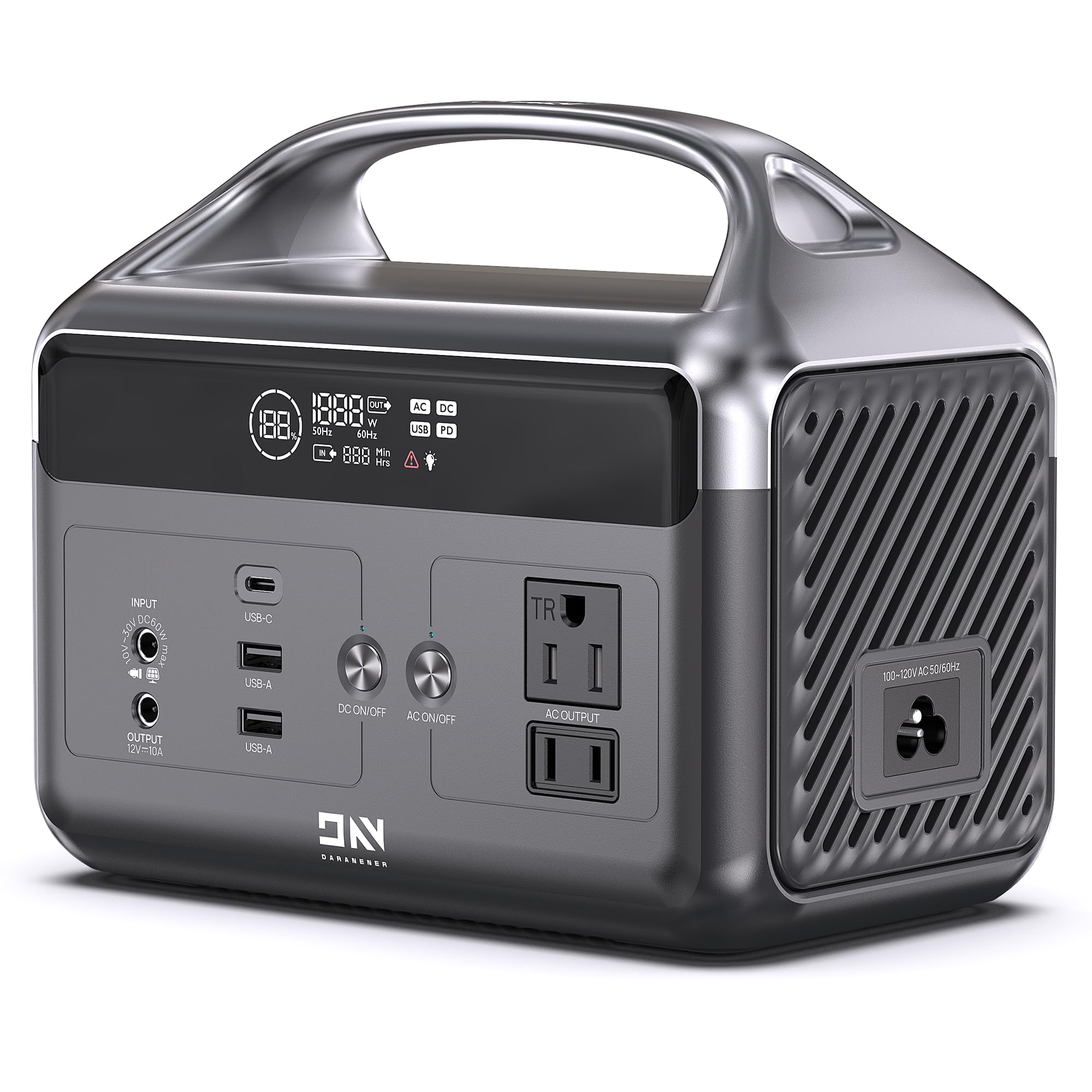
2. DaranEner Portable Power Station 192Wh
The toaster-sized station that keeps your essentials alive without hogging the trunk.
This is the entry point that actually makes sense. At 5.7 lbs and smaller than a toaster, the 192Wh capacity and 300W output (600W surge) handle phones, tablets, laptops, fans, and CPAP machines. It’s a fraction of the Jackery’s heft — about 4.2x lighter — but you’re also getting roughly a fifth of the capacity and a fifth of the output, so set your expectations to “essentials only,” not “whole kitchen.”
What wins people over is the performance for the size. It charges everything to full in about 2 hours, and the built-in LED flashlight has 4 brightness modes including an SOS signal for emergencies. The LiFePO4 cells are rated for 3500+ cycles, and the smart Battery Management System guards against overcharging, overheating, and short circuits. Owners ran a fan through an outage and inflated a queen mattress all weekend on a single charge — it dropped to 73% after four inflations.
For CPAP users, this is a quietly serious contender. Tests via the AC outlet showed 7-31 hours of runtime depending on your breath cycle, and the DC adapter likely runs all night. That’s a genuine all-night backup in a package you can toss in a duffel. The two USB-A ports (18W QC3.0) and one USB-C PD 60W mean modern phones and tablets charge at full speed.
The Strong Points
- Performance is the most-praised aspect — it just works for daily device charging
- Charging speed second: full in about 2 hours from a wall outlet
- Fits in a.50-cal ammo can with a little lid tapping, per one owner
Keep in Mind
- Not for high-power appliances — rice cookers, hair dryers, and mini-fridges exceed 300W
- One unit arrived fully discharged; owners advise keeping it above 20% charge
Best if: you want a cheap, light safety net for camping trips, power outages, and overnight CPAP use.
Not for: anyone hoping to run a refrigerator or any appliance that draws more than 300W.
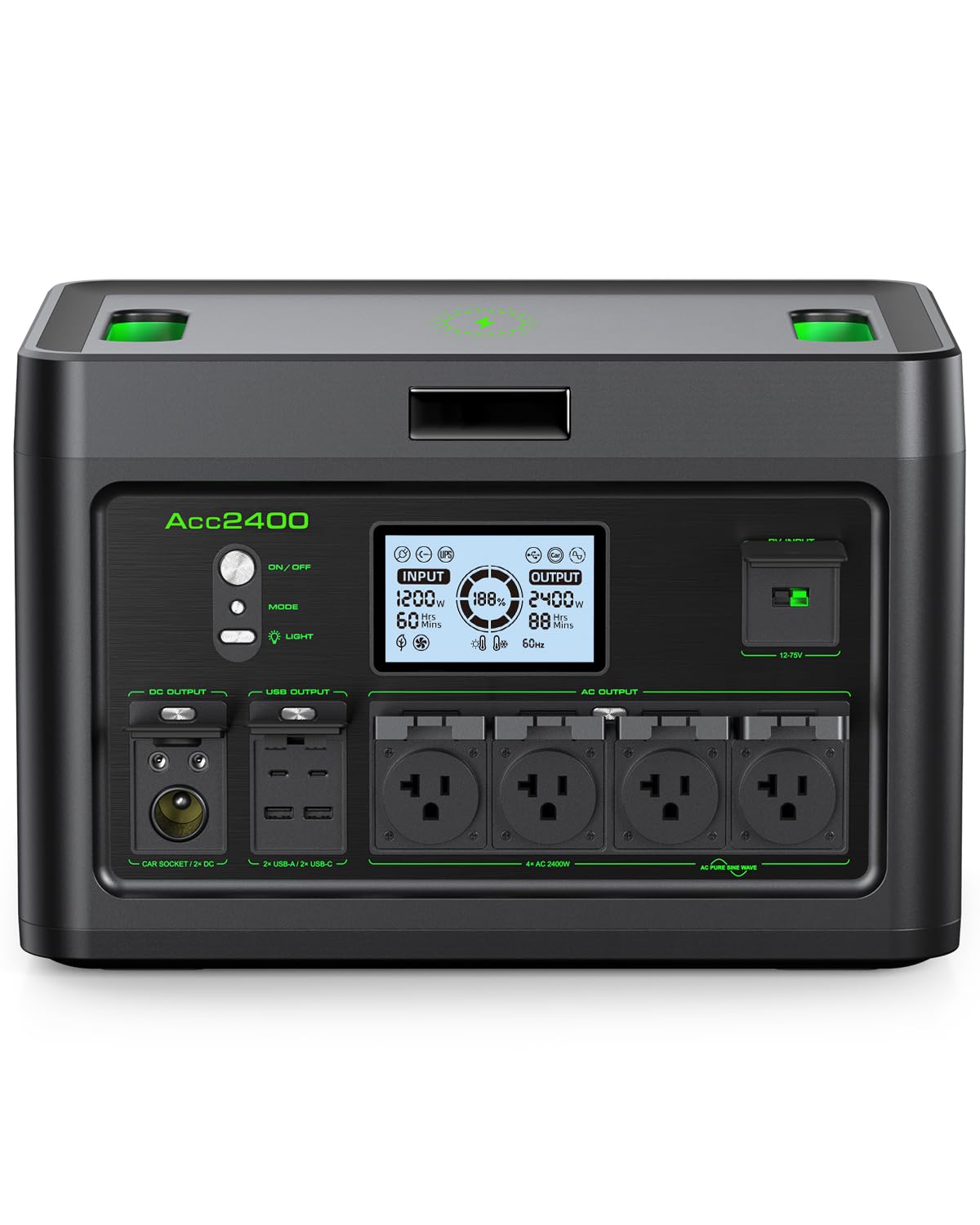
3. GRECELL 2400W Portable Power Station 1843.2Wh
A 2400W workhorse that turns a power outage into a minor inconvenience.
The value here is hard to argue with. For a mid-range price, you get 1843.2Wh of LiFePO storage and 2400W of continuous AC power — enough to run TVs, game consoles, kitchen appliances, and even an electric stove or heater. Owners highlight it as ideal for emergency use, and one ran a Ninja woodfire grill for about 2 hours while only dropping to 60%. The charging capacity gets mixed feedback though, so don’t expect it to be the fastest to refill.
Portability comes from a handle on each side, making it easier for two hands or two people to move the 55.6 lbs. It measures 16.95″ x 11.9″ x 11.1″, so it’s built for the garage, the jobsite, or the back of an SUV. The output panel is genuinely useful: a 10W wireless charging pad on top, 4 AC ports, 2 USB-A, 2 USB-C, 2 DC outputs, and a car charger port. That’s a lot of devices running at once, and owners say pass-through charging — wall plus DC/USB simultaneously — works without a hitch.
Safety is baked in with overcharge, temperature, and low-battery protection. One owner upgraded from a 300W unit to this 1000W-class station and ran a car fridge for 11 hours overnight, still showing 100% — a huge jump from the 6 hours the old one managed. The built-in light and the option to add a 200W solar panel make it a solid choice for off-grid weekends or storm season.
Why It Wins
- Value for money is the top praise — a lot of watts per dollar
- Functionality second: DC/AC outputs power multiple devices overnight
- Wireless charging pad is a rare convenience at this price
The Trade-Off
- Charging capacity is the most-discussed issue — some find solar recharge slow
- At 55 lbs, you’ll want the handles and a plan for moving it
Grab this for: jobsite power, home backup, or camping where you need to run real appliances, not just charge phones.
Think twice if: you need fast solar recharging or plan to move it often — the weight and charge time are real factors.
4. Dabbsson Portable Power Station 2000L
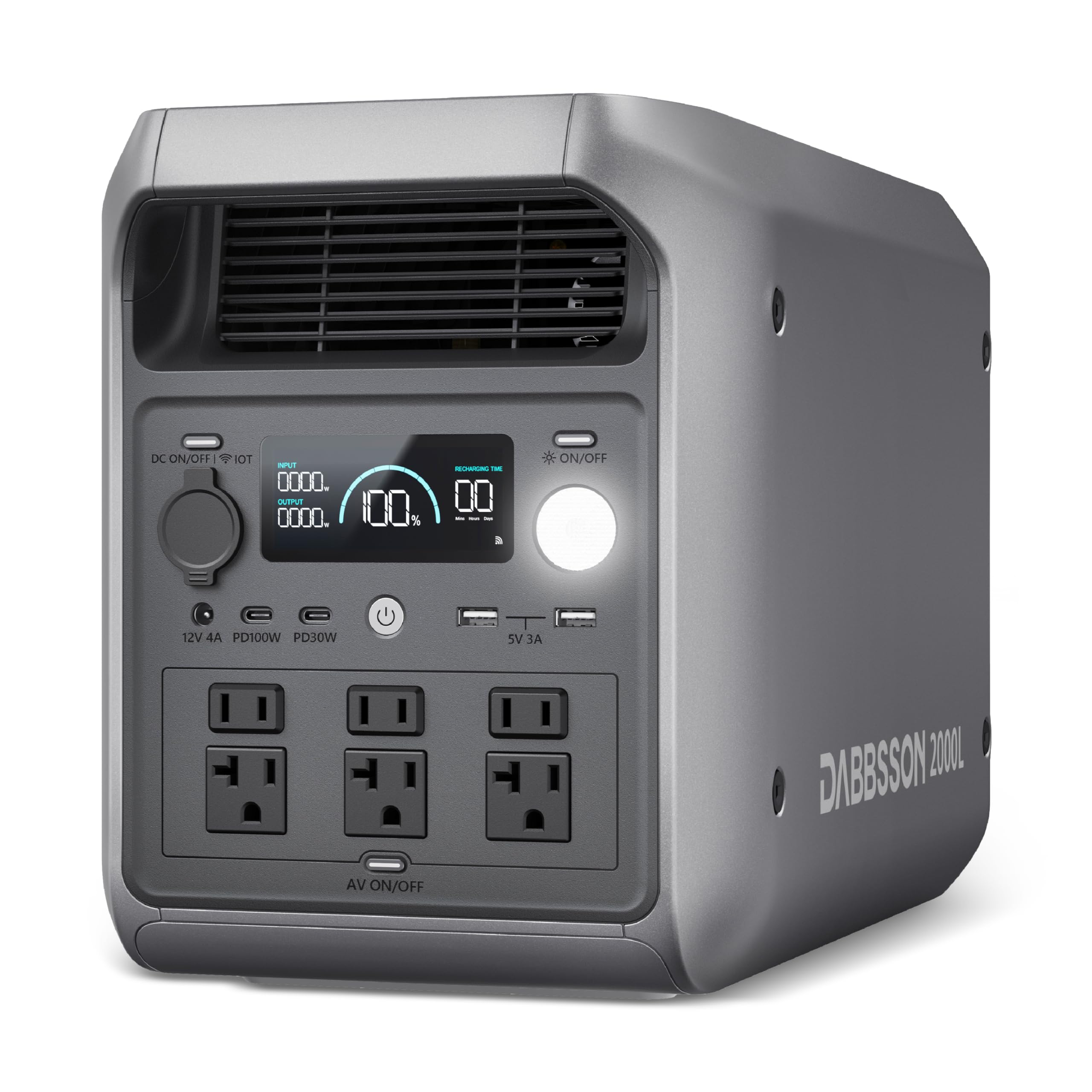
At 41 lbs, this 2048Wh station gives you whole-home power without the gym-membership weight.
For a 2048Wh battery, 41 lbs is genuinely light — most comparable high-capacity stations weigh more. The 2200W rated output (3300W surge boost) runs refrigerators, heaters, grills, and power tools, and the 6 AC outlets mean you can power a whole family’s worth of devices at once. It also delivers 1.3x longer runtime than comparable 2048Wh stations, per the maker, making it a strong all-day off-grid option.
You won’t wait long to recharge—it hits 100% in 1 hour from AC input, ultra-fast for its class. It also accepts solar (up to 800W with MPPT, a maximum power point tracker that tune solar input), 12V car charging, and hybrid dual-input for maximum flexibility. The semi-solid LiFePO4 cells are rated for 4000+ deep cycles to 80% capacity, backed by a UL94-V0 flame-retardant housing. The 5-year warranty (3 years standard plus 2 extended) adds confidence that most rivals don’t match.
Reliability is what owners praise most, with the charging speed right behind. One owner runs lights and tools from it daily without issues, and another notes it exceeded the 2kW rated output by 400-500W on surge. The <10ms EPS switch protects computers and NAS drives from power loss — no data loss when the grid flickers. A recurring nitpick is the loud non-variable fan, and the 800W solar input is lower than some competitors, so factor that in if off-grid solar is your main plan.
What Impresses
- Reliability is the top-rated aspect — it powers gear daily without drama
- Charging speed second: full in about 1 hour on AC
- Dual handles and a compact footprint make the 41 lbs manageable
What to Watch
- App functionality gets mixed reviews — Wi-Fi pairing can be finicky
- Fan is loud and cycles on even at zero load
Pick this if: you want near-whole-home capacity that’s still easy to carry and recharges faster than anything in its class.
skip it if: you need whisper-quiet operation or plan heavy solar input — the fan and 800W solar limit are your constraints.
5. Anker SOLIX S2000 Portable Power Station
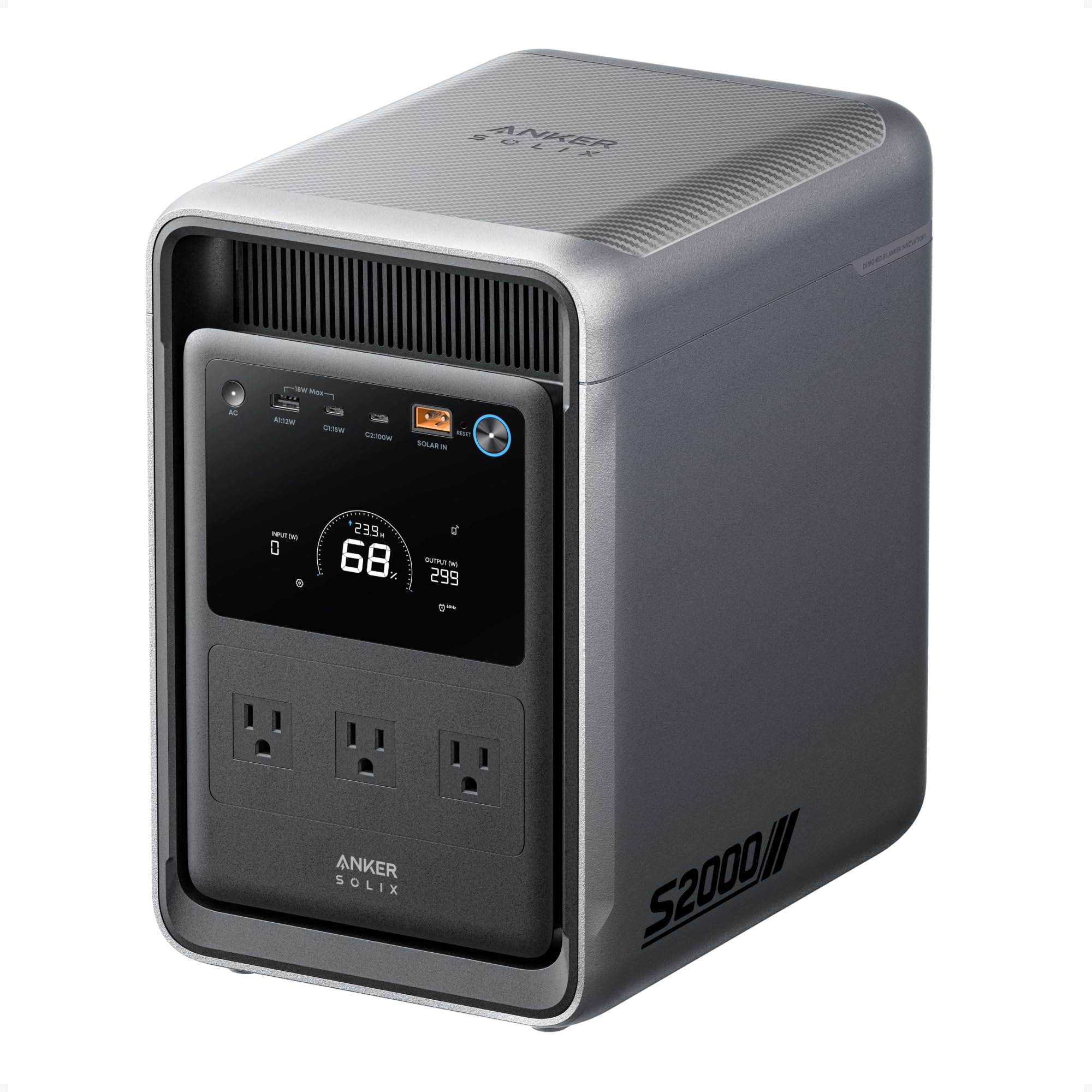
The fridge-focused station engineered to keep your food cold for a day and a half.
Anker designed this one with a single obsession: keeping your refrigerator running. The 2010Wh capacity, combined with a low 6W idle power draw, runs a fridge for up to 35 hours. Owners confirmed it — one ran a full-size fridge for about 30 hours and still had 20% left. That’s the difference between throwing out groceries and riding out a storm comfortably.
It’s remarkably compact for 2kWh of storage. At 35.7 lbs and 8.19″ x 11.1″ x 12.7″, the maker claims it’s 30% smaller and 25% lighter than the industry average — and owners agree it fits neatly without dominating a room. The 1500W continuous output (3000W peak) covers 99% of home essentials, and the <10ms UPS switchover protects computers and routers from even a flicker. You get 8 outlets split front and back; there’s no 12V DC port, so plan around USB and AC only.
The 10,000-cycle LFP battery is rated for a 15-year lifespan, making it a long-term investment. Recharging is flexible with 6 ways to power up, including up to 400W solar. Owners praise the clear display showing battery percentage and real-time wattage, plus WiFi app control. The recurring gripe is the fan noise during high-speed 1200W charging — it’s a droning sound, and one unit had an initial burn-off smell that dissipated after a few hours. The performance and reliability are where the praise concentrates: one owner ran it through a 30-hour outage and topped it off mid-way.
Standout Strengths
- Performance is the top praise — the 35-hour fridge claim holds up in real use
- Reliability second: owners trust it through multi-day outages
- Compact footprint for 2kWh of capacity
Honest Gripes
- Fan is noisy during fast charging — some find it droning
- Solar charging gets mixed feedback, so check your panel setup
Choose this for: the single most important outage job — keeping your fridge and a few essentials alive for over a day.
Look past it if: you need a 12V DC port or you’re sensitive to fan noise while recharging.
6. BLUETTI Elite 200 V2 Portable Power Station

Industry-leading 2600W output in a package that runs a microwave and an air fryer at the same time.
If you’ve ever been frustrated by a power station that trips when you plug in a hair dryer, this is the answer. The Elite 200 V2 delivers 2600W of continuous AC power, and with BLUETTI’s HyperWatt tech, a 3900W power-lifting mode for brief high-demand starts. That runs refrigerators, coffee makers, and even an induction cooktop. One owner powered an induction cooktop, air fryer, dishwasher, office gear, fridge, and a 3D printer simultaneously — without tripping.
The 2073.6Wh capacity uses a CNAS-certified automotive-grade LiFePO4 battery rated for over 6,000 cycles, or a 17-year lifespan of daily use. Standby draw is just 10W, which is 3x lower than similar stations, meaning less wasted energy and longer real-world runtime. A 60W diesel heater running 10 hours a day could go for 3.3 days on a single charge, per the maker’s example. The 4 AC outlets and 9-device simultaneous capacity make it a genuine home hub.
Charging is where it gets clever. Three smart modes via the BLUETTI app: Turbo hits 0-80% in one hour (1800W AC), Standard does a full charge in 1.6 hours, and Silent runs at just 16-30dB — 45% quieter than typical stations. Dual AC + DC charging reaches 0-80% in just 50 minutes. Owners rave about the 95%+ AC efficiency and the 53.4 lbs weight, which beats the older AC200L’s 61.4 lbs despite similar capacity. The trade-offs: rubbery buttons and no 30A 12V output for serious RV setups.
The Highlights
- Performance is the most-praised aspect by a wide margin — it just runs things
- Power capacity second: 2600W handles appliances others can’t
- Silent Mode at 16-30dB is a standout for indoor or nightly use
Consider These
- Charging speed gets mixed feedback — Turbo is fast, but some find Standard slow
- Weight is mixed: some find 53.4 lbs too bulky despite the handles
This is the pick if: you want to run high-wattage appliances like a microwave, air fryer, or power tools without thinking about limits.
Reconsider if: you need a 30A RV port or you’re moving it daily — the 53.4 lbs and button feel are real considerations.
7. BLUETTI AC200L Portable Power Station

The modular station that grows with you — from 2048Wh all the way to 8192Wh.
This is the station for people who know they’ll need more power later. The AC200L starts at 2048Wh with 2400W of output, but expand it with BLUETTI’s battery packs — B300K, B210, B300, or B230 — to reach a maximum of 8192Wh. That’s the difference between a weekend camper and a whole-home backup system you build over time. The 3600W power-lifting mode handles brief startup surges from tools and appliances.
What makes it special for RV owners is the 30A RV port and the 48V/8A DC port. Paired with the D40 voltage regulator, it can charge your RV’s battery directly — a feature few competitors offer at this price. The 11 total ports include 2x USB-C at 100W PD, and the 1200W solar input means a full charge in 1.7-2.2 hours with good sun. Owners say it runs everything in their motorhome, from a 1500W kettle to a 12000 BTU A/C for 4 hours on solar alone.
Performance and reliability are the twin pillars of the praise. One owner has used it for 2 years with Bluetooth app monitoring, running a grid-switch at 40%/50% for hands-free solar. Another notes the 45-minute fast recharge from 0-80% at 2400W AC input is genuinely useful before a storm hits. The honest caveat is weight — at 61.4 lbs, it’s a two-person lift. One owner called it “very heavy (~100 lbs, 2 people)” when packed with extras. Support gets strong marks too, with one owner’s failed unit replaced quickly by a responsive representative.
What Makes It Great
- Performance is the top praise — it runs everything in a motorhome
- Reliability second: owners trust it for years of regular use
- 30A RV port is a rare and genuinely useful feature
Know Before Buying
- Weight is the most-discussed downside — 61.4 lbs is a two-person lift
- Battery life gets mixed feedback depending on how hard you push it
Best for: RV owners and home users who want a station they can expand over time instead of replacing.
Not ideal if: you’re moving it solo — the weight is the one thing every owner mentions.
8. Anker SOLIX C2000 Gen 2 Portable Power Station
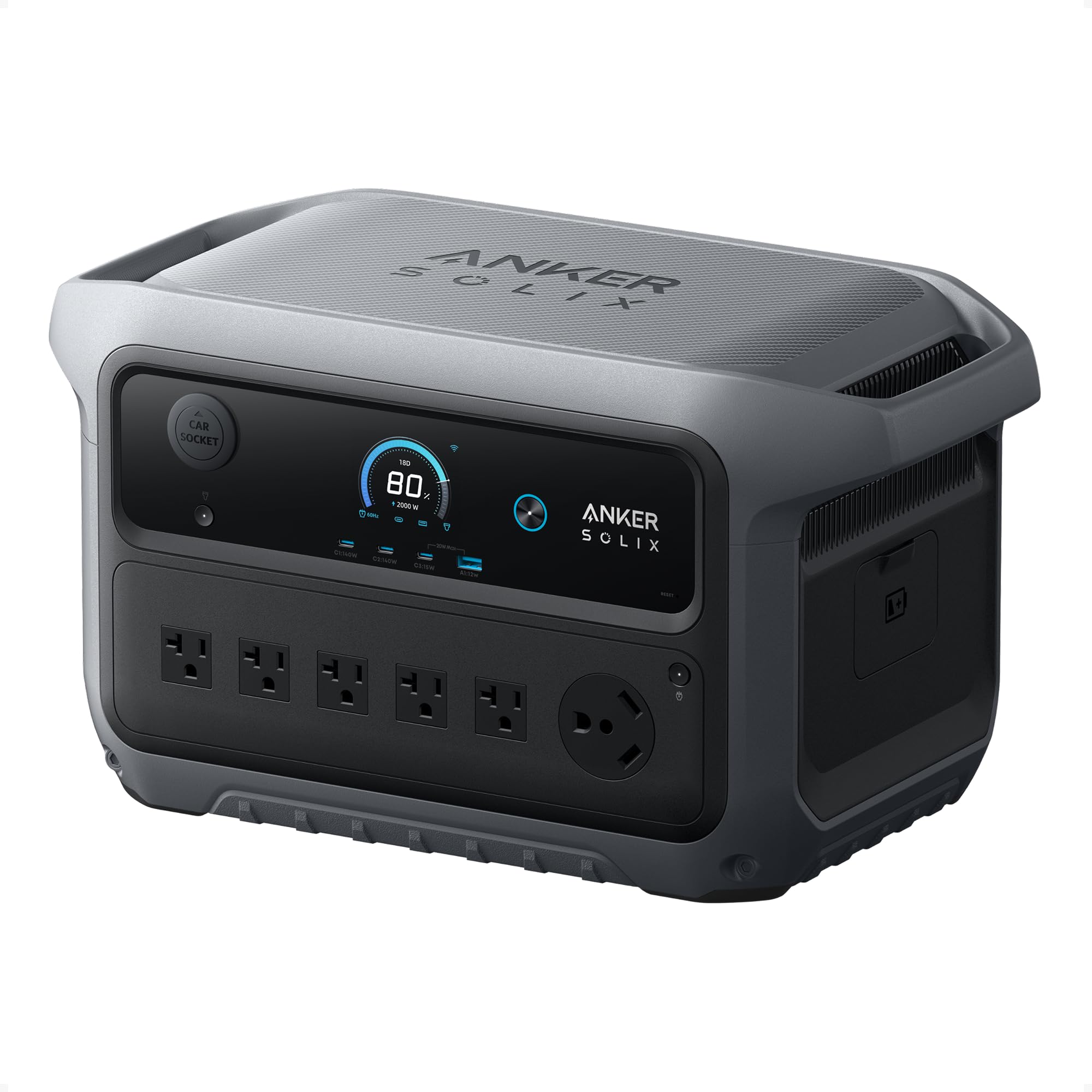
Fully recharged in under an hour — the fastest way back to full power after a storm.
If you hate waiting, this station is for you. With AC and solar combined, the C2000 Gen 2 hits 100% in just 58 minutes—remarkably fast for a 2048Wh unit. The 2400W rated output (4000W peak) runs most window and RV air conditioners, plus a miter saw, drill, and tool batteries all at once. Owners confirm it handles a camper’s AC for 1.5 hours and a fridge for days.
The standby draw is just 9W, so a dual-door fridge can run up to 32 hours on a single charge. Add an expansion battery and you’re at 4kWh — a 64-hour fridge run. At 41.7 lbs and 18.1″ x 9.8″ x 10.1″, the maker says it’s 25% lighter and 29% smaller than similar products. The 800W alternator charging tops it up from your car in 3 hours, which the maker says is 8x faster than a standard car socket.
Owners describe it as a great alternative to a gas generator for short outages — quiet, indoor-safe, and no fumes. One weekly remote-event user runs it at 70% after 4 hours of continuous use, and another powered an RV’s fridge, fans, and pumps for 3 days with 27% left. The five 3-prong outlets are a blessing for older homes with grounded plugs everywhere. The weight gets mixed feedback at 41.7 lbs — one owner recommends a wheeled case — but the performance and charging speed are the clear consensus winners.
Why People Love It
- Performance is the runaway top praise — 145 owners call it out
- Charging speed second: 58 minutes to full is class-leading
- 4000W peak output handles window ACs and power tools
The Balance
- Weight gets mixed reviews — 41.7 lbs needs a wheeled case for some
- App estimates can be inaccurate for cycling appliances like fridges
Reach for this when: you need maximum power restored fastest — the 58-minute recharge is the headline act.
Look elsewhere if: you want a built-in 12V DC port or the lightest possible 2kWh unit.
9. EF ECOFLOW DELTA Pro 3600Wh
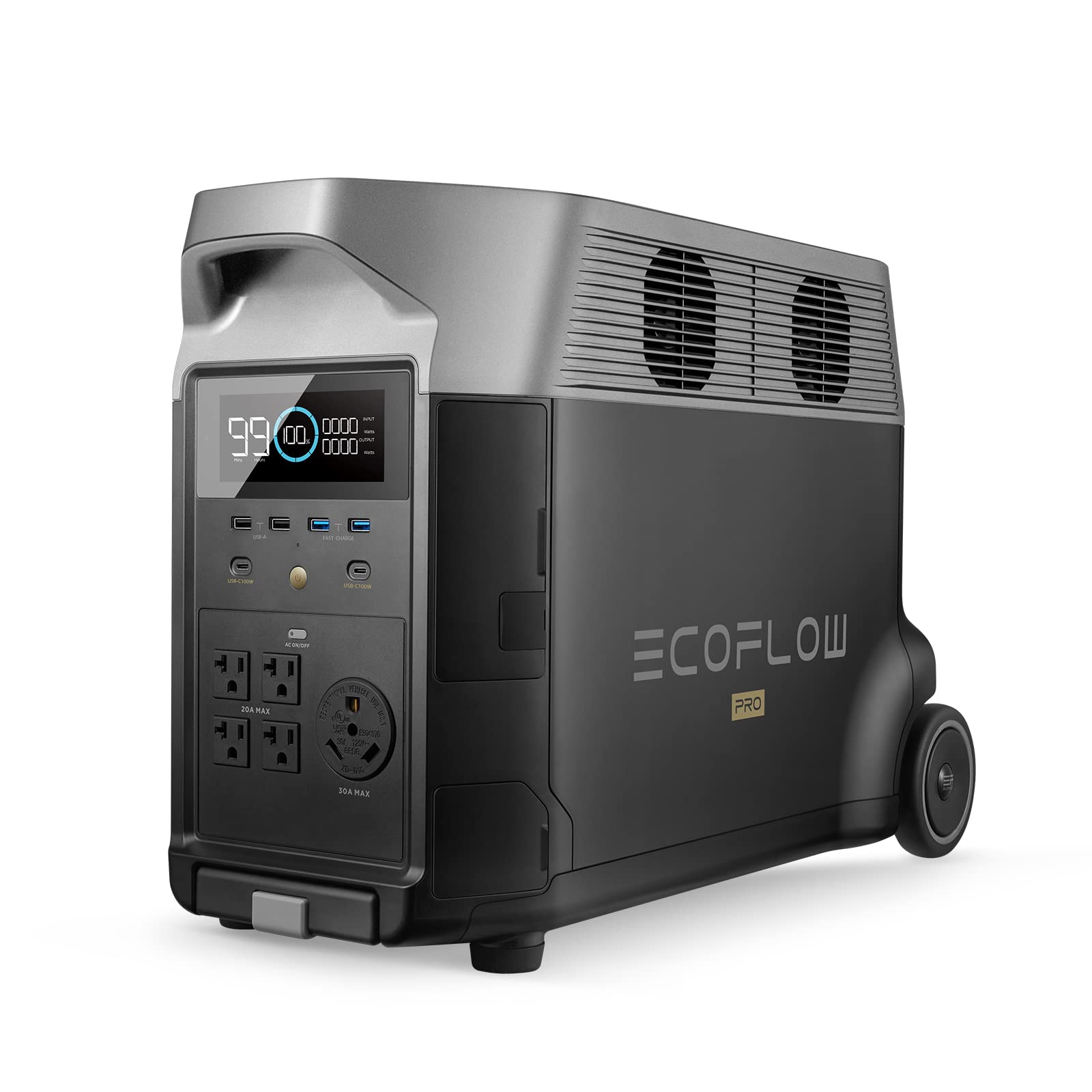
The endgame station — 3600Wh of storage that can power a whole house or a mobile business.
This is the biggest single-unit backup battery you can reasonably buy. The 3600Wh LFP capacity and 3600W AC output cover 99.99% of home and job-site devices, and the 5 AC outlets mean you can run multiple heavy loads simultaneously. One owner runs a heat press at vendor markets flawlessly — a mobile business powered entirely by battery. Expand with Extra Batteries or Smart Generators and you’re looking at up to 25kWh of total storage.
The X-Stream fast charging is genuinely impressive: a full recharge in 1.8 hours via a 240V outlet at 3000W, or 2.7 hours from a standard 1800W wall outlet. Solar charging works at up to 23% conversion efficiency, filling in 2.8 hours with 4x 400W panels. There are 5 ways to charge total — EV station, solar, wall, generator, or car outlet. Two DELTA Pro units can pair together for 7200W of output, which is serious whole-home territory.
Owners highlight the fast 2.7-hour recharge and up to 15 days of full charge retention. One ran it at 400W output for 9 hours straight without issue. The X-Boost technology expands output to 4500W for stubborn loads. The 15 output methods — including 2x USB-C at 100W, 2x USB-A Fast Charge, and an Anderson port — mean you’ll never run out of ways to plug things in. The honest downside is the 99 lbs. This is not portable in any practical sense; it’s a stationary home fixture you might wheel across a room. The fan also gets noisy under heavy load, and one unit arrived with a torn box that Amazon deemed non-returnable.
The Heavy Hitters
- Performance is the most-praised aspect — it powers heat presses and whole motorhomes
- Charging performance second: 2.7 hours to full from a wall outlet
- Expands to 25kWh — the only station on this list with true whole-home potential
The Reality Check
- Weight is the most-discussed downside — 99 lbs is a permanent fixture, not a carry-on
- Fan noise under heavy load gets called out regularly
This is the ultimate pick if: you need to power a whole home, an RV, or a mobile business and weight is irrelevant.
pass on it if: you plan to move your backup battery between rooms — the 99 lbs makes that impractical.
Understanding the Specs
Watt-Hours (Wh) — Your Total Energy
This is the fuel tank. It tells you how much total energy the battery stores. A 1070Wh unit can run a 100W fridge for roughly 10 hours; a 3600Wh unit runs it for over a day. Match this to what you need to keep alive, not to what sounds impressive.
Watts (W) — Your Power Flow
This is the pipe size. It tells you what you can plug in at once. A 1500W station runs most home essentials, but a microwave or power tool needs 2000W+ to start. The surge or peak rating (like 3000W) covers brief startup spikes, but the continuous rating is what you should compare.
LiFePO4 vs. Standard Lithium-Ion
LiFePO4 (Lithium Iron Phosphate) batteries last many more charge cycles — often 4000 to 6000 cycles versus 500 for older types. They also handle heat better and are safer. If you charge daily or keep it topped up for emergencies, the chemistry difference translates to years of extra life.
Pure Sine Wave Output
This describes the shape of the electricity coming out. Pure sine wave produces clean, stable power identical to your wall outlet. Sensitive electronics — CPAP machines, laptops, medical gear — need it to run safely. It’s a non-negotiable feature for most serious buyers.
Solar Input (MPPT)
How fast a solar panel can recharge your station. Measured in watts, this determines if you can sustain off-grid for days. A 200W input is fine for topping up; 800-1200W means you can genuinely live off solar in good sun.
UPS/EPS Switchover
How quickly the battery takes over when the grid fails. Look for under 10ms (milliseconds) — that’s fast enough to keep computers and routers running without a hiccup. Slower switchovers can cause equipment to reboot.
FAQ
How long will a backup battery run my refrigerator?
Can a backup battery run a CPAP machine all night?
What is the difference between watts and watt-hours?
Can I charge a backup battery with solar panels?
How long does a backup battery actually last before needing replacement?
Can I use a backup battery as a UPS for my computer?
What can a 300W backup battery power?
How do I maintain a backup battery that I only use occasionally?
Is it safe to use a backup battery indoors?
Can I expand a backup battery’s capacity later?
Final Thoughts: The Verdict
The standout backup battery for most households is the Jackery Explorer 1000 v2 — it balances 1070Wh of capacity, a 1500W output, and a manageable 23.8 lbs with the strongest owner reputation in the mid-size class. If you want the lightest grab-and-go option for camping or CPAP use, the DaranEner 192Wh delivers surprising runtime at 5.7 lbs. And for serious whole-home or RV power, the BLUETTI Elite 200 V2 brings 2600W of output and a 17-year lifespan to the table.
How We Picked
We do not accept paid placement. Every pick is matched to a real buyer and a real use-case; we do not hands-on test units.
Sources & Methodology
Specifications: manufacturer listings and product documentation. Review insights: verified customer reviews, as of August 2026. Pricing: not shown on this page (it changes often); check the current price via the retailer link.
As an Amazon Associate, Gadgets Feed earns from qualifying purchases. This does not affect which products we feature.