
Our readers keep the lights on and my morning glass full of iced black tea. As an Amazon Associate, I earn from qualifying purchases.
Specs are compiled from manufacturer listings and verified buyer reviews and can change over time — please confirm the key details on the product page before buying.
Cabinet table saws are the heavy hitters of the workshop — the machines that turn wobbly sheet goods into dead-square joinery without a second thought. But they’re also a big investment, so you want to choose right the first time. We’re looking at 5 serious contenders, from a 1-3/4 HP workhorse to a 5-HP industrial beast, to find the one that matches your shop’s real needs.
I’m Min — the founder and writer behind Gadgets Feed. This guide is built by comparing the manufacturers’ published specifications and the patterns across verified customer reviews, so you get each pick’s real strengths and trade-offs instead of marketing spin.
We’ve focused on the features that actually matter for a cabinet table saw — motor horsepower, fence accuracy, dust collection, and the safety systems that protect your fingers.
Our Picks at a Glance
How To Choose The Best Cabinet Table Saw
Before you commit to a machine that weighs more than a small motorcycle, you need to match the saw’s specs to your shop’s electrical setup and the work you actually do. A 3 HP saw on 230V will not run on a standard 110V outlet — and that alone kills most “just bought it home” plans.
Motor and Electrical
Cabinet saws typically run 3 HP or higher, but they need a 220V or 240V circuit to get there. Check your shop’s breaker panel first. A 1-3/4 HP saw like the Powermatic PM1000 can run on a 115/230V dual-voltage setup, which gives you more flexibility about where you plug it in.
Rip Capacity and Fence
The rip fence is the part you’ll touch on every single cut. A 50-inch rip capacity lets you split a full sheet of plywood down the middle and still have room for the fence on the other side. The 7-foot rails on some Grizzly models push capacity even further, making them the solo-friendly choice for full-sheet work.
Safety Systems
The biggest differentiation among these picks is safety. The SawStop stops the blade in under 5 milliseconds on skin contact — a different class of protection than a riving knife that only reduces kickback risk. If you value your fingers over your budget, that changes everything about the decision.
Quick Comparison
| Model | Best For | Motor | Weight | Cutting Angle | Amazon |
|---|---|---|---|---|---|
| JET XACTA Deluxe★ Best Overall | Best Overall — precision and value | 3 HP, 230V | — | 45 degrees | Amazon |
| SawStop ICSPremium Pick | Premium Pick — skin-contact safety | 5 HP | ~700 lbs | — | Amazon |
| Grizzly G1023RLX | Top Performer — commercial build | 3 HP, 240V | 402 lbs | 90 degrees | Amazon |
| Grizzly G0651 | Budget Champion — value for power | 3 HP, 220V | 435 lbs | 45 degrees | Amazon |
| Powermatic PM1000 | Best Value — single-phase flexibility | 1-3/4 HP, 115/230V | 330 lbs | 60 degrees | Amazon |
In-Depth Reviews
1. JET 10-Inch Deluxe XACTA Table Saw
Our pick — over 4★ from 40+ verified ratings; the strongest balance of quality and price.
The 50-inch rip fence that turns full plywood sheets into solo-friendly work
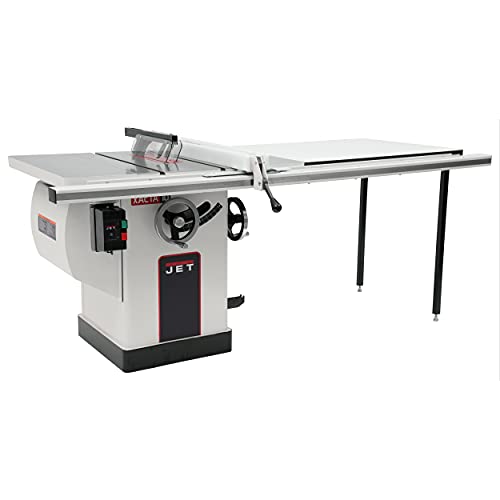
The JET XACTA Deluxe earns the top spot because it pairs a 3 HP, 230V motor with the exclusive 50-inch commercial XACTA fence II — a T-square design that stays square and lets you rip a 4×8 sheet without flipping it around. The 11-inch cast iron extension wings on both sides give you the largest table surface in its class, so a full sheet has somewhere to rest while you push it through.
Owners who upgraded from contractor saws like the Ridgid TS3650 say it cuts 3/4″ birch plywood easily, with no kickback or saw marks. What wins people over is the build quality — the most-discussed aspect by far — and the assembly experience, with the table and fence arriving pre-aligned. The poly-V drive belt keeps operation quiet, and the push-button arbor lock handles blade changes in seconds.
The honest trade-off: setup is a project, not a plug-and-play. Assembly runs about 8 hours for some, and a few units arrived with the wrong fence rails or cheap bolts that needed replacing. It also needs a 220V cord and plug, so budget for an electrician if your shop doesn’t have the outlet. The dust collection is a real strong point — the enclosed blade housing with a vacuum hookup means you may not even need a mask. As buyers report: it’s a “Powerful upgrade from Ridgid TS3650; cuts 3/4″ birch easily.”
What Owners Rave About
- Cuts 3/4″ birch easily with its 3 HP motor
- 50-inch rip capacity handles full sheets solo
- Enclosed blade housing with vacuum hookup for clean air
- Quick-release riving knife minimizes kickback risk
What to Know Before You Buy
- Assembly can take 8 hours for some owners
- Requires a 220V circuit — not a standard 110V plug
- Some units shipped with wrong fence rails or weak bolts
Reach for it if: you want the best blend of power, precision, and a 50-inch rip capacity for serious full-sheet work.
Look elsewhere if: you only have a 110V outlet — this needs 220V, so factor in an electrician’s visit.
2. SAWSTOP 10-Inch Industrial Cabinet Saw
The blade stops in five milliseconds — the only saw that treats your fingers like a priority
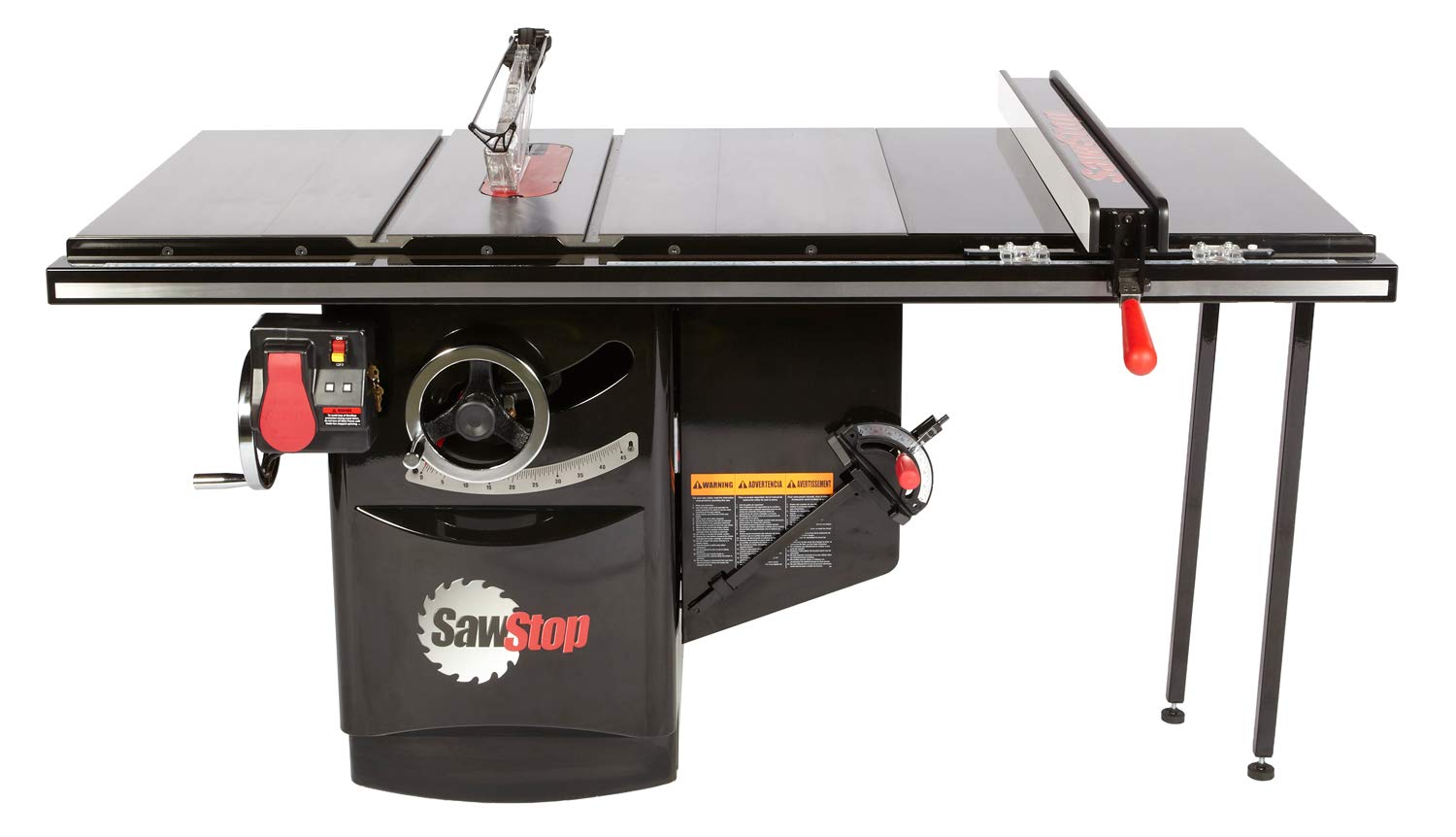
The SawStop ICS51230-TGI236 is in a league of its own because of one feature: the patented brake that stops a spinning blade on skin contact in under 5 milliseconds, dropping it below the table and turning a life-altering injury into a mere scratch. That’s not a marketing line — it’s a fundamental difference in how the saw protects you.
The machine around that safety system is equally serious. It’s built from almost 700 lbs of iron and steel, delivering 5 HP in a chassis that owners describe as “super quiet, no vibration.” The 36-inch industrial T-glide fence is made of heavy-gauge steel for lockdown that stays square for years without deflection. Dust collection hits 99% both above and below the table — critical for all-day use in a closed shop.
The catch is real and practical. This is a 700-pound machine — owners advise having 5 people handy to position it or ordering the rolling stand. A few shipped units arrived with minor defects like a misaligned blade or a missing washer, which suggests quality control isn’t flawless at this price. And while the safety brake is brilliant, there are scattered reports of the brake triggering without contact. The most expensive saw on this list by far, but it’s the one that offers a different class of protection for your hands.
Safety first, literally: The 5 ms blade stop is the single most compelling reason to spend up — no other saw here can make that claim.
Best for: the shop owner who refuses to gamble with their fingers and wants industrial-grade power with zero vibration.
Think twice if: your budget is tight or you don’t have a 5-HP circuit — the safety system is priceless, but only if you can actually feed it.
3. Grizzly Industrial G1023RLX

A 7-foot rail and 90-degree bevel range make this the most versatile cutting platform here
For the woodworker who wants maximum flexibility, the Grizzly G1023RLX stands out with its 7-foot rails and a 90-degree cutting angle — double the vertical range of the JET’s 45 degrees, meaning you can make square crosscuts that other machines physically can’t. The 3 HP, 240V motor spins at 3450 RPM with 14A of draw, and the 5/8″ diameter arbor accepts dado blades up to 13/16″ for joinery work.
Owners describe it as “commercial quality” and use it regularly — high praise for a tool that earns its keep. The solid cast iron table is first heat-treated for strength, then milled flat and ground to a mirror-like finish, so your workpieces glide without catching. The extension table measures 44″ x 27″, and the T-slots keep your miter gauge from falling off the table when retracted.
This saw is the kind of tool you buy once and keep for decades. The trade-off is that it’s a bare tool — no miter gauge or blade guard included — so you’ll be adding accessories separately. Some owners mention the box arriving without critical parts, which is a risk with any heavy shipment. At 402 pounds, it’s the lightest of the two Grizzlys here but still a two-person job to set up. For the serious hobbyist who wants commercial build quality without the industrial price tag, this delivers.
Where It Shines
- 90-degree cutting angle — versatile cuts others can’t make
- 5/8″ arbor takes dado blades up to 13/16″
- Mirror-like cast iron table for smooth, accurate cuts
Where It Costs You
- Ships as a bare tool — no guard, miter gauge, or stand
- 402 lbs means heavy lifting to assemble
- Occasional reports of missing parts in the crate
Who it suits: the intermediate-to-pro woodworker who needs maximum cutting range and wants to add their own accessories.
Not for: the first-time saw buyer who expects a complete package — budget for extra purchases and assembly help.
4. Grizzly Industrial G0651 Heavy Duty Cabinet Saw
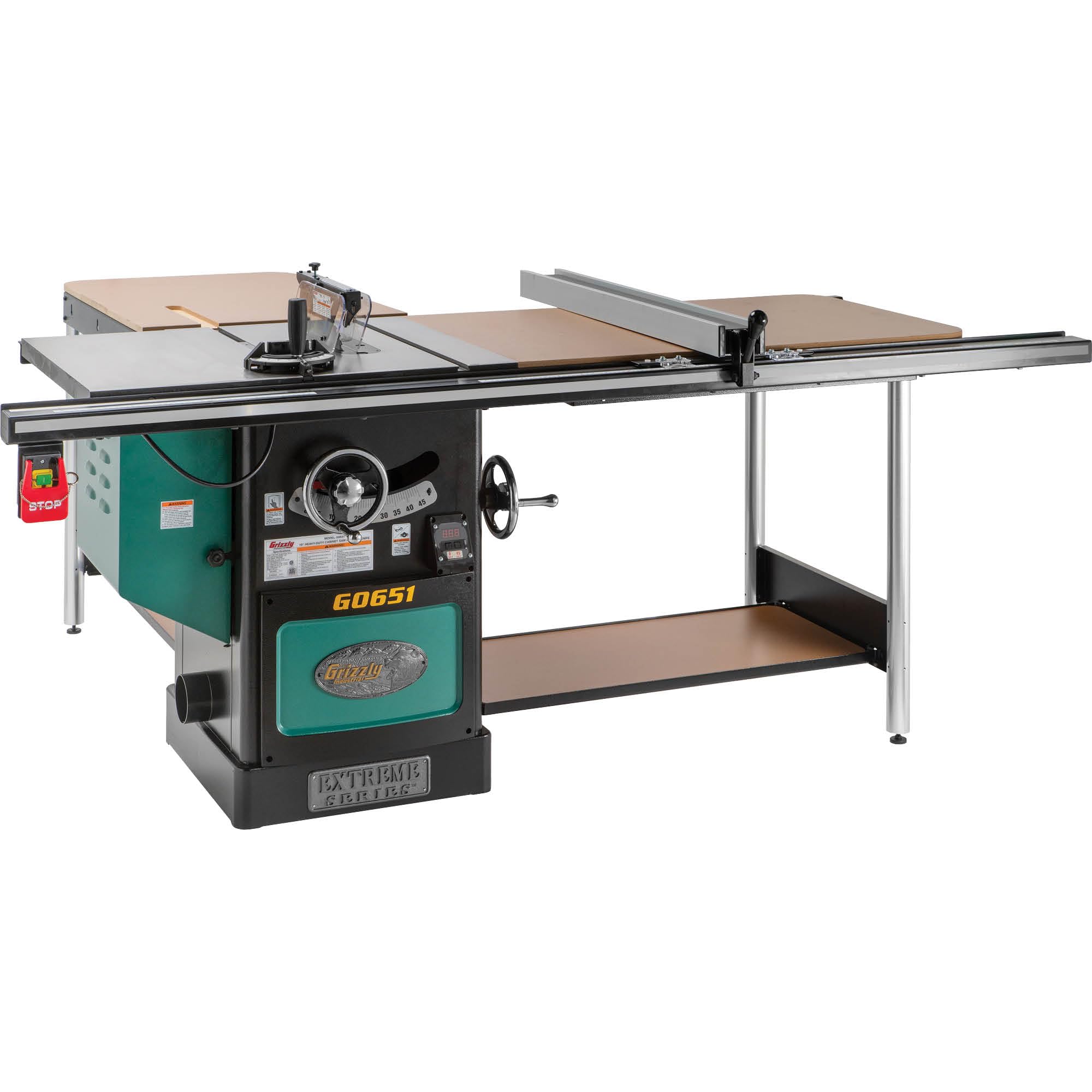
The biggest table surface here — 75-3/4 inches wide — for handling full sheets solo
The Grizzly G0651 gives you the most table for your money. With side and back tables included, the 75-3/4″ wide surface lets you manage full plywood sheets by yourself, while the 3 HP, 220V motor powers through hardwood easily. Owners call it “solid” and “powerful,” noting that dato changes are easy and the digital angle readout keeps setup fast.
At 435 pounds, this is the heaviest saw among the Grizzly pair — and that weight is exactly why it cuts so true. A 13A draw delivers the muscle you need for thick stock, and the left-tilt 45° blade lets you do precise bevel work. The fence earns consistent praise for its accuracy, a critical factor when you’re setting up repeated cuts.
The caveats are worth knowing: one owner reported a motor failure after a few months of use with no replacement available under warranty, and others noted QC quirks like shallow-tapped legs or a factory dent. Grizzly’s customer service drew lukewarm reviews in those cases. For the budget-conscious woodworker who wants a full-size cabinet saw, this is the strong value play — just inspect it carefully on arrival.
Most table per dollar: The 75-3/4″ surface and included side/back tables make this the practical choice for sheet-goods work.
Pick this if: you want a full-size 3 HP cabinet saw without the premium-brand markup and you handle a lot of plywood.
skip it if: your shop has no 220V outlet, or if you need a warranty you can absolutely rely on — Grizzly support was hit-or-miss for some.
5. Powermatic PM1000 Cabinet Saw

The only saw here that runs on a standard 115V outlet — flexibility you can plug in anywhere
The Powermatic PM1000 is the accessible entry point into real cabinet saws, because it runs on 115/230V dual-voltage — meaning it works on a standard 110V outlet, unlike every other saw on this list that demands 220V. At 1-3/4 HP it’s the least powerful here, but it’s also 330 pounds — noticeably lighter than the Grizzly competition, which makes it easier to move and set up.
Owners who upgraded from a contractor saw call it a huge improvement: quieter with the poly-V belt drive, better dust collection, stable, and accurate. The ergonomic 7-inch handwheels give you momentum for easy blade height and bevel adjustments, and the arbor lock means one-handed blade changes. The exclusive Accu-Fence provides rigidity and precision, and the miter gauge pivots 60 degrees to either side for a full range of cuts.
Power is the honest limitation here — owners note it handles thicker and denser materials with less authority than a 3 HP machine, and some found the riving knife misaligned straight from the start. There’s a real quality-control concern too: one owner reported a defective switch within 20 days, and the Amazon Prime return process shunted them to the manufacturer instead of helping directly. For the smaller shop or garage woodworker who doesn’t have 220V wired, the PM1000’s plug-in flexibility makes it the smart choice — just be ready to set it up carefully and verify alignment before you commit to heavy cuts.
The Practical Wins
- Runs on standard 115V — no electrician required
- Lighter at 330 lbs, easier to move and assemble
- Quiet poly-V belt drive and smooth handwheels
The Real Trade-offs
- 1-3/4 HP struggles with very thick or dense stock
- Some units ship with riving knife misaligned
- QC issues reported — check the switch and fence early
Choose this for: the home workshop on a standard outlet that wants a real cabinet saw without rewiring the garage.
Not for: heavy production work or thick hardwoods — the 3 HP siblings here will outmuscle it easily.
Understanding the Specs
Horsepower and Voltage
Cabinet saws trade raw horsepower for the electrical cost of running it. A 3 HP motor needs a 220V or 240V circuit — that’s the single biggest gotcha for buyers. The 1-3/4 HP Powermatic runs on standard 115V, which is why it’s the flexible pick. Always check your breaker panel before you buy; a saw you can’t plug in is just a very expensive paperweight.
Rip Capacity
Rip capacity is how wide a board you can cut between the blade and the fence. A 50-inch rip lets you split a 4×8 plywood sheet down the middle and still have room on the other side. Shorter 30-inch and 36-inch fences are fine for most furniture work but mean more maneuvering with full sheets. The 7-foot rails on the Grizzly G1023RLX push that capability even further.
FAQ
What voltage do I need for a cabinet table saw?
Can the SawStop safety brake really prevent serious injury?
What does rip capacity mean for my workshop?
Is it hard to assemble a cabinet table saw?
How heavy are these saws and does weight matter?
What is a riving knife and why do I need it?
Which saw is best for cutting thick hardwood?
What should I inspect when my saw arrives?
Final Thoughts: The Verdict
For most buyers, the cabinet table saw winner is the JET XACTA Deluxe because it delivers 3 HP, a 50-inch rip, and the largest table surface in its class — with the most positive owner reviews in its group. If you want the highest level of finger protection, grab the SawStop ICS. And if your shop only has a standard 115V outlet, the Powermatic PM1000 is the one to reach for.
How We Picked
We do not accept paid placement. Every pick is matched to a real buyer and a real use-case; we do not hands-on test units.
Sources & Methodology
Specifications: manufacturer listings and product documentation. Review insights: verified customer reviews, as of August 2026. Pricing: not shown on this page (it changes often); check the current price via the retailer link.
As an Amazon Associate, Gadgets Feed earns from qualifying purchases. This does not affect which products we feature.