
Our readers keep the lights on and my morning glass full of iced black tea. As an Amazon Associate, I earn from qualifying purchases.
Specs are compiled from manufacturer listings and verified buyer reviews and can change over time — please confirm the key details on the product page before buying.
You can step into virtual reality without buying a gaming console or a powerful computer. These headsets turn the smartphone already in your pocket into a portal for 360° videos, 3D films, and interactive games — the key is matching the goggles to your phone’s size and your tolerance for apps that may not cooperate with iOS.
I’m Min — the founder and writer behind Gadgets Feed. This guide is built by comparing the manufacturers’ published specifications and the patterns across verified customer reviews, so you get each pick’s real strengths and trade-offs instead of marketing spin.
Phone-based VR lives or dies on lens quality and phone fit, so this look at the best affordable virtual reality headset choices for every budget focuses on the specs that actually change what you see.
Our Picks at a Glance

How To Choose The Best Affordable Virtual Reality Headset
Every headset here is a plastic shell with lenses that you slide your phone into. There’s no built-in screen and no processing power, so your choice depends on three things: does your phone fit, can you see clearly through the lenses, and how much interaction do you really need?
Phone Size Is The First Filter
Before anything else, measure your phone’s screen diagonally. Most of these headsets accept phones between 4.7 and 7 inches, but the exact range varies — one pick here is built for screens up to 7.2 inches, while another tops out at 6 inches. A phone that’s too big simply won’t close properly, and one that’s too small leaves you staring at a floating image in black space. If you use a thick case, you may need to remove it for the phone to sit flush against the lenses.
Field Of View And Lens Adjustments
The field of view (FOV) is how wide the visible picture is, measured in degrees — the wider it is, the more the edges of the virtual world fill your peripheral vision. Most budget headsets offer between 100 and 120 degrees. Just as important are the lens dials: interpupillary distance (IPD) adjustment matches the lenses to the space between your eyes to stop double images, and focus adjustment sharpens the view for your particular vision. Some headsets even support eyeballing it directly if you’re nearsighted within 600 degrees, which means you can ditch your glasses.
Controller Caveats And App Reality
A Bluetooth controller bundled in the box sounds great, but check the fine print. Several brands admit their remote works fully on Android for steering wheels, swords, and navigation, while on iOS it’s often limited to simple functions like volume or YouTube playback. Also be aware that no phone-based headset converts regular videos to 3D — you have to download VR apps or search for side-by-side panoramic content yourself. Manage those expectations and The experience is genuinely fun.
Quick Comparison
| Model | Best For | Field of View | Phone Fit (inches) | Glasses Support | Amazon |
|---|---|---|---|---|---|
| Heromask Essentials★ Best Overall | First-time VR with precise lens tuning | Not specified | Screens up to 16 cm x 8 cm | Yes, plus 600° myopia dials | Amazon |
| DESTEK V5Best Value | All-ages family fun with controller | 110 degrees | 5.5 to 7.0 | Yes, anti-blue light | Amazon |
| TECKNET TK-VR005 | Extra-large phones and long sessions | 90° to 110 degrees | 4.7 to 7.2 | Yes, within 600° myopia | Amazon |
| SENYHPHC Glasses | Built-in audio for movies | 100 degrees | 4.7 to 7.0 | Yes, within 600° myopia | Amazon |
| VR SHINECON | High-res phone screens | 100 degrees | 4.7 to 6.0 | Yes, within 600° myopia | Amazon |
| Sharper Image Bluetooth VR | Wireless audio, no cables | 120 degrees | Up to 6.7 height | Not specified | Amazon |
In‑Depth Reviews
1. Heromask Essentials VR Headset for Phone
Our pick — over 4★ from 20+ verified ratings; the strongest balance of quality and price.
The sharpest entry point for glasses wearers who want dial-perfect focus.
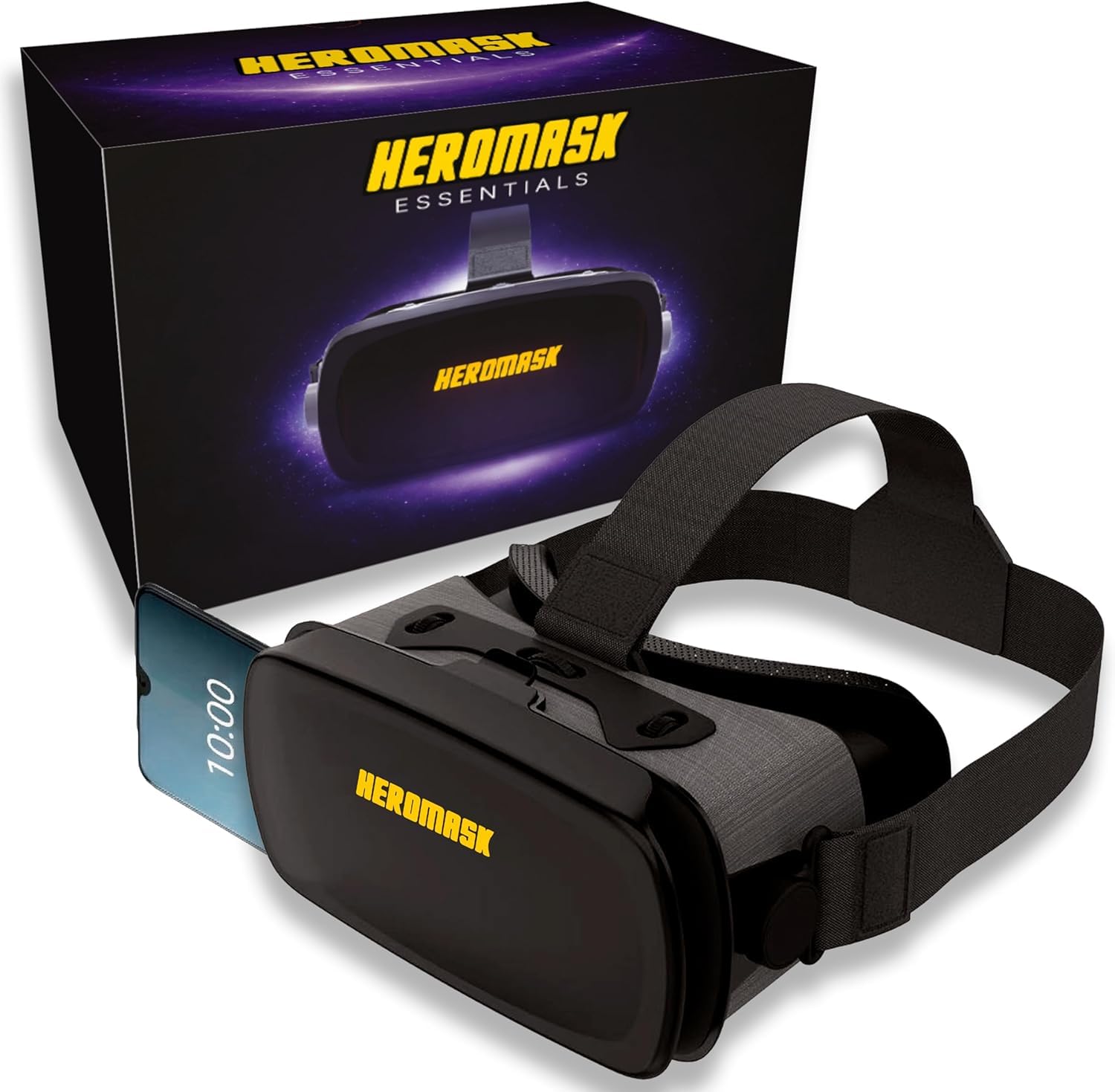
What wins people over here is the honesty of the design: three separate dials let you tune the interpupillary distance (the space between your eyes) and focus for each eye independently, so the image lands crisp without you needing to wear your glasses at all. Buyers report it as “Good VR entry headset; simple phone insert, works with iPhone 17.” The package fits phones with screens up to 16 cm x 8 cm, covering current iPhone and Samsung models comfortably.
The soft foam cushioning sits gently against your face, and the adjustable straps spread the weight well enough that longer sessions don’t turn into a neck workout. Several owners note the build is durable — one survived an actual drop without damage. The trade-off is that your phone’s display quality sets the ceiling: a Full HD+ screen keeps the pixel grid invisible, while lower-resolution phones show a visible mesh.
It comes with a curated guide to the best VR apps and a two-year warranty if the unit arrives factory damaged, plus English tech support over WhatsApp. For a first dip into 360° content on a mid-range budget, this is the one reviewers call “a surprisingly good, comfortable and affordable introduction to smartphone VR.”
Dialed-in clarity: individual focus per eye means no compromise for nearsighted users or glasses wearers, and the weight distribution keeps it comfortable across the whole family.
Reality check: your phone’s resolution, not the headset, decides sharpness — bring a clean Full HD+ screen to avoid seeing the pixel grid.
Reach for this if: you wear glasses or want precise per-eye focus tuning without stepping up to premium pricing.
The catch: the straps are passable but not premium-grade, so the fit is the one corner that gets cut.
2. DESTEK V5 VR Headset for Phone & Kids
The featherweight 4.8-ounce family set that turns your phone into a shared toy.
At just 4.8 ounces, this is the lightest headset in the lineup, and the whole kit — goggles plus a Bluetooth controller — is built around being passed around a household. As owners put it: “Gave this to my sister for her birthday and it was a big hit.” The 110° field of view gives a wide, private-cinema feel, and the anti-blue light lenses are designed for young eyes over a nine-year design refinement.
The bundled controller doubles as a steering wheel, sword, or remote inside supported VR apps. Critical fine print: on iPhones the controller is limited to YouTube playback controls, while Android open up full motion control and navigation. The headset itself fits all phones from 5.5 to 7.0 inches, and owners confirm snug fit even while wearing glasses — One buyer uses it for VR therapy via a phone app and reports it “works perfectly.”
Battery life on the controller is described as long-lasting once charged, which matters for a device that’s likely to be fought over at a birthday party. It ships with access to a library of over 100 apps and a one-year support window, making it a ready-to-gift starter set that’s “a fun alternative to the more expensive full version.”
What the crowd loves
- Featherlight at 4.8 oz so kids can play for long stretches
- Glasses-friendly fit with anti-blue light lenses
- Controller + 100+ app library included in the box
Know before you buy
- Controller is YouTube-only on iPhones; full control needs Android
- Phone must be between 5.5 and 7.0 inches to fit
Best for: families and gift-givers who want the most complete starter kit for the least complexity.
Look elsewhere if: you’re an iPhone owner expecting full controller navigation in games — that power is Android-only here.
3. TECKNET VR Headset with Bluetooth Controller

The 268-gram pick that swallows the biggest phones and breathes while you game.
This headset’s headline number is its compatibility range: it accepts phones from 4.7 up to 7.2 inches, the widest spread in this list. That means oversized phablets that jam other goggles fit here, and screens 6.2 inches or larger can have the frame removed for a perfect fit with improved heat dissipation. Weighing just 268g with a breathable soft foam mask, it’s built for the long-haul sessions TECKNET’s marketing openly targets.
The dual independent lenses support naked-eye viewing if you’re nearsighted within 600 degrees, and the adjustable pupil distance and focal length cut down on the aberration that causes eyestrain. Blue-light protection lenses are included as a comfort play for marathon viewers. A Bluetooth controller arrives in the box for gaming and interactive learning, and The 36-month warranty (for registered users) is the longest protection in this roundup.
Be honest with yourself about the app side: TECKNET explicitly notes this headset will not convert regular images to 3D, so you must download VR apps or watch panoramic videos yourself. That expectation-setting is why prepared owners enjoy it, while those expecting plug-and-play magic bounce off. The recurring critique among reviewers is the bundled controller — some find the stick and trigger unresponsive, calling it a weak link in an otherwise sturdy package.
Size-flexible comfort: the 4.7-7.2 inch range plus the removable frame for large screens makes this the safest fit bet for a household with mixed phone brands.
Notable trade-off: the controller quality draws mixed feedback in reviews, so treat it as a bonus rather than the main reason to buy.
Reach for this if: you have a phone larger than 6.5 inches or want max-size flexibility across a family’s worth of devices.
Keep in mind: game interaction depends on a controller that some owners find hit-or-miss, so don’t let that be your deciding factor.
4. SENYHPHC VR Headset with Remote Controller
An entry-level multimedia viewer with its own adjustable earphones for movie night immersion.
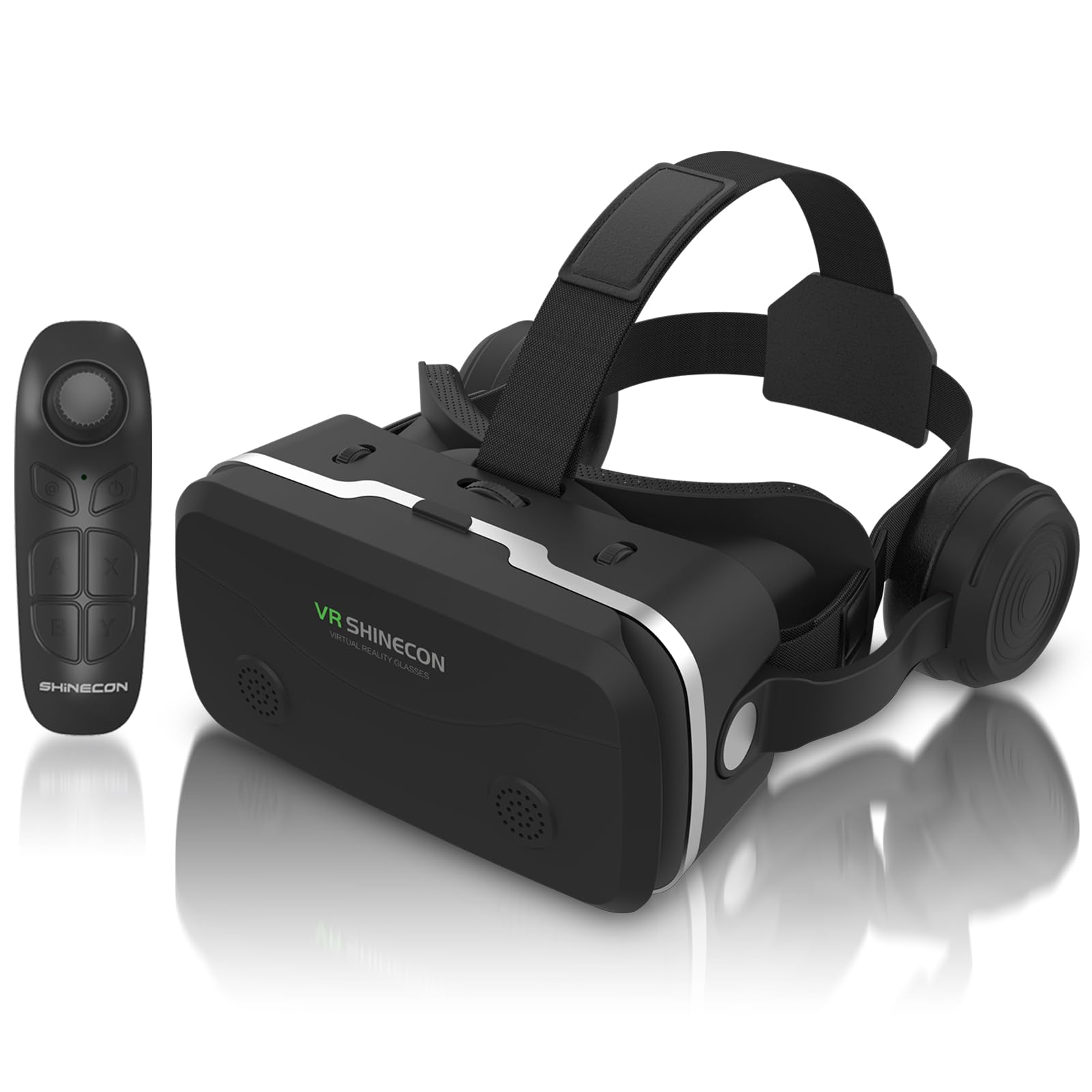
What separates this pick from the others is audio: it ships with comfortable adjustable earphones and 3D phase sound technology for spatial, bass-heavy listening, so you don’t need separate Bluetooth earbuds. A 3.5mm jack backs it up if you’d rather use your own wired set. The 42mm double spherical optical lens delivers a 100° wide view, and multi-function buttons handle volume, fast-forward, and answering calls without digging out your phone.
It accepts phones from 4.7 to 7 inches, and the independent lens pair supports myopia viewing below 600 degrees without glasses. Setup is genuinely plug-and-play: download VR apps, search for a side-by-side 3D video, slide the phone in, and adjust the pupil distance. The manufacturer is upfront that pop-up ads come from downloaded apps, not the headset, and that some third-party software simply won’t support the Bluetooth remote.
The honest caution: satisfaction here is polarizing. Some call it “lightweight, simple, yet versatile,” while several report units breaking within a month or apps failing to work with their phone. Buyers pick it for the integrated audio experience, but the inconsistent quality control means it’s a gamble better suited to patient, low-cost experimentation than to someone needing reliable performance from the start.
rich sound: the built-in adjustable earphones with spatial audio make this the only true all-in-one audio solution in the roundup.
Quality variance: while some find it a great value, others hit dead apps or early breakage — a real mixed bag in the reviews.
Best for: a budget-minded viewer who wants one device that handles both visuals and sound without extra accessories.
Think twice if: reliability is non-negotiable for you — the failure reports in reviews are frequent enough to take seriously.
5. VR SHINECON Headset with Remote Controller

The optical upgrade for high-resolution phones, capped at a 6-inch fit.
This model aims higher on optics than its price suggests. It uses Japanese SLR optical PMMA material with a 45mm short focal length design, and it’s rated to handle a display resolution up to 1284×2778 per eye — so owners with premium, high-PPI phones get about the sharpest possible view from a phone-based headset. The 100° wide angle approximates the natural human field of view, and a bottom button lets you adjust volume, fast-forward, rewind, or answer calls.
The catch begins with size: it only fits phones between 4.7 and 6 inches, which locks out many modern phablets and larger iPhones. The myopia support to 600 degrees and independent pupil/object distance adjustment keep it glasses-friendly, but one owner who wears glasses reports being unable to see clearly without them. The bundled Bluetooth remote is a sore point — iOS incompatibility with versions 11.2.5 and higher means the controller often fails on iPhones, and some Android users find it doesn’t work universally either.
Review sentiment splits down the middle. Grandkids and grandpas alike praise it for birthday gifts and constant use, calling it “good quality” and “very comfortable on his head.” On the flip side, a frustrated buyer with an iPhone 12 found the remote useless and could only watch videos. If you have an Android phone with a screen under 6 inches, the optics make this a real bargain; if you’re an iPhone owner, treat the controller as decorative.
Optical clarity: the PMMA lenses and 1284×2778 per-eye support reward owners of high-resolution Android phones with a genuinely sharp image.
Compatibility trap: the 6-inch phone cap plus the iOS controller limits make this a bad fit for large-screen or Apple users.
Reach for this if: you own a compact Android phone under 6 inches and care about squeezing maximum sharpness from its screen.
skip it if: you use a recent iPhone — the remote’s iOS incompatibility neuters the interactive experience.
6. Sharper Image Bluetooth VR Headset with Earphones
The widest 120-degree view in the roundup, with speakers built right into the frame.
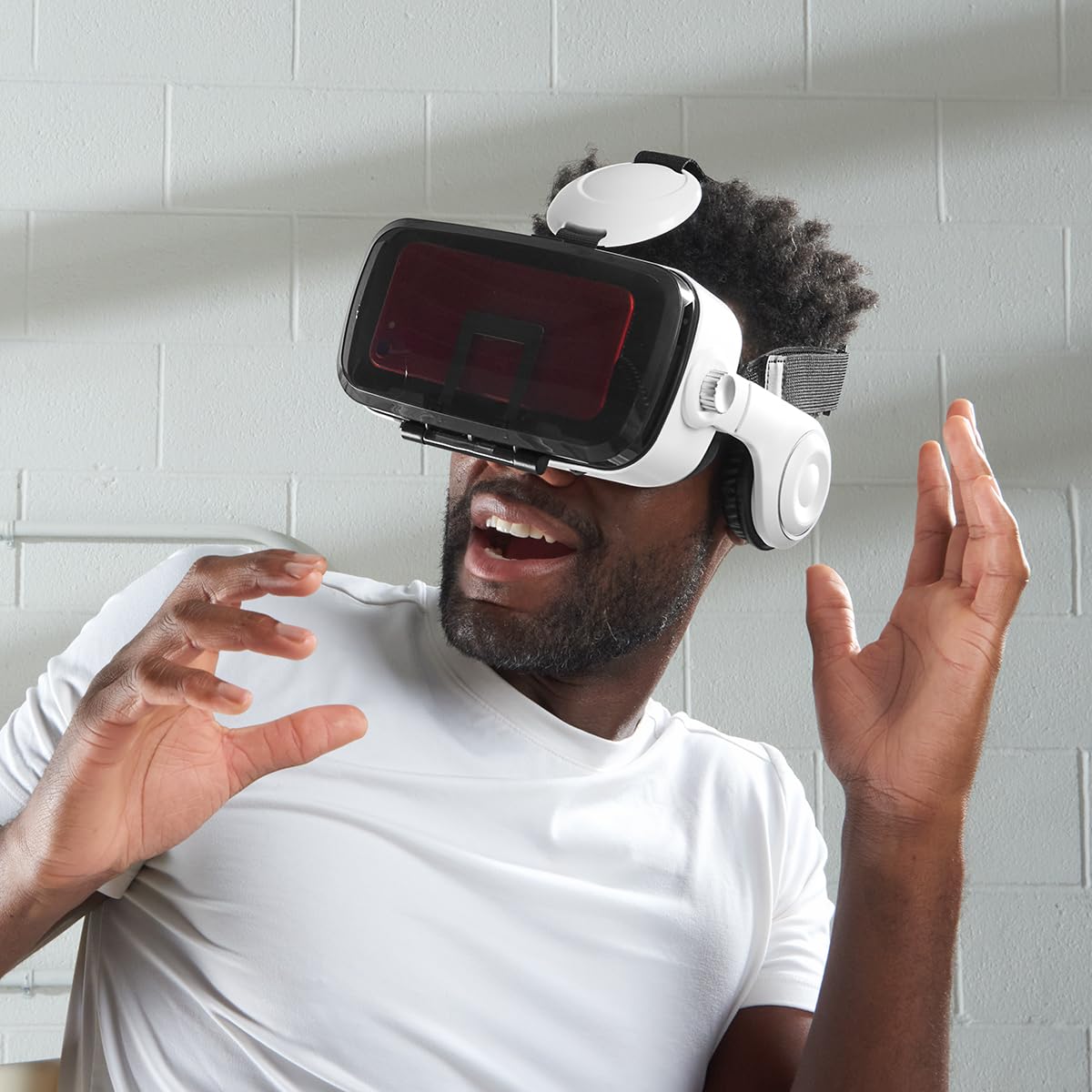
This Sharper Image headset stakes its claim on the broadest field of view here — 120 degrees — which pushes the virtual image far into your peripheral vision for a more convincing sense of immersion. It also packs built-in speakers and a touchscreen button, with Bluetooth handling the wireless connection, so there are no cables and no separate earbuds to track down before a session. The LCD display supports a 1080p (1080×1920) maximum resolution, which is plenty for side-by-side 3D video on most phones.
Phone compatibility is the sharpest limitation: it’s built for smartphones up to 6.7 inches in height, which is more restrictive than a pure screen-size spec. One buyer found it simply incompatible with a grandson’s phone as too large, though it worked fine on the parents’ phones once the cases were removed. The listed supported models stop at iPhone 13 Pro and Galaxy S22, so verify your device against the features tab before ordering.
Reviews divide hard on quality. The emotional highs are real. — One owner credits it with giving a granddaughter fighting cancer a brief respite during chemo treatment., and another calls it “a great gift for the guy who has everything.” But the quality complaints are equally real, including a defective unit with a totally blurred lens that the seller made difficult to return. For a 120° viewing experience with integrated audio, it’s a strong concept let down by inconsistent manufacturing.
Wide and wireless: the class-leading 120° FOV plus built-in Bluetooth speakers make this the most rich all-in-one media viewer on the list.
Inconsistent output: some units arrive with badly blurred lenses, and the fit ceiling at 6.7 inches excludes the latest big phones.
Best for: Android owners with a phone at or under the 6.7-inch height limit who want the widest possible view without extra audio gear.
Approach with care: the QC reports of defective blurred lenses make this a buy-and-inspect-immediately situation, ideally through a retailer with easy returns.
Understanding the Specs
Field of View (FOV) in Degrees
This number tells you how wide the virtual picture appears when you look through the lenses. A 90° view feels like watching through a window, while a 120° view lets the image bleed into the corners of your eyesight, which your brain reads as being inside the scene. It’s measured in degrees, and for a phone-based headset, 100° to 120° is the sweet conventional range.
Phone Screen Size and Resolution
Every headset here has a phone-fit range in inches (like 4.7 to 7.0) that decides whether your device closes correctly. The image sharpness itself comes from your phone’s pixels per inch (PPI) — a higher-resolution screen means less visible grid between pixels. Some headsets list a maximum supported display resolution, but that’s a ceiling, not a guarantee of that sharpness.
Interpupillary Distance (IPD) and Focus Dials
IPD is the distance between your pupils, and it differs from person to person. If the headset’s lenses don’t match yours, you see a double or blurry image. Look for separate focus dials or a triple-interpupillary adjustment system — these let you tune each eye independently, which is essential if you wear glasses. Many headsets here also support viewing without glasses if you’re nearsighted within 600 degrees.
Bluetooth Controller and iOS Limits
A bundled controller adds interaction, but its functionality hinges on your phone’s operating system. Android phones typically open up full motion control, steering, and navigation in supported apps. iPhones face a wall: due to Apple’s closed system, several manufacturers admit the controller is limited to basic functions like music playback and YouTube video controls. Read the fine print before counting on a controller for games.
FAQ
Will these VR headsets work with my iPhone?
Do I need a gaming console or computer to use these headsets?
Can I wear my glasses inside the headset?
Will the headset convert regular videos to 3D?
What phone size do I need for the DESTEK V5?
How does the Bluetooth controller work differently on Android vs iPhone?
Is a high-resolution phone necessary for a good VR picture?
How much does a typical headset weigh?
Does the SENYHPHC headset have built-in audio?
Final Thoughts: The Verdict
For most people, the best affordable virtual reality headset is the Heromask Essentials because its triple-dial lens tuning makes every session clear for glasses wearers and non-wearers alike, and its two-year warranty backs an under- investment. If you want a complete family kit with a Bluetooth controller and over 100 apps, grab the DESTEK V5. And for the widest 120° field of view wrapped in wireless built-in speakers, the Sharper Image is the one to reach for — just confirm your phone’s height fits its 6.7-inch ceiling first.
How We Picked
We do not accept paid placement. Every pick is matched to a real buyer and a real use-case; we do not hands-on test units.
Sources & Methodology
Specifications: manufacturer listings and product documentation. Review insights: verified customer reviews, as of August 2026. Pricing: not shown on this page (it changes often); check the current price via the retailer link.
As an Amazon Associate, Gadgets Feed earns from qualifying purchases. This does not affect which products we feature.