
Our readers keep the lights on and my morning glass full of iced black tea. As an Amazon Associate, I earn from qualifying purchases.
Specs are compiled from manufacturer listings and verified buyer reviews and can change over time — please confirm the key details on the product page before buying.
The biggest letdown for a new stargazer isn’t a bad telescope — it’s a telescope that makes planets look like fuzzy dots. You want to see the rings of Saturn and the bands on Jupiter, not just a bright point of light. This guide cuts through the jargon to find the scopes that actually deliver a “wow” moment on your first clear night, whether you have or to spend.
I’m Min — the founder and writer behind Gadgets Feed. This guide is built by comparing the manufacturers’ published specifications and the patterns across verified customer reviews, so you get each pick’s real strengths and trade-offs instead of marketing spin.
If you’re hunting for the best beginners telescope to see planets, the smart money is on a refractor with a 90mm aperture or a reflector with a 130mm mirror — both show Saturn’s rings clearly.
Our Picks at a Glance


How To Choose The Best Beginners Telescope To See Planets
Finding your first planet-viewing telescope is about matching the scope to your patience level and your backyard. Before you click buy, understand these three things: the aperture (how much light it catches), the focal length (how it magnifies), and the mount (how steady it holds).
Start with the Aperture, Not the Magnification
The aperture is the diameter of the main lens (on a refractor) or mirror (on a reflector). A bigger aperture catches more light, which is what makes faint planets and their details pop. For a beginner wanting to see Saturn’s rings, look for at least an 80mm refractor or a 130mm reflector. Ignore the “600x” numbers on the box; a stable 60x view of Jupiter beats a shaky 300x view every time.
Understand the Mount: Steady Wins the Race
Your telescope could have perfect glass, but if the tripod shakes every time you touch it, you will not see a thing. There are two main types of mounts. An alt-azimuth (AZ) mount moves up, down, left, and right — it’s intuitive and great for beginners. An equatorial (EQ) mount tilts to match Earth’s rotation, which helps you track planets as they drift across the sky, but it takes longer to learn.
Check the Focal Length and Eyepieces
The focal length (in millimeters) combined with the eyepiece determines your magnification. For example, a 900mm focal length with a 10mm eyepiece gives you 90x magnification (900 divided by 10). Most beginner scopes come with a 25mm and a 10mm eyepiece, which is a good range to start with. A Barlow lens doubles or triples that magnification, but it also magnifies the shakiness.
Quick Comparison
| Model | Best For | Aperture | Focal Length | Mount Type | Amazon |
|---|---|---|---|---|---|
| Celticbird 80900★ Best Overall | Overall Beginners | 80mm | 900mm | Alt-Azimuth | Amazon |
| MEEZAA 90mmTop Performer | High-Powered Clarity | 90mm | 800mm | Alt-Azimuth | Amazon |
| Hawkko 90mmBest Value | Value Performer | 90mm | 900mm | Alt-Azimuth | Amazon |
| GALAEYES 90mm | Color Accuracy | 90mm | 600mm | Alt-Azimuth | Amazon |
| Gskyer 600x90mm | Classic Readability | 90mm | 600mm | Alt-Azimuth | Amazon |
| Celestron StarSense | Smartphone Guidance | 80mm | 400mm | Alt-Azimuth | Amazon |
| Celestron AstroMaster 102 | Best 4-inch Refractor | 102mm | 380mm | Alt-Azimuth | Amazon |
| MEEZAA 150EQ | Deep-Sky Power | 150mm | 650mm | Equatorial | Amazon |
| Sky-Watcher Heritage | Portable Tabletop | 130mm | 650mm | Tabletop Dobsonian | Amazon |
In-Depth Reviews
1. Celticbird 80mm Aperture 900mm Telescope
Our pick — over 4.5★ from 150+ verified ratings; the strongest balance of quality and price.
The 80mm refractor that resolves detail seven miles away, yet fits in a carry bag.
This is the scope most beginners should start with because it balances light-gathering power with true portability. The 80mm aperture and 900mm focal length make it a long-tube refractor — the design that gives you high magnification without needing a huge mirror. Owners use it to spot crisp lunar craters and the rings of Saturn with ease.
The kit is refreshingly complete for a first telescope. You get two wide-angle eyepieces (20mm and 10mm), a 5×24 finder scope (a small scope that helps you aim the big one), and a phone adapter so you can snap photos of the moon. The tripod adjusts from 20 inches to 45 inches, so it works for kids and tall adults alike. Buyers report it “resolved flag 7 miles away” — a clear sign the optics punch above the price.
The crowd favorite verdict is that this scope is an excellent choice for beginners, with the build quality being the most-praised feature by far. It is lightweight enough for trips, which makes it a strong gift pick for an aspiring astronomer. The main trade-off is that, like many entry refractors, it won’t reveal deep-sky galaxies in detail, and occasional dust inside the lens has been noted.
What Wins People Over
- Outstanding value with clear moon and planet views
- Fully portable with a padded carry bag
- Phone mount works well for sharing your view
Before You Buy
- Deep-sky objects like galaxies stay faint
- The tripod is stable but not built for precise micro-adjustments
Reach for this if: you want the easiest path to seeing Saturn’s rings and the moon’s craters with zero frustration — this is the best all-rounder for a first scope.
Look elsewhere if: your goal is hunting faint nebulas and galaxies, where a larger reflector will serve you better.
2. MEEZAA 90mm Aperture 800mm Refractor
A 90mm refractor with 32X-240X range that shows Jupiter’s bands on a clear night.
Step up from the 80mm class and you gain 12% more aperture than the Celticbird above — 90mm versus 80mm — which means noticeably brighter, sharper images of the gas giants. The MEEZAA combines that larger lens with an 800mm focal length and fully multi-coated glass (layers that boost light transmission and cut glare). It delivers the planetary detail beginners crave.
Your magnification comes from a 10mm and 25mm eyepiece, plus a 3X Barlow lens that triples the power of each. Owners mention crisp views of Jupiter’s bands and lunar craters, and the included stainless steel tripod (adjusting 28 to 46 inches) keeps things steady. The package also includes a padded carry bag and a phone adapter for casual astrophotography.
The thing everyone raves about is the quality — the build and the images — followed closely by how well it serves beginners. Photographing through the phone mount can add weight that shifts the balance, and the finder scope needs alignment before first use. At its core, it’s a high-powered refractor that grows with you past the first few months.
Owners’ Take: Customers note “90mm optics show crisp lunar craters and Jupiter’s bands,” which sums up the consensus that this is a serious starter scope.
Choose this when: you want a genuine step up in brightness and detail from entry-level models without jumping to a complex reflector setup.
Think twice if: you want the shortest possible setup time; the finder scope alignment is a small learning curve.
3. Hawkko 90mm Aperture 900mm Refractor
The 90mm scope that reaches 270X magnification with a steady 360-degree steel mount.
Hawkko packs the same 90mm aperture as the MEEZAA but pairs it with a longer 900mm focal length, giving you a magnification range from 36X to 270X. That longer tube means more reach, which pays off when you try to enlarge Saturn’s rings or Jupiter’s cloud bands. The fully multi-coated optics boost light transmission by roughly 73% for brighter, sharper images.
Where this scope shines is stability. The stainless steel AZ mount (the base that lets you move the scope up, down, and around) rotates a full 360 degrees and adjusts from 28 to 46 inches high. Setup takes about 15 minutes with the illustrated manual. The kit is complete: 25mm and 10mm eyepieces, a 3X Barlow lens, finder scope, phone adapter, and a carry bag.
The consensus is that this is a solid entry-level scope that’s easy to assemble and delivers clear, detailed views of the moon. Owners specifically call out that Saturn’s rings are “clearly visible” even when viewing through a window. The minor shake on uneven ground and a slightly fiddly phone adapter are the only knocks, but the portability makes up for it.
The Highlights
- High 270X max magnification for planetary detail
- Stable steel tripod with easy 360° rotation
- Full kit included — no hidden extras to buy
The Trade-Offs
- Shows minor vibration on soft or uneven ground
- Phone adapter takes practice to align perfectly
Pick it for: the beginner who wants maximum magnification and stability for the same price as an 80mm scope — this is a true value play on a 90mm tube.
skip it if: you plan to set up on grass or a deck that vibrates easily; a sturdier base matters more to you.
4. GALAEYES 90mm ED Glass Refractor
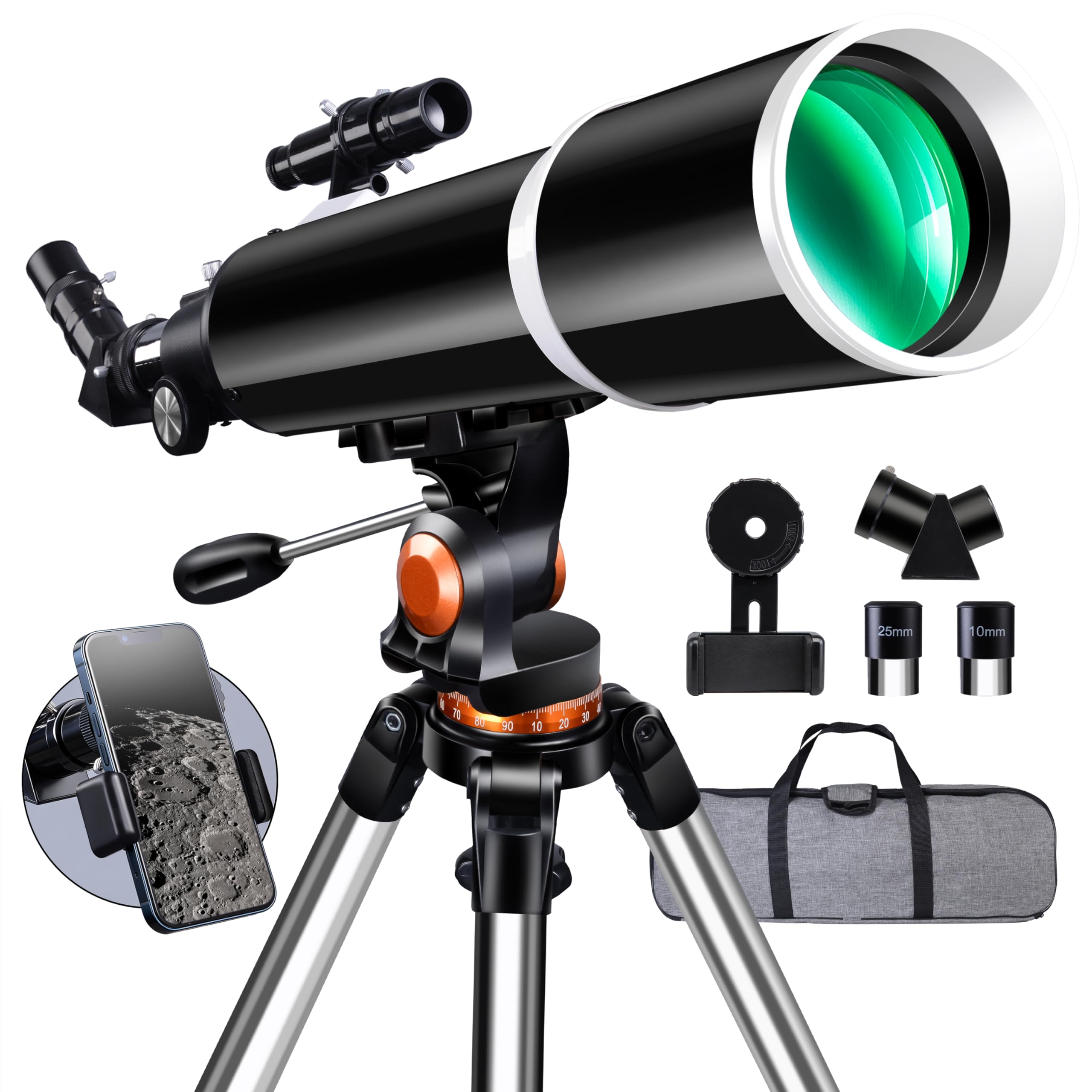
The ED-glass refractor that corrects color fringing for true-to-life views of Mars.
This is the scope for the buyer who cares about color accuracy. It uses double ED (extra-low dispersion) glass with FMC broadband multi-layer coating — a combination that reduces chromatic aberration, the purple fringing you often see around bright objects in cheaper scopes. You get sharp, high-definition views of lunar craters and Martian surface details.
With a 90mm aperture and a shorter 600mm focal length, the GALAEYES offers a wider field of view than the long-tube refractors above, which makes it easier to find objects in the first place. The kit includes an erecting prism, so your images are correctly oriented — useful if you also want to spot birds or landscapes up to 3km away. A phone adapter is included for astrophotography.
The mount system is a highlight: a metal AZ mount with 360° rotation and a reinforced stainless steel tripod that reduces vibration. Owners note the tripod is “heavy but solid,” which is exactly what you want for steady viewing. At 4.8kg, it’s portable enough for the backyard, though not for long hikes.
Editor’s Read: If you want the most refined image quality and a dual-purpose scope for sky and land, this 90mm ED model is the premium step up; the stock finder scope, however, is the weakest link per owners.
Buy it for: the sharpest possible views of the moon and planets within the 90mm class, with colors that look natural and true.
Pass on it if: deep-space observation is your main goal — the 600mm focal length favors planets and terrestrial targets over faint nebulae.
5. Gskyer 600x90mm AZ Refractor

A long-running 90mm favorite that pairs three eyepieces with a 3X Barlow for flexible power.
The Gskyer has been a staple in the beginner telescope world for years, and its longevity is proof of its solid design. With a 600mm focal length (f/6.7) and a 90mm fully coated objective lens, it captures plenty of light for crisp views of the moon and the planets. It comes with three interchangeable eyepieces offering 24X, 60X, and 120X magnification.
What sets this kit apart is the included 48-degree erecting BAK7 prism, which gives you correctly oriented images for both astronomy and land viewing. The adjustable aluminum tripod extends from about 31.5 inches to 49 inches, offering many comfortable viewing positions. Owners find it easy to assemble with no tools required — a big plus for total novices.
The feedback is generally strong: it’s an easy scope to set up with clear views of the moon, and kids love using it. The tallest tripod setting is still a bit low for some adults, and the quality control has mixed reports — with the manufacturer’s customer service getting high marks for fast replacements. It performs well for the price, especially for moon and Jupiter viewing.
Why It’s a Fan Favorite
- Tool-free assembly in minutes
- Erecting prism gives correct upright views
- Wide 49-inch max tripod height
Where It Falls Short
- Max magnification gets shaky without a sturdier tripod
- An occasional unit arrives with a defect — but support is responsive
Reach for this if: you want a proven, no-fuss refractor with the flexibility of three eyepieces and a Barlow — an ideal first scope for a family.
Look elsewhere if: you’re tall and can’t stand a low eyepiece; consider a model with a taller tripod or a tabletop design.
6. Celestron StarSense Explorer LT 80AZ

The 80mm scope that turns your phone into a guided tour of the night sky.
If your biggest fear is not being able to find anything, this Celestron removes the guesswork entirely. It uses patented StarSense technology: you dock your phone, launch the app, and it analyzes the star patterns overhead to pinpoint where your telescope is pointing. Follow the on-screen arrows until the bullseye turns green, and the target is in your eyepiece.
The optics are a solid 80mm (3-inch) fully coated refractor with a 400mm focal length, delivering sharp views of the Moon, Jupiter, and Saturn. It comes with 25mm and 10mm eyepieces plus a 2X Barlow lens to boost your magnification. The manual altazimuth mount includes a slow-motion adjustment rod for smooth tracking as planets drift.
What wins people over is how enjoyable it is — it’s described as a great starter scope that’s lightweight and easy to set up, with the app making finding objects fun. The trade-off is the app itself: owner experiences are mixed, with some finding it finicky and preferring a third-party app. At this price, it’s a premium-feeling experience with the convenience of phone guidance.
The Real Story: Reviewers point out it’s “the families gift” — a scope that everyone can enjoy together — but be ready to rely on the finder scope if the app acts up in the field.
Choose this when: you want a low-frustration learning curve and the fun of using your phone as a navigation tool — perfect for a tech-savvy beginner.
Think twice if: you’d rather not depend on a smartphone app to enjoy the scope, or you prioritize max aperture over smart features at this price.
7. Celestron AstroMaster 102AZ ShortTube

The 4-inch refractor that owners say is the minimum diameter for serious planet views.
The Celestron AstroMaster 102AZ is a leap in light-gathering power. With a 102mm (4-inch) fully coated short-tube refractor, it outperforms the 90mm and 80mm scopes above by catching significantly more light. On a clear first night, shoppers say seeing Saturn “and its rings!” — a moment that turns a casual interest into a lifelong hobby.
The short-tube design means a wide field of view, which makes it easier to scan star fields and locate bright star clusters. It’s also versatile: use it for land-based viewing during the day to spot wildlife or distant landmarks, thanks to the erect image star diagonal. Setup is quick — just a few parts, no tools required — and the preassembled tripod adjusts to your height.
The common refrain is to “not get anything less than 4 inches diameter on a refractor,” and that’s the strongest endorsement this scope gets. The included 20mm and 10mm eyepieces cover a good range, and the StarPointer red dot finder helps you aim. The recurring gripe is the mount — it’s a bit weak and lacks slow-motion controls, which frustrates precise tracking.
The Big Wins
- Bright, crisp views of Saturn, Jupiter, and Mars
- Wide field perfect for beginners finding objects
- Day and night dual use with erect image diagonal
The Honest Gripes
- Mount feels light for the tube; slow-motion controls are missing
- Some owners find focusing finicky at high power
Get it for: the biggest aperture jump over cheaper refractors — this is the balance for showing a child Saturn’s rings on night one.
pass on it if: you need a rock-solid mount for high-power tracking; you may want to budget for a sturdier tripod.
8. MEEZAA 150EQ Newtonian Reflector
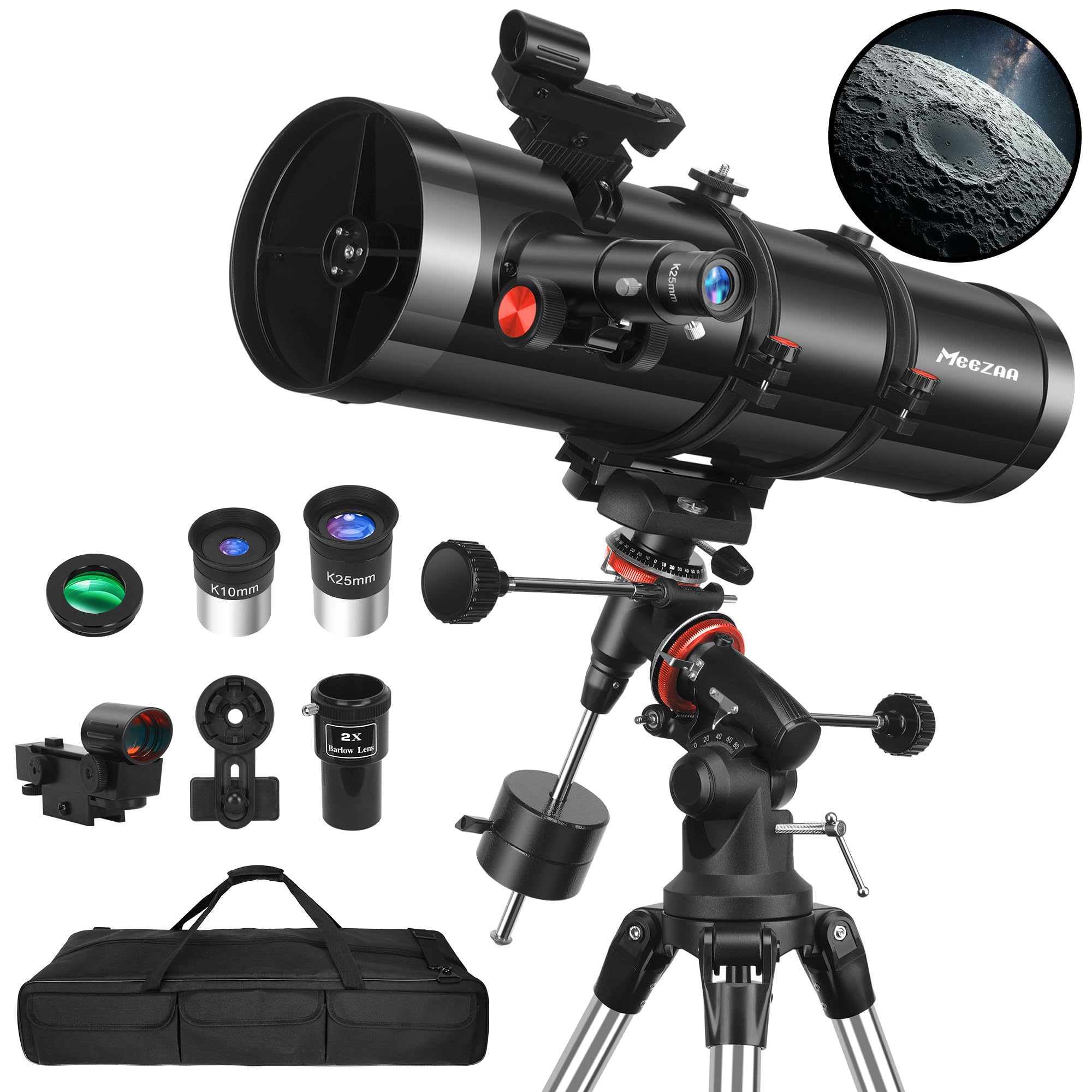
The 150mm reflector with an equatorial mount for beginners ready to track planets.
You get brighter, sharper views of planets and the Moon with the MEEZAA 150EQ because its 150mm aperture (the largest in this guide) gathers more light than any other scope here. Its 650mm focal length (the distance light travels from the lens to the eyepiece) keeps images clear and detailed. But you must learn equatorial tracking (a mount that follows stars as Earth rotates) — a real skill, not a plug-and-play setup.
The German equatorial mount (EQ) tilts to match Earth’s rotation, with precision dials and slow-motion control knobs for smooth, accurate manual tracking. This means you can follow the Moon, planets, and stars as they drift, which is essential at higher magnifications. The package is loaded: 25mm and 10mm eyepieces, a 2X Barlow lens, a red dot finder, a moon filter, and a phone adapter.
Owners praise the sturdy, stable mount and the ability to see fainter objects despite light pollution. The magnification range is 26X to 130X, which is plenty for a first detailed look at Jupiter and Saturn. The assembly is the main hurdle — it’s complex with many parts and heavy, sometimes needing two people. It’s not for the non-tech-savvy, but the reward is worth it.
The Verdict: Buy this scope when you know the hobby will stick; the learning curve is real, but the brightness and detail beat every refractor in this list.
Choose this if: you’re a beginner who wants room to grow into deep-sky observing and is willing to learn an equatorial mount step by step.
Pass if: you want grab-and-go simplicity — this is a two-person setup that demands patience and a stable surface.
9. Sky-Watcher Heritage 130mm Tabletop Dobsonian

The collapsible 130mm Dobsonian that fits in a car trunk and shows Saturn’s rings from the start.
You get more light-gathering per dollar with the Sky-Watcher Heritage 130 because its over 5 inches of aperture (the mirror’s diameter) pulls in plenty of light for bright views. It sits on a compact tabletop base and arrives fully assembled — no tools, no complex setup — so you can be looking at the Moon within minutes of opening the package. Buyers report great views of the Moon, Jupiter, and Saturn’s rings.
The collapsible design is the standout feature: the tube and base combine into a single tabletop package that’s easy to transport. Throw it in the back seat of a car and head to darker skies. It comes with two 1.25-inch eyepieces (10mm and 25mm) and a starpointer finderscope to help you aim, and it’s backed by a two-year warranty.
The consensus is that it’s a great value for beginners, with the simple Dobsonian mount (a base that swings up, down, and around) being intuitive and sturdy. The trade-off is that it requires a stable table, and the focuser knob runs tight. Visibility also drops in brightly lit city areas, so this scope shines brightest under darker skies.
What Makes It Special
- No assembly required — ready to go immediately
- 130mm aperture shows deep-sky objects faint scopes miss
- Collapsible and portable, fits in a car trunk
What to Know
- Needs a sturdy, flat surface to sit on for stability
- Focuser knob is tight and takes a firm hand
- Requires darker skies for the best deep-sky views
Pick it for: the beginner who values portability and maximum aperture — take it camping and you’ll be the most popular person at the site.
it’s not for you if: you view from a brightly lit city balcony, where the light pollution will overwhelm the deep-sky views.
Understanding the Specs
Aperture: The Most Important Number
The aperture is the diameter of the main lens (on a refractor) or mirror (on a reflector). Think of it as a bucket for light — a bigger bucket catches more light, which makes faint objects brighter and reveals more detail. For planets, a 90mm refractor or a 130mm reflector is a solid starting point. Don’t get caught up in high magnification numbers; the aperture is what actually determines image quality and brightness.
Focal Length and Your Magnification
The focal length (measured in millimeters) is the distance the light travels inside the tube. Combined with an eyepiece, it determines your magnification: divide the focal length by the eyepiece size. A 900mm scope with a 10mm eyepiece gives you 90x power. A Barlow lens can multiply that power, but it also magnifies any wobble in your mount, so use it sparingly.
Mount Types: AZ vs. EQ
The mount is the tripod base that holds your telescope, and it matters just as much as the glass. An alt-azimuth (AZ) mount moves up, down, left, and right — it’s simple and intuitive, perfect for beginners. An equatorial (EQ) mount is tilted to counter Earth’s rotation, allowing you to track planets as they drift. EQ mounts are more complex to set up but much better for high-magnification viewing.
Finderscopes and Eyepieces
A finder scope is a small, low-power scope mounted on the main tube that helps you aim. A red dot finder projects a dot onto a window — you put the dot on a bright star, then look through the main eyepiece. Most scopes include one, and it’s a huge help for long-tube refractors. Your eyepieces (usually 25mm and 10mm) let you switch between low-power wide views and high-power close-ups.
FAQ
What aperture do I need to see Saturn’s rings?
Is a long-tube refractor better than a short-tube one for planets?
What does a Barlow lens actually do?
How long does it take to set up a beginner telescope?
Can I see galaxies with a beginner telescope?
What is the difference between a refractor and a reflector?
Is a smartphone adapter worth having?
Can I use a telescope for daytime viewing?
How much maintenance does a reflector telescope need?
What is the best mount for a first-time buyer?
Final Thoughts: The Verdict
If you want one dependable pick, the beginners telescope to see planets winner is the Celticbird 80mm because it offers a strong balance of a 900mm focal length, portability, and a complete kit at a friendly price. If you want a genuine upgrade in brightness, grab the MEEZAA 90mm. And for the beginner who dreams of deep-sky galaxies later, the Sky-Watcher Heritage 130 is the one to reach for.
How We Picked
We do not accept paid placement. Every pick is matched to a real buyer and a real use-case; we do not hands-on test units.
Sources & Methodology
Specifications: manufacturer listings and product documentation. Review insights: verified customer reviews, as of August 2026. Pricing: not shown on this page (it changes often); check the current price via the retailer link.
As an Amazon Associate, Gadgets Feed earns from qualifying purchases. This does not affect which products we feature.