
Our readers keep the lights on and my morning glass full of iced black tea. As an Amazon Associate, I earn from qualifying purchases.
Specs are compiled from manufacturer listings and verified buyer reviews and can change over time — please confirm the key details on the product page before buying.
Before you spend money on a 400-watt solar kit, know this: the “400W” label is a lab number, not what you’ll get in real life. Heat and sun angle cut that rated wattage dramatically in your yard, on your RV roof, or at your campsite. So the real question is which kit delivers closest to its promise, which gives you the most complete starter system, and which is better left for a different job. Here’s the breakdown based on actual specs and verified owner experiences.
I’m Min — the founder and writer behind Gadgets Feed. This guide is built by comparing the manufacturers’ published specifications and the patterns across verified customer reviews, so you get each pick’s real strengths and trade-offs instead of marketing spin.
Whether you’re outfitting a cabin, an RV, or a home backup setup, the 400 watt solar panel kit you choose hinges on efficiency, included components, and honest output expectations.
Our Picks at a Glance


How To Choose The Best 400 Watt Solar Panel Kit
Before you compare brands, understand that a 400W kit is not just about the panels. The charge controller, the cables, and the mounting hardware determine whether you get a weekend project or a weekend of frustration. Here’s what separates a great kit from a box of components.
Rigid Roof Panels vs. Portable Foldables
Rigid aluminum-framed panels are the default for permanent installs on RVs, sheds, and cabin roofs. They’re durable, handle wind and snow loads, and usually come with mounting brackets. Portable foldable panels are for campers who charge a power station and want to move the array with the sun. They fold to a fraction of their size, weigh much less, but generally produce a smaller percentage of their rated wattage due to heat and less-than-ideal angles.
Read the “Included Components” Line Like a Detective
A true “kit” includes a charge controller, cables, and mounting. Some listings that say “kit” are really just two panels in a box, and you’ll need to buy the controller (the brain that regulates battery charging) separately. Look for a 40A MPPT (Maximum Power Point Tracking) controller — this type pulls more power from the panels than older PWM (Pulse Width Modulation) controllers. Also check for a Bluetooth module for monitoring, which is a huge convenience for a beginner.
Understand Real-World Power Output
Most panels produce 70-80% of their rated wattage in normal, warm conditions. The “400W” rating is a lab number at 77°F (25°C) with perfect sun. On a hot 90°F day, expect that number to drop. Also, panels wired in series (to raise voltage) behave differently than in parallel (to keep voltage low for a 12V system). For a 12V battery bank, parallel wiring is usually the safer bet unless your controller explicitly supports high input voltage.
Quick Comparison
| Model | Best For | Panel Style | Max Voltage | Weight | Amazon |
|---|---|---|---|---|---|
| Renogy 400W Premium Kit★ Best Overall | Complete Off-Grid Starter | 4x100W Rigid | 12V | 56.4 lbs | Amazon |
| DOKIO 400W Mono PanelBudget Champion | DIY System Builders | Single Rigid Panel | 12V | 49.4 lbs | Amazon |
| Greenmagic 2X200W FlexFlex Pick | Curved RV & Boat Roofs | 2x200W Flexible | 20V | Rated Light | Amazon |
| MHPOWOS 400W Foldable | Power Station Charging | Multi-Fold Portable | 31V | 27.9 lbs | Amazon |
| Greenmagic 400W Portable | Lightweight RV Use | Foldable Briefcase | 40V | 21.5 lbs | Amazon |
| Renogy 400W N-Type | High-Efficiency Roof Mount | 2x200W Rigid | 37.44V | Rated Light | Amazon |
| ECO-WORTHY 400W Premium | Budget Roof System | 4x100W Rigid | 12V | ~72 lbs (32.66kg) | Amazon |
| Renogy 400W Portable | Ultimate Portability | 16-Fold Blanket | 39.2V | 16.1 lbs | Amazon |
| ACOPOWER 400W RV Kit | High-Tech Full RV Setup | 4x100W Rigid | 12V | 54.8 lbs | Amazon |
| RICH SOLAR 2X200W Kit | Tool-Free Installation | 2x200W Rigid | 12V | 26.5 lbs | Amazon |
| ECO-WORTHY 1.6KWH Complete | Turnkey Cabin Power | 4x100W Bifacial | 12V | Rated Heavy | Amazon |
In-Depth Reviews
1. Renogy 400Watt Premium Solar Kit with 40A MPPT Charge Controller
Our pick — 4.5★ from 550+ verified ratings; the strongest balance of quality and price.
The turnkey system that powers real appliances and earns its premium badge with a 40A MPPT brain.
This is the kit that defines “plug-and-play” for the off-grid beginner. It bundles four 100W monocrystalline panels, a 40A MPPT Rover controller, Z-brackets, an adaptor kit, tray cable, and a Bluetooth module for phone monitoring — everything is in the box. Buyers report the value is the headline, with the most praise going to how complete the package feels versus buying components separately.
Real owners mention impressive headroom. One buyer says they charged a 200Ah battery from 77A to 200A in 8 hours on a cloudy day. Others report running a 1500W Keurig, a vacuum, and a blender, plus powering a gaming PC all day while a 12V fridge runs with power to spare. That’s the kind of real-world margin that makes a 400W system feel much bigger than its label.
The recurring gripe is the cable length — several note the panel-to-controller wiring is too short for an RV install and needs about a meter more. The included 10A fuse is also considered insufficient for parallel wiring, and the Bluetooth monitor is less reliable than a hardwired panel.
Renogy premium MPPT
- Everything needed is included — panels, 40A MPPT, brackets, cables, and a Bluetooth module for app tracking.
- It holds its own at 4.5 stars across 500+ ratings, with value and ease of installation the most-cited positives.
- Real-world output is strong enough to run a fridge, power tools, and even a 1500W appliance.
bulky rigid panels
- The panel-to-controller cables run short — RV owners will likely buy an extension.
- Setup instructions are minimal; the box only includes MPPT and Bluetooth manuals.
- The Bluetooth monitor is less consistent than a hardwired alternative.
best overall: you want a genuinely complete off-grid starter with room to grow and don’t want to piece together a controller, cables, and mounting from scratch.
skip if roof-limited: your panels will sit far from your battery bank — the short cables will force you to buy extra wire or re-crimp.
2. DOKIO 400W Solar Panel, 31V Monocrystalline, for 24V Off-Grid Systems
One giant 400W panel that slashes wiring joints, for builders who already own a controller.
This is a different animal: a single 400W panel, not a multi-panel kit, which means fewer branch pieces and connections and a faster install. It’s built for yards, sheds, and cabins — a tempered glass top over an aluminum frame with a sealed junction box for rain and splashes. The 3-meter (9.84 ft) MC4 leads give you much more routing freedom than typical short-lead panels, often saving you from buying extension cables.
Owners praise the performance and value most. One buyer reports panels delivering ~300W in 80°F temps when not at an optimal angle — a solid real-world number. At 49.4 pounds, it’s noticeably lighter than the Renogy kit’s 56.4 pounds, though it still needs a friend to carry; the footprint is about four times the size of a standard 100W panel.
The honest caveat is that actual output varies with sun angle and temperature — the reviews show a spread from about 120W to over 140W depending on conditions.
DOKIO high voltage: the DIY builder who already has a controller, batteries, and wiring, and just wants the most panel for the least money. The 31V design is intended for 24V systems, though it can be wired in parallel for 12V use.
no controller included: it’s a bare panel in a bag, not a system — you bring your own controller and cables.
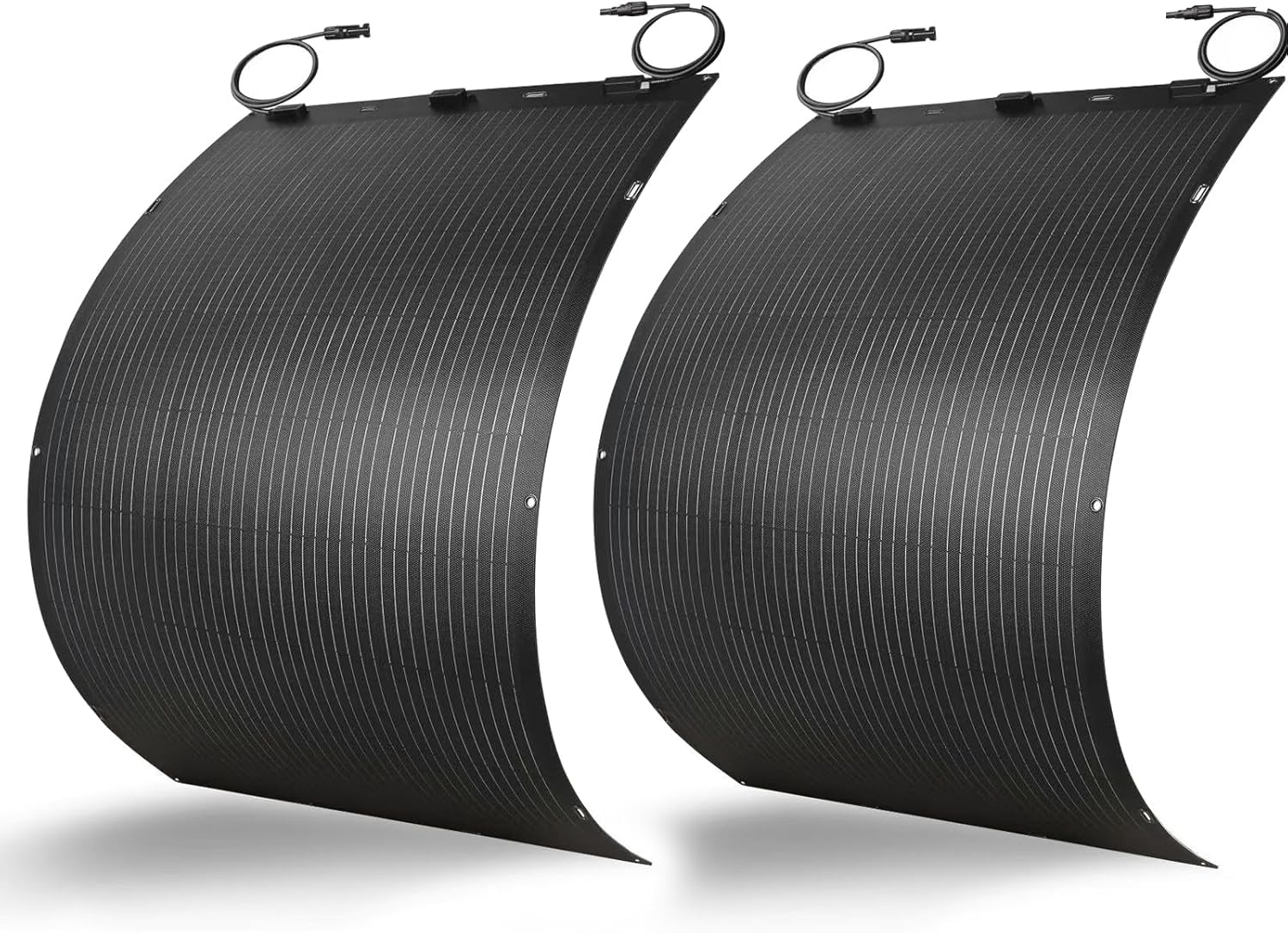
3. Greenmagic 400 Watt Flexible Solar Panel 2X200W Solar Panels Kit
The bendable 0.11-inch panel that conforms to curved roofs where rigid glass can’t go.
If your roof is curved — a boat deck, a camper shell, the front of a car — this is the rare panel that fits. Each 200W unit bends up to 260°, uses an advanced polymer material, and weighs only 8.5 lbs at 0.11 inches thin. The honeycomb ETFE (a tough, UV-resistant plastic film) surface uses refraction to catch sunlight from different angles, and the IP68 waterproofing shrugs off rainstorms and sandstorms.
The defining spec here is the 23% high conversion efficiency from the monocrystalline cells, which owners confirm translates to real power. The performance gets the most positive mentions, with one owner reporting their boat stayed powered through the entire season. The kit includes 6 mounting straps and MC4 outputs that connect to most power stations.
Be realistic about output: one owner measured a single panel at 150W instead of the claimed 200W — about 75% of rating, which is normal for panels in real conditions but still worth knowing.
flexible lightweight panels: boat decks, RV roofs with a curve, and anyone who values a panel that can be walked on and flexed. The trade-off is that flexible panels run warmer than glass-backed ones, so expect a slightly lower percentage of rated wattage on hot days.
4. MHPOWOS 400W Portable Solar Panel Foldable Solar Charger for Power Station

A 23.5% efficient foldable that speaks to nearly every power station with six adapter tips.
This is the charging companion for the portable power station crowd. It ships with a solar connector that adapts to Anderson, XT60, DC7909, DC5521, DC8020, DC5525, and DC35135 — meaning it pairs cleanly with EcoFlow, Anker, Jackery, and Bluetti units. The 23.5% efficient A+ cells lead the pack, and the multi-fold design packs into a zippered pouch with four kickstands for angled setup.
The IP67 waterproofing means it lives outdoors without worry. One reviewer noted it charged their generator in 2 hours, and another measured 350W on an ideal day with an EcoFlow Delta 2 — impressively close to the rated 400W. It’s the practicality that gets the most praise: functionality, charging power, and ease of use are the top positives.
The smart warning in the listing is worth heeding: many power stations cap their solar input below 400W, so even a perfect panel won’t exceed the station’s limit. At 27.9 pounds it’s portable, but owners call it heavy, and the kickstand is considered weak.
portable foldable design: you own a mainstream power station and want a foldable that recharges it fast with zero wiring. The weight is the honest friction — it’s portable, but you’ll feel the 27.9 pounds on a long walk to a campsite.
5. Greenmagic Portable 400 Watt Solar Panel, 39V 400W Foldable Panel Solar Charger
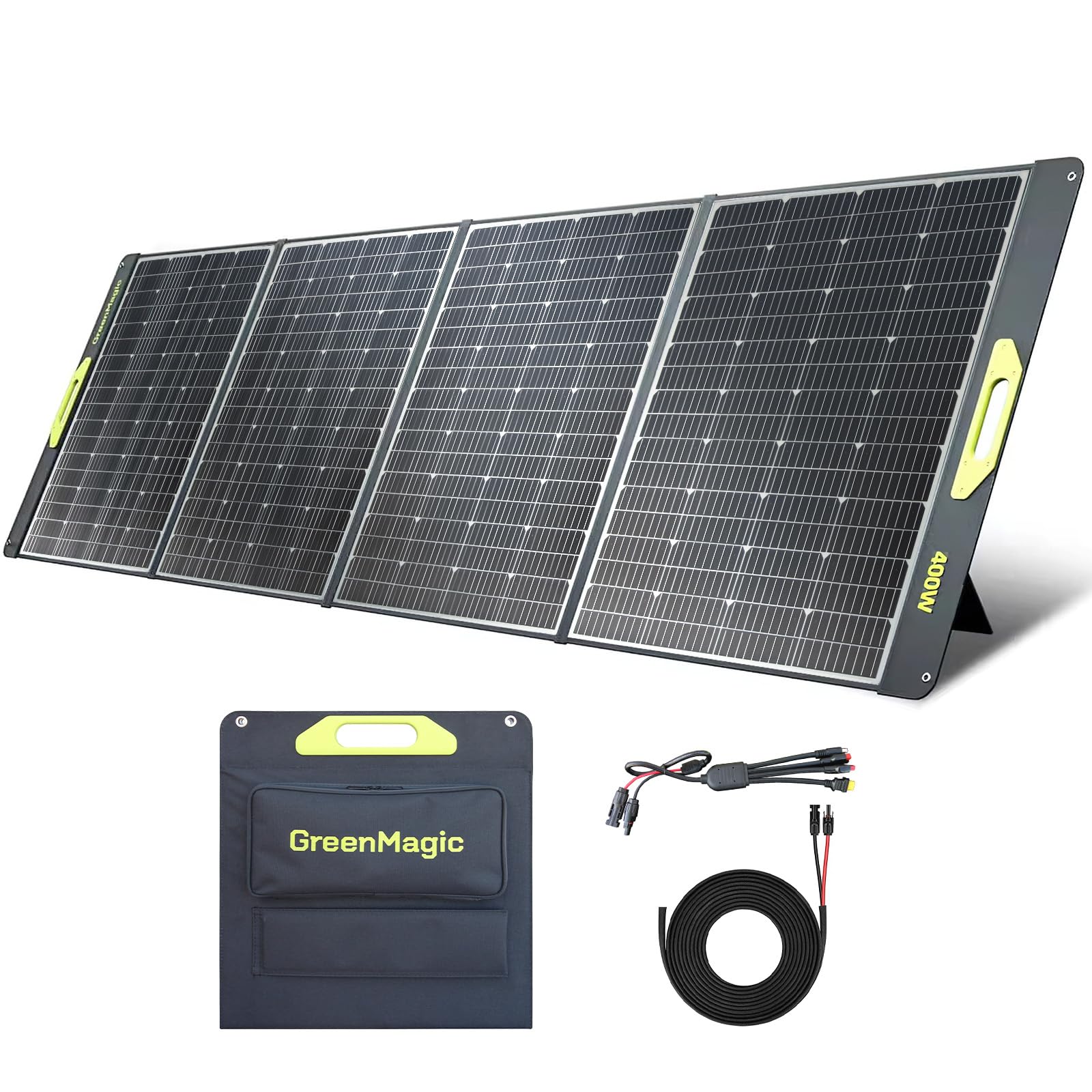
The briefcase-style 21.5-pound panel that folds to a quarter size and pairs with almost any generator.
This foldable panel works with the growing family of higher-voltage power stations, rated for 40V output, and stays compatible with 95% of them via a built-in MC4 cable (the standard solar connector). Its monocrystalline silicon cells hit 21.5-23.5% efficiency, so you get more power per square foot. It supports both parallel and series wiring, and the design is practical: four built-in adjustable kickstands, four hanging loops for mounting off an RV side, and a sturdy rubber handle for briefcase-style carrying.
At 21.5 pounds, it’s the lightest foldable 400W in this lineup by a clear margin. The quality earns the most praise from owners, and the performance is confirmed by a buyer easily hitting 350+ watts on a sunny day — a strong real-world number. One RV owner with six panels (2400W total) called it the lightest for its size, with setup taking about 5 minutes.
The IP65 waterproofing means it survives splashes, but do not leave it under rain — the junction box isn’t sealed. One owner noted it lacks a stability pole that a competitor includes.
Greenmagic foldable: you want a genuinely light foldable that handles high-voltage power stations and sets up in seconds. It’s the balance for the RV camper who moves the array with the sun each day.
6. Renogy Solar Panels 400 Watt N-Type, 16BB 25% High-Efficiency

The hot-climate specialist with a 25% efficiency rating and a 25-year output warranty.
This is the panel for Class B vans and tight roof spaces where every inch counts. It’s 7.5% smaller and 11.7% lighter than Renogy’s previous generation while delivering the same 400W output — a meaningful space saving on a small roof. The 25% efficiency comes from 16BB N-type cells that resist microcracks and perform better in heat.
The build quality is what wins owners over — it’s the most-cited positive, with one buyer stacking 12 of these panels on their roof and calling them far more durable than the old ones. The performance follows close behind: customers note pulling 1189W from a 1000W array, which is better than the rated output. The low temperature coefficient means it keeps producing in hot climates where other panels fade.
The catch is shipping fragility. One of two panels in a pack can arrive with a smashed corner, though the replacement process with Amazon was fast. Inspect the package immediately on arrival.
top efficiency: the most efficient rigid panel here at 25%, built for hot, tight, permanent installs with a 25-year 80% output guarantee.
skip for value: anyone wanting a full kit — this is two bare panels, so you’ll source your own controller and mounting.
7. ECO-WORTHY 400 Watt 12 Volt Premium Solar Panel Kit

A complete 4-panel system with an MPPT controller and Bluetooth 5.0 monitoring at a sharp price.
This kit is designed to deliver the full off-grid experience without the premium sticker. It bundles four 100W monocrystalline panels (21% efficiency), a 40A MPPT charge controller, a BT-02 Bluetooth module for phone monitoring, and mounting Z-brackets. The Bluetooth 5.0 signal reaches up to 82 feet, and the system tracks solar panel, battery, and load data in real time.
The panels are built to last, with 3.2mm low-iron glass and a 35mm aluminum frame that’s 2-5mm wider than others, handling wind up to 2400Pa and snow loads up to 5400Pa. The functionality and value get the most praise, with one full-time RV owner confirming 9 months of solid service. Peak output around 350W in good sun is a realistic expectation.
The honest warning is that this is not truly plug-and-play — it needs electrical knowledge, and the included wiring is only sufficient for short runs. One owner experienced a melted wire from undersized battery cables, though the company replaced the unit quickly.
ECO-WORTHY kit: the DIY-capable buyer who wants a complete 4-panel setup with Bluetooth for the least money. Think twice if you’re not comfortable sizing your own wire gauge for longer runs — the included cables are adequate but not generous.
8. Renogy 400W Portable Solar Panel for Power Stations, 25% High Efficiency
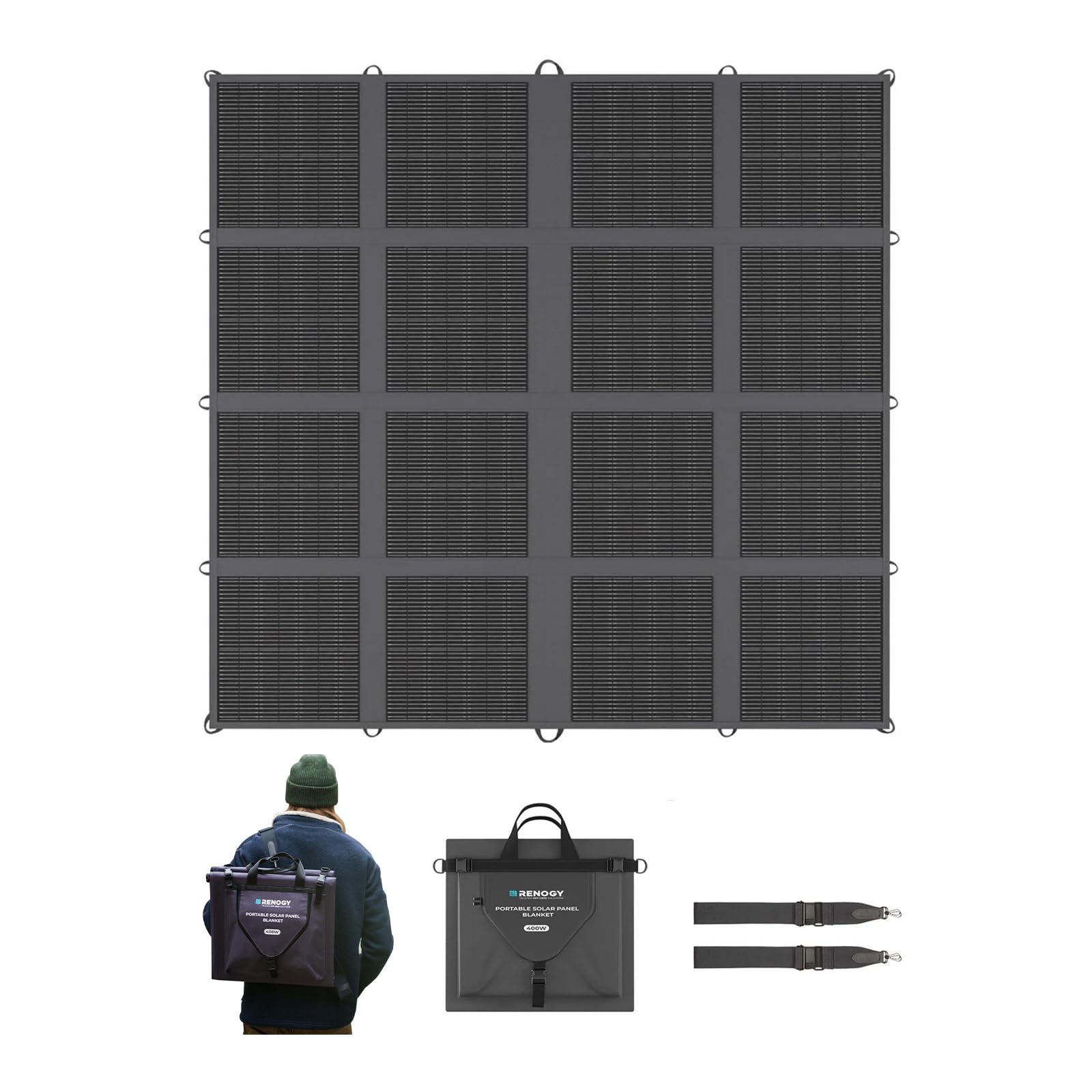
The 16.09-pound solar blanket that folds to backpack size and becomes a windshield shade while charging.
This is the most portable 400W panel here by a large margin. At 16.09 lbs, it’s 62% lighter than a conventional 400W portable panel, and the 16-fold design packs down to 16.54×15.83×4.13 inches — 75% smaller than typical camping panels. It stores flat in tight camper spaces, which is the defining spec for SUV, pickup truck, and 4×4 overland setups.
The 25% efficient 16BB N-type cells beat standard 9BB panels (22.5%), squeezing more power from the same sun. The installation flexibility is a real feature: lay it across your windshield to create shade while charging, deploy it on the ground, or hang it vertically between trees. The IP65-rated ETFE lamination and reinforced stitching handle extreme temps from -10°C to 65°C.
Performance gets the most positive mentions by far, with one owner pulling almost 400W on a sunny day and ~300W even when cloudy. One buyer charged a 1kW power station in a little over 2 hours. The honest trade-off: actual output varies, with some owners reporting 55-60% of the rated 400W in less-than-ideal sun.
for power stations: your camper space is measured in inches and you want the lightest, most packable 400W you can carry. It’s UL 61730 certified and backed by a 2-year warranty.
skip without one: you need a permanent roof install — this is a portable blanket, not a rigid mount.
9. ACOPOWER 400 Watt 12 Volt RV Solar Panel Kit 4 * 100W Solar Panels
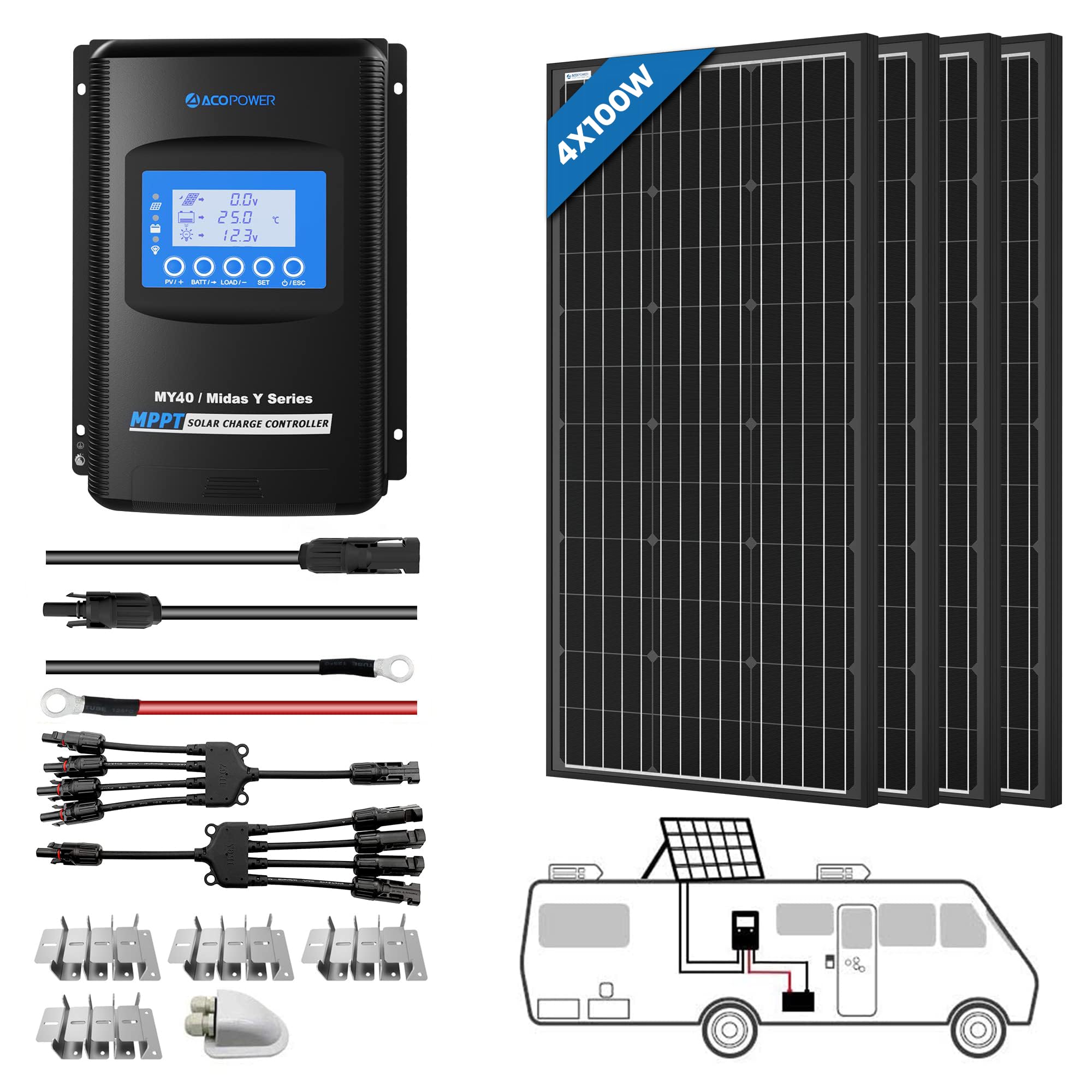
A premium 4-panel kit with a 99.5% tracking-efficiency MPPT controller and storm-proof construction.
This kit targets the serious RVer who wants maximum energy harvest and durability. Four 100W monocrystalline panels with A+ cells at 23% efficiency generate 2-2.5kWh daily. The 40A MPPT LCD controller hits 99.5% tracking and 98% conversion efficiency, with overcharge, overvoltage, short-circuit, and reverse-polarity protection.
The build quality is where this kit shines — IP67 waterproof with a corrosion-resistant aluminum frame and anti-reflective low-iron tempered glass, handling 2400Pa winds and 5400Pa snow loads. One full-time RV owner confirmed the panels survived hail, wind, and rain with watertight connectors, and eliminated their generator use entirely. A 500W test system recharged a 400Ah battery pack in 5 hours at a max of 415W.
It arrives with a 30ft 10AWG adaptor kit, which is generous, but you’ll likely need extra MC4 connectors, a crimper, and sealant for a clean install. One owner noted the controller’s charge display can be inaccurate — a supplemental monitor is recommended.
ACOPOWER RV kit: the full-time RVer who treats their solar system as a primary power source and appreciates high-efficiency cells plus a strong controller. It’s expandable, so you can grow it later.
10. RICH SOLAR 400 Watt Premium Solar Kit – 2 Pack of 200W Panel

The kit with a pre-assembled wiring harness that needs no crimping tools and a 25-year output warranty.
If the thought of crimping MC4 connectors makes you nervous, this kit is designed for you. The pre-assembled wiring harness plugs in without tools, and all RICH SOLAR products are compatible with each other, making expansion simply a matter of plugging in. It bundles two 200W monocrystalline panels with a digital 40A MPPT charge controller that shows real-time volts, amps, and amp hours on its display.
The 25-year output warranty and free lifetime support back the panel’s long-term reliability. Reviewers point out it powers a 3000W system easily, and one buyer pairs it with 2x12V 200Ah batteries to run a 1500W heater plus LEDs. The quality and functionality share top billing as the most-praised aspects, and the digital controller’s glanceable readout gets consistent appreciation.
The recurring caveats are the cable being too short for some layouts and the companion app being rarely updated — several owners prefer a wired monitor. One buyer mentioned the phantom 0.50A draw from the LOAD function and recommends disconnecting it when not in use.
space available: you’re a solar newcomer who wants the simplest possible install and a brand known for responsive customer service and fast replacements.
skip for small roofs: you plan to monitor via the app — it’s considered the weak link here.
11. ECO-WORTHY 1.6KWH Complete Solar Panel Kit 400W 12V for RV Off Grid
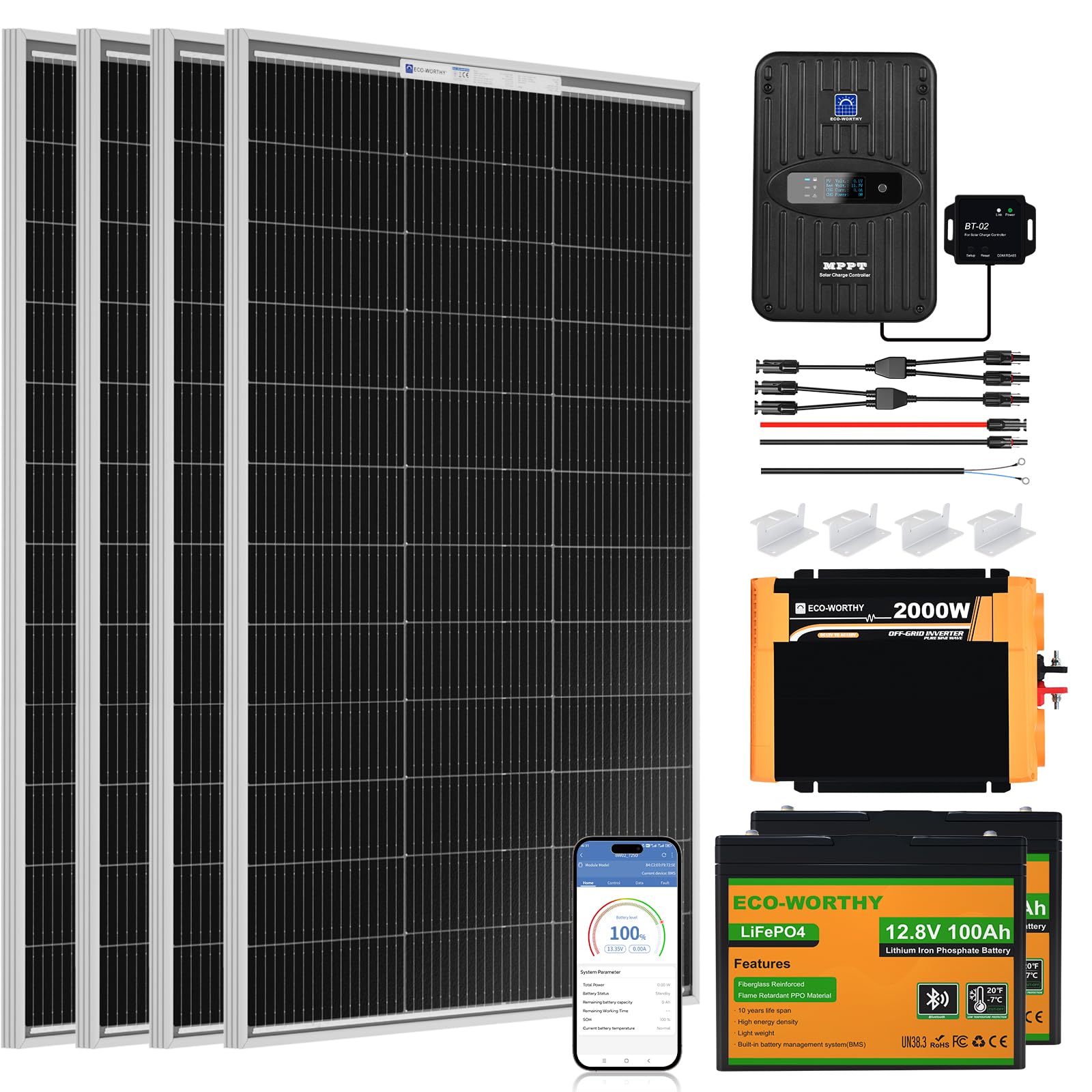
The everything-included system with batteries, inverter, and panels — a cabin power plant in one box.
This is the full turnkey solution: 4x100W bifacial solar panels, a 40A MPPT controller, a 2000W pure sine wave inverter, 2x12V 100Ah lithium batteries, and a Bluetooth 5.0 module. It’s designed to power AC 110V devices under 2000W rated power — your TV, air conditioner, and refrigerator. The lithium batteries offer more than 3000 deep cycles, far outlasting lead-acid, with a built-in BMS (battery management system) for protection.
The 23% efficient 12BB cells yield about 1.6kWh daily under 4 hours of sun. The kit can even be boosted by 40% with a dual-axis solar tracker or 20% with adjustable mounting brackets. Owners find it top quality and easy to set up, with one powering a detached garage for lights, openers, and a leaf blower.
The honest caveats: battery life is the most-discussed concern, with the system charging effectively only in direct sunlight, and parts arrive in separate shipments — check everything when it lands. One owner found the inverter terminals not code-compliant and noted a shock risk if the breaker is off.
complete system: you want a single-box cabin or RV power system — no separate battery purchase, no inverter shopping, just panels, storage, and 110V power out.
limited expandability: you’re comfortable sourcing your own lithium batteries, which can save money and let you size storage to your exact needs.
Understanding the Specs
MPPT vs PWM Charge Controllers
Your charge controller is the brain of the system. MPPT (Maximum Power Point Tracking) continuously adjusts to pull the maximum available power from panels — it’s roughly 40% more efficient than older PWM (Pulse Width Modulation) controllers, which are simpler and cheaper but waste the excess panel voltage. For a 400W system, a 40A MPPT controller is the balance, especially with a Bluetooth module to monitor output from your phone.
Panel Voltage and Your Battery Bank
Most 400W kits are 12V systems, meaning the panels are wired in parallel to keep voltage low for a 12V battery bank. Some panels are rated at higher voltages (like 20V, 31V, or 39V) — these are designed for 24V systems or high-voltage power stations. Always match the panel voltage to what your charge controller and battery can accept. A 39V panel wired into a 12V system without a suitable controller will damage equipment.
FAQ
Will a 400W panel kit actually produce 400 watts?
What is the difference between a 12V and a 24V solar panel?
Can I use a 400W portable panel with my EcoFlow, Jackery, or Bluetti power station?
How long will a 400W solar kit last?
Is it better to buy a full kit or individual components?
What size charge controller do I need for a 400W solar system?
Can I install a 400W solar kit myself?
What can a 400W solar kit actually power?
Are flexible solar panels as good as rigid glass panels?
What is the real-world weight difference between portable and rigid 400W panels?
Final Thoughts: The Verdict
If you want one dependable pick, the 400 watt solar panel kit winner is the Renogy 400W Premium Kit because it delivers the most complete, beginner-friendly package — panels, a 40A MPPT controller, Bluetooth monitoring, and mounting — backed by a 4.5-star crowd consensus across hundreds of owners. If you want maximum portability for camping, grab the Renogy 400W Portable Blanket at just 16.1 pounds. And for a full turnkey cabin power plant, the ECO-WORTHY 1.6KWH Complete Kit is the one to reach for.
How We Picked
We do not accept paid placement. Every pick is matched to a real buyer and a real use-case; we do not hands-on test units.
Sources & Methodology
Specifications: manufacturer listings and product documentation. Review insights: verified customer reviews, as of August 2026. Pricing: not shown on this page (it changes often); check the current price via the retailer link.
As an Amazon Associate, Gadgets Feed earns from qualifying purchases. This does not affect which products we feature.