
Our readers keep the lights on and my morning glass full of iced black tea. As an Amazon Associate, I earn from qualifying purchases.
Specs are compiled from manufacturer listings and verified buyer reviews and can change over time — please confirm the key details on the product page before buying.
Your camper’s fridge should still be humming on day three, not just the first afternoon. That’s the real test of a deep-cycle battery (one designed to be drained and recharged repeatedly), and it’s what separates a smart buy from a frustrating one. You’ll find the best battery for a camper here — the lithium iron phosphate (LiFePO4) options that give you nearly all their rated power, and the lead-acid workhorses that still make sense on a budget.
I’m Min — the founder and writer behind Gadgets Feed. This guide is built by comparing the manufacturers’ published specifications and the patterns across verified customer reviews, so you get each pick’s real strengths and trade-offs instead of marketing spin.
Here’s the short version: a 100Ah lithium battery gives you roughly double the usable power of a lead-acid one at half the weight, so you can run a 12V fridge all weekend without firing up a generator. battery for a camper choices come down to how much you value weight, lifespan, and dependable cold-weather charging.
Our Picks at a Glance
How To Choose The Best Battery For A Camper
A camper battery is a deep-cycle battery, which means it’s designed to be drained and recharged over and over. That’s different from your car’s starting battery, which delivers a quick jolt of power to crank an engine. For a camper, you want a battery that can handle your fridge, lights, and phone charging all night without complaining.
Lithium vs. Lead-Acid: The Core Decision
The biggest fork in the road is the chemistry. Lithium iron phosphate (LiFePO4) batteries are lighter, last longer, and let you use nearly all of their rated capacity. A traditional lead-acid battery (AGM or flooded) costs less upfront but only lets you safely use about half of its rated capacity before you risk damaging it. For a camper, that means a 100Ah lithium battery gives you roughly the same usable power as a 200Ah lead-acid one, but at a fraction of the weight.
The Battery Management System (BMS)
Every lithium camper battery has a built-in brain called a battery management system (BMS). This small circuit board protects the battery from overcharging, over-discharging, and short circuits — the three main ways batteries fail. A good BMS also includes low-temperature protection, which stops the battery from charging in freezing weather to protect the cells from permanent damage.
Capacity and Power Needs
Capacity is measured in amp-hours (Ah), and the most common size for a camper is 100Ah. Think of it as the fuel tank size — a 100Ah battery can deliver 100 amps for one hour, or 5 amps for 20 hours. You also want to check the watt-hours (Wh), which is the total energy stored. A 12.8V 100Ah battery holds about 1280Wh, enough to run a 12V compressor fridge for a day or two before needing a recharge.
Quick Comparison
| Model | Best For | Capacity | Weight | BMS | Amazon |
|---|---|---|---|---|---|
| Litime 12V 100Ah★ Best Overall | Smart monitoring & value | 100Ah | 21 lbs | 100A | Amazon |
| Redodo 12V 100AhBest Value | Proven performance & support | 100Ah | 22.04 lbs | 100A | Amazon |
| ECO-WORTHY 12V 280AhTop Performer | Maximum off-grid capacity | 280Ah | 60 lbs | 200A | Amazon |
| DUNFUME 12V 100Ah | Budget-friendly lithium | 100Ah | 21.6 lbs | 100A | Amazon |
| yeagulch 12V 150Ah | Extra runtime on a budget | 150Ah | 41 lbs | 100A | Amazon |
| Mighty Max ML100-12 | Simple lead-acid reliability | 100Ah | 28 lbs | — | Amazon |
| WEIZE 12V 100Ah | Heavy-duty lead-acid backup | 100Ah | 63 lbs | — | Amazon |
| HumsiENK 12V 100Ah | Compact smart lithium | 100Ah | 19.7 lbs | 100A | Amazon |
| Power Queen 12V 100Ah | Trolling motor & marine use | 100Ah | 22.16 lbs | 100A | Amazon |
In‑Depth Reviews
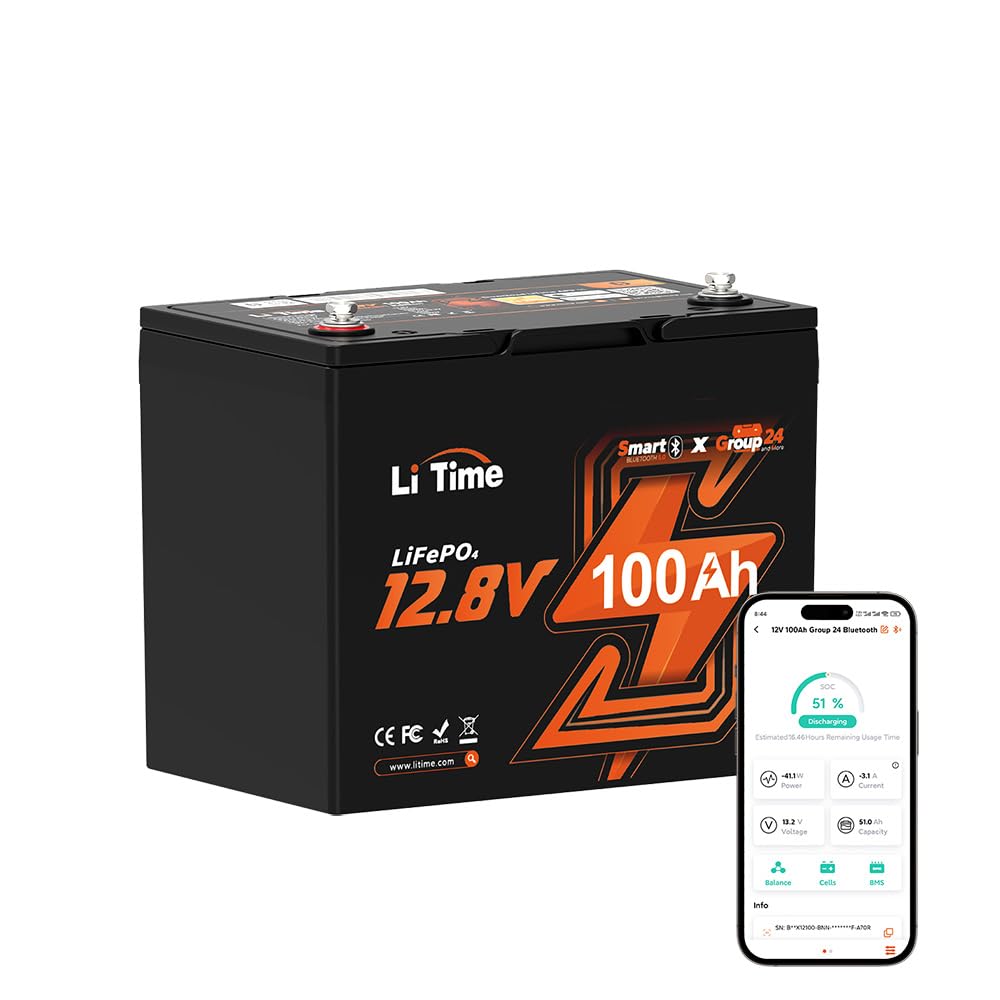
1. Litime 12V 100Ah LiFePO4 Battery, Group 24
Our pick — over 4.5★ from 700+ verified ratings; the strongest balance of quality and price.
The smart, lightweight lithium that tells you exactly how much juice you have left.
This is the battery that makes the upgrade from lead-acid feel easy. At just 21 lbs, it’s 63% lighter than a traditional lead-acid battery of the same 100Ah capacity, and it’s 35% smaller — so it fits neatly into a Group 24 battery box. In plain terms, that means you can lift it with one hand and slip it into tight spaces under a camper bench. Buyers report running this for over two years in a truck bed, powering a fridge and compressor on a 30A draw with only 34 cycles, which speaks to how forgiving this chemistry is.
The defining feature here is the smart Bluetooth 5.0 connectivity. Pair it with the LiTime app via a QR code and you see voltage, state of charge, and temperature in real time — no more guessing whether the fridge will make it through the night. The built-in 100A BMS offers 20+ safeguards, including a low-temperature cutoff that stops charging at freezing temps to protect the cells. It’s rated for 4,000+ deep cycles and comes with a 5-year warranty, a strong safety net for a purchase this important.
You get a full picture of your camper’s power at a glance, but the app can feel glitchy during charging, sometimes needing a reconnection. It’s not a heated battery — a few owners note you should buy the heated version if you camp in sustained sub-freezing weather. It also supports 4P4S expansion (a wiring setup that adds more batteries in parallel and series) up to 20.48kWh, so you can build a larger system later without starting over.
What wins people over
- Real-time Bluetooth monitoring for voltage and state of charge
- 21 lbs total weight makes for an easy one-hand install
- Full 100Ah usable capacity, versus half of a lead-acid’s
- 5-year warranty and 4,000+ deep cycles
The trade-offs to know
- App can need reconnecting during charging sessions
- Not heated — look elsewhere if you camp in deep freeze
- Requires a LiFePO4-compatible charger for a full wake-up
The smart money pick: If you want live data on your battery’s health and the lightest lift, this is the camper battery to start with.
Reach for this if: You camp in moderate climates and want to monitor your power via your phone.
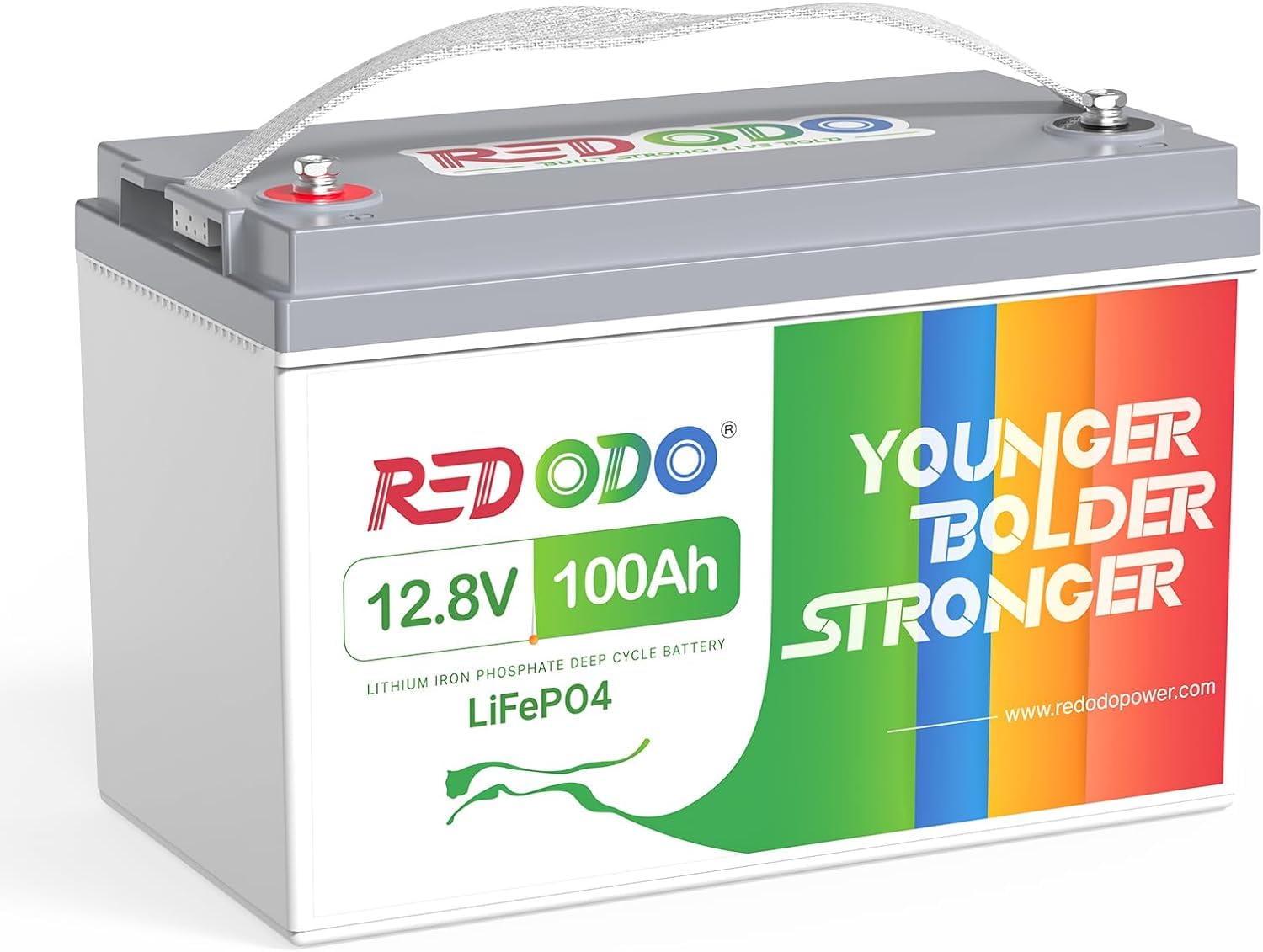
2. Redodo 12V 100Ah LiFePO4 Battery, Group 31
The proven crowd favorite that delivers more than its rated capacity and backs it up.
This battery actually over-delivers on its label. In a full-time van test, one owner measured it delivering 105Ah — 5 over the rated 100Ah — while running a 200W solar setup and a 1000W inverter. That kind of headroom is rare, and it’s part of why this is among the most popular Group 31 lithium options out there for campers. At 22.04 lbs, it’s 60% lighter than a comparable lead-acid battery, which makes a real difference when you’re wrestling it into a battery compartment.
Performance in the real world backs up the spec sheet. The built-in 100A BMS protects against overcharge, over-discharge, over-current, and high temperature, so you can push it hard without worrying about cooking the cells. Owners mention it runs 24/7 devices without ever dropping below 80% charge, and a pool cleaning company replaced failing lead-acid batteries with these and found they last all day with no slowdown.
The support story here is note too. When a boat owner’s battery failed to charge after three years, the company tested it and replaced it under warranty quickly — and he bought two more. The one limitation: it’s not a “smart” battery with built-in Bluetooth, so you’ll need a separate monitor or shunt to see exact state of charge. But for pure, reliable, no-frills power at a price that undercuts premium brands, this is a hard one to beat.
Measured overachiever: Delivers 105Ah of real capacity and survives heavy daily use in vans and boats alike.
Best for the long haul: If you want proven performance and responsive warranty support, this is the battery to trust.
Look elsewhere if: You need Bluetooth monitoring built in — this one keeps it simple and external.
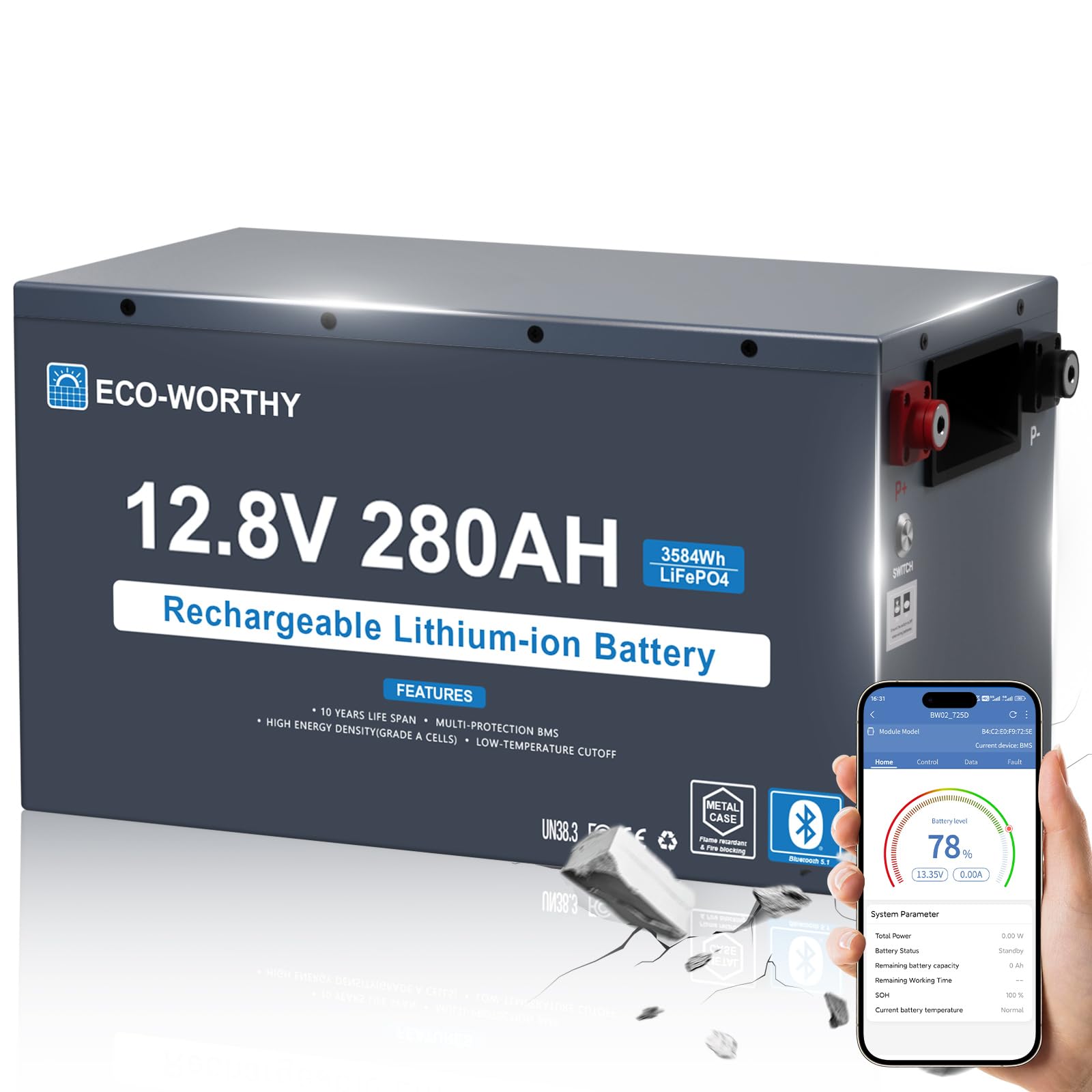
3. ECO-WORTHY EnergyRock 12V 280Ah Metal Case
The metal-clad powerhouse that keeps a fridge running for days, not hours.
This is the battery for campers who want to stop worrying about power entirely. With a massive 280Ah capacity, it stores up to 3584Wh of energy — enough to run a 12V 10 cu ft fridge for two days straight, even starting from warm. That’s the kind of headroom that lets you pack a 12,000 BTU air conditioner, a shop vac, and a table saw in a campervan and still have power to spare after two hours of heavy use. One owner reported it dropped to just 30% after running AC and lights.
The rugged metal case is the standout trait here, and it’s not just for looks. It provides enhanced heat resistance and fire protection, plus it resists shocks and vibration while you’re driving on rough roads. You can install it directly inside your RV with the 4 mounting feet — no separate battery box needed. It also has a physical safety switch that disconnects the discharge circuit with one touch, which is a great feature for safe installation and maintenance. Front terminals make wiring easier, and the flat top lets you stack it if you ever expand.
The built-in 200A BMS is double the capacity of most competitors, meaning it can handle a 200A surge easily — one owner runs a 1/2 HP sump pump on it continuously for 5 hours. Bluetooth monitoring shows voltage, capacity, and charge/discharge status in real time on your phone. The low-temp cutoff kicks in at 20°F, protecting the cells in winter camping (and owners confirm it worked fine in 20°F snow). The catch? At 60 lbs, it’s heavy — but that’s a fraction of what a comparable lead-acid bank would weigh, and it roughly matches a 110Ah AGM while giving you 2.5x the capacity.
The off-grid endgame: Massive capacity, a metal shell, and 200A of headroom make this the pick for serious boondocking and heavy loads.
Grab this for: Full-timing, solar-heavy rigs, or anyone who runs power tools and air conditioning off their camper.
skip it if: Your camper has a small battery compartment — this is a physically larger unit built for space.
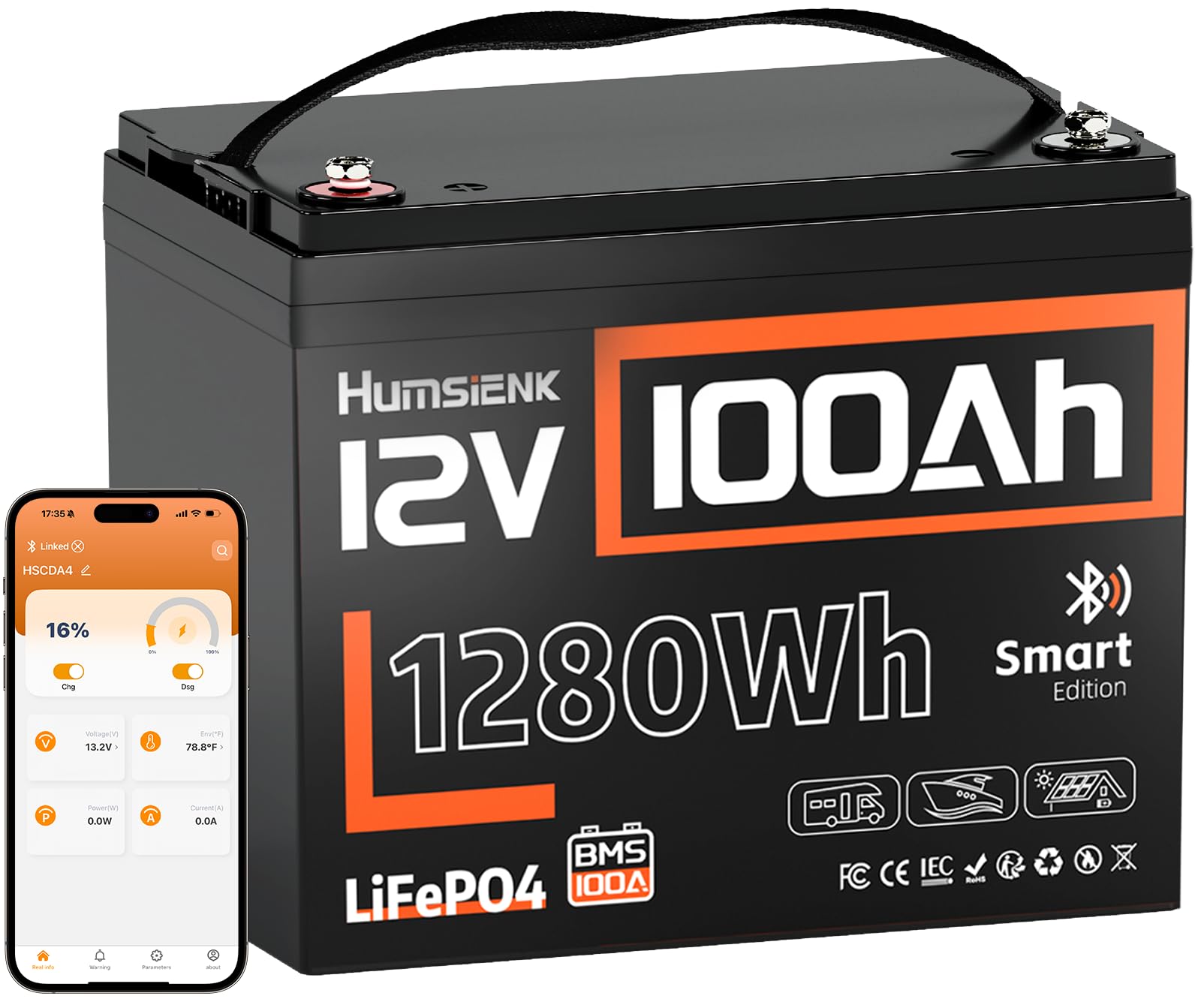
4. HumsiENK 12V 100Ah LiFePO4 with Bluetooth
The featherweight lithium that saves space without skimping on smarts.
At just 19.7 lbs, this is the lightest 100Ah battery on this list — 60% lighter than a lead-acid equivalent and small enough to fit any BCI Group 24–31 battery box. That weight saving is the kind of thing you feel every time you open the camper hatch. Its compact dimensions of 8.2″H x 6.6″W x 10.2″L mean it tucks into tight corners where a bulkier Group 31 simply won’t go. Owners describe it as a perfect drop-in replacement for RV, solar, or marine setups, with one noting it powered a 780W shop vac without issue.
This one pairs an upgraded 100A smart BMS with a Bluetooth app that updates several times per second. You get live voltage, state of charge, current, and temperature — plus per-cell data and detailed alarms, which is a level of detail you usually see in much pricier batteries. It’s built with A+ grade LiFePO4 cells, is UL tested, and carries IP65 waterproofing, so a little deck spray or rain won’t hurt it. The low-temperature cutoff operates across a range of –4°F to 158°F, automatically shutting down charging to protect the cells in the cold.
One owner noted a short terminal bolt caused overheating under a heavy load, but the company replaced it immediately — the fix was simply using a longer bolt for more contact. A few also had trouble with the app, which may have contributed to charging issues in isolated cases. But for the price, the combination of ultralight weight, compact size, and per-cell Bluetooth data is genuinely hard to match. It supports 4S4P configurations up to 48V and 20.48kWh if you grow your system later.
The light-lift advantage
- 19.7 lbs — easiest 100Ah lithium to carry and install
- Per-cell Bluetooth monitoring with rapid updates
- IP65 waterproof rating for exposed installs
- Saves over 30% space versus lead-acid
Watch out for
- Use a longer terminal bolt for a solid connection under heavy load
- App connectivity issues reported by a few owners
The space-maximizer’s choice: If every pound and inch counts in your camper, this is the lithium to fit.
Think twice if: You push heavy loads through short bolts — a simple hardware swap fixes it.
5. Power Queen 12V 100Ah Trolling Motor LiFePO4
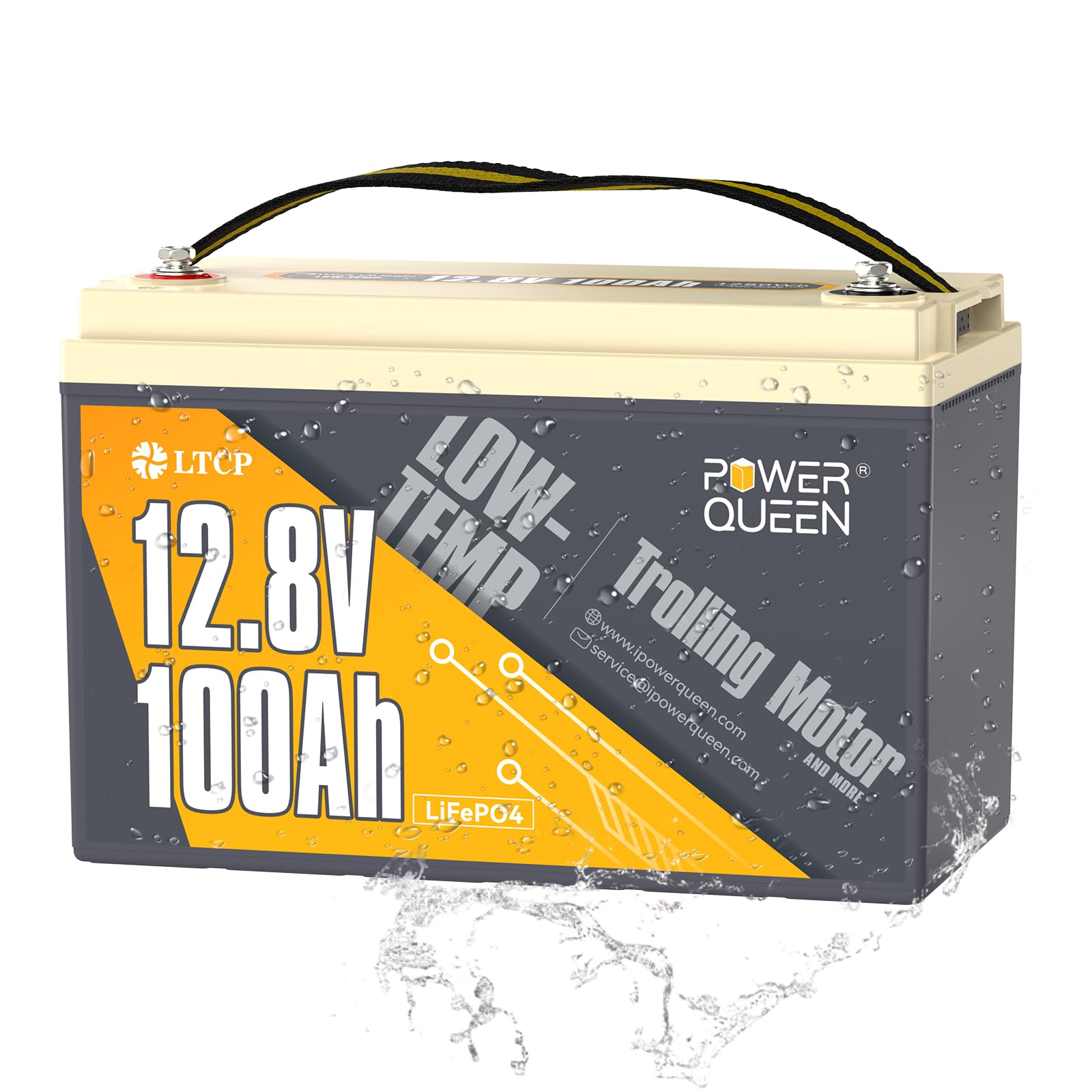
Built for the water, with surge protection that keeps your trolling motor steady.
This battery is engineered for the electric trolling motor crowd, and its name brand says it all. It’s built to handle motors up to 120lb thrust and includes a TVS surge protector (a component that blocks voltage spikes) for 12V-36V motors — so in rough water, your fishing gear stays steady. One owner runs it on a 10ft boat with a Minn Kota 50lb motor and reports 10+ trips of about 4 hours each with the battery meter still showing full; another went two full days of solid use on a 33lb thrust kayak motor with power to spare.
The ABYC E-13 compliance is a meaningful safety credential for marine use — it means the triple-protected BMS (dust, water, salt-spray) is built to a recognized marine standard. At 22.16 lbs, it’s up to 64% lighter than a comparable lead-acid battery, which owners say noticeably improves boat speed and handling. It’s also a legit camper battery: one traveler runs it powering a microwave, fridge, mini split, laptop, and TV in a travel trailer without issues.
Reliability is the recurring theme in owner experiences. One boater used it heavily for two years before a BMS issue appeared, then got replacements sent the next day after video proof — a warranty experience that genuinely stands out. The low-temperature protection stops charging below 32°F and stops discharging below -4°F, which protects it during cold winter storage. It supports up to 4P4S (51.2V 400Ah) expansion and 4,000+ cycles at 100% depth of discharge. If you split time between the water and the campsite, this dual-purpose design is tough to beat.
The dual-use standout: Surf-protection plus marine-grade certification makes it equally at home on a boat or in a camper.
Choose this if: You run a trolling motor and want the same battery to power your camper fridge.
Not ideal for: Heavy inverting loads over 120A continuous — it’s built around motor duty cycles.
6. DUNFUME 12V 100Ah LiFePO4 Group 31
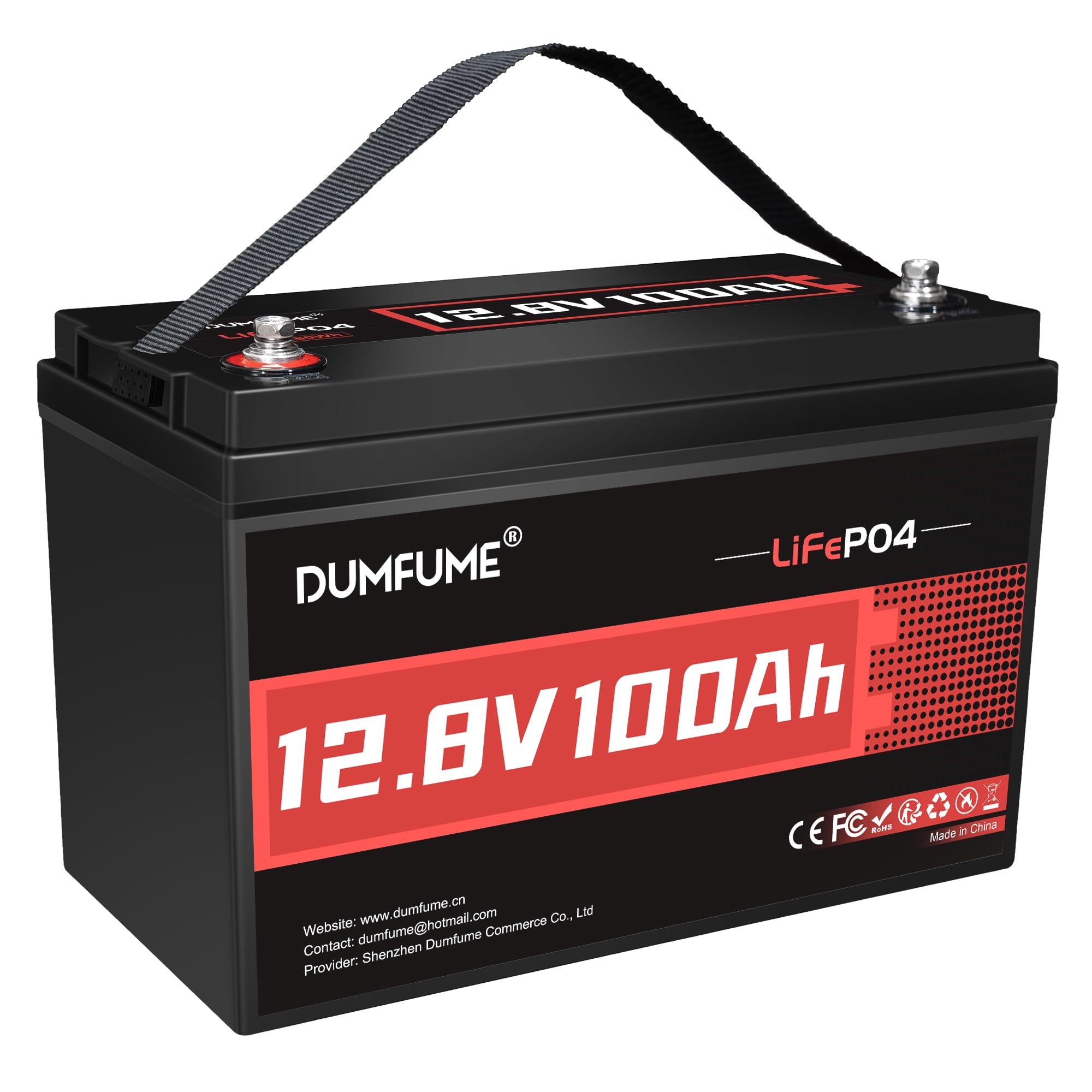
The no-frills lithium that gets you into the chemistry at a friendly price.
If you’re ready to leave lead-acid behind but aren’t ready for a premium price tag, this is the entry point. DUNFUME keeps things deliberately simple: no Bluetooth, no app, just a solid 100Ah LiFePO4 battery with a 1.28kWh capacity that works well even with modest solar input. One owner runs it on a Scamp Camper with just 100 watts of solar on the roof and calls it “good so far” — proof you don’t need a huge solar array to keep this topped up. At 21.6 lbs, it’s two-thirds lighter than a 100Ah AGM battery, which makes the install dramatically easier.
The integrated 100A BMS provides comprehensive protection against overcharging, over-discharging, short circuits, overheating, and overcurrent. The Grade A cells support up to 4,000 cycles at 100% depth of discharge — and the spec sheet stretches to 15,000 cycles at 60% DOD. The ABS casing is dustproof and weather-resistant (though not waterproof), so it’s fine in a dry camper compartment or outdoor enclosure. It supports series and parallel connections up to 4S4P to build a 51.2V 400Ah system if you scale up later.
The honest caveat: this is a “no-frills” battery, and that simplicity is a double-edged sword. One owner reported a unit that arrived at low voltage and needed a parallel jump-charge to wake the BMS — a fairly common lithium quirk, not a defect. A more serious individual report of a battery dying after a year in a campervan exists, with the note that the 5-year warranty only applies to direct purchases, not Amazon. Performance needs temperatures of 5°C or higher, so it’s not for winter camping. For warm-season campers on a budget, the value is real.
Why it earns its keep
- Entry price gets you full LiFePO4 benefits
- 21.6 lbs is easy to handle on install day
- Works with small solar setups like 100W
- 4,000+ cycles at full discharge
The honest limits
- No monitoring app — you’ll want a separate shunt
- Requires 5°C+ temperatures to perform
- Warranty stronger for direct buyers than Amazon purchases
Best for: First-time lithium upgraders who camp in mild weather and want the lowest entry cost.
Reach for a different pick if: You camp in freezing temps or want on-phone battery monitoring.
7. yeagulch 12V 150Ah LiFePO4
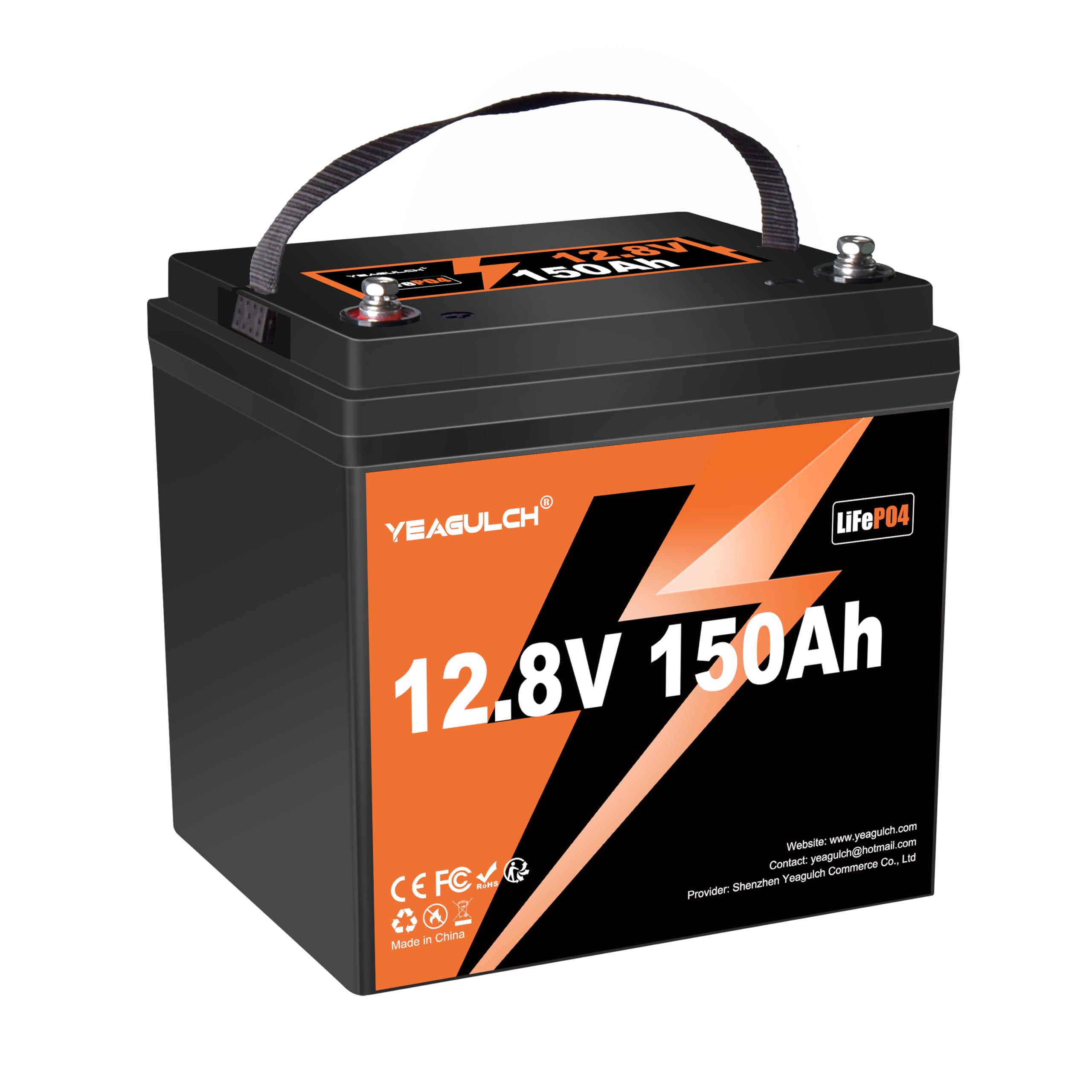
The budget route to a bigger fuel tank — 150Ah of off-grid headroom.
Here’s a smart budget workaround: instead of paying a premium for a 100Ah lithium from a big name, you can get 150Ah from a lesser-known brand for roughly the same money. That’s a 50% capacity bonus, which in real terms means an extra day of fridge runtime or the ability to run a trolling motor all week and still have half a charge. One owner dragged a pontoon around a lake all week on one of these and finished “at half charge” — a convincing real-world test of the 150Ah rating.
The built-in 100A BMS handles overcharge, over-discharge, short circuits, and overheating, and it includes low-temperature protection that stops charging at 32°F to protect the cells. A long-term solar owner reports the battery ran at full power for six months of daily charging, and another says it charged to full in half a day via solar panel. At 41 lbs, it’s heavier than a 100Ah lithium but still far lighter than the lead-acid equivalent capacity. The compact size of 10.01 x 7.68 x 9.84 inches fits in tight RV compartments.
The honest trade-off is branding. Owners describe it as “functional and an amazing value” rather than top-tier, and there’s no Bluetooth — you’ll monitor state of charge through a shunt, charger, or solar controller. One owner noted the BMS over-current protection felt uncertain and recommended babysitting the first smart charger use. For a trolling motor, solar shed, or weekend camper where budget is the priority, this delivers the most amp-hours per dollar on this list.
Capacity per dollar king: 150Ah of solid lithium performance at a budget price point is the whole story here.
Pick this if: You want maximum runtime for the smallest outlay and don’t need an app.
Step up if: You demand a major brand name or built-in monitoring on your battery.
8. Mighty Max Battery 12V 100Ah ML100-12 SLA

The dependable AGM workhorse that needs zero maintenance and zero learning curve.
Not everyone needs the latest lithium tech, and this sealed lead-acid (SLA/AGM) battery is proof that a simpler option still has a place in a camper. It’s a UL-certified 12V 100Ah battery that’s spill-proof and maintenance-free — mount it in any position, bolt it in, and forget about it. There’s no BMS to understand, no app to pair, no charging quirks. One owner replaced their van’s house battery with this and saw consistent 4 red lights on the meter after overnight use versus 2-3 from the old unit, across a four-week trip.
Performance holds up for real loads. A trolling motor user got 8+ hours of run time with 35% charge left, beating an older 4-6 hour battery. Another ran a 32″ TV and Roku through a 500W inverter for 4 hours and saw only 1% drain. It’s rated for high discharge rates and wide operating temperatures, which is why it also powers emergency lighting and solar setups. The one-year warranty is short compared to lithium options, but at this price point, it’s an easy entry into a reliable deep-cycle setup.
What you give up with lead-acid is usable capacity. You only want to drain this to about half before recharging, so a 100Ah AGM gives you roughly 50Ah of safe daily use — about what you’d get from a 50Ah lithium. It’s also heavy at 28 lbs, which is manageable but noticeably denser than the lithium equivalents here. If your camper usage is light (LED lights, phone charging, a small fan) and you want the cheapest reliable path, this is a perfectly sensible choice. Just know that one long-term owner found return shipping on a warranty claim to be pricey.
The simple life
- Zero maintenance, spill-proof, mount in any position
- UL certified with solid performance for the price
- No BMS or charging complexity to learn
The lead-acid reality
- Only about half the 100Ah is safely usable
- 28 lbs is heavier than any lithium pick here
- Warranty returns can carry shipping costs
Ideal for: Minimal-power campers who want a cheap, bulletproof battery with zero setup.
Choose lithium instead if: You run a 12V fridge all day and want double the usable capacity.
9. WEIZE 12V 100Ah Deep Cycle Battery, Group 31

The heavy-duty AGM that runs 18 LEDs and 3 vent fans for 20+ hours straight.
If you’re building a budget-conscious camper setup and weight isn’t a concern, this Group 31 AGM battery (a sealed lead-acid type that doesn’t spill) is the workhorse. It has a 3% self-discharge rate, meaning it holds its charge for months in storage and doesn’t need the constant babysitting of a flooded battery. One owner ran 18 interior LED lights and 3 vent fans for over 20 hours without recharging — a very realistic camper scenario — and plenty of others confirm it holds a charge well and outperforms standard lead-acid at a better price.
It’s built for flexibility, fitting applications from wheelchairs to golf carts to trolling motors, and it shines in commercial settings (schools, healthcare, property management) where maintenance-free reliability matters. Four of these in parallel feed a 2000W inverter for about 4.8kWh of backup power, running 120V outlets, fans, and a garage door. The 1150A max discharge current means it can handle a serious surge if you ever need it. Owners running two of these in an RV for two years with 300W of solar report zero issues, and note that charging at 13.8V float and 14.4V cyclic keeps them happy.
The honest trade-off is obvious the moment you pick it up: 63 lbs is heavy. But if the battery is staying put in a camper, that weight is irrelevant. The bigger consideration is that, like all lead-acid, you only get about half the rated capacity as safely usable — so this is best for moderate power needs. For a no-fuss, long-lasting AGM that won’t break the bank, it delivers exactly what it promises.
The sturdy budget backup: Heavy but dependable AGM power for campers where weight is a non-issue.
Right choice for: Stationary camper installs where you want maximum power per dollar and lifespan over portability.
Not for: Anyone who needs to lift or move the battery regularly.
Understanding the Specs
Amp-Hours (Ah)
This is the fuel tank size of your battery. A 100Ah battery can deliver 100 amps for one hour, or 5 amps for 20 hours. The key trick is that lithium batteries let you use almost all of that rated capacity, while lead-acid batteries should only be drained to about 50% to avoid damage. For a camper, that means a 100Ah lithium behaves like a much bigger lead-acid.
Watt-Hours (Wh)
This is the total energy your battery stores, and it’s the number that actually tells you what you can run. A 12.8V battery rated at 100Ah holds about 1280Wh of energy. To figure out runtime, divide the watt-hours by the watts your device uses — so a 50W fridge would run roughly 25 hours on a full 1280Wh battery.
Battery Management System (BMS)
Think of this as the battery’s protective brain. It watches over the cells and cuts power if something goes wrong — overcharging, over-discharging, short circuits, or overheating. A 100A BMS means it can safely deliver up to 100 amps of continuous current. The best BMSes add low-temperature protection, which stops charging in freezing conditions to save the cells.
Depth of Discharge (DOD)
This tells you how much of a battery’s capacity you can safely use. Lithium phosphate batteries are rated for 100% DOD, meaning you can drain them fully. Lead-acid batteries are typically limited to 50% DOD. Cycle life is tied to this — a battery rated for 4,000 cycles at 100% DOD can be fully drained and recharged 4,000 times.
FAQ
What size battery do I need for my camper?
Is a lithium battery worth the extra cost over lead-acid?
Will a lithium battery work with my existing camper charger?
Can I use a lithium battery in freezing weather?
What is a deep cycle battery and why do I need one for a camper?
How many amp-hours do I really need for a 12V fridge?
Can I connect multiple camper batteries together?
How long will a camper battery last?
Final Thoughts: The Verdict
For most campers, the smart pick is the Litime 12V 100Ah because it blends 21 lbs of easy weight with the Bluetooth visibility that removes all guesswork about your charge — and it backs it up with a 5-year warranty. If you want proven performance on a budget, the Redodo 12V 100Ah delivers more than its rated capacity and stellar support. And if you’re chasing maximum off-grid time or heavy loads, the ECO-WORTHY 280Ah with its metal case and 200A BMS (a battery management system that protects against overcharge and over-discharge) is the powerhouse that keeps the fridge running for days.
How We Picked
We do not accept paid placement. Every pick is matched to a real buyer and a real use-case; we do not hands-on test units.
Sources & Methodology
Specifications: manufacturer listings and product documentation. Review insights: verified customer reviews, as of August 2026. Pricing: not shown on this page (it changes often); check the current price via the retailer link.
As an Amazon Associate, Gadgets Feed earns from qualifying purchases. This does not affect which products we feature.