
A deer steps into a clearing at dawn. The light is perfect. You raise your camera, press the shutter — and the image that comes back is a soft, noisy disappointment. That split-second loss defines the gap between a casual snapshot and a frame you’d print large. For anyone stepping into nature photography, the camera you choose determines whether those fleeting moments become wall-worthy images or forgotten files. The body must balance reach, speed, and image quality without overwhelming a new photographer with complexity.
I’m Min — the co-founder and writer behind Gadgets Feed. I’ve spent hundreds of hours analyzing sensor performance, autofocus systems, and lens compatibility across the current mirrorless and DSLR market to find the bodies that actually serve a beginner learning to shoot landscapes, wildlife, and macro outdoors.
This guide covers autofocus coverage, sensor size, burst rate, and lens ecosystem support to help you find the perfect camera for beginner nature photography that grows with your skills without punishing your budget.
How To Choose The Best Camera For Beginner Nature Photography
A nature camera must handle low light at dawn, fast movement of wildlife, and the occasional rain shower. Beginners often overvalue megapixels while neglecting autofocus and lens support — two specs that define success in the field. Focus on these four pillars before anything else.
Sensor Size and Dynamic Range
An APS-C sensor offers the best balance of price, portability, and image quality for a beginner. Full-frame sensors capture more light and deliver wider dynamic range for high-contrast scenes like a sunset horizon, but the bodies and lenses cost significantly more. Micro Four Thirds cameras are lighter and offer superb telephoto reach but struggle more in deep shadow. For most beginners, a modern APS-C sensor with 20-24 megapixels provides enough resolution for large prints without taxing storage or processing.
Autofocus Performance and Point Coverage
A bird flitting between branches or a fox stepping through tall grass demands fast, accurate autofocus. Look for phase-detection AF with at least 100 points — and preferably animal eye-detection tracking. Cameras with fewer than 50 AF points or only contrast-detection AF will miss critical shots in nature where subjects move unpredictably. The number of cross-type points matters more indoors; for nature, wide area coverage across the frame is the priority.
Burst Rate and Buffer Depth
Continuous shooting speed, measured in frames per second, determines whether you capture the exact wing beat or the perfect leap. Aim for at least 5 fps for landscapes and slow wildlife; 10 fps or higher is ideal for birds in flight or running animals. Buffer depth — how many full-resolution shots the camera can fire before slowing down — matters just as much. A shallow buffer means the camera stops after a second or two, missing the best moment of the action.
Lens Ecosystem and Weather Sealing
The camera body is only half the equation. A strong lens lineup with affordable telephoto zooms (200mm or longer) and wide-angle options for landscapes is essential for nature photography. Check whether the mount system has native lenses suited for outdoor use. Weather sealing — dust and moisture resistance rated to IP53 or better — protects your gear when shooting in mist, light rain, or sandy environments. A sealed body with a sealed lens can mean the difference between a working camera and a ruined afternoon.
Quick Comparison
On smaller screens, swipe sideways to see the full table.
| Model | Category | Best For | Key Spec | Amazon |
|---|---|---|---|---|
| OM SYSTEM OM-1 Mark II | Premium Mirrorless | Extreme weather & wildlife | 1053-point Cross Quad Pixel AF | Amazon |
| Sony a7 III | Premium Mirrorless | Full-frame low-light mastery | 693 phase-detection AF points | Amazon |
| OM SYSTEM OM-5 Mark II | Premium Travel | Compact weather-sealed travels | 5-axis IBIS (6.5-7.5 stops) | Amazon |
| Canon EOS RP | Full-Frame Entry | Upgrading from APS-C | 26.2MP Full-Frame CMOS | Amazon |
| Nikon Z 30 (Two-Lens) | Mid-Range Mirrorless | Walk-around nature vlogging | 209-point Hybrid AF | Amazon |
| Canon PowerShot SX740 HS | Compact Superzoom | Ultimate reach in a pocket | 40x optical zoom (24-960mm) | Amazon |
| Canon EOS Rebel T7 + 18-55mm & 75-300mm | Mid-Range DSLR | Double-zoom kit learning | 24.1MP APS-C CMOS | Amazon |
| Nikon D3300 Kit | Entry DSLR | Budget two-lens landscape kit | 11 AF points with 3D tracking | Amazon |
| Canon EOS Rebel T7 + 500mm Bundle | Budget DSLR Kit | Getting started with telephoto | 500mm preset telephoto included | Amazon |
| Canon EOS Rebel T7 Renewed Triple Zoom | Budget DSLR Kit | Multiple focal lengths cheaply | 18-55mm, 75-300mm, 500mm lenses | Amazon |
| Canon EOS R100 | Budget Mirrorless | Lightest entry into RF system | 143-zone Dual Pixel CMOS AF | Amazon |
In‑Depth Reviews
1. OM SYSTEM OM-1 Mark II

The OM-1 Mark II redefines what a nature photography camera can deliver for a beginner willing to invest upfront. The Cross Quad Pixel AF system packs 1,053 all cross-type points covering the entire frame — a level of coverage that makes tracking a running fox or flying bird almost trivial. The 20MP Stacked BSI Live MOS sensor, paired with the TruePic X processor, delivers usable images at ISO levels above 10,000, a critical advantage when shooting under a forest canopy at dusk.
Weather sealing rated to IP53 means this body survives dust, splash, and freezing temperatures down to -10°C without complaint. The in-body 5-axis image stabilization rated up to 8 stops lets you handhold a 600mm equivalent telephoto at shutter speeds that would defeat most full-frame systems. Computational features like Handheld High Res Shot (80MP), Live ND, and in-camera Focus Stacking remove the need for external filters or post-processing software on many nature shots.
The burst rate reaches 20 fps with the electronic shutter and 10 fps with the mechanical, both with full AF/AE tracking. The buffer depth is generous — around 4000 shots per battery charge in real-world testing — letting you spray frames during a critical action sequence without the camera choking. The Micro Four Thirds mount gives access to a vast, lightweight lens lineup including the superb OM 50-200mm f/2.8 PRO and Panasonic Leica 100-400mm for wildlife reach without the weight of full-frame glass.
Why it’s great
- Best-in-class weather and dust sealing for rugged outdoor use
- Massive 1053-point cross-type AF covers the entire frame
- Computational features reduce need for filters and editing
Good to know
- 20MP resolution limits cropping compared to higher-res full-frame bodies
- Menu complexity may require a learning session to unlock all features
2. Sony a7 III

The Sony a7 III remains the benchmark for full-frame value in nature photography. Its 24.2MP back-illuminated Exmor R CMOS sensor delivers 15 stops of dynamic range, meaning you can recover shadow detail from a backlit landscape and hold highlight texture in a bright sky without banding. The 693 phase-detection AF points cover 93% of the image area, and real-time eye tracking for animals makes it exceptionally capable for wildlife despite not having the latest AI algorithms.
Low-light performance is class-leading. ISO ranges natively from 100 to 51,200 and expands to 204,800, producing clean files at ISO 6400 that print beautifully at A3 size. The 5-axis in-body stabilization provides 5 stops of compensation, helpful for handheld telephoto work at dawn and dusk. The electronic shutter fires at up to 10 fps with full AE/AF tracking, and the buffer clears quickly with a UHS-II SD card, letting you sustain long bursts during action sequences.
The kit lens (28-70mm f/3.5-5.6) is capable but not exceptional — most nature photographers will quickly pair this body with the FE 70-300mm f/4.5-5.6 G OSS for wildlife reach or the FE 16-35mm f/4 ZA OSS for sweeping landscapes. Battery life is remarkable: approximately 710 shots per charge in real-world use, meaning a single battery can cover a full day of hiking and shooting. The body includes a micro USB port for tethering and USB power delivery, though it lacks the newer USB-C standard found on later models.
Why it’s great
- 15-stop dynamic range recovers incredible detail in high-contrast outdoor scenes
- 693-point AF covers 93% of frame for reliable wildlife tracking
- Exceptional battery life for all-day hikes without recharging
Good to know
- Kit lens is decent but you’ll want a telephoto zoom for wildlife
- Weather sealing is modest compared to dedicated outdoor bodies
3. OM SYSTEM OM-5 Mark II
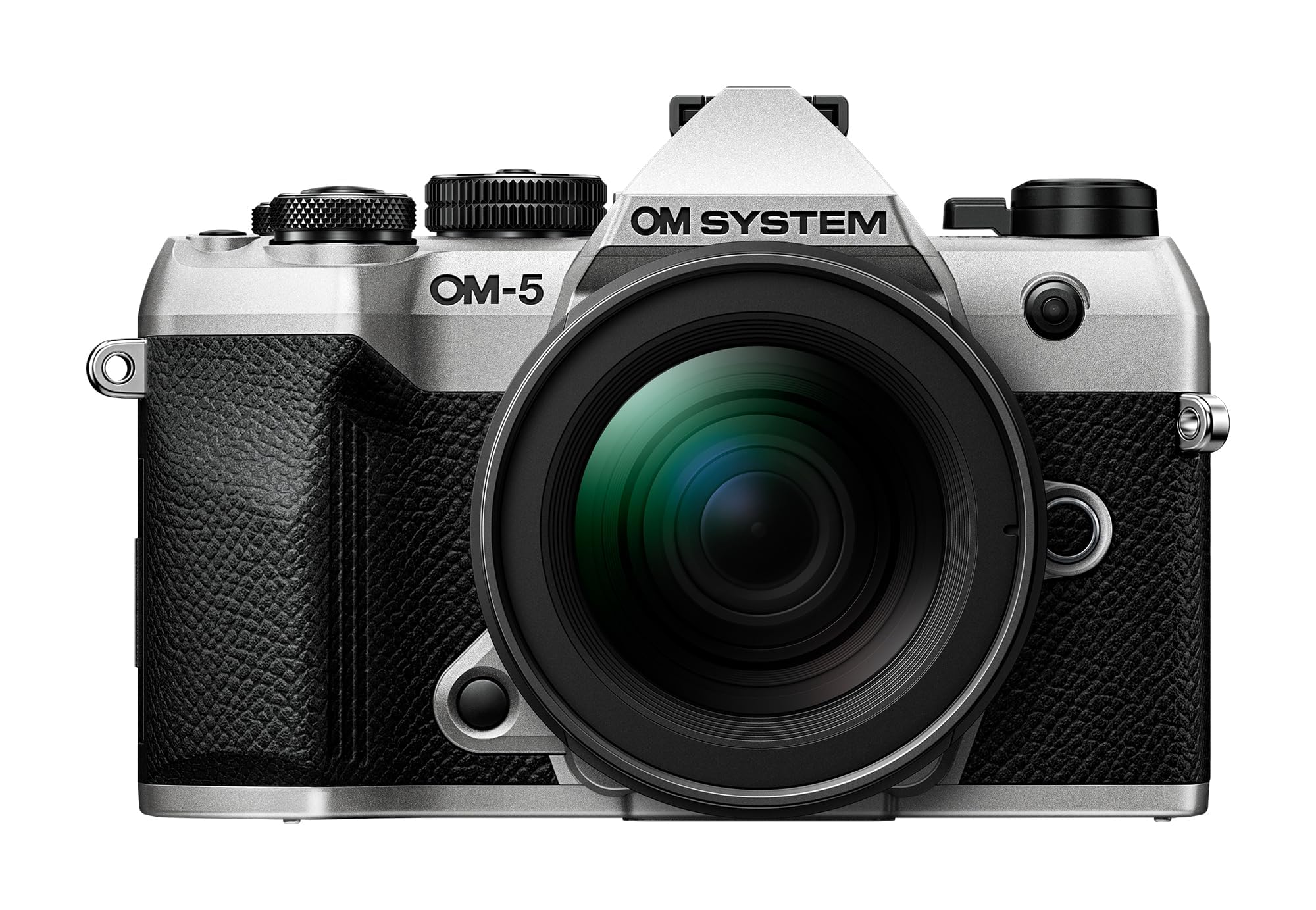
The OM-5 Mark II packs the core outdoor DNA of the OM system into a smaller, lighter package that disappears into a daypack. It shares the IP53 weather sealing of its bigger sibling, meaning rain, dust, and freezing conditions don’t stop shooting. The 5-axis in-body image stabilization delivers 6.5 to 7.5 stops of correction — sufficient to handhold a 300mm equivalent lens steady at 1/30th of a second, a game-changer for low-light nature work without a tripod.
The 20MP Micro Four Thirds sensor with 121 phase-detection AF points provides reliable subject tracking for slower-moving wildlife and landscapes. The computational photography button gives one-press access to features like Live ND, focus bracketing, and high-res shot mode (up to 50MP handheld). The kit lens, a M.ZUIKO Digital ED 12-45mm F4.0 PRO, is a constant-aperture zoom that offers excellent sharpness across the frame, making it ideal for landscape compositions from wide-angle to short telephoto.
Unlimited 4K video recording means you can capture time-lapses of clouds rolling over a mountain without worrying about recording limits. The compact form factor encourages you to bring the camera on every hike rather than leaving it at home. The main trade-off is sensor size: Micro Four Thirds has narrower dynamic range than APS-C or full-frame, meaning deep shadows may show more noise. A spare battery is recommended, as the smaller cell provides around 350 shots per charge.
Why it’s great
- Extremely compact and lightweight for a fully weather-sealed body
- 5-axis IBIS allows handholding long telephoto shots in low light
- Computational features built-in without needing software
Good to know
- Grip is small — larger hands may find it cramped over a long day
- Smaller battery requires a spare for all-day field work
4. Canon EOS RP

The Canon EOS RP provides the cheapest viable entry into full-frame mirrorless, making it an attractive step-up for nature photographers who have outgrown an APS-C kit. The 26.2MP full-frame CMOS sensor captures noticeably wider dynamic range than any APS-C sensor at the same price, preserving detail in high-contrast scenes like a sun-drenched meadow bordering a dark forest. The Dual Pixel CMOS AF with 4,779 manually selectable points delivers smooth, accurate face and eye tracking for both humans and animals — critical for keeping a deer’s eye sharp at f/2.8.
The RF 24-105mm F4-7.1 IS STM kit lens provides a versatile 24-105mm full-frame equivalent range with up to 5 stops of image stabilization. It covers wide-angle landscapes at 24mm and a short portrait perspective at 105mm, adequate for a beginner learning composition. The body weighs just 1.1 pounds with the battery and card, making it the lightest full-frame camera on this list, and the ergonomic grip supports comfortable handholding for hours of trail walking.
Video capture reaches 4K UHD at 24p, though with a 1.7x crop that significantly narrows the field of view. The 2.36-million-dot OLED electronic viewfinder is clear and responsive, providing a bright preview even in harsh midday light. Battery life is modest — around 250 shots per charge — so a spare battery is essential for a full day of nature shooting. The RP uses the RF mount, giving you access to Canon’s growing native lens lineup as well as EF lenses via an adapter.
Why it’s great
- Full-frame sensor provides superior dynamic range for high-contrast landscapes
- Lightest full-frame body at 1.1 lbs for easy hiking carry
- Dual Pixel CMOS AF is fast and accurate for animal tracking
Good to know
- 4K video mode has a heavy 1.7x crop
- Battery life is short — carry at least one spare
5. Nikon Z 30 (Two-Lens Kit)

The Nikon Z 30 bundles two dedicated zoom lenses — a 16-50mm wide-angle and a 50-250mm telephoto — covering the full range a beginner nature photographer needs before buying any additional glass. The 16-50mm captures sweeping landscapes and forest interiors, while the 50-250mm reaches out to 375mm equivalent in full-frame terms, enough to frame a distant bird or animal without disturbing it. The 20.9MP DX-format sensor delivers clean images up to ISO 3200, sufficient for golden hour and overcast forest light.
The hybrid autofocus system uses 209 points with eye-detection tracking for both people and pets, making it easy to lock onto and follow a moving subject. The flip-out touchscreen selfie monitor is useful for low-angle nature compositions — think mushrooms, flowers, or frog-level perspectives — without lying on the ground. The body features a built-in stereo microphone with adjustable sensitivity and a red tally light for video recording, plus plug-and-play UVC/UAC support for live streaming nature content directly over USB-C.
At 12.1 ounces for the body alone, the Z 30 is one of the lightest interchangeable-lens cameras available, encouraging you to take it on every hike rather than leaving it home due to weight. The 4K video records at up to 30p with no crop, and Full HD 60p works for smooth slow-motion clips. The biggest downside is the lack of a built-in viewfinder — you compose exclusively through the rear LCD, which can be difficult in bright sunlight. Additionally, the camera ships without a battery charger, relying solely on USB-C charging that some users find slow.
Why it’s great
- Two-lens kit covers wide-angle to telephoto without extra purchases
- Extremely lightweight body for all-day carry on trails
- 4K video with no crop and UVC streaming support
Good to know
- No built-in electronic viewfinder — composing in bright sun is tough
- No battery charger included; USB-C charging can be slow
6. Canon PowerShot SX740 HS
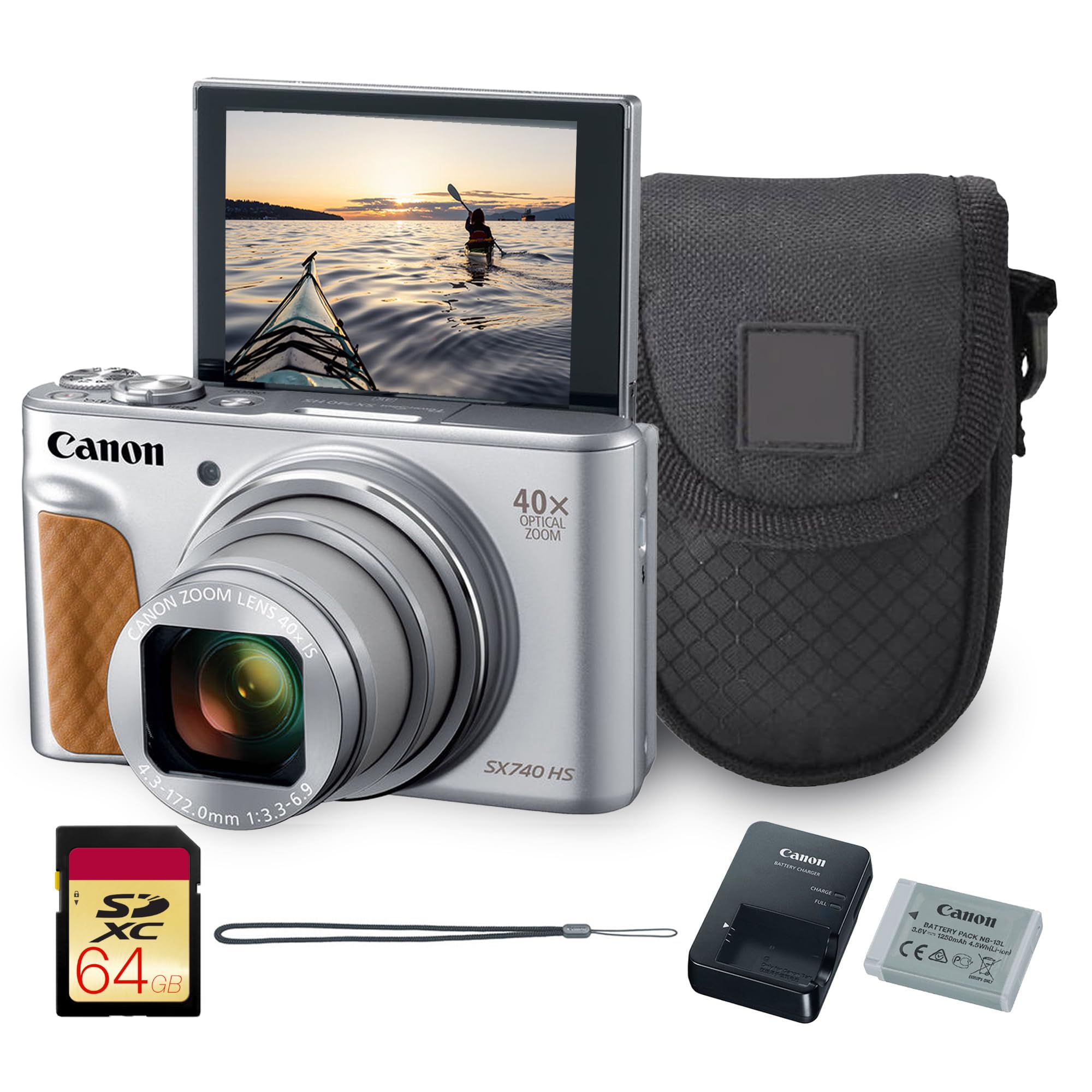
The Canon PowerShot SX740 HS proves that a compact point-and-shoot can deliver serious nature photography reach when you can’t carry a full kit. Its 40x optical zoom lens spans a 35mm equivalent range of 24mm at the wide end to 960mm at the telephoto end — enough to fill the frame with a squirrel in a tree or a heron across a pond. Optical Image Stabilization keeps the 960mm shots steady enough for sharp handheld captures in good light, though a tripod is recommended for the longest end in dim conditions.
The 20.3MP CMOS sensor paired with the DIGIC 8 processor delivers 4K video at 30p and a 4K time-lapse mode for creative nature sequences. Built-in Wi-Fi and Bluetooth let you transfer images to your phone for quick sharing or remote shutter control, useful when you want to trigger the camera from a distance to avoid scaring wildlife. The body slides easily into a jacket pocket or a small pouch, making it the only camera here that fits in a standard hiking belt pack alongside snacks and a water bottle.
Battery life is surprisingly strong — users report lasting through a 5-day trip on a single charge thanks to the efficient processor. The flip-up LCD screen aids in composing low-angle shots of wildflowers or insects without kneeling in mud. The trade-offs are significant for serious learning: the small sensor has limited dynamic range compared to any interchangeable-lens camera, and image quality at ISO 800 or above shows noticeable noise. The autofocus system uses a hybrid method that struggles in low contrast scenes like a deer against dark foliage.
Why it’s great
- 40x zoom (24-960mm equivalent) covers everything from landscapes to distant wildlife
- Pocket-sized design means you never leave it behind on a hike
- Excellent battery life for multi-day trips without recharging
Good to know
- Small sensor limits dynamic range and produces noise above ISO 800
- Hybrid autofocus struggles in low contrast and deep shade
7. Canon EOS Rebel T7 Double Zoom Bundle
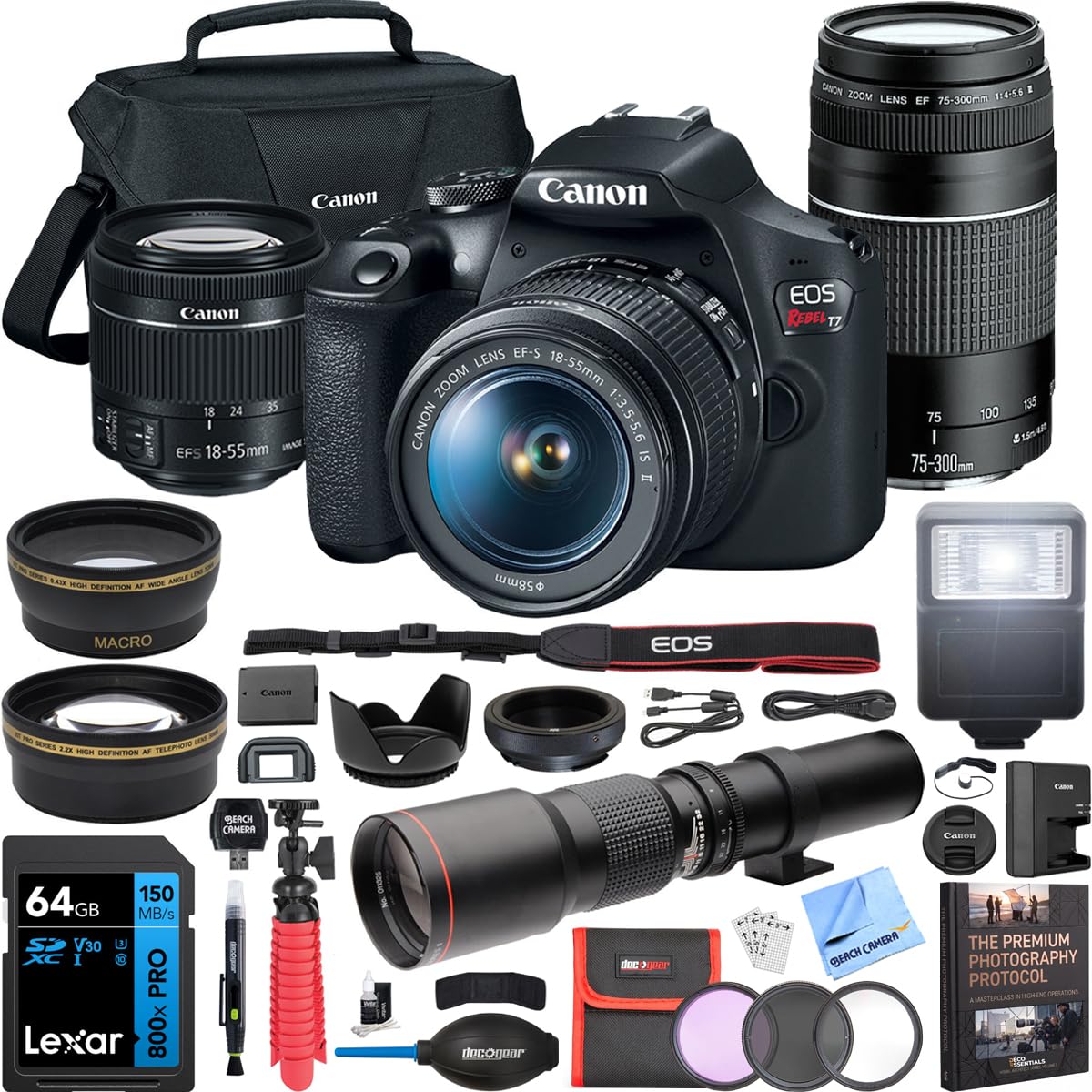
The Canon EOS Rebel T7 Double Zoom Bundle delivers the most beginner-friendly value proposition on this list: a proven APS-C DSLR body with two native zoom lenses, a 500mm preset telephoto, a bag, a 64GB memory card, and a flash — all under one purchase. The 24.1MP CMOS sensor with the DIGIC 4+ processor produces sharp, clean images up to ISO 3200 that satisfy a beginner learning to compose landscapes and portraits of nature. The 9-point AF system with a central cross-type point is basic by modern standards but functional for static subjects like flowers, trees, and perched birds.
The EF-S 18-55mm f/3.5-5.6 IS II lens covers wide-angle to normal perspective for sweeping landscape shots, while the EF 75-300mm f/4-5.6 III provides the telephoto reach to frame animals at a respectful distance. The bundle adds a 500mm f/8 preset telephoto lens with a T-mount adapter, giving you extreme reach for distant wildlife — though it is fully manual (no autofocus) and works best on a tripod. The included Lexar Professional 64GB SDXC card gives you ample storage for thousands of RAW+JPEG images.
The optical viewfinder provides a clear, lag-free view of the scene, crucial for tracking moving subjects. The 3.0-inch LCD with 920,000 dots offers live view composition for tripod-based work. Built-in Wi-Fi and NFC allow wireless image transfer to a smartphone for quick sharing. The major caveat is the 3 fps continuous shooting rate — the slowest on this list — which means capturing birds in flight or fast-moving animals will be frustrating. Some users also report rapid battery drain, with one reviewer getting only 8 shots from a full charge, suggesting defective batteries exist in the supply chain.
Why it’s great
- Complete kit with two zoom lenses, 500mm preset, bag, and 64GB card
- 24.1MP sensor delivers sharp images for printing and cropping
- Optical viewfinder is lag-free for tracking wildlife
Good to know
- 3 fps burst rate is too slow for fast wildlife action
- Some units may have battery drain issues — check immediately on arrival
8. Nikon D3300 Kit

The Nikon D3300 remains a strong entry-level DSLR choice for nature beginners who prefer a traditional viewfinder and want two dedicated zoom lenses from the start. The 24.2MP DX-format CMOS sensor delivers excellent detail up to ISO 6400, with usable images at ISO 12800 for emergency low-light situations. The 11-point AF system with 3D tracking locks onto and follows subjects across the frame — a step above the 9-point system in the Rebel T7 and sufficient for slower wildlife like grazing deer or ground-feeding birds.
The kit includes both an 18-55mm VR II lens for wide-angle landscapes and a 55-200mm VR II telephoto zoom that reaches 300mm equivalent, giving you a solid range for most nature subjects. Vibration Reduction (VR) provides up to 4 stops of stabilization on both lenses, allowing handheld shooting in lower light without a tripod. The burst rate reaches 5 fps, a full 2 fps faster than the Canon Rebel T7, giving you a better chance of capturing a sequence of a bird taking off or an animal turning its head.
The body is lightweight and the grip is ergonomically designed for smaller hands, making it comfortable for extended handheld use. The Guide Mode walks a complete beginner through different scene types and settings, teaching the relationship between aperture, shutter speed, and ISO without requiring prior knowledge. The included padded case fits the camera, both lenses, and a charger with room to spare. The lack of built-in Wi-Fi means you need an optional adapter for wireless transfers, and the 1080p video at 60 fps is good but not 4K. No memory card is included in this kit, so budget for one separately.
Why it’s great
- 5 fps burst and 11-point AF with 3D tracking for slow to moderate wildlife
- Two VR-stabilized zoom lenses cover wide to 300mm equivalent reach
- Guide Mode teaches exposure fundamentals step-by-step
Good to know
- No built-in Wi-Fi or 4K video recording
- No memory card included in the kit
9. Canon EOS Rebel T7 + 500mm Bundle
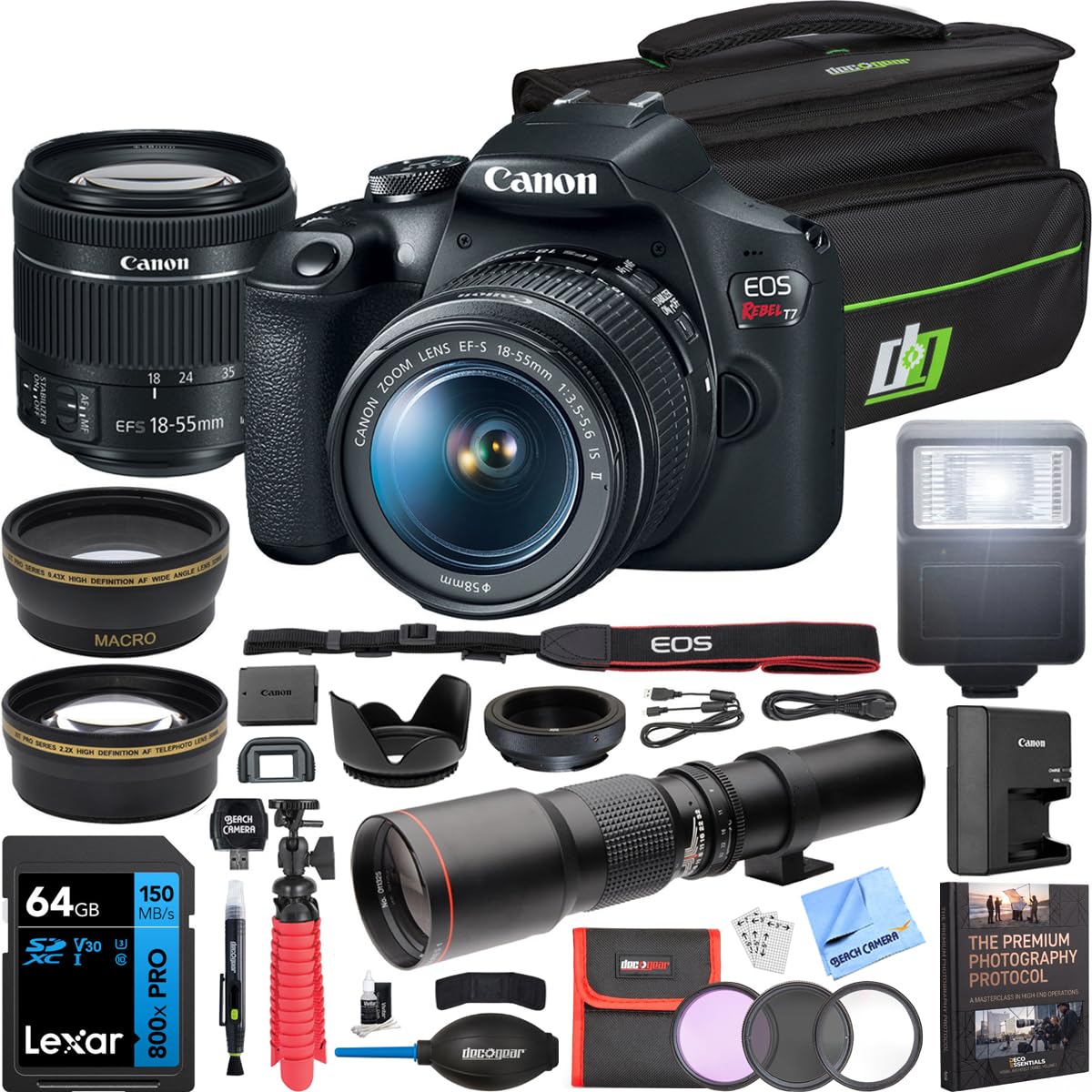
This bundle packages the Canon EOS Rebel T7 DSLR body and the 18-55mm IS II lens with a 500mm preset telephoto lens plus 13 total accessories, creating an all-in-one kit for a beginner wanting to experiment with extreme focal lengths. The 500mm f/8 manual lens screws onto the camera via a T-mount adapter, giving you the equivalent of an 800mm field of view on the APS-C sensor — enough to photograph birds and mammals at distances where they are completely undisturbed by your presence.
The core camera is the same 24.1MP APS-C Rebel T7 found in other bundles, with the DIGIC 4+ processor, 9-point AF, and 3 fps burst speed. The 18-55mm kit lens handles wide landscapes and environmental portraits, while the bundle adds a 0.43x wide-angle adapter and a 2.2x telephoto adapter that screw onto the front of the 18-55mm lens. The included SF3000 bounce zoom slave flash provides extra light for macro nature shots or fill in deep forest shadows.
The Lexar Professional 800x 64GB SDXC card provides fast write speeds for clearing the 3 fps buffer. The Deco camera bag holds the body and the standard lenses but is too small to accommodate the 500mm lens once installed — plan to store the long lens separately. The tripod included in the bundle is a 12-inch tabletop model, inadequate for stabilizing the 500mm lens at f/8 in anything other than bright daylight. As with other T7 bundles, some units have reported rapid battery drain, so test the battery immediately upon opening.
Why it’s great
- 500mm preset lens provides extreme reach for distant wildlife on a budget
- 14-piece bundle includes bag, flash, filters, card, and accessories
- 18-55mm kit lens covers standard outdoor photography needs
Good to know
- 500mm preset lens is fully manual with no autofocus or stabilization
- Bundle bag is too small to store the 500mm lens installed
10. Canon EOS Rebel T7 Renewed Triple Zoom

This renewed Canon Rebel T7 bundle offers the widest lens selection at the entry-level price: EF-S 18-55mm f/3.5-5.6 IS II, EF 75-300mm f/4-5.6 III, and a 500mm f/8 preset telephoto. The renewed body has been inspected and carries a one-year seller warranty, making it a viable option for budget-constrained beginners. The 24.1MP APS-C sensor and DIGIC 4+ processor are unchanged from new units, delivering the same image quality and feature set.
The 18-55mm lens provides the standard wide-to-normal range for landscapes and close-quarters forest scenes. The 75-300mm telephoto zoom extends to 480mm equivalent on the APS-C sensor, giving you genuine wildlife reach for the first time. The 500mm manual lens pushes to an extreme 800mm equivalent for the most distant subjects. The bundle also includes a SanDisk 32GB SDHC memory card, a shoulder bag, a slave flash, and a flexible spider tripod for low-angle nature compositions.
Users report that the camera performs well and takes excellent photos and videos, with battery life described as “great battery life” in some reviews. The renewed nature means the body may show minor cosmetic wear, but the optical elements in the three lenses are new old stock or like-new. The main drawback is the 9-point AF and 3 fps burst, which limit the camera strictly to static or slow-moving nature subjects. The 500mm lens, as with all preset telephotos, requires manual focus and a sturdy support to achieve sharp results at its maximum aperture of f/8.
Why it’s great
- Three lenses included (18-55mm, 75-300mm, 500mm) cover all common focal lengths
- Renewed body saves money while offering one-year warranty
- Includes accessories: bag, flash, tripod, and memory card
Good to know
- 9-point AF and 3 fps burst limit the camera to slow or static subjects
- 500mm lens is manual focus only — tripod required for sharp results
11. Canon EOS R100

The Canon EOS R100 serves as the lightest and most affordable mirrorless entry point into the Canon RF system, making it a competent starter camera for nature photography on a tight budget. The 24.1MP APS-C CMOS sensor paired with the DIGIC 8 processor produces excellent image quality with natural bokeh from the larger sensor area. The Dual Pixel CMOS AF covers 143 zones with human, face, eye, animal, and vehicle detection — an autofocus system that easily outclasses the 9-point DSLR AF in the Rebel T7 series, especially for tracking a moving bird or animal.
The RF-S 18-45mm f/4.5-6.3 IS STM kit lens is compact and includes optical image stabilization at up to 4 stops, but its maximum aperture is slow at the telephoto end. Continuous shooting reaches 6.5 fps in One-Shot AF mode, dropping to around 3.5 fps with continuous autofocus tracking. The camera records 4K video at 24 fps and Full HD at 60 fps, with 120 fps HD capture for slow-motion clips of moving water or flying insects.
The body is impressively small and light, making it ideal for packing on a hike where every gram counts. The battery is rated for approximately 400 shots per charge, enough for a half-day of shooting. The RF lens mount provides a clear upgrade path to premium glass like the RF 100-400mm f/5.6-8 IS USM for real wildlife reach when you’re ready to invest. The main limitation is the slow kit lens: f/4.5 at the wide end and f/6.3 at the long end, which forces high ISO settings in overcast forest light, producing visible noise above ISO 3200.
Why it’s great
- Dual Pixel CMOS AF with animal detection easily outclasses budget DSLR AF
- Smallest and lightest body in the EOS R series for hiking portability
- 6.5 fps burst with One-Shot AF captures action sequences
Good to know
- Kit lens (f/4.5-f/6.3) is slow — high ISO noise in low forest light
- No in-body stabilization — relies on lens IS only
FAQ
How many megapixels do I need for nature photography?
Is weather sealing necessary for a nature photography camera?
What lens is best for a beginner nature photographer?
Should I get a DSLR or mirrorless for nature photography as a beginner?
Final Thoughts: The Verdict
For most users, the camera for beginner nature photography winner is the OM SYSTEM OM-1 Mark II because it combines IP53 weather sealing, 1053-point cross-type AF, and computational features that eliminate the need for filters and external software — all in a lightweight, rugged body built for the outdoors. If you want full-frame dynamic range for high-contrast landscapes, grab the Sony a7 III. And for the best budget-friendly all-in-one kit that includes two zoom lenses and accessories, nothing beats the Canon EOS Rebel T7 Double Zoom Bundle.