
Our readers keep the lights on and my morning glass full of iced black tea. As an Amazon Associate, I earn from qualifying purchases.
Specs are compiled from manufacturer listings and verified buyer reviews and can change over time — please confirm the key details on the product page before buying.
Power outages and camping trips have the same problem: you need electricity where there is no outlet. The best battery generator solar setups solve this by storing sunlight in a battery you can carry anywhere, then turning it back into wall power for your fridge, phone, or CPAP machine. This guide compares the real specs and buyer experiences across 11 models so you can pick the one that fits how you actually live.
I’m Min — the founder and writer behind Gadgets Feed. This guide is built by comparing the manufacturers’ published specifications and the patterns across verified customer reviews, so you get each pick’s real strengths and trade-offs instead of marketing spin.
Whether you are prepping for blackouts or buying your first solar generator, the core choice is matching battery size to appliance wattage, and this breakdown of the best battery generator solar options makes that decision clear.
In this article
Note: This list uses flexible, human-like matching for solar charging capability — so not every pick is the exact number searched; the nearest same-type size/watt serves the same purpose.
Our Picks at a Glance

How To Choose The Best Battery Generator Solar
Before you compare brands, you need to answer one question: what are you powering? A weekend camper charging phones needs far less than a homeowner keeping a refrigerator running through a storm. The right purchase starts with a list of your appliances and their watt draw.
Battery capacity is your runtime budget
Capacity is measured in watt-hours (Wh), which tells you how long a device can run. A 300W laptop drawing power from a 288Wh station lasts roughly 5 hours. The rule of thumb: bigger capacity means longer runtime, but it also means more weight, so only buy what you truly need to haul around.
Output wattage decides what you can run
Output wattage is the ceiling for what the inverter can push at once. A 300W unit handles phones and laptops, while a 2400W unit runs a refrigerator and microwave. Check the continuous wattage, not just the surge peak, because that surge only lasts a few seconds for starting motors.
Solar input determines recharge speed
Solar panels are rated in watts, and the station’s solar input limit tells you the maximum it accepts. The bigger the panel wattage you can plug in, the faster the sun refills the battery. If you plan to live off-grid, prioritize a high solar input rating over sheer battery size.
Quick Comparison
| Model | Best For | Capacity | Output | Weight | Amazon |
|---|---|---|---|---|---|
| EF ECOFLOW DELTA 3 Max★ Best Overall | Whole-home backup | 2048Wh | 2400W | — | Amazon |
| Apowking HP200LBudget Champion | Backpacking & CPAP | 220Wh | 300W | 5 lbs | Amazon |
| GRECELL EB500Top Performer | Small appliances | 519.48Wh | 500W | 14.1 lbs | Amazon |
| Anker SOLIX C300 | Solo camping | 288Wh | 300W | 15.5 lbs | Amazon |
| DABBSSON 2000L | Off-grid job sites | 2048Wh | 2200W | 41 lbs | Amazon |
| Anker SOLIX S2000 | Fridge backup | 2010Wh | 1800W | 35.7 lbs | Amazon |
| BLUETTI AC200L | Expandable systems | 2048Wh | 2400W | 61.4 lbs | Amazon |
| BLUETTI Elite 200 V2 | High-efficiency living | 2073.6Wh | 2600W | 53.4 lbs | Amazon |
| Jackery Explorer 2000 v2 | Lightweight 2kWh power | 2042Wh | 2200W | 39.5 lbs | Amazon |
| Jackery HomePower 3000 | Large home essentials | 3072Wh | 3600W | 59.5 lbs | Amazon |
| EF ECOFLOW DELTA Pro | Maximum expandability | 3600Wh | 3600W | 99 lbs | Amazon |
In‑Depth Reviews
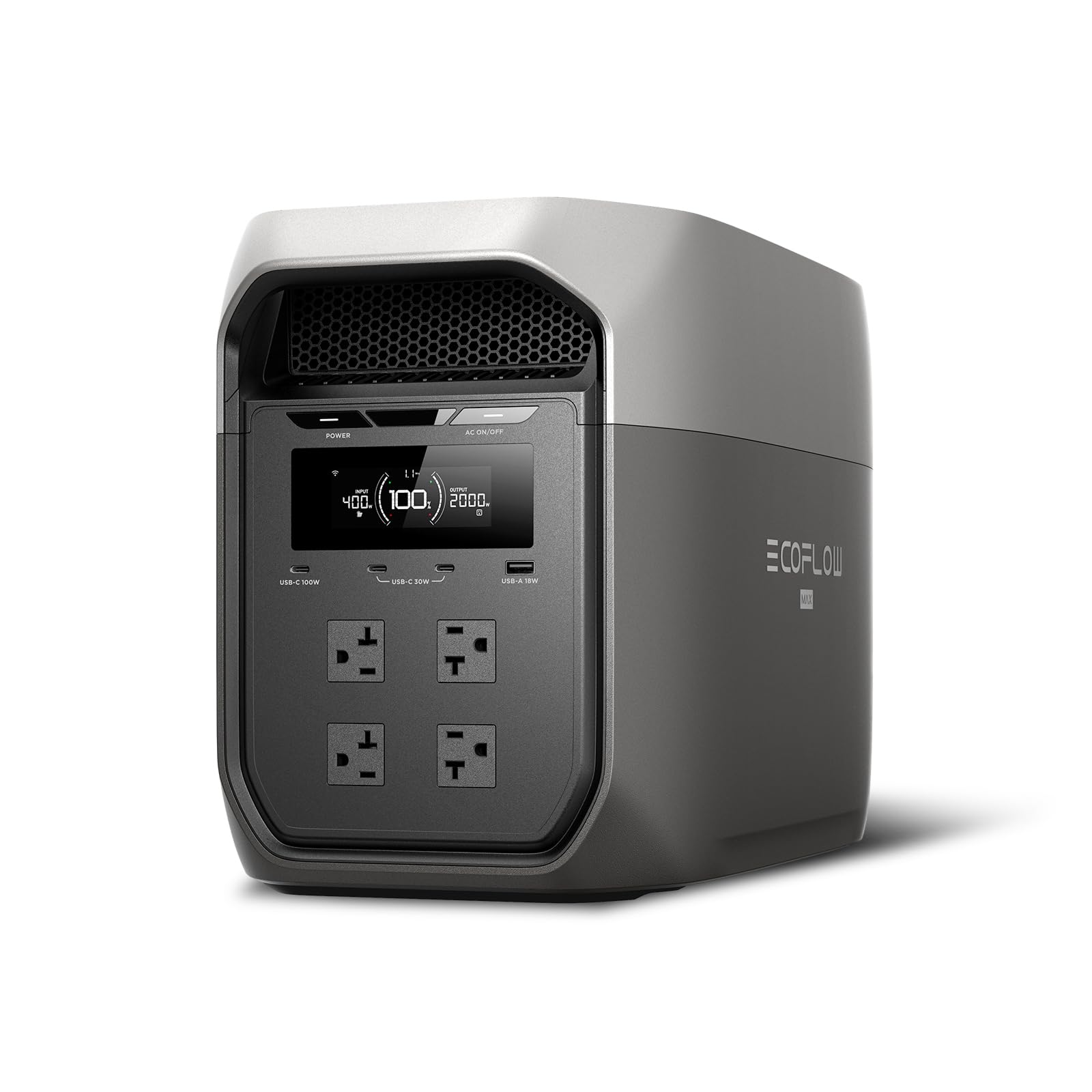
1. EF ECOFLOW DELTA 3 Max Portable Power Station
Our pick — over 4.5★ from 500+ verified ratings; the strongest balance of quality and price.
The 2048Wh home-backup heavyweight that refills to 80% in just over an hour.
For whole-home backup, this is the unit that sets the pace. It holds a 2048Wh LiFePO4 battery (a type of lithium battery known for long life) and pushes 2400W of continuous output, which handles fridges, microwaves, and power tools without breaking a sweat. What makes it stand out is the X-Boost feature that lets it surge to 3400W, covering 99% of household appliances.
You will spend less time waiting for power during a blackout because EcoFlow’s X-Stream technology (a fast-charging system) refills the battery from empty to 80% in just 1.13 hours. Buyers confirm the speed, with one owner noting: “What impressed me the most is how incredibly fast it charges to full capacity—it’s super efficient.” That quick top-up keeps your downtime short when the grid goes down.
Owners consistently rank its fast charging and quiet operation as the top reasons to buy. It is quieter than a gas generator and switches over in under 10ms when the grid fails, which keeps computers and medical devices safe. The trade-off is weight — it is a hefty unit to move, but owners say it is reliable enough to be worth it.
What Owners Rave About
- Recharges 0–80% in 1.13 hours via X-Stream tech
- 3400W X-Boost mode runs 99% of appliances
- Under 10ms transfer time protects sensitive electronics
The Honest Trade-Off
- Heavy to move between home and campsite
- Solar panel sold separately — budget for it
The whole-home winner: Pick this if you want one station that keeps a fridge, microwave, and tools running through multi-day outages.
Think twice if: You need something you can carry on long hikes — this is a rolling powerhouse, not a daypack companion.
2. Apowking 300W Portable Power Station with 40W Solar Panel
The 5-pound daypack power bank that brings a 40W solar panel along for the ride.
This is the pick that understands light travel. At just 5 lbs and measuring 8.5×6.7×4.1 inches, it fits in any daypack, yet its 220Wh (60000mAh) pack gives you roughly 15 phone charges or 6-8 hours of CPAP use. Buyers report they got it specifically so they could run a CPAP machine while camping, and that it worked great at home.
The included 40W panel uses 24% high-efficiency monocrystalline cells, which still deliver output in dawn, dusk, or overcast conditions. The station has 7 ports total — 2 AC outlets, 2 USB-C PD, 3 USB-A, and a DC carport — so you can power up to 6 devices at once with zero fan noise.
What wins people over is the build quality and the built-in LED floodlight that illuminates up to 100 sq.ft. for 30+ hours. The honest caveat is solar charging is slow — this is a small panel, so recharging takes patience. It is a fit note, not a flaw: this unit is for keeping phones and medical devices alive, not powering a fridge.
Comfortably Portable
- Only 5 lbs — fits in a daypack
- 2×110V pure sine wave AC outlets
- 100 sq.ft. LED floodlight runs 30+ hours
Set Expectations
- 40W solar panel recharges slowly
- 220Wh capacity suits light devices, not appliances
Grab this if: You hike or camp and need reliable power for phones, tablets, and a CPAP machine without hauling 40 pounds.
Look elsewhere if: You expect to run a mini-fridge — that needs several times this wattage and capacity.
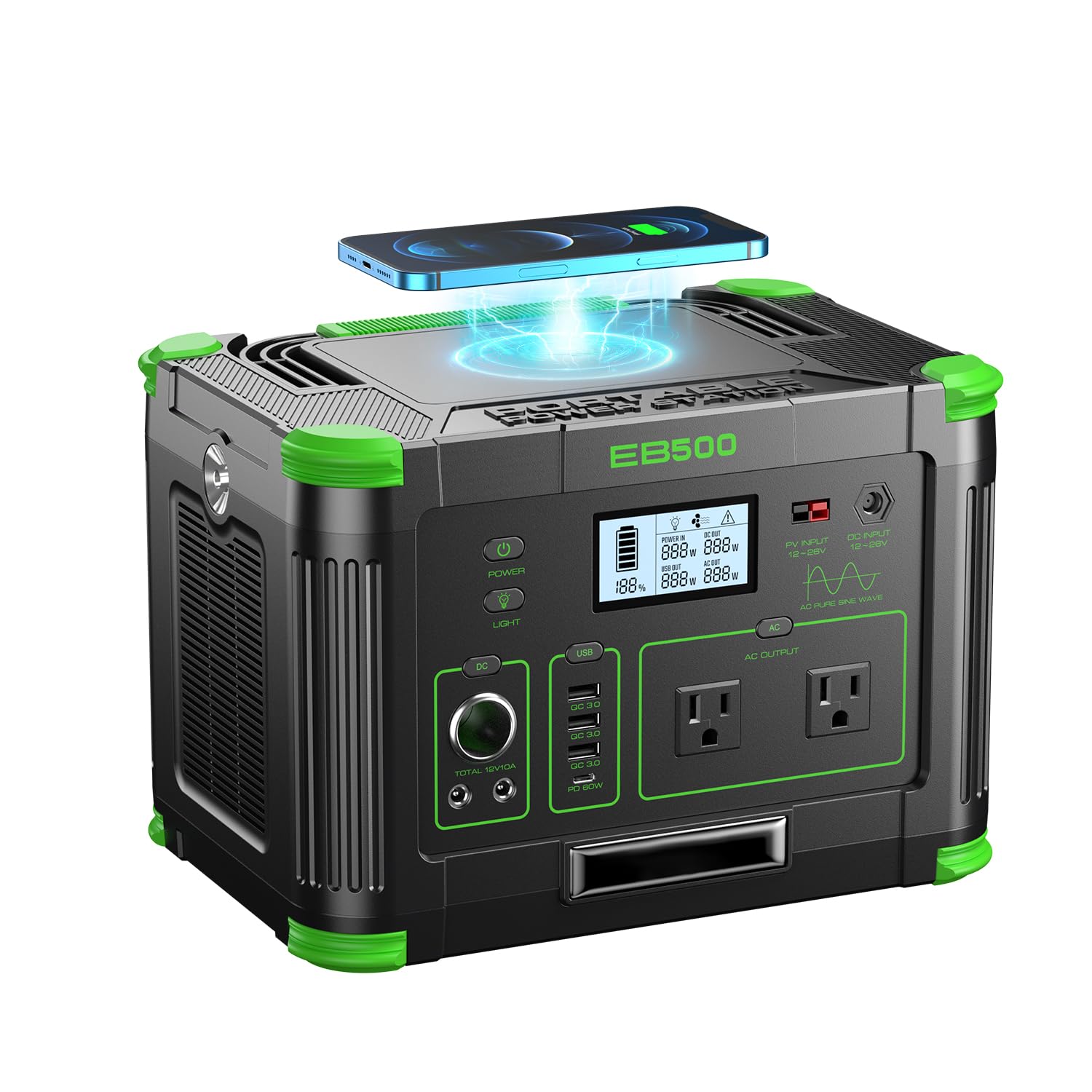
3. GRECELL Portable Power Station 500W, 519.48Wh
A 500W mid-range station that powers a surprising list of devices overnight.
If you need more than phone charging but do not want a 40-pound behemoth, the GRECELL EB500 fits the middle ground. Its 519.48Wh battery (a measure of energy storage) runs 10 devices at once through 2 pure sine wave AC outlets (120V/500W), 3 USB-A QC3.0 ports (fast-charging USB), a 60W USB-C PD port (power delivery for laptops), 2 DC ports, and a car port. Owners mention it powered a Ninja Woodfire grill for about 2 hours and dropped to 60% battery.
What surprises buyers is the pass-through charging — you can charge the wall input and run DC/USB outputs simultaneously, which is key for emergency use. The value-for-money angle is strong here, with owners calling it a great investment for its price and noting the build quality feels solid.
The honest note: solar charging is slow, and owners found it best for light-to-medium use rather than heavy off-grid living. It also weighs 14.1 pounds, which is very manageable for carrying from car to campsite. For a first-time buyer wanting a taste of solar power without the commitment, this is a smart entry point.
Feature-Packed Value
- 10 devices powered at once via 8 output options
- 60W USB-C PD charges laptops twice as fast
- Pass-through charging for continuous use
Keep It Real
- 500W limit excludes large appliances
- Solar recharge is slow — panel not included
Choose this for: Campers and emergency-kit builders who want a versatile mid-range station that handles small appliances and recharges in 6-7 hours from a wall.
skip it if: You need whole-home backup — that is a job for a 2000Wh-class unit.
4. Anker SOLIX C300 with 60W Solar Panel

The ultra-quiet 300W station that recharges to 80% in 50 minutes.
Anker built this for solo campers who value silence. At just 25dB from 3.3 ft away, it is nearly inaudible, and it packs a 288Wh LiFePO4 battery (90000mAh) with 300W output that surges to 600W. The included 60W solar panel recharges the bank from zero to 100% in about an hour in good sun, which buyers verified in real use.
It has 8 charging ports: 3 AC outlets, a car socket, 2 USB-C at 140W, another USB-C at 15W, and a USB-A. Owners love that it fits in a backpack and can run laptops rated up to 240 watts, making it a solid companion for work-from-anywhere trips. One owner ran a cooking pan and charged devices solo camping without ever running out.
Owners highlight its fast 50-minute wall recharge and quiet 25dB operation as top perks. Its 15.5-pound weight is a touch heavier than the Apowking, but you get faster wall recharging and a bigger solar panel. The trade-off is limited capacity — it is for personal devices, not family-sized loads.
Quiet & Quick
- Recharges to 80% in 50 minutes from a wall
- 25dB operation — sleep while it powers
- 60W solar panel tops up in ~1 hour
Consider This
- 288Wh suits personal devices, not fridges
- 15.5 lbs — heavier than the Apowking
Reach for this if: You want a quiet, fast-recharging station that fits a backpack and powers a laptop, phones, and a tablet for a weekend.
Choose Anker over Apowking if: You value the 50-minute wall recharge and quieter fan over the ultra-light 5-pound design.
5. DABBSSON Portable Power Station 2000L, 2048Wh
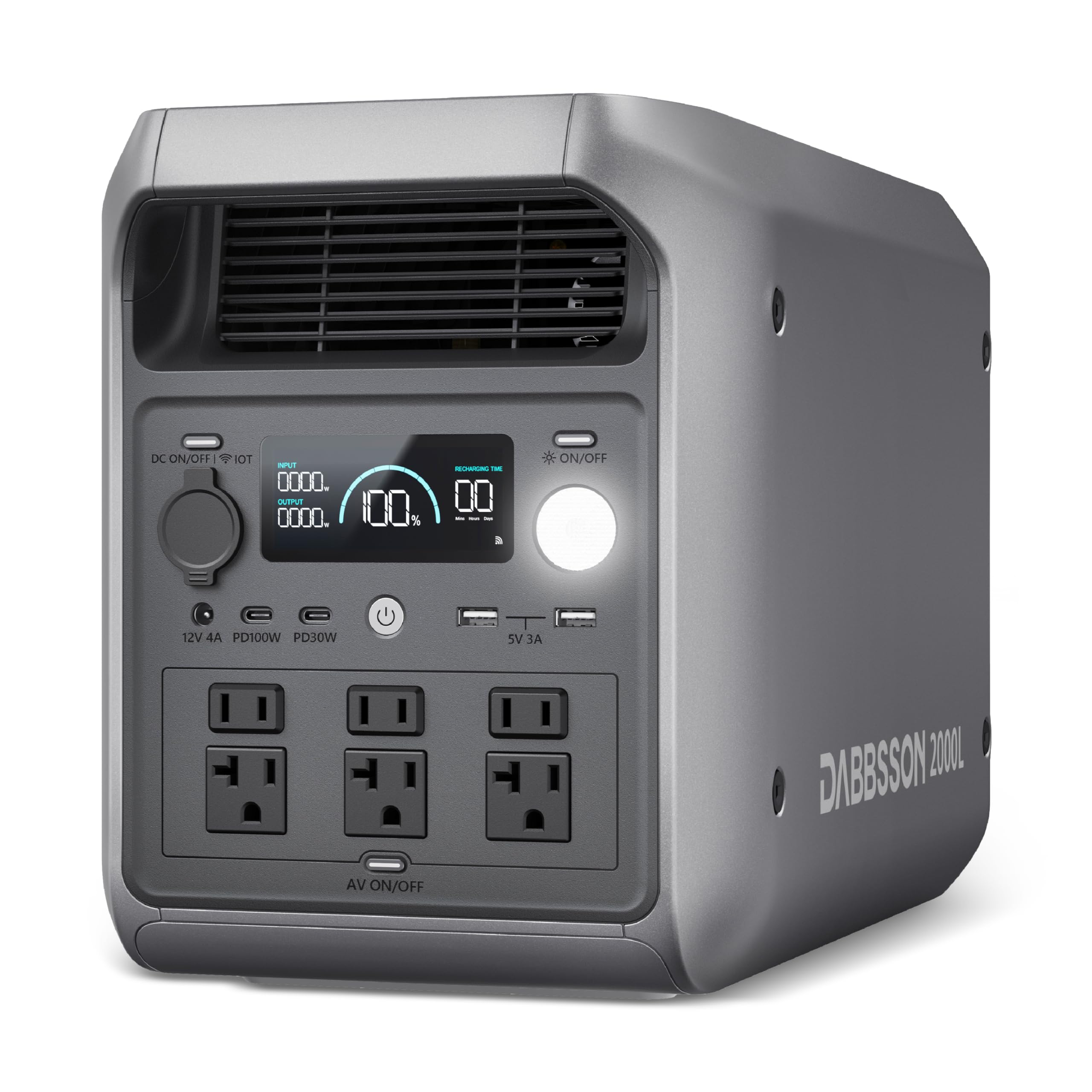
The 2048Wh value king that runs a full home setup at 41 pounds.
DABBSSON delivers the rare combo of big capacity and manageable weight. Its 2048Wh semi-solid LiFePO4 battery (a newer, more stable lithium chemistry) pushes 2200W continuous output with a 3300W surge boost — enough for refrigerators, heaters, grills, and power tools. At 41 lbs, it is notably lighter than the 61.4-pound BLUETTI AC200L.
Recharging is genuinely fast: AC input fills the 2048Wh to full in just 1 hour, and solar input accepts up to 800W MPPT. The Dabbsson app lets you adjust charging speed and set schedules via Wi-Fi or Bluetooth, and the <10ms EPS switch protects computers and NAS drives during outages.
Owners consistently praise its reliability for powering lights and tools daily, and the 6 AC outlets let you run multiple devices at once. The recurring gripe is the fan, which cycles on even with zero load and is loud. Battery charge-limit settings also drew some mixed feedback in the app. It is a budget-friendly way into 2kWh-class power.
Big Power, Lighter Carry
- 2048Wh capacity at just 41 lbs
- Full recharge in 1 hour via AC input
- 6 AC outlets for whole-crew power
The Noise Factor
- Fan is loud and cycles on at zero load
- 800W solar input is low for its class
Pick this if: You want a 2kWh station for camping or job sites without paying premium-brand prices.
Look elsewhere if: You need whisper-quiet operation indoors — the fan will be noticeable.
6. Anker SOLIX S2000, 2010Wh
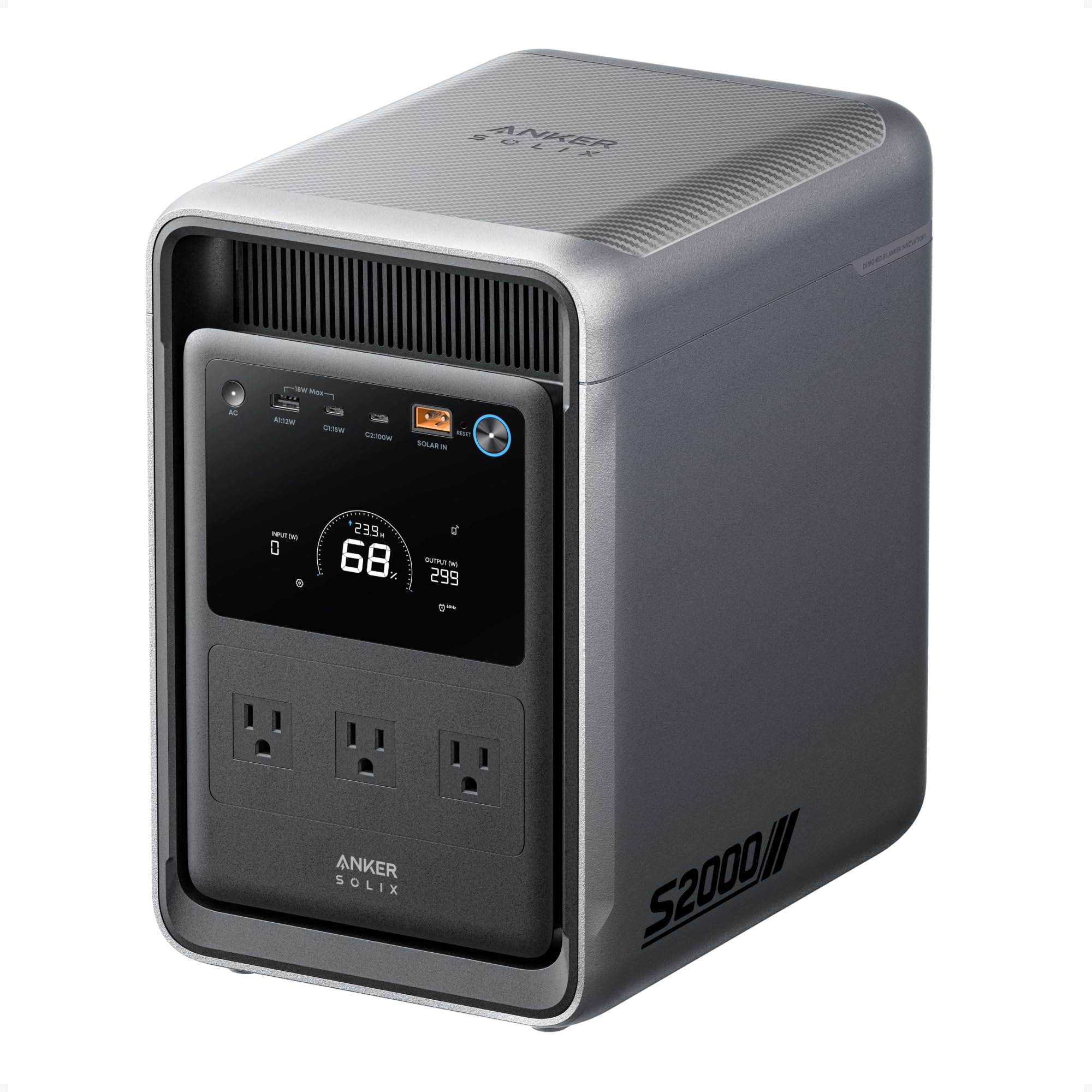
The fridge-backup specialist that runs a 220L fridge for 35 hours.
This Anker is purpose-built for one job: keeping your food cold. Its 2010Wh battery with a 6W idle power draw runs 20% longer than other 2kWh systems, and Anker claims up to 35 hours of fridge backup. Owners verified this in practice — one ran a full 220L fridge for an hour using only 3% battery.
At just 35.7 lbs, it is 30% smaller and 25% lighter than the industry average for 2kWh stations, measuring 8.2 × 11.1 × 12.7 inches. The 10,000-cycle LFP battery (a lithium-iron-phosphate type) gives it a 15-year lifespan, and it handles a 1500W continuous output with 3000W peak, covering 99% of home essentials.
Owners love the 6-way recharging (up to 400W solar) and dependable performance. The 8 outlets split between front and rear keep cables tidy. The honest caveat: the fan gets annoyingly noisy during 1200W fast charging, and an initial burn-off smell dissipates after a few hours. It is a premium pick for those who want fridge protection in a compact package.
Fridge-Ready Design
- 35 hours of fridge backup from real-world testing
- Only 35.7 lbs — lightest 2kWh station
- 10,000-cycle LFP battery lasts 15 years
Watch For
- Fan noise during heavy charging
- No 12V DC port — car devices need an adapter
Buy this if: You want the lightest, most efficient way to keep a refrigerator running through outages.
Think twice if: You need to power 12V car accessories directly — this unit skips that port.
7. BLUETTI AC200L, 2048Wh

The grow-with-you station that expands from 2048Wh to 8192Wh.
This BLUETTI is for buyers who hate outgrowing their gear. It starts with a 2048Wh LiFePO4 battery and 2400W output, then expands with extra battery packs (B300K, B210, B300, or B230) up to a massive 8192Wh. That means you can start affordable and add capacity as your needs grow.
Charging is brisk: a 2400W AC input takes it from 0-80% in just 45 minutes, while up to 1200W solar input tops it off in 1.7-2.2 hours of good sun. The 13 versatile ports include a 30A RV port and a 48V/8A DC port for charging your RV’s battery with the D40 voltage regulator.
One owner powered a 1500W kettle and a 12000 BTU air conditioner from solar, citing reliability as the top trait. The honest trade-off is weight — at 61.4 pounds it needs two people to move comfortably, and the expansion batteries add significant cost.
Built to Grow
- Expands from 2048Wh to 8192Wh
- 0-80% recharge in 45 minutes
- 13 ports including 30A RV output
Heavy Commitment
- 61.4 lbs — needs two people to move
- Expansion batteries cost extra
Best for: RV owners and home preppers who want a modular system they can scale up over time.
pass on it if: You need one portable unit, not a growing ecosystem — the DABBSSON is lighter for similar capacity.
8. BLUETTI Elite 200 V2, 2073.6Wh

The 17-year-lifespan station that wastes only 10W on standby.
The Elite 200 V2 is the efficiency nerd’s dream. Its 2073.6Wh battery drops standby power draw to just 10W — 3 times lower than similar stations — which means more of every charge goes to your devices, not to the unit itself. BLUETTI claims a 17-year lifespan thanks to automotive-grade LiFePO4 cells rated for over 6,000 cycles.
Output is serious: 2600W continuous and up to 3900W in power-lifting mode via BLUETTI’s HyperWatt tech. That runs refrigerators, hair dryers, and coffee makers, powering up to 9 devices at once. Owners ran induction cooktops, air fryers, and even 3D printers without issue.
Its 40% smaller footprint than the AC200L makes it easier to store, and owners rank performance as the top reason to buy. The three charging modes (Turbo/Standard/Silent) let you balance speed and noise — Silent mode hits just 16-30dB. The caveat: at 53.4 pounds it is still a two-hand lift, and some owners found charging speed slower than expected in certain modes.
Efficiency First
- 10W standby draw — 3x lower than rivals
- 2600W continuous, 3900W surge
- 6000+ cycles for 17-year life
The Cost of Power
- 53.4 lbs is heavy for frequent moves
- Charging speed varies by selected mode
Choose this for: Off-grid living where every watt of efficiency counts and you want a station that outlasts your other gear.
Prefer the S2000 if: Weight matters more than raw output — the Anker is 17.7 lbs lighter.
9. Jackery Explorer 2000 v2 with 2x200W Solar Panels
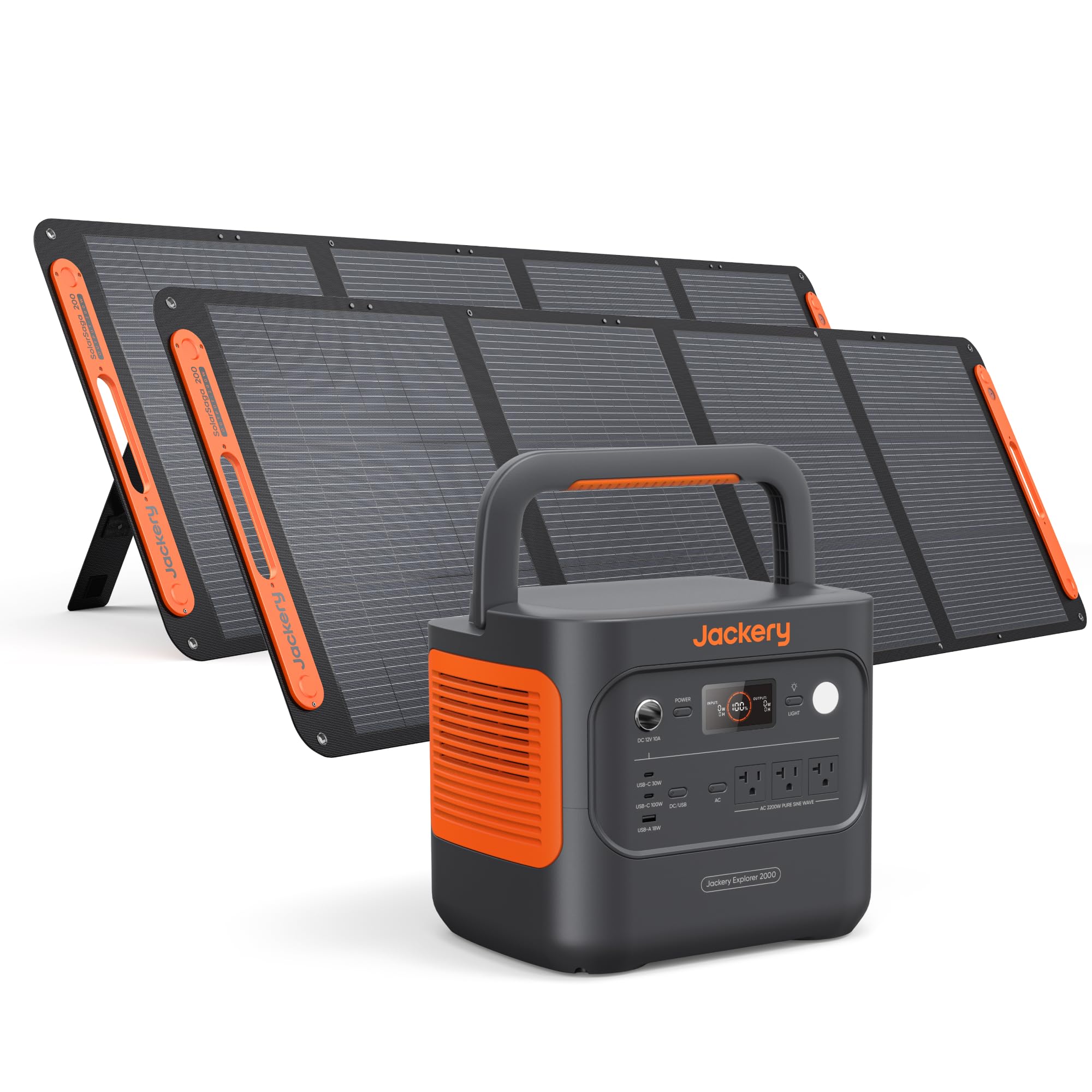
The complete solar kit that’s 41% lighter than other 2kWh stations.
Jackery’s answer to the 2kWh class is a bundled kit that includes two 200W solar panels right in the box. The Explorer 2000 v2 itself weighs just 39.5 lbs — 41% lighter than conventional 2kWh LiFePO4 stations — thanks to EV-style Cell-to-Body technology that packs more capacity into less space.
The kit delivers 2042Wh capacity with a 2200W AC output across 3 AC ports, plus a USB-C PD 100W port for fast laptop charging. Owners ran a window air conditioner for 3.5 hours (100% to 45%) and noted the solar panels topped the bank to 60% in 1.5 hours of good sun. Full solar recharge takes about 6 hours with the included 400W panel setup.
The 20ms UPS switching (a backup power feature that kicks in almost instantly) keeps critical devices running during outages, and the UL1778 certification (a safety standard) adds confidence. The bundle costs more upfront, but you get a complete solar setup with no extra panel costs.
Complete Solar Kit
- 2x200W solar panels included
- 39.5 lbs — 41% lighter than rivals
- Device from 8% to 100% in under 1 hour
Setup Notes
- Panels can yellow grass underneath during long sun exposure
- Requires correct plug orientation for solar connection
Pick the whole bundle if: You want solar panels included and a station light enough for frequent car-to-campsite moves.
Look elsewhere if: You need more than 2200W continuous — the Elite 200 V2 pushes 2600W.
10. Jackery HomePower 3000 with 2x200W Solar Panels
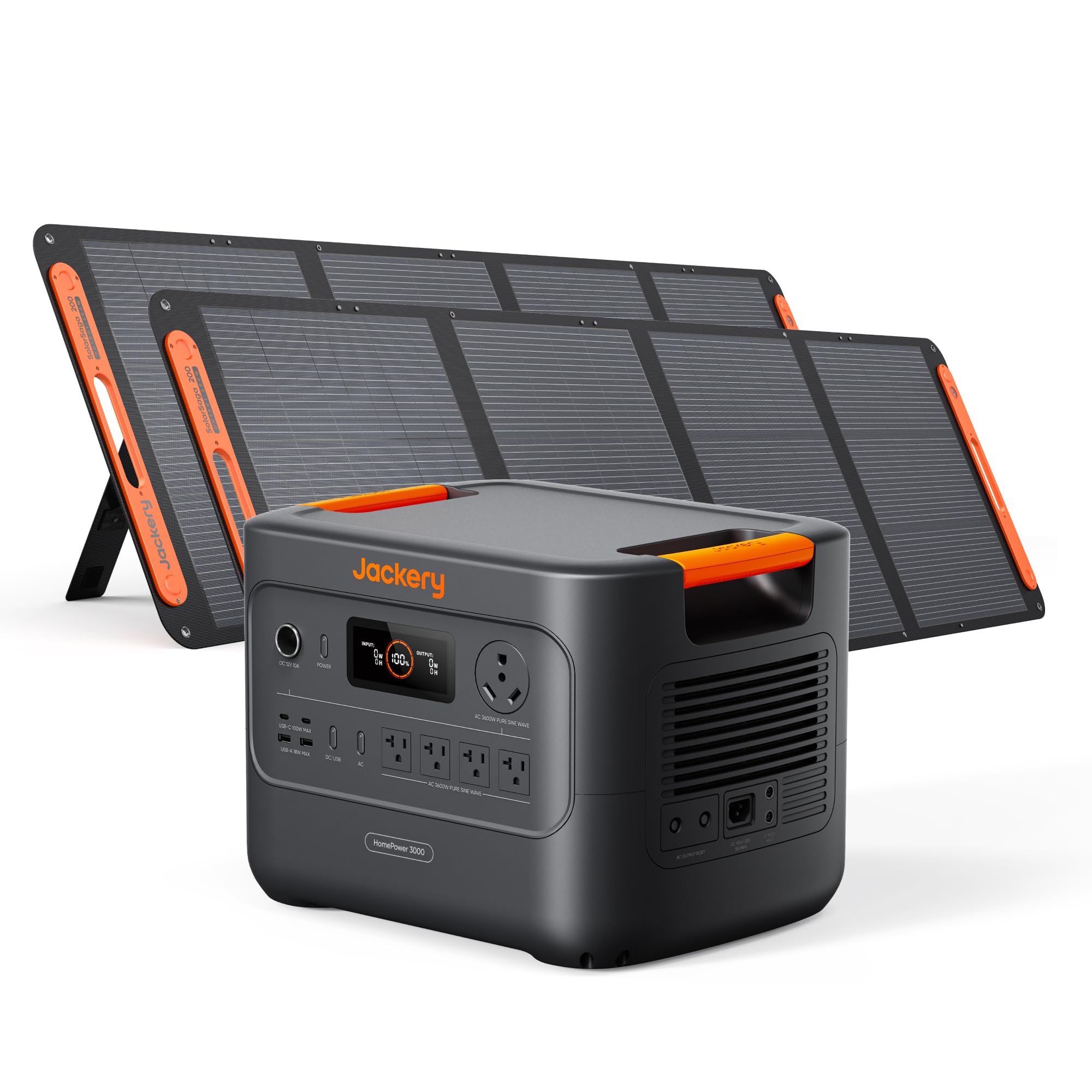
The 3072Wh home backbone that powers a household up to 15 hours.
When a storm knocks out the grid, the HomePower 3000 steps in. Its 3072Wh battery delivers 3600W output with a 7200W surge, powering a household for up to 15 hours and keeping a refrigerator running for 1-2 days. Owners reported running three refrigerators and one freezer through a 4.5-hour outage without a hiccup.
This is Jackery’s largest home-focused unit, designed to keep your essentials running: fridge, fan, WiFi router, lights, security cameras, and even medical refrigerators. The ≤20ms UPS switchover (a backup power feature that activates in under 20 milliseconds) keeps Zoom calls and pet feeders running without a hiccup. Dual 100W PD ports (power delivery ports) fast-charge phones and tablets.
Owners rate build quality highest, with value for money a close second. The LiFePO4 battery holds 4,000 cycles while retaining 70% capacity, and the CTB technology makes it 47% smaller and 43% lighter than comparable 3kWh models.
Whole-Home Readiness
- 3072Wh runs a household up to 15 hours
- 3600W output with 7200W surge
- 4,000 cycles to 70% capacity
Weight Factor
- 59.5 lbs — wheel kit recommended
- 2x200W panels may need supplementing for full off-grid
Buy this if: You want a stationary home backup that keeps the fridge, WiFi, and security running through multi-day outages.
Consider the DELTA Pro if: You need even more capacity — it starts at 3600Wh.
11. EF ECOFLOW DELTA Pro, 3600Wh
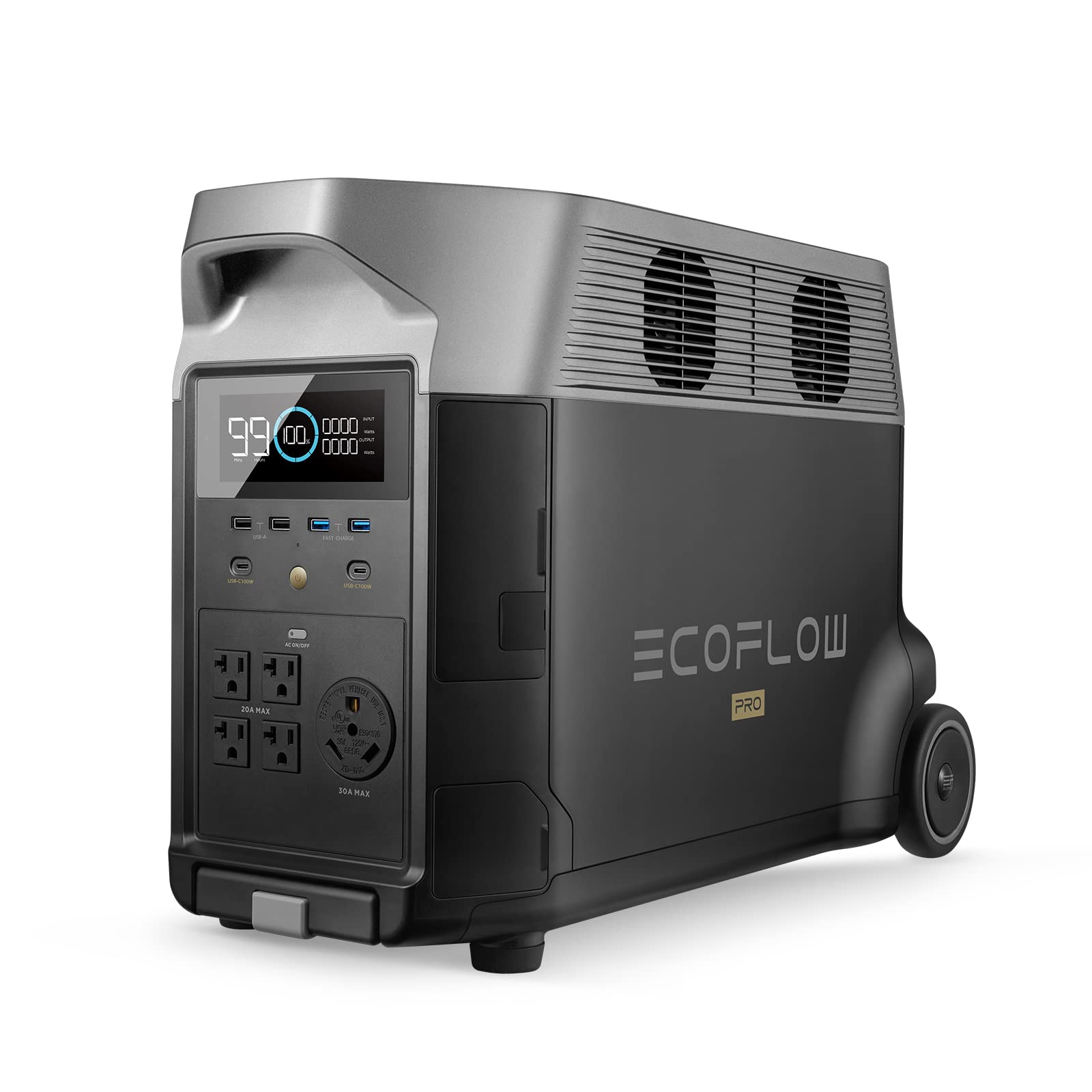
The 3600Wh giant that scales to 25kWh for serious off-grid living.
For the biggest jobs, the DELTA Pro is the heavyweight champion. Its 3600Wh LFP battery delivers 3600W AC output, expandable to 4500W with X-Boost, and you can pair two units for 7200W total. Add Extra Batteries or the Smart Generator and capacity stretches from 3.6kWh all the way to 25kWh.
Charging is flexible with 5 ways: EV station, solar, wall outlets, the smart generator, or a car outlet. A full wall recharge takes 2.7 hours at 1800W, and 4×400W solar panels fill it in 2.8 hours thanks to up to 23% solar conversion efficiency. Owners ran a heat press at vendor markets flawlessly and powered fridges and lights overnight with 30% to spare.
Owners praise the 2.7-hour recharge and 15-day charge retention as standout performance features. The 15 output methods (5 AC outlets, 2 USB-C 100W, plus DC and Anderson ports) cover every device you own. The commitment is the weight — at 99 pounds this is a stationary unit, not a camping companion.
Big Power, Big Storage
- 3600Wh, expandable to 25kWh
- 3600W output, 4500W with X-Boost
- 2.7-hour wall recharge
Stationary by Nature
- 99 lbs — not meant for daily carries
- Fan is noisy under heavy load
Get this if: You need whole-home or business-scale backup that can grow with extra batteries over time.
it’s not for you if: You plan to move it often — the HomePower 3000 is 40 lbs lighter for similar capacity.
Understanding the Specs
Watt-hours (Wh) vs. Watts (W)
Wh measures the battery’s total energy storage — think of it as the fuel tank. Watts measure the instantaneous power output — the speed at which energy flows out. A 2048Wh station with a 2400W output can run a 400W fridge for roughly 5 hours, but it cannot run a 3000W heater because the output ceiling is too low.
LiFePO4 Battery Chemistry
LiFePO4 (lithium iron phosphate) is the safer, longer-lasting battery chemistry now standard in quality stations. It typically supports 3,000-10,000 charge cycles versus around 500 for older lithium-ion types. That translates to 10+ years of daily use before capacity noticeably drops, which justifies the higher upfront cost for frequent users.
Pure Sine Wave Inverter
A pure sine wave inverter produces clean power that matches what comes from your wall outlet, making it safe for sensitive electronics like laptops, CPAP machines, and medical devices. Cheaper modified sine wave inverters can damage these devices over time. For anything with a motor or digital circuit, demand pure sine wave output.
Solar Input vs. Panel Wattage
Solar input is the maximum wattage the station can accept from panels, while panel wattage is what the panel produces. Matching them matters: a 1200W solar input with two 400W panels gives you 800W of charging. Higher solar input means faster sun recharge, which is critical for off-grid use where every hour of sun counts.
FAQ
What size solar generator do I need for a refrigerator?
How long does it take to recharge a solar generator from panels?
Can I run a CPAP machine overnight on a solar generator?
What is the difference between X-Boost and power lifting mode?
Do I need a pure sine wave inverter for sensitive electronics?
How long does a LiFePO4 battery actually last?
Can I expand the capacity later?
Is a solar generator safe to use indoors?
What wattage do I need to power a microwave or coffee maker?
Final Thoughts: The Verdict
Across the board, the battery generator solar winner is the EF ECOFLOW DELTA 3 Max because it delivers whole-home backup power with a 2048Wh capacity, a 1.13-hour recharge, and a 3400W X-Boost surge (a power boost feature) that runs nearly any appliance. If you want a lightweight option for camping and CPAP use, grab the Apowking HP200L for its class-leading 5-pound portability. And for maximum expandability that grows with your needs, the EF ECOFLOW DELTA Pro is the one to reach for.
How We Picked
We do not accept paid placement. Every pick is matched to a real buyer and a real use-case; we do not hands-on test units.
Sources & Methodology
Specifications: manufacturer listings and product documentation. Review insights: verified customer reviews, as of August 2026. Pricing: not shown on this page (it changes often); check the current price via the retailer link.
As an Amazon Associate, Gadgets Feed earns from qualifying purchases. This does not affect which products we feature.