
Our readers keep the lights on and my morning glass full of iced black tea. As an Amazon Associate, I earn from qualifying purchases.
Specs are compiled from manufacturer listings and verified buyer reviews and can change over time — please confirm the key details on the product page before buying.
Buying a native 4K projector is a big-ticket decision, and the hardest part is trusting the label. Many projectors claim 4K but use pixel-shifting to fake it, while others quote brightness figures that don’t survive a lit room. This guide sorts the real native-resolution performers from the marketing, so you buy the right screen for your home cinema the first time.
I’m Min — the founder and writer behind Gadgets Feed. This guide is built by comparing the manufacturers’ published specifications and the patterns across verified customer reviews, so you get each pick’s real strengths and trade-offs instead of marketing spin.
From laser-powered giants to ultra-short-throw wonders, we break down the specs that matter for your 4k native projector hunt.
Our Picks at a Glance

How To Choose The Best 4K Native Projector
Choosing a native 4K projector means matching it to your room, your content, and your setup patience. You need a model whose brightness suits your lighting, whose throw distance fits your wall, and whose image processing keeps fast action smooth without ghosting.
Native 4K vs. Pixel Shifting
A native 4K projector has a chip with 8.3 million physical pixels. Pixel-shifting projectors have a lower-resolution chip that vibrates the image to fake extra detail. If you sit close to a huge screen, native 4K shows sharper text and finer texture, which is why serious home theater buyers demand it.
Brightness: Lumens and Your Room
Brightness is measured in lumens, but the standard matters. ANSI lumens and ISO lumens are different scales, so don’t compare numbers across brands without checking the standard. A projector rated at 2,000 lumens may struggle with lights on, while a 3,000+ lumen model can handle a bright living room.
Laser vs. Lamp Light Sources
Laser projectors deliver instant-on brightness, wide color, and long life without lamp replacements. Lamp projectors are cheaper upfront but dim over time and need new bulbs. For a premium native 4K purchase, a laser source with a 20,000-hour life often outlasts the lamp’s running costs.
Quick Comparison
| Model | Best For | Brightness | Contrast | Input Lag | Amazon |
|---|---|---|---|---|---|
| Valerion VisionMaster Pro2★ Best Overall | Cinema & Gaming Hybrid | 3000 ISO Lumens | 15000:1 | 4ms | Amazon |
| JMGO N3 UltimatePlacement King | Flexible Placement | 5800 ISO Lumens | 20000:1 | 1ms | Amazon |
| XGIMI HORIZON 20 MaxBright Room Beast | Bright Rooms | 5700 ISO Lumens | 20000:1 | 1ms | Amazon |
| AWOL VISION Aetherion Max | Daytime Laser TV | 3300 ISO Lumens | 6000:1 | 1ms-class | Amazon |
| Hisense XR10 | Lens Flexibility | 6000 ANSI Lumens | 6000:1 | <16ms | Amazon |
| Sony VPL-XW5000ES | Reference Image Quality | 2000 Lumens | High | <13ms | Amazon |
| Sony VW325ES | Reference 4K & HDR | 1500 Lumens | High | N/A | Amazon |
| NexiGo Aurora Pro MKII | Ultra Short Throw Value | 2400 Lumens | 30000:1 | 4.2~8ms | Amazon |
| Hisense PX4-Pro | Design & Audio | 3500 ANSI Lumens | 6500:1 | 1ms | Amazon |
| BenQ TK710 | Budget Laser Gaming | 3200 ANSI Lumens | 600,000:1 | 16ms | Amazon |
| Nebula X1 | Portable Cinema | 3500 ANSI Lumens | 5000:1 | N/A | Amazon |
| NexiGo Aurora Pro | All-in-One UST | 2400 Lumens | 3000:1 | 8ms | Amazon |
In‑Depth Reviews
1. Valerion VisionMaster Pro2
Our pick — over 4.5★ from 500+ verified ratings; the strongest balance of quality and price.
The hybrid champ that crushes movies and competitive gaming without compromise.
This projector is the crowd favorite — 4.6 stars across 500+ owners — and the reason is its rare split personality. The VisionMaster Pro2 delivers 3000 ISO Lumens of brightness with a 15,000:1 contrast ratio, so dark scenes stay deep and colors pop even in a room with some light. For gamers, the 4ms input lag is a 4.0x improvement over the BenQ TK710’s 16ms, making it feel instant on fast shooters.
It’s built for flexibility. The OpticFlex Lens System offers a 0.9-1.5 throw ratio, meaning you can fill a 150″ screen from a short distance or a 300″ one from further back without losing sharpness. Auto focus, auto keystone, and obstacle avoidance handle the setup fiddling, and the built-in Google TV+ gives you Netflix, YouTube, and Prime Video instantly, plus AirPlay and Chromecast for phone casting.
Owners upgrading from older Epson models report it’s a massive step up. One buyer jumping from an Epson 5040UBe saw stunning 4K/HDR with deep blacks and rich colors on a 150″ screen, praising the motion handling. The main trade-off is the short throw ratio, which at 19.5ft forced one user to use digital zoom and lose some brightness. Buyers report the built-in speaker is adequate, but a soundbar still improve the experience.
What Wins People Over
- 4ms input lag for responsive gaming
- 3000 ISO Lumens bright enough for lit rooms
- 15,000:1 contrast for deep blacks
- Built-in Google TV+ with all major streaming apps
The Real Trade-offs
- Short throw range may force digital zoom at long distances
- Built-in speaker is fine, not exceptional
- Fan noise increases when brightness is pushed
Who It’s For: The buyer who wants one projector that handles 4K movies in the evening and competitive gaming on the weekends, without owning two devices.
Think Twice If: Your room demands a very long throw distance — you’d be using digital zoom and losing some of that crisp 4K sharpness.
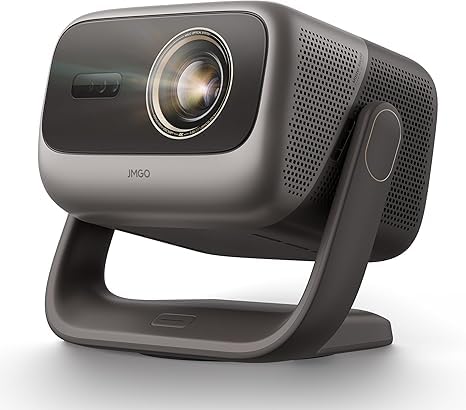
2. JMGO N3 Ultimate
A motorized gimbal and massive lens shift let you point this beam anywhere.
The JMGO N3 Ultimate attacks the biggest pain of home projection: placement. Its motorized AI gimbal rotates 360° and tilts 150°, while a four-way lens shift moves the image H ±53% and V ±130% — all optical, so you never lose 4K resolution to digital cropping. If your room has an odd layout, this is the projector that adapts to you.
Brightness is a headline feature at 5800 ISO Lumens, enough for daytime viewing with lights on. The triple laser engine covers 110% BT.2020 color gamut with a 3,000,000:1 dynamic contrast ratio, and Dolby Vision support makes HDR content look incredible. Owners rave about the deep blacks and vibrant colors that hold up even in ambient light.
Gamers get a 1ms input lag with up to 240Hz refresh and VRR to stop screen tearing. The built-in 2×12.5W dual speakers deliver a 35Hz bass dive, so you can skip a soundbar for casual viewing. The honest catch: brightness feedback is mixed — some say it’s exceptional, others feel it’s not quite the advertised figure — and the fan becomes audible at max output.
Setup Freedom
- Motorized gimbal with 360° pan and 150° tilt
- Four-way lens shift up to V ±130%
- 1ms input lag for competitive play
- 300″ screen capability
Honest Limits
- Fan noise at max brightness
- Some owners find brightness below the claim
- Bulky form factor
Reach For This If: You need to project from an odd angle, ceiling, or corner where a fixed-position unit would never fit.
Look Elsewhere If: Silence is critical — several owners mention the fan at peak brightness is audible and can distract during quiet scenes.
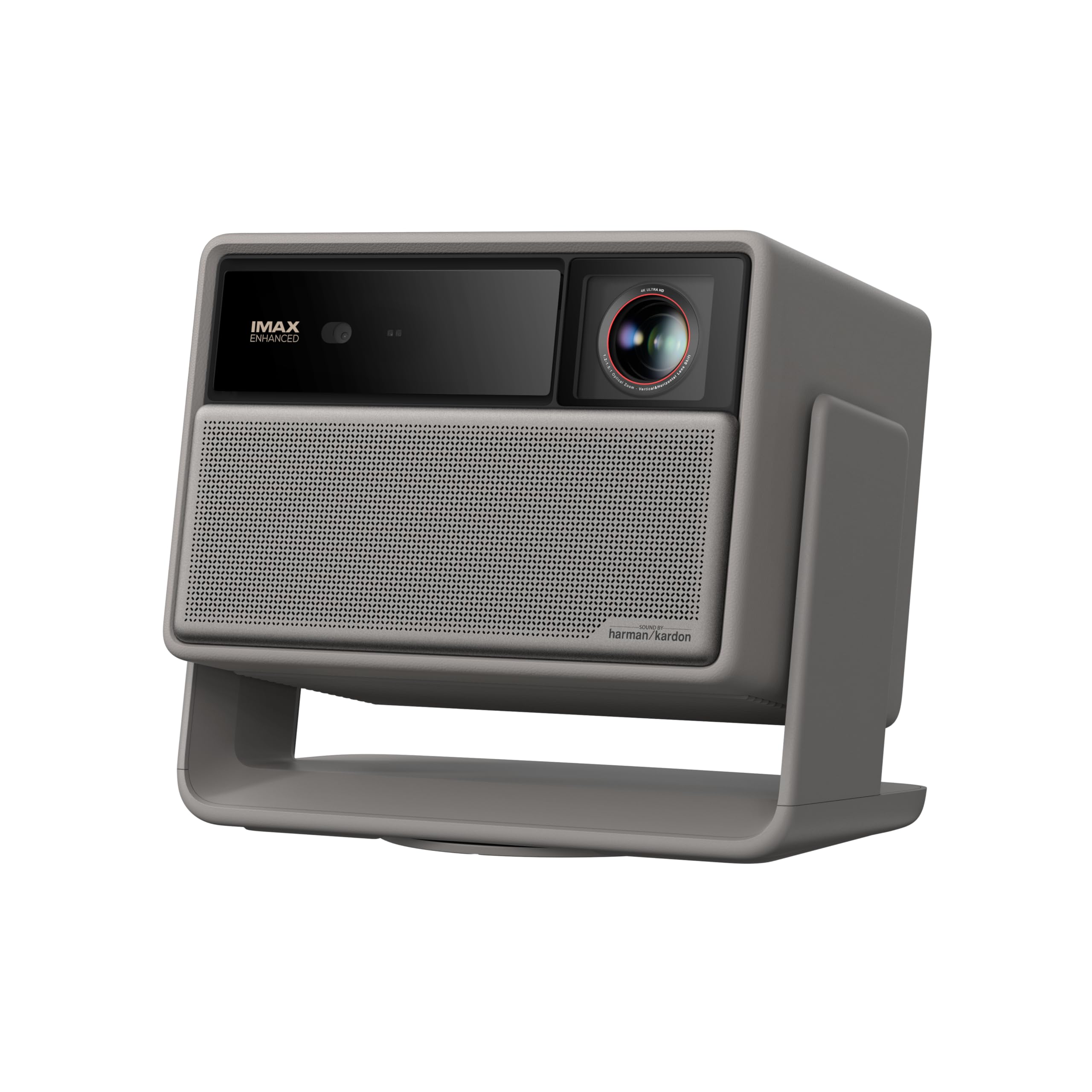
3. XGIMI HORIZON 20 Max
Daylight-grade brightness with a premium design that looks as good as it projects.
The XGIMI HORIZON 20 Max is the projector owners say genuinely replaced their TV. Its X-Master RGB triple laser engine (a three-laser light source for vivid colors) delivers 5700 ISO Lumens of peak brightness and a 20,000:1 contrast ratio, so standard 4K content looks better and brighter than HDR, according to real-world feedback. One owner reports running it with lights open on a 170″ ALR screen (a screen that rejects ambient light), meaning daytime viewing without blackout curtains.
Design matters here. The Elephant Grey finish with a leather-like texture is built to sit proudly in a living room, not hide in a media closet. Inside, Google TV is fully integrated with licensed Netflix, so you get instant app access and hands-free voice control without extra devices. The Harman Kardon speakers are a standout — owners describe them as excellent, neutral, and clear enough to skip a soundbar.
Performance is anchored by a 1ms input lag and 240Hz motion for gaming, plus flexible lens shift and optical zoom for setup. The strongest praise centers on incredible clarity and deep colors, with one owner saying it’s twice as sharp and smooth as an Epson 5050UB. The recurring negative is reliability — a minority report units turning off unexpectedly, so check your warranty coverage. A 2-year warranty is included.
The Breakthrough: The Harman Kardon audio is genuinely good enough that many owners skip a soundbar entirely — rare for a projector’s built-in speakers.
The Caveat: A few units have shown unexpected shutdowns, so the 2-year warranty is worth having.
4. AWOL VISION Aetherion Max
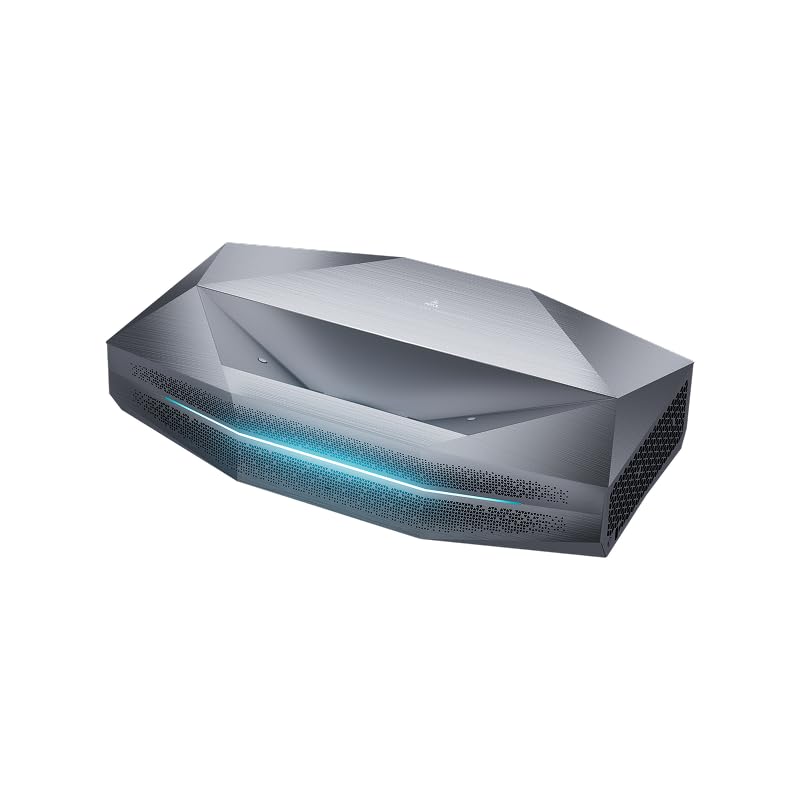
A lifestyle laser TV that shrugs off daylight and mounts inches from the wall.
The Aetherion Max answers “I want a huge TV without the blackout curtains” with an ultra-short-throw design. Its 0.2:1 throw ratio (the distance from the wall needed for a given image size) means it sits just inches from the wall, so you skip the ceiling mount and professional install. With 3,300 ISO Lumens of RGB triple-laser brightness, the picture stays vivid in open-plan spaces, and at 200 inches, the screen is 6 times larger than an 85-inch TV while using a fraction of the wall space.
Color science is a big story. The 110% Rec.2020 gamut delivers lifelike greens and accurate skin tones that owners say lamp projectors can’t match. The Noirscene System II adds a 7-level IRIS and EBL algorithm for up to 6,000:1 native contrast, so dark scenes stay deep even with lights on. Anti-RBE technology cuts rainbow-effect distractions by 99.99%, a comfort win for eye-sensitive viewers.
Gaming is covered too: 1ms-class input latency at 240Hz, VRR, ALLM, and Dolby Vision Gaming, with 3x HDMI 2.1a plus DisplayPort 1.4a for simultaneous PS5, Xbox, and PC connections. Owners with ceiling-mounted setups report excellent daytime brightness with blinds open and near-TV quality HDR at night. The honest catch is setup patience — UST alignment takes time, and one owner found the menu navigation unintuitive.
The Standout: Anti-RBE technology reducing rainbow effects by 99.99% makes this the most comfortable UST for marathon viewing.
The Reality: UST alignment demands care, and the on-screen menus aren’t the most intuitive — budget time for initial setup.
5. Hisense XR10
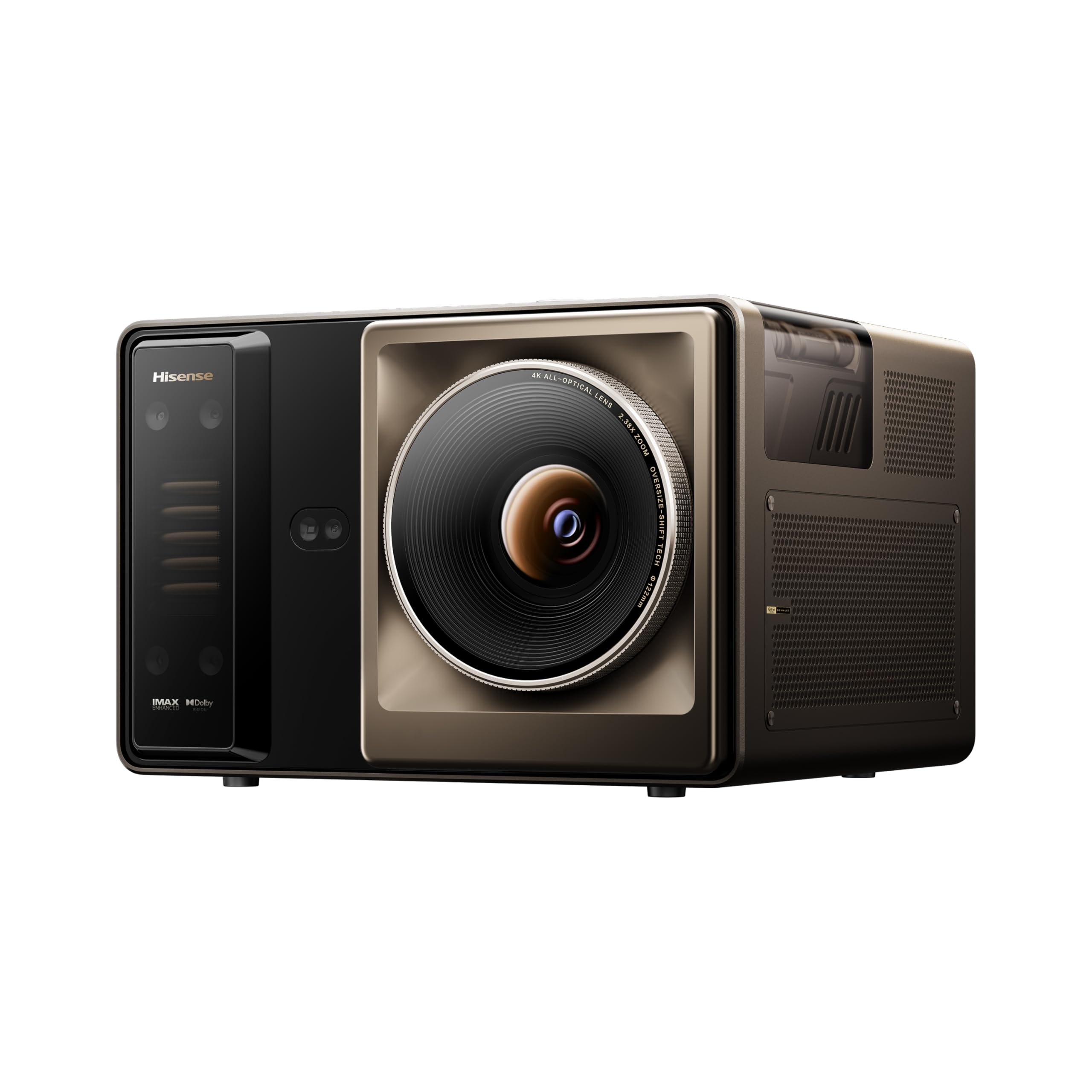
An industry-first all-glass lens and 6000 ANSI lumens for flexible, distortion-free placement.
The Hisense XR10 is for buyers who refuse to compromise on placement. Its industry-first 17-element all-glass lens delivers crisp images with superior light transmission, and the high-temp-resistant design prevents fading and warping over time. With 6,000 ANSI Lumens of peak brightness from dual laser sources, it stays bright even in well-lit rooms.
Setup flexibility defines this model. The optical zoom with a 0.84-2.0:1 throw ratio lets you size the image from 65″ to 300″ without losing sharpness, and lens shift moves the picture up, down, left, or right optically, so you never have to move the projector. A 7-level iris (a mechanical aperture that controls light) fine-tunes brightness and black levels for your room, achieving up to 6,000:1 contrast.
Owners praise the performance exceeding expectations, with strong picture quality that displays well even in lit rooms. The liquid cooling system keeps things quiet and reliable during long sessions. The VIDAA OS brings over 1,200+ apps with built-in AI voice control. The trade-off for some: daytime blacks are weak with blinds closed, and the throw distance needed for a 100″ screen is longer than some rooms allow.
Optical Mastery
- 17-element all-glass lens for true images
- Optical zoom 0.84-2.0:1 without sharpness loss
- Lens shift for precise placement without moving unit
- 6,000 ANSI Lumens for lit rooms
The Fit Check
- Longer throw distance needed for smaller screens
- Daytime black levels weaken with blinds closed
Choose This If: You want to dial in the perfect image size from a fixed shelf or ceiling location without moving the projector an inch.
skip it if: Your space is tight and you need a small image from a short distance — this lens wants room to stretch.
6. Sony VPL-XW5000ES

The reference-grade native 4K SXRD panel that sets the standard for home cinema.
If image purity is everything, this is the projector. The Sony VPL-XW5000ES uses an all-new Native 4K SXRD panel with a true 3,840 x 2,160 pixel resolution — no pixel-shifting tricks. Owners consistently describe the detail as breathtaking, with one noticing it reveals pores in skin texture, and another saying it’s the best image they’ve seen from a projector, period. The flagship X1 Ultimate processor handles the image processing.
The laser light source delivers up to 2,000 lumens for up to 20,000 uninterrupted hours. That’s a huge longevity story — a lamp projector would need multiple bulb replacements in that time. TRILUMINOS PRO reproduces over a billion colors, and Wide Dynamic Range Optics achieve a 95% DCI-P3 wide color gamut for rich, natural shades.
Gamers get a 4K 60Hz input with lag under 21ms, and 2K 120Hz input with lag under 13ms. The compact design is about 20% smaller in volume and 30% lighter than the VPL-VW915ES. The honest downsides: setup is tricky with manual lens shift and no keystone, it’s heavy at 28 lbs, and startup takes about a minute. Owners note it ideal for night viewing with excellent dark scene detail.
Cinema Purity
- True native 4K SXRD panel at 3,840 x 2,160
- 20,000-hour laser light source
- 95% DCI-P3 color gamut
- Under 13ms lag at 2K 120Hz
Setup Realities
- No keystone — needs level mounting
- Manual lens shift only
- Heavy at 28 lbs
Pick This If: You want a dedicated dark-room cinema with reference-grade 4K detail and don’t mind precise, one-time installation.
Pass If: You need to move the projector between rooms or mount it at an angle — this demands a fixed, level position.
7. Sony VW325ES

Sony’s X1 processing delivers native 4K on three SXRD imagers for color purists.
The Sony VW325ES is a pure image-processing powerhouse. It delivers Full Native 4K resolution on 3 SXRD imagers at 4,096 x 2,160 pixels each — that’s a true 4K cinema chipset, not a pixel-shifted approximation. The X1 processor brings Sony’s best video processing, with Dynamic HDR Enhancer widening contrast scene by scene for striking realism.
Owners upgrading from Epson units consistently report it looks superior — sharper than pixel-shifting technology, with richer HDR and no color filter compromises. TRILUMINOS Display delivers a wide array of rich colors, and Motionflow keeps 4K and HD movement smooth. At 1,500 lumens, it’s not a daylight projector, but owners say it’s plenty bright in a dark or controlled-light room.
The honest catch is that HDR content demands per-content tuning. Owners describe needing aggressive settings for some films and different handling for bright scenes like The Lord of the Rings versus challenging HDR balance in Dune. Advanced Reality Creation upscales and sharpens without adding noise, but this is a projector for someone who enjoys calibrating. The 18 Gbps HDMI inputs with HDCP 2.2 keep you ready for 4K services.
The Core Strength
- True native 4K at 4096 x 2160 per imager
- Dynamic HDR Enhancer for wider contrast
- TRILUMINOS for rich color
- Input lag reduction for gamers
The Demands
- Requires per-content HDR tuning
- Needs a dark room for best results
- No aspect memory
For The Enthusiast: You’ll be rewarded with superior 4K sharpness and HDR richness if you enjoy tweaking settings per film.
Not For: Casual viewers who want plug-and-play — this Sony expects some calibration effort to shine.
8. NexiGo Aurora Pro MKII

A compact UST that punches above its size with a 30,000:1 contrast ratio.
The Aurora Pro MKII is a size-to-performance marvel. Its ALPD 5.0 laser engine delivers 2,400 lumens of brightness with 107% BT.2020 color gamut and ΔE≈1 color accuracy — impressive precision for a unit this portable. The Scene Adapt Engine (SAE) drives a >30,000:1 contrast ratio by adjusting laser output in real time based on content, producing deeper blacks and brighter highlights.
As a UST projector, it sits close to the wall with just a 0.21:1 throw ratio to create up to a 150-inch image. That means a huge screen in a small room. Owners describe the image as crisp and clear from about 20ft with minimal adjustment needed, and brighter than a Samsung Freestyle they compared it to. The 60W speakers with Dolby Atmos deliver sound with actual bass, and HDMI eARC lets you add a soundbar easily.
The ALPD 5.0 engine promises a 30,000-hour lifespan, which the manufacturer notes is 18+ years for the average viewer. Gaming is covered with 4K at 120Hz and ultra-low latency between 4.2ms and 8ms in Gaming Mode. The honest caveats: some owners note oddly shaped pixels can cause soft focus at the center and fan speed fluctuates between high and low.
Compact Power
- >30,000:1 contrast with SAE technology
- 0.21:1 throw for huge image in small room
- 4.2ms-8ms low latency gaming
- 30,000-hour light source lifespan
Minor Gripes
- Center focus can be soft on some units
- Fan speed fluctuates audibly
Best For: Apartment dwellers who want a 150-inch cinematic image from a tiny footprint without ceiling mounting.
Consider Elsewhere If: You’re a pixel-peeper who notices slight center softness — a standard-throw lens might serve you better.
9. Hisense PX4-Pro
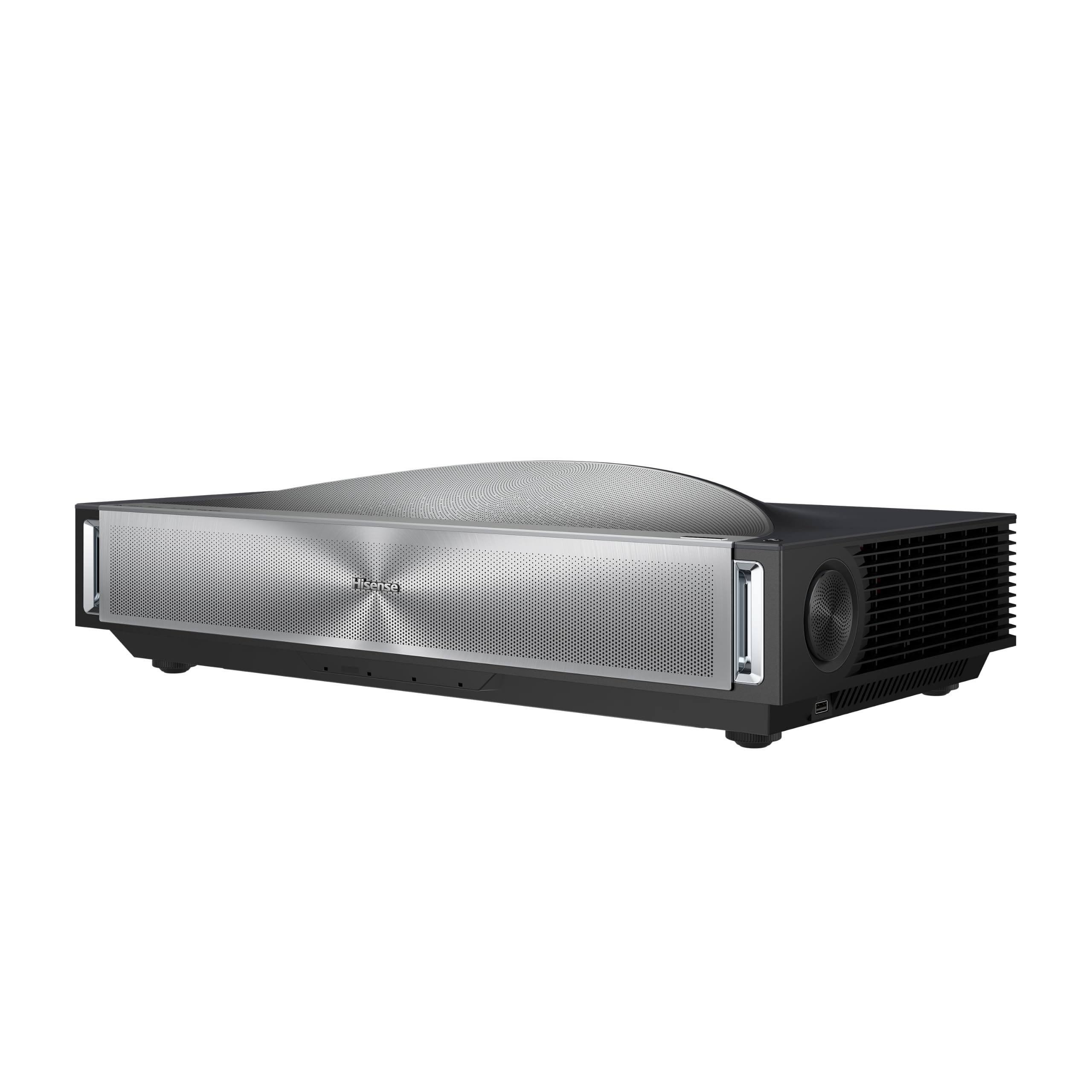
Devialet-tuned audio and FreeSync Premium make this UST a living room centerpiece.
The PX4-Pro pairs a 3500 ANSI Lumen RGB laser engine with the world’s first FreeSync Premium certified UST projector status. The LPU Digital Laser Engine 3.0 delivers a Super Wide Color Volume of BT.2020 118% and industry-leading color accuracy with ΔE≤0.9. Its CineBlack Pro System combines a 6500:1 contrast ratio with Dynamic Grayscale Technology and EBL Algorithm for real-time shadow detail.
Audio sets this one apart. Professionally tuned by Devialet, the 66W (peak 198W) Dolby Atmos 4.0.2 system (a surround-sound setup with two up-firing speakers) places sound above and around you. Owners describe the audio and visual quality as “really good” and the colors as “coming out of the screen.” The 0.2 throw ratio UST design creates a massive image just inches from the wall, saving space and eliminating shadows.
Buyers love the TV-like quality on regular light gray walls, noting it’s brighter and quieter than expected. The 1ms low latency at 2K 240Hz with VRR support, MEMC, and built-in Xbox Cloud Gaming makes it a legitimate gaming display. The honest trade-off is that auto keystone is poor — one owner had to upload a photo to a device-hosted website to fix it, and a slight rainbow effect appears for some.
All-Rounder
- Devialet-tuned 4.0.2 Atmos audio
- 118% BT.2020 color volume
- 1ms latency at 2K 240Hz
- FreeSync Premium certified
Setup Gaps
- Auto keystone needs manual workaround
- Slight rainbow effect for sensitive eyes
Reach For This If: You value out-of-the-box audio excellence and want a gaming-certified UST you barely need to plug speakers into.
Be Ready For: A fiddly auto-keystone process — plan to fine-tune alignment manually on setup day.
10. BenQ TK710

The entry point into native 4K laser projection with serious gaming chops.
The BenQ TK710 is the smart value pick for anyone wanting true 4K laser projection without the flagship price. Its 3200 ANSI lumen laser light source delivers bright, vivid images — owners upgrading from older BenQ models like the W1070, which served one buyer faithfully for 12 years, immediately notice the jump in brightness and color. The durable laser eliminates frequent lamp replacements.
This is a gaming-first projector. The 16ms input lag at 4K/60Hz keeps gameplay responsive on PS5, Xbox, and PC, while the 4ms response time at 1080p@240Hz gives competitive shooters the speed they need. True 4K UHD with HDR10/HLG support brings rich detail and improved contrast, and the Dynamic Function rapidly adjusts the light source for better contrast in real time.
Owners find the picture quality stunning with a perfect balance between clarity and refresh rate, and consider it well worth the price. The strongest praise centers on overall quality and picture quality. The honest limitations: it lacks Bluetooth, the built-in speaker isn’t loud, and the throw distance is shorter — one owner needed to sit about 3ft closer for the same 96″ screen size. A soundbar plus a Fire Stick solves the audio gap.
The Value Play
- 16ms input lag for responsive 4K gaming
- Durable laser, no lamp replacements
- 3200 ANSI lumens for lit-room viewing
- 4ms response at 1080p@240Hz
Cost Cuts
- No Bluetooth connectivity
- Underwhelming built-in speaker
- Shorter throw distance needs more room
Grab This If: You’re a gamer on a sensible budget who wants native 4K laser quality and doesn’t mind pairing it with a soundbar.
Think Twice If: You need a compact unit for a small room — the shorter throw means you’ll need more distance for your screen size.
11. Nebula X1

A portable powerhouse with cinema-grade Dolby Vision and one-click auto alignment.
The Nebula X1 brings certified cinema-grade color to a portable form factor. Dolby Vision delivers the contrast and depth streaming services encode but most displays discard, and ISF-calibrated color accuracy faithfully reproduces frames as the filmmaker intended. A custom 14-element all-glass lens maintains edge-to-edge 4K sharpness even on ultra-large 300-inch projections.
Brightness is a headline at 3500 ANSI lumens, making it vivid in ambient light or full darkness. A 6-blade iris delivers a native contrast ratio of 5,000:1, enhanced by NebulaMaster technology to reach an impressive 56,000:1 for deeper blacks and sharper shadow detail. Owners describe a 90-inch bright, sharp image with dark and bright parts of the picture looking better than expected.
Setup is easy by design. Auto-alignment scans your projection surface and adjusts the image to the best position, size, and clarity in one click, while Spatial Recall saves preferences for each space. It also carries TÜV Rheinland certification for visual comfort across brightness, color accuracy, contrast, and blue light levels. The honest trade-off is a 60Hz input limit and a remote without an Input Select button, which frustrates some gamers.
The Convenience
- One-click auto alignment and focus
- 3500 ANSI lumens for daylight viewing
- 56,000:1 dynamic contrast
- TÜV Rheinland visual comfort certified
The Limits
- 60Hz input limit caps high-refresh gaming
- Remote lacks Input Select button
- QC inconsistency between units
Best For: The yard-movie and living-room wanderer who wants one portable 4K laser they can carry outside and set up in minutes.
Pass If: Competitive gaming at high refresh is a priority — the 60Hz input ceiling will hold you back.
12. NexiGo Aurora Pro

A complete UST TV package with 60W speakers and the lowest tested UST input lag.
The NexiGo Aurora Pro is a full home cinema in one box. Its ALPD 4.0 RGB+ technology delivers a native contrast ratio of 3000:1, and dynamic laser dimming pushes black levels 60% deeper while saving over 30% energy. It’s the only UST projector combining Dolby Vision, HDR10+, a native contrast ratio over 3000:1, and dynamic laser dimming in one unit.
Audio is a major draw here. The built-in 60W stereo speakers include two 15W woofers and two 15W tweeters, with Dolby Atmos support and eARC (a high-bandwidth audio return channel) for rich surround. Owners using it as a main TV for 7 months praise the out-of-box colors and excellent performance in the dark, with workable built-in speakers. The 120Hz MEMC (motion estimation, motion compensation) reduces ghosting, and it’s one of the few projectors supporting 4K@120Hz input.
At 8ms, it holds the lowest tested input lag among all UST projectors on the market — a genuine win for console gamers. The honest catch: reliability is a mixed bag in owner feedback, with one long-term user reporting dead pixels after 1.5 years of heavy daily use as a main TV.
The Complete Package
- 60W speakers with 2x15W woofers and tweeters
- Lowest tested UST input lag at 8ms
- Dolby Vision, HDR10+, and HLG support
- 4K@120Hz input for smooth gaming
The Long Game
- Reliability questions after heavy daily use
- The 3000:1 native contrast is modest
Choose This If: You want a true all-in-one UST with room-filling audio and console gaming support from the start.
Look Elsewhere If: You plan to run it as a main TV for 8+ hours daily — some owners mention longevity concerns that a dedicated TV might avoid.
Understanding the Specs
Native Resolution vs. Pixel Shifting
Native 4K means the imaging chip physically has 8.3 million pixels. Pixel-shifting projectors use a lower-resolution chip and rapidly shift the image to create the illusion of detail. For a projector labeled “native 4K,” check the display resolution maximum — a true 3840 x 2160 or 4096 x 2160 pixels spec means real 4K, while 1920 x 1080 with 4K input support means it’s faking it.
Lumens: ANSI vs. ISO
Lumens measure brightness, but the standard matters. ANSI lumens are measured on a specific test pattern, while ISO lumens use a different, often more conservative methodology. A projector rated in ISO lumens may appear dimmer than an ANSI-rated unit with the same number. Always compare like-for-like standards, and remember that 2,000+ lumens is the floor for a living room with any ambient light.
FAQ
What does native 4K resolution actually mean on a projector?
Is the Valerion VisionMaster Pro2 good for gaming or just movies?
How many lumens do I need for daytime viewing?
What is the difference between ANSI lumens and ISO lumens?
Does an ultra-short-throw projector need a special screen?
How long does a laser projector light source last?
What input lag is considered good for gaming on a 4K projector?
Is a 4K Native Projector worth it over a pixel-shifting model?
Do I need a soundbar with a projector that has built-in speakers?
What is the best 4K Native Projector under?
Final Thoughts: The Verdict
Across the board, the 4k native projector winner is the Valerion VisionMaster Pro2 because it balances cinema-grade color, serious gaming speed, and smart features at a price that undercuts rivals. If you want absolutely maximum brightness for a daylight living room, the JMGO N3 Ultimate at 5800 ISO Lumens is the one to grab. And if you prefer the clean, unobtrusive look of an ultra-short-throw sitting inches from the wall, the AWOL VISION Aetherion Max is the smartest pick for daytime viewing without curtains.
How We Picked
We do not accept paid placement. Every pick is matched to a real buyer and a real use-case; we do not hands-on test units.
Sources & Methodology
Specifications: manufacturer listings and product documentation. Review insights: verified customer reviews, as of August 2026. Pricing: not shown on this page (it changes often); check the current price via the retailer link.
As an Amazon Associate, Gadgets Feed earns from qualifying purchases. This does not affect which products we feature.