
Our readers keep the lights on and my morning glass full of iced black tea. As an Amazon Associate, I earn from qualifying purchases.
Specs are compiled from manufacturer listings and verified buyer reviews and can change over time — please confirm the key details on the product page before buying.
The real challenge in bowhunting is knowing the exact distance to your target on steep terrain, where a rangefinder with angle compensation is essential. Angle compensation converts a guessed 40-yard shot into a precise one, preventing missed shots and wounded animals. This guide ranks the best archery rangefinders by angle compensation, bow modes, and display clarity, so you can pick the right one without overspending.
I’m Min — the founder and writer behind Gadgets Feed. This guide is built by comparing the manufacturers’ published specifications and the patterns across verified customer reviews, so you get each pick’s real strengths and trade-offs instead of marketing spin.
We zero in on angle compensation, archery modes, and display clarity to help you pick the right archery rangefinder for your next hunt.
Our Picks at a Glance


How To Choose The Best Archery Rangefinder
Buying a rangefinder for a bow is different than buying one for a rifle. You rarely shoot past 60 yards, so extreme range is a nice extra — but a clear display and true angle-compensated distance are what keep your arrow on target. Here are the specs that matter most for archers.
Angle Compensation Is Everything
When you shoot uphill or downhill, the straight-line distance to the animal is not the distance your arrow travels. Gravity pulls on the arrow over the horizontal distance, not the slope distance. Angle compensation (sometimes called ARC or TBR) calculates that true horizontal distance for you, so a steep 40-yard shot behaves like a flat 35-yard one. Without it, you will miss high on downhill shots and low on uphill ones. Angle compensation is the most critical feature for any bowhunter.
Bow Mode and Flightpath
Some rangefinders go beyond simple angle math. A dedicated bow mode uses your arrow’s speed and weight to calculate a range that fits your exact setup. The most advanced models literally map the arc of your arrow and show you the highest point of its flight — so you can see if a low-hanging branch will block your shot before you release. If you shoot in thick timber or take long shots, this feature can save you from losing arrows.
Display Readability in Low Light
Deer are most active at dawn and dusk, when a dim LCD screen is hardest to read. Look for a red or black display with adjustable brightness, or a display that auto-adjusts to the background. Many hunters find a red reticle easier to see against dark trees, while others prefer the contrast of a black reticle on a bright sky. Choose a reticle color that your eyes pick up fastest in low light.
Quick Comparison
| Model | Best For | Max Range | Magnification | Weight | Amazon |
|---|---|---|---|---|---|
| Leupold RX-1400I TBR/W Gen 2★ Best Overall | Bow & rifle versatility | 1,400 yds | 5x | 5.1 oz | Amazon |
| Gogogo Sport Vpro GS03Best Value | Budget bowhunting | 1,200 yds | 6x | 184 g | Amazon |
| TAKENJOY HM7Budget Champion | Rechargeable value | 1,200 yds | 7x | 158 g | Amazon |
| Bushnell BoneCollector 1000 | Fast scanning | 1,000 yds | 6x | 8 oz | Amazon |
| Acer SW-RF700 | Compact all-rounder | 800 yds | 6x | 0.73 lb | Amazon |
| REDTIGER H002 | Long-range value | 1,600 yds | 7x | 5.6 oz | Amazon |
| Nikon PROSTAFF 1000i | Trusted brand optics | 1,000 yds | 6x | 4.6 oz | Amazon |
| Maven CRF.1 | Premium glass clarity | 2,400 yds | 6x | 8 oz | Amazon |
| Bushnell Broadhead | Archery-first accuracy | 1,500 yds | 6x | 5.9 oz | Amazon |
| SIG SAUER KILO3K | Ballistic ecosystem | 3,000 yds | 6x | 11.84 oz | Amazon |
| Leupold RX-FullDraw 5 | Serious competition archers | — | — | 7.5 oz | Amazon |
In-Depth Reviews
1. Leupold RX-1400I TBR/W Gen 2 w/Flightpath
Our pick — over 4.5★ from 400+ verified ratings; the strongest balance of quality and price.
A dual-purpose rangefinder that excels for both bow and rifle hunting.
You get a rangefinder that handles both sides of hunting season, and it does each one properly. The TBR/W technology gives you ballistically calculated ranges for steep angles and long shots, and it will even generate a hold point for a 10-mph crosswind out to 800 yards. For bowhunters, the selectable Bow mode with Flightpath shows potential arrow obstructions and calculates angle-compensated ranges, so you can see if a branch will block your arrow before you let it fly.
It reaches 1,400 yards on reflective objects and 1,200 yards on trees, which is far beyond what any bow needs, but it means you can also use it for rifle season or spotting. The TOLED display uses bright red numbers with adjustable brightness, keeping the readout visible as light conditions change through dawn and dusk. Buyers report that a previous 1100 version gave them years of service, and the review pages sum it up: TBR line is great for accuracy and function, with top-notch optics. One trade-off worth knowing: durability opinions are mixed, with some owners noting a plastic build issue around the battery cap.
Why It Leads The Pack
- Flightpath shows arrow obstructions for safer shots
- TBR/W calculates wind holds out to 800 yards
- Red TOLED display stays readable in shifting light
The Trade-Off
- Durability feedback is mixed, with battery cap concerns
- Heavier at 5.1 oz than some rivals in this list
Grab it for: the hunter who wants one unit that handles bow season and rifle season with equal confidence.
Think twice if: you only shoot a bow and want to save weight — lighter dedicated archery units exist.
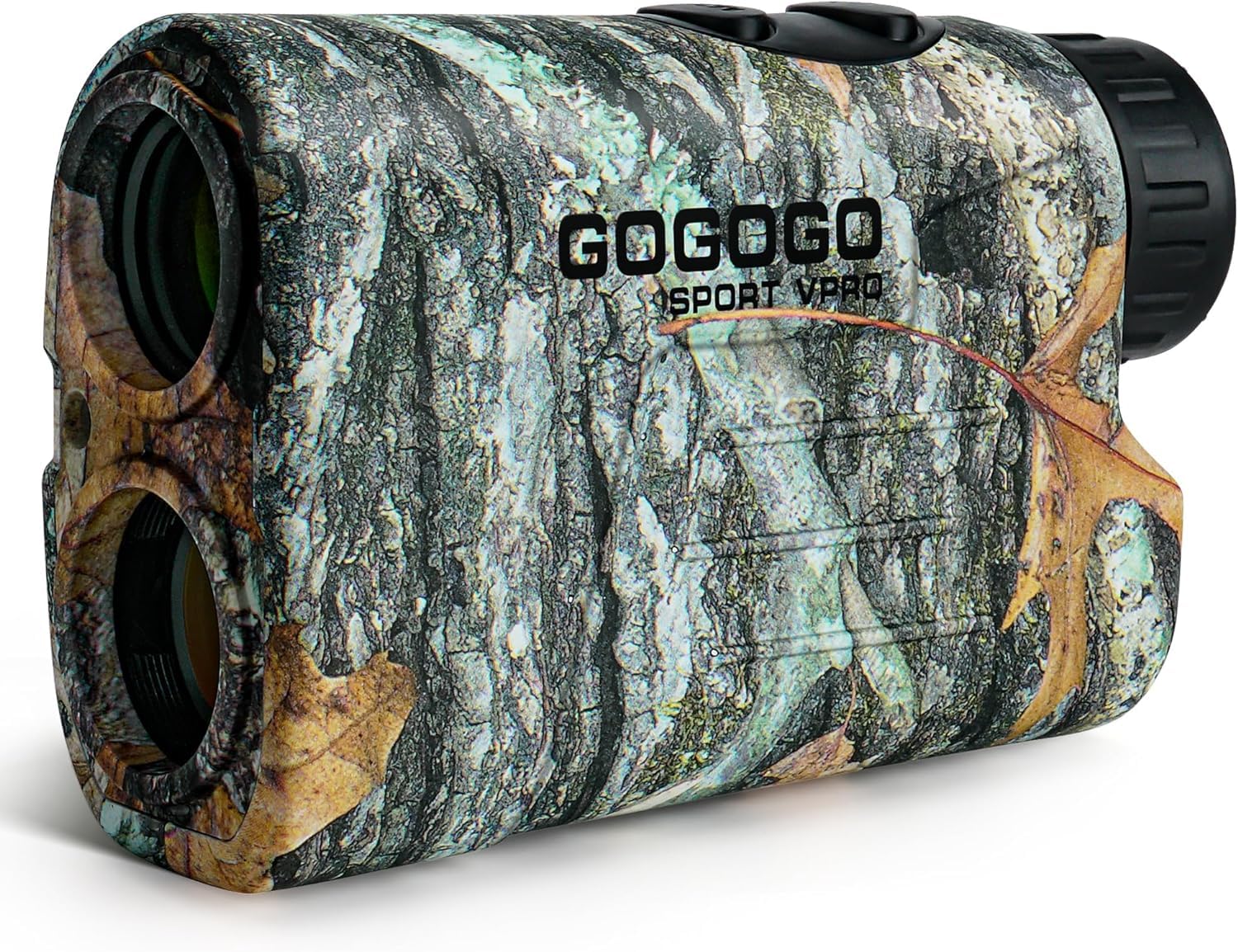
2. Gogogo Sport Vpro GS03 Laser Golf/Hunting Rangefinder
A budget-friendly camo rangefinder with slope compensation for uneven terrain.
This one earns its keep with slope compensation that helps calculate true distance in uneven terrain, which works for both golf and bowhunting. The silent Hunting Mode shows linear distance, horizontal distance, and angle with a scan function, and it delivers no vibration — so you won’t spook game while ranging. With up to 1,200 yards of measuring distance and ±1 yard precision, it handles any shot you can legally take with a bow.
The high-transmission LCD keeps things clear in daylight, and the adaptive red display improves visibility in dark or low-light settings — perfect for dawn and dusk hunts. Owners mention it proved accurate in tests under 60 yards for bow hunting, and it’s held up well over roughly two years of use. The honest catch: this is the most-discussed area, and opinions split. Some owners find it very accurate, while others report accuracy issues and units that won’t turn on. The battery door also opens easily on some units, and one owner lost the battery that way, so treat that latch gently. Quality feedback is genuinely mixed rather than glowing.
What Wins People Over
- Slope compensation for true distance on hills
- Silent mode with no vibration to spook game
- Adaptive red display for low-light reads
The Honest Catch
- Reliability feedback is mixed across owners
- Battery door can open easily and drop the CR2
- Display washes out in bright midday sun
Best for: the budget-conscious bowhunter who wants angle help and a camo look without spending big.
Look elsewhere if: you need guaranteed reliability — the mixed owner feedback suggests some units have quality issues.
3. TAKENJOY HM7 Hunting Rangefinder
Rechargeable convenience that skips the battery aisle entirely.
You never have to hunt down a replacement battery with this one, because it charges over USB-C and stays powered for hours on end. It measures from 5 to 1,200 yards with ±0.5 yard accuracy, and the 7X magnification pulls distant targets in close. The built-in transparent LCD display features red crosshairs that stand out in forested areas, which owners say works well in any lighting condition.
The one-button design keeps operation simple — you get straight-line vertical and horizontal distance, angle measurement, continuous scanning, and speed measurement all from a single control. It’s lightweight at 158 g, which pairs nicely with an IP54 water-resistance rating. A tactical clip lets you attach it to your belt for easy bowhunting access, and it comes with a 2-year warranty plus lifetime technical support. Customers note the red display shines in low light, and the build “has the look an feel of the higher priced competitors.” The honest note: one owner found it “not very accurate,” so while the value story is strong, a rare unit may disappoint on precision.
The Rechargeable Edge
- USB-C charging means no battery replacements
- 7X magnification with red crosshair display
- 2-year warranty and lifetime technical support
The Fit Note
- A rare owner found accuracy lacking
- Plastic build feels less premium than metal rivals
Reach for this if: you hate swapping batteries and want a lightweight, simple unit for bow season.
Pass if: you demand maximum precision from every single unit — a rare one misses the mark.
4. Bushnell BoneCollector 1000 Hunting Rangefinder
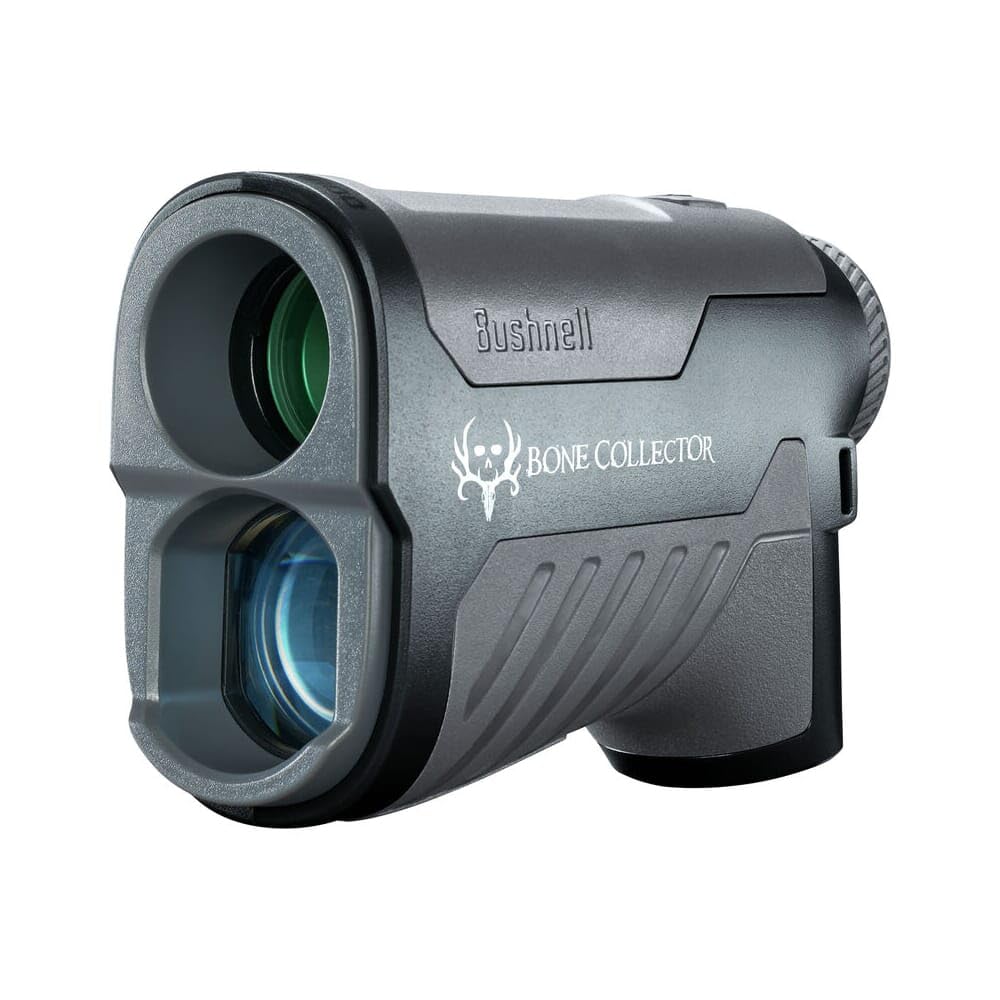
A rapid-fire scanner that refreshes ranges four times a second.
When a buck is moving, speed matters, and this unit’s ultra-fast scan mode updates ranges four times per second. That rapid refresh helps you lock onto a target quickly for a more informed shot. It delivers up to 1,000 yards with 1-yard precision, and the ARC (Angle Range Compensation) technology provides genuine horizontal and line-of-sight distances with 1-degree angle precision — so uphill and downhill shots stay accurate across varied terrain.
The imaging gets a boost from a 50% larger objective lens with an all-glass optical system and multi-coated lenses, delivering up to 2X brighter imaging for dawn and dusk conditions. It’s built for both bow and rifle hunters, runs on a CR2 battery, and tips the scale at 8 ounces. One owner had a previous unit for 12 years and calls this one even better. The recurring gripe is accuracy and clarity: some reviewers point out issues with yardage readings, and a few noticed black speckles through the lens. It’s a well-regarded budget-adjacent finder, but not every unit is flawless.
Why It Stands Out
- Scan mode refreshes 4 times per second
- ARC gives true horizontal distance on slopes
- 50% larger objective lens for brighter views
The Trade-Off
- Accuracy feedback is mixed, with some yardage issues
- A few owners spotted speckles in the lens
- No illuminated display for low-light use
Choose it for: the hunter who ranges moving targets and wants fast, refreshing yardage.
skip it if: you need a backlit display for late-evening hunts — this one has none.
5. Acer Hunting Range Finder with Slope
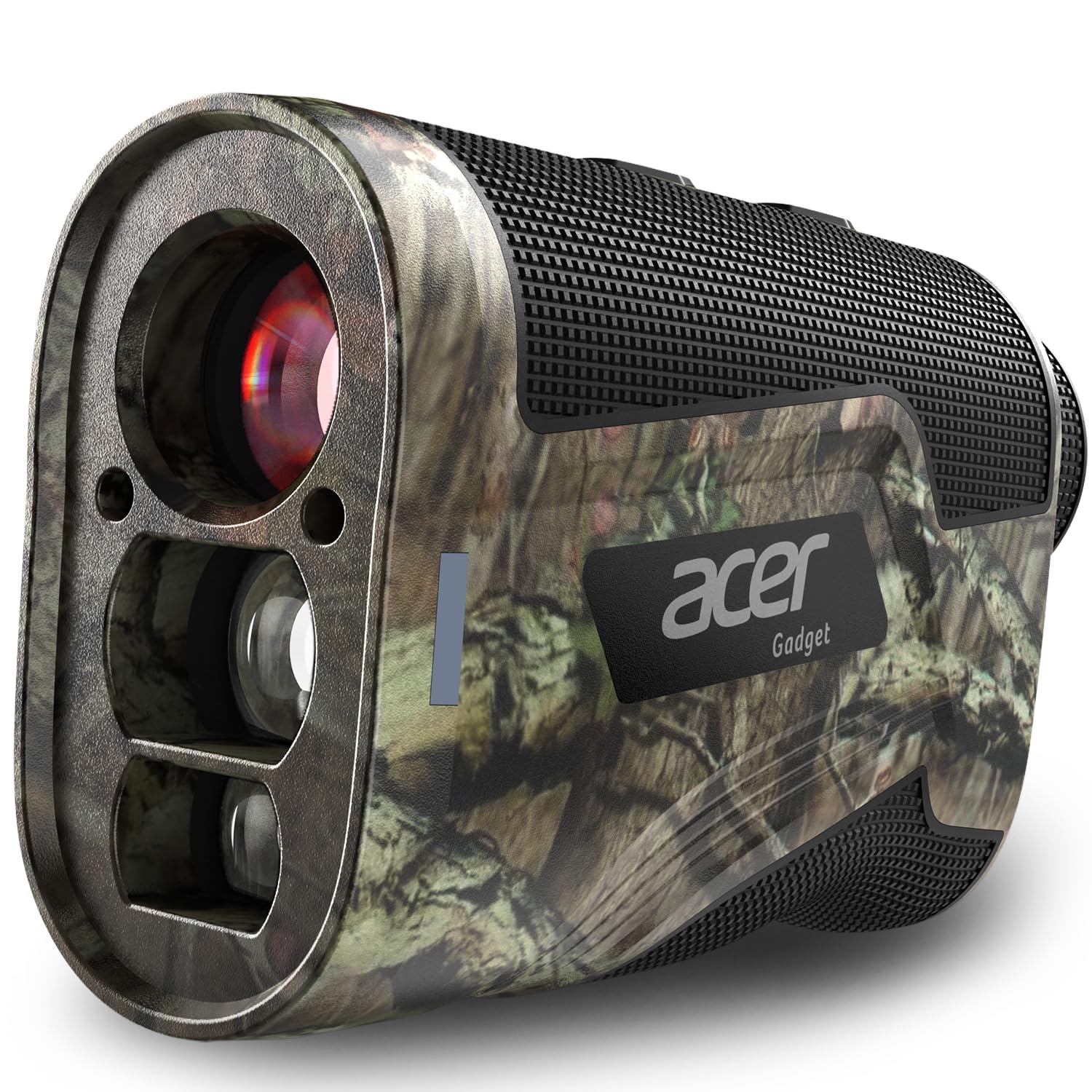
A palm-sized recharger with a strong magnet for quick on-the-move access.
Stealth is the theme here, from the battle-tested woodland camo to the non-reflective finish that kills glare so you stay undetected. At just 0.73 lb, it won’t weigh you down during long stalks. Activate Hunt Mode and it locks onto running deer, hogs, or coyotes in 0.5 seconds even at 800 yards, with ±1-yard accuracy — built for archers chasing fast game or taking long shots.
You get angle, scan, speed, height, horizontal distance, and slope compensation modes all behind one-button control. The IP54 rating resists rain, mud, and dust, and the textured grip stays firm in wet gloves. It’s USB-C rechargeable, so no battery stops your day. Owners note it easily fits in the palm and drops into a harness pocket, with accuracy that’s held up in limited archery use. The magnet is strong, though one owner advises keeping the lanyard attached as a backup. The only real complaint? Angle compensation is fine but feels built more for golf than archery, so steep shots may not be as precise as a dedicated bow unit.
The Compact Strengths
- 0.73 lb build fits easily in a harness pocket
- USB-C rechargeable battery for all-day hunts
- Hunt Mode locks targets in 0.5 seconds
The Catch
- Angle compensation leans golf-oriented, not archery-tuned
- Magnet is strong but a lanyard backup is wise
Best suited for: the mobile bowhunter who values a featherlight, rechargeable unit that disappears into a pack.
Not for: shooters who live on extreme slopes and need archery-calibrated angle math.
6. REDTIGER H002 Hunting Rangefinder

A 1600-yard reach with a battery that lasts up to 8000 measurements.
For western hunts where you need to glass across canyons, this unit stretches out to a 1,600-yard range with 7X magnification and ±0.5-yard accuracy, delivering readings in under 0.5 seconds. It’s overkill for a bow, but the range headroom means you’ll never worry about maxing out. The upgraded battery jumps from 750mAh to 1000mAh, supporting up to 8,000 measurements on a full charge — enough for long trips without a power source.
The optics offer light transmission up to 80% through an HD LCD display, keeping targets clear in challenging light. A single button toggles between horizontal distance, angle, height, straight-line distance, and speed modes for bow or rifle scenarios. At 0.35 lb it’s easy to handle, with an IP54 waterproof rating. Shoppers say it matched a friend’s pricier unit and even ranged 800 yards when that one couldn’t, with accuracy holding at 10-35 yards for archery. The honest note: toggle buttons feel lower-quality, and the speed mode on vehicles reads inaccurately. It’s a solid value for the reach.
The Reach Advantage
- 1,600-yard range with ±0.5-yard accuracy
- 1000mAh battery supports 8,000 measurements
- Fast readings under 0.5 seconds
The Honest Limits
- Speed mode reads vehicles inaccurately
- Toggle buttons feel lower-quality
Pick this for: long-range hunters who want extreme distance headroom and a battery that outlasts the trip.
Pass if: you need a reliable speed function — that mode misses the mark.
7. Nikon PROSTAFF 1000i 6×20 Laser Rangefinder
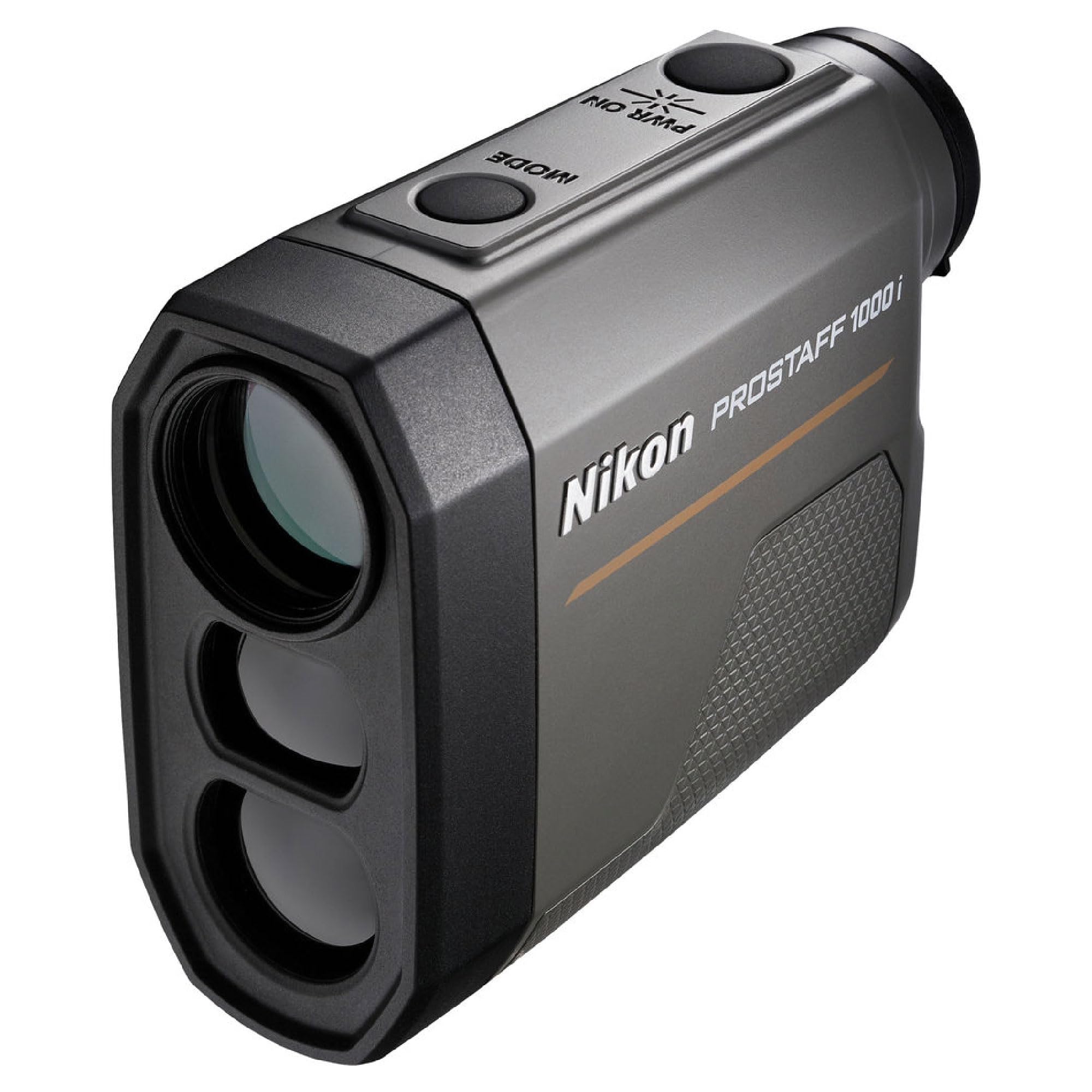
A 4.6-ounce pocket package with Nikon-grade glass and angle math.
The ID (Incline/Decline) Technology here calculates true horizontal distance on slopes up to ±89 degrees, so steep ridge shots come out accurate whether you’re uphill or downhill. The TRU Target system lets you switch between First Target or Distant Target priority — a huge help when you’re trying to range a buck standing behind a tangle of branches. You choose whether to read the closest object or the farthest one in the group.
The 6x magnification with a 20mm objective lens and anti-reflection multi-coated optics delivers bright, sharp, color-accurate images. It’s accurate to ±1 yard up to 100 yards and ±2 yards beyond, with a max range of 1,000 yards to reflective surfaces. At 4.6 ounces with a compact body, it slips into a bino pack pocket without adding bulk. Buyers report ranging 700-800 yards on reflective targets and 500-650 yards on game in clear conditions. The catch: accuracy feedback is mixed, with some owners finding issues returning readings at 200 yards or greater, and the display has no illumination — so it’s a daytime unit, not a low-light one.
The Nikon Strengths
- ID Tech calculates true horizontal distance to ±89 degrees
- TRU Target isolates one object in dense brush
- Featherlight at 4.6 oz with bright multi-coated optics
The Trade-Offs
- No illuminated display for low-light hunting
- Some owners see readings drop beyond 200 yards
Reach for this if: you value trusted glass and a light unit for ranging deer in brushy cover during legal hours.
Look elsewhere if: you hunt into twilight and need an illuminated readout.
8. Maven CRF.1 Laser Rangefinder

Extra-low dispersion glass that brings out contrast in flat light.
What sets this unit apart is the premium ED (extra-low dispersion) glass, which delivers exceptional clarity, contrast, and color accuracy. That helps you identify targets and terrain in bright daylight or low-light conditions — exactly when a blurry image costs you a shot. It ranges from 5 to 2,400 yards with line of sight and angle compensation, plus field and forest functionality for different hunting scenarios. The quick-access menu keeps operation intuitive, and the auto black/red display ensures visible readouts in changing light.
At 8 ounces with a compact, ergonomic design, it fits comfortably in your hand or pocket for backcountry hunts. It comes with a wrist strap, preinstalled CR2 battery, and a double-layered microfiber storage bag. Buyers describe it as a bargain against pricier rivals, praising the Japanese glass and quick target acquisition, with accuracy holding solid under 1,500 yards. The honest caveat: eye relief is poor for glasses wearers, so if you shoot with corrective lenses, you may struggle to see the full display. It’s a small but real ergonomic flaw.
Where It Shines
- ED glass gives standout clarity and color accuracy
- 5-2,400 yard range covers any scenario
- Auto black/red display adapts to conditions
The Limitation
- Poor eye relief for eyeglass wearers
- Range is over-advertised beyond 1,500 yards
Choose it for: the backcountry hunter who prioritizes glass clarity above all else and doesn’t wear glasses.
Pass if: you shoot with eyeglasses — the eye relief will frustrate you.
9. Bushnell Broadhead Hunting Laser Rangefinder

A bowhunting specialist with industry-leading 0.3-yard accuracy out to 150 yards.
This is one of the few units built exclusively for archery, and it shows. It delivers an industry-leading 0.3-yard accuracy out to 150 yards, tested on 3D archery targets and animal hides to ensure range stays accurate in real conditions. The Full Spectrum ranging system solves the classic problem of ranging dark, low-reflectivity targets — the exact ones archers aim at. The ActivSync display auto-adjusts the reticle from black to red, morphing with your background for maximum contrast in any condition.
ARC technology with ±1-degree angle accuracy gives you true horizontal distance plus line-of-sight distance, keeping uphill and downhill shots honest. You also get two targeting modes: Brush mode ignores foreground branches and reads background objects only, while Bullseye mode locks onto small targets without accidentally reading the background. Owners mention it beats a Leupold RX-Fulldraw on accuracy, display, and price, with one tournament archer saying it made them look better than they are. The honest notes: display readability suffers in very dark conditions, and the plastic exterior feels cheap despite the excellent internals. Value opinions split, with some seeing it as a bargain and others as pricey.
The Archery Edge
- 0.3-yard accuracy out to 150 yards for bow work
- ActivSync auto-adjusts black-to-red display
- Brush and Bullseye modes isolate your real target
The Fit Note
- Display gets hard to read in dark conditions
- Plastic exterior feels cheaper than the insides
Best for: the dedicated bowhunter who wants laser-precise yardage on dark targets out to 150 yards.
Not for: hunters who demand a premium-feeling exterior — this one prioritizes function over finish.
10. SIG SAUER KILO3K 6X22MM Laser Rangefinder

A ballistic brain that links to your scope and calculates the shot for you.
This isn’t just a rangefinder — it’s the brain of a connected hunting system. The KILO3K delivers accurate readings out to 3,000 yards to reflective targets, and its Lightwave DSP engine processes readings fast. The dedicated Archery Mode (ARCH) is superb, proven accurate beyond 100 yards at 30-degree angles, while other modes cover line-of-sight, angle-modified range, and two Applied Ballistics levels for rifle work. A segmented OLED display shows distance, elevation holdover, and wind hold data clearly.
It holds 25 bullet profiles and 8 ballistic groups, with environmental sensors providing real-time ballistics calculations. The BDX 2.0 Bluetooth connects to SIG SAUER’s app and pairs with compatible Sig ballistic scopes, relaying ranged targets and firing solutions directly. Customers note it correctly ranged a 598-yard deer and transmitted the solution to the scope for a shoulder hit. The honest trade-offs: the menu is complex with many modes, the stock battery is weak and should be replaced, and battery life draws negative owner feedback. It’s a serious tool for the hunter who wants a full ecosystem, not a simple point-and-shoot unit.
The Power Features
- Archery Mode proven accurate beyond 100 yards at 30° angles
- Bluetooth pairs with Sig ballistic scopes and the app
- 25 bullet profiles and 8 ballistic groups onboard
The Cost of Complexity
- Menu is steep to learn with many modes
- Battery life draws negative owner feedback
- Stock battery is weak and should be swapped
Grab it if: you’re building a connected Sig ecosystem and want a rangefinder that talks to your scope.
Avoid if: you want a simple, pick-up-and-read unit — this one demands a learning curve.
11. Leupold RX-FullDraw 5 Rangefinder with DNA

The competition-grade unit that maps your arrow’s arc before you release.
This is the most bow-specialized rangefinder on the list, and it’s clearly built for serious archers. The Archer’s Advantage bow ballistics uses your arrow weight, arrow velocity, and peep height to calculate accurate ranges for steep-angle and long-distance shots — tuned to your exact setup, not a generic profile. Flightpath technology then displays the highest point of your arrow’s flight, so you can see if a limb will block your shot before you commit. Owners describe it as “high speed stuff” and one competition archer credits it with saving him from hitting limbs in TAC and SHOT tournaments.
The selectable OLED display uses bright characters with adjustable brightness for strong light transmission in low-light conditions. Last Target mode reads the farthest target in the laser’s path, so grasses and twigs don’t interfere with an accurate range. At 7.5 ounces with an aluminum build, it feels substantial in hand. The review pages sum it up: “Best rangefinder I’ve owned.” The honest catch: reliability feedback is mixed, with several owners reporting units that didn’t work on arrival — so inspect yours early and use the warranty if needed.
The Specialist Edge
- Bow ballistics tuned to your arrow weight and speed
- Flightpath shows potential limb obstructions
- Last Target mode ignores foreground brush
The Reliability Question
- Several reviewers point out units that didn’t work
- Heavier at 7.5 oz than dedicated hunting rivals
Pick this for: the competition or dedicated archer who wants ballistics tuned to their exact arrow setup.
Think twice if: you’re wary of early reliability issues — check the unit quickly and lean on the warranty.
Understanding the Specs
Angle Compensation vs. Straight-Line Range
Your eyes see the slope distance, but your arrow only travels the horizontal distance. Angle compensation (called ARC, TBR, or ID by different brands) does that math for you. Without it, a 40-yard shot down a steep hill actually behaves like a 32-yard flat shot — and you’d miss high. For bowhunters, this feature matters far more than maximum yardage.
Magnification and Display Readability
Higher magnification (6x or 7x) pulls distant targets closer, which helps identify game and aim precisely. But the display is where shots are won or lost. A red reticle stands out against dark trees, while a black reticle works on bright skies. Look for adjustable brightness or an auto-adjusting display — it’s the difference between reading your yardage at dusk or guessing.
FAQ
Is angle compensation necessary for bowhunting?
How much range do I really need for archery?
What is Flightpath technology in a rangefinder?
Should I get a rechargeable or battery-powered rangefinder?
Can I use a golf rangefinder for bowhunting?
What does the IP54 rating mean on these rangefinders?
<
How much does weight matter in a rangefinder?
What is the difference between Archery Mode and regular bow mode?
How do I range a target through thick brush?
What does ±0.3-yard accuracy mean for archery?
Final Thoughts: The Verdict
For most buyers, the archery rangefinder winner is the Leupold RX-1400I TBR/W Gen 2 because it pairs true bow-specific Flightpath technology with rifle-ready TBR/W ballistics in one aluminum body. If you want a rechargeable unit that skips the battery aisle entirely, grab the TAKENJOY HM7 for its USB-C charging and 2-year warranty. And for the competition archer who lives on steep angles and long shots, the Leupold RX-FullDraw 5 is the one to reach for — its arrow-arc mapping is a genuine edge you won’t find elsewhere. Whatever your budget, angle compensation and display clarity matter more than raw yardage, so prioritize those two and you’ll never misjudge a shot again.
How We Picked
We do not accept paid placement. Every pick is matched to a real buyer and a real use-case; we do not hands-on test units.
Sources & Methodology
Specifications: manufacturer listings and product documentation. Review insights: verified customer reviews, as of August 2026. Pricing: not shown on this page (it changes often); check the current price via the retailer link.
As an Amazon Associate, Gadgets Feed earns from qualifying purchases. This does not affect which products we feature.