
Our readers keep the lights on and my morning glass full of iced black tea. As an Amazon Associate, I earn from qualifying purchases.
Specs are compiled from manufacturer listings and verified buyer reviews and can change over time — please confirm the key details on the product page before buying.
You want a window alarm that will actually wake you up if someone opens a window—so focus on three things: loudness in decibels, how the sensor triggers, and whether the adhesive holds. For most homes, the best pick pairs a 120-decibel siren (about as loud as a chainsaw) with a magnetic sensor that trips the instant a gap opens, and it needs no wiring.
I’m Min — the founder and writer behind Gadgets Feed. This guide is built by comparing the manufacturers’ published specifications and the patterns across verified customer reviews, so you get each pick’s real strengths and trade-offs instead of marketing spin.
Whether you’re shielding a ground-floor bedroom, a pool gate, or a kids’ cabinet, the right window alarm deters intruders instantly and alerts you to any unwanted entry the second it happens.
Our Picks at a Glance

How To Choose The Best Window Alarm
Every alarm here does one job: it alerts you the moment a window or door opens. But how loud, how sensitive, and how reliable each one is will determine whether you hear it in time to react. So pick the type that matches your specific risk—like a ground-floor window near a dark alley versus a second-story bedroom.
Magnetic contact vs. vibration sensors
Most window alarms use a magnetic contact sensor—two small pieces that sit side by side, and the alarm sounds when they separate past a set gap. These are ideal for sliding windows and standard doors. A vibration sensor, by contrast, detects the shock of glass being tapped or forced, which makes it the better fit for windows where someone might break the pane rather than slide it open.
Decibels and battery life
The loudness rating tells you how far the sound travels. A 65 db alarm is noticeable in the same room, while a 120 db siren is meant to be heard across the house and to startle an intruder. Battery choice matters too—some run on button-cell LR44 batteries, others on 2 AAA batteries, and that affects how often you’ll be replacing them.
Quick Comparison
| Model | Best For | Loudness | Sensor Type | Pack Size | Amazon |
|---|---|---|---|---|---|
| TECKNET 3-Pack★ Best Overall | Versatile home coverage | 65 db | Magnetic | 3 | Amazon |
| TECKNET 3PcsBudget Champion | Simple alarm/chime modes | — | Magnetic | 3 | Amazon |
| UltraPro 4-PackTop Performer | Entry-level confidence | 120 db | Magnetic | 4 | Amazon |
| Flyoukki 3-Pack | Maximum deterrent volume | 120 db | Magnetic | 3 | Amazon |
| Philips 4-Pack | Trusted brand reliability | 120 db | Magnetic | 4 | Amazon |
| CATSONIC 6-Pack | Glass-break detection | 130 db | Vibration | 6 | Amazon |
| METAK 5-Pack | Adjustable volume (90/120 dB) | 120 db | Magnetic | 5 | Amazon |
| Ring 2-Pack | Smartphone notifications | — | Magnetic | 2 | Amazon |
| Rinetiy 10-Pack | Whole-house coverage | 120 db | Magnetic | 10 | Amazon |
In‑Depth Reviews
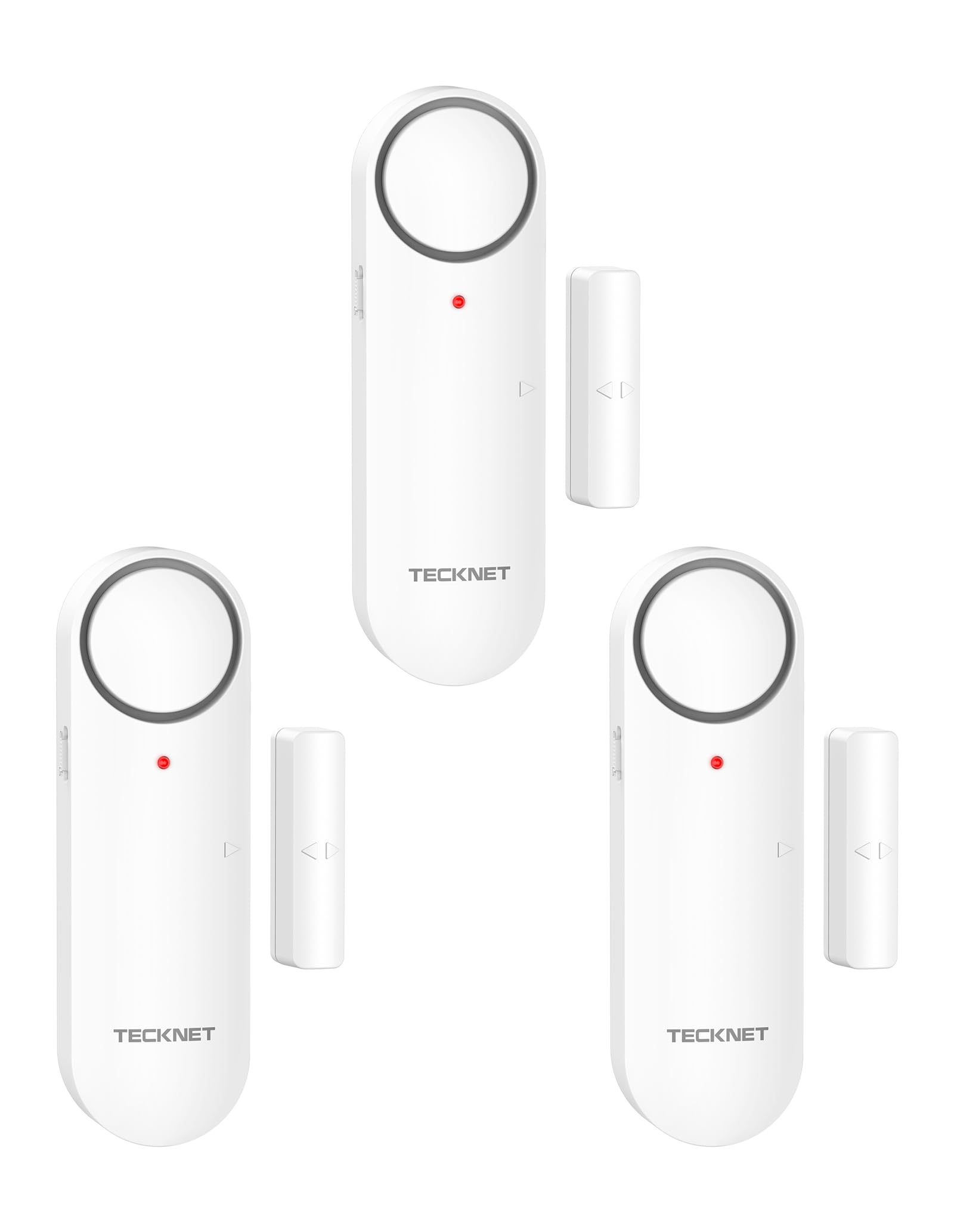
1. TECKNET Door Alarms for Kids Safety (3 Pack)
Our pick — over 4.5★ from 900+ verified ratings; the strongest balance of quality and price.
The versatile three-pack that blends a 65 db beep with a car-alarm-style blast for every room in the house
This is the crowd favorite for a simple reason: it gives you three volume settings plus two alert modes in one compact 4.96″L x 4.33″W x 0.79″H body. You can set it to a gentle chime for a cabinet or switch to a full alarm for a front door—the same unit handles both. The magnetic sensor trips when the gap exceeds 0.78 inches, so even a slightly-ajar window triggers it.
Installation is genuinely tool-free. You tear off the sticker, press the sensor within 0.5 inches of the arrow on the alarm, and it’s live.
The trade-off is the 65 db ceiling, which is quieter than the 120 db sirens on other picks. At 65 db it’s noticeably quieter than the 120 db sirens on other picks—fine for alerting you from the next room, but not the ear-splitting deterrent some want. If your priority is scaring off an intruder rather than hearing a reminder, the louder options below are the better fit.
What wins people over
- Three volume levels let you match the alert to the room
- Dual alarm/chime modes cover doors, windows, and cabinets
- 36-month warranty (with registration) backs the purchase
Who should pass
- 65 db output is mild compared to 120 db competitors
- Small switches are hard to read for older users
Reach for this if: you want one alarm that works across doors, windows, drawers, and even a hotel room while traveling.
Choose a louder siren if: your goal is maximum intruder deterrence rather than everyday awareness.
2. TECKNET Door Alarms When Opened (3Pcs)
The entry-level trio that runs on 2 AAA batteries for longer life than button cells
This sibling of the Best Overall pick trades the polished finish for one practical upgrade: AAA battery power. Where many competitors rely on small LR44 button cells, this unit runs on 2 AAA batteries, which owners say means fewer replacements and more reliable daily use. At just 141 g, each alarm is light enough to carry in a bag when you travel.
The experience is refreshingly simple. Press and hold the volume/mode button for 3 seconds to toggle between a doorbell-style chime and a full alarm, then pick low, medium, or high volume. Align the sensor with the magnetic stripe arrow at a gap of less than 2cm, peel the sticker, and it’s done. Buyers report they “work great, nice and loud,” and the chime mode is a favorite for knowing when a door opens without a startling blast.
The honest limitation is the volume ceiling—it doesn’t hit the 120 db mark, so it’s best for awareness rather than shock-and-awe deterrence. It’s also a newer model with fewer owner reports behind it, so you’re relying more on the 36-month warranty than on years of collective feedback.
Best as a starter set: this trio gives you reliable alarm and chime modes at a friendly entry cost, with AAA batteries that outlast button cells.
The catch: the quieter output means it shines as a doorbell-style alert, not as a burglar-scaring siren.
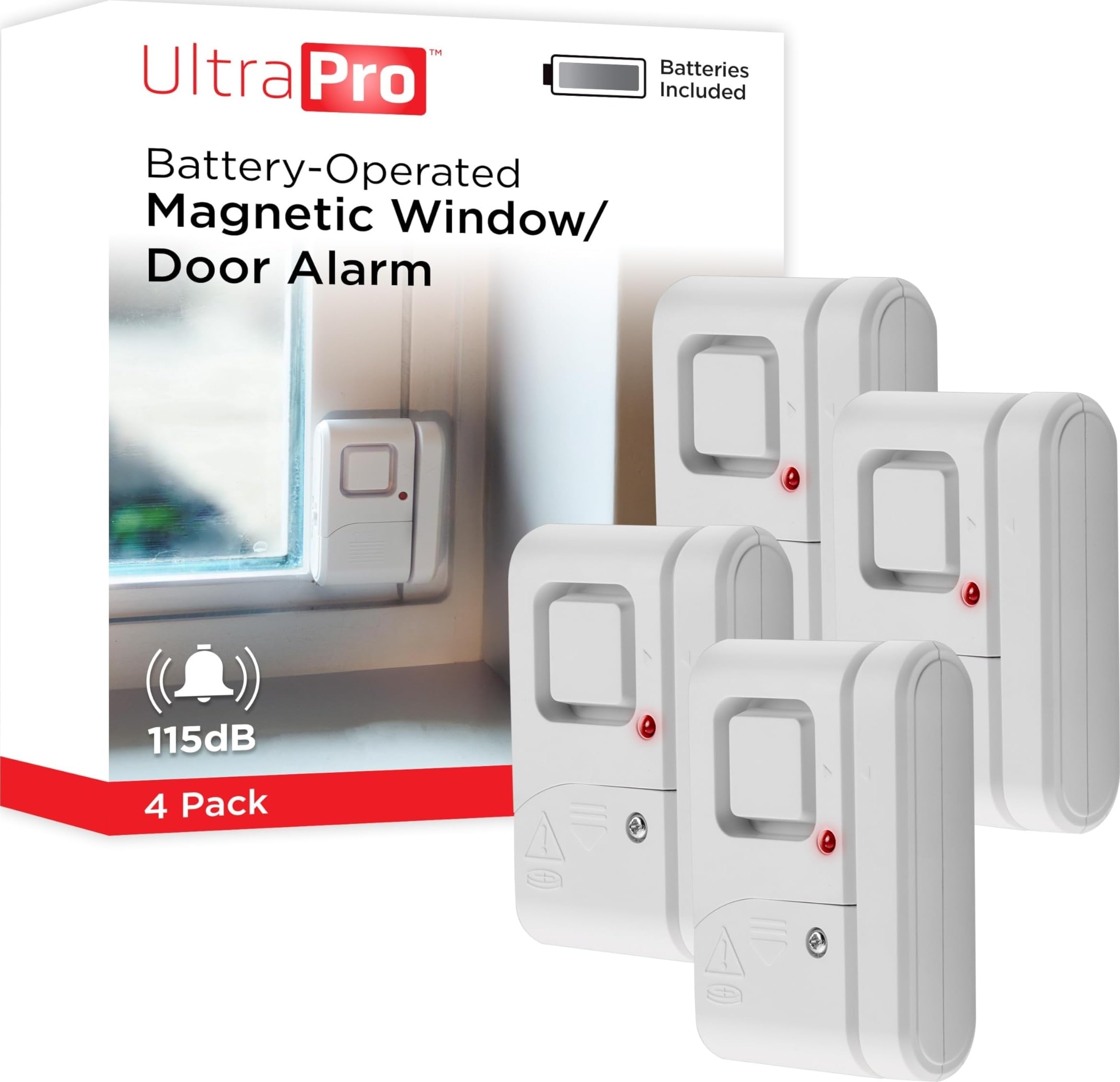
3. UltraPro Personal Security Window and Door Alarm (4 Pack)
The 120 db four-pack that’s become a household name for easy, wire-free security
This is the alarm that tens of thousands of owners have trusted, and it’s easy to see why. The 120 db siren is loud enough to alert everyone in the house, yet the unit is compact at just 1.63″L x 0.8″W x 4.62″H—roughly a third the footprint of the TECKNET above. That size difference matters when you’re mounting it on a narrow window frame.
A side switch cycles through OFF, chime, and alarm modes, so you can use the gentle chime during the day and switch to the full siren at night. It runs on four included LR44 batteries with a front LED low-battery indicator, so you get a heads-up before it dies. Owners describe it as “very easy to install, and it works exactly as expected”—the kind of reliability that made this a best-seller.
The recurring gripe is the adhesive. The included double-sided tape works for most, but a few owners swapped in stronger tape like Gorilla tape for a permanent mount. There’s also a fair warning that the magnetic sensor needs both pieces within about 1/4″ of each other, so some frames require an upside-down mount for proper alignment.
Why it’s a household name
- 120 db siren is audible house-wide
- Four alarms cover multiple entry points at once
- Tool-free tape mounting in about 5 minutes
Expect these quirks
- Stock adhesive can be weak—many swap in stronger tape
- Some frames need an upside-down mount for magnet alignment
Grab this if: you want proven, loud reliability with minimal setup fuss across four windows or doors.
Think twice if: you’d rather not fuss with replacing the tape on a permanent install.
4. Flyoukki 120 DB Alarm Sensor (3 Pack)

The ultra-slim 120 db siren rated audible at over 750 feet, with ear plugs tossed in
If your priority is sheer volume, this is the alarm to beat. The 120 db siren is audible at over 750 feet, and the marketing backs it up—owners describe the high-pitched sound as “alarming,” perfect for waking a household or startling someone mid-intrusion. The slim 1.5″L x 0.37″W x 2.9″H build is discreet enough to blend into a doorframe.
Each of the three alarms includes 3 LR44 batteries rated to last 6–12 months, plus a low-battery indicator so you’re never caught off guard. The package even includes 2 anti-noise ear plugs, a nod to just how piercing the siren is. Owners mention it works especially well for keeping toddlers in their room and for dementia wandering, where the loud blast interrupts the behavior immediately.
The honest caveats: some owners found the strong tape can crack the plastic if you press too hard during install, and there’s no volume adjustment—it’s full siren or nothing. The adhesive also needs a flat, clean surface, so sliding patio doors can be a challenge. This is a “set it loud and forget it” pick, not a nuanced one.
Loudness above all: the 120 db blast plus 750-foot audibility makes this the pick when you need to be heard from anywhere.
Handle with care: the strong tape can crack the housing if you press too firmly, and there’s no volume dial to soften it.
5. Philips Personal Security Window and Door Alarm (4 Pack)
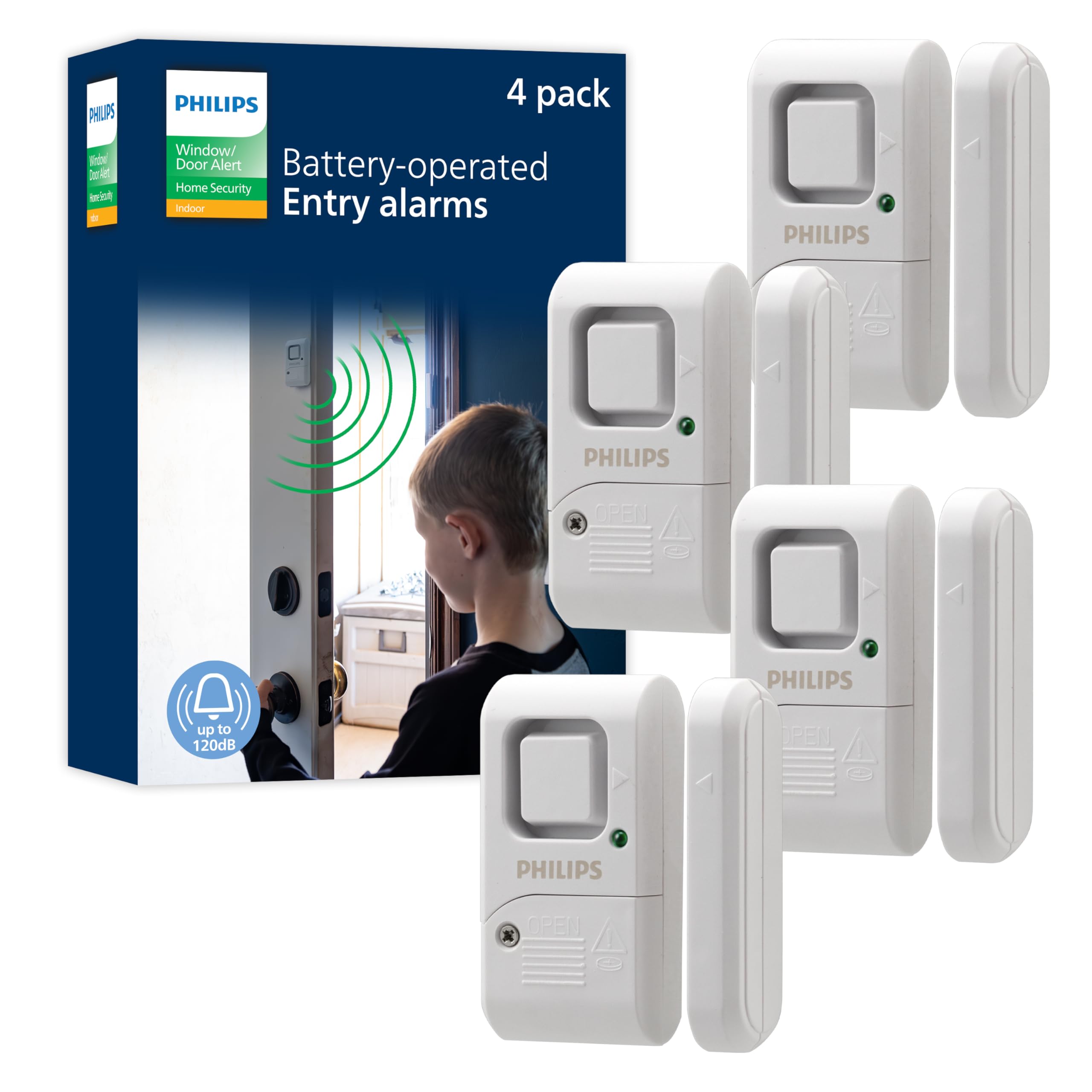
The trusted-brand four-pack whose 120 db siren is loud enough to wake the whole house
Philips brings a confidence factor that generic alarms don’t. This four-pack delivers a 120-decibel alarm triggered by a high-quality magnetic sensor, and it’s remarkably loud for the size. Customers note hearing it “from the other side of the house” and even using it to wake deaf parents with dementia—the ding-dong chime cuts through noise, and the full alarm is startling.
It’s a more polished take on the UltraPro concept. The side OFF/chime/alarm switch is easy to reach, and it includes a battery test button plus a low-battery indicator LED, so you can check power status without guessing. The 1-year limited warranty adds a layer of protection that budget brands skip. Owners consistently call it “very easy to install” with the included double-sided tape.
The downsides are minor and rare: a few units arrive dead on arrival, and the adhesive gets mixed reviews. A few units arrived dead on arrival, and the included adhesive gets the same mixed reviews as most tape-mounted alarms. It’s also note this uses LR44 button batteries, which some owners found less convenient than AAA-powered rivals. That’s the only real reason to look elsewhere.
The brand-name edge
- 120 db siren audible across the entire house
- Battery test button plus low-battery LED for easy checks
- 1-year limited warranty from a trusted maker
Know before you buy
- Rare units can arrive dead on arrival
- LR44 button batteries, not the longer-lasting AAA type
Pick this for: the reassurance of a major brand name with a siren loud enough for any room.
Look elsewhere if: you’d prefer AAA batteries over hard-to-find LR44 cells.
6. Catsonic 6 Pack Window Glass Break Alarm

The six-pack that shifts from magnetic sensors to a vibration detector for glass-break protection
This is the alarm that thinks differently. Instead of the standard magnetic contact sensor, it uses an advanced vibration sensor that detects the slightest shock or vibration of the window glass—so it catches someone tapping, breaking, or forcing the pane, not just sliding it open. That makes it uniquely suited to windows where a burglar might smash rather than open.
The siren tops out at an ear-piercing 130 db, louder than every other pick on this list. A mute switch on the middle lets you silence it quickly, and the LED blinks for 5 seconds when you arm it so you know it’s live. The maker claims the batteries last up to 1 year, and installation takes under a minute with the peel-and-stick backing—no tools at all. Owners say “they work great and are very loud. Loud enough to scare someone.”
The catch is sensitivity: it can trigger on a dog barking or passersby bumping the glass. Because it detects vibration, it can trigger on a dog barking, passersby bumping the glass, or a neighbor’s noise—some owners disable it when pets are around. There’s no sensitivity or volume adjustment, just on/off. And it’s not ideal for doors or sliding windows that open without force; the brand itself recommends a magnet-sensor alarm for those.
The glass-break advantage
- 130 db siren is the loudest in this lineup
- Vibration sensor catches taps and forced entry, not just openings
- Six units in the box cover a whole floor of windows
The sensitivity trade-off
- False alarms from dogs or passersby are common
- No volume or sensitivity adjustment to fine-tune
Best for: windows where a burglar might break glass rather than slide it open—this catches both.
Skip if: you have pets near the windows; the vibration sensor may trip on them.
7. Metak Window & Door Alarm (5-Pack)
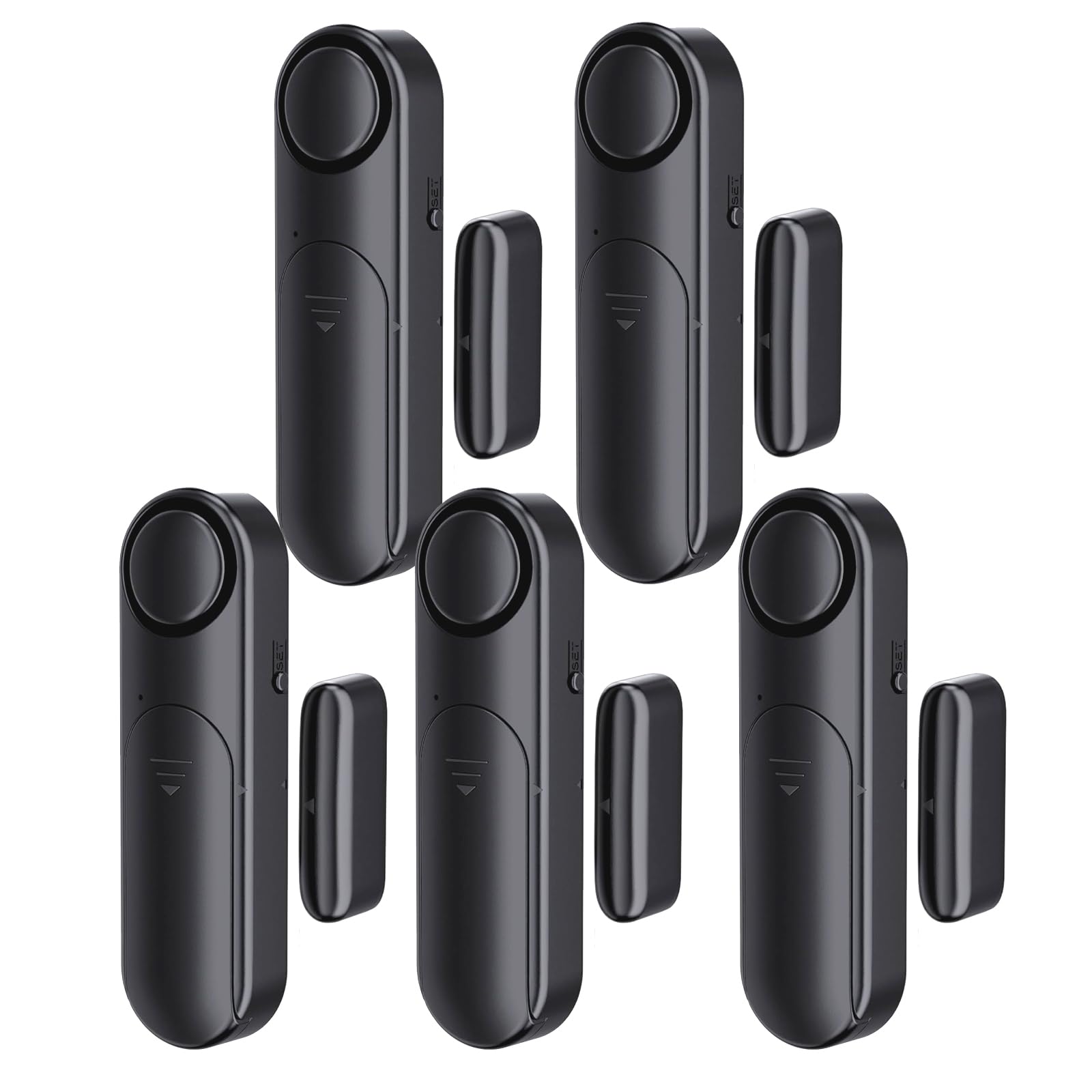
The five-pack with a Set button that toggles between a 90 dB chime and a 120 dB siren
This pick solves the one problem most window alarms ignore: you can’t adjust the volume. The Metak uses a Set button to switch between 90 dB and 120 dB output, so you can run a gentler chime during the day and a full siren at night. That flexibility makes it a strong fit for families who want one alarm that adapts to the situation.
It’s powered by 2 AAA batteries (not included), which reviewers point out gives long battery life compared to button cells. The built-in LED flashes red both when the alarm triggers and when the battery runs low, so you always know its status. At 0.27 kg, the five alarms are light enough to mount anywhere, and the self-adhesive install needs no tools or wiring.
The trade-offs are small: no remote control support and the adhesive gets mixed reviews. There’s no remote control support, so all settings happen via the Set button on the unit itself. And the adhesive gets the usual mixed reviews. But for the adjustable volume alone, this is a genuinely distinct pick from the fixed-siren competition.
The flex factor: the 90/120 dB toggle gives you a day-time chime and a night-time siren in one alarm.
Keep in mind: no remote support and AAA batteries are sold separately.
8. Ring Window & Door Sensor (2-Pack)
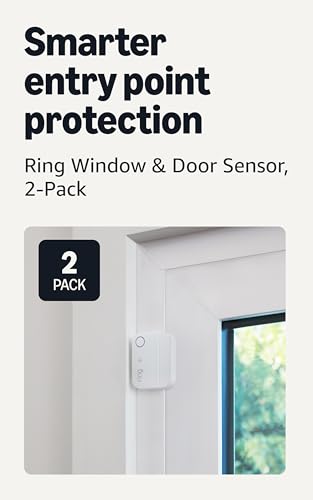
The smart option that pings your phone instantly instead of screaming from the window frame
This is a completely different beast from the siren alarms above. The Ring sensor doesn’t blast 120 db—it sends an instant notification to your phone the moment a window or door opens, integrating with the Ring app and your existing cameras. It mounts in minutes with no tools or wiring, and it’s so compact that owners say “if you didn’t know it was there, you wouldn’t see it.”
The setup is genuinely different. It requires no base station, connecting instead over Amazon Sidewalk for simple, flexible coverage throughout your home. You can add 24/7 Pro Monitoring with a compatible Ring subscription for emergency response to break-ins and fires, with no multi-year contracts. For this reason, it’s the right pick for someone who already lives in the Ring ecosystem.
Know the limits before you commit. Several shoppers say connection issues, and the alerts are tied to your phone—one buyer found them too quiet to hear while sleeping, with no volume adjustment. It escalates to a police alarm after 30 seconds if unanswered. And this is a sensor, not a deterrent; it won’t scare anyone off with sound.
The smart-home advantage
- Instant phone notifications instead of a local siren
- Compact, discreet, tool-free mounting
- Optional 24/7 Pro Monitoring with a Ring subscription
Its honest limits
- Connection issues reported by several owners
- No local siren—alerts depend on your phone volume
Choose this if: you’re already in the Ring ecosystem and want notifications, not noise.
skip it if: you need a loud local siren or you’re not willing to rely on your phone for alerts.
9. Rinetiy Window Alarm Sensors (10 Pack)

The ten-pack that covers every window and door in the house with a 120 dB siren rated at 800 feet
When you’ve got more entry points than alarms, this is the fix. The Rinetiy ten-pack delivers 120 dB sirens that are audible at over 800 feet, and the sheer count means you can secure every window on a floor without rationing. Owners describe it as “extremely loud” and one ground-floor resident says the alarm “functions exactly as described” for catching uninvited attempts to open windows.
The install is the easiest on this list: pull the tab, remove the sticky tape, turn it on, and go. No drilling, no tools, no wiring. The alarms work with a chime switch so you can use a gentler alert for a storefront or a full siren at home. One owner who ordered three different brands called this “the winners” for both ease and volume.
The honest weakness is the adhesive—the same refrain across tape-mounted alarms. One owner noted the small piece “came loose a few times” and wished the tape was stronger. Some also found the AG13 (LR44) button batteries drain faster than expected. But at this count and volume, it’s the best value for whole-house coverage.
Why ten is worth it
- 120 db siren audible at over 800 feet
- Ten alarms cover every window and door in one go
- Peel-and-stick install takes under a minute per unit
The honest trade-offs
- Adhesive can loosen over time on some frames
- LR44 batteries drain faster than AAA-powered rivals
Buy this for: whole-house or whole-store coverage where you need volume and quantity in one box.
Consider a smaller pack if: you only need to secure a couple of windows and prefer stronger stock adhesive.
Understanding the Specs
Decibels (dB)
This is the loudness rating, and it’s the single most important spec for a window alarm. A 65 db alarm is audible in the next room, while 120 db is roughly the volume of a rock concert—loud enough to wake a sleeping household and startle an intruder. The loudest pick here hits 130 db. When in doubt, go louder; you can always use a chime mode if the full siren is too much for daily use.
Magnetic vs. vibration sensors
The magnetic contact sensor is the standard: two pieces sit aligned, and the alarm sounds when they separate. It’s ideal for sliding windows and doors. A vibration sensor, by contrast, reacts to the shock of glass being tapped or forced—better for windows where a burglar might smash the pane. Choose based on how an intruder is likely to enter that specific window.
FAQ
What’s the difference between a 65 db and a 120 db window alarm?
Will a magnetic sensor alarm work on my sliding window?
How long do window alarm batteries actually last?
Can a window alarm double as a door alarm?
What’s the best window alarm for dementia or toddler wandering?
Which is better, a magnetic sensor or a vibration sensor alarm?
Does a window alarm need wiring or a hub?
How do I install a peel-and-stick window alarm?
What happens when the battery runs low on these alarms?
Can I use a window alarm on a pool gate or cabinet?
Final Thoughts: The Verdict
If you want one dependable pick, the best window alarm is the TECKNET 3-Pack because it pairs an easy sticker install with three volume levels and two alert modes for less than you’d expect. If you want maximum deterrent volume, the UltraPro 4-Pack brings a proven 120 db siren with a fraction of the footprint. And for glass-break protection that catches forced entry, the Catsonic 6-Pack and its 130 db vibration sensor is the one to reach for.
How We Picked
We do not accept paid placement. Every pick is matched to a real buyer and a real use-case; we do not hands-on test units.
Sources & Methodology
Specifications: manufacturer listings and product documentation. Review insights: verified customer reviews, as of August 2026. Pricing: not shown on this page (it changes often); check the current price via the retailer link.
As an Amazon Associate, Gadgets Feed earns from qualifying purchases. This does not affect which products we feature.