
Our readers keep the lights on and my morning glass full of iced black tea. As an Amazon Associate, I earn from qualifying purchases.
Specs are compiled from manufacturer listings and verified buyer reviews and can change over time — please confirm the key details on the product page before buying.
Cutting a 0000 (4/0) battery cable with a hacksaw or basic pliers is a sweaty, slow chore that wears out your wrists. The right battery cable cutters use leverage, shear blades, or a ratcheting mechanism to do the heavy work for you. Your real choice is between the raw power of a shear cutter and the easy, one-handed action of a ratchet.
I’m Min — the founder and writer behind Gadgets Feed. This guide is built by comparing the manufacturers’ published specifications and the patterns across verified customer reviews, so you get each pick’s real strengths and trade-offs instead of marketing spin.
We break down the best battery cable cutters for electricians, solar installers, and DIYers, covering cutting capacity, handle design, and durability. Each pick is judged on real-world cutting performance and long-term value.
Our Picks at a Glance


How To Choose The Best Battery Cable Cutters
Match the cutter’s cut capacity to the biggest cable you handle. A cutter rated for 600 MCM (a measure of cable cross-section) will slice through a 4/0 battery cable easily, but a smaller tool will struggle and crush the strands.
Shear Cutters vs. Ratchet Cutters
Shear cutters, like the Klein models, use long handles and a pivoting jaw for a quick, scissor-like slice—ideal for fast, clean cuts when you have both hands free. Ratchet cutters use a step-by-step mechanism that clicks the blade through the cable with each squeeze, which means tiny hand movements can cut through massive conductors, but each cut takes more squeezes. For cutting battery cables in a tight engine bay, the compact ratchet design often wins.
Understanding Cable Ratings (mm² and MCM)
Cable sizes are rated in mm² (cross-sectional area) or MCM (thousands of circular mils). A 600 MCM rating equals roughly 300 mm², which covers nearly all battery, welding, and service entrance cables. Before you buy, check the cutter’s maximum rating and your cable’s size—exceeding it will damage the blade and crush the wire.
Blade Quality and Handle Design
The blade should be forged, heat-treated steel (often “induction-hardened” or “oil-hardened”) to hold an edge. Look for cushioned, non-slip grips—these reduce hand fatigue when you’re making dozens of cuts on a big job. Also, consider the jaw opening; some cutters need to be opened wide to fit around thick cable, which can be awkward for smaller hands.
Quick Comparison
| Model | Best For | Cutting Capacity | Mechanism | Handle Material | Amazon |
|---|---|---|---|---|---|
| Klein Tools J63225N★ Best Overall | Electricians needing one-hand power | 4/0 Al, 2/0 Cu | High-Leverage Shear | Plastic Blend | Amazon |
| TEMCo TH0001Pro’s Choice | Welding & battery cable pros | 4/0 gauge | Forged Shear | Steel with Rubber | Amazon |
| Klein Tools 63225Confined Space | Confined spaces, tool pouches | 4/0 Al, 2/0 Cu | One-Hand Shear | Aluminum/Plastic | Amazon |
| BETOOLL J40 | Heavy daily use, value seeker | 300 mm² Max | Ratchet | Alloy Steel | Amazon |
| KF CPTEC | Car audio & occasional use | 600 MCM / 300 mm² | Controlled Ratchet | Polypropylene | Amazon |
| Sanuke SE-H325A | Budget-friendly multi-strand cuts | 600 MCM / 240 mm² | Fast Ratchet | Aluminum/Rubber | Amazon |
| LUBAN DLJ-HS325A | Mid-size battery cables | 240 mm² Max | Ratchet | PVC | Amazon |
| HKS Cutter 36D | RVers & mobile repairs | 300 mm² (600 MCM) | Ratchet | Aluminum | Amazon |
| INNETOC IT323H | Large service entrance cable | 400 mm² Max | Lock Ratchet | PC | Amazon |
In‑Depth Reviews
1. Klein Tools J63225N
Our pick — over 4.5★ from 250+ verified ratings; the strongest balance of quality and price.
The electrician’s standard that slices through 4/0 with a single-handed squeeze.
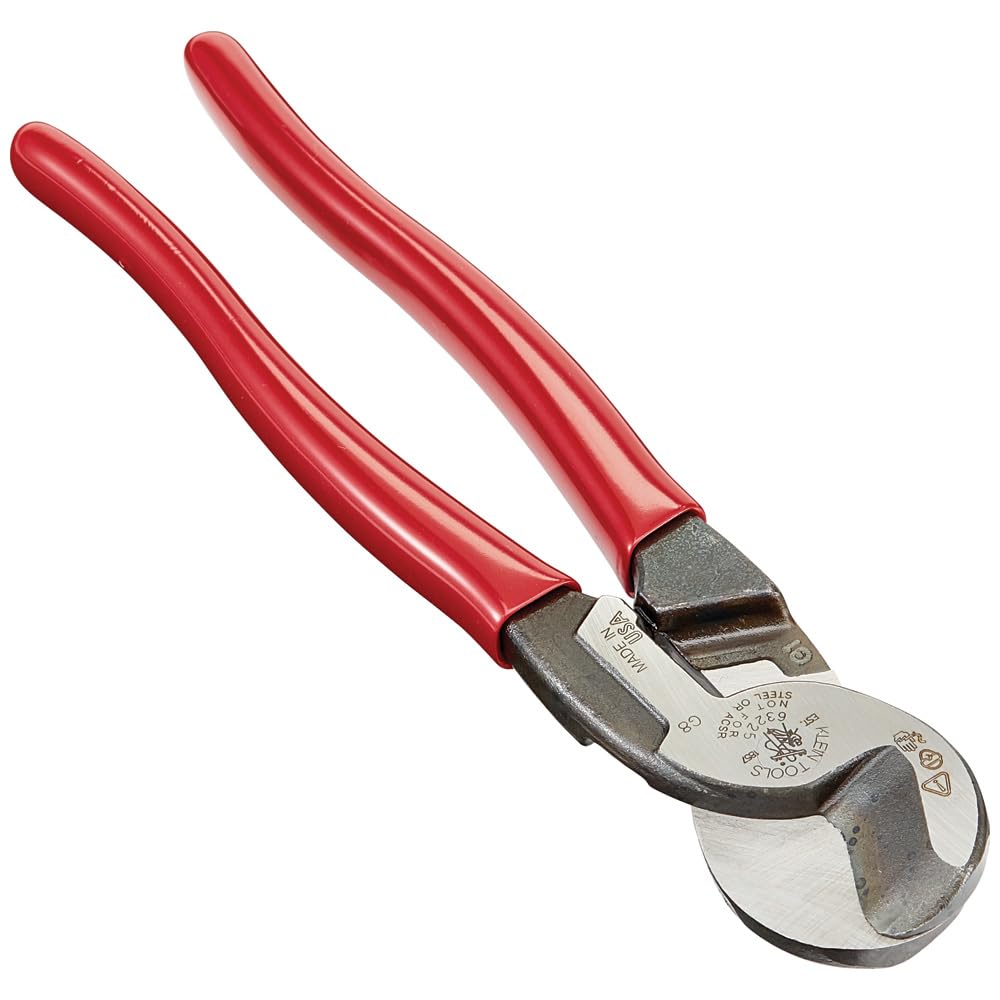
This Klein cutter is the gold standard for a reason: it’s a high-leverage shear cutter that requires 30% less force to cut, because the rivet sits closer to the cutting edge. It handles 4/0 aluminum and 2/0 soft copper with ease, and its cable-gripping, beveled jaws pull the wire into the center for a cleaner, more controlled slice.
The integrated stripping hole is a clever bonus, stripping 1/0 and 2/0 cable, and the dual-material Journeyman handles offer a secure grip without sacrificing durability. It’s built to cut aluminum, copper, and 100-pair communications cable, and the quality is such that it’s the tool buyers report reaching for first for pigtails and fuse box work.
At just 9.3 inches long and 13.12 ounces, it’s compact enough to live in a tool pouch, though the jaws do need to open wide for thick cable—a minor note for those with smaller hands. Buyers consistently praise its sharpness, with phrases like “cuts like butter” and “goes through #4 copper like butter” recurring in the consensus.
Why it wins
- 30% less force needed for thick cuts
- Integrated stripping hole for 1/0 and 2/0
- Shear-type jaws pull cable to center
Keep in mind
- Needs wide handle opening for large gauges
- Not designed for steel or ACSR cable
Reach for this if: you want a professional-grade cutter that makes quick, clean work of battery and welding cable without the slow squeeze of a ratchet.
Look elsewhere if: you have small hands and need to cut the largest service cables, where the wide jaw opening becomes a hassle.
2. TEMCo TH0001
Long-handled shear power that makes 4/0 welding cable feel like soft butter.
The TEMCo TH0001 leans on old-school leverage: 12-inch steel handles with rubber grips give you serious mechanical advantage to drive its forged, precision-ground shear blades through copper and aluminum up to 4/0 gauge. The jaw opens 0.625 inches, which is plenty for most battery and welding cables.
It’s one of the few cutters here specifically recommended for battery and welder cables, building wiring, and SO cord, and a 5-year warranty backs the build. Owners mention slicing through 2/0 welding stranded copper cable “like butter” with a super clean cut, and solar installers praise how it handles 4/0, 1/0, and 6 AWG welding cable cleanly and straight.
There’s an honest warning in the specs: it will not cut 4/0 MTW or similar diameter wire, so check your cable’s exact construction. It’s also smaller than some expect despite the long handles, and the shear action demands two hands for the biggest cuts.
The leverage king: if you want the fastest, cleanest one-slice cuts on welding and battery cable, this is the tool—just be ready to use both hands.
Who it beats: any ratchet cutter on speed, since a single squeeze of the long handles finishes what takes several clicks elsewhere.
The catch: it can’t handle the thickest 4/0 MTW cable, and the size surprises some buyers who expect a larger tool.
3. Klein Tools 63225
A 9-inch precision cutter that slips into tight engine bays and tool pouches alike.
The Klein 63225 is the slightly shorter, more maneuverable sibling to our top pick, designed explicitly for working in confined spaces. It offers the same high-leverage cutting capability for 4/0 aluminum, 2/0 soft copper, and 100-pair communications cable, but its 9-inch frame and 0.43 kg weight make it easier to carry and deploy.
The beveled jaw tips provide proper mating and shearing action, protecting the leading edges from chipping so the cutter stays effective for years. The precision, one-hand shearing action suits auto electricians cutting pigtails for fuse boxes.
Buyers don’t hold back: “best cable cutters you can buy” and “slices through those wires like butter” are typical of the consensus, alongside reliable mentions of clean cuts on larger cables. It’s a premium-feeling tool that justifies its place for anyone who values a compact, dependable cutter.
The compact edge
- Fits most tool pouches for easy carry
- Beveled jaw tips protect the cutting edge
- One-hand shearing action in tight spots
Trade-off
- Shorter handles mean less leverage than the 12-inch TEMCo
- Same 2/0 copper limit as the larger Klein
Grab this if: you work under dashboards or in service vehicles and need a top-tier cutter that doesn’t take up bag space.
Pass if: you routinely cut the biggest 4/0 cables and want maximum handle leverage.
4. BETOOLL J40
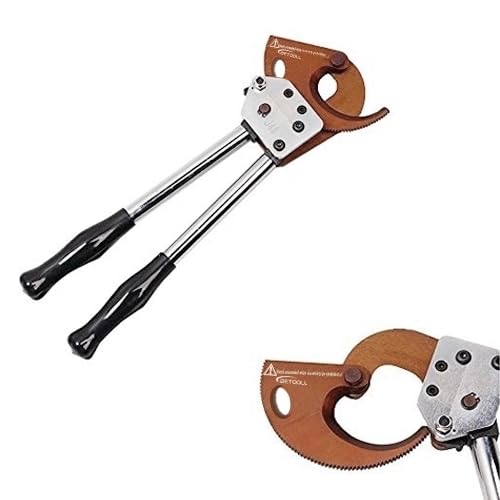
A heavy-duty ratchet that delivers pro-level cuts at a fraction of the price.
The BETOOLL J40 is a top-of-the-range ratchet cutter that uses a J40 300mm² max cutting capacity to handle copper and aluminum cable cores easily. Its 34cm total length and 1.3kg weight put it in the “serious tool” category, and it’s designed to be compact enough to fit in a backpack when you’re on the move.
What wins people over is the cutting performance and value—it cuts through 4/0 welding cable and aluminum 400 MCM with ease, and customers note it replaces expensive alternatives costing and up. The ratchet action clicks 1-2 times per stroke, building leverage so even those with weaker grip strength can slice through #2 and #3 wire without strain.
The ratchet mechanism does get the most negative mentions in the data, with some owners noting the spring can be an issue, although replacements are often sent free. It’s a trade-off: you get massive capability for the money, but you should treat the mechanism with care.
The value pitch
- Cuts 500 MCM cable and 4/0 welding cable easily
- Long handles provide extra leverage
- Heavy-duty build that handles daily use
The mechanism note
- Occasional spring issues reported
- No instructions included for operation
Best for: the working electrician who wants ratchet power without the premium price tag, and needs a tool that survives a backpack.
skip it if: you’d rather have a simpler shear cutter with fewer moving parts to worry about.
5. KF CPTEC KF-325A
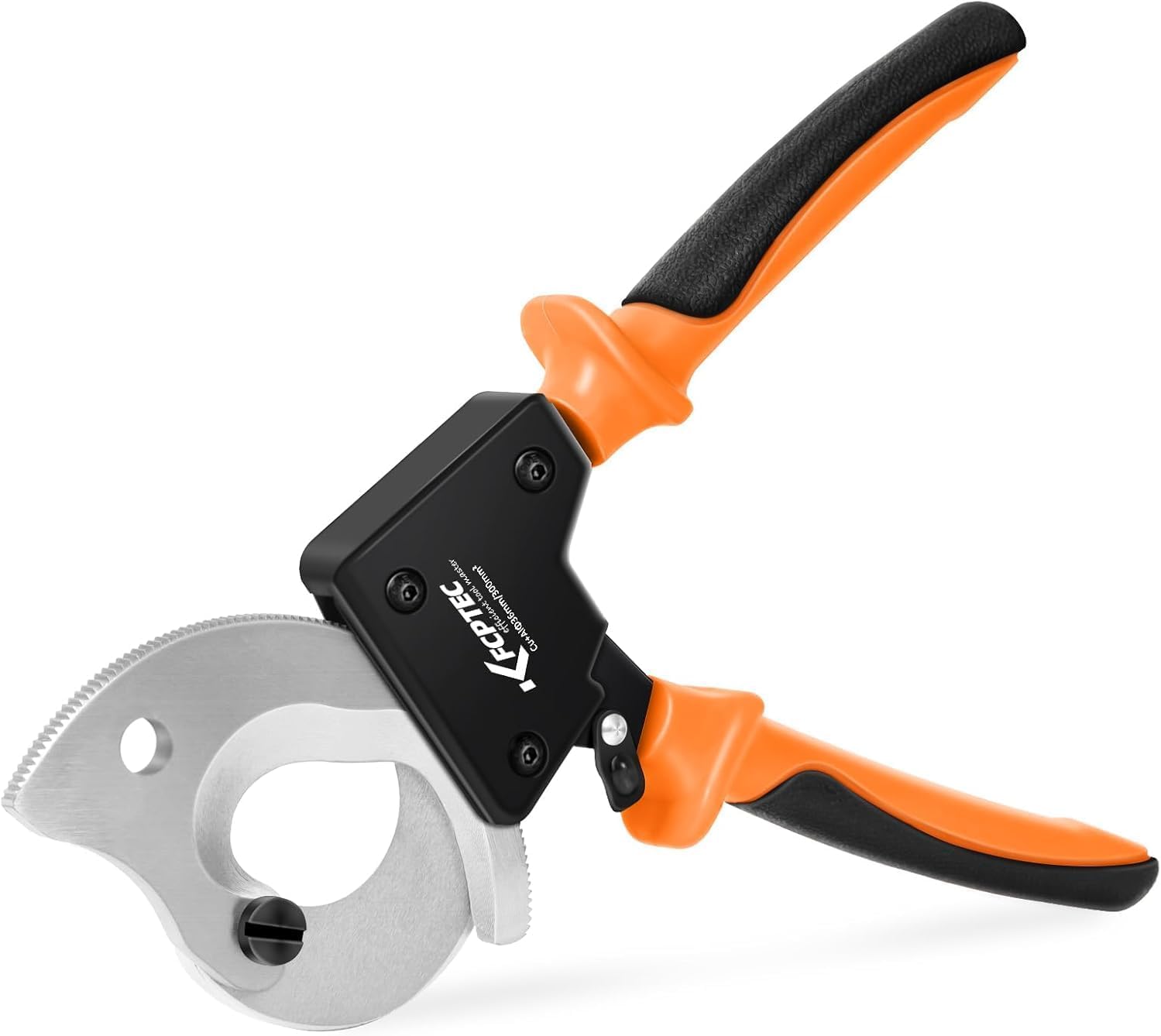
The controlled ratchet that makes 1/0 gauge car audio power wire feel easy.
The KF CPTEC is engineered around a controlled ratchet action: it holds the cable in position while advancing the blade step-by-step, giving you better control and reducing effort with each handle movement. It handles copper and aluminum up to 300mm² (600 MCM), and its 644-gram weight keeps it manageable for extended use.
The blade is heat-treated steel with a chrome-plated surface to resist wear and corrosion, and the curved cutting profile supports cleaner cuts with less conductor flattening. This is a big deal for car audio installers who need precise cuts on 1/0 gauge power wire to avoid damaging strands.
Buyers using it for car audio report cutting 1/0 gauge “like butter” and using it around 32 times without any loss of performance. Others use it successfully on 2-2-2-4 SER cable and 3/0 copper, noting it’s a solid value, though the large grip means two-handed operation for most users.
Safety-first design: the quick-release lever and handle lock keep the blade closed for safer toolbox storage, a feature many budget cutters skip.
Reach for this if: you install car audio or work with 1/0 gauge power wire and want a clean, controlled cut every time.
Note: the large grip is awkward for one-handed use, and the plastic storage case can arrive damaged in shipping.
6. Sanuke SE-H325A

A fast-ratchet worker that proves budget tools can still handle serious cable.
The Sanuke cutter is built around a fast ratchet mechanism that makes easy, clean, labor-saving cuts on copper and aluminum. It cuts copper cable up to 300 MCM and aluminum up to 600 MCM (about 240mm²), making it a capable tool for #2 copper stranded through 1/0 underground wire.
The jaws are heat-treated carbon steel with induction-hardening for strength, and the PVC non-slip handle keeps a firm grip in your palm. It’s a compact design that reviewers point out works well one-handed in tight spaces, and it’s genuinely praised for cutting sizes from 6 AWG to 3/0 without much effort, with clean cut lines.
The honest trade-off is in the durability data: some shoppers say parts falling out over time, and the blade can crush wire when trimming very short pieces off, causing jams. For mid-length cuts on recycling or service work, it’s a bargain; for fine trimming work, it’s not the tool.
Budget strength
- Cuts 1/0 and 2/0 cable with one hand
- Induction-hardened jaws for durability
- Very sturdy for the price point
Watch out for
- Reports of parts falling out over time
- Dull blades can crush wire on short trims
Best for: the DIYer or recycler who needs to snip large bundles into manageable sections without spending much.
Avoid if: you plan to trim short pieces repeatedly, since that’s where this design jams.
7. LUBAN DLJ-HS325A

A Germany-designed ratchet that’s more compact than the big-name brands yet just as capable.
The LUBAN HS-325A uses a high transmission ratio in its ratchet mechanism, meaning very little hand force is required to drive the blade through copper and aluminum single conductors up to 240mm². It’s designed for one-hand operation and can be used even in confined areas thanks to its lightweight, compact body.
The blade is high-grade special tool steel, forged and oil-hardened for durability, and an anti-slip rubber hand guard offers a secure grip. A unique ratchet driving unit holds the cable tight and allows rapid, straight cuts with minimum effort, while a hold-open spring design speeds up the cutting action.
Electricians in the reviews call it “legit” and “excellent for the money,” noting it cuts 4/0 AL SER cable easily and is more compact than well-known brands. The fast ratchet means you’ll squeeze more times per cut than some might like, but the trade-off is a tool that works faster than more expensive options on battery cables.
Compact power: if you’re cutting battery cables of various sizes in tight spots, this one-hand ratchet is a safe and very effective choice.
Who it fits: electricians who want a compact ratchet that disappears in a bag but still cuts 4/0 cable.
The quirk: you’ll squeeze more times per cut than with a longer-lever shear, and steel wire is strictly off-limits.
8. HKS Cutter 36D

The lightweight ratchet that pays for itself in a single mobile repair job.
The HKS cutter brings a 1000-volt insulated handle to the table, a safety feature most budget ratchets skip, and it handles copper and aluminum single conductors and multi-strand cables up to 300mm² (600 MCM). At just 0.76 kg, it’s among the lighter ratchets here, and its compact design is built for tight spaces.
The ratchet driving unit provides rapid, straight cuts with minimal effort thanks to a high transmission ratio. For a mobile RV repair company, this tool “paid for itself numerous times” according to the review data, because of how quickly and easily it cuts through electric cables.
It’s a budget-friendly alternative to premium brands that cuts 2/0-3/0 copper THHN for solar installs, though the finish wears with use and minor edge damage appears on large gauge cuts—so it’s not meant for daily professional abuse. Keep it oiled and use it for what it is: a highly capable, affordable workhorse.
Safety plus value
- 1000V insulated handle for added safety
- Very lightweight at 0.76 kg for easy handling
- One-hand operation cuts through large cables fast
Durability note
- Finish wears down and edge can chip on big gauges
- Not built for daily heavy pro use
Grab this if: you’re an RV tech, solar installer, or mobile repair person who needs a capable cutter that won’t weigh down your kit.
Think twice if: you’re a production electrician cutting cable all day, every day—this is a great tool, but not that kind of tool.
9. INNETOC IT323H

The highest-capacity ratchet here, built to open wide for 200 amp SEU service cable.
The INNETOC IT323H is the largest-capacity cutter in this lineup, with a lock ratcheting design rated for 400mm² max—meaning it can handle the biggest copper and aluminum service entrance cables you’ll find. The forging blade and high-carbon steel construction are built to last, and at 2 pounds, it has a reassuring heft without being a burden.
Its defining feature is the safety lock that holds cable tightly, so you don’t need to hold the wire with your hands while cutting. The anti-slip rubber hand guard provides a secure grip, and the ratchet structure is compact enough for tight areas despite its large 11-inch frame.
Electricians in Massachusetts doing residential service changes, cutting wires from 2 AWG to 400 kcmil, report it opens large enough to cut a 200 amp SEU cable with no problem. The recurring gripe is the pivot bolt, which tightens during use and needs occasional loosening—a simple maintenance step but a real one.
Big cable power
- Opens wide for 400mm² and 200 amp SEU cable
- Safety lock holds wire so you don’t have to
- High-carbon steel blade stays sharp
Maintenance needed
- Pivot bolt tightens during use and needs loosening
- Durability is the most-cited concern in the data
Choose this if: you regularly tackle the largest residential service cables and want a tool that opens wide enough to fit around 200 amp SEU.
pass on it if: you want a set-and-forget tool; this one asks for a little wrench attention now and then.
Understanding the Specs
mm² and MCM Ratings
These numbers tell you the thickest cable the cutter can handle. MCM (thousands of circular mils) and mm² (cross-section in square millimeters) are two ways to measure the same thing—a 600 MCM cable is roughly 300mm². Match this rating to your thickest battery or welding cable, and don’t exceed it, or you’ll crush the wire and damage the blade.
Shear vs. Ratchet Mechanisms
A shear cutter uses long handles and a scissor-like pivot for a single, fast slice—best for speed when you have two hands free. A ratchet cutter clicks the blade through the cable with each squeeze, multiplying your hand force so you can cut massive conductors one-handed, but each cut takes several squeezes. Your choice is speed versus raw capability and one-hand convenience.
Blade Material and Heat Treatment
The blade’s steel and how it’s hardened determine how long it stays sharp. Look for terms like “forged,” “heat-treated,” “oil-hardened,” or “induction-hardened” carbon or tool steel—these processes prevent the edge from rolling over or chipping on tough copper. Chrome plating adds corrosion resistance. A cheap, soft blade will crush strands instead of slicing them cleanly.
Handle Length and Grip
Longer handles give you more leverage, which means less force needed per cut—great for shear cutters. But they’re harder to maneuver in tight engine bays or service vehicles. Cushioned, non-slip grips (rubber, PVC, or dual-material) reduce hand fatigue on long jobs. Consider your typical work environment: a 12-inch shear is powerful but bulky, while a 9-inch ratchet fits in tight spots.
FAQ
Will these cutters work on live battery cables?
What size battery cable do most of these cutters handle?
Why does my cutter crush the wire instead of cutting it cleanly?
Are shear cutters or ratchet cutters better for car audio installs?
Can I cut steel wire or armored cable with these tools?
How do I maintain a ratchet cable cutter to make it last?
What is the difference between the two Klein Tools cutters in this guide?
Is a 4/0 gauge cutter big enough for welding cable?
Final Thoughts: The Verdict
If you want one dependable pick, the Klein Tools J63225N tops the list because it combines the fastest shear action with professional-grade quality and a stripping hole—it holds a 4.8-star rating from hundreds of owners. If you want maximum leverage for the quickest cuts on welding cable, the TEMCo TH0001 with its 12-inch handles is the one to reach for. For one-handed ratchet power in tight spaces, the KF CPTEC delivers controlled, clean cuts on car audio power wire while staying affordable.
How We Picked
We do not accept paid placement. Every pick is matched to a real buyer and a real use-case; we do not hands-on test units.
Sources & Methodology
Specifications: manufacturer listings and product documentation. Review insights: verified customer reviews, as of August 2026. Pricing: not shown on this page (it changes often); check the current price via the retailer link.
As an Amazon Associate, Gadgets Feed earns from qualifying purchases. This does not affect which products we feature.