
If you need to capture a subject standing fifty yards away and still see the expression on their face, the zoom range of your camcorder is the only spec that matters. Digital zoom crops into pixels until the image falls apart; optical zoom moves glass to keep every detail intact. That difference separates a watchable family video from a blurry disappointment, especially when the action is happening far from your lens.
I’m Min — the co-founder and writer behind Gadgets Feed. I’ve spent hundreds of hours cross-referencing sensor size, optical reach, stabilization systems, and low-light performance across dozens of camcorder models to identify which ones actually deliver usable footage at their maximum focal length.
A real buyer needs a camcorder with zoom that keeps the image stable and sharp when the lens is fully extended, because a long zoom without effective stabilization produces footage that is unwatchable on any screen.
How To Choose The Best Camcorder With Zoom
The zoom specification on a camcorder can be misleading. A camera might claim a massive number like 250x digital zoom, but that figure means nothing if the footage turns into a pixelated mess beyond 20x or 30x. The real benchmark is optical zoom, which uses the lens to magnify light before it reaches the sensor. Digital zoom simply enlarges the recorded image, reducing resolution at every step. For any serious shooting at a distance, you want the highest optical zoom number you can afford, paired with a stabilization system that can counter the natural shake that becomes obvious at high magnification.
Optical Zoom Magnification
Every camcorder in this guide prioritizes optical zoom. The range runs from 12x on an entry-level model to 40x on several bridge-style cameras and 20x on premium 4K units. A 20x optical zoom covers most outdoor events, sports, and wildlife scenarios. A 40x optical zoom draws in subjects that are over a hundred feet away and still produces a recognizable, detailed face. The key trade-off is that longer zoom lenses are physically larger and often require a tripod for rock-steady results at maximum magnification — handheld footage at 40x will show micro-movements unless the camcorder has a very effective gimbal stabilizer.
Image Stabilization Type
There are two main stabilization approaches in this category: optical image stabilization (OIS) and electronic image stabilization (EIS). OIS physically moves lens elements to compensate for hand shake. EIS crops into the sensor and shifts the frame digitally. Optical stabilization is generally superior for zoomed shooting because it preserves full resolution. Some premium camcorders now include a gimbal-like mechanical stabilizer that floats the entire lens assembly — this is the most effective solution for long zoom handheld shots, but it adds cost and slight weight. For most buyers, OIS with 3-axis or 5-axis correction is the sweet spot for balancing zoom reach with usable handheld footage.
Sensor Size and Low-Light Performance
Zooming in reduces the amount of light reaching the sensor. A camcorder with a larger physical sensor, such as a 1-inch CMOS, gathers more light than a standard 1/2.3-inch sensor. That extra light translates to cleaner, less noisy footage when you are fully zoomed in during golden hour, indoor events, or overcast days. The sensor size also affects the depth of field — a larger sensor can blur the background behind your zoomed subject, producing a more professional look. Entry-level and mid-range models typically use 1/2.3-inch or 1/3-inch sensors, while premium units may use 1-inch sensors that deliver visibly richer zoomed video in challenging light.
Audio Capture Capability
A long zoom lets you get close to the action visually, but the built-in microphone will still pick up sound from your position, not from the subject. If you are shooting a performance, interview, or wildlife scene from a distance, the camcorder’s audio quality matters less than its ability to accept an external microphone. Look for a 3.5mm microphone input jack — this allows you to attach a shotgun or lapel mic that captures clear audio from the source, independent of your zoom position. Some specialized models include XLR inputs with phantom power for professional-grade multi-track recording, which is a rare feature that justifies the premium tier for music and broadcast use.
Quick Comparison
On smaller screens, swipe sideways to see the full table.
| Model | Category | Best For | Key Spec | Amazon |
|---|---|---|---|---|
| Canon VIXIA HF G70 | Premium | Professional 4K with livestreaming | 20x optical zoom, 1/2.3” CMOS | Amazon |
| Sony FDR-AX43 | Premium | Gimbal-stabilized 4K zoom | 20x optical zoom, Balanced OIS | Amazon |
| Xtra Muse Pocket Gimbal | Mid-Range | Vlogging and smooth walking shots | 1” CMOS, 4K/120fps, 3-axis gimbal | Amazon |
| Zoom Q8n-4K | Mid-Range | Multi-track audio and music recording | 150° wide lens, 2x XLR inputs | Amazon |
| Canon VIXIA HF R600 | Mid-Range | Budget-friendly entry-level camcorder | 57x advanced zoom, 3” touchscreen | Amazon |
| Minolta MN40Z | Value | Long-distance outdoor photography | 40x optical zoom, Wi-Fi sharing | Amazon |
| Kodak PIXPRO AZ405 | Value | Travel-friendly still photography | 40x optical zoom, AA battery power | Amazon |
| ORDRO AX65 | Budget | Beginners wanting 4K and extras | 12x optical zoom, 64GB kit included | Amazon |
| Zoom Q2n-4K | Budget | Musicians recording performances | 150° wide lens, X/Y stereo mics | Amazon |
In‑Depth Reviews
1. Canon VIXIA HF G70 Camcorder

The Canon VIXIA HF G70 is built around a 1/2.3-inch 4K UHD CMOS sensor paired with a DIGIC DV6 processor, delivering sharp 4K30 footage with a powerful 20x optical zoom lens. The 8-blade aperture produces a natural cinema-style bokeh when zoomed in on a subject, which is uncommon at this price tier. The Hybrid AF system locks onto faces quickly, and users report excellent outdoor color saturation during daylight hours.
This camcorder supports UVC livestreaming at 1080p directly to a computer, which makes it a versatile tool for live events without needing a separate capture card. The dual SD card slots allow uninterrupted recording — when one card fills, the camera switches to the second. Build quality feels solid, and the lens hood with barrier protects the front element during transport. The physical zoom rocker provides smooth, variable-speed control that feels precise even at maximum reach.
On-screen display time stamp recording is a niche but essential feature for legal, educational, and event documentation where proof of recording time matters. The main limitation is low-light performance — reviews indicate that gain above 4 dB introduces visible noise, and above 10 dB the image becomes soft. For indoor work without controlled lighting, an external light source is recommended. The HDMI output is capped at 1080p, which is fine for monitoring but prevents 4K external recording.
Why it’s great
- 20x optical zoom holds sharpness at full extension with Hybrid AF face tracking.
- UVC livestreaming at 1080p works with a single USB cable — no capture card needed.
- Dual SD card slots enable hot-swap recording for long events.
Good to know
- Low-light performance degrades noticeably above 4 dB gain; needs supplemental lighting indoors.
- HDMI output is limited to 1080p, not 4K pass-through.
- The gimbal stabilization is mild — a tripod is still safest for fully zoomed handheld shots.
2. Sony FDR-AX43 UHD 4K Handycam

The Sony FDR-AX43 uses a 1/2.5-inch Exmor R CMOS sensor combined with a BIONZ X processor to produce true 4K video at 30 fps. Its standout feature is the Balanced Optical SteadyShot stabilizer, a built-in gimbal that physically floats the lens assembly. This technology makes handheld 20x optical zoom footage remarkably stable — the camera compensates for walking, panning, and moderate hand shake without the artificial crop of electronic stabilization. The 26.8mm wide-angle ZEISS Vario-Sonnar T lens also provides a generous field of view for wide establishing shots before zooming in.
The Clear Image Zoom extends the reach to 30x in 4K and 40x in HD using pixel interpolation that preserves more detail than standard digital zoom. Fast Intelligent AF continuously tracks subjects during zooming, which prevents the focus hunting that plagues slower camcorders. The camera supports Wi-Fi and NFC for remote control via a smartphone app, and it can operate while charging via a USB/DC connection, ideal for long stationary shoots like stage performances or speeches.
A recurring user observation is the large battery that protrudes from the rear — it extends the total body length and can feel awkward when mounted on a selfie stick. The date/time settings reset quickly after the battery is removed, which is a minor inconvenience for users who swap batteries often. The camcorder has no internal memory, so a U3-rated SD card is mandatory for 4K recording. Sony claims 250x digital zoom, but for usable results, optical and Clear Image Zoom are the only modes worth considering.
Why it’s great
- Balanced Optical SteadyShot delivers gimbal-like stabilization at 20x zoom handheld.
- Clear Image Zoom extends to 30x in 4K without the pixelation of standard digital zoom.
- Fast Intelligent AF keeps subjects in focus during zoom pulls and panning.
Good to know
- Protruding rear battery increases total length; may feel unbalanced on compact tripods.
- No internal memory — a Class 10 U3 SD card is required before first use.
- Date/time resets quickly after battery removal, requiring re-entry each swap.
3. Xtra Muse Vlogging Camera with 1” CMOS

The Xtra Muse packs a 1-inch CMOS sensor — physically larger than everything else on this list — into a pocket-sized body with a built-in 3-axis gimbal. The larger sensor captures significantly more light, producing clean 4K footage at 120fps even in twilight conditions. The gimbal stabilizer eliminates the micro-jitters that plague optical stabilization on longer walks or while running, making it ideal for active vloggers and travel creators. Face and object tracking keep the subject centered frame-to-frame during zooms and movements.
The 2-inch touchscreen flips between horizontal and vertical orientation physically, which suits creators who post to both YouTube and TikTok without cropping. True 10-bit X-Log color grading supports a billion colors for professional post-production. The standard bundle includes a carrying bag, wrist strap, and a handle with a 1/4-inch thread for tripod mounting. Users consistently report that video sharpness and gimbal smoothness rival devices costing twice as much, and the compact form factor fits in a jacket pocket.
The 1-inch sensor does not offer the extreme optical zoom range of bridge cameras — the lens is wide-angle with no physical zoom ring. For pure zoom performance, this is not the right tool. Battery life runs around 161 minutes of continuous recording, which is good for a gimbal camera but may require a midday charge on all-day shoots. The Micro SD card slot accepts C10 and U3 cards; the camera does not support full-size SD cards.
Why it’s great
- 1-inch CMOS sensor delivers exceptional low-light performance and 4K/120fps video.
- 3-axis gimbal stabilizer produces smooth footage during walking, running, and panning.
- 10-bit X-Log color grading offers professional flexibility in post-production.
Good to know
- No optical zoom lens — this is a fixed wide-angle camera for close-to-medium range.
- Battery life of ~161 minutes may require midday charging for full-day events.
- Micro SD card only; full-size SD card users will need an adapter.
4. Zoom Q8n-4K Video Recorder

The Zoom Q8n-4K is designed around four-track audio recording — two built-in stereo microphones plus two XLR inputs with phantom power. This makes it the only camcorder on this list that can simultaneously record a vocal microphone, a guitar DI, a lapel mic, and room ambience into separate tracks. The 150-degree wide-angle F2.8 lens captures expansive stage views, and the five field-of-view presets (indoor, outdoor, nighttime, concert, and auto) adapt the exposure to different lighting conditions. It records 4K video at 30fps and streams live via USB while recording locally to an SD card.
The swappable microphone capsule system allows you to change the audio character depending on the shoot — a cardioid capsule for interviews or a bidirectional capsule for duets. The flip-out touchscreen and companion remote control app make solo operation manageable. For musicians, podcasters, and documentary shooters who prioritize audio quality over extreme zoom range, the Q8n-4K is unmatched. Users in professional media production praise its audio functionality and the reliable connection of pro-grade XLR gear.
Video quality is the compromise here. The 1/2.3-inch sensor produces usable 4K in well-lit conditions, but it becomes grainy in low light, and there is no optical zoom at all — only fixed wide-angle fields of view. Reviewers note that an iPhone can shoot better video in dim environments. The single battery provides around 70 minutes of recording, so a spare is essential for full sessions. This is a purpose-built tool for audio-first capture, not a general-purpose zoom camcorder.
Why it’s great
- Dual XLR inputs with phantom power for professional multi-track audio recording.
- Swappable capsule system adapts the microphone pattern to the shooting scenario.
- Records 4K video while streaming live and logging to SD simultaneously.
Good to know
- No optical zoom — exclusively fixed wide-angle field of view.
- Low-light 4K video is grainy; this is an audio-first device.
- Battery life is approximately 70 minutes; carry spares for long sessions.
5. Canon VIXIA HF R600 Full HD Camcorder

The Canon VIXIA HF R600 is a renewed Full HD camcorder that offers a 57x advanced zoom — the highest zoom number on this list — from a trusted brand at a mid-range price point. The 3-inch capacitive touchscreen provides intuitive menu navigation and tap-to-focus functionality. It includes both a microphone input and a headphone jack, which is rare at this level and essential for anyone doing interviews or live sound monitoring during recording. The tripod screw mount on the bottom is standard, but the R600 also has a handheld grip mount point on the side, making it versatile for both tripod and run-and-gun setups.
Video quality is solid 1080p HD. It is not a 4K camera, but for users who are producing content for social media, school projects, or personal archives, 1080p at 60fps is still the most widely compatible format. The 57x advanced zoom uses a combination of optical and digital processing — Canon does not break out the pure optical figure in official specs, but user reports indicate the optical range is around 32x with digital extension to 57x. The touchscreen auto-adjusts exposure and focus quickly, and the zoom rocker has a smooth variable-speed feel.
The screen is difficult to see in direct sunlight; some users have improvised a cardboard hood to shade it. As a renewed product, cosmetic condition varies — some units arrive with scratches or without the original manual. The camera uses SD memory cards and does not include one in the box, so factor that into your budget. Build quality is light plastic, and it is not designed to survive drops. For the price, it is a capable entry-level camcorder with impressive zoom reach for its class.
Why it’s great
- 57x advanced zoom provides impressive reach for sports and outdoor events at this price.
- Microphone input and headphone jack for clean audio control.
- Touchscreen interface with smooth variable-speed zoom rocker.
Good to know
- Screen is nearly unusable in bright sunlight without a shade hood.
- Renewed condition varies — inspect carefully upon arrival for scratches.
- No 4K recording; limited to Full HD 1080p video.
6. Minolta MN40Z 20MP Digital Camera

The Minolta MN40Z delivers a true 40x optical zoom — meaning each magnification step uses actual lens movement, not digital cropping. At full 40x extension, you can capture wildlife, moon craters, or distant performers with enough detail for prints and social shares. The 20MP sensor records 1080p Full HD video at 30fps, which is sufficient for standard viewing and editing. Built-in Wi-Fi enables instant photo transfer to a smartphone and remote control shooting, which is especially useful for group portraits or time-lapses where touching the camera would introduce shake.
Face, smile, and blink detection assist in framing portraits and reducing missed shots. The 3-inch LCD display provides a clear live view and playback, and the camera supports SD/SDHC/SDXC cards up to 512GB. The body is compact and lightweight, making it easy to carry on hikes or to the stadium. Users consistently praise the 40x optical zoom as the primary reason to buy — it delivers recognizable detail on subjects that would be tiny specks with a typical smartphone camera.
The autofocus system is adequate but slow for fast-moving subjects — birds in flight and athletes in motion may require pre-focusing or continuous shooting to capture the right moment. The image stabilizer is optical but does not fully eliminate shake at 40x handheld; a monopod or tripod significantly improves success rate at maximum zoom. Low-light performance is acceptable in daylight but deteriorates indoors, with increased noise above ISO 800. The camera uses AA batteries, which is convenient for travel but means carrying spares for all-day shoots.
Why it’s great
- True 40x optical zoom captures clean detail on distant subjects.
- Built-in Wi-Fi enables wireless image transfer and remote shutter control.
- Compact body and AA battery power are ideal for travel.
Good to know
- Autofocus is slow — not ideal for fast-moving wildlife or sports action.
- Optical stabilizer helps but tripod is recommended for 40x handheld shots.
- Low-light image quality declines noticeably indoors or after sunset.
7. Kodak PIXPRO AZ405-WH 20MP Digital Camera
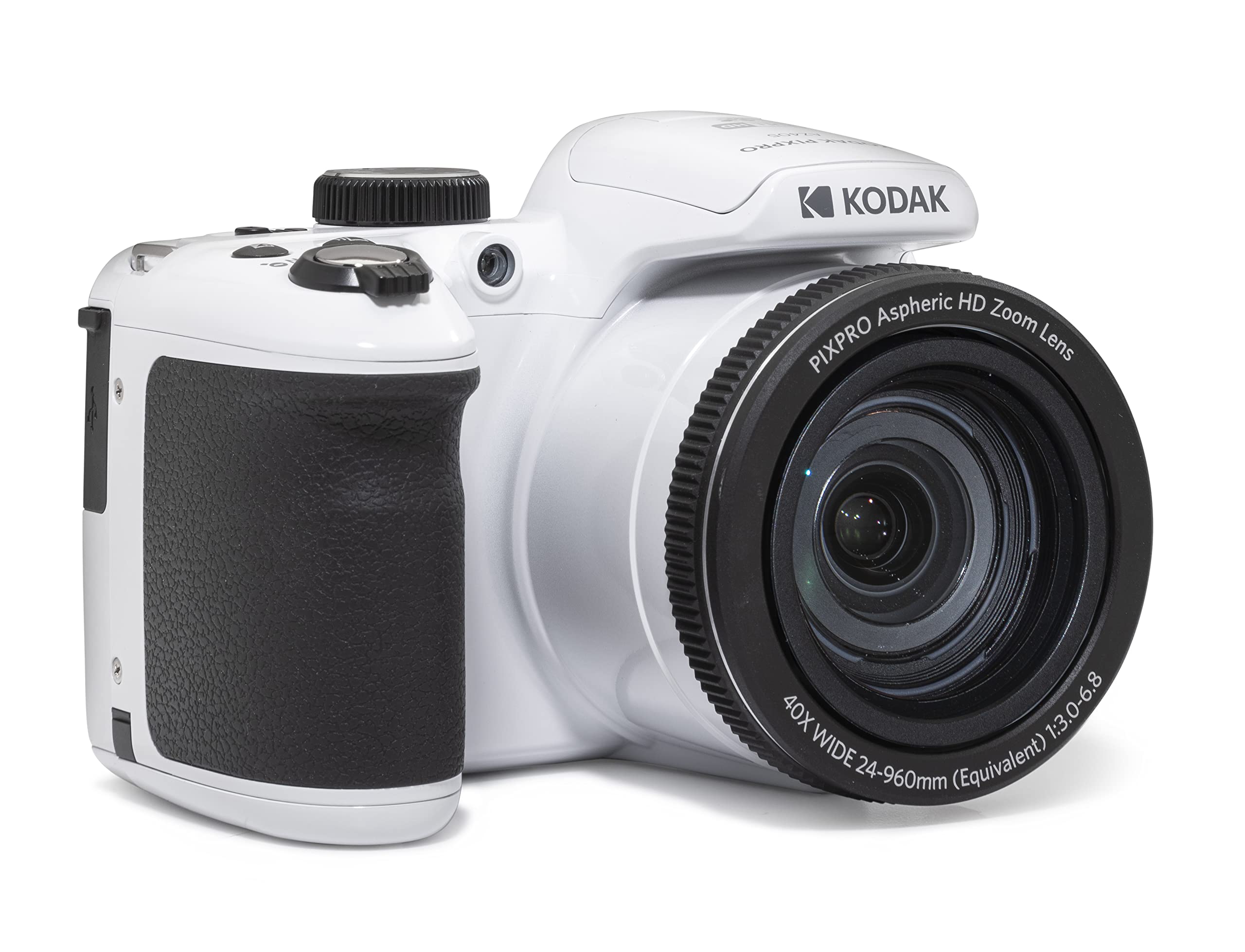
The Kodak PIXPRO AZ405 combines a 40x optical zoom with a 24mm wide-angle lens, letting you switch from sweeping landscape shots to extreme close-ups without changing lenses. The 20MP sensor delivers detailed JPEG files straight out of camera, and optical image stabilization reduces blur at full zoom. The bridge camera design feels like a traditional DSLR but with a fixed lens, providing a comfortable grip and a large zoom ring for manual control. Automatic scene detection selects the appropriate shooting mode for portrait, landscape, night, and sports scenarios without requiring menu diving.
Power comes from standard AA batteries, which is a deliberate design for travelers who may not have access to charging outlets on safaris, cruises, or remote road trips. You can buy alkaline or lithium AAs at any convenience store worldwide. The camera supports Class 10 SD, SDHC, and SDXC cards up to 512GB. Full HD 1080p video recording captures smooth travel clips, and the 3-inch LCD provides live composition. The Kodak imaging heritage shows in the color science — images have a warm, consumer-friendly tone that requires minimal editing.
Several user complaints center on battery drain — some units get only 17 to 27 photos per set of fresh alkalines. Rechargeable NiMH AAs improve this significantly, but the camera is power-hungry. Removing the SD card sometimes resets the settings, requiring reconfiguration of the date, time, and shooting parameters. A small number of users report system lockups that require battery removal to clear. These issues are inconsistent, but they point to quality control variability at this price point. For the planned, patient shooter with spare batteries, the AZ405 provides exceptional zoom reach.
Why it’s great
- 40x optical zoom with 24mm wide-angle covers a massive focal range.
- AA battery power eliminates proprietary charger dependency during travel.
- Optical image stabilization reduces blur at extended zoom lengths.
Good to know
- Battery drain is high — some users report less than 30 photos per AA set.
- Removing the SD card can reset camera settings.
- Intermittent lockups reported; quality control varies.
8. ORDRO AX65 4K Camcorder
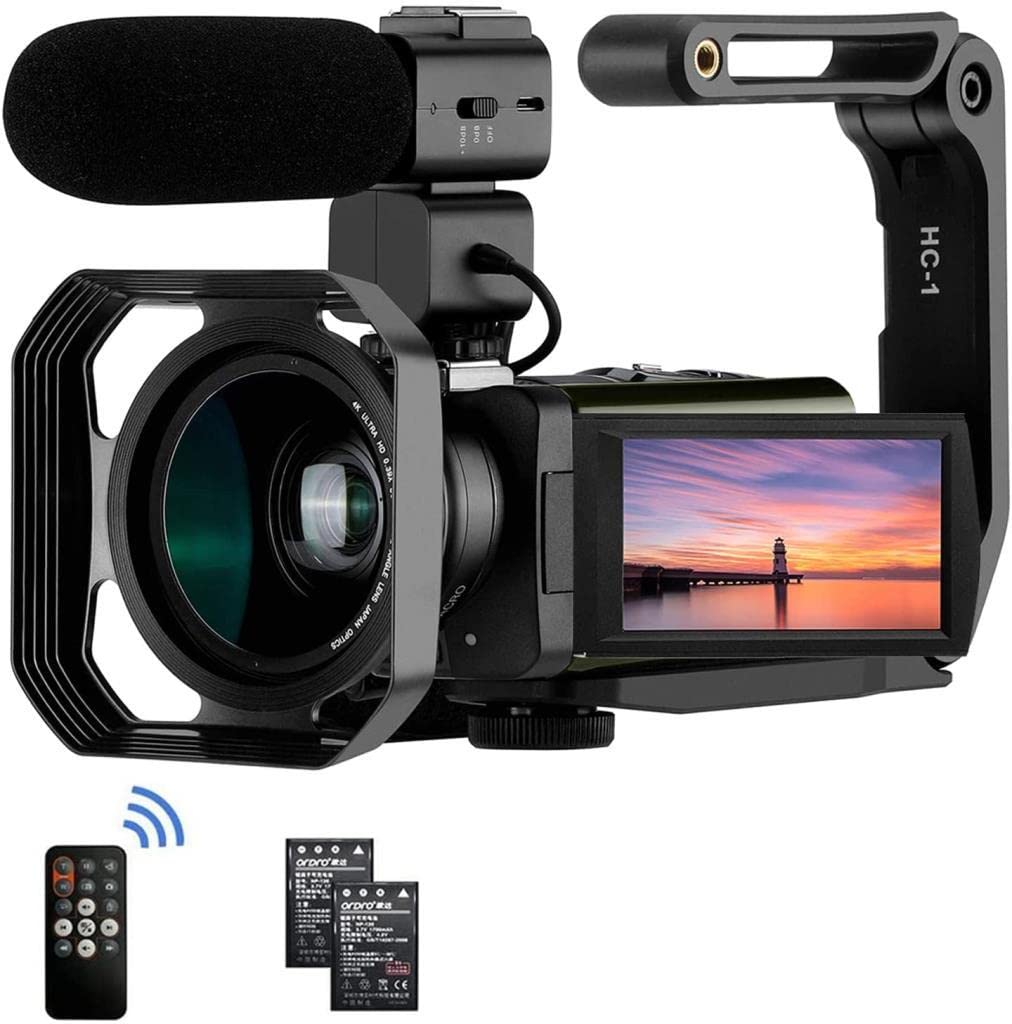
The ORDRO AX65 is a full-featured 4K camcorder that bundles everything a beginner needs: two rechargeable batteries, an external microphone, a wide-angle lens, a macro lens, a remote control, a card reader, and a 64GB SD card, all in the box. The 12x optical zoom provides enough reach for kids’ recitals and outdoor events, and the 100x digital zoom is available for emergency distance, though image quality drops sharply past the optical limit. The 3.5-inch IPS touchscreen with 270-degree rotation allows selfie framing and low-angle shooting.
A Sony 1/3-inch CMOS sensor improves low-light performance compared to generic sensors, and the anti-shake feature smooths handheld footage. The AX65 doubles as a UVC webcam for livestreaming to YouTube or Zoom with a single USB connection. Creative modes include time-lapse with intervals from 1 second to 30 minutes, loop recording, and continuous photo shooting. The hot shoe mount accepts an external fill light, and the included external microphone captures cleaner audio than the internal mic.
Image quality has variability. In good daylight, 4K at 24fps produces sharp, colorful footage. In lower light, brightness and color can shift noticeably, and the camera struggles with automatic white balance consistency. The 2.2F lens is wide enough, but the aperture range is limited — at full zoom, the effective aperture narrows, reducing light capture. Some users report that the camera develops a loud electronic croak sound in video after a year of storage, and the seller support can be inconsistent. For the price of the all-in-one kit, it is an excellent learning tool with a generous accessory package.
Why it’s great
- Comprehensive kit includes lenses, microphone, remote, and 64GB SD card.
- 12x optical zoom with Sony sensor provides decent 4K video in good light.
- UVC webcam mode allows direct livestreaming without extra hardware.
Good to know
- Color and exposure shift unpredictably in non-ideal lighting conditions.
- 100x digital zoom is unusably pixelated beyond optical range.
- Some units develop audio artifacts after extended storage; reliability is inconsistent.
9. Zoom Q2n-4K Handy Video Recorder

The Zoom Q2n-4K is a niche device designed specifically for recording live performances, rehearsals, and musical events where audio quality is the top priority. Its built-in X/Y stereo microphones can handle sound pressure levels up to 120 dB SPL without distortion, meaning you can place it in front of a drum kit or a cranked guitar amp and still get clean, phase-coherent stereo audio. The 150-degree wide-angle lens captures the full stage or ensemble, and HDR video processing preserves detail in the shadows and highlights of contrasty stage lighting. It records in 4K at up to 30fps and in HD at 1080p60.
Twelve scene presets optimize the camera for different lighting environments, and the auto setting works well for quick setup. The bundled 32GB memory card, tabletop tripod, and AA NiMH battery charger make the kit ready to use out of the box. The Q2n-4K is small enough to place on a music stand or a tabletop without obstructing sightlines. For musicians reviewing their own performances or educators recording demonstrations, the combination of high-SPL mics and 4K video in one device is uniquely practical.
Video quality is acceptable but not class-leading — it is described as “good” and “decent” by users, not outstanding. The lens is fixed wide-angle with no zoom, so the Q2n-4K is useless for distant subjects. The AA battery configuration requires four cells and there is no included power adapter — several users expressed frustration at the lack of a wall charger in the box. There is no Wi-Fi or Bluetooth connectivity, so file transfer requires removing the SD card or connecting via USB. This is a single-purpose tool that excels at its specific mission and should only be considered if your primary need is high-quality audio capture alongside wide-angle video.
Why it’s great
- X/Y stereo mics handle 120 dB SPL without distortion — ideal for loud music.
- 150-degree wide-angle lens captures full stage or ensemble in one frame.
- HDR video preserves shadow and highlight detail in contrasty stage lighting.
Good to know
- No optical zoom — fixed wide-angle lens only.
- No power adapter included in the box; requires AA batteries.
- No Wi-Fi or Bluetooth — files must be transferred via SD card or USB cable.
FAQ
What is the difference between optical zoom and digital zoom on a camcorder?
How much optical zoom do I need for wildlife and sports recording?
Does image stabilization matter when using a camcorder with high zoom?
Can I use a camcorder with zoom for livestreaming?
What type of memory card do I need for 4K zoom recording?
Final Thoughts: The Verdict
For most users, the camcorder with zoom winner is the Sony FDR-AX43 because its Balanced Optical SteadyShot stabilizer delivers gimbal-like smoothness at 20x optical zoom without adding bulk, and the Clear Image Zoom extends that reach to 30x in 4K without sacrificing usability. If you need professional 4K zoom with livestreaming and dual SD slots, grab the Canon VIXIA HF G70. For the purest zoom reach at a value price, the Minolta MN40Z with its true 40x optical zoom is the budget-conscious choice that still delivers recognizable detail at extreme distances.