
That mid-afternoon brain fog, the stuffy feeling in your bedroom after a long night, or the nagging cough that won’t quit could all trace back to one thing: the air you’re breathing. An air monitor pulls back the curtain on your indoor environment, giving you real-time data on invisible pollutants like fine dust (PM2.5), carbon dioxide (CO₂), volatile organic compounds (VOCs), and formaldehyde so you can stop guessing and start fixing.
I’m Min — the co-founder and writer behind Gadgets Feed. I’ve spent countless hours combing through technical datasheets and cross-referencing sensor types and accuracy specs to separate the genuinely useful monitors from the gimmicky ones for this guide.
After deep analysis, the best air monitor for most households balances a broad sensor suite with smart connectivity and a clear display, giving you actionable insights without constant fiddling.
How To Choose The Best Air Monitor
Walking into the air monitor market, you’re hit with acronyms like PM2.5, TVOC, HCHO, and CO₂. Before you buy, understand what each sensor actually measures and which ones matter for your specific concern—be it allergies, sleep quality, or new furniture off-gassing.
Sensor Technology: The Heart of Accuracy
Not all sensors are equal. For CO₂, NDIR (Non-Dispersive Infrared) and photoacoustic sensors are the gold standard—they measure actual gas molecules rather than inferring levels. For particulate matter (PM), laser scattering sensors offer reliable counts down to 0.3 microns. Cheaper electrochemical sensors for VOCs and HCHO can drift over time, so look for units with auto-calibration or manual recalibration options.
Connectivity and Data Logging
If you want to track trends over days or weeks, Wi-Fi connectivity is a must. It lets you view historical data on an app, receive alerts when levels spike, and even integrate with smart home devices like purifiers or fans. For pure spot-checking across rooms, a portable monitor with a good battery and no app is perfectly sufficient and simpler to use.
Display Readability and Alerts
A screen you can read from across the room is invaluable. Look for adjustable brightness to avoid light pollution at night and color-coded indicators for instant status. Audible alerts matter if you want to be notified of dangerous CO₂ buildup or high PM levels when you’re in another room.
Quick Comparison
On smaller screens, swipe sideways to see the full table.
| Model | Category | Best For | Key Spec | Amazon |
|---|---|---|---|---|
| GoveeLife H5140 | Premium | Smart home CO₂ tracking | Photoacoustic NDIR CO₂ sensor | Amazon |
| 16-in-1 YNAK AK22A | Premium | Comprehensive display monitoring | 7-inch display, 9 parameters | Amazon |
| KDWKD AK23CA | Premium | Full suite portable testing | PM0.3–PM10 + HCHO + TVOC | Amazon |
| Bcetasy PV33 | Mid-Range | 18-in-1 app-driven monitoring | Dual chip, 3000mAh battery | Amazon |
| LifeBasis 11-in-1 | Mid-Range | Budget-friendly sensor variety | NDIR CO₂, 2500mAh battery | Amazon |
| GoveeLife H5106 | Mid-Range | Smart PM2.5 and appliance linking | PM2.5 ±15 µg/m³, 2s refresh | Amazon |
| U UNNI UN0601S | Mid-Range | Dedicated CO₂ monitoring | Photoacoustic sensor, ±50ppm | Amazon |
In‑Depth Reviews
1. GoveeLife Smart Air Quality Monitor (H5140)
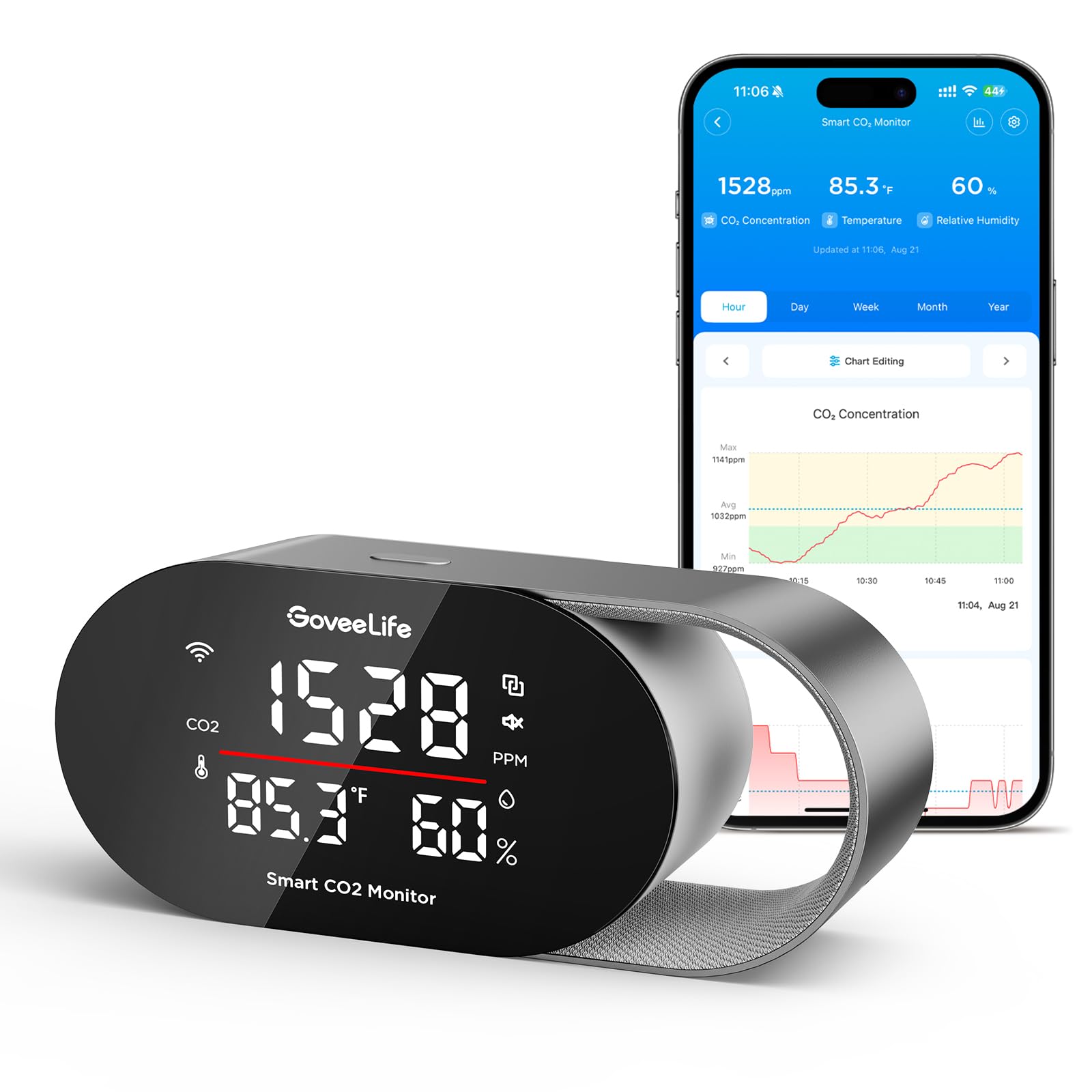
The GoveeLife H5140 sets the standard for a smart CO₂-focused air monitor. Using a photoacoustic NDIR sensor from Sensirion’s SCD4x series, it delivers accuracy of ±(40ppm + 5%) with a fast 5-second refresh rate and built-in pressure compensation for high-altitude use. This is the sensor stack you want if cognitive performance—avoiding that drowsy CO₂ buildup—is your primary concern.
Beyond CO₂, it tracks temperature and humidity with a customizable tri-color light bar that auto-adjusts brightness on a day/night schedule. The AC-powered design means zero battery anxiety for 24/7 monitoring, and the app stores two years of data with CSV export for detailed analysis. Voice control via Alexa and Google Assistant plus smart linkages with GoveeLife fans and humidifiers make this a central piece of a smart environmental ecosystem.
Real-world reviews confirm it catches CO₂ spikes from crowded rooms and cooking, with push notifications that prompt immediate ventilation. Users note that air purifiers cannot reduce CO₂, which this monitor makes abundantly clear. The connection to a routine of opening windows measurably improves alertness and sleep quality.
Why it’s great
- Industry-leading photoacoustic NDIR CO₂ sensor
- AC-powered for uninterrupted 24/7 monitoring
- Two-year data storage with CSV export
- Smart home voice and appliance integration
Good to know
- Does not measure PM2.5, TVOC, or HCHO
- Wi-Fi connectivity can be flaky if far from router
2. 16-in-1 Air Quality Monitor (YNAK AK22A)
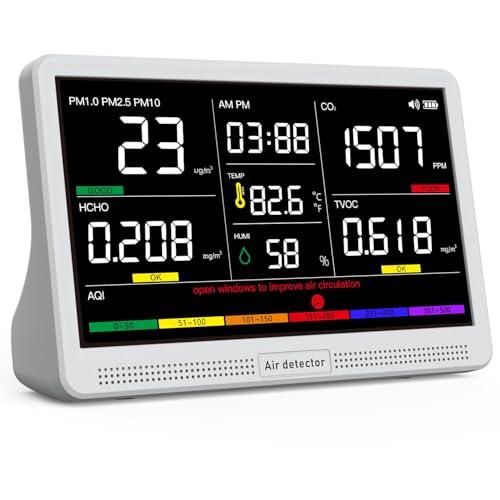
The YNAK AK22A is built for those who want every air quality metric visible at a glance without navigating through menus. Its 7-inch LED display is the largest in this roundup, showing CO₂, PM2.5, PM1.0, PM10, HCHO, TVOC, temperature, humidity, and AQI simultaneously. The screen has three brightness settings, making it readable in direct sunlight without blinding you at night.
Accuracy is driven by external high-precision sensors with a claimed resolution of 0.001 units, and the multi-sensor array with enhanced airflow design catches rapid environmental changes—like a candle being blown out or hairspray mist. It packs a 2500mAh battery for up to 8 hours of cordless operation, though reviewers recommend keeping it plugged for continuous use. Setup requires no app, and the 7 distinct AQI alert buzzers can be muted for silent operation.
Customer feedback highlights its sensitivity to cooking, candles, and vape smoke, with a detection lag of 3-7 seconds—perfect for trend tracking, not spill detection. The relative readings are more important than absolute precision, and the large display makes it a conversation piece in any room.
Why it’s great
- Massive 7-inch display shows all metrics at once
- Detects 9 parameters including HCHO and TVOC
- External sensors with fast response time
- 8-hour battery for cordless room-to-room use
Good to know
- No Wi-Fi or app for remote monitoring
- Some users report TVOC accuracy concerns
3. KDWKD Indoor Air Quality Monitor (AK23CA)
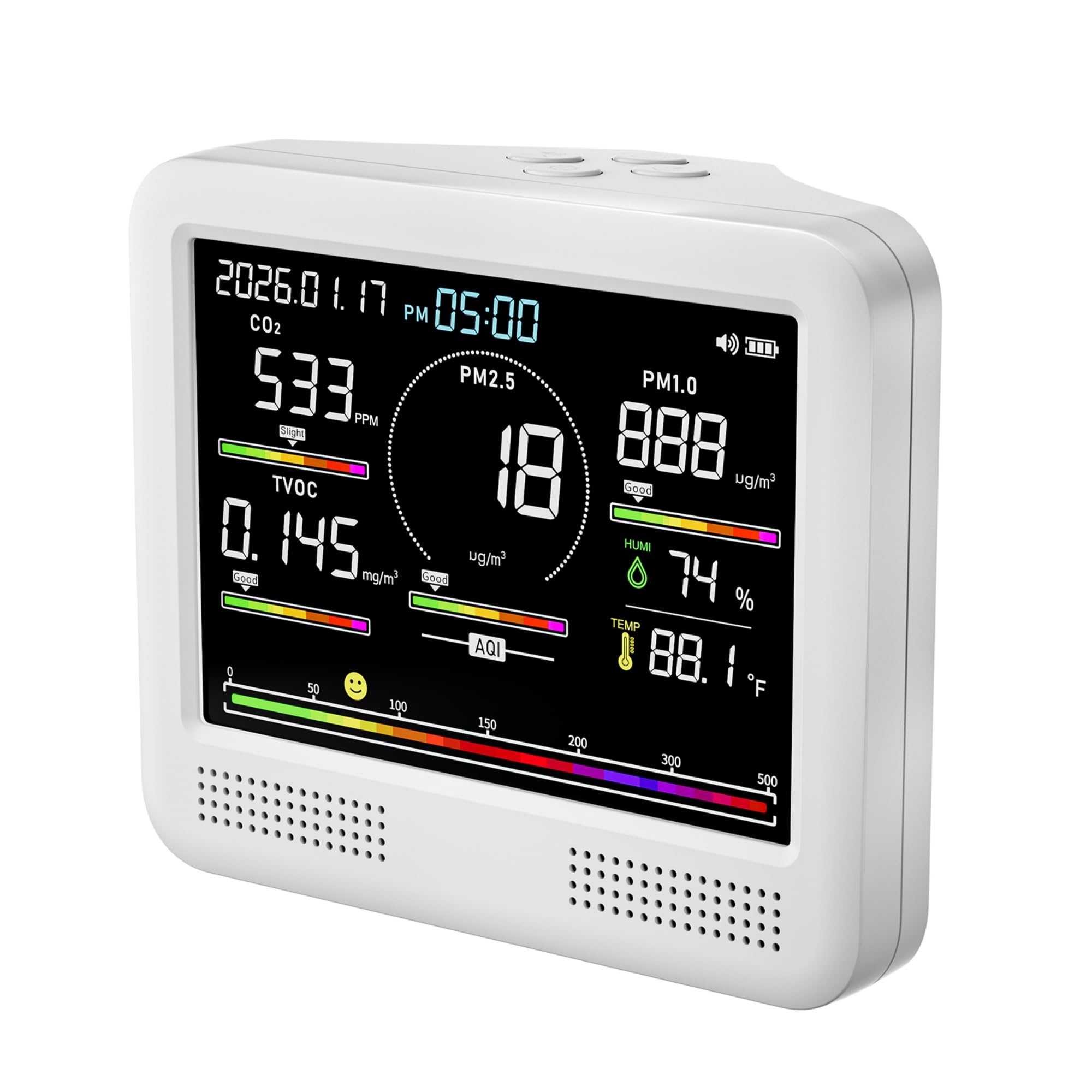
The KDWKD AK23CA is a full-spectrum analyzer that tracks CO₂, PM0.3, PM0.5, PM1.0, PM5.0, PM10, HCHO, TVOC, temperature, and humidity—covering everything from ultrafine particles to chemical off-gassing. Its rechargeable battery provides up to 9 hours of operation, making it the most portable option for testing air quality across multiple rooms, hotels, or even in an RV.
The unit uses a laser particle counter for PM measurements down to 0.3 microns, which catches the smallest respirable particles that deeper lung penetration. An audible alarm triggers when any parameter exceeds safe thresholds, and the display color shifts from green to yellow to orange to red for instant visual feedback. Setting it up involves a simple outdoor calibration for the CO₂ sensor to establish a 400ppm baseline.
User reports confirm that it matches readings from trusted monitors like PurpleAir for PM2.5, and the TVOC sensor reacts specifically to ammonia and water vapor in controlled tests—showing real sensor differentiation rather than a single guesstimate. The faint fan noise from the laser sensor is noticeable in a quiet room.
Why it’s great
- Broadest sensor suite: CO₂, PM0.3–PM10, HCHO, TVOC
- 9-hour battery life for true portability
- Manual CO₂ calibration for accuracy
- Color-coded display with audible alerts
Good to know
- No Wi-Fi or Bluetooth connectivity
- Faint fan hum from laser sensor
4. Bcetasy 18-in-1 Smart Air Quality Monitor (PV33)
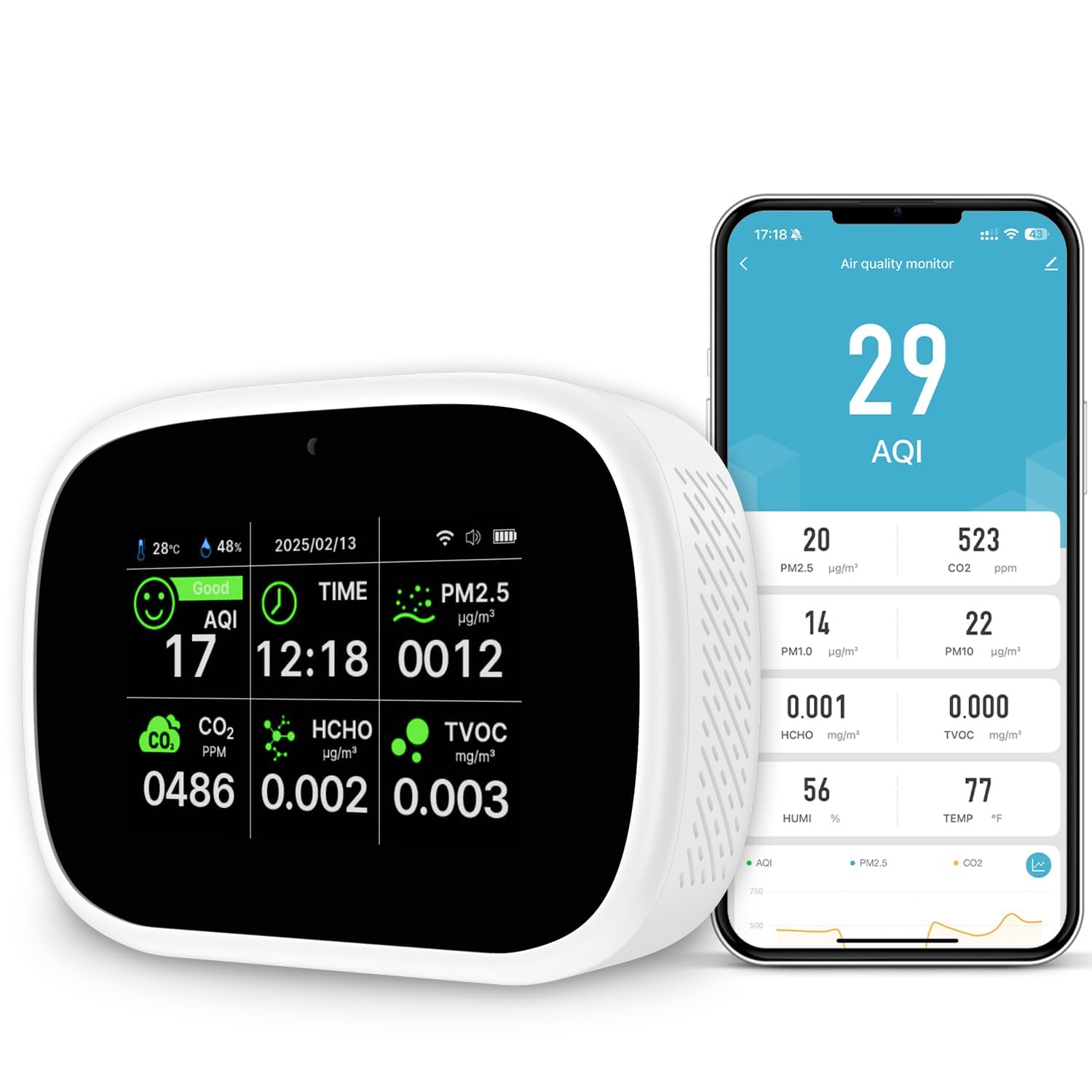
The Bcetasy PV33 stands out for its dual-chip architecture—one chip dedicated to sensor data processing and another managing the user interface—which promises faster, more responsive readings than single-chip designs. It measures AQI, CO₂, PM2.5, PM1.0, PM10, TVOC, HCHO, temperature, and humidity, all displayed on an HD LCD with auto-brightness adjustment.
Wi-Fi connectivity via the Smart Life or Tuya Smart app enables remote monitoring, historical data tracking, and customizable alerts. The 3000mAh battery offers 7-15 hours of continuous use, and the energy-efficient chip continues tracking even in power-saving mode. Setup requires a 2.4GHz Wi-Fi network, and the device needs an initial 10-minute charge before first use.
Reviews are mixed on consistency. While many confirm sensitive detection of cigarette smoke and VOCs from cooking, others report large unit-to-unit variance and unreliable CO₂ readings that never drop below 400ppm outside. The app is functional but requires an SMS-based subscription for push notifications, which is a notable downside for a fully connected device.
Why it’s great
- Dual-chip design for responsive performance
- Large 3000mAh battery with power-saving mode
- Wi-Fi app with remote monitoring and alerts
- Auto-brightness HD LCD display
Good to know
- Inconsistent CO₂ accuracy reported by some
- App notifications require SMS subscription
- Only 2.4GHz Wi-Fi compatible
5. LifeBasis 11-in-1 Air Quality Monitor

The LifeBasis 11-in-1 packs a genuine NDIR infrared CO₂ sensor, a laser particle sensor for PM1.0, PM2.5, and PM10, plus semiconductor sensors for TVOC and HCHO—all in a slim, pocketable chassis that weighs just 6.1 ounces. It tracks AQI, temperature, and humidity, with color-coded icons and a ticking alert sound when any parameter exceeds safe levels.
A 2500mAh battery delivers 11-12 hours of continuous run time, making it ideal for day-long monitoring across multiple rooms. The LCD screen has adjustable brightness, and each pollutant gets its own color indicator (green, yellow, orange, red) for at-a-glance status. Calibration requires placing it outdoors for 30 minutes after first use to set the CO₂ baseline.
Customer feedback confirms its PM2.5 readings closely match established monitors like PurpleAir. The TVOC sensor shows real differentiation—ammonia spikes TVOC without affecting PM, and water vapor spikes PM2.5 and humidity without affecting TVOC. There is no Wi-Fi or Bluetooth, but for pure standalone accuracy at this price, it’s tough to beat.
Why it’s great
- Genuine NDIR CO₂ sensor at a budget price
- 11-12 hour battery life for all-day use
- Slim, portable design with real sensor differentiation
- Color-coded display with dual alert system
Good to know
- No Wi-Fi or Bluetooth connectivity
- Faint fan hum from laser particle sensor
6. GoveeLife Smart Air Quality Monitor (H5106)

The GoveeLife H5106 focuses on PM2.5, temperature, and humidity with a 2-second refresh rate that catches rapid changes—like dust kicked up during vacuuming or paint fumes in a workshop. Its PM2.5 accuracy is ±15 µg/m³ up to 100 µg/m³, and the switchable display shows either a clock or PM2.5 readings with four levels of air quality.
The real draw here is smart home integration. You can link it with compatible GoveeLife air purifiers, humidifiers, and space heaters to auto-activate when air quality dips. The app stores up to two years of data with CSV export for long-term trend analysis. It’s USB-C powered with no internal battery, so it stays put once plugged in—perfect for a fixed installation in a workshop or nursery.
Users confirm it accurately detects sawdust and paint fumes, automatically triggering the linked purifier. The integration works about 70% of the time according to one reviewer, with occasional failures to activate. The crisp screen and easy app interface earn consistent praise, and the 2-second refresh makes it feel live rather than laggy.
Why it’s great
- 2-second refresh rate for real-time PM2.5 tracking
- Smart linkage with GoveeLife purifiers and humidifiers
- Two-year data storage with CSV export
- Clear switchable display with 4-level indicator
Good to know
- No internal battery—requires constant USB-C power
- Smart automation works about 70% of the time
7. U UNNI CO₂ Monitor (UN0601S)
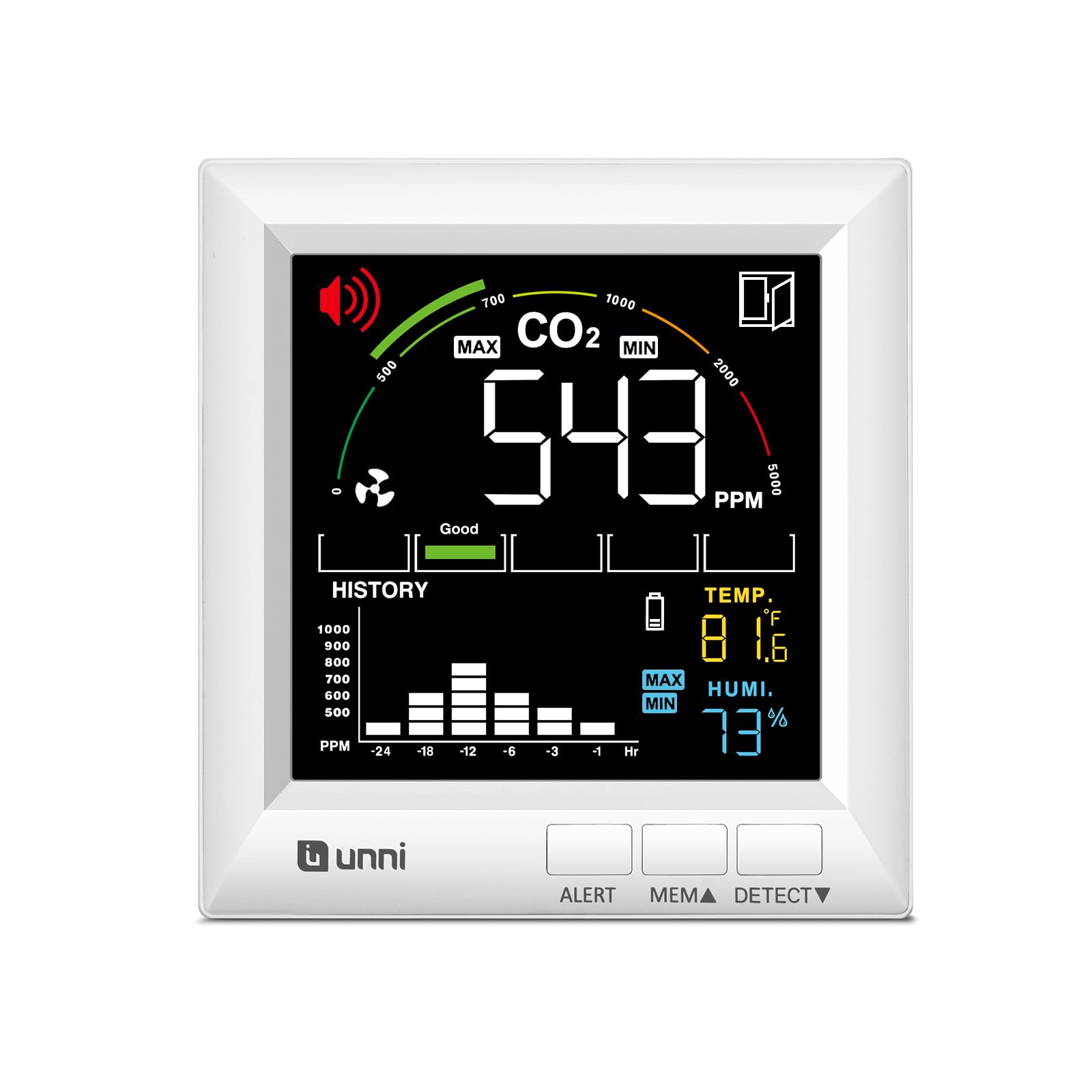
The U UNNI UN0601S proves you don’t need to spend a lot for a high-quality CO₂ monitor. It uses a Swiss-made photoacoustic sensor—the same technology found in premium units—with a detection range of 400–5000ppm and accuracy of ±(5% + 50ppm). Temperature and humidity are also measured, with a switchable °F/°C display.
The USB-powered unit has a 3x AAA battery backup for operation during power outages, and the 3-level adjustable backlight and 3-level audible alert volume make it adaptable for a bedroom or office. It shows a 24-hour CO₂ history in 4-hour increments on the clear display, and an outdoor calibration mode sets the 400ppm baseline. The low battery indicator is a practical touch for the backup system.
Customers report accurate readings that rise with cooking, fireplace use, and candle burning, triggering the alarm reliably. Multiple reviewers confirm it helps optimize ventilation for better sleep and cognitive function. The bright, dimmable display is easy to read from across a room, and the wall-mountable design keeps it out of the way.
Why it’s great
- Photoacoustic sensor at a budget-friendly price
- Battery backup for uninterrupted monitoring
- Adjustable backlight and alert volume
- 24-hour CO₂ history without an app
Good to know
- No Wi-Fi or smart home connectivity
- AAA batteries not included
- No PM, TVOC, or HCHO sensors
FAQ
Why is CO₂ monitoring important in an air monitor?
What does TVOC mean on an air quality monitor?
Can an air monitor detect mold?
Final Thoughts: The Verdict
For most users, the best air monitor winner is the GoveeLife H5140 because its premium photoacoustic CO₂ sensor, smart home integration, and app-based data tracking make invisible air quality actionable for better sleep and sharper focus. If you want comprehensive multi-parameter monitoring on a giant display, grab the YNAK AK22A. And for a portable full-sensor suite that travels from room to room, nothing beats the KDWKD AK23CA.