
Our readers keep the lights on and my morning glass full of iced black tea. As an Amazon Associate, I earn from qualifying purchases.
Specs are compiled from manufacturer listings and verified buyer reviews and can change over time — please confirm the key details on the product page before buying.
If you are building a home studio, the speakers you choose decide whether your mixes sound right everywhere or just in your room. Active studio monitors have their own built-in amplifiers, so you plug them straight into your interface with no separate amp needed. The catch is that a flat, honest sound takes real engineering, and the differences between models show up fast once you start listening.
I’m Min — the founder and writer behind Gadgets Feed. This guide is built by comparing the manufacturers’ published specifications and the patterns across verified customer reviews, so you get each pick’s real strengths and trade-offs instead of marketing spin.
Finding the best active studio monitors means weighing driver size, amplifier power, and room correction features against where you actually listen.
Our Picks at a Glance


How To Choose The Best Active Studio Monitors
Active studio monitors pack the amplifier inside the speaker cabinet, so the amp is matched to the drivers from the factory. That removes the guesswork of pairing separate amps and speakers, and it is why most pro studios run powered monitors today.
Match the woofer size to your room
A 5-inch woofer is the classic near-field choice for a desk setup, but an 8-inch woofer moves noticeably more air and reaches deeper bass without needing a subwoofer. The trade-off is physical size and placement demands. Bigger drivers need more room to breathe, so measure your desk before you commit.
Check the amplifier power split
The wattage rating tells you two numbers, one for the low-frequency driver and one for the high-frequency driver. More total watts means more headroom to hit loud, clean peaks before distortion sets in. A bi-amped design gives each driver its own amp, which keeps the sound controlled and detailed.
Look for room-tuning controls
Room correction features like boundary EQ and high-frequency trim let you fix common placement problems. If your monitors sit close to a wall, a boundary EQ switch reduces the booming bass that reflections cause. These small adjustments often matter more to your final sound than the driver quality alone.
Quick Comparison
| Model | Best For | Woofer | Amplifier Power | Frequency Response | Amazon |
|---|---|---|---|---|---|
| Yamaha HS5 Pair★ Best Overall | Mixing & mastering | 5″ | 70W (45W LF + 25W HF) | 54Hz – 30kHz | Amazon |
| Edifier MR3 PairBudget Champion | Budget desktop listening | 3.5″ | 18W x 2 RMS | 52Hz – 40kHz | Amazon |
| KRK RP5G5 ROKIT 5Top Performer | Modern build quality | 5″ | Class D amps | — | Amazon |
| Pioneer DJ DM-50D Pair | DJ sets & house parties | 5″ | Built-in amplification | — | Amazon |
| ADAM Audio T5V | Revealing high-frequency detail | 5″ | — | — | Amazon |
| KALI AUDIO LP-8V2 | Deep bass without a sub | 8″ | 100W (60W woofer + 40W tweeter) | — | Amazon |
| JBL 305P MkII Pair | Wide balance | 5″ | Dual 41W Class-D | — | Amazon |
| KRK Classic 5 Pair | Smooth highs up to 35kHz | 5″ | Bi-amp | Up to 35kHz | Amazon |
| KALI AUDIO LP-UNF Pair | Ultra-nearfield small desks | 4.5″ + 1″ tweeter | — | — | Amazon |
| Edifier MR5 | Powerful room-filling sound | 5″ + 3.75″ mid + 1″ tweeter | 110W RMS | 46Hz – 40kHz | Amazon |
| IK Multimedia iLoud MTM MKII | Compact precision with room correction | MTM design | 200W | 36Hz – 32kHz | Amazon |
In-Depth Reviews
1. Yamaha HS5 Powered Studio Monitor, Pair
Our pick — over 4.5★ from 400+ verified ratings; the strongest balance of quality and price.
The studio-standard reference that makes your final mix translate everywhere else
The Yamaha HS5 is the monitor you will see in more project studios than any other, and the reason is its ruthlessly honest character. It uses a 2-way bass reflex design with a 5-inch cone woofer and a 1-inch dome tweeter, and it is engineered to emphasize sonic purity without coloring the original sound. That means what you hear is what your mix actually contains, not a flattering version of it.
Buyers report it handles guitar tones perfectly and delivers fantastic stereo imaging, which is why it has become a go-to for tracking instruments. The bi-amplified system splits 45 watts to the low-frequency driver and 25 watts to the high-frequency driver for a total of 70 watts, so there is enough clean power for a modest home studio. Inputs come in both XLR and TRS phone jack formats, accepting balanced or unbalanced signals from almost any interface.
Owners consistently rate this as a huge upgrade from smaller budget monitors, citing more detail and a wider stereo field. It is a heavy, solidly built speaker, so it feels reassuring on a desk, and it stays compact enough not to dominate your workspace.
Why It Wins
- True flat sound praised for mixing and mastering
- 70W bi-amp gives clean, controlled headroom
- XLR and TRS inputs accept balanced or unbalanced
Trade-Offs
- Connectivity feedback is mixed, mainly around setup flexibility
- Some feel lower-priced rivals come close for the money
Reach for these if: you are mixing or mastering and want a trusted, flat reference that shows you the truth.
Look elsewhere if: you want deep bass without adding a subwoofer, because the 5-inch woofer stays honest rather than thumpy.
2. Edifier MR3 Powered Studio Monitor Speakers, Hi-Res Audio Certified Bluetooth V5.4
A compact desktop pair that punches far above its size for music and editing
The Edifier MR3 brings Hi-Res Audio certification to the budget tier, with a flat response across 52Hz to 40kHz that suits precise monitoring, music creation, and everyday listening. Inside sit 3.5-inch mid-low drivers and 1-inch tweeters, driven by 18W x 2 RMS output with a peak SPL of 92.5dB. That is plenty of volume for a 10-by-12-foot office or a small bedroom studio.
What makes them versatile is the connection panel. You get balanced TRS, RCA, and AUX inputs plus a headphone output, alongside Bluetooth 5.4 with multi-point connection. Owners pair them with a T5s subwoofer via a clean sub passthrough with no DAC needed, and call the highs crisp and the mids clear. The front headphone jack and rear highs and lows dials add real control for the price.
A recurring note is that the rear control dials have a minimal effect on tone, and the app offers deeper EQ. Some owners found Bluetooth pairing finicky, but those who use wired inputs report flawless performance and big value over older computer speakers.
Crisp and capable: studio-style clarity for music, gaming, and video editing at an entry-level price.
Know the limits: Bluetooth pairing glitches and finicky volume control show up for a minority of owners.
3. KRK RP5G5 ROKIT 5 Generation Five 5″ Powered Studio Monitor
The fifth-generation upgrade that owners call crisp, clean, and easy to live with
The KRK ROKIT 5 Gen Five refines the classic with custom-designed Class D power amplifiers, which run cooler and keep better audio integrity. A new 1-inch silk dome tweeter improves high-mid, high-frequency, and phase performance, while the Low Diffraction Baffle Design cuts distortion and sharpens stereo imaging. For placement, acoustic foam wedge isolation pads come included to minimize resonance.
Owners mention these are loud, clean, and easy to install on an Apollo UAD interface, working wonderfully in a home studio. The built-in DSP offers three equalization modes with 25 equalization combinations, giving you serious room-tuning power that the Gen 4 lacked. Inputs arrive via an XLR and 1/4-inch TRS combo jack, and Bluetooth is also listed for wider compatibility.
Owners who upgraded from the Gen 4 hear cleaner, higher fidelity sound and hope the power supplies are more reliable this time around. For serious production work, several recommend adding a KRK S10.4 sub, since the 5-inch woofer stays accurate rather than bass-heavy.
What Impresses
- Crisp, clear, balanced sound ideal for mixing
- DSP with 25 EQ combinations adapts to any room
- Included foam pads cut resonance fast
Watch For
- Opinions on value split, with some calling them overpriced
- Takes up more desk space than smaller sets
Best if: you want a modern 5-inch monitor with serious built-in room correction and a clean top end.
Think twice if: your desk is tiny, because the cabinet and foam pads eat real estate.
4. Pioneer DJ DM-50D 5-inch Active Desktop Monitor Speakers, Pair

The DJ-tuned set that gets loud enough to annoy the neighbors while you practice
Pioneer DJ voicing shows up immediately in the DM-50D, which is tuned for punchy, defined low frequencies rather than flat neutrality. The built-in amplification means you plug straight into your gear with no separate amp, and the DSP tuning gives clear, balanced sound for mixing, producing, and DJ sets. A bass boost feature adds more low end when you want it.
Customers note these 5-inch monitors communicate clearly with Ableton for guitars, bass, and midi, and they get louder than needed for close mixing. One owner even threw a house party loud enough to bring the police, so headroom is not a concern here. The all-black design matches DJ gear like the DJ Rev1 perfectly, which matters to the brand-loyal crowd.
Some say the audio quality is not the very best they have heard, but it is certainly not bad by any measure. As a step up in size for DJs and producers who want more presence, the DM-50D delivers exactly what it promises.
Built for performance: punchy low end and enough volume for practice rooms and small parties.
Not for purists: if you demand flat, uncolored monitoring, the DJ-tuned bass is a compromise.
5. ADAM Audio T5V Studio Monitor
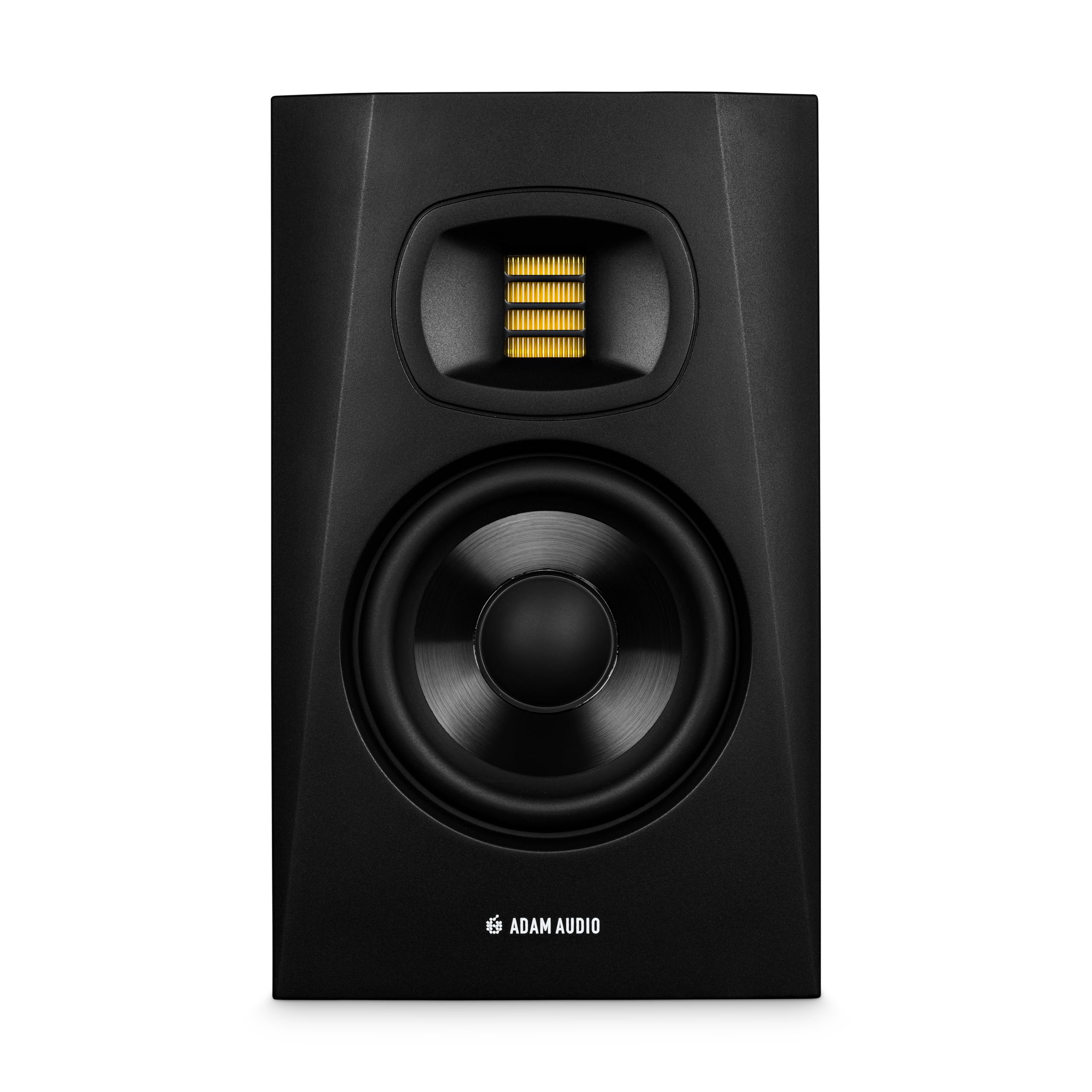
A Berlin-designed monitor that reveals high-frequency detail other 5-inchers miss
The ADAM Audio T5V earns its reputation through the signature U-ART tweeter and HPS waveguide, which deliver detailed sound across the high-frequency spectrum. Made in Berlin, this 5-inch monitor is built for recording, producing, or mixing, and reviewers point out crisp high-end frequencies with enough bass to hear kick drum thumps. A beveled cabinet with a rear-firing bass reflex port lets it fit tight spaces.
You get a flat, spacious sound that owners call solid, with ±2dB high and low adjustment via DSP-based filters (digital signal processing that fine-tunes the audio). The cabinet is larger than expected and sturdy, and the full-bodied balanced bass is satisfying without shaking the room. Multiple analog connections let you hook up various soundcards and home audio devices easily.
The one honest complaint is a constant tweeter hiss that is noticeable in a quiet room when nothing plays. Most owners still call the speakers very well made and great sounding, and some prefer them to their KRK monitors. For a home studio where high-frequency detail matters, the T5V is a real step up.
The Highlights
- Crisp, revealing highs from the U-ART tweeter
- ±2dB DSP filters adapt to difficult rooms
- Rear port fits placement in limited space
The Catch
- Noticeable tweeter hiss in quiet listening moments
- Larger than expected, not ideal for tiny desks
Grab these if: you track stringed instruments or podcast and need every high-frequency detail exposed.
Pass if: you sit in dead silence between takes, because the tweeter hiss will stand out.
6. KALI AUDIO LP-8V2 8″ Powered Studio Monitor

An 8-inch monitor with 117dB of headroom that replaces a standalone subwoofer
The KALI AUDIO LP-8V2 is the monitor for people who want deep, tight bass without buying a separate sub. It pairs a 1-inch 40W soft dome tweeter with an 8-inch 60W woofer for a 100W system, and the specs say it reaches a maximum SPL of 117dB while playing non-stop at 85dB with 20dB of dynamic headroom. The port tube lets air leave at a consistent velocity, so bass stays clean without chuffing noise.
Owners call this the best value in monitors, noting mixes translate perfectly and the sound stays comfortable during long sessions. The rear dip switches let you adjust boundary compensation EQ, LF trim, HF trim, and RCA power, which several buyers used to fix a tubby sound from wall placement. At 60Hz without a sub, the low end is deep enough for band practice and home stereo duty.
A white-noise hiss shows up for a few owners but does not affect listening at normal volumes. These are better as midfield monitors than near-field, so give them some distance. The XLR, TRS, and RCA inputs make hookup easy to a laptop, phone, mixer, or audio controller.
Bass without a box: real low-end extension that lets you skip a subwoofer entirely.
Size matters: position these a few feet away, because they play bigger than near-field speakers.
7. JBL 305P MkII 5″ 2-Way Active Powered Studio Reference Monitors Pair

The 5-inch monitor with thousands of reviews, giving you a wide balance and deep, punchy bass
The JBL 305P MkII earns its spot because it is among the most thoroughly validated monitors here, thanks to its wide balance. The patented Image Control Waveguide (a waveguide that shapes how sound spreads) delivers precise, rich audio that stays consistent even when you shift your head, so you can move around while producing music or podcasting. Inside, dual 41-Watt Class-D amplifiers (efficient digital amps) drive a 5-inch woofer with a Slip Stream port for deep bass, so you feel the low end without needing a subwoofer.
Shoppers say these are a remarkable upgrade from smaller budget monitors, with bass that is deeper and more controlled, mids that are clear, warm, and natural. The Boundary EQ and HF Trim adjust low and high frequencies to suit any room, which owners use to keep mixes accurate. An MDF enclosure built with 70 years of JBL expertise is rigorously tested for 100-hour reliability.
Several owners pair them with a JBL LSR310S sub and describe the combination as phenomenal, with music that is rich and full. The recurring thread is value: consistent recommendations name the 305P MkII first or second on reputable lists for the – range per pair.
What Wins
- Wide balance that keeps imaging true
- Deep, controlled bass for the size
- Boundary EQ and HF Trim fix room placement
Minor Notes
- Performance and noise get a few mixed mentions
- Needs a decent audio interface to shine
Choose these if: you want a proven, widely trusted 5-inch monitor with flexible room tuning.
Skip if: you need a sub-free deep bass solution, because a 5-inch woofer has natural limits.
8. KRK Classic 5 Professional Bi-Amp 5″ Powered Studio Monitor Pair + XLR Cable + Phone Holder

A versatile near-field monitor bundle with silky highs and an optional bass boost
The KRK Classic 5 is an incredibly versatile powered near-field monitor that handles any style of music. A soft-dome tweeter with an tune waveguide delivers smooth, pristine, articulate highs up to 35kHz, while the lightweight glass-aramid composite woofer produces clear midrange and tight bass. The bi-amped design gives each driver its own power section for controlled output.
Owners describe the instrument separation as nothing less than magic, and several say it rivals the Yamaha HS5 for mastering. A flat low-frequency adjustment adds versatility for mixes that translate in different environments, and a +2dB KRK bass boost gives extra low-end extension when you want it. The bundle includes a pair of XLR cables and a phone holder, so it is ready to wire up immediately.
Some owners use them as TV speakers to replace a soundbar, and others run them with Logic Pro X for serious EQ work. The recurring caution is reliability, with a few owners reporting the speakers shut off at listening levels. For the money, the sound quality and included accessories make it a strong mid-range option.
The Strengths
- Smooth, articulate highs up to 35kHz
- Includes XLR cables and a phone holder
- Extra +2dB bass boost for low-end punch
The Risk
- Reliability gets mixed feedback, including shutdown reports
- Best paired with a KRK sub for deep bass
Best for: versatile listening and production where smooth highs beat raw bass quantity.
Be aware: the shutdown reports mean you should test them early and keep the warranty handy.
9. KALI AUDIO LP-UNF Ultra Nearfield Monitor System
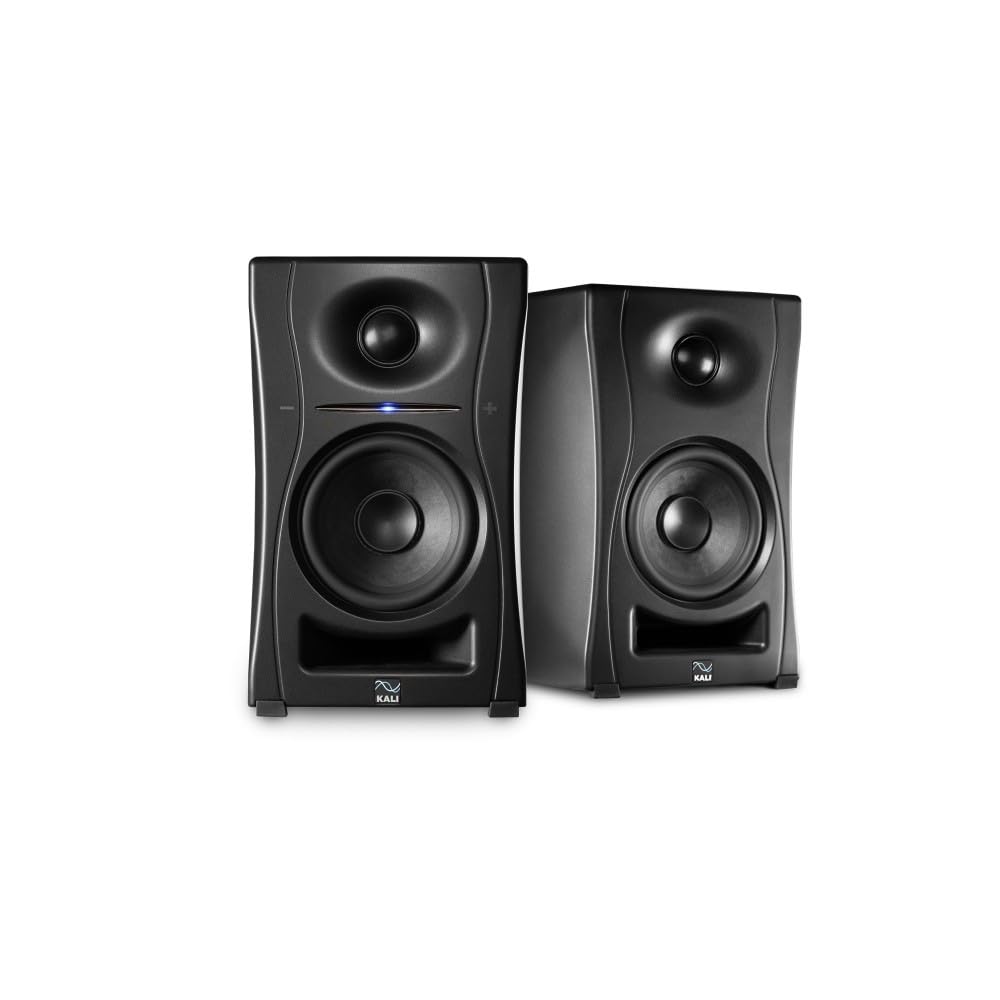
An ultra-nearfield pair that fills a small room with tight bass and a phantom center
The KALI AUDIO LP-UNF is the answer for small desks where standard monitors are simply too big. It pairs 4.5-inch powered woofers with 1-inch tweeters in a design built around a 3D Imaging Waveguide, and buyers report incredible bass without a sub and superb vocal clarity. A touch-sensitive volume slider sits right on the front, and Bluetooth connectivity removes cable clutter entirely.
Owners call these the best near-field monitors for small rooms, with a tight bass response and a fantastic volume range. The Boundary EQ and dip-switches on the back let you shape the sound for tricky placements, which several buyers found especially helpful. One owner measured real bass down to 39Hz and a wide stereo image with a strong phantom center.
The honest trade-off is the touch controls, which some find too sensitive, and a short 5-foot interconnect cable with an unusual connector. It also lacks a sub output, but owners say the pure sound needs none. For a small bedroom or office, the LP-UNF delivers big-monitor sound in a proportionally small package.
Tiny footprint, big sound: real bass and clear imaging designed for ultra-nearfield listening.
Touchy controls: the touch-sensitive volume and power buttons take some getting used to.
10. Edifier MR5 2.0 Studio Monitor Bookshelf Speakers, 110W RMS

A three-way powered speaker that fills a room with 110 watts of clean, punchy sound
The Edifier MR5 steps up from typical two-way monitors with a 3-way active crossover system: a 5-inch long-throw woofer, a 3.75-inch mid driver, and a 1-inch silk dome tweeter. That three-way design gives it a frequency response of 46Hz to 40kHz, and the 110W RMS Class D amplifier delivers a 101dB peak SPL. For a bookshelf speaker, it has serious power that fills mid-sized rooms with ease.
Owners mention theater-like sound for movies, extremely loud output with strong bass, and clear instrument separation. The Hi-Res Audio support handles 24-bit/96kHz wired and wireless LDAC, which keeps high-resolution detail intact. Physical rear knobs adjust High and Low frequency, while the EDIFIER ConneX app offers advanced room compensation with Low Cut-Off, Desktop Control, and Acoustic Space presets.
Connectivity is generous with Bluetooth 6.0 multi-point, plus XLR, TRS, RCA, and AUX inputs, and a front-panel 3.5mm headphone output. Owners upgraded from the Edifier MR3 for more power and call these small, heavy, and powerful with clean sound. The dimpled tweeter waveguide keeps sound consistent across a wider listening area.
Why It Stands Out
- Three-way design separates mids from highs
- 110W RMS fills a mid-sized room easily
- XLR, TRS, RCA, AUX plus Bluetooth 6.0
Keep In Mind
- Adjustability and input options get mixed feedback
- EQ controls described as barely adequate by some
Perfect if: you want one speaker pair that handles studio work and movie nights with power to spare.
Consider smaller if: you only mix near-field at low volume, because the MR5 wants to be turned up.
11. IK Multimedia iLoud MTM MKII Pair Plus ARC Mic
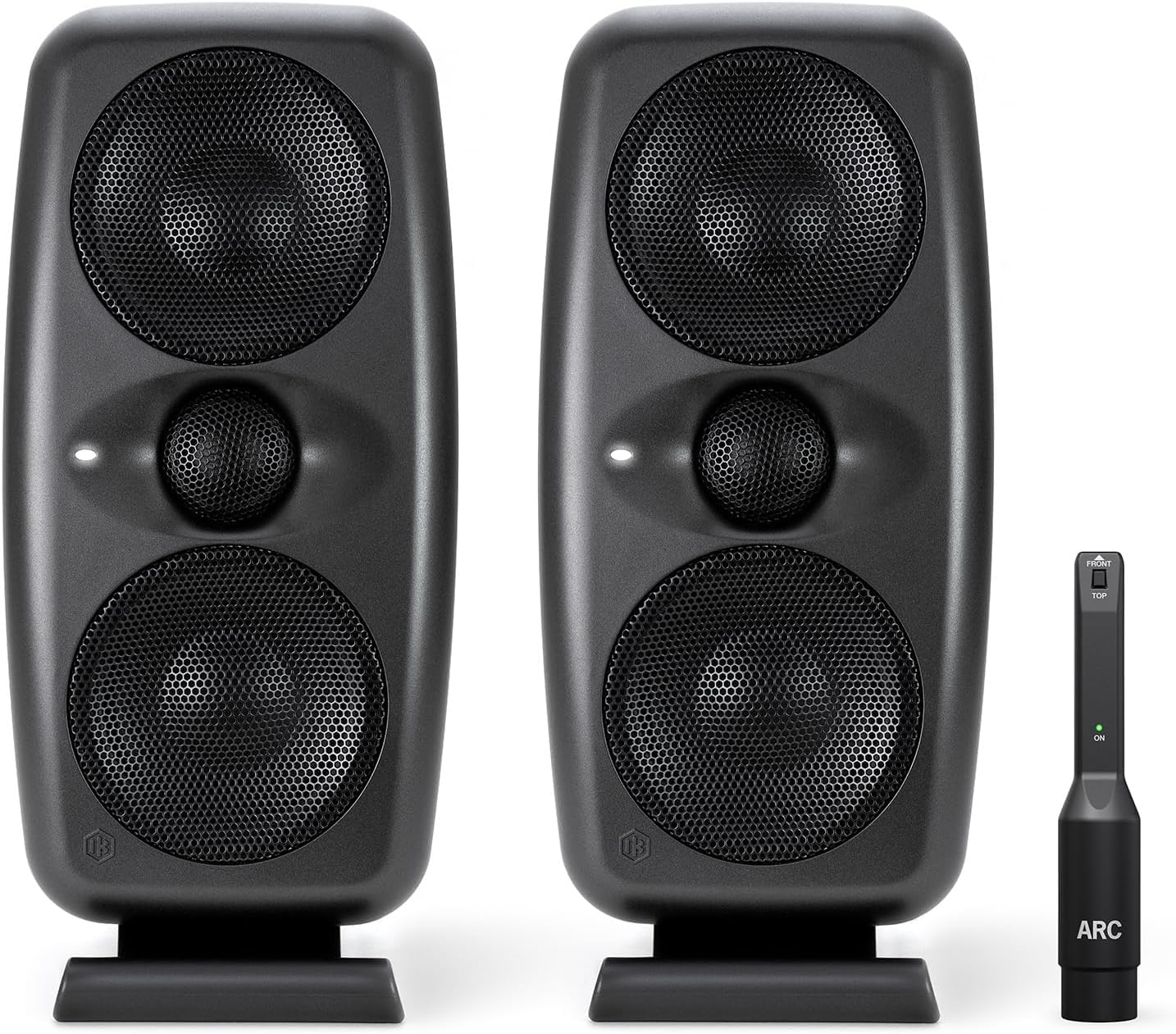
The compact monitor with room calibration that sound engineers call mini-Genelecs
The IK Multimedia iLoud MTM MKII is the precision tool in this lineup, with an ultra-flat frequency range from 36Hz to 32kHz that delivers deep, controlled bass and crisp, clear highs. The MTM driver layout, with a tweeter between two mid-bass drivers, gives precise time alignment and linear phase sound that reduces ear fatigue during long sessions. Owners call them the mini-Genelecs because they sound accurate above their small size.
What sets them apart is the built-in ARC room correction. The included ARC mic instantly tune sound for any room, correcting acoustic inconsistencies and placement issues. Customers note you can hear every tiny nuance of music, with strong deep bass and accurate response that works for bass guitar tracking. ARC X software even emulates a variety of top monitors and reference systems to test mix translation.
Versatile mounting options include desktop stands and mic stand mount points, so they fit any desk, shelf, or stand. The 200W of power in a compact body explains the deep, punchy bass. The honest note is the price, which makes them an investment, and a minority of owners question whether the cost is justified until they hear them calibrated.
The Strengths
- Ultra-flat 36Hz – 32kHz response with deep bass
- ARC room correction fixes any acoustic space
- Compact size with adjustable stands and mic mounts
The Reality
- Premium price with some owners unsure it is worth it
- Materials feel less premium than the sound suggests
Invest in these if: you need accurate room-corrected monitoring in a small or medium studio and mix for a living.
Hold off if: your budget is tight, because the sub-compact size does not justify the premium for casual use.
Understanding the Specs
Bi-Amplification
A bi-amped monitor gives the woofer and tweeter their own separate amplifier. That split keeps the low and high frequencies controlled and reduces distortion, so you can push the volume louder before the sound breaks up. Look for the two wattage numbers, like 45W LF plus 25W HF, which tell you how much power each driver gets.
Frequency Response
The frequency response range, like 54Hz to 30kHz, tells you how low and how high the speaker plays. The low number matters most for bass, and the high number affects air and detail in the top end. A wider range usually means fuller sound, but the room and speaker placement change what you actually hear.
FAQ
Do I need an audio interface to use active studio monitors?
What is the difference between active and passive studio monitors?
Should I buy a 5-inch or 8-inch woofer monitor?
What is a near-field studio monitor?
Why do studio monitors sound flat compared to regular speakers?
What is boundary EQ and do I need it?
Do I need a subwoofer with my studio monitors?
What is room correction in a studio monitor?
Final Thoughts: The Verdict
For most people, the best active studio monitors pick is the Yamaha HS5 because its flat honesty makes your mixes translate reliably everywhere. If you want deep bass without adding a subwoofer, the KALI AUDIO LP-8V2 with its 8-inch woofer is the one to reach for. And for a compact desk where space is tight, the KALI AUDIO LP-UNF delivers big-monitor sound in a small footprint.
How We Picked
We do not accept paid placement. Every pick is matched to a real buyer and a real use-case; we do not hands-on test units.
Sources & Methodology
Specifications: manufacturer listings and product documentation. Review insights: verified customer reviews, as of August 2026. Pricing: not shown on this page (it changes often); check the current price via the retailer link.
As an Amazon Associate, Gadgets Feed earns from qualifying purchases. This does not affect which products we feature.