
Our readers keep the lights on and my morning glass full of iced black tea. As an Amazon Associate, I earn from qualifying purchases.
Specs are compiled from manufacturer listings and verified buyer reviews and can change over time — please confirm the key details on the product page before buying.
If you are reading this, you are probably tired of pixelated screens, frozen frames, or channels that refuse to load on one TV while working perfectly on another. That is the classic symptom of a signal being split too many times without help. An amplified coax splitter is the fix, and this guide cuts straight to which ones actually deliver a clean signal to every room in your house.
I’m Min — the founder and writer behind Gadgets Feed. This guide is built by comparing the manufacturers’ published specifications and the patterns across verified customer reviews, so you get each pick’s real strengths and trade-offs instead of marketing spin.
Here is how to pick the right amplified coax splitter without wasting money on the wrong type.
Our Picks at a Glance


How To Choose The Best Amplified Coax Splitter
Before you buy, ask yourself one question: what are you feeding? Cable TV with internet, or a TV antenna? That answer decides which amplifier type you need.
Active Return vs. Passive Return
An active return amplifier boosts the signal that travels back up the cable to your internet provider. This is essential for cable modems and VoIP phones, where your upload signal needs power to reach the street. A passive return is for TV antennas (OTA) and standard cable TV viewing, where you only need the downstream signal boosted to your TVs.
Gain and Noise Figure
Gain, measured in decibels (dB), tells you how much the amplifier boosts the signal. A +7.5 dB gain is typical for a 4-port unit. More gain is not always better. If the input signal is already strong, over-amplifying can cause picture distortion. A low noise figure means the amplifier adds very little background hiss to the signal, which keeps weak channels watchable rather than snowy.
The Return Path and Your Modem
Check your manual to see which output port is dedicated to your modem. On some models, the first port has special priority for the return path. Cabling that runs upstairs or across the house can weaken your signal before it even reach the TV, so placing the amplifier where the cable enters the home is usually the best strategy.
Quick Comparison
| Model | Best For | Output Ports | Gain | Return Type | Amazon |
|---|---|---|---|---|---|
| 9 Port Bi-Directional Kit★ Best Overall | Whole-home cable TV | 8 | Lossless | Active | Amazon |
| Antronix MRA4-08/ACBudget Champion | OTA antenna sharing | 4 | +7.5 dB | Passive | Amazon |
| Lindsay LSA84-EQ8Long-Run Pick | Long cable runs | 4 | +7.5 dB | Passive | Amazon |
| Lindsay LSA84 | HD antenna distribution | 4 | 8 dB | Passive | Amazon |
| Channel Master CM-3424 | Antenna + LTE filtering | 4 | 7.5 dB | Passive | Amazon |
| Televes 552380 | Variable gain tuning | 5 | 12-16 dB | Passive | Amazon |
| Antennas Direct JUICE4 | ATSC 3.0 / 4K TV | 4 | — | Passive | Amazon |
| Arris BDA-42-4-AR-R | Cable modem + TV | 4 | 5x Forward | Active | Amazon |
| Reliable LSA48 | 8-room setups | 8 | +4 dB | Passive | Amazon |
In‑Depth Reviews
1. 9 Port Bi-Directional Cable TV Splitter Signal Booster/Amplifier Kit
Our pick — over 4.5★ from 250+ verified ratings; the strongest balance of quality and price.
The commanding hub for large homes with cable TV wired into every room without a drop in strength.
If you are trying to feed eight separate coax outlets from one cable line, this is the powerhouse to beat. It provides eight amplified output ports that are truly lossless in both directions, meaning your cable modem and your TVs all get a clean signal. The layout points every port downward, which keeps the wiring neat and the connectors tight in any mounting position.
This unit is built specifically for cable TV, and it shows. It has a dedicated modem port for VoIP equipment so a power outage won’t knock out your phone service. Buyers report it fixed signal degradation across 6 coax outlets and resolved Xfinity X1 connection problems that a 15-year-old splitter could not. The powder-coated aluminum housing resists rust, and all RF ports carry 6 kV surge protection to shrug off electrical spikes.
A green light confirms power, and the kit arrives with the amplifier, power supply, three F59 terminators, and a dedicated power cable. The one honest caveat: this is not for OTA antennas or satellite systems, so it belongs in a cable household only.
Built For Cable Homes
- Truly lossless 8-port splitter with active return
- Modem port keeps VoIP phone alive in a power cut
- CamPort auto-seizing F-ports hold cables firmly
- Comes with terminators and a power cable
Know Before You Buy
- Not for OTA antennas or satellite dishes
- Not MoCA capable, so check with your provider
- Warranty is 2 years on amp, 1 year on supply
Reach for this if: you have cable TV (plus phone and internet) wired to six to eight rooms and want one clean, dependable hub.
Look elsewhere if: your signal comes from an antenna or a satellite dish — this unit is strictly for cable systems.
2. Antronix Amplifier, Cable TV RF Broadband 8dB Gain Four Output
The budget-friendly workhorse that shares one antenna’s bounty with every TV in the house.
This four-port amplifier delivers a +7.5 dB boost per port, which is plenty to overcome the signal loss from splitting one antenna line to several televisions. It excels at clearing up snow (analog static) and stopping the pixelation that plagues digital cable pictures. A 3 dB noise figure keeps the amplification clean, so weak channels stay watchable instead of turning into visual static.
This model is a favorite among cord cutters. Owners mention it flawlessly shares an outdoor antenna across multiple TVs, pulling in roughly 60 channels with no distortion or pixelation. Others found it solved stubborn VHF issues on channels like 2, 6, and 12 that a cheap stock amplifier could not handle. The nickel-plated housing gives solid corrosion protection, and all ports carry 6 kV surge protection.
It also meets SCTE standards and includes a 5-year warranty on the amplifier. The one thing to note: it does not ship with an F-connector power cable, so you will need a short one on hand, and the unit runs warm so give it breathing room.
Defining strength: the cleanest budget route to sharing an OTA antenna across multiple TVs, backed by a five-year warranty.
Honest caveat: skip it if your system already has an amplifier, since stacking amps creates distortion.
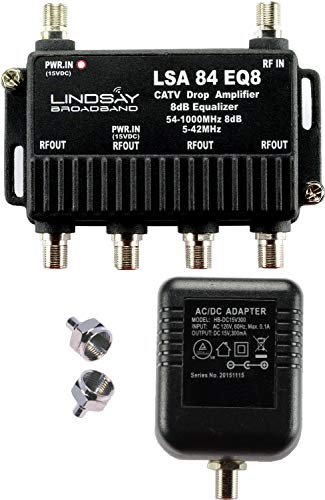
3. Reliable Cable 4-Port Digital Signal Amplifier with Equalizer (Lindsay LSA84-EQ8)
The equalizer-savvy amplifier that rebalances high frequencies lost over very long cable runs.
This is the specialist for long cable runs. It includes an integrated equalizer that gives more amplification to high-frequency signals, which are the ones that weaken most over long coax distances. All four ports get amplified output, from a minimum of +0 dB at 54 MHz up to +7.5 dB at 1000 MHz, so the shortest and longest TV runs end up with the same channel lineup.
That equalizer makes a real difference in the field. Customers note connecting four TVs to an outside antenna and getting identical channels on every set, from the shortest to the longest run. Another found it perfect for a weak-signal attic antenna feeding TVs 75 feet away, staying stable for over three years of daily use. The metal housing has a 15 PSI weather-tight seal and handles operating temperatures from -40°F to +140°F, so it is ready for an attic or a garage.
It works with both antenna and cable TV, but it is not for systems that already have an amplifier or pre-amplifier installed. Some owners wish it used a regular DC adapter instead of the DC-to-F connector style.
Why it stands out: the built-in equalizer is the fix for cable runs over 50 feet where high frequencies die out before the TV.
The catch: it demands a clean input signal and high-quality RG6 cable to show its best.
4. 4-Port Digital Signal Amplifier with Passive Return (Lindsay LSA84)

The channel-count machine that turns a modest antenna into a full program guide.
The LSA84 is an 8 dB, four-output amplifier that exists for one purpose: getting more channels from your antenna to every TV. Reviewers point out it picked up 140 stations across all three TVs after replacing a basic 2-way splitter, with every image crisp. Another owner saw channels jump from roughly 60 to 140 across three sets, a transformative upgrade for free broadcast TV.
It works with standard and digital cable TV and OTA antenna reception, with a passive return path that suits antenna setups. The power supply has self-resetting short-circuit protection, and the amplifier carries a 6 kV ring-wave surge design. It handles freezing attics and hot garages thanks to its -40°F to +140°F operating range, plus a 15 PSI weather-tight seal.
This unit is honest about its limits: it boosts a good signal rather than fixing a weak one, and it is not compatible with satellite systems or MoCA networks. No power cable is included, so plan to make your own from a short coax jumper.
What It Does Best
- Large channel gains reported, up to 140 stations
- Compact black housing suits attic or cabinet
- Surge protection on every port
What To Plan For
- Power cable not included
- Only boosts a good signal, cannot fix a bad one
- Not for satellite or MoCA systems
Pick it if: you want maximum channel discovery from a healthy antenna signal spread across three or four rooms.
Think twice if: your incoming signal is already weak and needs rescuing rather than distribution.
5. Channel Master TV Antenna Booster 4 (CM-3424)

The weatherproof distributor that cleans up cellular interference while feeding four antenna TVs.
Channel Master has been in the antenna game since 1949, and this booster carries that pedigree. It gives you four output ports with a 7.5 dB gain, splitting your antenna signal to four rooms while actually improving it. The standout feature is the built-in LTE filter, which blocks cellular signals above 608 MHz that cause the pixelation and dropouts you might blame on your antenna.
The housing is heavy-duty and weatherproof, so you can install it indoors, outdoors, or in an attic. Shoppers say the Channel Master 4 booster improved picture quality and increased channels from 45 to 97 on all four TVs. In a rural, 90-mile setting, another owner saw signal-to-noise ratios improve from 15-17 to 18-22, with 5G interference filtered out completely.
The consensus is strong: quality is what this unit is known for, and it is engineered as a replacement for standard splitters rather than a fix for weak signal areas. If you are in a genuinely low-reception zone, the maker points you toward a dedicated pre-amplifier instead.
Standout trait: the built-in LTE filter quietly eliminates cellular interference, a problem many antenna users never diagnose correctly.
Best paired with: a clean antenna signal you want to distribute, not a weak one you need to rescue.
6. Televes 552380 Indoor Distribution Amplifier
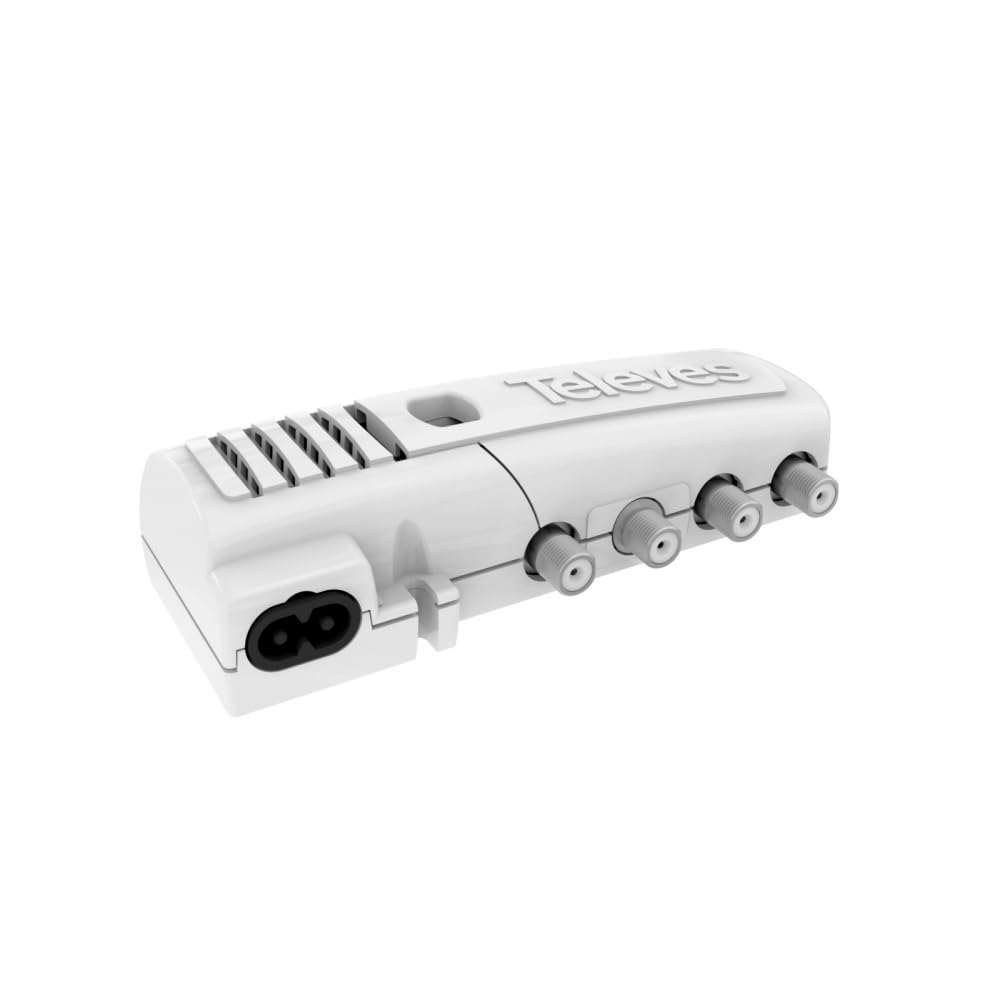
The precision tuner with per-output gain dials for households where one TV is farther than the rest.
Here is the finesse option. Instead of a single fixed boost, the Televes offers one output with 12 dB gain for the nearest TV and four outputs with 16 dB gain for longer cable runs. Every output has its own manual gain control spanning 0-15 dB, so you can dial in the exact level each room needs and prevent over-amplification on short cable runs.
This granular control is a real advantage in tricky homes. It is designed to work with both amplified and non-amplified antennas, and it is ideal for distributing signal from a mast-mounted preamplifier to multiple rooms. The built-in LTE filter blocks cellular signals above 608 MHz to keep your HDTV picture clean, and the high-shield metal chassis resists electromagnetic interference.
Buyers report picking up 66 OTA channels across four TVs with this unit, and one owner notes it performed better than the RCA amplifier it replaced. Made in Spain, it keeps power consumption low with over 50% energy savings versus other distribution amps. The trade-off is that this level of control and premium build commands a higher price.
Precision Perks
- Independent 0-15 dB gain per output
- LTE filtering blocks cellular interference
- High-shield metal chassis resists interference
Before You Buy
- Premier build comes at a premium price
- Compact size may surprise you
- Signal quality results vary by setup
Choose this if: your rooms have very different cable lengths and you want to tune each TV’s signal level precisely.
Pass if: you would rather set one dial and forget it than manage five separate gain controls.
7. Antennas Direct ClearStream JUICE4 Distribution Amplifier
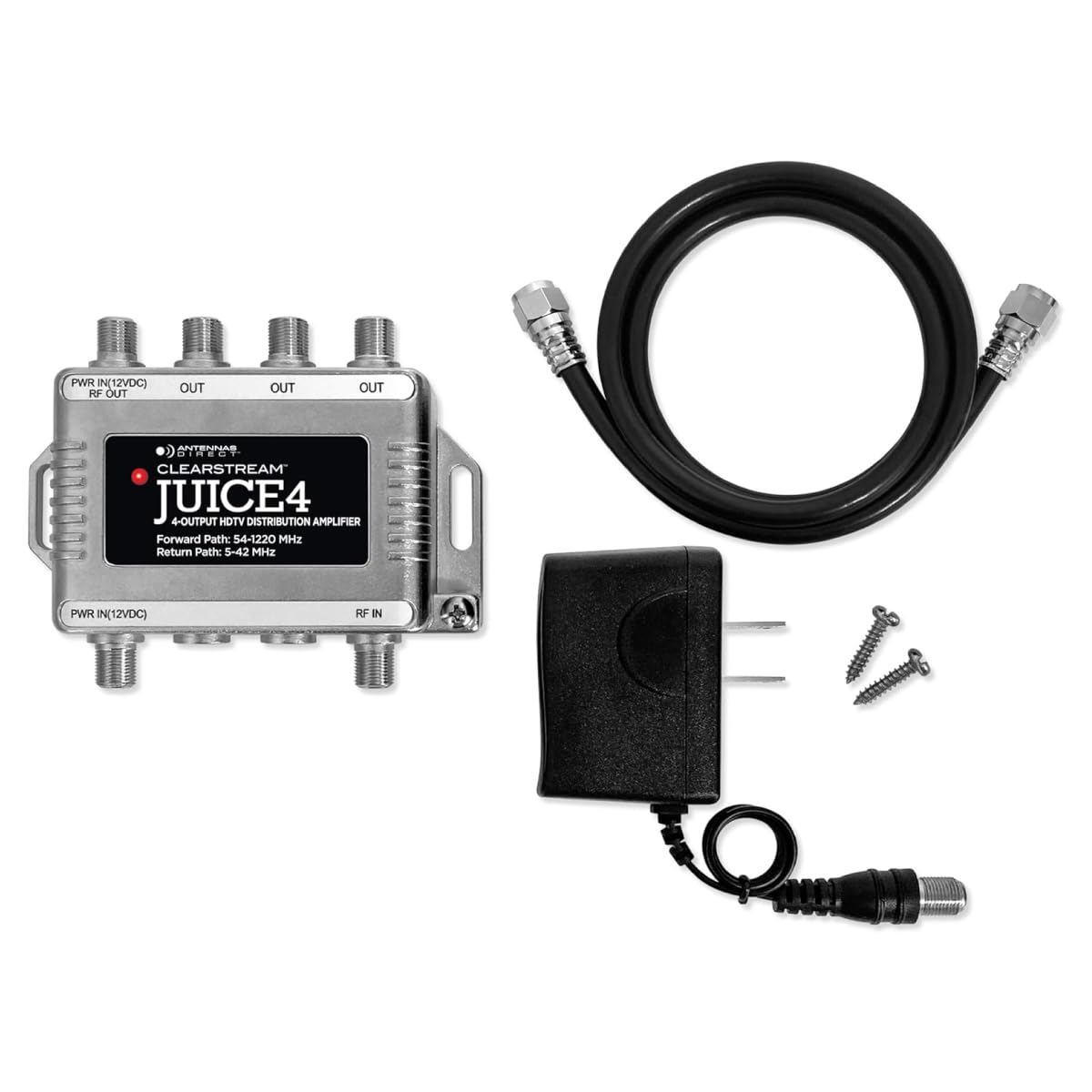
This compact silver box is built for next-generation ATSC 3.0 (the latest over-the-air TV standard) broadcasts, so you get crisp 4K reception.
Future-proofing is the name of the game here. The JUICE4 boosts your antenna signal for up to four TVs or digital converter boxes, and it supports ATSC 3.0 NEXTGEN TV along with 4K and 8K UHD. Its operating frequency extends up to 1.2 GHz, which also accommodates CATV and cable broadband applications if you later switch services.
The housing is a precision machine-sealed zinc diecast that protects against dust and water droplets. Owners mention hooking up four smart TVs and watching the pixelation stop immediately, while another saw their signal increase by 10% after installation. Several owners note they now receive 51 channels, and the unit handles weather-related signal instability far better than previous amps they had used.
It is compact at 3.5 inches high and 3.8 inches wide, so it tucks neatly behind furniture. It can even be used outdoors with termination caps and weather boots. The one caution: it gets warm to the touch during operation, though never hot.
Why it converts buyers: it clears up pixelation and low-signal problems on multiple cable drops, and customers note picking up more channels than expected.
Heads up: some early units had reliability complaints, so it is worth testing within the return window.
8. Arris 4-Port Cable Modem, TV, HDTV Amplifier Splitter with Active Return

The bi-directional booster that rescues flaky cable internet and pixelating TV in one compact box.
This is the amplifier for homes where internet drops are just as annoying as TV pixelation. It boosts the downstream signal by 5x and the upstream by 2x, strengthening both your video and your cable modem connection. The active return path is critical for broadband devices, especially when your upstream modem power level sits above 48 dBmV and your connection keeps dropping.
Reviewers point out dramatic fixes. One owner with old coaxial cables and old splitters kept losing internet to the modem; this unit solved the weak-signal problem with no drops since installation. Another saw speeds climb from around 400 Mbps toward gigabit with improved consistency. A third noted their TV improved after install, with richer colors and sharper text, once they learned output #1 must feed the cable modem.
The unit runs slightly warm, so give it airflow, and it meets all applicable IEEE surge standards on every output port. It comes with a 36-inch white connection cable and terminators. This model is strictly for cable systems — using it with antennas will cause total loss of OTA signals.
Where It Wins
- 5x forward and 2x reverse signal boost
- Built for cable modem + TV households
- Includes 36-inch cable and terminators
Installation Notes
- Output #1 must feed the modem or the system fails
- Runs warm, needs open airflow
- Not for antennas or satellite dishes
Best fit: you subscribe to cable internet and TV, and your modem power levels are high enough to cause disconnects.
Avoid if: you are a cord cutter using a TV antenna — this amp will kill your OTA signal entirely.
9. Reliable 8-Port TV Antenna Signal Splitter (LSA48)

The ultra-compact eight-port hub that feeds an entire house from a single antenna or cable line.
When you need to reach eight devices, this is the compact solution. The LSA48 provides eight ports with a +4 dB boost per port, which the maker says doubles your signal strength to overcome the losses of a big split. It works with both OTA antennas and cable TV, preventing signal loss across a long list of rooms.
Shoppers say picking up 20 more channels and enjoying crisp pictures with no lag or fuzzy images. One owner cut satellite TV, installed their own antenna, and now receives 125 channels, including many they previously watched via satellite. Another uses it in a radio studio to share a rooftop FM antenna across multiple receivers with zero signal loss. It has been running flawlessly for over two years in some setups.
The form factor is ultra-small, making it easy to install in tight spaces, and it can be used outdoors inside an approved enclosure. Connection cables are sold separately, and the power supply is for indoor use only.
Strongest suit: the eight-port capacity in a small package, ideal for whole-home antenna distribution without losing channels.
Plan for: an upgrade if you have an amplified antenna, since this unit is not compatible with pre-amplified systems.
Understanding the Specs
Active Return vs. Passive Return
Active return amplifiers boost the signal that travels back up the coax to your internet provider, which is why they are essential for cable modems and VoIP phone service. A passive return, by contrast, only boosts the downstream signal to your TVs, making it the right choice for OTA antennas and standard cable viewing. Matching the return type to your service is the single most common source of buyer error — an antenna won’t work with an active return amp, and a modem may fail without one.
Gain and Noise Figure
Gain (in dB) measures how much your amplifier boosts the signal. Typical values here run from +4 dB on an 8-port unit up to +7.5 dB or 8 dB on 4-port units. More gain is not better: an already-strong signal over-amplified can distort. The noise figure (often 3 dB) tells you how much background hiss the amp itself adds. The lower the noise figure, the cleaner the amplification for weak channels.
FAQ
What is the difference between an active return and a passive return amplifier?
Will an amplified coax splitter work with my TV antenna?
How many TVs can one amplified splitter support?
What does the dB gain number actually mean for my picture quality?
Do I need to put terminators on unused ports?
Can I use an amplified splitter if I already have a pre-amplifier on my antenna?
What is LTE filtering and why does it matter?
Is a more expensive amplifier always better for my cable modem speed?
Where should I install the amplifier for the best results?
Will an amplified splitter fix a weak signal that is already bad quality?
Final Thoughts: The Verdict
For the majority of shoppers, the amplified coax splitter winner is the 9 Port Bi-Directional Kit because it delivers a true lossless signal to eight rooms with active return, ideal for a full cable household. If you need clean OTA antenna sharing across multiple TVs, grab the Antronix 4-Port for its reliable +7.5 dB boost. And for cable internet dropouts, the Arris amplifier with its active return and 5x forward boost is the one to reach for.
How We Picked
We do not accept paid placement. Every pick is matched to a real buyer and a real use-case; we do not hands-on test units.
Sources & Methodology
Specifications: manufacturer listings and product documentation. Review insights: verified customer reviews, as of September 2026. Pricing: not shown on this page (it changes often); check the current price via the retailer link.
As an Amazon Associate, Gadgets Feed earns from qualifying purchases. This does not affect which products we feature.