
A yellow jacket nest hidden under a porch eave or buried in the ground turns a backyard barbecue into a no-go zone. These aggressive stingers swarm when their colony is threatened, and the wrong spray can provoke an attack before it kills a single insect. Choosing the right formula — foaming, jet-stream, or non-conductive — determines whether you neutralize the threat or escalate it.
I’m Min — the co-founder and writer behind Gadgets Feed. I’ve spent hundreds of hours analyzing insecticide formulations, nozzle reach, and active-ingredient knock-down speeds to separate the sprays that actually protect you from those that only wet the nest.
The right tool delivers instant immobilization from a safe distance, and this guide breaks down the top contenders to help you find the best bee spray for yellow jackets for your specific situation.
How To Choose The Best Bee Spray For Yellow Jackets
Yellow jackets behave differently from paper wasps or hornets — they are highly defensive, often nest in the ground, and can send out alarm pheromones that trigger a swarm response. The spray you pick must deliver immediate knockdown, reach the nest from a safe distance, and ideally prevent surviving members from sounding the alarm.
Spray Distance and Stream Type
A spray that reaches 20 to 27 feet lets you treat overhead eave nests or ground holes without stepping into the yellow jackets’ danger zone. Jet-stream sprays deliver a concentrated blast that penetrates deep into nest cavities, while foaming aerosols expand to coat interior surfaces and trap insects. For ground nests, a foaming formula with an extension tube is more effective because the foam spreads through the tunnel system rather than pooling at the entrance.
Active Ingredients and Knockdown Speed
The fastest-acting formulas use prallethrin and cypermethrin or similar pyrethroid compounds that paralyze the insect’s nervous system on contact. Some sprays include a residual component that kills returning foragers and prevents re-nesting for days after application. If you are treating a nest near electrical outlets or outdoor lighting, check whether the spray is labeled as non-conductive — standard aerosols can conduct electricity and create a shock hazard.
Quick Comparison
On smaller screens, swipe sideways to see the full table.
| Model | Category | Best For | Key Spec | Amazon |
|---|---|---|---|---|
| Spectracide Wasp & Hornet 3-Pack | Jet Spray | High aerial nests | 27 ft range | Amazon |
| Raid Wasp & Hornet 4-Pack | Jet Spray | Versatile outdoor use | 22 ft range, non-conductive | Amazon |
| Spectracide Carpenter Bee & Ground-Nesting 3-Pack | Foam | Ground nests & tunnels | Expanding foam + tube | Amazon |
| BASF PT Wasp-Freeze 2-Pack | Foam | Instant knockdown, low pheromone | Prallethrin 0.1% formula | Amazon |
| Bengal Non-Conductive Spray | Jet Spray | Near electrical equipment | Non-conductive up to 38,800V | Amazon |
| Bengal Foaming Wasp Spray | Foam | Nest encapsulation | 25 ft foam jet | Amazon |
| Revenge Wasp & Hornet Spray | Jet Spray | Multi-species control | 20 ft jet stream | Amazon |
In‑Depth Reviews
1. Spectracide Wasp and Hornet Killer Aerosol 3-Pack

The Spectracide 3-pack tops the list because its 27-foot spray reach is the longest in this roundup, giving you the maximum safe standoff distance from angry aerial nests. The jet stream soaks the nest completely and kills on contact, with enough residual activity to stop returning foragers that survived the initial blast. The three-can bundle ensures you have backup for multiple nests around the property without running out mid-treatment.
Users consistently report that the foam-like action traps insects inside the nest material, and the 20-ounce can size offers generous coverage per application. The formula is effective against paper wasps, hornets, and yellow jackets alike, making it a universal tool rather than a niche product.
One caveat: the spray is not labeled as non-conductive, so avoid using it near outdoor electrical sockets, light fixtures, or fuse boxes. Stick to wooden eaves, soffits, fence lines, and shrubs where electrical contact is not a concern.
Why it’s great
- Industry-leading 27-foot range keeps you far from stinging range
- Three-pack provides excellent value for multi-nest properties
- Kills on contact with residual action that prevents re-nesting
Good to know
- Not electrically non-conductive — avoid use near outlets or wiring
- Jet stream can be narrow; precise aim is required for high nests
2. Raid Wasp & Hornet Killer Spray 4-Pack
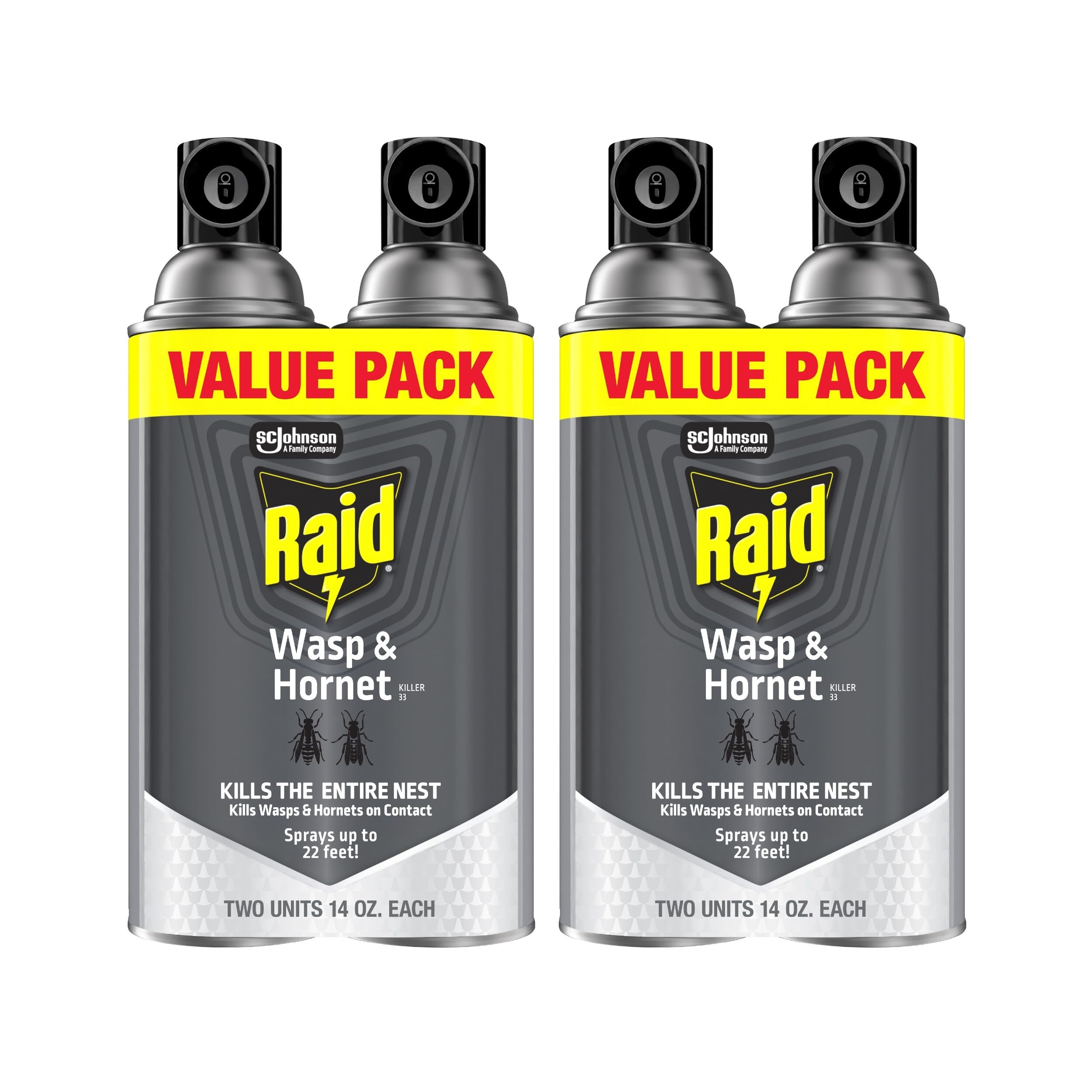
The Raid 4-pack earns its premium status with a dual active-ingredient formula (prallethrin and cypermethrin) that delivers near-instant knockdown while being electrically non-conducting up to 32,500 volts. This means you can safely treat nests built around outdoor lighting, security cameras, or porch ceiling fans without worrying about electrical shorts or shocks.
The 22-foot spray range is generous enough for most two-story eave treatments, and the narrow stream design lets you direct the insecticide precisely into small gaps where nests are hidden. The four-can pack gives you the flexibility to stage cans at different doors or keep one in the garage for spontaneous nest discoveries.
Some users note that the cans are relatively small at 14 ounces each, so if you are facing a massive ground nest requiring extended spraying, you might burn through a can quickly. The tradeoff is a lighter can that is easier to maneuver and aim one-handed.
Why it’s great
- Non-conductive formula rated to 32,500V for electrical-area safety
- Dual active ingredients provide extremely fast knockdown
- Four-pack allows convenient staging around the property
Good to know
- 14 oz cans run out faster than larger 20 oz competitors
- Stream is narrow — may require multiple passes for large nests
3. Spectracide Carpenter Bee and Ground-Nesting Yellowjacket Killer 3-Pack
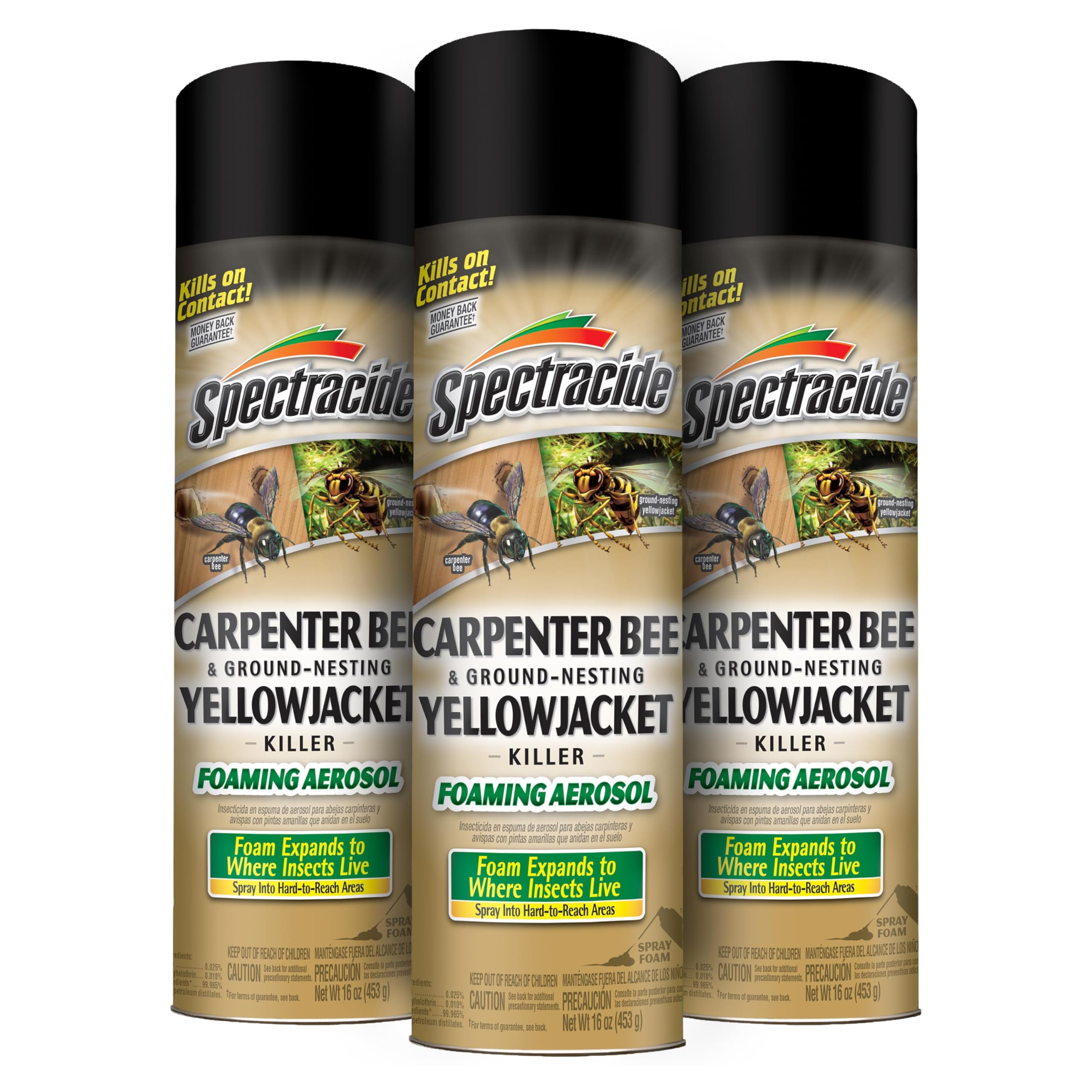
Ground-nesting yellow jackets are notoriously difficult to eradicate because standard jet sprays only coat the entrance hole, leaving the colony intact deeper in the tunnel. This foaming aerosol from Spectracide solves that problem — the foam expands as it travels, filling the entire cavity and coating the insects with insecticide as it spreads. The included extension tube lets you insert the nozzle directly into the hole for subsurface delivery.
The formula contains prallethrin and lambda-cyhalothrin, providing both immediate contact kill and residual activity that eliminates returning workers. Users report that one treatment typically wipes out the colony, and the foam also works on carpenter bee tunnels in wood decks and siding.
A small number of users received cans with low propellant that failed to foam properly. This appears to be a batch-specific issue rather than a design flaw, but it is worth checking the manufacture date upon arrival to ensure freshness.
Why it’s great
- Expanding foam reaches deep into ground tunnels and wood cavities
- Extension tube enables targeted application without bending over the nest
- Dual active ingredients deliver contact kill plus residual protection
Good to know
- Some cans may arrive with low propellant — check date codes
- Foam does not seal the hole; insects could dig a new exit
4. BASF PT Wasp-Freeze Insecticide 2-Pack

BASF PT Wasp-Freeze is designed for professionals and serious homeowners who need the fastest possible knockdown to prevent stinging pheromones from being released. The prallethrin 0.1% formula freezes yellow jackets mid-air within seconds, and the manufacturer specifically engineered the spray to suppress alarm pheromone emission — meaning fewer reinforcements show up while you are treating the nest.
The foam stream reaches up to 15 feet, which is shorter than other entries on this list, so you have to be closer to the nest than with a 27-foot spray. However, the tradeoff is unmatched speed: users report seeing insects drop instantly, even before the foam fully envelops them. The residual activity continues to kill returning foragers for days.
The 14-ounce cans are pricey per ounce, and each can covers roughly one large nest or two small ones. For properties with multiple active nests, the two-pack may not stretch far enough, making this a better choice for targeted nest elimination rather than perimeter spraying.
Why it’s great
- Suppresses alarm pheromones, reducing swarm risk during treatment
- Knocks down insects within seconds of contact
- Residual activity prevents re-nesting for several days
Good to know
- 15-foot range is shorter than competing sprays
- Small cans run out quickly on large infestations
5. Bengal Non-Conductive Wasp and Hornet Killer

When yellow jackets build nests around outdoor electrical panels, pool pumps, or security light fixtures, a non-conductive spray is non-negotiable. Bengal’s non-conductive formula is rated up to 38,800 volts, giving you the highest safety margin in this category for spraying near live equipment. The solvent-based formula delivers instant paralysis on contact, knocking insects down before they can sting.
The 20-foot range is adequate for most residential treatments, and the spray pattern is a wide shotgun blast rather than a narrow stream, making it easier to hit moving targets. Users praise the lack of foaming, which means the spray penetrates nest crevices without blocking them, and the absence of odor makes application more pleasant.
One downside: the solvent base can stain certain siding materials and asphalt shingles if over-applied. Spot-test on an inconspicuous area before full treatment, and avoid saturating painted surfaces.
Why it’s great
- Highest non-conductive rating at 38,800V for electrical-area safety
- Wide shotgun spray pattern makes hitting moving insects easier
- No foaming — penetrates deep into nest crevices
Good to know
- Solvent base may stain siding and shingles on contact
- Single 15 oz can may not be enough for multiple large nests
6. Bengal Foaming Wasp and Hornet Killer

Bengal’s foaming formula uses a delayed-action mechanism that lets the thick foam fully encapsulate the nest before the insecticide takes effect, trapping yellow jackets inside the foam blanket. The 25-foot range is among the longest of any foaming product, so you can treat high eaves from ground level with confidence. The water-based formula is safe for ornamental plants and shrubs, and it won’t stain most siding or asphalt shingles.
User reports highlight its effectiveness on large clusters — one user eliminated a nest with 30-40 wasps in a single treatment. The foam holds its structure well, clinging to vertical nest surfaces rather than dripping off, which maximizes contact time with the insects.
Because the foam is water-based, it is not rated as non-conductive and should not be sprayed near electrical sockets or equipment. It also takes a few seconds longer to kill compared to solvent-based sprays, so you need to wait for the foam to do its work before approaching the nest.
Why it’s great
- Delayed-action foam encapsulates nests for full coverage
- 25-foot range keeps you far from the nest
- Water-based and non-staining on most surfaces
Good to know
- Not non-conductive — avoid electrical equipment
- Kill time is slightly slower than solvent-based sprays
7. Revenge Wasp & Hornet Killer Aerosol

Revenge from Bonide delivers a solid entry-level option that covers all the basics without the frills. The triple-action formula provides instant knockdown, quick kill, and residual activity, and the 20-foot jet stream is sufficient for most single-story homes. The spray is labeled for wasps, hornets, yellow jackets, carpenter bees, and mud daubers, making it a versatile tool for anyone dealing with multiple stinging insect species.
Users consistently confirm that it drops yellow jackets on contact and that the residual effect prevents re-nesting in treated areas. The 15-ounce can is on the smaller side, but the price point makes it an affordable choice for light-duty or occasional use around doors, windows, and eaves.
The biggest limitation is the single-can purchase — you will need to buy multiple cans if you have several nests or a large property. Additionally, the spray is not foaming and not non-conductive, so its application range is limited to standard outdoor structural areas away from electricity.
Why it’s great
- Triple-action formula kills on contact with residual protection
- Effective against five different stinging insect species
- Easy-to-use no-mix design with 20-foot reach
Good to know
- 15 oz can is small for large infestations
- Not foaming or non-conductive — limited use scenarios
FAQ
Can I use bee spray for yellow jackets on a ground nest?
Why does non-conductive spray matter for yellow jacket treatment?
How long does it take for the spray to kill a yellow jacket nest?
Final Thoughts: The Verdict
For most users, the best bee spray for yellow jackets winner is the Spectracide Wasp and Hornet Killer 3-Pack because it combines the longest 27-foot range, reliable contact kill, and generous three-can value that covers multiple nests in a single purchase. If you need non-conductive protection for electrical areas, grab the Raid Wasp & Hornet Killer 4-Pack. And for ground-nesting colonies, nothing beats the expanding foam action of the Spectracide Carpenter Bee and Ground-Nesting Yellowjacket Killer 3-Pack.