
Our readers keep the lights on and my morning glass full of iced black tea. As an Amazon Associate, I earn from qualifying purchases.
Specs are compiled from manufacturer listings and verified buyer reviews and can change over time — please confirm the key details on the product page before buying.
If you drive an older truck, van, or classic car without factory air conditioning, summer driving can feel like sitting in an oven. A 12V under-dash cooling unit is made to fix exactly that, blowing cold air straight into the cabin so every mile is bearable. This guide breaks down the three types of portable car AC units — the under-dash evaporator kit, the split-system mini-split, and the premium inverter unit — and tells you which one matches your ride and your habits.
I’m Min — the founder and writer behind Gadgets Feed. This guide is built by comparing the manufacturers’ published specifications and the patterns across verified customer reviews, so you get each pick’s real strengths and trade-offs instead of marketing spin.
From the best budget-friendly 12V evaporator kit to a premium heating-and-cooling unit, here is the shortlist of the ac portable for car that genuinely earns a spot under your dash.
Our Picks at a Glance
How To Choose The Best AC Portable For Car
Before you buy, know that these are not household window units. They all run off your 12V electrical system, which means your battery and alternator — not the wall outlet — carry the load. Pick the wrong one for your vehicle and you could end up with a drained battery on a hot day.
Cooling power and your cab size
The number that tells you how cold a unit can get is its BTU (British thermal units) rating — roughly, how much heat it can remove per hour. A small car cabin cools fast with 11,000 BTU, while a roomy van or truck cab wants closer to 16,500 BTU so the cold air reaches the back seats and not just your knees.
Airflow in CFM
BTU tells you how cold it can get; CFM (cubic feet per minute) tells you how fast that cold air moves. High CFM means the air circulates quickly, so you feel the chill sooner. If the fan feels weak, even a strong compressor will leave the cabin unevenly cool.
Battery and power draw
The reality is your car’s electrical system has limits. A simple evaporator kit draws around 8A, which most standard alternators handle easily. A split system with a real compressor can pull 400-600W — that drains a standard battery fast when the engine is off. If you plan to idle or sleep with the AC running, a second battery or a generator becomes part of your budget.
Quick Comparison
In-Depth Reviews
1. jiaji A/C Evaporator Kit 12V
Our pick — over 4★ from 20+ verified ratings; the strongest balance of quality and price.
The complete retrofit kit that turns an old truck into a walk-in cooler.
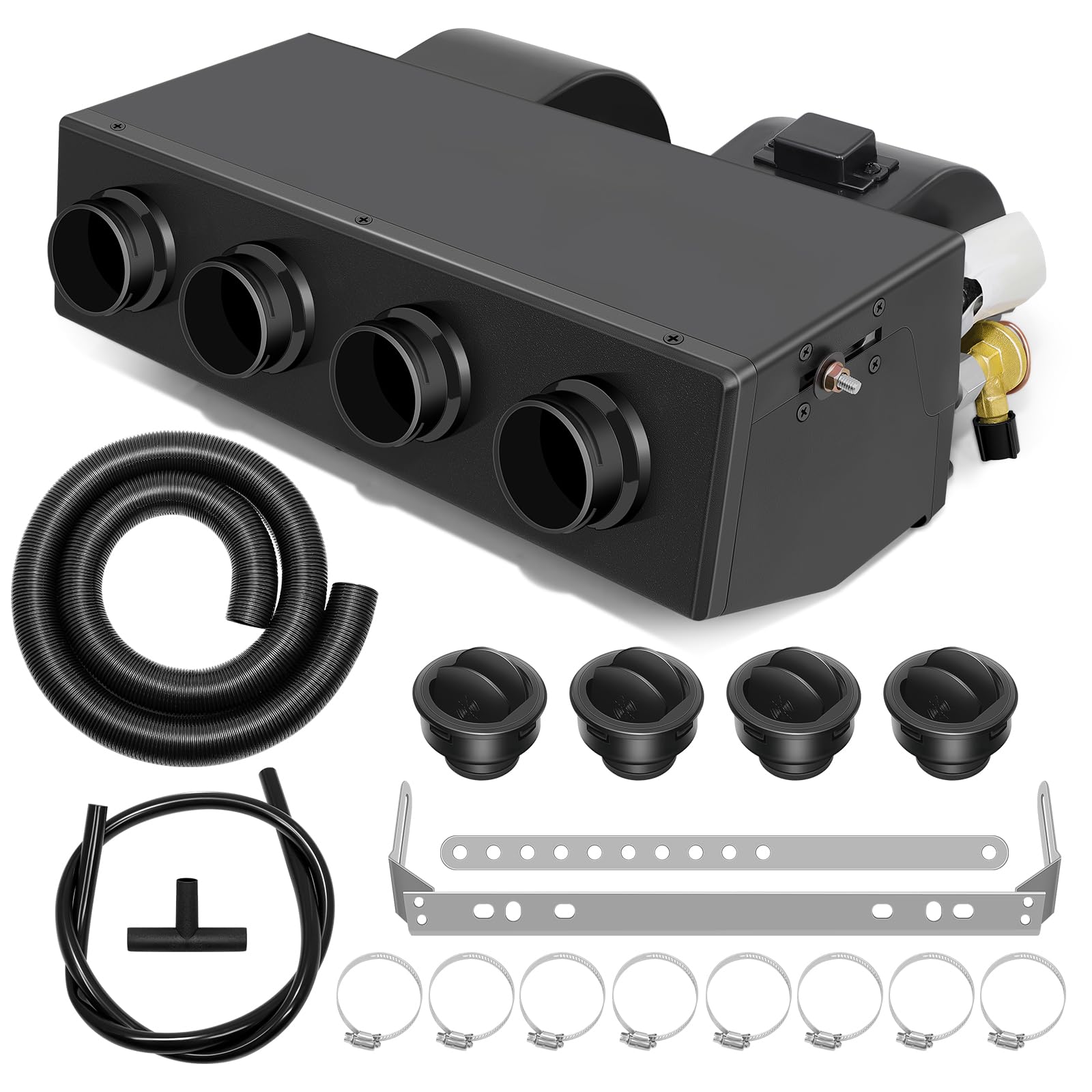
This is the kit for anyone who wants factory-style cooling without cutting up the firewall. It leads with the strongest cooling power on this list — 16,500 BTU per hour — which beats the 11,000 BTU of the split-type unit above by half, so a truck cab drops in temperature noticeably faster. Its 32-channel, 4-way all-aluminum coil and 600 CFM airflow push cold air out fast.
The three fan speeds give you real control. Buyers running it for long hauls report that high speed makes a small cabin feel cool within minutes, while the low speed saves power when you just need a steady breeze. It draws about 8A from the 12V system, a load a standard alternator handles without drama.
You can install this yourself because the box includes every part you need: the evaporator, a 6.5-foot hose, four round vent caps, a drain hose, a T-joint, and all mounting hardware. Reviewers suggest dry-fitting the round vents on the dash before cutting anything, so the holes line up the first time. The 1-year warranty covers the whole kit for added confidence.
Why owners choose it
- Biggest raw cooling output here at 16,500 BTU
- Complete box — hose, vents, drain line all included
- 3-speed fan means low-power cruising
Who should think twice
- No heating function — cooling only
- Best suited to cabs, not wide van interiors
Reach for this if: you want the most cooling muscle per dollar and a simple bolt-in retrofit for a truck or older vehicle.
Look elsewhere if: you need warmth in winter or your rig has a huge open cargo area that demands more airflow.
2. JAYGOVAN 12V Split Type 11000BTU
The two-piece split system built for serious off-grid comfort.
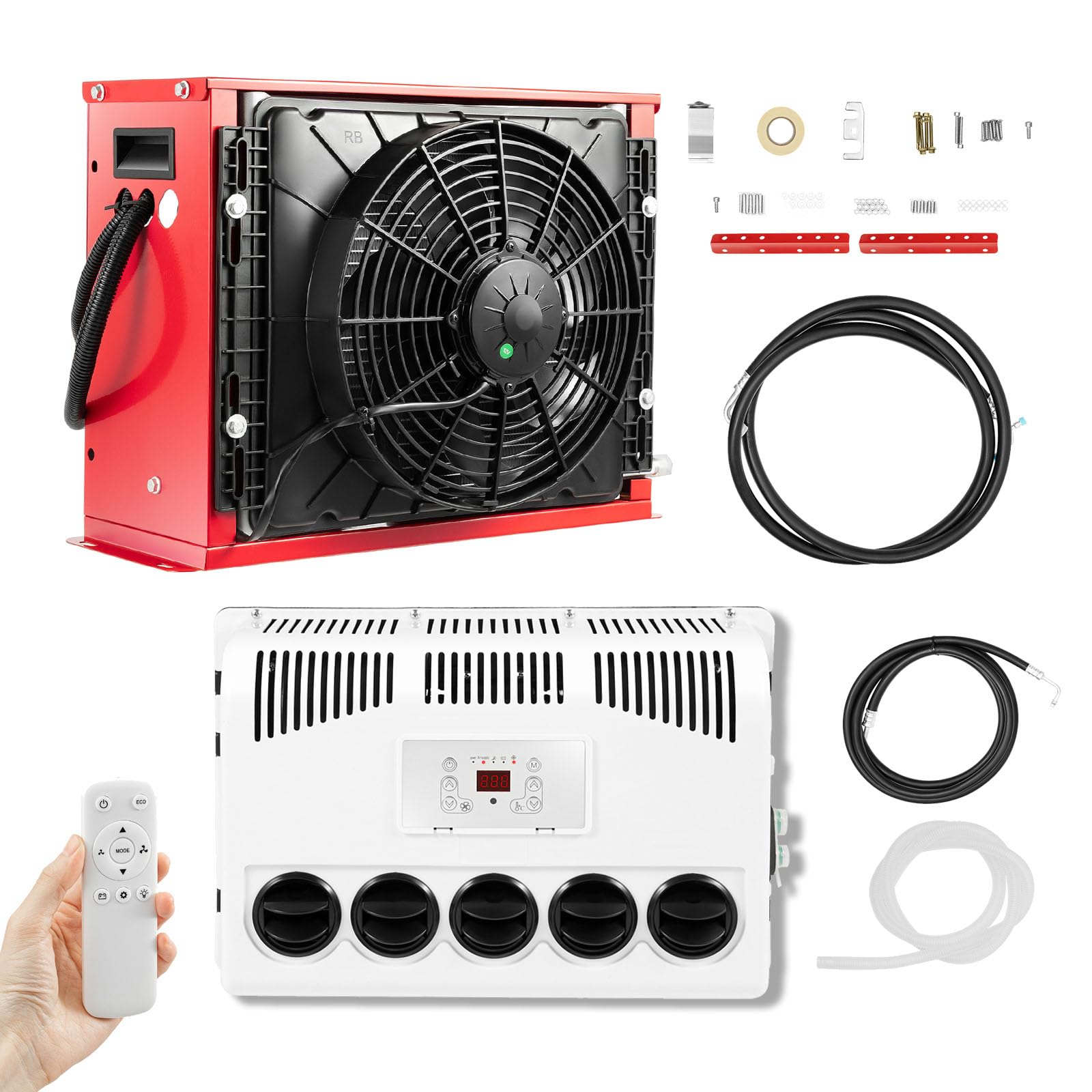
For a camper, trailer, or heavy truck cab, this split-type unit keeps the noisy parts outside the cabin. The plastic internal unit and iron-shelled external unit deliver 11,000 BTU — less than the jiaji kit’s 16,500 BTU, but enough for a cab at high airflow. A 400-600W pure copper wire motor moves air at up to 15,891.6ft³/h, reaching the back seats.
Where this one stands apart is finesse: five fan speeds, plus a remote control and a digital display, so you dial in the exact breeze without reaching across the cab. That is two more speed steps than the jiaji kit’s three, and the remote makes it feel closer to a home air conditioner than a truck add-on.
The honest trade-off is power draw. Buyers running it off-grid report it uses roughly 300-400W on cooling, and a standard truck battery will not survive a long idle session. For overnight use, owners pair it with big lithium banks — 2x280Ah with a 60A DC-DC charger delivers about 20 hours of runtime. Low-voltage protection kicks in at 11V to help protect your battery.
What wins people over
- 5 speeds plus remote control for fine tuning
- High airflow up to 15,891.6ft³/h
- Off-grid capable with solar in the mix
Where it tests your patience
- Power hungry — needs big batteries for idle use
- Reliability is mixed; the low-battery shutdown has failed for some
Best for: campers and big rigs where you want remote-controlled, off-grid comfort and already have a serious battery setup.
Not for: casual users on a stock battery — you will drain it fast if you idle for hours.
3. Bailigo 12V 12000 BTU Under Dash AC
The only unit here that heats as well as cools, with inverter quietness.
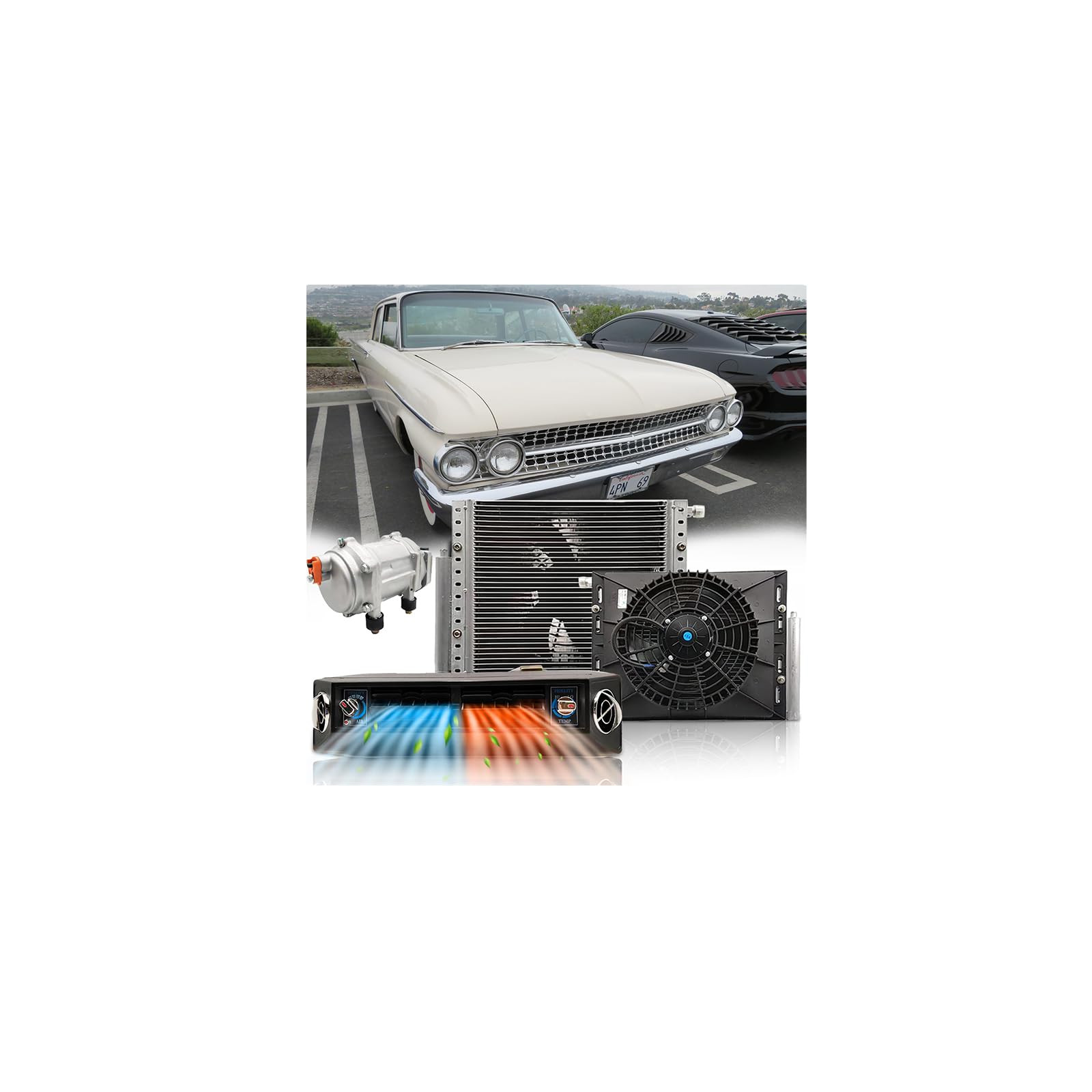
This is the premium all-rounder, and the headline is the heating function — the only pick on this list that keeps you warm in winter and cool in summer. It delivers 12,000 BTU via a 20cc scroll compressor (R-134A refrigerant not included) and cools the cabin in as little as 8 minutes. That sits between the 16,500 BTU of the jiaji kit and the 11,000 BTU of the JAYGOVAN split unit.
What makes it feel premium is the inverter technology. Unlike fixed-speed units, an inverter adjusts its operating frequency to match the cooling demand, which cuts energy use and keeps noise below 50dB (decibels, the loudness level — roughly a quiet indoor conversation). The 3-in-1 design merges receiver dryer, condenser fan, and condenser into one component, simplifying under-dash wiring.
At 5.5 x 12.6 x 15.7 inches, it fits a wide range of vehicles, including classics like a 1956 Chevy Belair. The catch is the paperwork: there are no instructions in the box, and some buyers report the AC lines need cutting and the fittings are not plug-and-play. It is a unit for someone comfortable with custom wiring, not a weekend bolt-on.
Year-round comfort: heating plus cooling makes this the only true all-season pick, and the inverter keeps it quiet at under 50dB.
DIY skill required: plan for custom fitting and bring your own refrigerant — instructions are absent and lines often need cutting.
Reach for this if: you own a classic car or truck and want a quiet, year-round climate system that runs off 12V.
Think twice if: you expect an easy plug-and-play install — this one rewards mechanical skill and patience.
Understanding the Specs
BTU vs CFM
BTU (British thermal units) tells you how much heat the unit can remove in an hour — the raw cooling muscle. CFM (cubic feet per minute) tells you how fast that cold air moves. A high-BTU unit with weak CFM will cool slowly; a high-CFM unit with low BTU will feel breezy but not icy. For a car cab, you want a balance: strong BTU to pull the heat out, strong CFM to push the cold air to your face.
12V Power and Your Battery
These units draw from your car’s 12V system. A low-draw evaporator kit pulls around 8A — fine for a standard alternator. A split or inverter unit can pull 400-600W, which is a heavy load. If the engine is off, a standard battery drains fast; serious users add a second battery bank or a generator to idle or sleep comfortably.
FAQ
Will a 12V AC unit drain my car battery when the engine is off?
What size BTU do I need for my truck cab?
Can I install an under-dash AC unit myself?
Do these units need refrigerant, and is it included?
Is a split-type AC unit better than an under-dash evaporator kit?
Can these units run on solar power for off-grid use?
Will an under-dash AC fit in my classic car?
How noisy are these car AC units?
Final Thoughts: The Verdict
For the majority of shoppers, the strongest ac portable for car pick is the jiaji Evaporator Kit because it delivers the biggest cooling punch at 16,500 BTU with a complete, easy install. If you want remote-controlled comfort and already have a serious battery setup, the JAYGOVAN Split Unit is your match. And for classic car owners who want quiet, year-round heating and cooling, the Bailigo Inverter Unit is the one to reach for.
How We Picked
We do not accept paid placement. Every pick is matched to a real buyer and a real use-case; we do not hands-on test units.
Sources & Methodology
Specifications: manufacturer listings and product documentation. Review insights: verified customer reviews, as of September 2026. Pricing: not shown on this page (it changes often); check the current price via the retailer link.
As an Amazon Associate, Gadgets Feed earns from qualifying purchases. This does not affect which products we feature.