
Switching from a lead-acid deep-cycle to a lithium iron phosphate (LiFePO4) battery means accepting a completely different voltage curve, a far longer cycle life, and a BMS that will shut you down if you push too hard. Most buyers get the chemistry right but miss the critical differences in low-temperature cutoffs, continuous discharge current ratings, and the specific BMS logic that governs a trolling motor vs. a solar bank vs. an RV fridge load. This guide separates the spec-sheet heroes from the real-world performers by examining each battery’s BMS architecture, usable capacity, and expansion flexibility — not just the marketing Ah number.
I’m Min — the co-founder and writer behind Gadgets Feed. I have spent hundreds of hours dissecting LiFePO4 datasheets, cross-referencing customer teardown photos against manufacturer claims, and mapping BMS behavior across different load profiles to determine which 12V lithium batteries actually deliver their rated cycles under real off-grid conditions.
After evaluating capacity tests, BMS protection layers, low-temperature behavior, and expandability limits across nine models, the most reliable best battery lithium iron battery choices emerge from a mix of proven cell quality, smart BMS features, and a weight-to-power ratio that makes lead-acid feel archaic.
How To Choose The Best Battery Lithium Iron Battery
LiFePO4 is not a commodity buy. The differences between a battery and a battery show up in three areas: the quality of the prismatic cells (Grade A vs. Grade B), the sophistication of the BMS (simple cutoffs vs. active cell balancing with Bluetooth telemetry), and the real-world cycle life at meaningful depth of discharge. Beginners often assume all 100Ah packs are equal; a closer look at delivered capacity at 100A continuous draw reveals the gap.
BMS Architecture and Low-Temperature Protection
Every LiFePO4 battery requires a Battery Management System that prevents overcharge, over-discharge, short circuits, and thermal runaway. But the critical differentiator in this category is the low-temperature charging cutoff — models that lack this feature can be permanently damaged if charged below 32°F. Premium units like the ECO-WORTHY 280Ah and the Power Queen TM series embed multi-layer BMS boards with per-cell voltage monitoring and TVS surge protection for marine environments. Budget models may use basic BMS chips that disconnect at the pack level without granular cell balancing, leading to premature capacity fade after 200-400 cycles.
Usable Capacity and Continuous Discharge Current
Lead-acid batteries deliver only about 50% of their rated capacity before voltage sag becomes unusable, while LiFePO4 provides essentially 100% of its rated Ah down to the BMS cutoff — but only if the cells are genuine Grade A. Verified buyer tests on the CYCLENBATT 100Ah Mini and the Redodo 100Ah consistently show ~105Ah actual capacity, confirming conservative cell grading. Continuous discharge current (100A, 200A, or 500A burst) determines whether the battery can run a 120lb-thrust trolling motor, a 2000W inverter, or multiple RV appliances simultaneously without tripping the BMS.
Quick Comparison
On smaller screens, swipe sideways to see the full table.
| Model | Category | Best For | Key Spec | Amazon |
|---|---|---|---|---|
| ECO-WORTHY 12V 280Ah | Premium | Large RV / Off-grid | 3584Wh, 200A BMS, Bluetooth | Amazon |
| GOLDENMATE 12V 400Ah | Premium | Massive energy reserve | 5120Wh, 250A cont. discharge | Amazon |
| Redodo 12V 100Ah | Mid-Range | RV / Solar backup | 100Ah, 100A BMS, 10-year life | Amazon |
| Power Queen 12.8V 100Ah TM | Mid-Range | Trolling motor / Marine | ABYC E-13, TVS surge protection | Amazon |
| Litime 12V 100Ah TM | Mid-Range | Marine / Boat | ABYC E-13, low-temp protection | Amazon |
| Wattcycle 12V 100Ah | Mid-Range | Group 24 battery box fitment | BCI Group 24, 15,000 cycles | Amazon |
| CYCLENBATT 12V 100Ah Mini | Budget-Friendly | Tight-space installs | 45% smaller than Group 31, Bluetooth | Amazon |
| DUMFUME 12V 150Ah | Budget-Friendly | High-capacity / Low budget | 1920Wh, 22 lbs | Amazon |
| HQST 12V 100Ah | Budget-Friendly | First-time LiFePO4 upgrade | LED display, 20+ layer BMS | Amazon |
In‑Depth Reviews
1. ECO-WORTHY 3584Wh 12V 280Ah LiFePO4 Battery
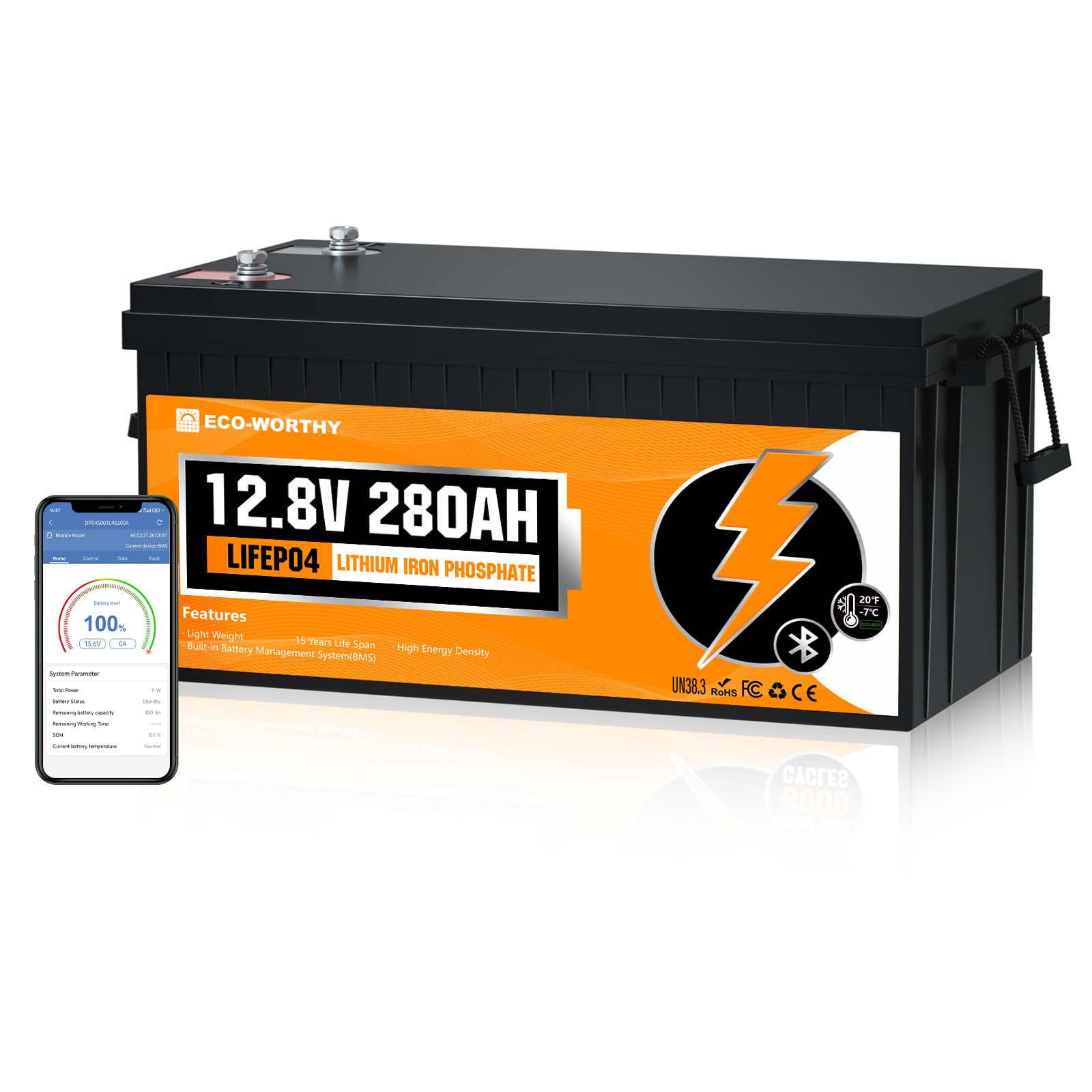
The ECO-WORTHY 280Ah battery is the standout choice for anyone building a serious RV power system or off-grid solar bank. Its 200A continuous BMS can handle a 2000W inverter running a microwave and induction stove simultaneously, and the metal compression frame prevents the cell swelling that shortens lifespan in cheaper plastic-case packs. Bluetooth telemetry from the JBD BMS works with third-party apps like Overkill Solar for granular per-cell voltage tracking — a level of detail usually reserved for DIY server-rack batteries.
At 61.7 pounds, it is roughly the same weight as a 100Ah lead-acid battery but delivers 3584Wh of usable energy — nearly 3x the usable capacity. The low-temperature cutoff is set at 19.4°F for charging and -4°F for discharging, making it viable for four-season camping in cold climates. Verified buyers report actual capacity exceeding the 280Ah rating, and the front-terminal design simplifies wiring in tight RV battery compartments.
The 3-year warranty is shorter than some competitors’ 5- or 10-year terms, but the replaceable JBD BMS component and metal enclosure add durability that matches the longer cycle life claims (6,000 cycles to 80% DoD). For users who need expandable 12V or 48V capacity with real-time monitoring, this is the best overall value in the premium tier.
Why it’s great
- Verified >280Ah capacity with Grade A cells
- Metal compression case with built-in on/off switch
- Bluetooth app compatible with Overkill Solar for detailed cell-level data
Good to know
- 3-year warranty is shorter than some competitors
- Heavier than multiple 100Ah packs of similar total capacity
2. GOLDENMATE 12V 400Ah LiFePO4 Battery
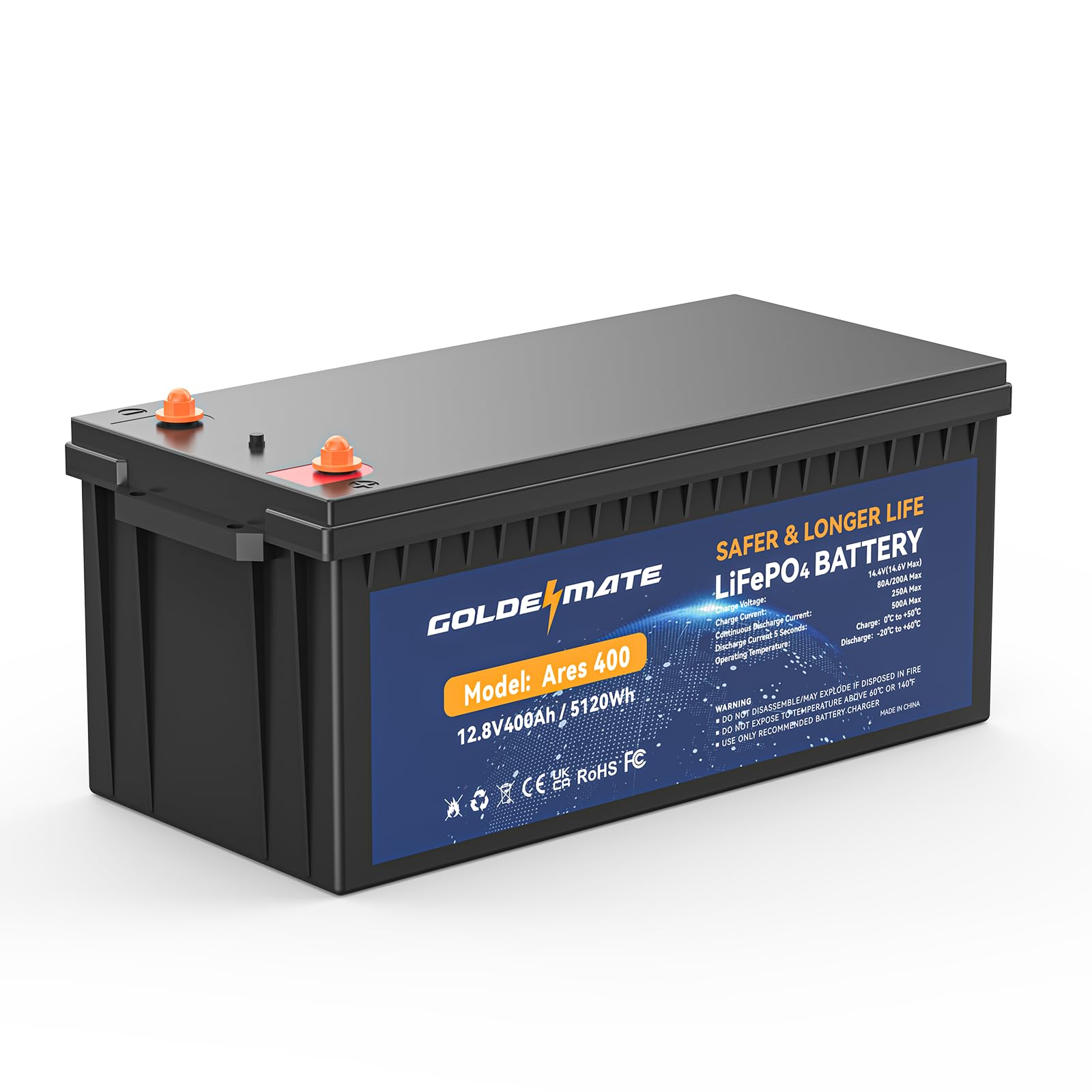
The GOLDENMATE 400Ah is the single-unit solution for users who want massive capacity without wiring multiple batteries in parallel. At 88.2 pounds, it delivers 5120Wh of usable energy — enough to run a 12V fridge, LED lights, a water pump, and a CPAP machine for 3-4 days without solar input. The 250A continuous discharge rating (500A peak for 5 seconds) means it can handle a 3000W inverter for short bursts, though sustained high draw will require the 200A recommended charge current.
Goldenmate includes a custom Bluetooth app that shows charge percentage, run time, and charge time — data that many budget-tier batteries omit. The BMS provides full protection against overcharge, over-discharge, and temperature extremes, with a self-discharge rate low enough to allow one year of storage at full charge. For users with a single large power demand — like an RV residential fridge or a whole-home backup — this battery reduces wiring complexity and BMS coordination issues common with multi-pack setups.
The 1-year warranty is disappointingly short for a battery in this price range, and the 88-pound weight requires two people for installation. But for those who need the highest per-unit capacity in a standard 12V footprint, the GOLDENMATE 400Ah is the definitive choice.
Why it’s great
- 5120Wh in a single 12V battery eliminates parallel wiring complexity
- 250A continuous discharge supports large inverters
- Bluetooth app with accurate capacity and runtime tracking
Good to know
- 1-year warranty is much shorter than the category average
- Very heavy (88 lbs) for a single battery
3. Redodo 12V 100Ah LiFePO4 Battery
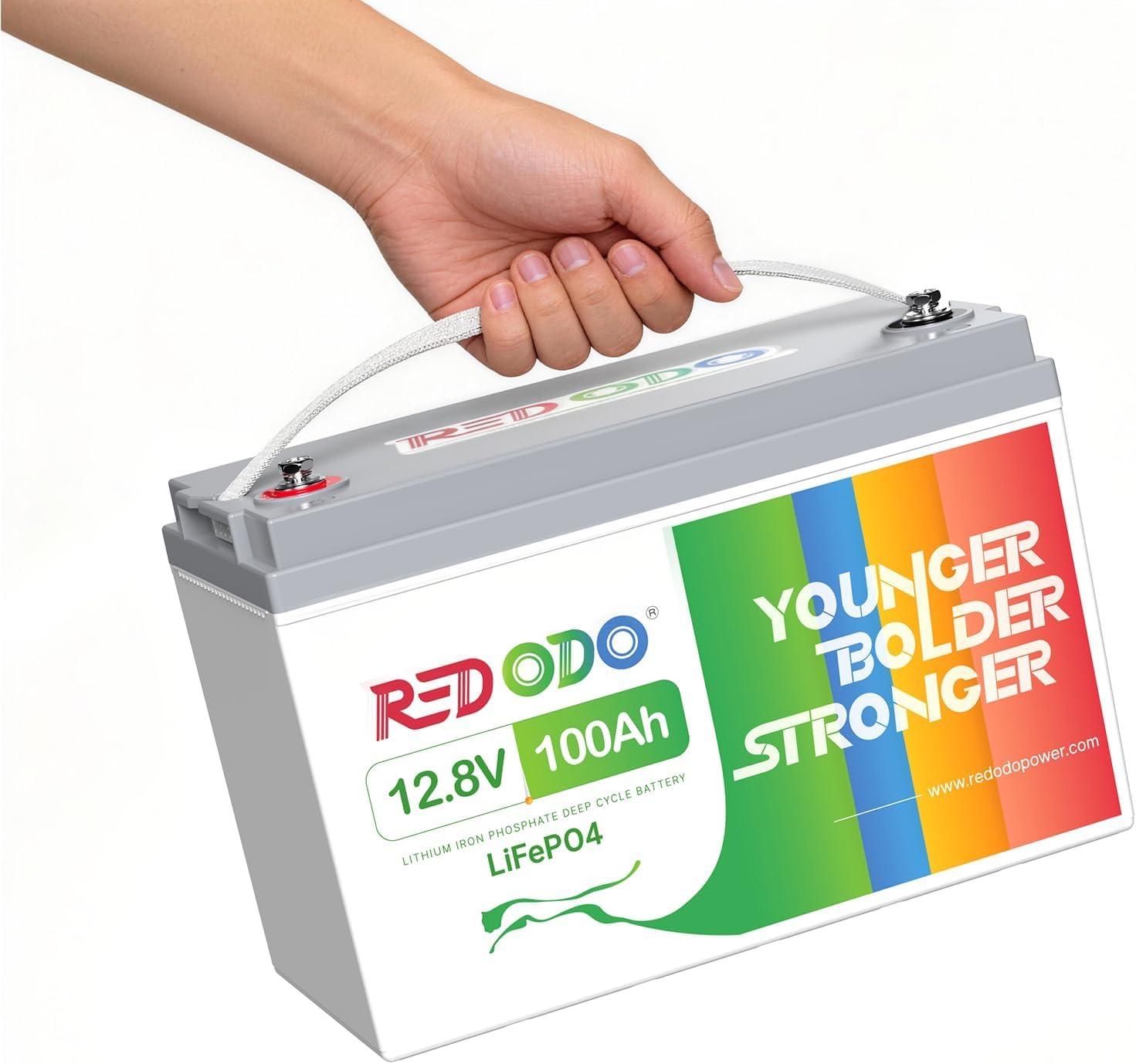
Redodo has built a reputation for using automotive-grade LiFePO4 cells that consistently test above their 100Ah rating in third-party capacity checks. Verified users report ~105Ah actual capacity and cells that stay balanced within 0.04V even after hundreds of cycles. The 100A BMS handles sustained loads like a 1000W inverter or a 70lb-thrust trolling motor without nuisance tripping, and the Group 31 form factor fits standard battery boxes from Renogy, Battle Born, and others.
Users have documented 3+ years of daily duty in motorhomes and off-grid solar systems with zero capacity fade. The 5-year warranty and 10-year design life align with the 4,000-cycle rating at 100% DoD — a realistic claim supported by customer reports of running entire home networks, fish tanks, and freezers without the battery dropping below 80% state of charge overnight. Redodo’s customer support team is notably responsive, providing detailed configuration help for MPPT charge controllers that lack native LiFePO4 profiles.
The lack of Bluetooth monitoring is the main omission at this price point — users who want real-time telemetry will need an external shunt like a Victron SmartShunt. But for buyers who prioritize cell quality, reliable BMS behavior, and long-term durability over app connectivity, the Redodo 100Ah is a top-tier performer.
Why it’s great
- Verified >100Ah actual capacity from automotive-grade cells
- Proven 3+ year lifespan in continuous daily use
- Responsive customer support with detailed tech help
Good to know
- No built-in Bluetooth monitoring
- Not suitable as a starter battery for engine cranking
4. Power Queen 12.8V 100Ah Trolling Motor LiFePO4 Battery
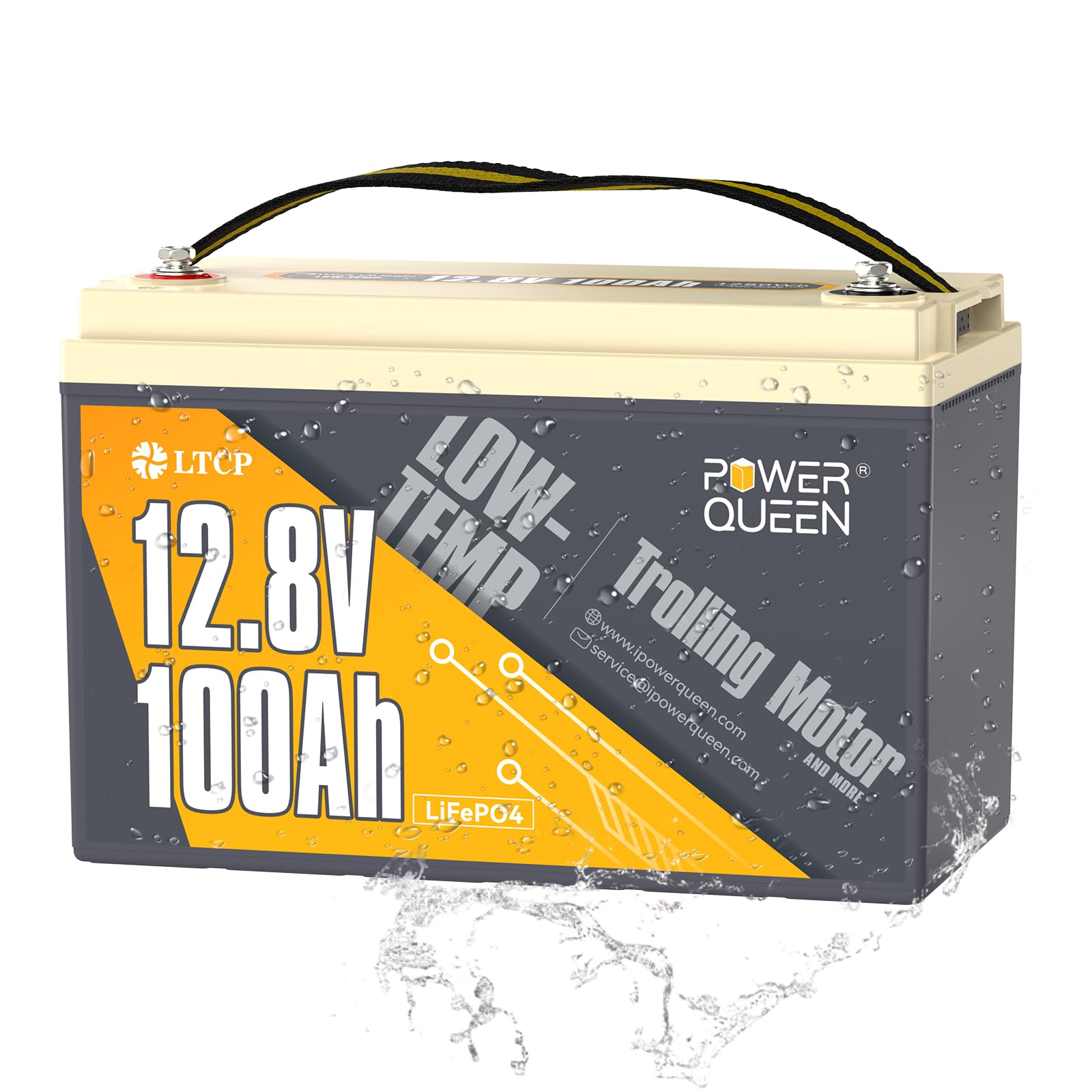
The Power Queen TM (Trolling Motor) battery is engineered specifically for the demanding electrical environment of small to mid-size boats. It meets the ABYC E-13 standard for marine electrical systems, with added TVS (transient voltage suppression) diodes that protect the battery and connected electronics from voltage spikes caused by trolling motor brushes or alternator load dumps. The low-temperature charging cutoff at 32°F and discharge cutoff at -4°F prevent cold-weather damage, making it viable for early-spring fishing trips.
At 22 pounds in a standard Group 31 case, it is 64% lighter than a lead-acid equivalent — a meaningful difference for boat hull balance and fuel economy. Verified users report running a 50lb-thrust trolling motor for 4+ hours of continuous use with less than 10% battery drain, and the included M8 terminal bolts and insulating caps simplify installation. The BMS supports up to 4P4S expansion for a total of 51.2V 400Ah (20.48kWh), allowing users to scale up for larger boats or house loads.
One user noted the physical size is identical to Group 31 lead-acid — not more compact — so boats with tight compartments may need to measure carefully. The 5-year warranty is standard, and Phone support has been positive in reviews. For a dedicated marine battery with proper certifications, this is the best choice in the mid-range tier.
Why it’s great
- ABYC E-13 certified with TVS surge protection for trolling motors
- 30+ lbs lighter than lead-acid, improving boat handling
- Proven long runtime on 50-70lb trolling motors
Good to know
- Same size as Group 31, not smaller
- Bluetooth requires external monitor
5. Litime 12V 100Ah Trolling Motor LiFePO4 Battery

The Litime 100Ah TM battery is a direct competitor to the Power Queen, sharing the same ABYC E-13 marine certification and low-temperature protection thresholds. The key difference is Litime’s BMS programming: it uses a more conservative discharge curve that protects cells at the cost of slightly lower peak output, making it ideal for sustained low-draw applications like running a 12V fridge or a 45lb-thrust trolling motor at cruising speed rather than full-throttle sprints. The TVS surge protection is present but rated for slightly lower energy absorption than the Power Queen’s.
User feedback highlights the battery’s ability to run a 16-foot jonboat with three occupants and a trolling motor for hours without meaningful voltage drop — one reviewer reported only 10% discharge after 4 hours of continuous use in wind conditions. At 22.16 pounds, the weight reduction is immediate: users report improved hole shot and 4 mph top-end speed gains versus lead-acid. The app connectivity is simple and responsive, showing voltage, current, and cycle count.
One caveat: Litime’s manual for parallel wiring includes an incorrect diagram, as several buyers noted. Wiring multiple units in parallel using busbars alone works correctly, but users should verify connections with a multimeter. The 5-year warranty and responsive phone support mitigate this minor documentation issue.
Why it’s great
- ABYC E-13 certified with TVS protection
- Very long runtime on moderate trolling motor settings
- Lightweight enough to improve boat performance
Good to know
- Parallel wiring diagram in manual is incorrect
- Conservative BMS may trip on sudden high loads
6. Wattcycle 12V 100Ah LiFePO4 Battery
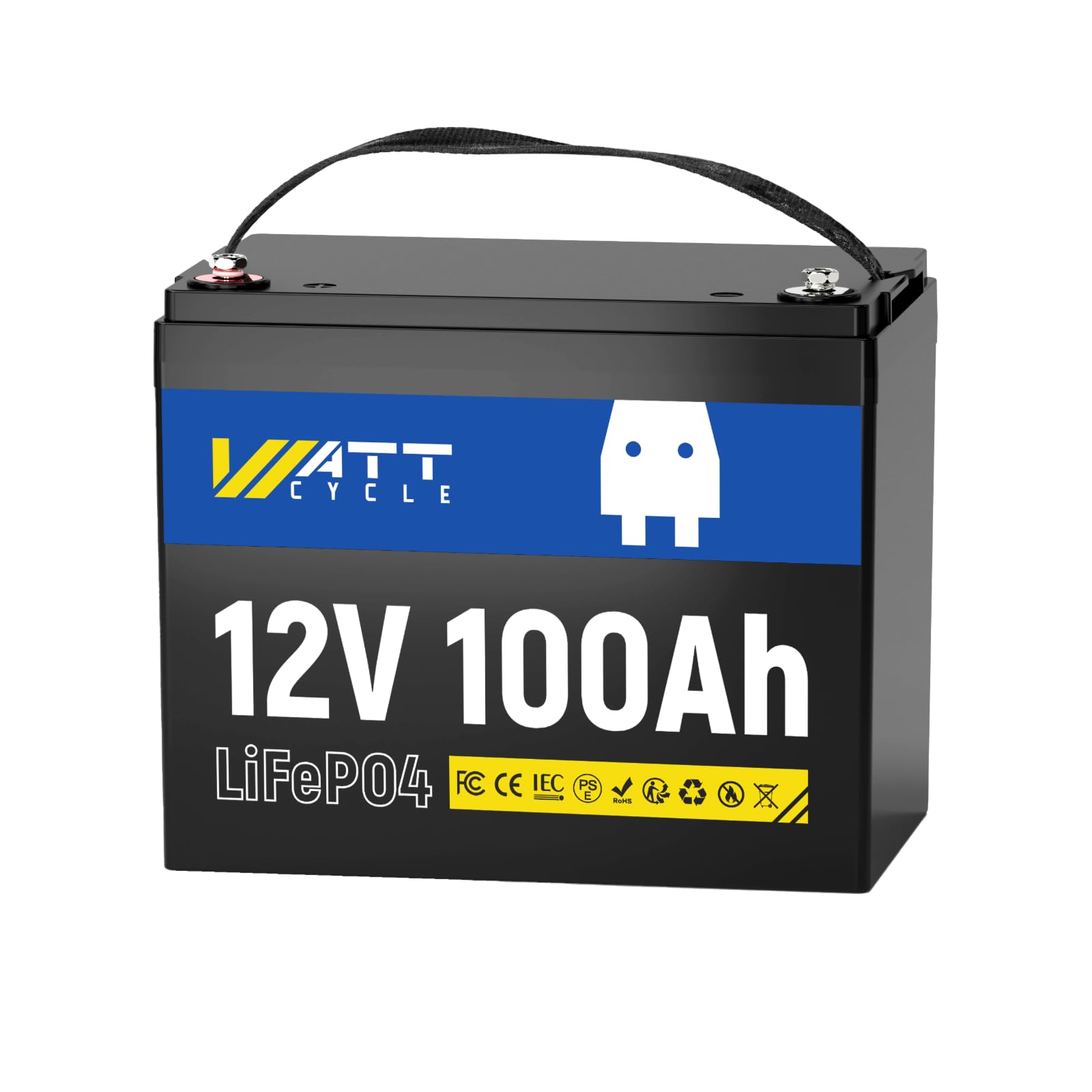
The Wattcycle 100Ah battery stands out for its BCI Group 24 form factor — a smaller footprint than the standard Group 31, measuring just 10.2 x 6.6 x 8.2 inches. This makes it the best choice for RVs, golf carts, and boats with pre-existing Group 24 battery boxes where Group 31 batteries simply won’t fit. Despite the smaller case, it uses A+ grade cells with a published cycle life of 15,000 cycles at low DoD, backed by SDS, UN38.3, FCC, CE, and RoHS certifications.
Verified buyers who use the battery in 24V trolling motor configurations report consistent performance: after a full day of fishing, voltage never dropped below 12.5V per battery (25V system total), and recharging at 75% depth of discharge took about 12.5 hours with a 6A charger. The 100A BMS handles peak surges of 300±50A before disconnecting, which protects against accidental over-current from inverter start-up transients or motor stalls.
The main complaint across multiple users is the extremely short terminal bolts — the included M8 bolts are only 1/2 inch long, making it difficult to stack ring terminals for parallel wiring. Users recommend purchasing M8x16mm bolts separately for about . There is no Bluetooth monitoring, but the battery’s build quality and certifications make it a strong mid-range contender for those who need the smaller Group 24 footprint.
Why it’s great
- True BCI Group 24 size fits smaller battery boxes
- Multiple safety certifications (SDS, UN38.3, FCC, CE, ROHS)
- Excellent customer-verified cycle life in real-world use
Good to know
- Terminal bolts are too short for parallel wiring — buy M8x16mm
- No Bluetooth monitoring built-in
7. CYCLENBATT 12V 100Ah Mini LiFePO4 Battery
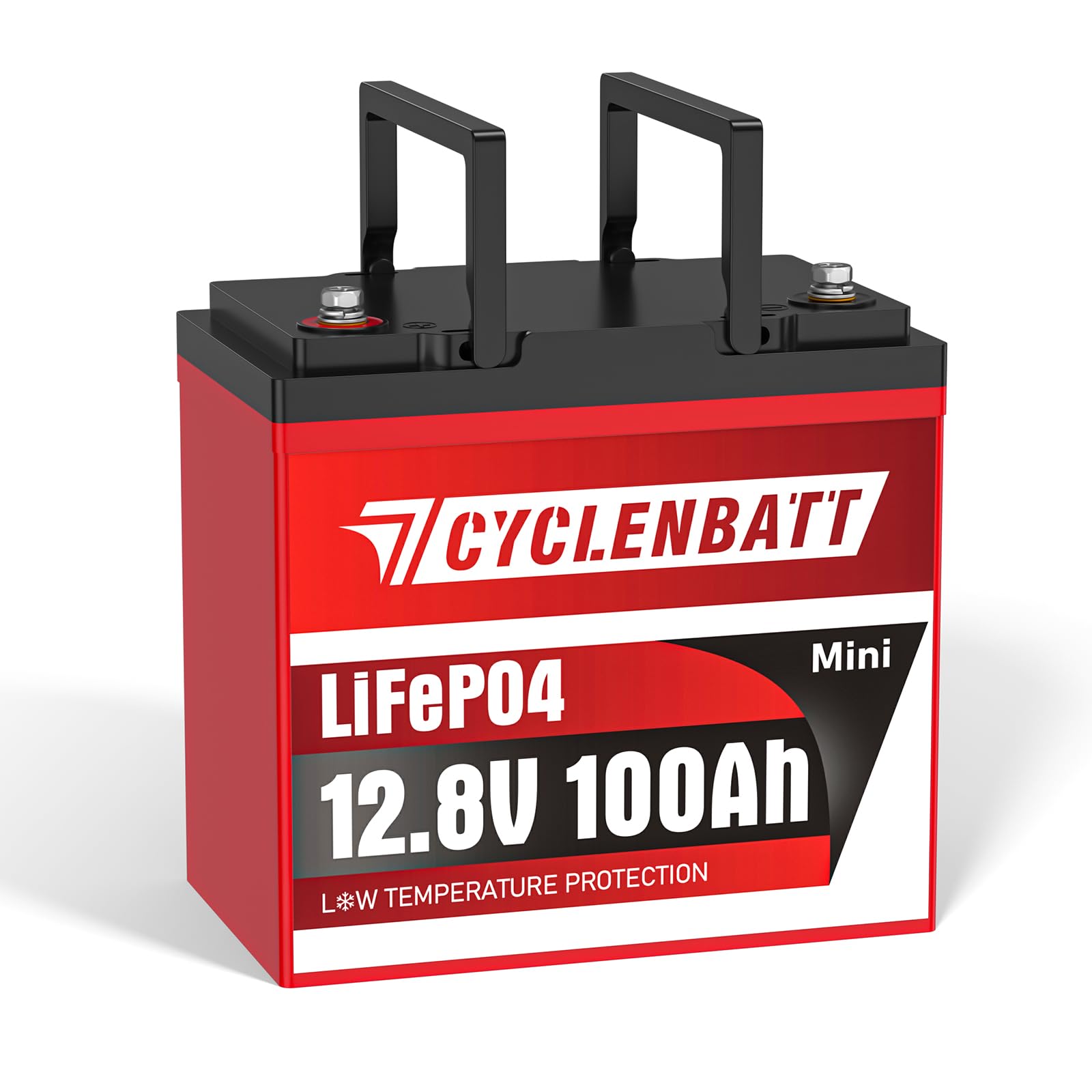
The CYCLENBATT Mini achieves a 45% volume reduction compared to standard Group 31 100Ah batteries while maintaining the same 100Ah capacity and 100A continuous discharge. It uses Class A prismatic cells with an advertised 15,000-cycle lifespan under ideal conditions, and the built-in Bluetooth app provides real-time telemetry including per-cell voltage, current, temperature, charge cycles, and charge/discharge status — data usually found only in premium batteries costing twice as much.
At 20.5 pounds, it is 66% lighter than a lead-acid equivalent, and the compact dimensions (5.4 x 8.2 x 9.0 inches) allow it to fit in spaces designed for smaller batteries, such as under seats in a kayak or inside a battery box originally built for a 50Ah AGM. Verified capacity tests show ~104-105Ah actual energy, and the cells are matched within 0.04V out of the box. The Bluetooth range is excellent, and Python scripting support exists for technical users who want to log data to a home automation system.
One user reported a broken handle clip, and the mini size means the terminals are closer together, requiring care when wiring lugs to avoid shorting. The 5-year warranty is standard, and the company’s 24-hour support turnaround is better than many budget-tier competitors. For space-constrained installations like small boats, camper vans, or overland setups, this Mini is the best option.
Why it’s great
- 45% smaller than Group 31, fits tight spaces
- Bluetooth app with per-cell voltage monitoring
- Verified >100Ah actual capacity from Class A cells
Good to know
- Handle clip may be fragile
- Terminal spacing is tight for large-gauge lugs
8. DUMFUME 12V 150Ah LiFePO4 Battery
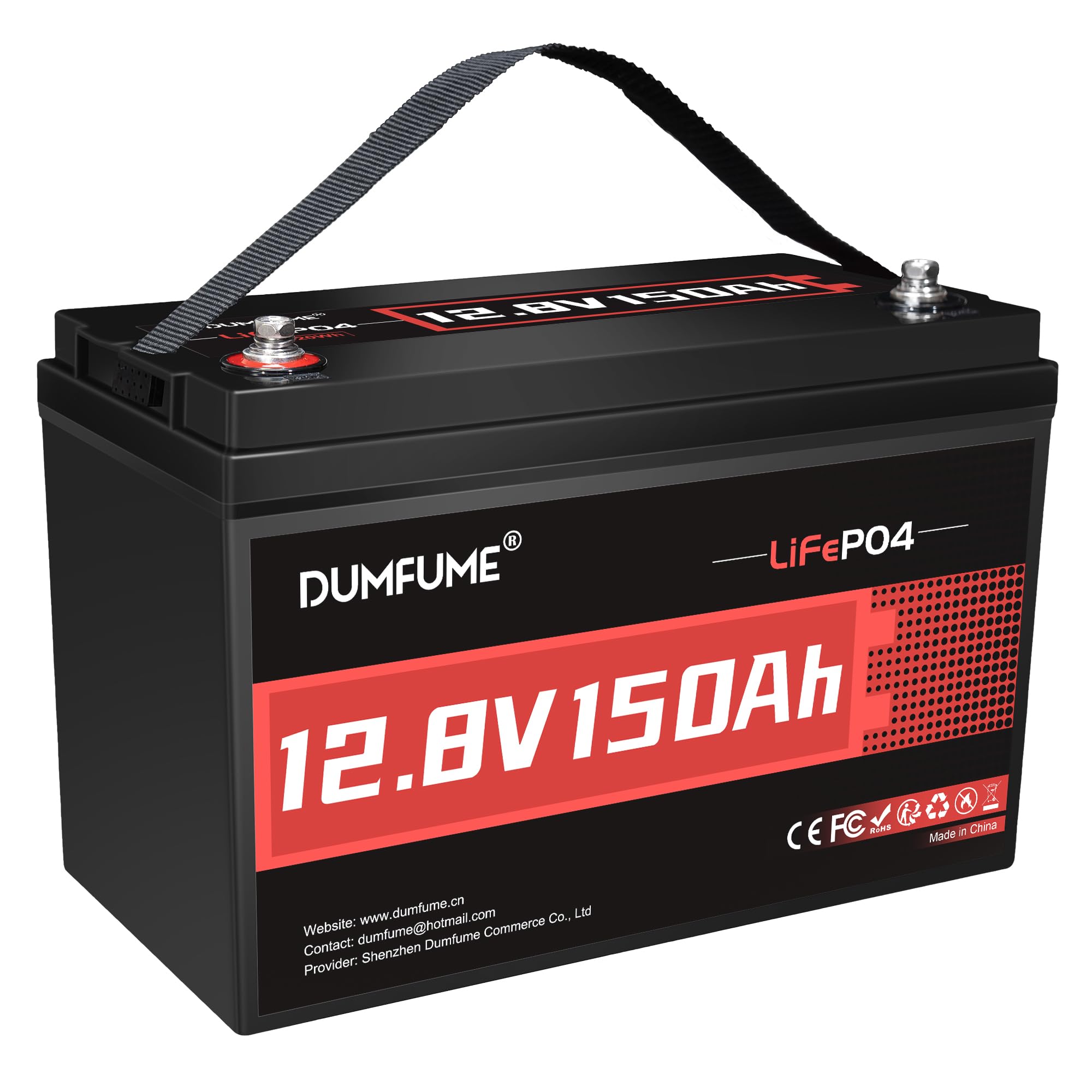
The DUMFUME 150Ah battery delivers 1920Wh of energy at a weight of just 22.05 pounds — an exceptional energy-to-weight ratio that makes it a strong value contender for stationary solar storage and backup power. Multiple verified buyers report actual capacity exceeding the rating by about 7Ah, and the 100A BMS has proven reliable in continuous load testing at 50A charging without tripping. The compact dimensions (13.05 x 6.78 x 8.66 inches) fit standard Group 31 footprints.
Users have successfully deployed four 150Ah units in parallel for home solar arrays, with the oldest unit still exceeding its rated capacity after one year of twice-weekly charging cycles. The 5-year warranty from the manufacturer is straightforward, though a few customers note that the warranty is only valid for purchases made directly through Dumfume — not through Amazon Marketplace — so buyers should verify the seller. The 100A BMS provides standard protections, but there is no Bluetooth monitoring at this price point.
The main concern is reliability variance: while the plurality of users report flawless performance, a very small number have experienced BMS failure after 12-18 months of light use, suggesting that the BMS component quality may not match premium-tier units. For budget-constrained buyers who prioritize raw capacity per dollar and are comfortable with external monitoring, the DUMFUME 150Ah is a compelling pick.
Why it’s great
- 1920Wh for under 22 lbs — excellent energy density
- Verified >150Ah actual capacity in third-party tests
- 5-year warranty for direct purchases
Good to know
- Warranty only valid through direct purchases, not Amazon
- BMS reliability may not match premium-tier batteries
9. HQST 12V 100Ah LiFePO4 Battery

The HQST 100Ah battery is the entry-level benchmark for budget-conscious buyers who want the core LiFePO4 advantages — lightweight, full 100% usable capacity, and a 10-year support commitment — without paying for Bluetooth or premium BMS features. The built-in LED display shows real-time voltage, current, and remaining capacity, providing basic telemetry that replaces the need for a separate battery monitor in simple 12V systems. The 20+ layer BMS includes low and high-temperature cutoffs, though some users report the low-temp cutoff activating too early in cold conditions.
Ice-fishing users have verified the battery runs a Humminbird fish finder and Mega Live imaging sonar for 12+ hours with less than 0.5V voltage drop, and other users report powering 36V trolling motors all day from a bank of three in series. The 22-pound weight makes it easy to transport, and the expansion capability up to 20.48kWh (16 batteries in series/parallel) provides a path for scaling up as power demands grow.
The LED screen is not waterproof — multiple users caution that exposure to splashing water can damage the internal computer, requiring a silicone sealant application. Customer service has been responsive about warranty replacements for water-damaged units, but this is a design limitation compared to sealed-case competitors. For buyers on a strict budget who can protect the battery from moisture, the HQST 100Ah offers solid foundational value.
Why it’s great
- Built-in LED display provides voltage, current, and capacity at a glance
- Very light (22 lbs) for easy transport and installation
- 10-year support and expandable up to 20.48kWh
Good to know
- LED screen is not waterproof — must be sealed in wet environments
- Low-temperature cutoff may engage earlier than specified
FAQ
Can I use a LiFePO4 battery as a starter battery in my car?
How do I charge a LiFePO4 battery with a solar panel?
Why does my LiFePO4 battery voltage stay at 13.2V even when partially discharged?
Final Thoughts: The Verdict
For most users, the best best battery lithium iron battery winner is the ECO-WORTHY 12V 280Ah because its 3584Wh capacity, metal compression case, Bluetooth telemetry, and 200A BMS provide the best balance of performance, monitoring, and durability for serious off-grid and RV systems. If you need the highest single-unit capacity for a large solar array or whole-home backup, the GOLDENMATE 12V 400Ah delivers 5120Wh without the complexity of parallel wiring. And for trolling motor and marine applications where ABYC certification and surge protection matter most, nothing beats the Power Queen 12.8V 100Ah TM.