
A motorcycle battery that dies mid-season isn’t just an inconvenience—it’s a symptom of neglect that a proper charger can prevent entirely. The right unit doesn’t just dump current into a dead cell; it analyzes, conditions, and maintains voltage with precision that a standard trickle charger simply cannot match.
I’m Min — the co-founder and writer behind Gadgets Feed. I’ve spent countless hours cross-referencing charge profiles, desulfation pulse patterns, and real-world owner reports to separate the units that genuinely preserve battery life from those that just claim to.
Whether you ride year-round or store your bike for the season, this guide cuts through the voltage noise to identify the best motorcycle battery charger for your specific setup and storage habits.
How To Choose The Best Motorcycle Battery Charger
Selecting a charger for your bike involves more than matching voltage. The key is understanding how your battery chemistry (AGM, flooded, gel, or LiFePO4) interacts with the charger’s output stage and maintenance logic. A mismatched charger can overheat a sealed battery or fail to wake a deeply discharged lithium unit.
Amp Rating vs Battery Capacity
The charger’s current output, measured in amps, dictates how quickly it replenishes a battery. A 0.75A unit like the Battery Tender Junior is ideal for small 6Ah–30Ah motorcycle batteries, offering safe, slow charging over 24–48 hours. A 5A charger such as the NOCO GENIUS5 cuts that time dramatically and can handle larger 50Ah batteries without stress. A 20A or 35A unit belongs on deep-cycle marine or large RV batteries, not on a standard 12Ah sportbike battery — the higher current risks triggering the battery’s internal protection circuits or causing gassing in a flooded cell.
Smart Charging Stages and Desulfation
A true smart charger follows a multi-stage profile: initialization, bulk charge (constant current), absorption (constant voltage), and float. The critical differentiator is desulfation — a pulse mode that reverses the lead sulfate crystal buildup that kills batteries left in a partial state of charge. The NOCO GENIUS5 and VEVOR 20A explicitly advertise desulfation, while the Battery Tender Junior does not. If your bike sits for more than two weeks, desulfation is the feature that decides whether a battery lasts one season or five.
Chemistry Compatibility and Force Mode
Lead-acid, AGM, and gel cells charge at roughly 14.4V–14.7V. LiFePO4 batteries require a lower absorption voltage (14.2V–14.6V) and a different float profile. Units like the ECO-WORTHY 5A and NOCO GENIUS5 offer a dedicated lithium mode. Even more important is Force Mode — a manual over-ride that allows the charger to begin conditioning a battery that has dropped below 1V (completely dead). The NOCO and VEVOR models both offer this. Units without Force Mode will simply refuse to charge a fully depleted battery, rendering them useless in a revival scenario.
Physical Design and Mounting
Motorcycle battery chargers live in garages, on shop floors, and occasionally in rain. The OptiMate3 features a fully sealed case for light rain resistance. The Battery Tender Junior includes ring terminal harnesses that let you leave the connector attached to the battery under the seat, making weekly connection a 5-second clip-on. The NOCO ships with a mounting bracket and Velcro strap. If your bike lives outside, prioritize spark-proof circuitry and a sealed housing.
Quick Comparison
On smaller screens, swipe sideways to see the full table.
| Model | Category | Best For | Key Spec | Amazon |
|---|---|---|---|---|
| NOCO GENIUS5 | Smart | General motorcycle use | 5A, 6V/12V, LiFePO4, desulfation | Amazon |
| Battery Tender Junior | Maintainer | Long-term storage | 0.75A, 12V, spark-proof | Amazon |
| OptiMate3 | Specialist | AGM/Gel powersport | 0.8A, 12V, sealed case | Amazon |
| Schumacher SC1280 | Rapid | Fast top-off | 15A, 6V/12V, digital display | Amazon |
| VEVOR 20A | Desulfator | Deep-cycle / fleet | 20A, 6/12/24V, LCD, desulfation | Amazon |
| ECO-WORTHY 5A | Value | Budget LiFePO4 support | 5A, 12V, LCD, dual chemistry | Amazon |
| WAVLINK 35A | Powerhouse | Multi-vehicle garage | 35A, 6/12/24V, forced mode | Amazon |
In‑Depth Reviews
1. NOCO GENIUS5

The NOCO GENIUS5 delivers 5A of clean, multi-stage power across 6V and 12V systems, supporting both lead-acid (AGM, gel, flooded) and LiFePO4 chemistries. Its thermal sensor adjusts the charge voltage dynamically based on ambient temperature, preventing the overcharging that plagues fixed-profile chargers in warm garages. At just 1.59 pounds, it includes a mounting bracket for permanent installation near the bike’s battery tray.
Where the GENIUS5 separates itself from the pack is its Force Mode — a manual override that allows the charger to begin conditioning a battery that has dropped to zero volts. Combined with precision desulfation pulses that reverse lead sulfate crystal buildup, this unit can revive a battery that a standard maintainer would reject as dead. Users report successfully recovering batteries that sat discharged for months, bringing them back to functional capacity within 24 hours.
The included hardware (ring terminals, alligator clips, 80-inch DC cable) supports both permanent under-seat connections and emergency clip-on use. The 3-year warranty backs a unit that is physically smaller than the G3500 it replaces yet delivers 65% more power. For a single motorcycle owner who wants one charger that handles everything from storage maintenance to mid-season revival, this is the benchmark.
Why it’s great
- Force Mode charges batteries down to zero volts
- Active temperature compensation prevents overcharge
- Compact design with included mounting bracket
Good to know
- Plastic case may crack if dropped on concrete
- No storage pouch included for cable management
2. Battery Tender Junior 021-0123

The Battery Tender Junior is the most recognized name in powersport charging for good reason — it performs a reliable 4-step charge profile (initialization, bulk, absorption, float) at a gentle 750mA that is perfectly matched to standard 12Ah–30Ah motorcycle batteries. The unit weighs just 1 pound and measures 2.9 x 2.15 x 4.4 inches, making it easy to store under a workbench or leave permanently connected.
Its spark-proof circuitry and automatic reverse hook-up detection are not marketing fluff; they prevent the arcing that can damage a bike’s sensitive electronics when clamps touch. The included ring-terminal harness lets riders zip-tie a permanent SAE lead to the battery, enabling a 3-second connection for weekly maintenance. Owners regularly report that this single unit extends battery service life from 3 years to 8 years or more when used consistently during storage periods.
The Junior lacks desulfation capabilities and does not support lithium chemistries, so it is best suited as a dedicated maintainer for a healthy lead-acid battery rather than a revival tool for a deeply discharged one. Its two-color LED provides clear at-a-glance status red (charging) and green (full/float). For the rider who simply wants to park the bike in November and find it ready in April, this remains the gold standard of simplicity.
Why it’s great
- Proven 4-stage smart charging for lead-acid batteries
- Ring terminal harness enables permanent bike-side connection
- Spark-proof and reverse polarity protected
Good to know
- No desulfation mode for reviving aged batteries
- Does not support LiFePO4 lithium batteries
3. OptiMate3 TM432

The OptiMate3 is the charger that Honda, Yamaha, Kawasaki, and KTM recommend for a reason — its 7-step charging program handles AGM, gel, standard, and deep-cycle 12V batteries with a precision that redefines “connect and forget.” Its fully sealed, weather-resistant case means it can survive a splash from a pressure washer or a light garage rain, a durability advantage over the open-frame designs of cheaper units.
This charger’s diagnostic capability is unique in its class. If it detects a battery that cannot hold a charge after the initial conditioning phase, it stops charging and flashes a warning LED — it will not waste energy attempting to charge a failed cell. This test-and-validate approach saves hours of frustration compared to units that endlessly cycle a dead battery. The 0.8A output is deliberately slow, optimized for the 6Ah–30Ah batteries found on most modern motorcycles and ATVs.
The SAE connector system uses the same form factor as Battery Tender accessories, meaning you can swap extension cables, adapters, and quick-disconnects between brands. At 16 ounces, it is slightly heavier than the Junior, but the sealed construction and OEM backing justify the extra grams. For the enthusiast who trusts factory engineering and wants a charger that diagnoses battery health rather than just dumping current, the OptiMate3 is the specialist choice.
Why it’s great
- Sealed case resists moisture and light rain
- Diagnostic test stops charging if battery is faulty
- Recommended by major motorcycle OEMs worldwide
Good to know
- 0.8A output is slow for batteries over 30Ah
- No lithium battery compatibility
4. Schumacher SC1280

The Schumacher SC1280 delivers 15A of rapid charging for both 6V and 12V batteries (standard, AGM, gel, and deep-cycle), making it one of the fastest options in this roundup for bringing a depleted battery back to a usable state. Its digital display shows real-time battery voltage and charge percentage, giving you visibility that the simpler LED-based units lack. At 2.7 pounds, it is heavier, but the extra mass comes from a larger transformer core built for sustained current output.
The microprocessor control automatically detects the battery voltage and selects the correct charging profile — a no-guesswork approach that works well for the casual rider. The maintain/float mode switches in automatically once the battery reaches full charge, preventing overcharging during long-term storage. Users with classic cars, lawn tractors, and marine batteries find this unit’s versatility valuable, as it can handle everything from a 12Ah motorcycle battery to a 100Ah deep-cycle marine cell.
The SC1280 defaults to a 15A AGM mode on power-up, which is suboptimal for small motorcycle batteries — on a 6Ah battery, a 15A charge rate can cause overheating. The lack of a forced low-amperage manual mode means owners of small-displacement bikes should monitor charge progress. There is also no dedicated desulfation mode. Despite these caveats, the Schumacher brand’s reputation and the unit’s robust construction make it a strong choice for riders who also need to charge larger batteries.
Why it’s great
- 15A rapid charge significantly reduces wait time
- Digital display provides real-time voltage feedback
- Works on 6V and 12V batteries of multiple chemistries
Good to know
- Defaults to 15A AGM mode on power-up
- No manual low-amp setting for small motorcycle batteries
5. VEVOR GS280C 20A

The VEVOR 20A smart charger operates across 6V, 12V, and 24V systems, with support for lead-acid, lithium, and LiFePO4 chemistries — making it the most voltage-versatile unit in this lineup. Its 3.6-inch LCD screen displays real-time voltage, current, and state-of-charge percentage, providing a level of granular feedback that is rare at this tier. The adjustable current (up to 20A) allows the user to match the charge rate to the battery capacity, a feature that avoids the high-current defaults that plague fixed-profile chargers.
Its dedicated desulfation mode uses pulse repair technology to reverse lead sulfate buildup, a feature typically reserved for more expensive units. Users have reported successfully reviving batteries that were previously written off as dead after sitting for months. The forced charging mode enables the unit to begin conditioning batteries with voltage as low as 1V, matching the NOCO’s Force Mode capability. This makes the VEVOR a strong revival tool for neglected fleet vehicles or seasonal bikes that were not winterized.
At 1.8 pounds, it is reasonably portable, and the included copper wire terminals and figure-eight power cable offer straightforward connection. The charger does get warm during sustained bulk charging, so ventilation is advised. It lacks cell-balancing features for lithium batteries, but for the rider who manages multiple vehicles (motorcycles, boats, lawn equipment) and wants one charger that covers all voltage ranges and chemistries, the VEVOR 20A delivers exceptional breadth of utility.
Why it’s great
- Adjustable current up to 20A matches battery capacity
- Desulfation mode revives sulfated lead-acid batteries
- Large LCD shows charge status and voltage in real-time
Good to know
- Runs warm during high-current bulk charging
- No lithium cell-balancing feature
6. ECO-WORTHY 12V 5A

The ECO-WORTHY 5A offers automatic charging and maintenance for both 12V lead-acid and 12V lithium (LiFePO4) batteries at a price point that undercuts the NOCO while still providing a digital LCD display. Its bulk/absorption/float stages are genuinely automated, with an intelligent detection system that alerts the user if it senses vulcanization or capacity loss. The 5A output is well-suited to standard motorcycle batteries (12Ah–30Ah), providing a full charge in roughly 2 to 4 hours from a 50% state of charge.
Connection flexibility is a key strength — the package includes battery clips, O-ring terminal cables, and an SAE connector with a 10A inline fuse. This means you can switch between permanent ring terminal installs and quick clip-on use without purchasing additional adapters. The unit’s compatibility with lithium batteries is genuinely functional, with multiple verified user reports of successful charging of LiFePO4 batteries for RVs and generator backup systems.
The charger runs warm during bulk charging and requires ventilation — some users noted it would not charge its own branded battery when a small parasitic draw was present, an issue resolved by switching to the NOCO. The fan-less design means silent operation during overnight charging, which is a convenience for riders who keep their bike in a garage adjacent to living space. For the budget-conscious rider who needs lithium compatibility and a clear display, the ECO-WORTHY delivers strong value.
Why it’s great
- Supports both lead-acid and LiFePO4 batteries
- Includes three connection types (clips, rings, SAE)
- Digital display shows charge status clearly
Good to know
- Runs warm during bulk charging phase
- May struggle with batteries under small parasitic loads
7. WAVLINK 450W 35A
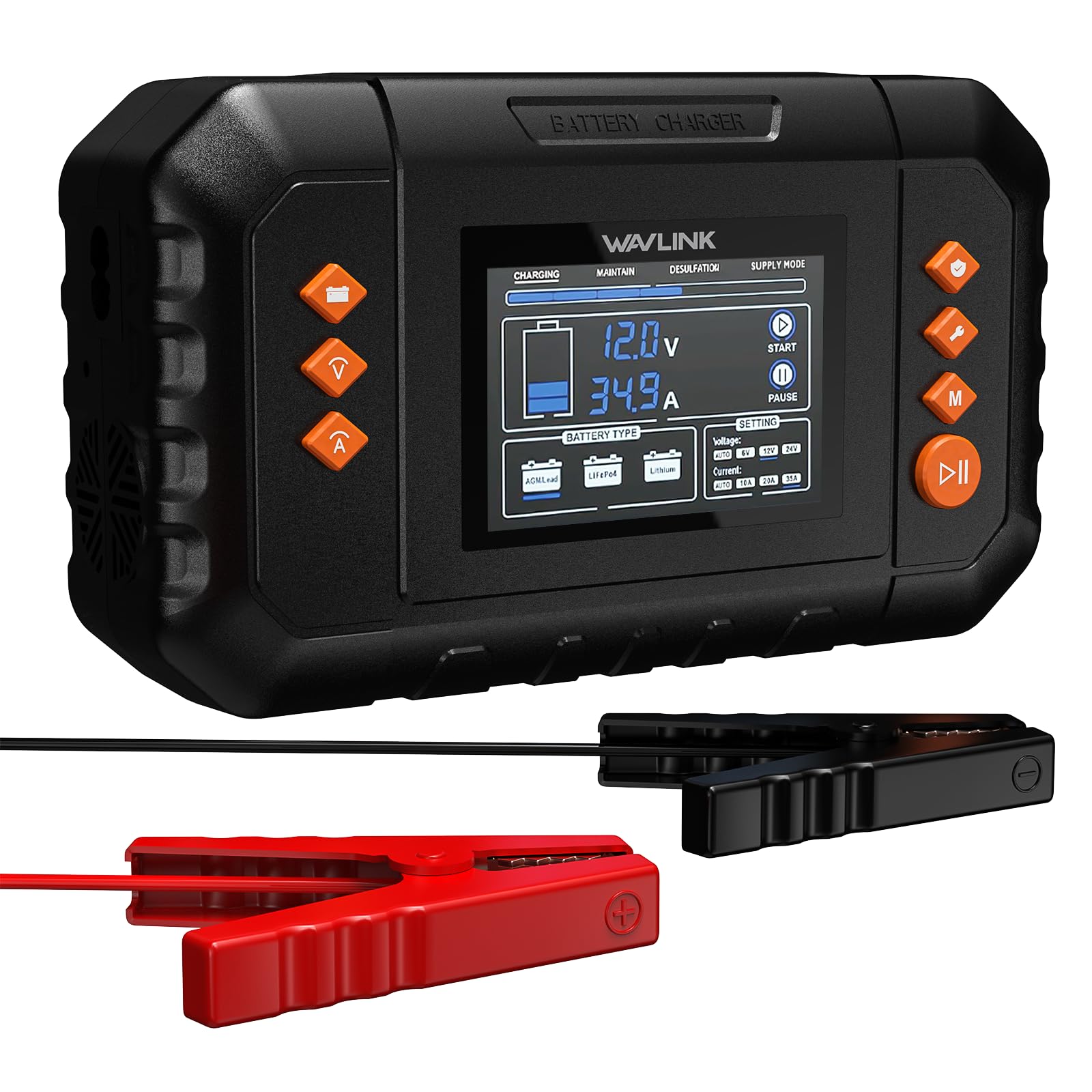
The WAVLINK 450W charger is the most powerful unit in this guide, capable of delivering up to 35A across 6V, 12V, and 24V systems for lead-acid, lithium, and LiFePO4 batteries. Its forced mode allows it to begin charging batteries that have dropped to zero volts — a capability demonstrated by users who revived LiFePO4 batteries whose BMS had shut down. The LCD display provides real-time feedback on charging mode, voltage, current, and percentage complete.
The multi-stage charging includes a soft start to gently bring depleted batteries up, followed by a fast bulk phase and a final top-off balancing stage. ETL certification confirms it meets safety standards for over-current, over-voltage, reverse polarity, and spark-proof operation. The intelligent fan cooling system engages when needed, though some users note the fan is audible and runs frequently during high-current charging. Operating range from -20°C to +40°C makes it usable in unheated garages through winter.
At 35A, this charger is overkill for a standard 12Ah motorcycle battery — the high current can stress small batteries and may trigger the BMS on lithium units. It is best suited for riders who also manage large RV batteries, golf carts, or fleet vehicles alongside their motorcycle. The instructions contain some translation issues, but the unit’s physical interface is intuitive enough to use without the manual. For the garage that needs one charger to handle everything from a sportbike to a 200Ah deep-cycle bank, the WAVLINK is the versatile workhorse.
Why it’s great
- 35A output handles large deep-cycle and RV batteries
- Force mode charges batteries from zero volts
- ETL certified with multiple safety protections
Good to know
- Overkill for standard 12Ah–20Ah motorcycle batteries
- Cooling fan is audible and runs frequently
FAQ
Can I leave a smart charger connected to my motorcycle battery all winter?
Can I charge a lithium motorcycle battery with a lead-acid charger?
What does the ring terminal adapter do on a motorcycle battery charger?
Why does my charger refuse to start charging a completely dead battery?
Final Thoughts: The Verdict
For most riders, the best motorcycle battery charger is the NOCO GENIUS5 because it combines 5A charging speed, full LiFePO4 compatibility, and desulfation into a compact package that can be mounted permanently and left connected indefinitely. If you want the proven simplicity of a dedicated 12V maintainer with no chemistry confusion, grab the Battery Tender Junior. And for a multi-vehicle garage that needs one charger to handle everything from a motorcycle to a RV deep-cycle bank, the WAVLINK 35A is the versatile workhorse.