
Our readers keep the lights on and my morning glass full of iced black tea. As an Amazon Associate, I earn from qualifying purchases.
Specs are compiled from manufacturer listings and verified buyer reviews and can change over time — please confirm the key details on the product page before buying.
Why do perfectly good-looking circuit boards stop working? A swollen or silently failing capacitor is the usual culprit, and a multimeter often misses it. A capacitor tester measures ESR to catch a dying cap before it bulges, saving hours of part swapping.
I’m Min — the founder and writer behind Gadgets Feed. This guide is built by comparing the manufacturers’ published specifications and the patterns across verified customer reviews, so you get each pick’s real strengths and trade-offs instead of marketing spin.
Here is a clear breakdown of what separates an essential shop tool from a one-job gadget, so you can identify the best capacitor tester for your bench without paying for features you’ll never use.
Our Picks at a Glance

How To Choose The Best Capacitor Tester
A capacitor tester is a diagnostic tool, not just a measuring device. The right tester checks parts in-circuit, so the testing method matters more than the brand.
Capacitance vs. ESR testing
Capacitance testing measures the storage value (in microfarads, µF) of the component. ESR (equivalent series resistance) testing measures the internal wear that makes a cap fail — and it is the test that catches bad parts with a normal capacitance reading. If you repair power supplies, motherboards, or audio gear, an ESR-capable meter is the one that finds the actual fault.
In-circuit ability and test frequency
Being able to test a capacitor while it is still on the board saves you from hours of desoldering. Meters that use a low voltage (around 15mV) for testing are safe for in-circuit checks because they don’t turn on other components. The test frequency (often 100kHz for ESR work) is what strips away the capacitor’s impedance so the real internal resistance shows up.
Quick Comparison
| Model | Best For | Measurement Range | Power Source | Weight | Amazon |
|---|---|---|---|---|---|
| Supco MFD10★ Best Overall | HVAC technicians | 0.01 – 9,999 µF | 3 x AAA (not included) | 6.4 oz | Amazon |
| FNIRSI LCR-P1Best Value | Component identification | Capacitor, resistor, transistor | 300 mAh rechargeable | 2.72 oz | Amazon |
| Signstek MESR-100 V2 | In-circuit ESR checks | 0.01 – 100 Ω | Battery powered | 8 oz | Amazon |
| Geevorks Professional V2 | Low-value resistor testing | 0.001 – 100.0 Ω | Battery powered | — | Amazon |
| FNIRSI LC1020E | Bench precision with Kelvin probes | 1pF–100mF / 10mΩ–10MΩ | 3000 mAh rechargeable | 250 g | Amazon |
| Velleman Atlas ESR70 | Fast in-circuit troubleshooting | 1µF – 22000µF | Battery powered | 0.1 kg | Amazon |
| DER EE DE-5000 | Lab-grade accuracy at home | Inductance/Capacitance/Resistance | DC 9V battery | 450 g | Amazon |
In-Depth Reviews
1. Supco MFD10 Digital Capacitor Tester
Our pick — over 4.5★ from 850+ verified ratings; the strongest balance of quality and price.
The field tech’s fastest route from “cap looks fine” to “found it.”
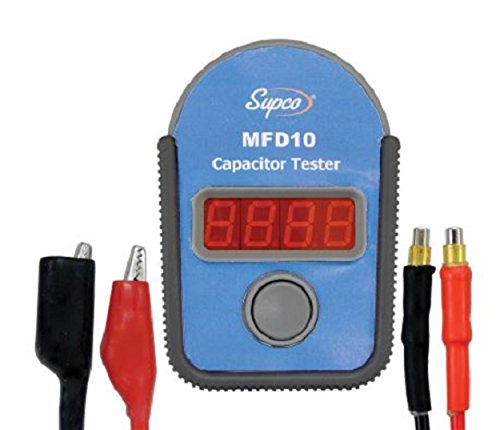
This is the workhorse for HVAC technicians who need a verdict, not a thesis. It reads capacitance from 0.01 µF up to 9,999 µF, so it covers everything from a tiny start cap in a refrigerator to the larger run caps in air conditioning units — and you get the answer on a bright LED display with one button press. Buyers report it’s “easy to use and diagnose capacitors,” with a readout that’s simple to glance at in a dim mechanical room.
The MFD10 doubles as a continuity tester to check for open and short circuits, which helps you confirm a wiring fault before you blame the component. It runs on 3 x AAA batteries (not included) and ships with a soft carry case, so it lives comfortably in a service bag. Owners praise the speed, noting it’s faster than using a multimeter for this specific job.
Durability is mixed—some owners mention breakage after about ten uses. It’s a lightweight 6.4-ounce tool meant for routine diagnostics, not for being dropped from a ladder.
Why Techs Grab It
- Wide 0.01–9,999 µF range covers HVAC start and run caps
- Bright LED display with fast, simple readouts
- Continuity testing for open/short circuits adds value
- Includes a soft carry case for field work
Who Should Pass
- Not an ESR meter — it won’t catch a failing cap with normal capacitance
- Durability questions after repeated heavy use
Reach for this if: you’re an HVAC or appliance tech who needs a fast, accurate capacitance check in the field.
Look elsewhere if: your repair work is in-circuit ESR troubleshooting on circuit boards.
2. FNIRSI LCR-P1 Transistor Tester
A pocket lab that identifies parts instead of just measuring them.
This is the Swiss-army pick for sorting through a bin of loose components. The LCR-P1 automatically identifies pin definitions and parameters for NPN, PNP, MOSFETs, FETs, diodes, Zener diodes, capacitors, resistors, inductors, and even batteries — so you plug in a mystery part and it tells you what it is. Hobbyists find it handy for sorting, and the pin identification is a major time-saver for transistors.
Build is compact at 2.72 ounces, which makes it nearly 3x lighter than a bench ESR meter — and at 3.19 x 2.56 x 0.98 inches it slips into a drawer or pocket easily. It has a 1.44-inch full-color screen, a 300 mAh battery, and charges via Type-C. There’s even a built-in anti-burn mechanism that automatically discharges undischarged capacitors the moment you insert them, protecting the unit from damage.
Accuracy gets mixed feedback from owners. Customers note capacitors read within 2-3%, but some find pin identification on transistors can be wrong (one PNP showed “EBC” in both directions). It’s a capable tool for component ID, but treat specific readings as estimates rather than lab-grade results.
Great For
- Auto-detects transistors, caps, resistors, and diodes
- Zener diode test function is genuinely convenient
- Tiny and light at 2.72 ounces
- Type-C charging and firmware updates
Know Before Buying
- Pin identification on transistors can be misleading
- One-significant-digit precision limits lab use
- Small and fragile feel, so keep the box
Best suited to: the hobbyist bench where sorting parts and quick component ID beat absolute measurement precision.
Not the tool for: certified lab work where a wrong pinout or 50% off on tiny mica caps is unacceptable.
3. Signstek MESR-100 V2 ESR Meter
The classic bench weapon that finds the bad caps a multimeter can’t see.
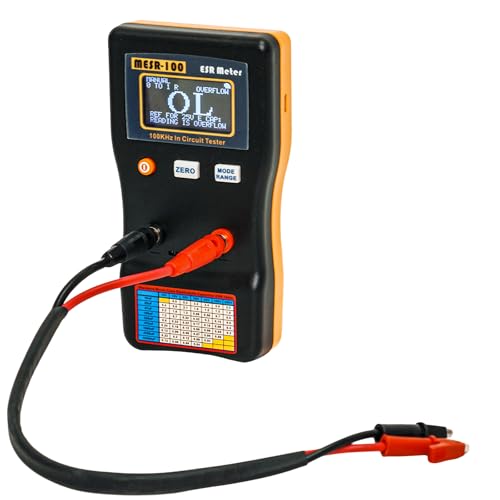
This is the go-to ESR meter for electronics repair enthusiasts who work on power supplies, motherboards, and GPUs. It uses a 100kHz test signal to measure equivalent series resistance across 0.01–100Ω, which is exactly how you detect a failing capacitor that still reads normal capacitance. Owners rely on it for in-circuit testing, meaning you can check components without desoldering them from the board — a massive time-saver when troubleshooting an Xbox PSU or an old TV.
The built-in ESR table lets you check your reading against expected values at a glance, and auto-ranging means you just clip on and read. It’s simple enough that the review pages sum it up: “works well to identify defective capacitors.” The time saved on repairs is the most common reason owners call it worth the money.
The leads are too short and tightly spaced, needing about 4″ more length and 2″ more separation for tight spots. It’s a fixable annoyance — longer clip leads solve it — but it will test your patience on tight boards from the start.
Why Repair Techs Love It
- 100kHz in-circuit ESR testing catches failing caps fast
- Auto-ranging with a 0.01–100Ω range
- Built-in ESR chart for quick reference
- Saves hours of desoldering guesswork
The Frustration
- Stock leads are too short and tightly spaced
- Battery door is awkward to access
Grab this when: you’re repairing PSUs, motherboards, or audio gear and want to test caps in-circuit with confidence.
Budget for: aftermarket Kelvin leads if your work takes you into tight spaces.
4. Geevorks Professional Capacitor Tester V2

The meter that sees the failing cap hiding inside aging electronics.
This MESR-100 V2 auto-ranging meter digs into the internal series resistance of a capacitor using a 100kHz signal, and it supports in-circuit testing on TVs, LCDs, and audio boards. Its low test voltage — less than 15mV on a good capacitor — is what makes in-circuit checks safe, since it won’t accidentally power up surrounding components. Owners describe it as “easy to use” and reliable at identifying bad caps even when they show no visible damage.
What sets this version apart is the included SMD alligator clip, which improves accuracy when testing tiny surface-mounted components. The dual-terminal design and a printed ESR table keep the workflow fast: clip on, read the value, compare, move on.
The main thing to know: this meter measures the internal resistance of the capacitor, not its capacitance value. And the plug-in leads have weak connections, so taking a reading requires keeping the cables still after zeroing the meter for spot-on results.
High Points
- Finer 0.001–100.0 Ω range catches out-of-spec low-value resistors
- In-circuit safe with low test voltage
- Includes SMD clip for surface-mount work
- Reliable at telling good caps from bad consistently
Watch Out For
- Not a capacitance value meter — ESR only
- Plug-in leads need to stay still after zeroing
Choose this over the Signstek if: you need the finer low-ohm resolution and the SMD clip for board work.
Expect to: re-zero the meter anytime you reposition the leads.
5. FNIRSI LC1020E LCR Meter
The bench-grade upgrade that gives you a lab’s worth of data on one screen.
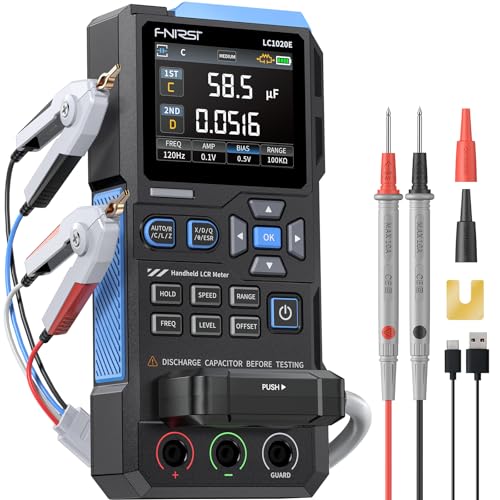
This is a serious step up for the enthusiast who wants precision. The LC1020E measures capacitance (1pF–100mF), resistance (10mΩ–10MΩ), and inductance (1µH–100H), with main and secondary parameters like X/D/Q/θ/ESR shown simultaneously on a bright 2.8-inch TFT display. The 19,999-count resolution keeps readings precise, which owners say Owners say its readings closely match those from pricier HP lab gear..
It uses a 4-terminal Kelvin measurement setup through 3-pin sockets and 5-slot jacks, which eliminates lead resistance errors at low ohms — a feature you’d normally expect on a benchtop unit. Five test frequencies (100Hz/120Hz/1kHz/10kHz/100kHz) let you match the datasheet conditions of the component you’re testing. The 3000 mAh battery charges via Type-C and has auto-off to save power.
Owners consistently rate the quality and accuracy highly, calling it “definitely punches above its weight” and noting it surpasses even a B&K 879B in some tests. The minor complaints: it’s lightweight and slides on a bench, and the manual is Chinglish — but for the price, the feature set is hard to argue with.
What You Get
- KerKelvin 4-wire measurement for low-resistance accuracy
- 19,999-count display across L/C/R
- 5 test frequencies up to 100kHz
- Sorting mode with sound/LED alerts for pass/fail
Minor Trade-offs
- Lightweight body slides on a smooth bench
- No carry case included
Pick this for: the hobbyist or pro who wants lab-grade LCR measurements without benchtop prices.
Accept that: you’ll want a mat or strap to keep it from sliding mid-measurement.
6. Velleman Atlas ESR70 Capacitance and ESR Meter

The all-in-one ESR meter that auto-discharges caps and gives you an answer in seconds.
Designed by Peak Electronic Design, this meter is built for bench techs who want speed and clarity. It measures capacitance and ESR for any capacitor between 1µF and 22000µF — including motor caps, smoothing caps, electrolytics, and polypropylenes — with a dynamic ESR range of 0.00 to 40.0 ohms and resolution as fine as 0.01 ohms. Owners across the board call it a “big time saver,” with One owner reports it cuts troubleshooting time by 75%..
What makes it special is the auto-discharge function: it safely drains the capacitor before testing, so you don’t get zapped or get a false reading. Audible alerts for different ESR levels mean you can keep your eyes on the probe while it signals whether a cap is good or bad. It’s a genuinely hands-free experience.
The flip side is build quality, which gets mixed feedback — several describe it as fairly fragile, so it’s a bench tool, not a jobsite tool. And it is priced at a premium over the budget ESR meters, so you’re paying for the refinement and the brand’s reputation.
Why It’s Worth It
- Auto-discharge protects you and the meter
- 0.01-ohm ESR resolution is excellent for the class
- Audible alerts for different ESR levels
- Fast in-circuit testing with auto-detect
Consider This
- Premium price — you pay for the refinement
- Fragile build; not meant for drops
- In-circuit/SMD precision needs extra probes
Step up to this if: you’re a bench tech who values efficiency and safety, and you test caps all day.
skip it if: you’re on a budget and just need a basic good/bad verdict.
7. DER EE DE-5000 Handheld LCR Meter
The handheld that gives you laboratory accuracy for a fraction of a benchtop price.
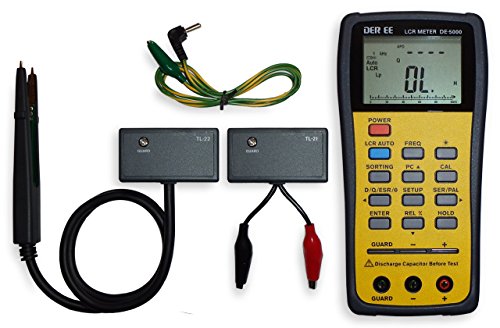
This is the serious buyer’s endgame. The DE-5000 is a 19,999-count dual-display LCR meter that measures inductance, capacitance, and resistance, plus secondary parameters like dissipation factor (D), quality factor (Q), phase angle, and equivalent series/parallel resistance (ESR or Rp). Owners who’ve used it for years still call it “the BEST LCR Analyzer available with Laboratory Accuracy @ Handheld.”
It offers five selectable test frequencies — 100Hz/120Hz/1kHz/10kHz/100kHz — so you can match the datasheet conditions of whatever you’re testing. This is what lets it read small SMD ceramic caps that other meters show as zero. The fully auto-ranging “AUTO-LCR” mode means you can drop a component in and get a reading without selecting a function. It includes a 9V battery, alligator test leads (TL-21), SMD tweezers (TL-22), and a guard line (TL-23) in the box.
The build is famously tank-like, with owners praising the solid plastic feel. The weak point is the manual, which gets flagged as poorly translated and not detailed enough in English. And some find the stock TL-21 leads too short for bench work, so upgrading to longer Kelvin clips is a common first purchase.
Why It’s The Endgame
- Lab-grade accuracy in a rugged handheld
- 5 test frequencies up to 100kHz match datasheets
- Auto-ranging AUTO-LCR mode for instant reads
- Includes SMD tweezers and guard line accessories
What To Plan For
- Cheesy, poorly translated manual
- Short stock leads — budget for longer Kelvin clips
- Can’t test high-voltage cap leakage
Buy this if: you want bench-grade LCR measurement for a fraction of the cost of a lab instrument.
Be ready to: upgrade the leads and rely on online tutorials instead of the manual.
Understanding the Specs
ESR (Equivalent Series Resistance)
Think of this as the capacitor’s internal wear-and-tear meter. A healthy cap has very low ESR, measured in ohms (Ω). As a cap ages or dries out, its ESR climbs — and this is what causes circuit failures even when the capacitance value looks normal. An ESR meter measures this internal resistance, often using a 100kHz test signal, to separate good caps from dying ones. For in-circuit testing to work, the meter must apply a very low voltage (around 15mV) so it doesn’t accidentally power up other components on the board.
Test Frequency
Capacitors behave differently at different frequencies, so a good tester lets you choose. Common options are 100Hz, 120Hz, 1kHz, 10kHz, and 100kHz. Matching the test frequency to the component’s datasheet conditions gives you readings you can actually compare against the manufacturer’s specs. For ESR work specifically, 100kHz is the standard because it strips away the capacitor’s reactance and reveals the true internal resistance.
FAQ
What is the difference between a capacitance meter and an ESR meter?
Can I test capacitors while they are still on the circuit board?
What does 100kHz test frequency mean for capacitor testing?
Will a capacitor tester measure the microfarad (µF) value?
Is a capacitor tester safe to use on a live circuit?
How do I know if my capacitor is bad or just old?
What is the best capacitor tester for a beginner?
Why do my test readings keep changing between measurements?
Final Thoughts: The Verdict
For the majority of shoppers, the capacitor tester winner is the Supco MFD10 because it nails the most common real-world job — fast, accurate capacitance checks for HVAC and appliance work — with a wide range and a simple readout. If you want to hunt down failing caps on circuit boards, grab the Signstek MESR-100 V2 for its in-circuit ESR testing. And for the enthusiast who wants lab-grade data without a benchtop price, the FNIRSI LC1020E is the one to reach for.
How We Picked
We do not accept paid placement. Every pick is matched to a real buyer and a real use-case; we do not hands-on test units.
Sources & Methodology
Specifications: manufacturer listings and product documentation. Review insights: verified customer reviews, as of September 2026. Pricing: not shown on this page (it changes often); check the current price via the retailer link.
As an Amazon Associate, Gadgets Feed earns from qualifying purchases. This does not affect which products we feature.