
Our readers keep the lights on and my morning glass full of iced black tea. As an Amazon Associate, I earn from qualifying purchases.
Specs are compiled from manufacturer listings and verified buyer reviews and can change over time — please confirm the key details on the product page before buying.
You want to paint a model, a cake, or a skateboard deck without pouring a fortune into gear. The catch is that cheap airbrush kits often clog, sputter, or vibrate across the bench just when you hit your stride. This guide sorts out which budget machines actually lay down smooth, fine lines and which ones you will end up fighting.
I’m Min — the founder and writer behind Gadgets Feed. This guide is built by comparing the manufacturers’ published specifications and the patterns across verified customer reviews, so you get each pick’s real strengths and trade-offs instead of marketing spin.
If you want a low-cost way to start spraying fine details, the budget airbrush crowd-verified winner is the VEVOR kit because its quiet compressor and three brush sizes make a complete first setup.
Our Picks at a Glance


How To Choose The Best Budget Airbrush
A budget airbrush is a trade-off between what you pay and how much fiddling you can tolerate. Before you click buy, you need to know your paint type and your project size, because those two answers decide which nozzle and feed style you need.
Match the nozzle to the job
The needle size is the single biggest factor in what you can spray. A 0.2mm needle produces ultra-fine detail lines for tiny miniatures, while a 0.5mm or 0.8mm needle moves a lot of paint for broad coverage or thicker media. A kit that includes three interchangeable needles, like 0.2mm, 0.3mm and 0.5mm, means you get one tool that can handle everything from a thin line to a wide background wash.
Gravity feed vs siphon feed
On a gravity feed airbrush, the paint cup sits on top, so gravity pulls paint down toward the needle. That means you use almost every drop and switching colors takes seconds. A siphon feed draws paint up from a bottle underneath, which holds more paint but wastes a little when you change colors and needs slightly more air pressure to lift the paint.
Read the compressor carefully
Many budget kits include a mini compressor, and this is where the real compromise lives. Look for adjustable pressure levels rather than a fixed output, because thick paints like acrylics need thinning to a skim-milk consistency to spray cleanly. Also check the noise rating in decibels — a 35dB compressor is far more pleasant for late-night projects than one that sounds like a vacuum cleaner.
Quick Comparison
| Model | Best For | Nozzle Sizes | Max Pressure | Airflow (L/min) | Amazon |
|---|---|---|---|---|---|
| VEVOR Airbrush Kit★ Best Overall | All-in-one beginners | 0.2, 0.3, 0.8mm | Adjustable | 23 L/min | Amazon |
| NEOECO SJ83Detail King | Detail line work | 0.2, 0.3, 0.5mm | 35 psi | — | Amazon |
| SAGUD Mini KitBudget Champion | Ultra-budget entry | 0.3mm | 25 psi | — | Amazon |
| Colima XJ300 | Beginner control | Dual-action | 27 psi (7 levels) | 8-15 L | Amazon |
| pyewin Cordless | On-the-go spraying | 0.38mm | 32 psi (4 levels) | 10.5 L/min | Amazon |
| Timbertech AS18-2K | Quiet home studio | 0.30mm | 58 psi | 20-23 L/min | Amazon |
| Gaahleri GTS-06 | Compact quiet power | Dual-action | 27 psi (7 levels) | — | Amazon |
| Timbertech AS186 | Tank-stabilized flow | 0.2 to 0.8mm | 4 bar | 20-23 L/min | Amazon |
| Master Cool Runner II | Multi-brush flexibility | 0.3, 0.35, 0.8mm | 57 psi | — | Amazon |
In‑Depth Reviews
1. VEVOR Airbrush Kit
Our pick — over 4.5★ from 450+ verified ratings; the strongest balance of quality and price.
The complete first kit whose quiet compressor sprays wide-to-thin lines all afternoon.
You get three replaceable spray airbrushes — 0.2mm, 0.3mm and 0.8mm — so one box covers fine model details, makeup, nail art, and even food decorating. That trio of needle sizes is the reason this kit stretches further than a single-brush setup as your skills grow.
The 120V 120W compressor pushes a steady 23 liters of air per minute through a 70.8-inch hose. Owners consistently report the compressor is quiet, powerful, and reliable enough to spray cakes and class projects daily. The rubber feet do not tame the vibration, though — it can “run away” off the work surface unless you clamp it, as buyers report.
Cleanup is straightforward, which owners say is the real test of a budget gun. The fluid nozzle design protects the needle from bending and breaking, and the pen holder on the compressor keeps your brush safe between coats. Its FDA food-contact clearance makes it safe for cake decorating and cosmetic spraying.
Why owners pick it
- Three needle sizes in one kit, from 0.2mm detail to 0.8mm coverage
- Quiet compressor with adjustable pressure valve and real-time gauge
- FDA-cleared for food and face work, so it is not just a hobby tool
What needs a workaround
- Vibrates across the bench unless you clamp the base down
- Best for small jobs — add a tank if you plan long continuous runs
Your starter system: If you want one kit that does food, faces, models, and clothes from the start, this is the crowd-verified pick.
The honest catch: Keep a hand on it or clamp it, and clean the brushes after every use or acrylics will corrode the un-chromed parts.
2. NEOECO SJ83 Airbrush
The needle that aligns itself so your fine lines actually stay fine.
This is a brush-first buy rather than a full kit. The self-centring plug-in nozzle means the needle seats itself, which cuts down on bent needles and the frustration of fiddly alignment. It ships with 0.2mm, 0.3mm and 0.5mm nozzle sets plus three chrome-plated cups — 9cc, 20cc and 40cc — so you can jump between fine detail and 1.5-inch wide background sprays by swapping the tip.
There is no thread in the nozzle, which owners say makes a 5-second tip change and removes the fear of snapping a threaded nozzle. The cutaway handle lets you flush clean air passages quickly, and the chrome-plated cups resist shedding.
The trigger gets the most complaints — a few units arrive with the trigger sticking in the depressed position, and the trigger is notchy for the first 20-30 minutes before it smooths out. Owners also note the fluid control knob feels loose. At 0.36 kg it is light enough for long sessions, and the copper and stainless steel build inspires confidence.
The upside owners love
- Self-centring nozzle protects the needle and speeds up tip changes
- Three nozzle sizes and three cup volumes in the box
- No-thread nozzle cleans faster and never strips
Where it stumbles
- Trigger can stick at first, then smooths after some use
- An occasional brush arrives with poor airflow — test it early
Grab it for: paint-the-details work like baits, T-shirts, and skateboard decks where you need a precise, even finish.
Reach elsewhere if: you want a compressor in the box — this is a brush and accessories only, so budget separately for air.
3. SAGUD Professional Mini Airbrush Kit
The cheap ticket that works hard only after you thin the paint enough.
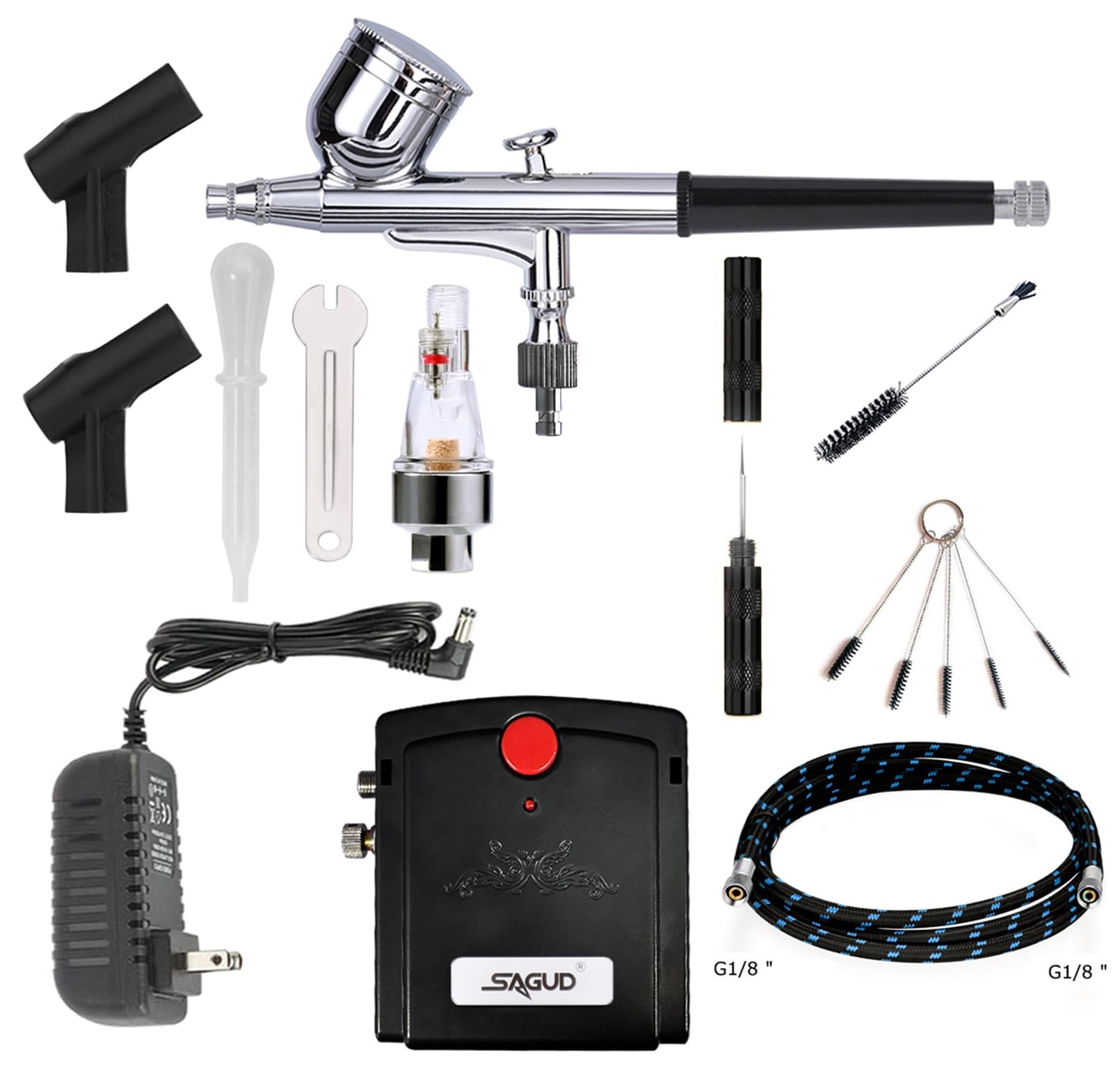
If your budget is extremely tight, this kit gets you a dual-action gravity feed gun (the SD 130) with a 1/3 oz cup and a 0.3mm nozzle, plus the AC-100 mini compressor. The compressor is genuinely portable and light, with a 25 psi maximum and an automatic on/off that starts at 10 psi and stops at 25 psi. A 6-foot braided hose and a mini air filter for moisture are included.
The trade-off is painted in bold letters: this compressor has almost no fine pressure adjustment — owners describe it as effectively 0 or 15-20 psi, stopping at low settings. That means you cannot fine-tune pressure for delicate work, and you must thin your paint heavily, to the consistency of milk, or nothing sprays. Once you get the dilution right, the gun flows well and owners call it a great value at a fraction of pro setup costs.
The catch is that performance here is genuinely split. Some kits simply do not work from the start — one buyer left it sealed for months only to find the compressor turned on then shut down. This is entry-level hardware, so buy it expecting to learn paint thinning and treat pressure control as a fixed setting.
What it does well
- Portable, lightweight compressor under 25 psi max
- Automatic start/stop saves power between sprays
- Includes cleaning brush set and air filter
The hard limitations
- No fine pressure adjustment, only roughly 15-20 psi
- Paint must be thinned to milk consistency or it will not spray
Best for: a learner who wants the smallest possible spend to test whether airbrushing sticks.
Look elsewhere if: you need reliable pressure control or consistent operation straight from the start — test this one immediately.
4. Colima XJ300 Airbrush Kit

A beginner kit that lets you dial in pressure from delicate to heavy coverage.
The headline here is the 7-gear adjustable pressure, which spans 15 to 27 psi. That range lets you drop to a gentle spray for fine skincare-style detail or crank up for high coverage, and it is the difference between fighting a fixed-pressure compressor and actually controlling your paint. The dual-action trigger regulates both air and paint volume, so you can pull fine lines or broad strokes without wasting ink.
This 27 psi compressor also supports two airbrushes at once, with airflow reaching 8-15 L/min, and it comes with a 73-inch hose, two holders, three paint cups (5cc, 20cc, 40cc), cleaning tools, and an adapter. Owners, including parents buying for kids, say the spray is smooth with no clumps and the level coverage is consistent. The built-in holders keep your brush parked and mess-free, and the unit is compact and lightweight yet feels well-built.
The compressor is on the budget side — it only runs while you are actually spraying, which is normal for a tankless mini but worth knowing if you expected continuous air. Setup takes minutes, and cleaning takes a couple more, which owners call a real strength.
What wins people over
- 7 pressure levels from 15 to 27 psi for real control
- Connects two airbrushes at once for quick switching
- Included holders keep brushes put between coats
The honest limits
- Compressor runs only during actual spraying, no air tank
- Good for basic work, not sub-millimeter precision details
Choose this for: beginners and intermediate users who want adjustable pressure and a tidy, complete kit without a big spend.
Mind this: if you need ultra-fine detail for serious miniature painting, the pressure ceiling will feel limited.
5. pyewin 32PSI Cordless Airbrush Kit

The first truly portable rig — no hose, no wall socket, no bulky compressor.
This is the kit for mobile work. The rechargeable 1000mAh Type-C battery delivers up to 40 minutes of continuous spraying and supports use-while-charging, so barbers, nail techs, and custom sneaker artists can move around freely. A built-in LED display shows battery status and pressure, and you toggle between 20, 24, 28, and 32 PSI to suit the project.
The upgraded 0.38mm nozzle delivers smoother, more consistent airflow than a common 0.3mm, which helps reduce sputtering when you push thicker acrylics. The standard 1/8-inch connection means it works with many professional accessories, and the kit includes three fluid cups (5/20/40cc), an extension hose, five cleaning brushes, and 11 acrylic paints. An intelligent auto-stop sensor shuts the compressor off the moment you release the trigger, cutting noise and saving battery.
Owners rave about the quality and ease of use, with one rookie calling it a revelation. But the battery is the weak point — several report it does not last the full 40 minutes, often dying around ten minutes of actual spraying. It also clogs if you do not flush the nozzle with water immediately after use, and durability is a question mark for heavy daily use.
What makes it fun
- True cordless freedom with up to 40 minutes of spray
- 4 pressure levels via a smart LED display
- Includes 11 acrylic paints right in the box
Where it frustrates
- Battery can fall short of the rated 40 minutes in real use
- Clogs easily unless you flush with water after every session
Ideal for: on-the-go creators — barbers, nail artists, and model builders who work away from a power outlet.
Not for: marathon sessions or thick paints; treat the battery as a real constraint and keep that water rinse handy.
6. Timbertech AS18-2K Airbrush Kit

A whisper-quiet piston pump that holds pressure without shaking the room.
Noise is the quiet killer of hobby spaces, and this kit nails it. The oil-less piston compressor runs at 47dB — about the level of a quiet conversation — which owners with 35 years of professional airbrush experience call genuinely quiet and good at maintaining pressure. The build-in carry handle makes it portable, and with 9 pounds and dimensions of 12.6 by 5.5 by 12.2 inches, it tucks under a desk between sessions.
Performance-wise the compressor pushes 20-23 L/min with a 58 psi maximum and autostart at 3 bar, autostop at 4 bar. The regulator includes a gauge, water trap, and air filter, so you can see and control moisture, plus a pressure relief safety valve and overheat protector. It comes with a basic double-action gravity feed airbrush with a 0.30mm nozzle, a 6-foot hose, cleaning brushes, and five test paints to get you spraying on day one.
The recurring gripe is the included airbrush, which owners call cheaply made and prone to clogging, and the hardware that came with it. The advice from long-time users is blunt: buy this for the excellent compressor and budget for a decent airbrush separately. The compressor also runs hot if you push it too long, so give it breaks.
The real strength
- 47dB oil-less piston is genuinely quiet for home use
- 58 psi max with regulator, gauge, and water trap
- Constant air pressure with no sputtering, per pros
The weak link
- The included airbrush clogs and is not easy to clean
- Compressor runs hot during long sessions
Buy it for: the compressor — seasoned artists call it the smart purchase and pair it with a better gun.
Plan for: upgrading the airbrush; the stock one will test your patience with clogging.
7. Gaahleri Ambition Series GTS-06

The tiny workhorse that runs at a library-hush 35dB with seven pressure choices.
This is the premium-compact play. The Serenair mini compressor is small enough to take up no room on your desk, yet it offers 7 pressure levels up to 27 PSI and can connect two airbrushes simultaneously. Four improve rubber feet cut vibration dramatically, and at 35dB it is one of the quietest units in this lineup — owners literally replaced their old loud pancake compressor with it.
The kit arrives ready to spray with an airbrush, hose, and two holders included. Owners praise the smooth trigger and good accuracy for miniature and statue work, calling it a great compromise between a bulky high-end setup and a weak portable pen. The pressure stays consistent, so sputtering is not a worry. It is genuinely beginner-friendly, with everything primed and ready for Vallejo-style paints.
You will hit a few snags: no spare O-rings (the rubber seals that keep air from leaking) or extra tips come in the box, both holders face the same way, and the max pressure runs low for very thick paints. The listing quotes noise at 20dB (a decibel is a unit of sound level), but buyers measure around 65dB at the brush, so treat “super quiet” as relative — it is still far quieter than most. Assembly was smooth and needed no other tools.
Why it stands out
- Ultra-compact with 4 vibration-damping rubber feet
- 7 pressure levels up to 27 psi for fine control
- Connects two airbrushes at once
Small frustrations
- No spare O-rings or replacement tips in the box
- Max 27 psi is limiting if you spray thick paints
Choose it for: a tidy, quiet, powerful mini that disappears into your workspace while supporting two brushes.
Mind the ceiling: if you need over 30 psi for heavy-body paints, shop elsewhere.
8. Timbertech AS186 Compressor

The tank-equipped pump that delivers pulse-free air for a steadier finish.
If you hate the stutter of a tankless compressor kicking in mid-stroke, this AS186 solves it. The 3-liter receiver tank stores air so output stays smooth and constant at 20-23 L/min, and the compressor only refills between sessions — which also extends its lifespan. The oil-less, maintenance-free piston is compact and portable at 4.82 kg, with a built-in carry handle.
It runs at 47dB, and owners mention no more “jump scares” when the compressor kicks on, thanks to rubber feet that isolate vibration. The industrial-type regulator includes a gauge, water trap, and air filter, plus a pressure relief safety valve and overheat protector. It autostarts at 3 bar and autostops at 4 bar, and it suits any airbrush gun with 0.2 to 0.8mm nozzles — though the gun itself is not included, so this is purely a compressor upgrade.
The major complaint is the complete absence of instructions — no setup guide, no connection help, no maintenance tips, which is rough for a beginner. Owners also note it gets hot fast during continuous use, and a few report units dying within two weeks. Tested units reach pressure with no leaks and auto-restart to top off, so it works, but it clearly favors buyers who know their way around a compressor.
The core benefit
- 3L tank delivers pulse-free, constant airflow
- Quiet 47dB operation with vibration-isolating feet
- Regulator, gauge, water trap, and filter built in
What bites back
- Zero instructions included for setup or care
- Runs hot quickly, and some units fail within weeks
Pick this for: a steady-air compressor upgrade if you already own an airbrush and want cleaner, tank-stabilized flow.
Hold off if: you are a total beginner — the lack of any manual makes it a frustrating first compressor.
9. Master Airbrush Cool Runner II
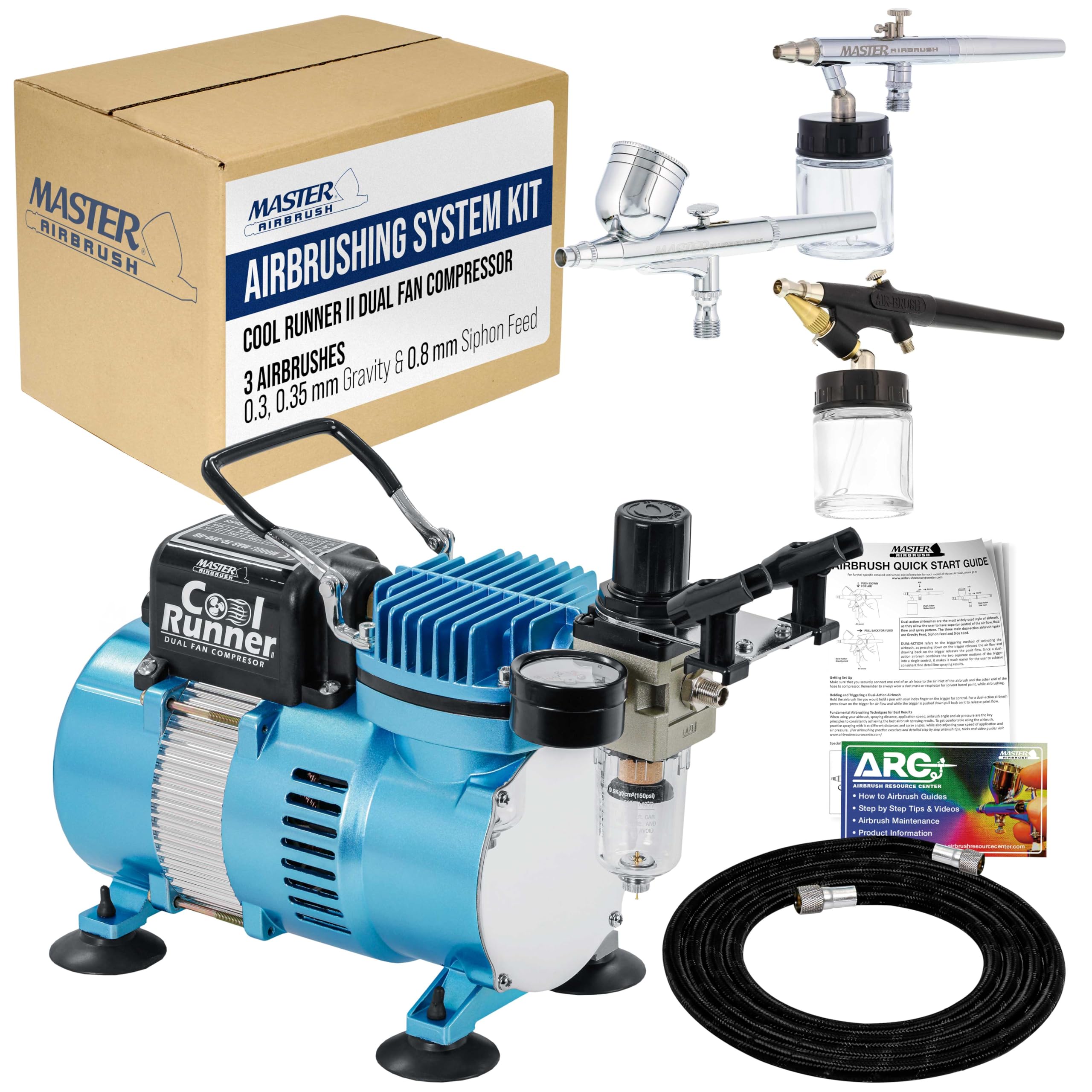
Three different feeds — gravity and siphon — in one system for every paint style.
You get three airbrushes with different feed styles, so you are never stuck with the wrong tool for the job. The G22 is a dual-action gravity feed (you control air and paint with one trigger, and paint flows from a cup on top) with a 1/3 oz cup and 0.3mm tip for fine detail work. The S68 is a precision dual-action siphon feed (paint is drawn up from a bottle below) with a 0.35mm tip and 3/4 oz bottle for larger coverage. The E91 is a single-action siphon feed (one trigger controls air only, paint is set separately) with a 0.8mm tip and two 3/4 oz bottles for heavy spraying.
The TC-320 Cool Runner II compressor is the heart, a 1/5 hp single-piston unit with two cooling fans that keep it from overheating during longer continuous runs. Owners call it super quiet and a great value for beginners, performing like a pro-level Model Master for model kits. The kit includes an airbrush holder for two brushes, a bonus Quick Start Guide, and an Airbrush Resource Center Access Card.
Not every brush shines, though. The S68 siphon feed gets dinged for an awkward cup and a trigger that leaks air. The G22 is good and handles unthinned acrylics, though its nozzle is non-removable, which complicates cleaning. The E91 needs a separate hose, an extra purchase. The compressor runs only when used — there is no air tank — so it kicks on immediately and is best for figurines and statues, not giant surfaces.
Why the trio wins
- Gravity and siphon feed brushes covered in one box
- Twin cooling fans allow longer duty cycles
- Super quiet compressor suits beginners
What to expect
- S68 siphon trigger leaks air; E91 needs a separate hose
- No air tank, so the compressor kicks on mid-use
Grab it for: a beginner who wants to experiment with both gravity and siphon feed brushes in one go.
Understand this: you will likely favor the G22 and treat the siphon brushes as backups; clean every brush promptly after use.
Understanding the Specs
Nozzle and Needle Size
This number, measured in millimeters, sets the width of your spray. A 0.2mm nozzle makes hair-thin detail lines, while a 0.5mm or 0.8mm nozzle moves more paint for backgrounds and coverage. Kits with multiple needles let you swap between detail and fill work without buying a second gun.
Pressure and Airflow
Pressure, measured in PSI or bar, pushes the paint out. Higher max pressure means you can push thicker paints, but adjustable pressure levels matter more than the peak number — they let you drop to a gentle detail spray or crank up for coverage. Airflow, in liters per minute, determines how steadily paint flows without sputtering.
FAQ
What is the difference between gravity feed and siphon feed airbrushes?
What nozzle size should I start with?
Do I need a compressor with an air tank?
Why does my airbrush keep clogging?
Can I use a budget airbrush for cake decorating and food?
What PSI do I need for airbrushing?
Is a cordless airbrush kit worth it?
How quiet should an airbrush compressor be?
Final Thoughts: The Verdict
If you want one dependable pick, the budget airbrush winner is the VEVOR Airbrush Kit because its three needle sizes and quiet 23 L/min compressor make a complete, FDA-cleared first setup. If you want pure detail control at a low spend, grab the NEOECO SJ83 and add air separately. And for on-the-go work away from outlets, the pyewin Cordless is the one to reach for.
How We Picked
We do not accept paid placement. Every pick is matched to a real buyer and a real use-case; we do not hands-on test units.
Sources & Methodology
Specifications: manufacturer listings and product documentation. Review insights: verified customer reviews, as of September 2026. Pricing: not shown on this page (it changes often); check the current price via the retailer link.
As an Amazon Associate, Gadgets Feed earns from qualifying purchases. This does not affect which products we feature.