
Our readers keep the lights on and my morning glass full of iced black tea. As an Amazon Associate, I earn from qualifying purchases.
Specs are compiled from manufacturer listings and verified buyer reviews and can change over time — please confirm the key details on the product page before buying.
Cutting aluminum with a standard wood blade can melt the metal, snag the workpiece, and cause dangerous kickback. A blade built with a Triple Chip Grind (a tooth shape that shears instead of tears) and a negative hook angle (which pulls the work down instead of catching it) turns that scary job into a smooth, clean pass. You need a blade designed for non-ferrous metals, and this guide helps you match one to your saw and your projects.
I’m Min — the founder and writer behind Gadgets Feed. This guide is built by comparing the manufacturers’ published specifications and the patterns across verified customer reviews, so you get each pick’s real strengths and trade-offs instead of marketing spin.
You’ll learn which tooth counts and coatings matter most, how to match a blade to your miter or table saw, and what real owners say about longevity, so you can confidently choose the right blade for cutting aluminum on the first try.
Our Picks at a Glance


How To Choose The Best Blade For Cutting Aluminum
Choosing the right blade means matching its tooth geometry, tooth count, and coating to the thickness of the aluminum you cut most often. A blade that slices through thin window screen frames will struggle with thick 6061-T6 bar stock.
Tooth Geometry and Hook Angle
The core of any aluminum blade is its tooth grind. The Triple Chip Grind (TCG) uses an alternating pattern of flat and angled teeth to shear the metal cleanly, leaving a burr-free edge. Pair that with a negative hook angle, which tilts the teeth away from the direction of rotation, and the blade pushes the stock down instead of grabbing it and pulling it up.
Tooth Count and Thickness
The number of teeth controls the finish and the feed rate. A 60-tooth blade cuts thick stock quickly with a slightly rougher edge, while 80 and 100-tooth versions deliver a smoother finish on thinner material. A thinner kerf (the width of the cut slot) removes less material and requires less power, but a thicker plate stays more rigid for heavy work.
Quick Comparison
| Model | Best For | Teeth | Kerf | Arbor | Amazon |
|---|---|---|---|---|---|
| Diablo D1080N★ Best Overall | Overall versatility | 80 TCG | .094″ | 5/8″ | Amazon |
| FOXBC 80-ToothTop Performer | Premium finish | 80 TCG | .094″ | 5/8″ | Amazon |
| Oshlun SBNF-100060Professional Grade | Thick stock without lube | 60 TCG | — | 5/8″ | Amazon |
| MASTEC 80-Tooth | Budget value | 80 TCG | — | 5/8″ | Amazon |
| Luckyway 52-Tooth | General purpose on a budget | 52 | — | 5/8″ | Amazon |
| TWIN-TOWN 80-Tooth | Plastics alongside metal | 80 TCG | — | 5/8″ | Amazon |
| CRALY 100-Tooth | Thin aluminum and composites | 100 TCG | 2.5 mm | 5/8″ | Amazon |
| IVY Classic 200-Tooth | Very thin sheet up to 1/8″ | 200 | — | 5/8″ | Amazon |
In‑Depth Reviews
1. Diablo D1080N 10″ 80-Tooth TCG
Our pick — over 4.5★ from 750+ verified ratings; the strongest balance of quality and price.
The shop favorite that slices 1/16″ aluminum without melting or splintering, right from the start.
What wins people over is the cutting performance — it is the most-discussed trait by a wide margin, and for good reason. Buyers report clean, smooth passes through aluminum, 1/4″ and 1/8″ material, and plexiglass, with no end chipping and no melted edges. Owners mention it handles ABS, plywood, melamine, and thin 1/16″ aluminum, even claiming it outperforms a premium Forrest combo blade with no melting or splintering.
The engineering backs up the hype. The Triple Chip Grind (TCG) tooth design shears metal cleanly, while the Tri-Metal Shock-Resistant Brazing lets the blade take extreme impact without losing teeth. Its Perma-SHIELD Non-Stick Coating resists heat, gumming, and corrosion so the blade stays clean longer, and the Laser-Cut Stabilizer Vents trap noise and cut vibration for better accuracy on a miter saw.
One honest catch: you need a rigid saw and good technique. Cutting aluminum T-slot demands a consistent bite, clamping the work, and cutting wax; leave the piece unclamped and the cut can go wavy. It runs at 6000 Max RPM, so verify your saw’s speed before pushing it hard.
The Sharp Side
- Rarely needs sanding after a cut, per the owners’ consensus
- Mirror-like finish on the cut edge
- 10-inch size fits most miter, chop, and table saws
The Fine Print
- Demands a rigid saw setup to keep cuts square
- Unclamped work can drift and cut wavy
Reach for this if: you want one do-it-all non-ferrous blade that the crowd consistently calls a miracle for home and shop use.
Look elsewhere if: your saw has excessive play, since this blade rewards a rigid setup.
2. FOXBC 10″ 80-Tooth TCG
The industrial-grade overachiever that cuts acrylic and aluminum with zero tear-out and a fraction of the noise.
The thing everyone raves about here is the blade quality, and it shows in the cut finish. Owners describe slicing through 3/8 inch acrylic with no tear out or chipping, and cutting 3/16″ plexiglass cleanly on a table saw. On aluminum, the super-sharp TCG grind delivers clean, smooth cuts on thin 1/16″ up to medium 1/4″ stock.
This blade shares the same 0.094″ kerf as the Diablo above, but it is built from high-density tungsten carbide for toughness and wear-resistance. The Laser-Cut Stabilizer Vents trap noise and cut vibration, which is why it feels smooth even on a cordless saw. It is listed as compatible with DeWalt, Skil, Metabo, and Makita 10″ miter, slide miter, and table saws.
One limit to note: nobody has owned it long enough to confirm how many years of heavy use it survives, so treat the lifetime claims as unproven. For the price, though, the owners’ verdict is that it competes fine with the premium brands at a fraction of the cost.
What wins people over: exceptionally clean cuts on both aluminum and plastics, with no tear-out or chipping, at a value that surprises most owners.
The unknown: long-term durability unverified, so this is a buy for the here and now.
Buy it for: mixed material days where you switch between aluminum extrusions, copper pipe, and acrylic sheets.
skip it if: only one reviewer’s track record matters more than next-day sharpness.
3. Oshlun SBNF-100060 10″ 60-Tooth TCG
The 60-tooth workhorse that chews through 6061 aluminum extrusion like cheese, with no lube and no kickback.
What sets this blade apart is its 60-tooth setup, which is the smart pick for thicker stock because fewer teeth mean more room to clear chips. Customers note excellent results on 6061 aluminum extrusion from 1×1″ to 2×3″, with no lube needed, no kickback or grab, and a semi-finish cut with minimal burrs. One owner reports it still cuts cleanly after 5 years of service, a durability record few blades match.
The engineering is professional-grade: C-1 carbide tips, a negative hook angle to prevent the blade from grabbing the workpiece, and a Triple Chip Tooth Grind (TCG) for burr-free edges. The copper plugged expansion slots keep the blade from warping under heat. It handles aluminum, brass, bronze, and copper, and cuts aluminum soffit and hickory with equal ease.
The one caveat: sharpness gets mixed feedback, and some owners note it leaves a bit of burr depending on the material and feed rate. But the cutting performance is the most-praised trait by a wide margin, and reviewers point out it outperforms a Freud Diablo blade after hundreds of cuts with no visible wear.
Proof in the pudding: hundreds of cuts on thick extrusions with no wear and no need for cutting fluid.
The honest catch: minimal burrs can still show up on certain alloys, so expect a light deburr now and then.
Choose this for: heavy fabrication work where you need a blade that lasts years, not months.
Think twice if: you only cut thin sheet metal, where a higher tooth count gives a finer finish.
4. MASTEC 10″ 80-Tooth TCG
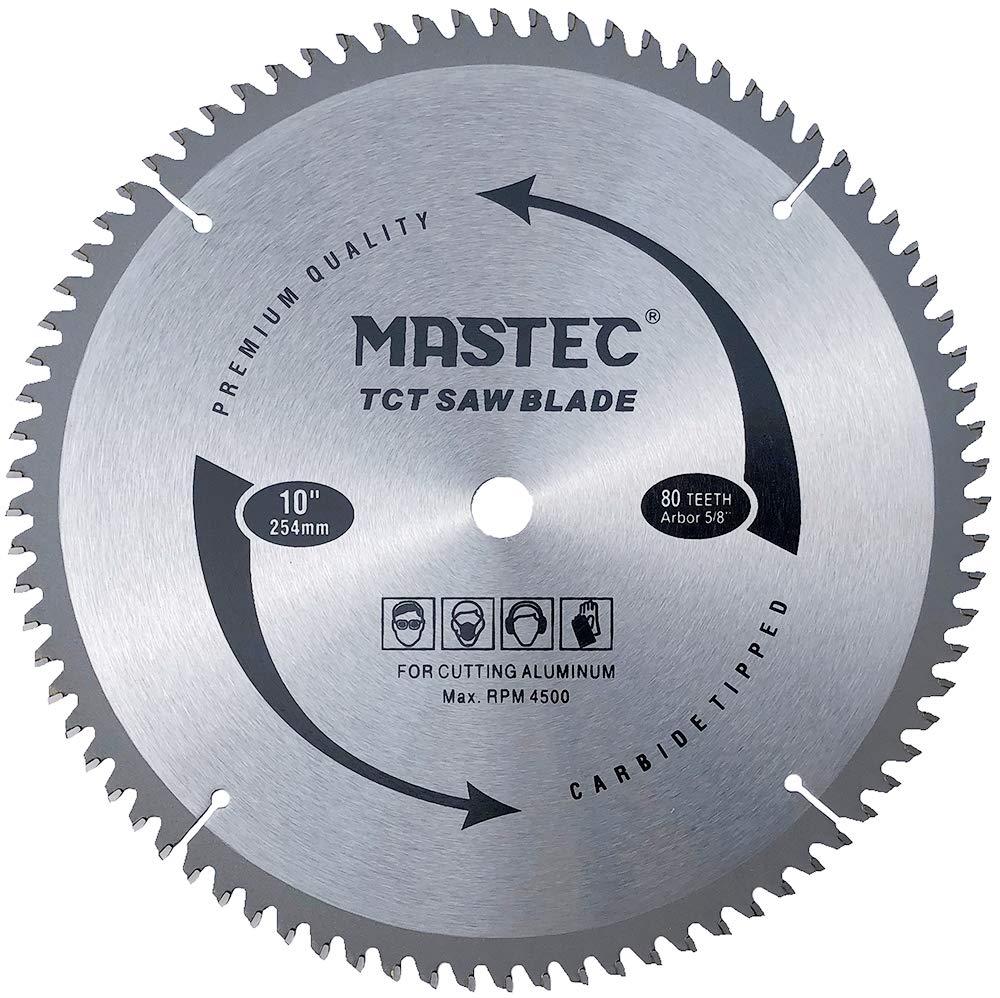
The budget champion that cuts 6061-T6 aluminum angle cleanly, with a warranty that promises a 100% replacement.
The crowd consensus is that this blade cuts aluminum like butter and leaves a clean, smooth result. Owners unanimously praise its clean cuts in aluminum angle stock and T-trac, making cutting performance the most-discussed trait. One standout report: shoppers say it cut 6061-T6 aluminum with no issues on a 3/8″ thick wall, taking a 0.020″ cut an inch up the side of an angle.
It packs 80 carbide teeth with a 5/8″ arbor in a 10-inch package that works on miter saws, circular saws, and table saws. The Triple Chip Teeth (TCG) design is ideal for aluminum, plexiglass, plastic, and non-ferrous metals, and owners note it doesn’t require filing after use. The brand also stands behind it with a 100% replacement guarantee, with any problem addressed within 24 hours.
The honest trade-off is durability — a few buyers report carbide tips coming off over time, which is the one recurring gripe. But for light to medium aluminum work, this is the value pick that outperforms its price point.
Why Owners Like It
- Clean cuts on 6061-T6 aluminum without filing
- Easy to clean after use
- 100% replacement warranty backed by the maker
The Recurring Gripe
- A few owners mention carbide tips coming off with heavy use
Reach for this if: you want respectable aluminum cuts without paying a premium — the value champion here.
Look elsewhere if: you plan to run it daily on thick extrusion, since durability is the mixed bag.
5. Luckyway 10″ 52-Tooth General Purpose

The wallet-friendly all-rounder that cuts laminate like butter and still costs less than a resharpening.
The best thing this blade has going for it is the blade quality — the most-praised trait — combined with a price that makes resharpening feel pointless. Customers note it cuts through 12mm laminate like butter, delivers tear-out free cuts on plywood in both directions, and handles MDF perfectly. Reviewers point out the 52-tooth blade cuts as good as the best Italian-made blades for a table saw, yet costs about a fourth of the price — even less than getting a blade resharpened.
This is a general-purpose blade first and an aluminum blade second. It is rated for wood, aluminum, and non-ferrous metals, and owners confirm it works well on aluminum. The 52-tooth count makes it a faster, more aggressive cutter than the 80-tooth options, which suits wood but means slightly rougher edges on aluminum.
The trade-off is a mixed verdict on durability and sharpness — some owners find it durable, while others report quick dulling or tear-out. For the price, it is a fantastic spare or entry blade, though the pure aluminum specialists above it will hold an edge longer on metal work.
The value read: nearly a thousand owners back this as the budget pick that punches above its weight on wood and light aluminum.
Who it isn’t for: dedicated metal shops that need a carbide edge to survive daily extrusion work.
Buy it if: you need one cheap blade for mixed wood and light aluminum projects and hate paying resharpening costs.
Pass if: aluminum is your primary material and you want the burr-free finish of an 80-tooth TCG.
6. TWIN-TOWN 10″ 80-Tooth TCG
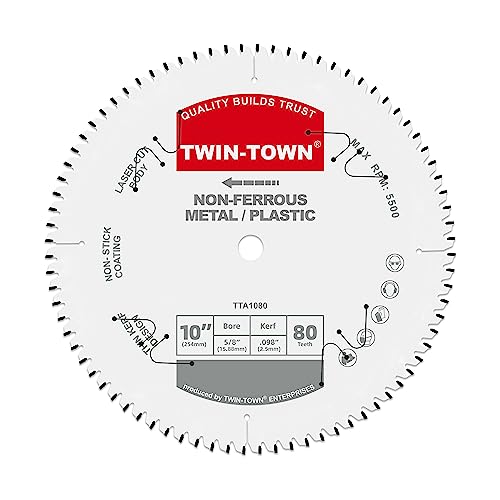
The plastic-friendly cutter that handles heavy aluminum shower headers and Lexan in the same afternoon.
Owners praise its smooth cut across aluminum, Lexan, PVC, and even high-carbon steel. It cuts thick aluminum shower door headers precisely on a 10″ miter saw, handles Lexan and high-density plastic with ease, and slices through PVC baseboard without melting. One owner even reports it handles 2.25″ diameter bushings of high carbon steel effectively.
Unlike the thinner blades above, this one uses a thick, non-thin-kerf plate, which gives it the rigidity to cut heavier stock without flexing. The C4 ultra-fine grain carbide teeth claim to hold sharpness up to 2X longer than standard blades., and the Electrophoretic Coating (a rust-resistant finish applied electrically) fights corrosion. The TCG grind tooth design ensures smooth, burr-free cuts in non-ferrous metals and plastic. Add the Limited Lifetime Warranty and a Unique ID Code for quality tracking, and you have a genuinely versatile shop tool.
One thing to note: durability and sharpness both get mixed reviews, so the 2X longevity claim is optimistic for heavy daily use. But for the price, owners say it works better than expected and beats spending on a single-purpose blade.
A real all-rounder: the thick plate and 80 TCG teeth handle metal, plastic, and even some steel without changing blades.
The fair warning: longevity is unverified, so treat the 2X sharpness claim as a bonus, not a promise.
Choose this when: your projects swing between aluminum frames, PVC trim, and acrylic sheets.
pass on it if: you need the absolute finest finish on thin sheet metal, where a 100-tooth blade wins.
7. CRALY 10″ 100-Tooth TCG
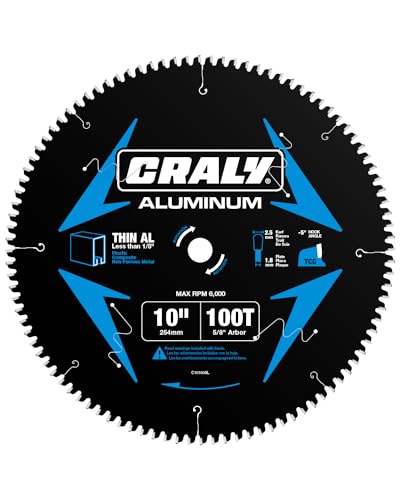
The high-tooth-count specialist that leaves a razor finish on thin aluminum rails and sheets.
Sharpness is the trait owners praise most, and with 100 TCG teeth, the geometry is built for fine finish work. Shoppers say it cuts 1/8″ aluminum rails like butter and carves through a 1-millimeter (0.04″) aluminum sheet with ease, leaving a smooth edge without any cleanup. It also tackles carbon fiber sheets and acrylics without dulling mid-project.
The thin kerf design (2.5 mm) removes less material and requires less saw power, which makes it ideal for corded and cordless circular saws. The BLACK ICE anti-stick coating reduces friction, heat, and corrosion so the blade slides through stock instead of grabbing, and the laser-cut expansion slot plus stabilizer vents keep the body quiet and true. Owners consistently call it a bargain compared to hardware-store blades.
The one split in the reviews is noise — some owners find it quieter than abrasive blades, while others report loud screeching on certain cuts. The maker’s guidance is simple: use it only on aluminum and non-ferrous materials to protect the fine edge.
The finish first: 100 teeth means a nearly polished edge on thin stock, with no filing or deburring.
Who should skip: anyone cutting thick extrusion or steel, since the fine teeth are not built for heavy bite.
Reach for this if: you cut thin aluminum sheet, trim, and composite materials and demand a smooth, finished edge.
Look elsewhere if: your work is thick bar stock that needs the chip clearance of a 60-tooth blade.
8. IVY Classic 35056 10″ 200-Tooth
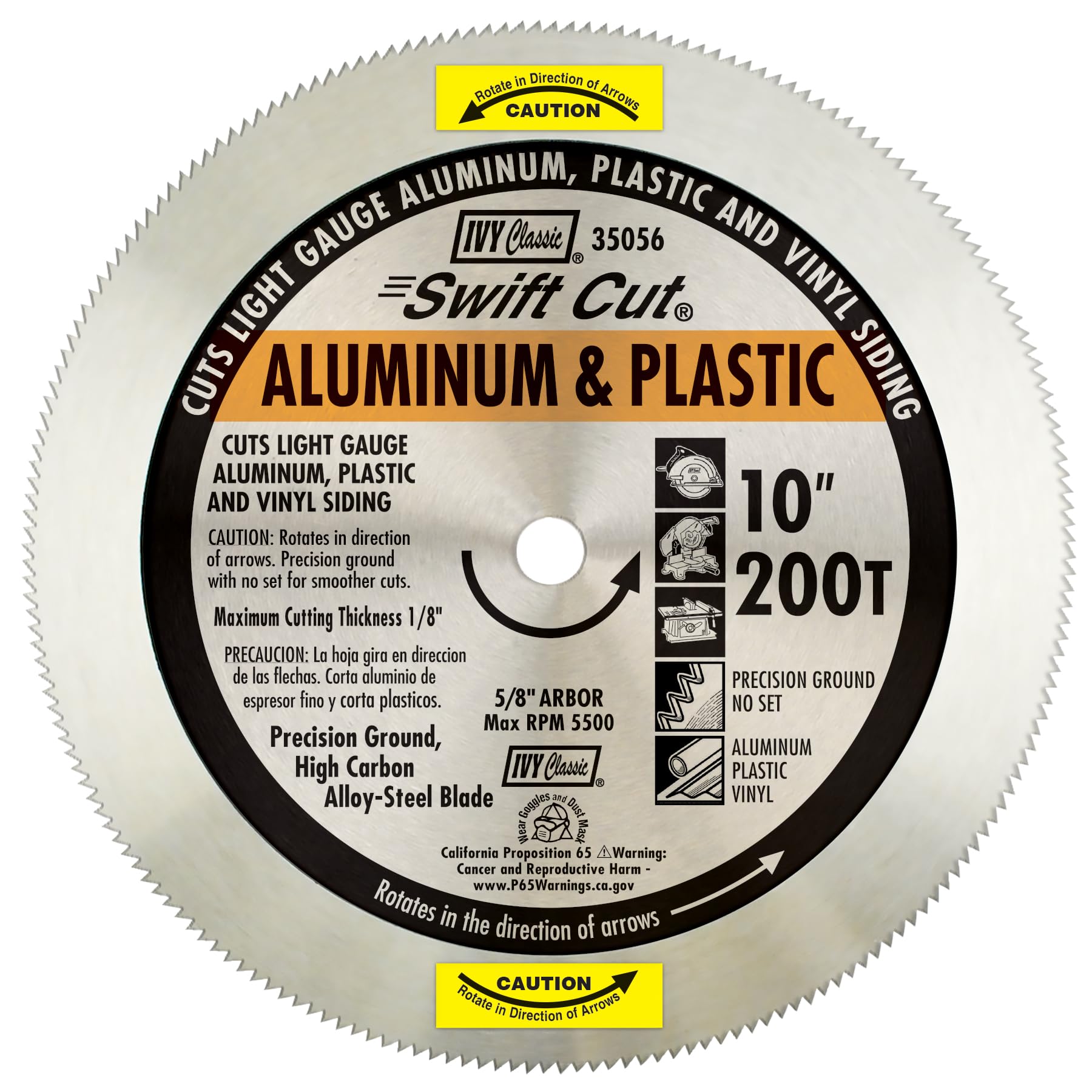
The 200-tooth specialist for feather-light cuts on thin aluminum, plexi, and vinyl siding.
Sharpness is what stands out here, and the ultra-high tooth count is the reason. Buyers report it cuts aluminum frames for window screens far better than a hacksaw, works great on 1/8″ plexi for picture frames, and excels on vinyl siding. With 200 precision-ground teeth and no set (meaning the teeth do not bend outward), it leaves a glass-smooth edge on thin material.
This is a high carbon-alloy steel blade with a 5/8″ arbor, and it is very specifically designed for light gauge aluminum, plastic, and vinyl siding up to 1/8″ thick. The maker is explicit: for material thicker than 1/8″, step up to their 80-tooth non-ferrous blade. It also carries a clear caution — the blade must rotate in the direction of the arrows printed on it.
The honest trade-off is durability: owners mention the blade dulls quickly and can warp after use, which makes it a consumable for light jobs rather than a long-term shop blade. There is also a rare note that some units arrive with the rotation arrow printed backward — an easy fix if you know the correct direction.
Best for the light stuff: window screen frames, vinyl siding, and thin plastic where a fine edge matters more than longevity.
The hard truth: treat it as a job-specific tool, not a daily driver, since the edge fades fast on thicker stock.
Buy it for: a specific project cutting 1/8″ or thinner aluminum and plastic where you want a perfect edge.
it’s not for you if: you regularly cut thicker aluminum — the maker themselves point you to an 80-tooth blade for that.
Understanding the Specs
Tooth Count & Grind
The number of teeth controls the finish. A 60-tooth blade clears chips fast for thick stock, 80 teeth balance speed and smoothness, and 100 or 200 teeth deliver a near-polished edge on thin material. The Triple Chip Grind (TCG) — an alternating flat and angled tooth design — is the standard for non-ferrous metal because it shears the material cleanly instead of tearing it, which prevents burrs and melted edges.
Hook Angle & Kerf
A negative hook angle (where the tooth face leans away from the rotation direction) stops the blade from grabbing the aluminum and pulling it up toward you, which is the main cause of kickback on metal. Kerf is the width of the cut slot: a thinner kerf like 0.094″ or 2.5 mm removes less material and needs less power, while a thicker plate stays more rigid for heavy extrusion work.
FAQ
Can I use a regular wood blade to cut aluminum?
What does TCG mean on a saw blade?
What is the best tooth count for cutting aluminum?
Will a 10-inch blade fit my miter saw?
Do I need cutting fluid or lubricant for aluminum?
What is the difference between a negative hook angle and a positive one?
Why do my aluminum cuts have burrs or melted edges?
How long does an aluminum cutting blade last?
What is kerf and why does it matter?
Will these blades cut plastic and acrylic too?
Final Thoughts: The Verdict
If you want one dependable pick, the blade for cutting aluminum winner is the Diablo D1080N because it pairs a proven TCG grind with Tri-Metal brazing and a non-stick coating for consistently clean cuts. If you want the very best finish on thin stock, grab the FOXBC 80-Tooth with its tungsten carbide build. And for heavy extrusion work that demands a blade still sharp after 5 years, the Oshlun 60-Tooth is the one to reach for. The crowd favorite holds a 4.7-star score with 700+ owners backing it, making it the safest single-blade bet.
How We Picked
We do not accept paid placement. Every pick is matched to a real buyer and a real use-case; we do not hands-on test units.
Sources & Methodology
Specifications: manufacturer listings and product documentation. Review insights: verified customer reviews, as of September 2026. Pricing: not shown on this page (it changes often); check the current price via the retailer link.
As an Amazon Associate, Gadgets Feed earns from qualifying purchases. This does not affect which products we feature.