
Our readers keep the lights on and my morning glass full of iced black tea. As an Amazon Associate, I earn from qualifying purchases.
Specs are compiled from manufacturer listings and verified buyer reviews and can change over time — please confirm the key details on the product page before buying.
Stripping the hex nut on a seized oxygen sensor is the fastest way to turn a 30-minute job into a weekend project. The right O2 sensor tool grips the flats so hard that even a 25-year-old, heat-seized sensor finally lets go without rounding corners or cutting wires.
I’m Min — the founder and writer behind Gadgets Feed. This guide is built by comparing the manufacturers’ published specifications and the patterns across verified customer reviews, so you get each pick’s real strengths and trade-offs instead of marketing spin.
Whether you’re a pro tech or a driveway mechanic, this breakdown of the best o2 sensor tool options shows exactly which socket or wrench profile wins on seized hardware.
Our Picks at a Glance

How To Choose The Best O2 Sensor Tool
An oxygen sensor sits right in the exhaust flow, so it gets baked by heat and blasted by road salt. That means the nut is often rusted solid, and the tool you use has to grip hard without slipping off the flats. The three things that decide success are the drive size, the socket shape, and the opening that lets the wire pass through.
Slotted Socket vs. Solid Socket
A slotted socket has a side cutout so the sensor’s wiring can slide through the opening. That lets you spin the socket onto the hex nut without unplugging the harness first, which is a lifesaver on rear sensors where the connector is buried. Some kits pair this with an offset design, so the socket body is set at an angle to give your ratchet extra clearance around exhaust pipes.
6-Point vs. 12-Point Grip
A 6-point socket wraps fully around the hex nut’s flats, spreading the force across a bigger surface. A 12-point socket is easier to line up in a tight spot but concentrates force on the corners, which is exactly where rounded-off nuts begin. For a rusted sensor you want maximum contact, so 6-point is the safer bet.
Flex Head vs. Fixed Offset
A flex-head wrench pivots at the top so you can angle the handle around manifolds and heat shields. A fixed offset head is machined at a permanent bend, which gives a solid feel but only works if the vehicle’s layout matches that angle. On overhead or firewall-side sensors, the flex design usually wins because you can adjust it on the fly.
Quick Comparison
| Model | Best For | Drive Size | Key Sizes | Weight | Amazon |
|---|---|---|---|---|---|
| GEARWRENCH 41720★ Best Overall | Pro techs needing full coverage | 3/8″ | 7/8″ + 1-1/16″ | 2.6 lb | Amazon |
| ABN 8817HDBest for Tight Spots | Tight flex-head access | Wrench | 22mm / 7/8″ | — | Amazon |
| DASBET 7pcBest Value Set | Full kit on a budget | 3/8″ + 1/2″ | 22mm – 29mm | 4.6 lb | Amazon |
| OMT 7pc | Sockets plus thread chasers | 3/8″ + 1/2″ | 22mm / 27mm / 29mm | 2 kg | Amazon |
| OEMTOOLS 33625246 | Ford 4.6L / 5.4L engines | Wrench | 22mm / 7/8″ | 14.4 oz | Amazon |
| WORKPRO 7PCS | Thread repair included | 3/8″ + 1/2″ | 22mm / 27mm + 7/8″ / 1-1/16″ | — | Amazon |
| Prokomon 10pc | Universal coverage set | 3/8″ + 1/2″ | 7/8″ / 22mm | — | Amazon |
| ARES 70318 | Complete pro-grade kit | 3/8″ + 1/2″ | 22mm / 27mm / 29mm | — | Amazon |
| OTC 4673 | Snug-fit OEM-level quality | 3/8″ + 1/2″ | 29mm / 27mm / 7/8″ | 5 lb | Amazon |
In‑Depth Reviews
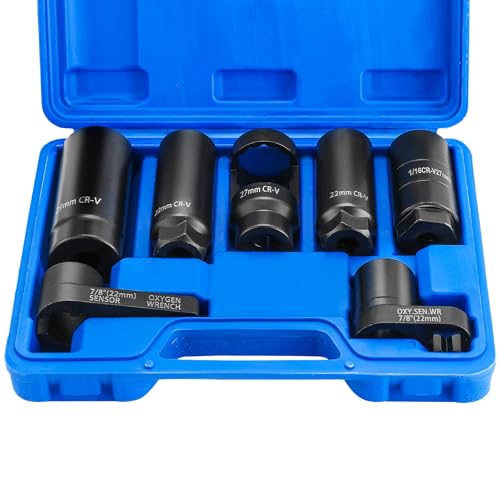
1. GEARWRENCH 8 Piece Sensor and Sending Socket Set | 41720
Our pick — over 4.5★ from 2,500+ verified ratings; the strongest balance of quality and price.
The 8-piece set that deals with every sensor type without slipping.
This set survives six years of daily dealership abuse because its sockets grip the flats so well they outperform tool-truck brands on seized hardware. The set covers oxygen sensors, oil pressure sending units, and vacuum switches, so you are never hunting for the right piece mid-job.
The 7/8″ slotted socket handles PVS, TVS, and O2 sending units with wiring still attached, and a 3/8″ drive 1-1/16″ deep socket reaches oil pressure sending units. Buyers report the 22mm O2 socket doesn’t flex under an impact gun, when cheaper tools round off the nut.
What wins people over is the build quality — the black oxide finish and heavy-duty blow-molded case get praise in nearly every review. The trade-off is a few sockets arriving with light surface rust from the factory, which is cosmetic and wipes off, not a functional issue.
eight-piece sensor coverage
- Survives daily pro use for years
- No flex under impact gun
- Case keeps the set organized
sockets can feel bulky
- Some sockets arrive with light rust
- Heavier than single-socket options at 2.6 lb
everyday pick: This is the set for working techs who need reliable grip on every sensor type without a second trip to the toolbox.
not for tight spots: You want a complete, durable kit that has survived working in a dealership — and you’re fine with a bit of surface rust that doesn’t affect the job.
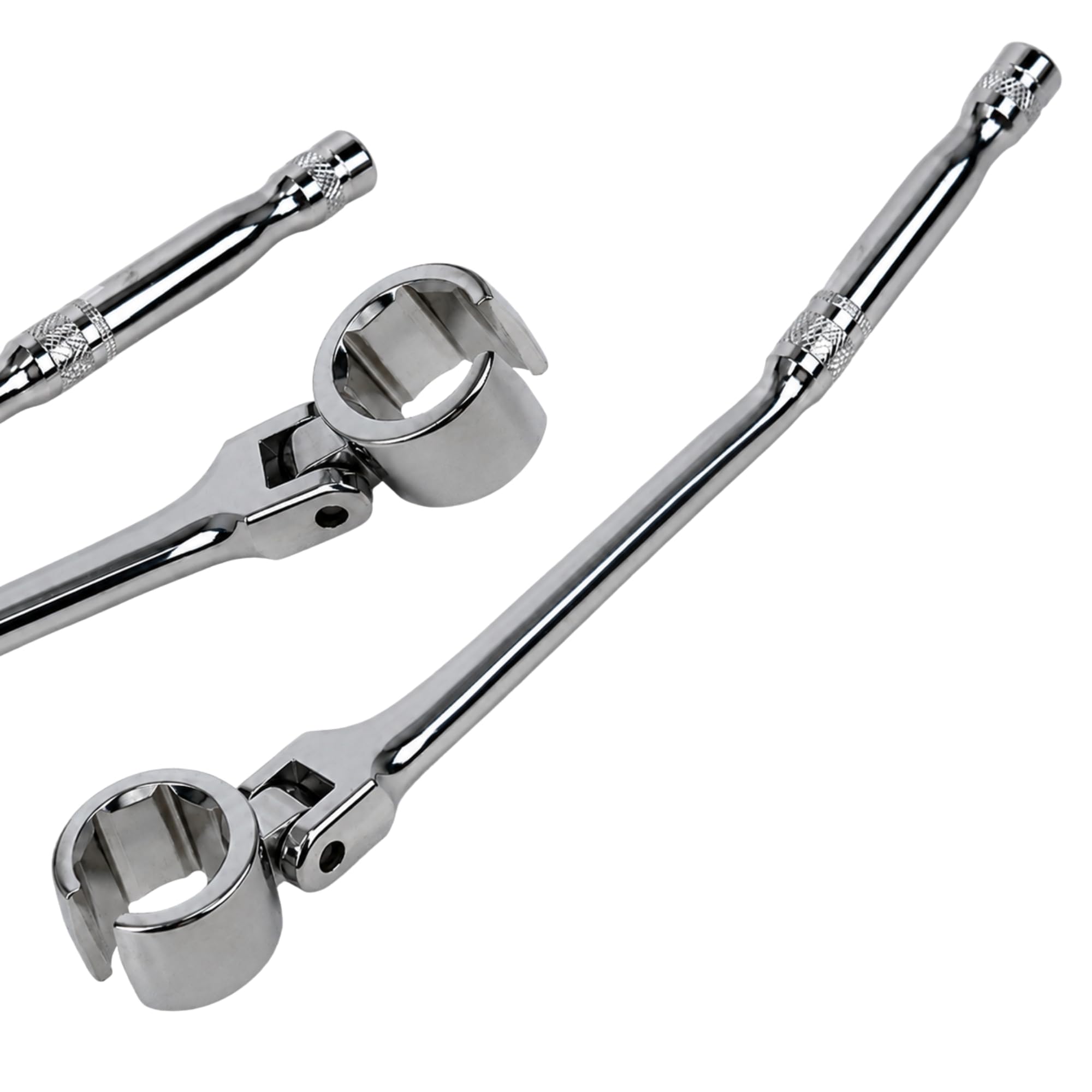
2. ABN 7/8in 22mm Flexible Head Oxygen Sensor Head Wrench
One flex-head wrench that sneaks into spots sockets simply cannot reach.
The defining spec here is the flex head on a slim 22mm body, which gives you extra clearance for oxygen sensors positioned upward and inward of the floorboard. That is the exact spot where a fixed socket fails — you cannot swing a ratchet. The curved handle on this O2 sensor wrench provides leverage around exhaust pipes, and you can flip the handle around to fit most spaces.
Owners mention it freed a 25-year-old sensor on a 1999 Buick Century after torching, and another owner cleared a tight space under a ’93 BMW 740IL with mallet taps. The cold-forged steel construction gives it the strength to take that kind of abuse, though the durability gets mixed feedback from a few who broke it under heavy pressure.
The honest catch is that a single wrench demands technique: pre-soak the threads with penetrating oil, use short cheater bar, and keep the swivel aligned square to the nut. When you do that, it beats socket-end removers for access — and at just one piece, it’s a budget-friendly way to try the flex-head approach.
hard-access hero: If your sensor sits above the exhaust with no room to swing a ratchet, this flex head is the one that gets you out of the driveway without cutting anything.
limited size range: You prefer a full socket set with multiple sizes and you’d rather not develop the technique this wrench demands.
3. DASBET 7pcs O2 Oxygen Sensor & Oil Pressure Sending Unit
A 7-piece master set that covers sensors, sending units, and injectors.
This set’s headline is the coverage: seven pieces spanning a 1″, 1-1/6″, and 1-3/16″ oil pressure sending unit socket, a 1-1/16″ GM thermal switch socket, plus 7/8″ short, universal, and vacuum switch sockets. That breadth is why customers note grabbing it after a single parts-store socket failed to fit the space — this set had the right socket waiting.
Build quality comes from chrome molybdenum and solid cast steel with a black oxide coating for rust resistance. The standard 6-point design with a low-profile side cutout lets you remove sensors with the wiring harness still attached, and the offset body gives leverage with a breaker bar in hard-to-reach spots.
What wins people over is the value — a heavy-duty tool that also worked for a motorcycle rear tire, at a price that undercuts buying individual sockets. The mixed feedback is on assembly and gripping: one owner found the 22mm fits a new sensor but slips on an old one, so treat seized nuts with penetrating oil first.
value set: This is the set for home mechanics who want every sensor size covered so they never discover the missing socket halfway through a job.
check build quality: It’s best on sensors that aren’t fully seized — for a 25-year-old rusted nut, add heat and penetrating oil before you put torque on the 22mm.
4. OMT 7pc Oxygen Sensor Socket Set for Oil Vacuum Fuel Injector Switch
A set that pairs 6-point torque with 12-point alignment convenience.
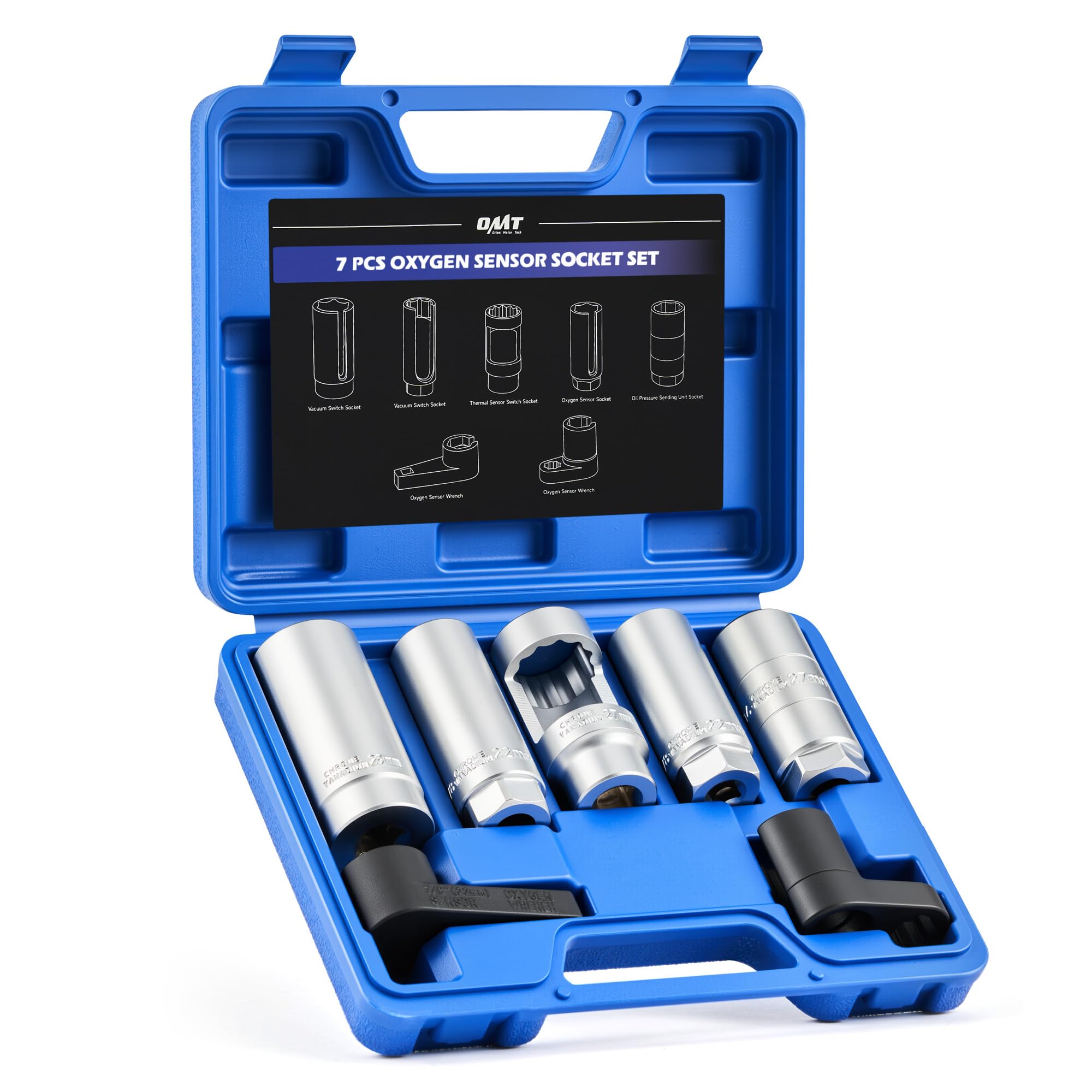
The clever design here is dual-point geometry: 12-point sockets make it easy to align in cramped spaces, while the 6-point sockets deliver maximum torque when you need it. The kit includes five sockets in 22mm, 27mm, and 29mm with both 3/8 and 1/2 inch drives, plus two sensor wrenches, covering oxygen sensors, oil pressure units, diesel injectors, and vacuum switches.
The U-shaped groove keeps wiring intact during removal, so you don’t cut the harness. Owners describe the tools as solid sockets that can take some abuse, and the included thread chasers are called a helpful bonus feature. The set costs a fraction of Snap-on alternatives while feeling anything but cheap.
The honest weakness is the 7/8″ wrench-style O2 sockets, which can flex open a little and slip on a stubborn sensor. For most jobs the socket set performs as described, but if you regularly fight heavily corroded sensors, a solid 6-point slotted socket is the more reliable tool for that specific fight.
all-rounder: This suits DIYers who want socket variety and thread chasers in one box and don’t want to pay truck-brand prices.
mind the sockets: They are the weak link on seized nuts — reach for the 6-point slotted sockets when the wrench-style pieces start to slip.
5. OEMTOOLS 7/8″ (22MM) O2 Sensor Wrench for Ford 4.6 and 5.4 Engines

The swivel-head wrench engineered specifically for Ford 4.6 and 5.4 engines.
The core spec is a 10.5-inch chrome vanadium steel wrench built for Ford 4.6L and 5.4L engine layouts, where sensor access is notoriously tight. The swivel head lets you work around heat shields, manifolds, and recessed positions, and the Posi-Grip system holds flat surfaces to prevent slippage and rounding.
Reviewers point out it removed firewall-side sensors on a nearly 20-year-old Nissan VQ35DE in minutes, with consistent praise for the articulation. At 14.4 ounces, it’s light enough to maneuver one-handed in tight engine bays, and the tight fit means rounding is rarely a concern.
The real-world catch is fitment: this is designed for specific Ford engine layouts and will not fit all vehicles, and it may not work on sensors with heat shields or recessed locations. It also fits most 7/8″ sensors across Ford, GM, Chrysler, Toyota, Honda, and Nissan, but it’s best on sensors that aren’t heavily corroded.
ford-focused: If you drive a Ford truck or SUV with the 4.6 or 5.4 engine, this is the one tool that articulates exactly where those sensors hide.
verify space first: The maker warns it won’t fit all vehicles, so confirm access space and sensor configuration before you order.
6. WORKPRO 7PCS O2 Oxygen Sensor Socket, 3/8″ 1/2″ Drive
The set that cleans damaged threads and prevents cross-threading.
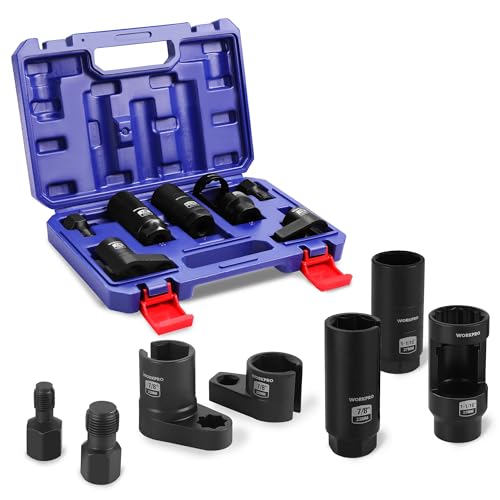
The standout feature is the pair of thread chasers — M12 x 1.25mm and M18 x 1.5mm — that clean and straighten damaged threads before you install a new sensor. That is the step most DIYers skip, then they blame the sensor when it cross-threads. The wide wire gate lets the sensor wire pass through without damage, and the square hole’s slotted design holds the ratchet securely with anti-slip performance.
Built from high-grade alloy steel with surface phosphating and heat treatment, the set delivers maximum torque without flexing. Owners praise the variety of socket styles, saying the fit was great and removal was easy thanks to having every socket they might need for an O2 sensor.
You can use this set on oil pressure, vacuum, thermal, and oxygen sensors across most vehicles. But shoppers say a catch: the 7/8″ 22mm socket is 32mm in outer diameter, which is too wide to fit shielded upstream sensors on some models, like a 2nd-gen Prius. So check the clearance around your specific sensor before relying on it there.
failure preventer: This is the set for DIYers who want to clean and straighten the bung threads so the new sensor seats perfectly.
check shield type: If your car has a heat-shielded upstream sensor, verify the 32mm OD fits the gap before you commit.
7. Prokomon 10pcs Oxygen Sensor Socket Set
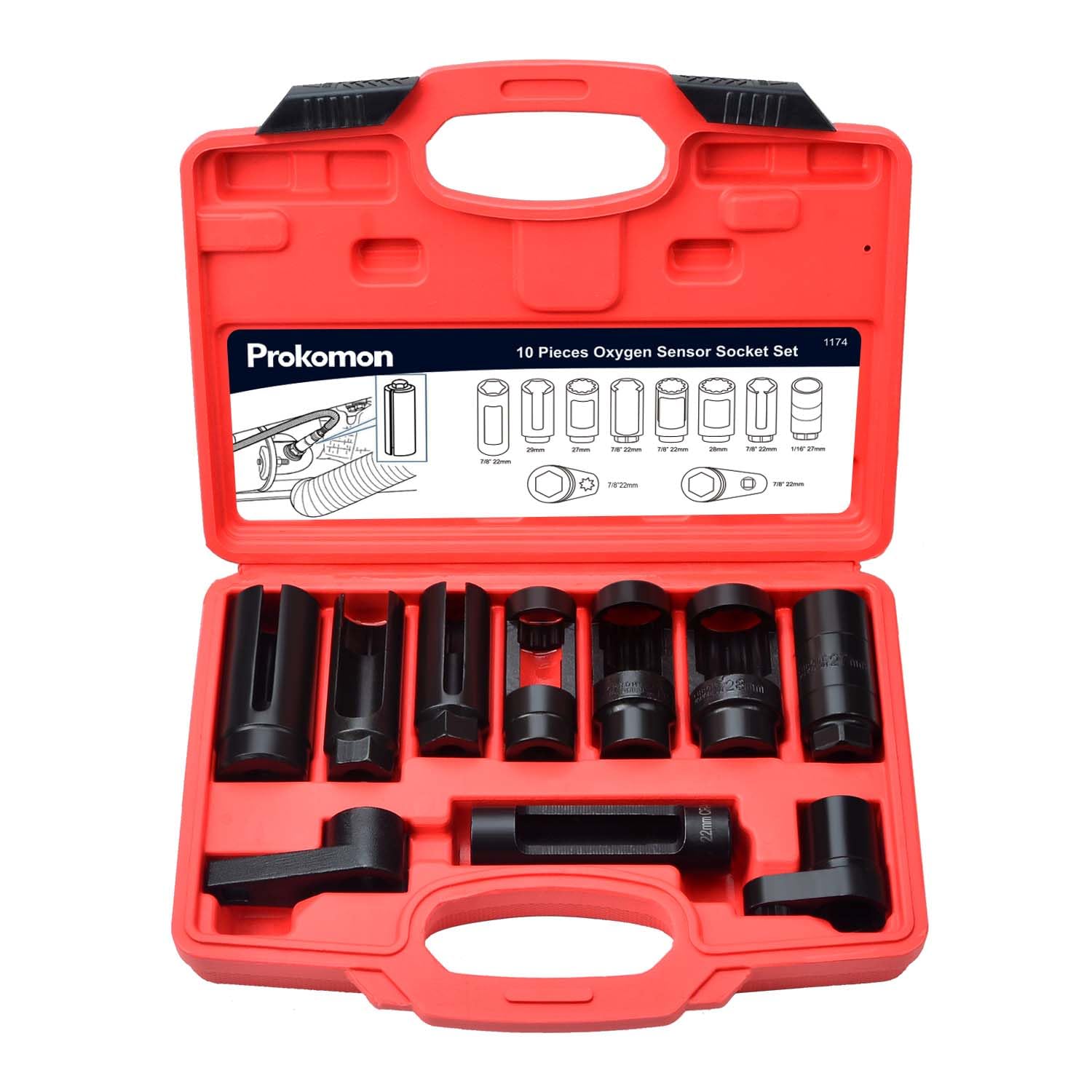
A ten-piece kit built for use with 3/8″ ratchets, 1″ wrenches, and breaker bars.
The headline spec is the 7/8″ (22mm) x 6-point x 80mm socket with a 7mm slot and 8mm x 64mm side cutout, letting you remove sensors with the wiring harness still attached. The socket is offset and compact, which gives extra leverage even in hard-to-reach spots, and it fits all standard oxygen sensors with a 7/8″ hexagon nut.
Heat-treated chrome vanadium steel with a black oxide finish gives it the strength and corrosion resistance you want from a 10-piece kit, and it supports both 3/8″ and 1/2″ drives. Owners call it a real nice set with competitive pricing and good quality, with the full-kit approach being the main draw.
The honest note is that one owner had to buy a separate tool for a smaller gap, since the kit’s sockets were too wide for that specific sensor location. For most standard sensors the set works, but keep in mind that no universal kit fits every single recessed location on every car.
coverage king: This suits buyers who flip cheap cars and want every standard size available in one box without paying per-piece at the parts store.
backup required: Some recessed sensor locations are too narrow for these sockets, so have a slim flex-head wrench as a fallback.
8. ARES 70318 10-Piece Oxygen Sensor Kit
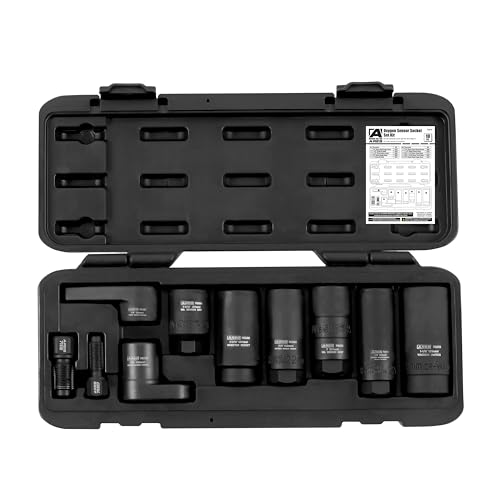
The complete kit that pulled a stuck sensor two shops failed to remove.
This 10-piece set includes a 29mm vacuum switch socket, a 27mm injector socket, a 22mm heated O2 sensor socket, a 22mm 6-point offset O2 sensor wrench, and a 22mm deep offset O2 sensor socket, plus M12 x 1.25mm and M18 x 1.5mm rethread tools. Owners credit the offset socket with a breaker bar for freeing a stuck O2 sensor in a tight space where two shops failed, saving an exhaust replacement.
All tools are chrome vanadium steel with a manganese phosphate coating to resist corrosion, and the kit ships in a storage case so you never misplace a piece. Owners call the quality fantastic and the fit excellent, and the included rethreaders are repeatedly praised as the bonus that makes the kit feel complete.
The build quality is consistently praised, though durability gets mixed feedback with a few finding it not strong enough under hard use. For the home mechanic who also works on friends’ cars, this kit’s coverage and the anti-seize tip — apply it to threads only — make it the one that turns a dreaded job into a 20-minute fix.
stuck-sensor aid: This is the kit for owners facing a seized sensor where the offset socket and breaker bar combination is the winning move.
use rethreaders: Clean the bung threads before installing, and you will avoid the cross-threading that ruins a new sensor.
9. OTC 4673 7-Piece Sensor Socket Set – Includes 7 Popular Sockets + Case

The set that fits snugger than a Matco set on loose sensors.
Fit is the standout here — buyers report this set sits much snugger on sensors than a Matco set that was always loose, especially the O2 socket. The seven pieces include a 29mm vacuum switch and O2 socket, a 7/8″ wide-slot and narrow-slot socket, a 27mm thermal sensor switch, a 1-1/16″ and 1″ oil pressure sending unit socket, and two offset 7/8″ O2 sockets with both 3/8″ and 1/2″ drives.
The build quality gets described as perfectly machined with deburred edges and no sharp parts — rare quality that fits a wide variety of automotive sensors including oil pressure, oxygen, and vacuum switches. It ships in a blow-molded case to keep the pieces organized, and the whole kit weighs 5 pounds, so it feels substantial in the hand.
The balanced take is that build quality and fit earn mixed feedback overall: some find it perfectly machined while others call it cheaply made, and the fit is snug for some but not tight for others. It also compares well on value — One owner noted it looks like a Matco set costing at least twice as much, making it a solid pick for hobby mechanics wanting OEM-grade coverage.
hobbyist pick: If a loose socket has rounded your sensors before, this set’s tighter fit on the hex flats is the reason to choose it.
not pro-grade: This fits the weekend mechanic who wants a must-have sensor kit without chasing the tool truck.
Understanding the Specs
Slotted vs. Offset Socket Design
A slotted socket has a side cutout that lets the sensor’s wiring pass through, so you can remove the sensor without unplugging the harness first. An offset socket sets the body at an angle to give your ratchet or breaker bar extra clearance around exhaust pipes and manifolds. Many kits combine both, so you can choose the right approach for each sensor’s location.
Thread Chasers and Why They Matter
A thread chaser cleans and straightens damaged threads in the exhaust bung before you install a new sensor. Sizes like M12 x 1.25mm and M18 x 1.5mm match common O2 sensor threads. Running a chaser through first prevents cross-threading, which is the most common way a brand-new sensor gets ruined during installation.
FAQ
Will a slotted O2 sensor socket fit with the wiring still attached?
What is the difference between a 6-point and 12-point socket for O2 sensors?
Will a universal O2 sensor socket set fit my car?
Why does my new O2 sensor socket slip on the old sensor?
What does a thread chaser do and do I really need one?
Should I use a 3/8″ drive or 1/2″ drive O2 sensor socket?
Is a flex-head O2 sensor wrench better than a fixed offset socket?
How do I remove a severely seized or rusted O2 sensor?
Why is the sensor wire gate important on an O2 socket?
Final Thoughts: The Verdict
For the majority of shoppers, the o2 sensor tool winner is the GEARWRENCH 41720 because it combines six years of dealership-proven durability with coverage for every sensor type. If you want a flex-head wrench that reaches sensors sockets simply cannot, grab the ABN 8817HD. And for a complete kit with thread chasers that prevent your next failure, the ARES 70318 is the one to reach for.
How We Picked
We do not accept paid placement. Every pick is matched to a real buyer and a real use-case; we do not hands-on test units.
Sources & Methodology
Specifications: manufacturer listings and product documentation. Review insights: verified customer reviews, as of September 2026. Pricing: not shown on this page (it changes often); check the current price via the retailer link.
As an Amazon Associate, Gadgets Feed earns from qualifying purchases. This does not affect which products we feature.