
Pairing an amplifier with Bluetooth speakers is about preserving signal integrity from the source device all the way to the cabinet. The wrong amp introduces noise, timing issues, or insufficient power to drive the passive speakers you already own or plan to buy. The market offers everything from miniature Class D boards to integrated streaming hubs with room correction—but matching the amp’s output stage, DAC quality, and connectivity to your specific passive speakers determines whether the system sounds clean or compressed.
I’m Min — the co-founder and writer behind Gadgets Feed. My research for this guide involved analyzing over 50 hours of user feedback and technical spec sheets across these nine amplifiers to isolate which ones deliver stable Bluetooth pairing, adequate current delivery, and sonic transparency for real-world systems.
Whether you are upgrading a bookshelf setup or building a multi-room zone, the best amp with bluetooth speakers balances enough clean wattage with flexible inputs so your passive speakers sound their best without needing a separate preamp or DAC.
How To Choose The Best Amp With Bluetooth Speakers
Selecting the right amplifier for your passive Bluetooth speaker system starts with understanding the power requirements of your specific speakers. Sensitivity ratings in dB and nominal impedance in ohms determine how much voltage the amp must swing. A speaker rated at 86 dB sensitivity at 4 ohms needs significantly more current than a 90 dB model at 8 ohms. Ignoring this mismatch leads to audible distortion or insufficient volume. The following factors will help you narrow down the choices to the amplifier that matches your existing hardware and listening habits.
Power Output and Impedance Matching
The continuous RMS power rating per channel at your speaker’s nominal impedance is the key figure. Many budget amplifiers advertise peak power numbers that are irrelevant for sustained listening. Look for clean wattage into 4 ohms and 8 ohms separately. An amp that delivers 60 watts per channel into 8 ohms typically doubles to around 120 watts into 4 ohms—this current headroom prevents clipping during dynamic peaks. Speakers with low impedance dips below 4 ohms require an amplifier stable down to 3 ohms, which only premium Class D designs with robust power supplies can handle without thermal shutdown.
Bluetooth Codec and Signal Integrity
Bluetooth version numbers (5.0 vs 5.2 vs 5.3) matter less than the codec support. SBC is mandatory and adequate for casual listening, but aptX HD or LDAC preserves near-CD quality resolution over wireless. Amplifiers that rely on internal antennas should maintain a stable connection at 30 feet through drywall. If your source device supports aptX HD, pairing it with an amp that includes Qualcomm chipsets ensures the transmission path retains bit-depth integrity before the DAC stage converts the digital signal to analog.
DAC Quality and Input Versatility
An amp with Bluetooth speakers is only as good as its digital-to-analog converter stage. Look for integrated DACs from ESS, Cirrus Logic, or Texas Instruments that support 24-bit/192 kHz resolution. This matters when streaming from services like TIDAL or Qobuz. Beyond Bluetooth, having optical, coaxial, USB, and RCA inputs future-proofs the system for connecting a TV, CD player, turntable preamp, or game console without needing a separate audio switcher.
Subwoofer Integration and Room Correction
If your system includes a powered subwoofer, the amplifier must offer a dedicated subwoofer pre-out with adjustable crossover. Without a high-pass filter on the main speaker outputs, the amp wastes power trying to reproduce low frequencies that the sub handles more efficiently. Advanced models include room correction DSP that measures the acoustic environment and adjusts EQ curves to flatten frequency response—critical for bookshelf speakers placed near walls that naturally boost bass frequencies.
Quick Comparison
On smaller screens, swipe sideways to see the full table.
| Model | Category | Best For | Key Spec | Amazon |
|---|---|---|---|---|
| WiiM Amp Ultra | Streaming Integrated | Multi-room + room correction | ESS ES9039Q2M DAC, 100W 8Ω | Amazon |
| WiiM Amp | Streaming Integrated | TV + multi-room music | 60W 8Ω, HDMI ARC | Amazon |
| AMPAPA D1 | Desktop HiFi | Near-field listening | TPA3255, OLED VU meter | Amazon |
| AIYIMA T9 PRO | Hybrid Tube | Warm signature, multiple DAC inputs | 200W, JAN 5725 tubes | Amazon |
| AIYIMA A07 Pro | Value Class D | Budget desk setup | TPA3255, 300Wx2 4Ω | Amazon |
| Fosi Audio BL20C | 2.1 Value | Subwoofer integration on a budget | TDA7498E, 320W peak | Amazon |
| Donner | Karaoke Receiver | Home karaoke and multi-speaker zones | 1000W peak, dual mic inputs | Amazon |
| Pyle PDA77BU | Budget Receiver | Garage or office 4-speaker setup | 800W peak, FM radio | Amazon |
| Bose SoundLink Plus | Portable Speaker | Portable outdoor party | 20 hr battery, IP67 | Amazon |
In‑Depth Reviews
1. WiiM Amp Ultra

The WiiM Amp Ultra is the most complete integrated streaming amplifier in its class, combining a premium ESS ES9039Q2M DAC with dual TPA3255 Class D amplifier modules. This configuration delivers 100 watts per channel into 8 ohms with total harmonic distortion plus noise below -106 dB, meaning the amp adds virtually nothing to the signal path. The built-in RoomFit room correction uses the microphone in your phone to measure speaker placement and applies parametric EQ adjustments to smooth out standing waves and boundary bass gain—a feature normally reserved for processors costing several times more.
Connectivity is exhaustive: HDMI ARC for TV integration, optical, RCA, and USB inputs, plus Wi-Fi 6 and Bluetooth 5.3 with LE Audio. The 3.5-inch touchscreen on the unibody aluminum chassis displays album art and system settings, eliminating the need to reach for a phone to switch sources. Users report stable Bluetooth connections with minimal latency, though the unit does not support AirPlay as a receiver, which iPhone users should note. The dual TI amplifier chips handle impedance dips down to 4 ohms without audible strain, driving tower speakers like Polk Ti200s with extended highs and precise subwoofer integration via the dedicated sub out with adjustable crossover.
For those building a multi-room system, the WiiM Amp Ultra syncs with other WiiM devices, Amazon Echo, and Google Home speakers through the WiiM Home app. The voice remote included supports Alexa and Google Assistant, so the system can be integrated into a smart home without additional hubs. The main drawback is the price point, which sits at the premium end of this guide, but the combination of room correction, ESS DAC, and streaming capabilities justifies the investment for users who want a single box solution that will not need upgrading for years.
Why it’s great
- ESS ES9039Q2M DAC delivers studio-level clarity with no audible noise floor
- RoomFit auto-EQ dramatically improves bass response in less-than-ideal room placements
- Wi-Fi 6 and Bluetooth 5.3 provide lag-free streaming from any music service
Good to know
- Does not support AirPlay; iPhone users must use Chromecast or Bluetooth
- No coaxial digital input—optical and HDMI ARC are the only digital options
- Premium pricing places it above budget-focused buyers
2. WiiM Amp

The WiiM Amp distills the streaming amplifier concept into a smaller, more affordable package without sacrificing the core features that make the ecosystem powerful. It delivers 60 watts per channel into 8 ohms and 120 watts into 4 ohms, which is sufficient for most bookshelf speakers and even smaller floor-standing models in medium-sized rooms. The HDMI ARC port allows the amplifier to serve as a TV sound system, automatically powering on and switching input when the television is turned on—a convenience that many stereo receivers at double the price cannot match.
Streaming is handled through the WiiM Home app, which aggregates Spotify, TIDAL, Qobuz, Amazon Music, and internet radio, plus supports Google Cast and AirPlay 2. The amplifier also includes a USB-A port for playing files from a thumb drive and a subwoofer pre-out with adjustable crossover, so integrating a powered sub is straightforward. Users consistently praise the sound quality when paired with speakers like KEF Q150s, noting a wide soundstage and clean midrange without the harshness typical of some Class D designs. The built-in parametric EQ and optional room correction (via the paid upgrade) allow fine-tuning for room acoustics.
The amp does not include a headphone jack or phono preamp, so turntable users will need an external phono stage. Bluetooth connectivity is reliable with SBC and AAC support, but lacks aptX HD, which may matter for Android users streaming high-resolution files. Despite these omissions, the WiiM Amp represents the best balance of streaming features, connectivity, and clean amplification for users who want a modern, app-controlled system without spending premium-tier money.
Why it’s great
- HDMI ARC with auto-detect simplifies TV integration to a single cable
- Multi-room support works with AirPlay, Google Home, and other WiiM devices
- Parametric EQ and subwoofer crossover give advanced bass management
Good to know
- No aptX HD or LDAC support for high-resolution Bluetooth streaming
- Lacks a headphone output for private listening
- Requires phone app for initial setup; no physical input selector
3. AMPAPA D1
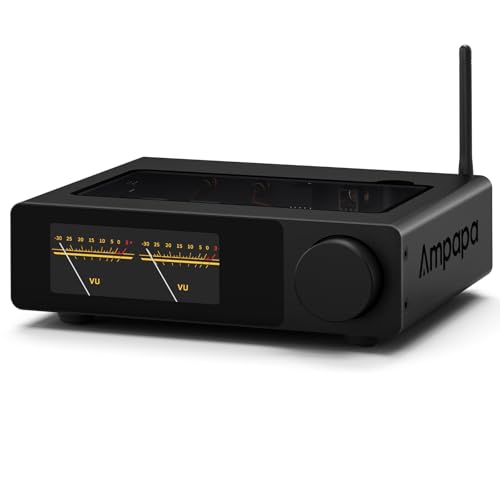
The AMPAPA D1 is a collaboration between Ampapa and Douk Audio, essentially an upgraded Douk A5 with a digital VU meter, TRS balanced input, and Bluetooth 5.2. At the heart is the TPA3255 chip, supported by PFFB (Post Filter Feedback) technology that eliminates load dependency, meaning the amplifier’s frequency response remains flat regardless of whether the connected speakers are 4 ohms or 8 ohms. The inclusion of a GaN 48V/5A power adapter gives the amplifier clean, regulated power that reduces ripple noise compared to traditional switched-mode supplies.
The front panel features a vibrant OLED screen with seven VU meter styles in yellow, blue, or black themes, plus a glass-covered top panel that reveals the socketed NE5532 op-amps. Users can swap these op-amps for alternatives like LM4562 or Muses 02 to tailor the sound signature—an unusual feature at this price point. Connectivity includes RCA, TRS balanced inputs, a 30–200 Hz adjustable high-pass filter for the speaker outputs, and a full-range subwoofer pre-out. The 12-volt trigger input allows integration into custom automation systems.
Real-world performance driving JBL Studio 530s is described as dynamic and detailed with a wide soundstage. The high-pass filter protects smaller bookshelf speakers from overpowering bass frequencies, allowing the subwoofer to handle all low-end reproduction. The auto-standby feature activates after five minutes of inactivity and requires pressing a button on the remote to wake—there is no setting to disable this, which some users find annoying. Still, for desktop near-field systems, the D1’s combination of balanced inputs, tone controls, and VU meter feedback makes it a standout.
Why it’s great
- PFFB technology keeps frequency response stable across different speaker impedances
- Swappable op-amps let users fine-tune the sound without buying a new amplifier
- TRS balanced input and 12V trigger enable professional studio integration
Good to know
- Non-defeatable auto-standby wakes only via remote, not front button
- Glass top panel is removable and might dislodge during transport
- Real-world wattage at 8 ohms is about 80W, lower than the 300W peak suggests
4. AIYIMA T9 PRO

The AIYIMA T9 PRO blends modern Class D amplification with preamp vacuum tubes to add harmonic warmth to the signal. It uses a Jan 5725 tube in the preamp stage to filter out the digital edge from streaming sources while maintaining the efficiency of the power stage. The result is a slightly softened treble presentation and a fuller midrange compared to fully solid-state designs. The amplifier delivers 200W peak power with bass and treble tone controls, plus a VU meter that adds visual feedback but requires a moderate volume level before the needles become animated.
Input selection is broad: Bluetooth 5.2 with Qualcomm chips, USB for PC, coaxial, optical, and stereo RCA. This makes the T9 PRO a viable hub for a desktop system that connects to a computer via USB, a turntable via RCA, and a TV via optical without needing a separate switcher. Users applaud the sound quality when paired with speakers like the Jamo S 803, citing transparent soundstage and clear vocal reproduction. The remote control handles all source switching and tone adjustments, though the unit itself is compact enough to sit on a desk without dominating the workspace.
One limitation is that the VU meter’s sensitivity is low at quiet listening levels, so it does not convey dynamic information during background listening. The tubes generate noticeable heat, so the amplifier needs ventilation clearance on both sides. Some users report that the upper frequency range can sound slightly harsh at moderate volume before the tone controls tame it. Upgrading the stock tubes to Riverstone or other aftermarket options improves the low-end weight and separation, making the T9 PRO a good platform for tube rolling enthusiasts.
Why it’s great
- JAN 5725 tube preamp adds warmth without the high cost of pure tube amplification
- Input flexibility covers USB, optical, coaxial, Bluetooth, and RCA in one small chassis
- Tube rolling capability lets users customize the sound signature directly
Good to know
- VU meter is unresponsive at low volumes, limiting its usefulness for near-field desks
- Tubes run hot—ensure nothing is stacked on top of the amp
- Upper treble can sound grainy before tone control adjustment
5. AIYIMA A07 Pro

The AIYIMA A07 Pro is an upgrade of the widely popular A07, adding tone controls and a 3.5mm line output that enables 2.1-channel subwoofer integration. It uses the Texas Instruments TPA3255 chipset—the same high-performance amplifier IC used in amplifiers costing three times as much—and a NE5532 dual op-amp that can be upgraded by the user. The amplifier delivers a maximum of 300 watts per channel into 4 ohms when paired with a 48V power supply, though it ships with a 36V 6A adapter that provides roughly 165W per channel into 4 ohms, which is still generous for most bookshelf speakers.
Bluetooth 5.2 with Qualcomm chips includes aptX HD support, giving Android users near-CD quality over wireless. The connection range extends roughly 40 meters through walls in open environments, making it suitable for workshops or garages. The physical controls include bass, treble, and volume knobs, plus an input toggle between Bluetooth and RCA. The chassis is compact at 6.6 x 4.4 x 1.2 inches, fitting easily beneath a monitor. Reviews highlight the A07 Pro’s ability to drive low-sensitivity speakers like Polk ES15s with authority, producing a spacious soundstage without noticeable distortion.
A few stability issues emerge when the amplifier is pushed to extremes: at very low impedance loads (around 3 ohms) with maximum bass/treble boost, the thermal protection can trigger at full volume. This is a niche scenario but relevant for users trying to drive demanding speakers in large rooms. The Bluetooth signal can suffer intermittent interference in congested wireless environments, though aptX HD over a direct line of sight is solid. For the price, the A07 Pro delivers the best power-to-cost ratio in this guide, making it the entry-level recommendation for users building a first HiFi system.
Why it’s great
- TPA3255 chipset provides transparent, low-distortion power at an entry-level price
- aptX HD Bluetooth preserves detail from compatible Android source devices
- Line-out with volume control enables seamless 2.1 subwoofer integration
Good to know
- Thermal protection may trigger at very low impedance with aggressive EQ
- Bluetooth can experience interference in dense wireless environments
- No optical, coaxial, or USB inputs limit connection options to Bluetooth and RCA
6. Fosi Audio BL20C

The Fosi Audio BL20C is one of the few budget amplifiers that natively supports a 2.1 channel setup with a dedicated subwoofer output. It is built around the STMicroelectronics TDA7498E chipset, which delivers a maximum of 320W peak with a single 19V DC power supply. The amplifier includes front-panel controls for bass, treble, and volume, plus a USB-A port that reads MP3, WMA, FLAC, APE, and WAV files directly from a flash drive—a useful feature for users who prefer offline music libraries without a computer involved.
Bluetooth 5.0 provides stable pairing with phones, tablets, and computers, and users report instant connection without the pairing dropouts common on older budget amps. The RCA input allows connection of a TV, CD player, or turntable preamp, while the compact chassis (small enough to fit in a backpack) makes it a candidate for portable speaker setups. Reviews consistently note that the amplifier runs cool even at moderate listening volumes, thanks to the efficient Class D topology. The bass control offers enough range to compensate for smaller bookshelf speakers that lack low-end extension.
The main caveat is that the amplifier lacks a high-pass filter for the main speaker outputs, meaning the satellites receive the full frequency range. This is less of a problem if the satellites can handle bass, but with very small speakers, it can result in distortion at higher volumes. The spring-loaded speaker terminals accept only up to 16-gauge wire, which limits bi-wiring options. For a simple 2.1 system with a powered subwoofer and passive bookshelf speakers, the BL20C offers the most straightforward path to that configuration without needing extra filters or splitters.
Why it’s great
- Dedicated subwoofer output with bass/treble controls enables a true 2.1 system
- USB-A port plays FLAC and WAV directly from a thumb drive
- Runs cool and stays stable during extended listening sessions
Good to know
- No high-pass filter on speaker outputs—small speakers may struggle with full bass
- Speaker terminals only accept up to 16 AWG wire
- Uses an AC-DC adapter brick rather than an internal power supply
7. Donner

The Donner stereo receiver is engineered for multi-purpose home entertainment with a heavy emphasis on karaoke functionality. It boasts a 1000W peak power rating with 25W RMS per channel across 4 channels, which translates to support for up to eight speakers (four pairs). The receiver includes two 1/4-inch microphone jacks with independent volume controls, echo, and a Talkover function that lowers music volume during announcements—features that make it a natural choice for family gatherings, weddings, or small venue hosting.
Input connectivity is extensive: Bluetooth 5.0, USB (up to 64GB), two pairs of RCA, AUX, optical, and coaxial digital inputs. The remote control provides full access to treble, midrange, and bass adjustments across all input modes. The front-panel control center with digital LED display gives real-time feedback on source selection and EQ settings. Users who pair this receiver with efficient speakers report that the system gets loud enough for outdoor parties and large living rooms without strain, though the bass response is limited by the low RMS output compared to the peak rating.
Not all experiences are positive—some users report that the amplifier struggles to drive speakers with low sensitivity or low impedance, producing thin sound quality even after adjusting the three-band EQ. There are also complaints about intermittent sound dropouts caused by loose speaker wire connections rather than the amplifier itself. The unit’s labeling for the eight speaker terminals can be confusing; each of the four channels has its own volume knob, so wiring must be methodical. For karaoke parties where ease of mic integration and source switching matters more than audiophile transparency, the Donner delivers the needed features at a budget-friendly price.
Why it’s great
- Dual mic inputs with echo and Talkover simplify event hosting and karaoke
- Optical and coaxial inputs enable direct connection to modern TVs
- Independent volume knobs per channel allow zone-level control
Good to know
- Low RMS power (25W per channel) may not drive large, low-sensitivity speakers
- Bass response is limited; three-band EQ cannot compensate for power deficiency
- Speaker terminal labeling is non-standard and can cause wiring confusion
8. Pyle PDA77BU

The Pyle PDA77BU is a traditional stereo receiver adapted for the modern era with built-in Bluetooth 5.0. It provides 800W peak power across 4 amplifier channels, supporting up to four speakers plus a passive subwoofer. The receiver includes a built-in FM radio tuner, USB-A and SD card slots for digital media playback, and dual 1/4-inch microphone jacks with independent volume controls. This combination makes it a versatile central hub for a garage, workshop, or living room where multiple audio sources need to be accessible without complex switching.
The front-panel control center includes a digital LED display, source selection, and dedicated knobs for microphone volume, reverb, and delay. Users report that the Bluetooth connection is stable up to 30 feet and pairs easily with phones and tablets. The receiver’s form factor is larger than the compact Class D amps in this guide, measuring 13.78 inches wide by 10 inches deep, so it requires shelf or rack space. Reviews from owners who use this unit for TV sound in home offices or for playing music in garages highlight the ease of setup and the convenience of having FM radio alongside Bluetooth streaming.
The sound quality is described as “loud enough” rather than refined, which is expected at this price tier. The Bluetooth connection can occasionally skip when reconnecting to a smart TV, requiring a manual re-pair. The peak power rating is significantly higher than the continuous output, so expect clean output only at moderate volume levels. For users who need a simple four-speaker setup with microphone inputs and FM radio, the Pyle PDA77BU covers the bases without breaking the bank, but it does not deliver the clarity or headroom of dedicated Class D amplifiers with higher-quality DACs.
Why it’s great
- Built-in FM tuner and SD card slot provide offline radio and media playback
- Four speaker channels with dual mic inputs suit basic whole-room audio
- Remote control manages all functions from across the room
Good to know
- Bluetooth reconnection can be inconsistent with some smart TVs
- Peak power rating is far above the continuous output—volume ceiling is moderate
- Large chassis requires dedicated shelf space, unlike compact desktop amps
9. Bose SoundLink Plus

The Bose SoundLink Plus is a self-contained portable Bluetooth speaker, not a traditional amplifier, but it earns a place in this guide because it eliminates the complexity of speaker wire and separate components entirely. It houses a Class D amplifier, digital signal processing, and high-excursion drivers inside a rugged IP67-rated enclosure. The 20-hour battery life and USB-C charging port mean this unit can serve as a primary music source for outdoor events, camping, or poolside gatherings where AC power is unavailable.
Audio performance is categorically different from passive speaker systems—the SoundLink Plus uses Bose’s proprietary DSP to optimize frequency response within the enclosure, producing a bold, resonant sound with surprisingly deep bass for its size. The Bose app allows three-band EQ adjustment for bass, midrange, and treble, giving users control over the tonal balance. SimpleSync technology connects the speaker to compatible Bose smart soundbars for whole-home audio, while Party Mode and Stereo Mode—using two SoundLink Plus speakers—enable either synchronized playback or left/right channel separation.
At roughly three pounds, the SoundLink Plus is heavier than typical portable speakers, which contributes to its excursion authority but makes it less pocketable. The USB-C charge-out function lets the speaker serve as a power bank for a phone, which is handy during extended outdoor use. For users who want a weatherproof, battery-powered system without the hassle of pairing an amplifier with passive speakers, the SoundLink Plus is the most polished all-in-one solution. The trade-off is that the speaker cannot be upgraded component by component—what you buy is what you have until you replace the entire unit.
Why it’s great
- IP67 dust and waterproof rating lets you use it at the beach, pool, or in rain
- 20-hour battery with USB-C charge-out keeps your devices powered
- Bose DSP delivers exceptional bass for the size without audible distortion
Good to know
- No option to swap drivers or upgrade components—the speaker is sealed
- Heavier than other portable options at just over three pounds
- Relies on Bose app for EQ; no physical tone controls on the unit
FAQ
What impedance speakers should I use with a Class D amp like the AIYIMA A07 Pro?
Do I need a separate DAC if my amplifier has Bluetooth 5.2?
Can I use a portable Bluetooth speaker like the Bose SoundLink Plus as a permanent TV speaker?
What does the high-pass filter on the AMPAPA D1 actually do?
How many speakers can the Donner or Pyle receiver drive simultaneously?
Final Thoughts: The Verdict
For most users, the best amp with bluetooth speakers winner is the WiiM Amp because it combines clean 60W per channel amplification, HDMI ARC TV integration, and a polished streaming app that works with every major music service. If you want room correction EQ and a premium ESS DAC, grab the WiiM Amp Ultra. And for a pure near-field desktop setup with swappable op-amps and a gorgeous VU meter, nothing beats the AMPAPA D1.