
Struggling to hear dialogue over action scenes or constantly asking others to repeat what was said is a common frustration. Standard TV speakers compress and muddle speech, forcing you to choose between deafening volume and missing the plot entirely. Assistive listening devices bypass this compromise entirely, delivering crisp, personalized audio straight to your ears or a nearby speaker.
I’m Min — the co-founder and writer behind Gadgets Feed. I spend my weeks dissecting audio specs, comparing latency figures, and testing connectivity options across dozens of wireless TV hearing solutions to find which ones actually deliver on their promise for the hard of hearing. This guide is based on hundreds of hours of spec analysis and customer feedback mining across the entire category.
Whether you need headphones, a neckband speaker, or a dedicated transmitter, finding the right technology can restore the joy of watching TV without disturbing your family or straining to hear. This guide examines the best assistive listening devices on the market today.
How To Choose The Best Assistive Listening Devices
Not all TV hearing solutions are created equal. The right choice depends on your specific hearing profile, your TV’s outputs, and whether you wear hearing aids. Here are the critical factors to weigh before buying.
Connectivity Type: RF vs. Infrared vs. Bluetooth vs. Auracast
2.4GHz RF wireless systems offer the most reliable connection through walls and across rooms, with zero audio delay. Infrared systems require direct line-of-sight to the transmitter, which restricts movement but avoids interference. Standard Bluetooth often introduces 100–250ms of lip-sync lag, but transmitters supporting aptX Low Latency can reduce that to under 40ms. Auracast is a new Bluetooth broadcast standard that lets you share audio with multiple compatible hearing aids or headphones simultaneously, making it the most future-proof option for hearing aid users.
Form Factor: Headphones vs. Neckband vs. Speaker
Over-ear headphones provide the best sound isolation and dialogue clarity, ideal for users who want to block out room noise. In-ear monitors and earbuds are lightweight but can cause fatigue during long sessions. Neckband speakers like the HomeSpot JY538 sit on your shoulders and direct sound toward your ears without covering them, allowing you to hear ambient conversation. Wireless TV speakers such as the Coby unit sit on a table next to you and amplify TV audio in a small zone, perfect for couples with different hearing needs.
Special Features: Tone Control, Balance, and Ambient Listening
Look for left/right balance adjustment if you have asymmetric hearing loss. A dialogue or treble boost mode can cut through background music and sound effects. Ambient sound listener mode uses a built-in microphone to let you hear someone speaking to you without removing your headphones — a critical safety and convenience feature for seniors.
Quick Comparison
On smaller screens, swipe sideways to see the full table.
| Model | Category | Best For | Key Spec | Amazon |
|---|---|---|---|---|
| Conqier 2.4G Digital Wireless TV Headphones | Wireless Headphones | All-day comfort with spare battery | 14-hour battery per cell; 164ft RF range | Amazon |
| HomeSpot BA210 v2 + JY538 Neckband | Neckband + Transmitter | Auracast sharing & 50-hour battery | 50-hour neckband playtime; aptX Adaptive | Amazon |
| Avantree Audikast 4 | Bluetooth Transmitter | Auracast hearing aid compatibility | Auracast + Classic dual mode; firmware upgradeable | Amazon |
| Coby Wireless TV Speaker | TV Speaker | Tabletop speaker for shared listening spaces | 10W stereo; 100ft range; 8-hour battery | Amazon |
| SIMOLIO Digital Wireless TV Headphones | Infrared Headphones | Zero-delay line-of-sight with balance control | Infrared transmission; balance + ambient mode | Amazon |
| HomeSpot JY100 Wireless Neckband | Neckband Headphones | Ultra-lightweight comfort for long TV sessions | 24g weight; aptX Low Latency <40ms | Amazon |
| Swiitech Wireless Headphones + Dock | Over-Ear Headphones | Plug-and-play simplicity with charging dock | 24-hour battery; Bluetooth 5.3; 45H standby | Amazon |
In‑Depth Reviews
1. Conqier 2.4G Digital Wireless TV Headphones

The Conqier system is the most complete wireless TV headphone package we evaluated, built around a 2.4GHz RF base station that delivers audio up to 164 feet without signal drop. It uses a voice-enhancing DSP to isolate speech from background noise, and it offers three tone modes — dialogue, standard, and cinema. The left/right balance control is a standout for users with asymmetric hearing, allowing separate volume adjustment per channel.
Battery life is uniquely generous: the package includes two rechargeable batteries, each rated for 14 hours. You can swap them to achieve 28 hours of continuous TV watching with zero downtime. The optical bypass port lets you connect a soundbar simultaneously, so others can listen through the TV speakers while you use the headphones. The unit uses balanced armature drivers, which typically offer more accurate speech reproduction than dynamic drivers in this price range.
Users consistently praise the crystal-clear dialogue reproduction and reliable RF connection that works through walls and into adjacent rooms. The only compromise is the in-ear design, which some users find uncomfortable for extended wear — though the included memory foam tips mitigate this for most. The ambient sound mode is a practical addition for hearing doorbells or conversation without removing the earpieces.
Why it’s great
- 164-foot RF range with zero audio delay and no line-of-sight requirement
- Two hot-swappable batteries provide 28 hours of total playback
- Voice-enhancing DSP improves dialogue clarity without boosting background noise
Good to know
- In-ear earbud design may cause discomfort after several hours of continuous wear
- Optical connection requires TV audio to be set to PCM format
2. HomeSpot BA210 v2 + JY538 Neckband Speaker
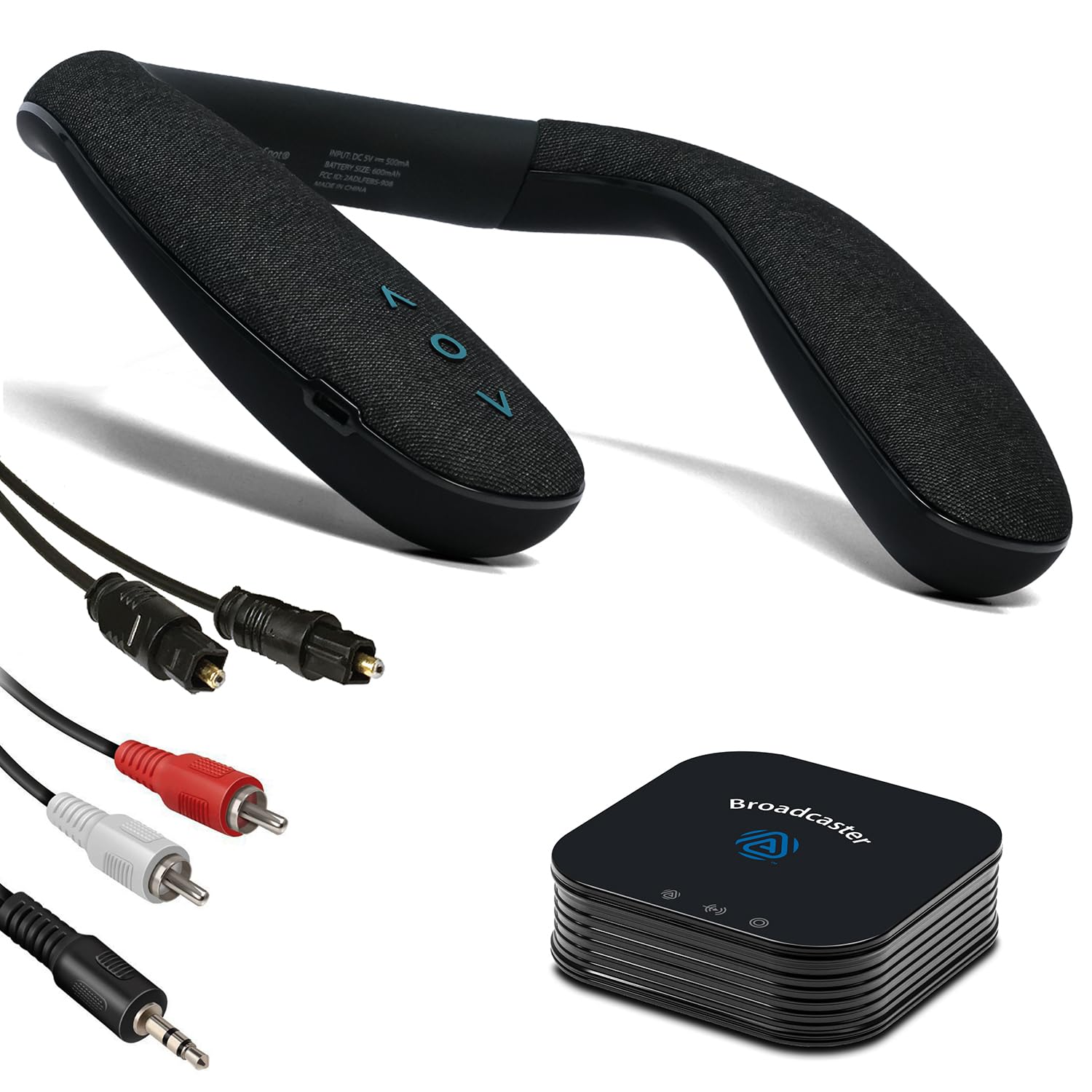
The HomeSpot BA210 v2 transmitter supports the new Auracast broadcast standard, meaning it can stream audio to an unlimited number of Auracast-compatible headphones, earbuds, or hearing aids simultaneously. This is a genuinely future-proof feature for households with multiple hearing aid users. The bundled JY538 neckband speaker is a unique form factor — it sits on your shoulders and projects sound upward toward your ears without covering them, keeping you aware of your surroundings.
The transmitter supports aptX Adaptive, aptX Low Latency, and aptX HD codecs, so latency stays under 40ms for lip-sync-free viewing. Battery life on the neckband is an enormous 50 hours per charge, enough for a full week of heavy TV watching. The QK Audio app lets you manage Auracast broadcasts, adjust volume, and rename the stream for easy identification. The RCA, optical, and 3.5mm inputs ensure compatibility with virtually any TV.
Users report excellent sound quality with clear stereo separation and minimal room disturbance — the sound is directed at your ears, not the entire room. The neckband is lightweight enough to forget you are wearing it, and many users appreciate the ability to walk to the kitchen and still hear the TV. The bass can produce a slight vibration against the collarbone at high volume, but adjusting the position usually solves this.
Why it’s great
- Auracast broadcast streams to unlimited compatible devices simultaneously
- 50-hour battery life on the neckband speaker with aptX Low Latency codec support
- Open-ear design keeps you aware of ambient sounds while watching
Good to know
- To connect two neckbands requires an additional Auracast receiver due to single USB port
- Bass vibration can be felt on the collarbone at higher volume levels
3. Avantree Audikast 4
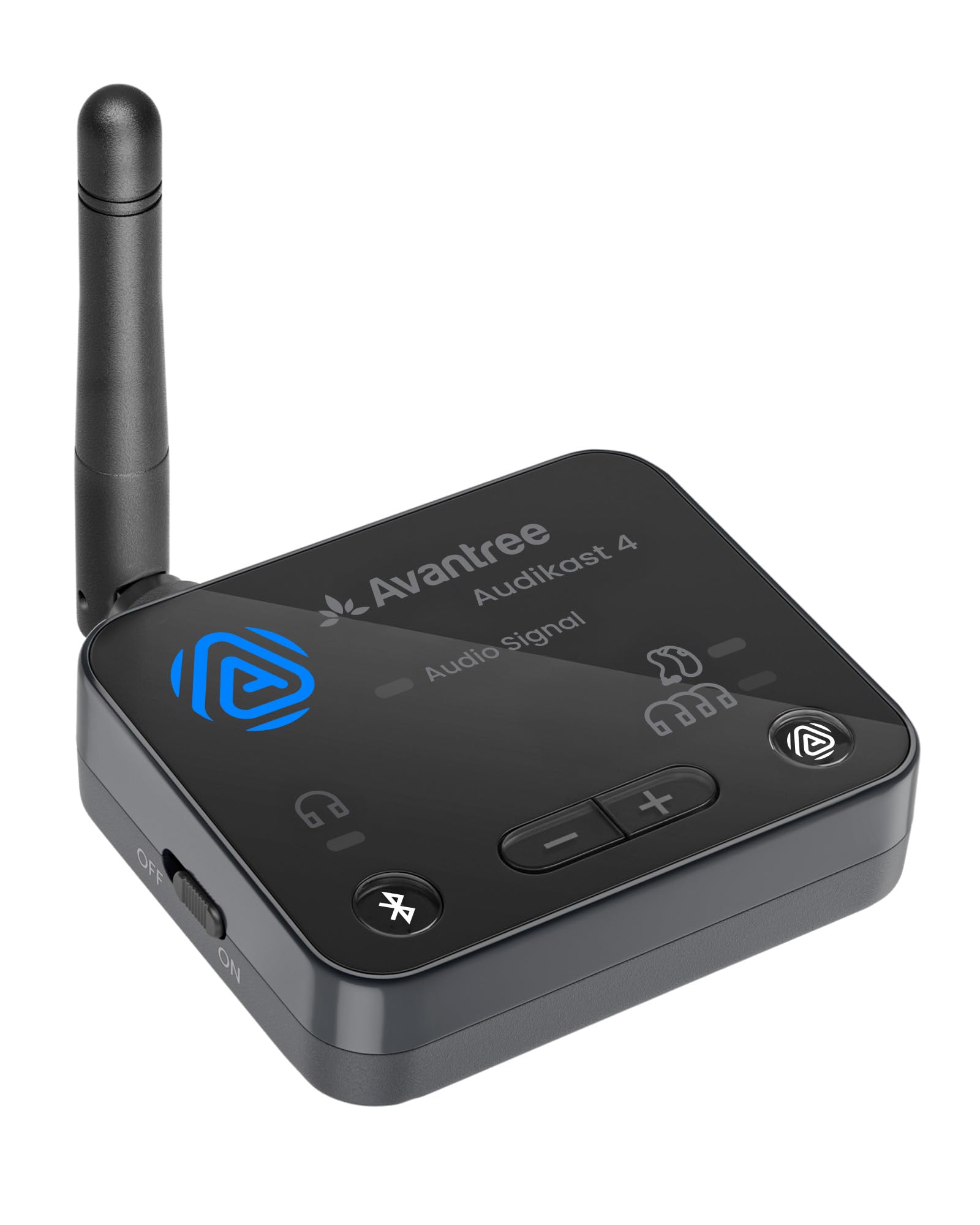
The Avantree Audikast 4 is the only transmitter on our list that switches between Auracast broadcast mode and classic Bluetooth mode. This dual-mode design means you can stream TV audio to Auracast-compatible hearing aids (such as Jabra Enhance, Oticon Intent, ReSound Vivia, or Starkey Edge AI) or to a single pair of standard Bluetooth headphones. For hearing aid users, this is often the most cost-effective solution — it costs roughly half the price of proprietary hearing aid TV streamers.
Setup is simple via optical TOSLINK or 3.5mm AUX input. The device has upgradable firmware, meaning it can receive future Auracast feature updates as the standard evolves. In Auracast mode, audio latency is negligible, and users report dialogue that is sharp, clear, and free of the tinny sound that plagues many TV streamers. Importantly, it allows hearing aids to maintain their ambient sound processing, so you can still hear the doorbell or conversation while watching.
Customer reports from Costco audiologists and hearing aid forums confirm compatibility with multiple major brands. Some users experienced initial connection issues that were resolved by reinstalling the Avantree app. The device failed for one reviewer outside the return window, though the support process was described as confusing. Overall, this is the most versatile bridge between modern hearing aids and TV audio currently available.
Why it’s great
- Dual Auracast and Classic Bluetooth modes support hearing aids and headphones
- Firmware upgradeable for future Auracast feature enhancements
- Costs roughly half as much as proprietary hearing aid TV streamers
Good to know
- Only works with Auracast-compatible hearing aids — check compatibility list before buying
- Not compatible with HDMI-only TVs or soundbar passthrough setups
4. Coby Wireless TV Speaker
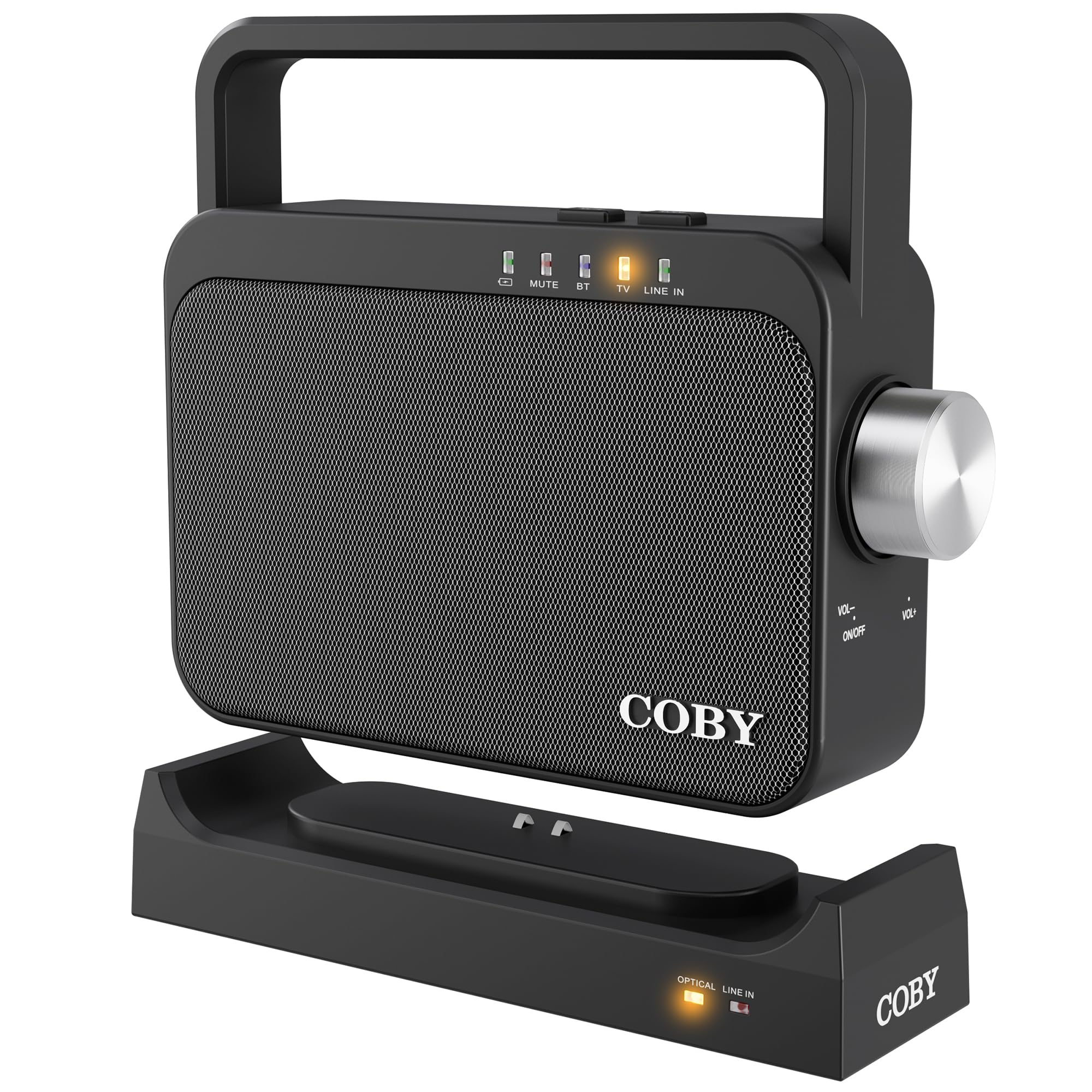
The Coby Wireless TV Speaker takes a different approach from headphones — it is a portable tabletop speaker that you place next to your chair. The base connects to your TV via optical or AUX, wirelessly transmitting audio up to 100 feet to the speaker. The 10W stereo output delivers clear, amplified dialogue that can be heard across a room without blasting the main TV speakers. It is an excellent solution for couples where one person needs louder audio while the other prefers normal volume.
Battery life is rated at 8 hours, with recharging via a dedicated docking base or Micro USB. The speaker doubles as a standard Bluetooth speaker for music, podcasts, or phone calls when the TV is off. Controls are simple: a smooth volume knob, one-touch mute, and clear LED indicators. The build quality features a premium fabric finish and feels more substantial than typical entry-level TV hearing amplifiers.
User feedback is overwhelmingly positive, with many praising the crisp, static-free audio and the convenience of moving the speaker between rooms. An important setup note: the optical cable has small clear plastic caps that must be removed before insertion, or no audio will pass through. A small number of users reported muffled audio when using the base’s optical passthrough, but direct Bluetooth connection from the TV generally resolved this. The TV must be set to output PCM audio for the optical connection to work.
Why it’s great
- Tabletop speaker design allows shared listening without individual headphones
- 10W amplifier delivers clear, room-filling dialogue with zero static
- Charging dock and Bluetooth music mode add versatility beyond TV use
Good to know
- Optical caps must be removed before first use or audio will not pass through
- TV must be set to PCM audio format for digital connection to work
5. SIMOLIO Digital Wireless TV Headphones
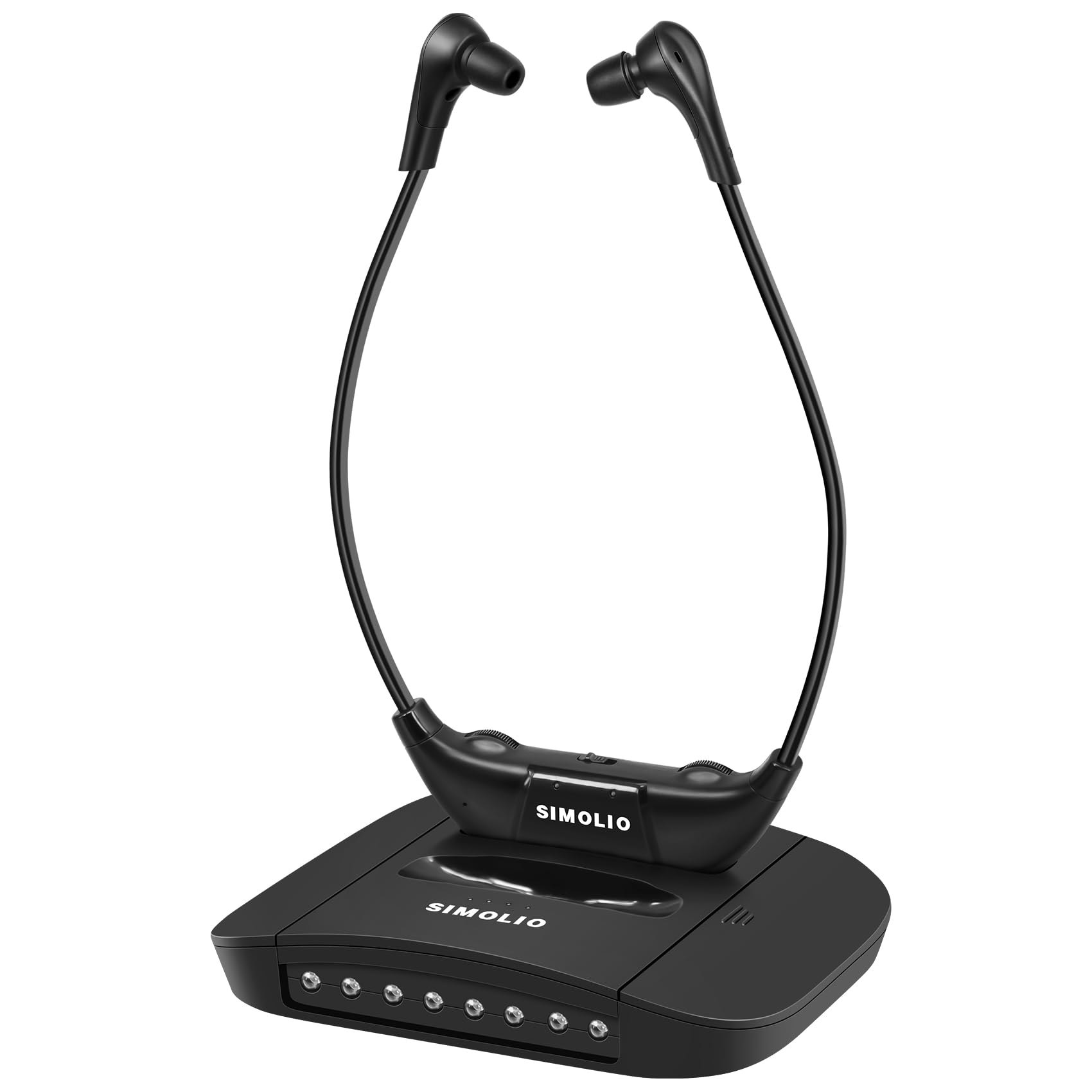
The SIMOLIO system uses infrared wireless technology, which means the headphones must remain within line-of-sight of the transmitter — roughly 12 meters in optimal conditions. This is a limitation compared to RF systems, but the payoff is zero interference from Wi-Fi or other Bluetooth devices, making audio exceptionally stable and free of dropouts. The system is truly plug-and-play with no pairing required, and audio latency is nonexistent since infrared transmits instantaneously.
The headset includes three tone profiles via a TONE control, letting you boost treble for dialogue clarity, emphasize mids, or flatten for full-range content. The left/right balance adjustment is particularly useful for users with different hearing sensitivity in each ear. The charging dock doubles as the transmitter base, providing 15 hours of battery per full charge. An ambient sound listener mode activates a built-in microphone so you can hear someone speaking nearby without removing the earpieces.
Users consistently note that setup takes under 30 minutes and that sound quality is notably better than legacy brand TV Ears systems. The optical bypass port allows simultaneous soundbar operation. However, the infrared limitation is critical: if you lean back in your chair or stand up, the signal cuts out. The earbud-on-earhook design can cause pressure on the earlobes after extended wear. SIMOLIO recommends this for users who sit relatively still in front of the TV.
Why it’s great
- Zero audio delay and no interference from Wi-Fi or other wireless devices
- Left/right balance control addresses asymmetric hearing loss directly
- Ambient sound listener mode lets you hear conversation without removing headphones
Good to know
- Transmission requires direct line-of-sight — signal drops if you move or lean back
- In-ear loop design can cause discomfort for some users during long TV sessions
6. HomeSpot JY100 Wireless Neckband Headphones

At just 24 grams, the HomeSpot JY100 is the lightest assistive listening device on this list — so light that most users forget they are wearing it. This is a neckband-style headphone with earbuds that sit in your ear canals, connected by a flexible collar that rests behind your neck. It comes paired at the factory with a dedicated transmitter that supports Qualcomm aptX Low Latency, delivering audio latency under 40ms for perfect lip-sync.
The bundled transmitter accepts optical, AUX, and RCA inputs, making it universally compatible with any TV, even older non-smart models. Battery life is 20 hours per charge, and quick charging delivers 8 hours of playback from just a 20-minute charge. The 10mm dynamic drivers are tuned for a warmer, bass-rich sound signature designed with seniors in mind. The left/right balance adjustment and high maximum volume make it effective for users with moderate hearing loss.
User reviews highlight excellent customer support from HomeSpot, with one reviewer receiving a free replacement unit after their initial pair died from an incorrect power adapter. The neckband design is far less fatiguing than over-ear headphones for binge-watching sessions. Some users reported static when moving their head, but this appears to be related to the earbud fit rather than the wireless signal. The JY100 also works as standalone Bluetooth headphones for phone or tablet use.
Why it’s great
- 24g weight is the lightest option — barely noticeable for all-day wear
- aptX Low Latency transmitter delivers under 40ms of audio delay
- 20-hour battery with quick charge feature for 8 hours in 20 minutes
Good to know
- Neckband design may not fit comfortably under high-collared clothing
- PCM audio format required for optical connection to transmit properly
7. Swiitech Wireless Headphones for TV Watching with Charging Dock
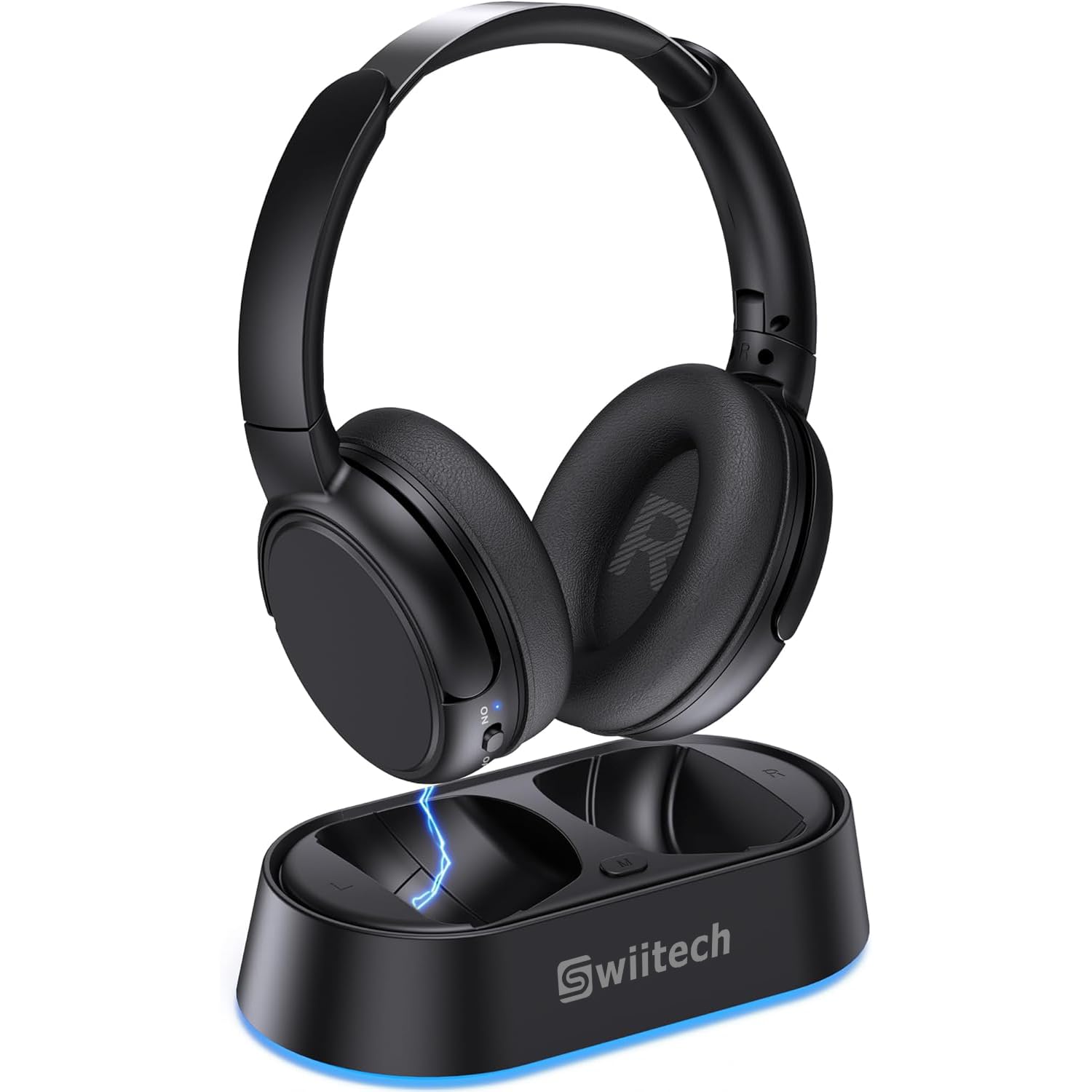
The Swiitech system is the most accessible entry-point into the assisted TV listening category, bundling a comfortable over-ear headphone set with a transmitter base that also serves as a charging dock. It uses Bluetooth 5.3 with a claimed latency under 40ms, though this relies on the TV supporting Bluetooth audio transmission — otherwise, you use the included optical, AUX, or RCA cables for a wired-transmitter-to-headphones connection.
The over-ear design features memory foam cushions and a lightweight frame, making it comfortable for extended wear. Battery life is 24 hours per charge, with the dock providing convenient drop-in recharging. The headphones automatically power on and pair when lifted from the base, eliminating repeated setup steps. The 30-meter Bluetooth range is adequate for a single room, though thick walls may cause intermittent static as reported by some users.
Customers consistently praise the zero-lag performance and plug-and-play setup, with many noting it solved the problem of blasting TV volume for a hard-of-hearing family member. The main compromises are the lack of left/right balance control and no ambient sound listener mode, which more advanced models include. The Swiitech is best suited for users who want a simple, reliable over-ear solution without complex settings or hearing aid compatibility needs.
Why it’s great
- Convenient charging dock with auto-pair functionality when lifted from base
- 24-hour battery life with memory foam cushions for comfortable long wear
- Multiple input options including optical, AUX, and RCA for broad TV compatibility
Good to know
- No left/right balance adjustment for asymmetric hearing loss
- Bluetooth range drops with thick walls; static reported beyond 30 feet in some setups
FAQ
What is the difference between RF and infrared wireless TV headphones?
Can I use Auracast hearing aids with any Bluetooth TV transmitter?
Why does my TV need to be set to PCM audio for optical connections to work?
Are neckband speakers better than headphones for seniors who need to hear family members?
Final Thoughts: The Verdict
For most users, the best assistive listening devices winner is the Conqier 2.4G Digital Wireless TV Headphones because it combines the most reliable RF connection with voice-enhancing DSP and a hot-swappable dual-battery system that guarantees uninterrupted TV time. If you need Auracast compatibility for modern hearing aids, grab the Avantree Audikast 4. And for households where one person needs amplified audio without isolating themselves, nothing beats the open-ear versatility of the HomeSpot BA210 v2 with JY538 neckband speaker.